Outdoor wood wall paneling transforms a flat facade into something that earns every second glance from the street — but only when the species, finish, and installation direction actually match your climate. I’ve watched homeowners spend $8,000 on cedar siding that warped within eighteen months because they skipped the end-grain sealer. You’ll notice the difference between a facade that ages beautifully and one that just ages the moment the first rainy season hits. This guide pulls from real material costs, real failure modes, and the kind of specificity you only get after making expensive mistakes with patio wood walls.
Outdoor wood wall panels sit at the intersection of architecture and landscaping — they define whether your exterior reads as intentional or accidental. The wrong panel direction alone can make a two-story house look squat. Get the species wrong and you’re resealing every eighteen months instead of every five years. I’ve done both. Here’s what I learned.
Quick Scan — What This Page Covers
- Weathered reclaimed wood panels and how to source them without overpaying
- Modern horizontal and vertical panel layouts for minimalist facades
- FSC-certified sustainable species that actually last outdoors without constant maintenance
- Species comparison: cedar vs. ipe vs. thermally modified ash with real price ranges
- Patio wood wall ideas — from privacy screens to full feature walls
- The one mistake that ruins even expensive outdoor wood paneling
Weathered Reclaimed Wood Panels Age Into Something No New Lumber Can Fake
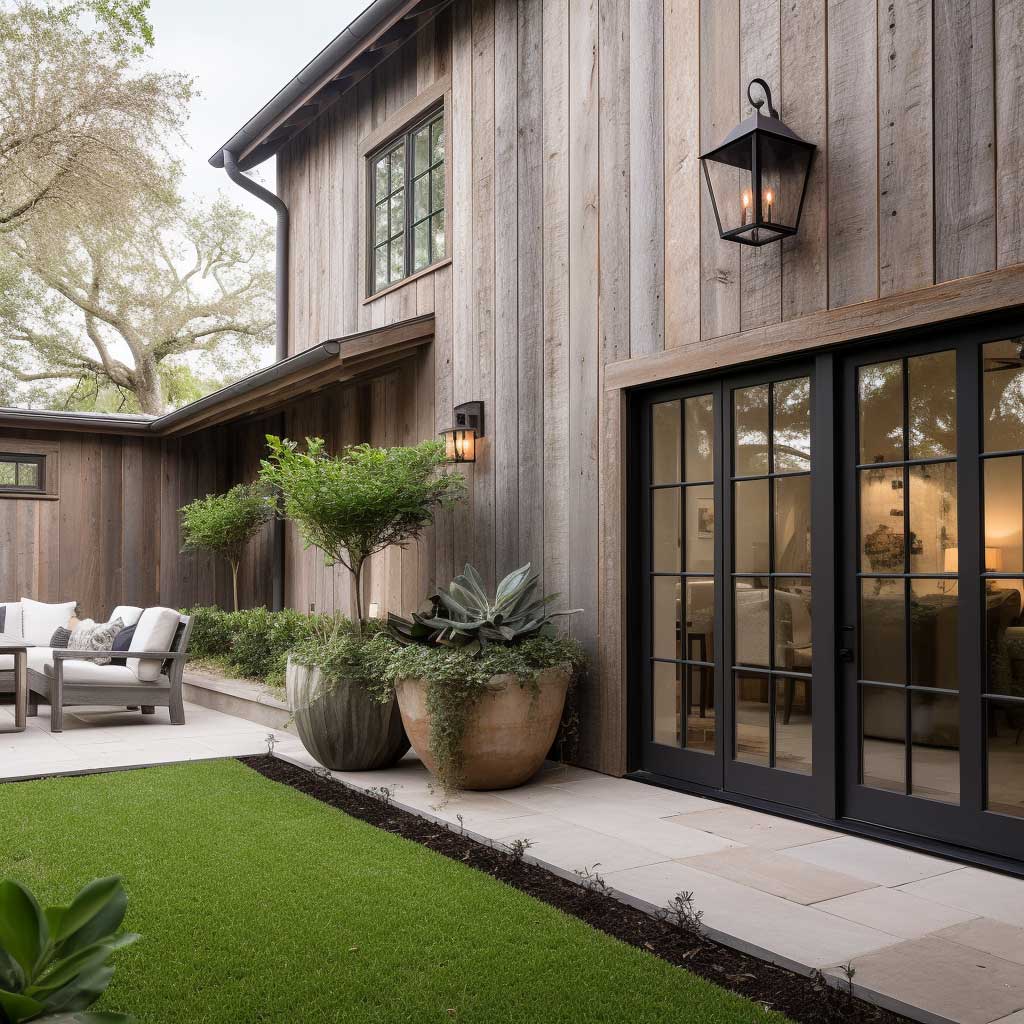
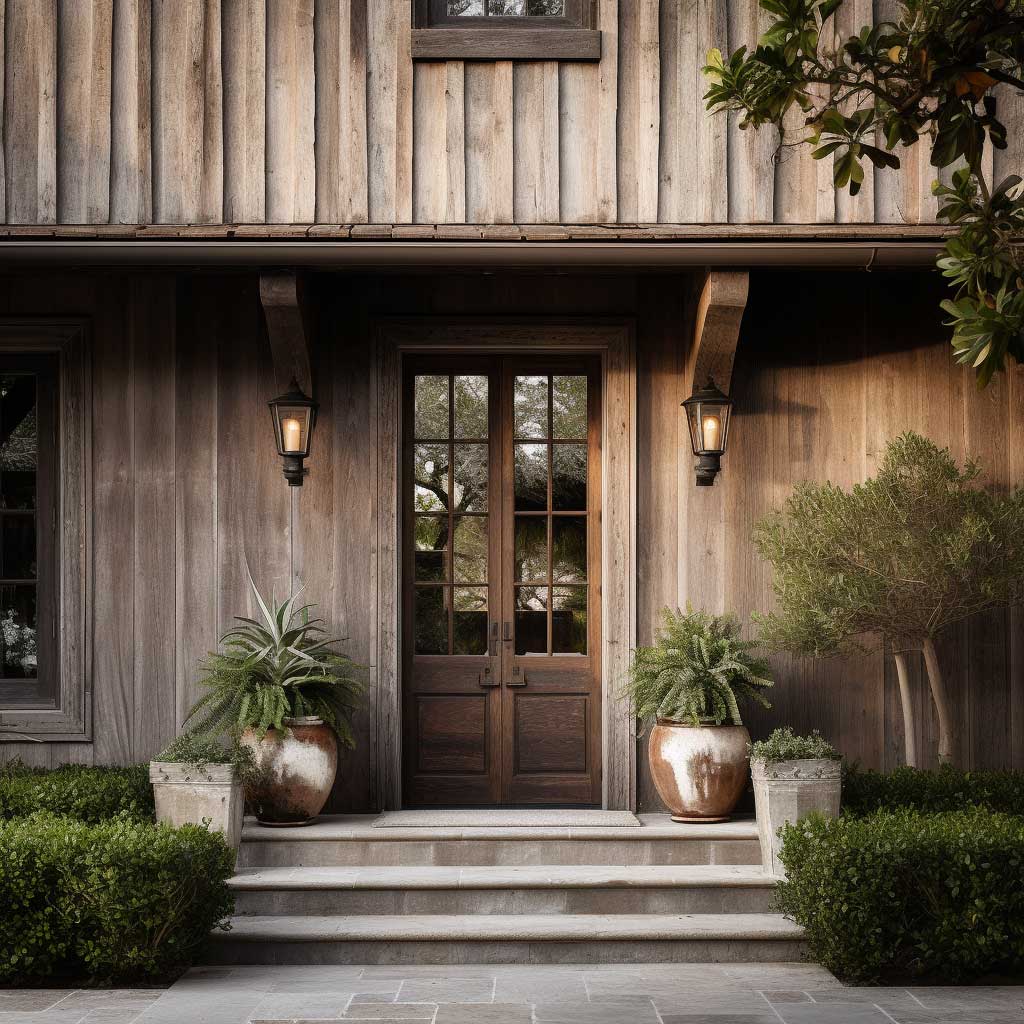
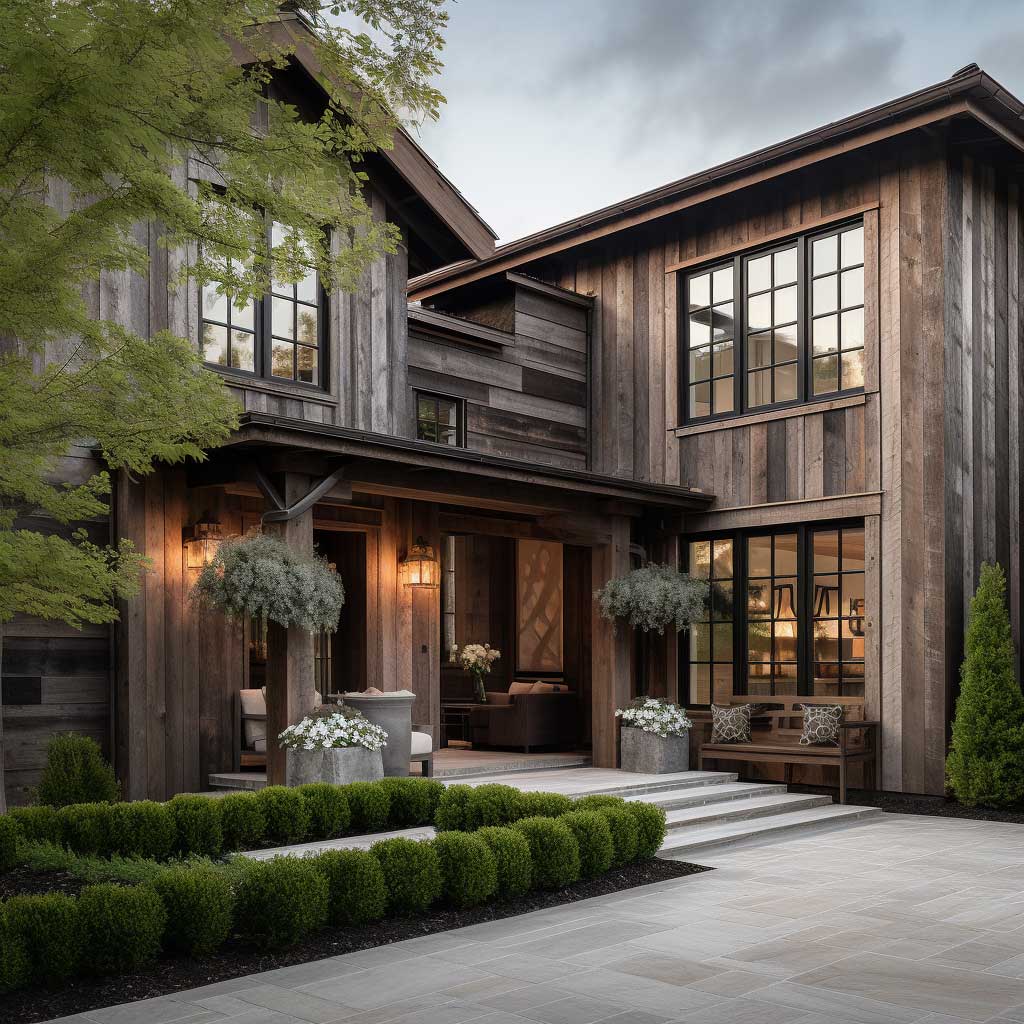
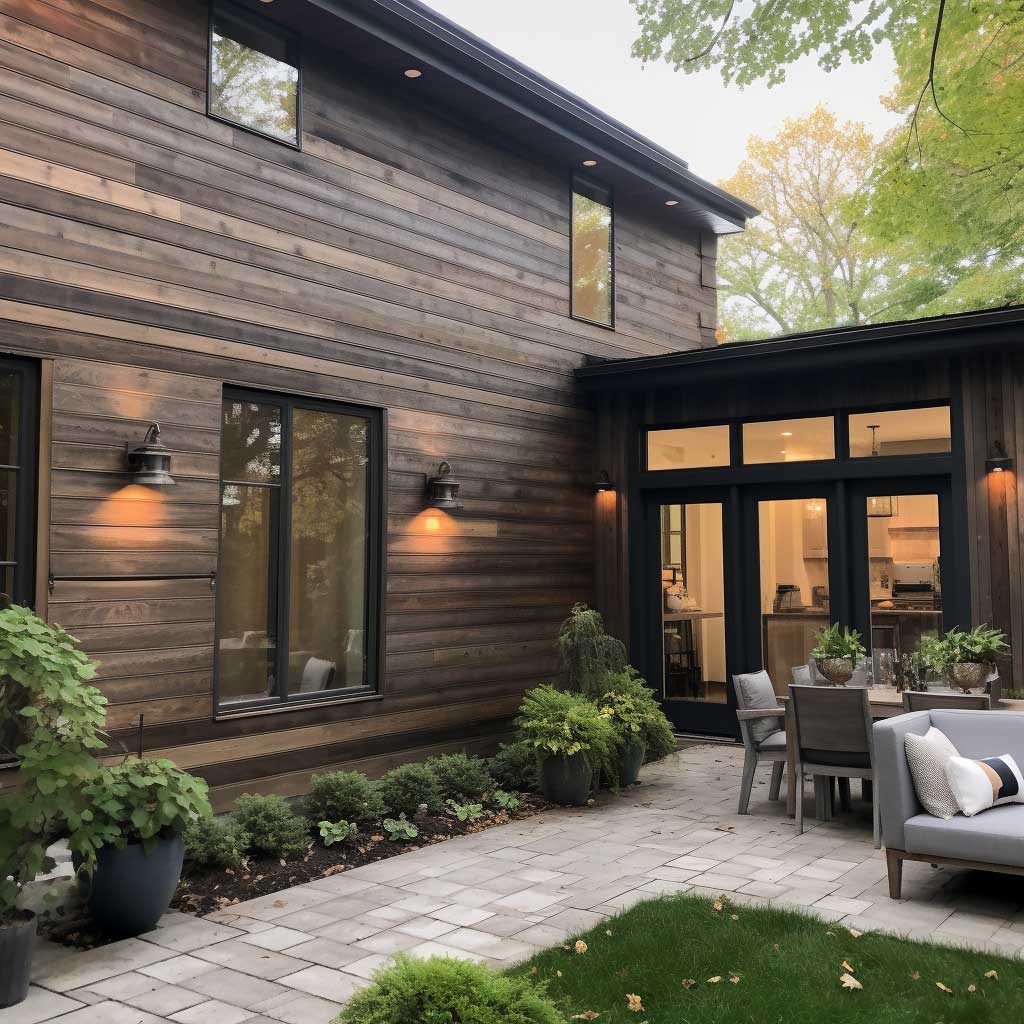
Reclaimed barn wood runs between $5 and $15 per square foot before installation — cheap compared to fresh ipe at $22 to $30 per square foot, and frankly more interesting. Every plank carries dye lines, nail holes, and compression marks that no new board will ever replicate. I stole this trick from an architect in Portland: she sources her reclaimed panels from agricultural demolitions, not salvage yards, because barn-grade material has been air-dried for decades and moves almost nothing once installed. You’ll notice far less gapping in winter than you get with fresh-cut lumber.
The anti-advice here is blunt. Don’t buy “reclaimed-look” new wood that’s been wire-brushed and stained to appear aged — it costs nearly as much as the real thing and fools nobody in direct sunlight. My go-to source is Longleaf Lumber, which ships nationwide and grades each board. Pair the panels with a penetrating oil like Rubio Monocoat in Raw or Hardwax, applied once before installation, and skip the topcoat films that crack and peel at exposed joints.
Durability of weathered reclaimed wood surprises most people. Because these boards have already cycled through decades of moisture expansion and contraction, their movement is minimal. What you’re buying is a stable, pre-seasoned product, not a liability. Apply a borate preservative treatment at the back face before mounting and you’re protecting against moisture wicking from the wall cavity — the part that actually causes rot, not the rain-facing surface.
Eco-credentials are real, not marketing. Using reclaimed material means no new trees harvested. It means the embodied carbon in that lumber is already accounted for. For anyone tracking a renovation’s environmental footprint, that distinction matters more than an FSC label on new-cut board.
Modern Horizontal Panels Make a Facade Look Wider — and That Is Often the Wrong Call
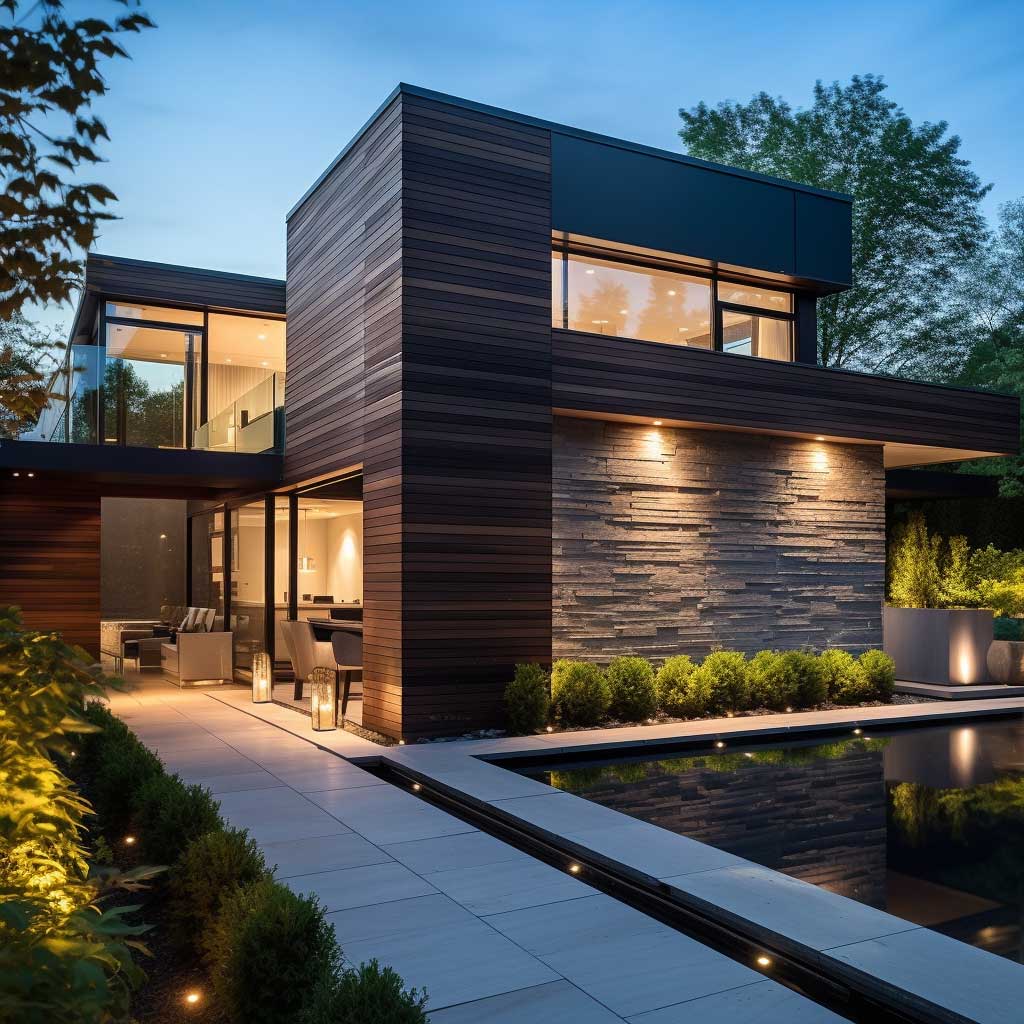
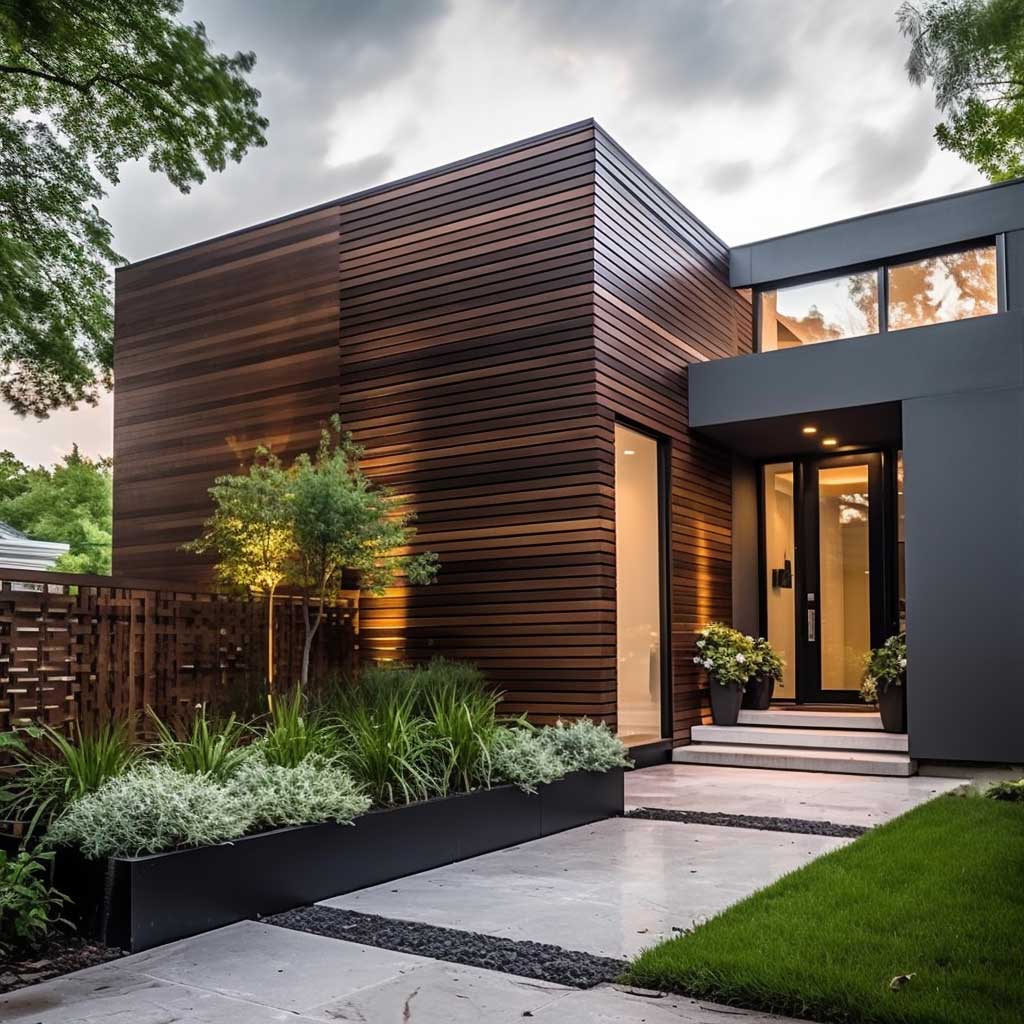
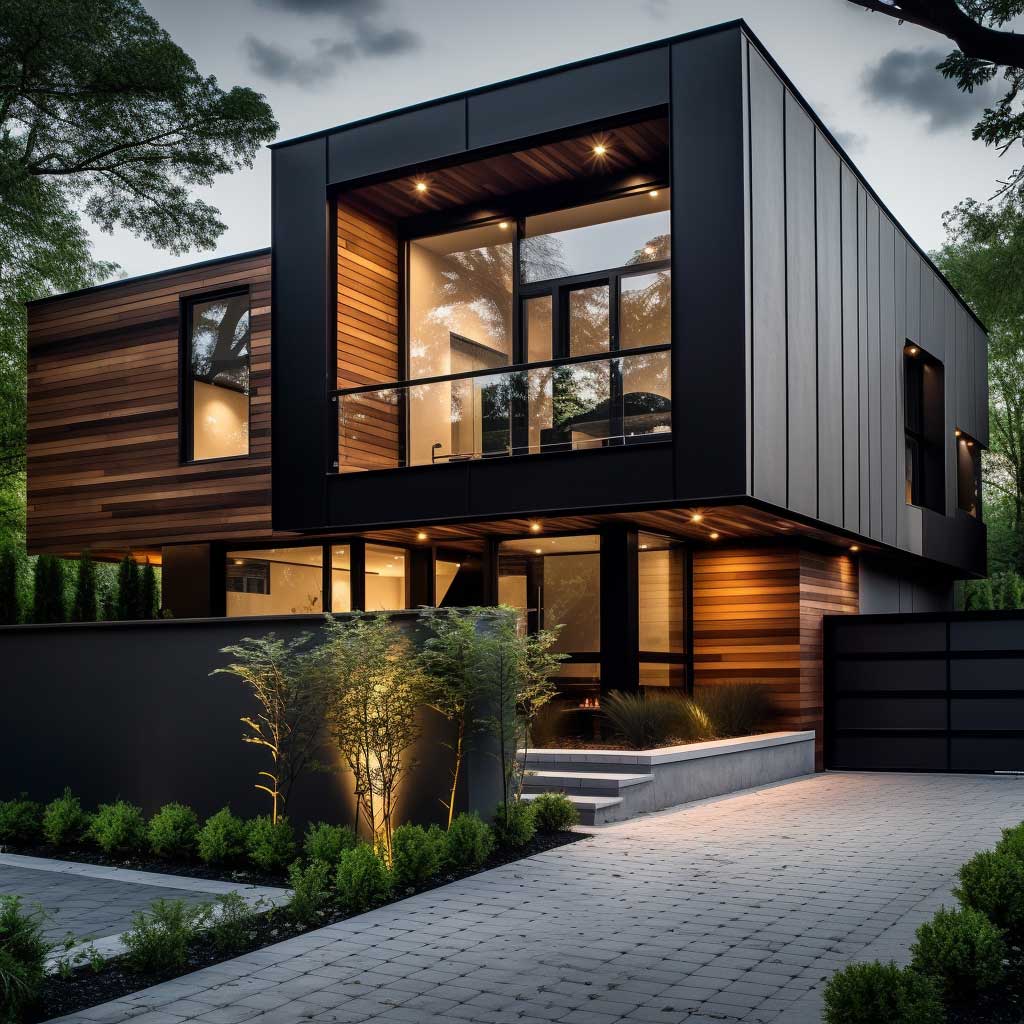
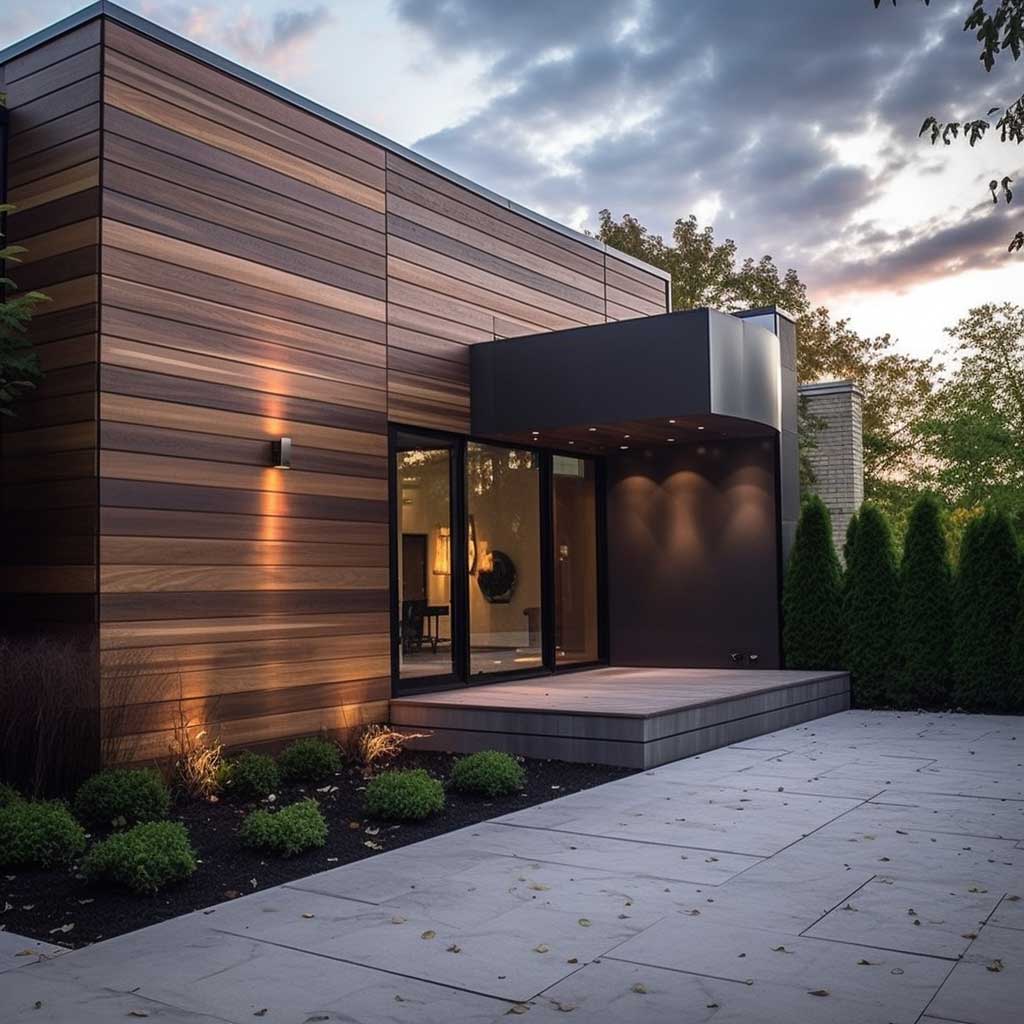
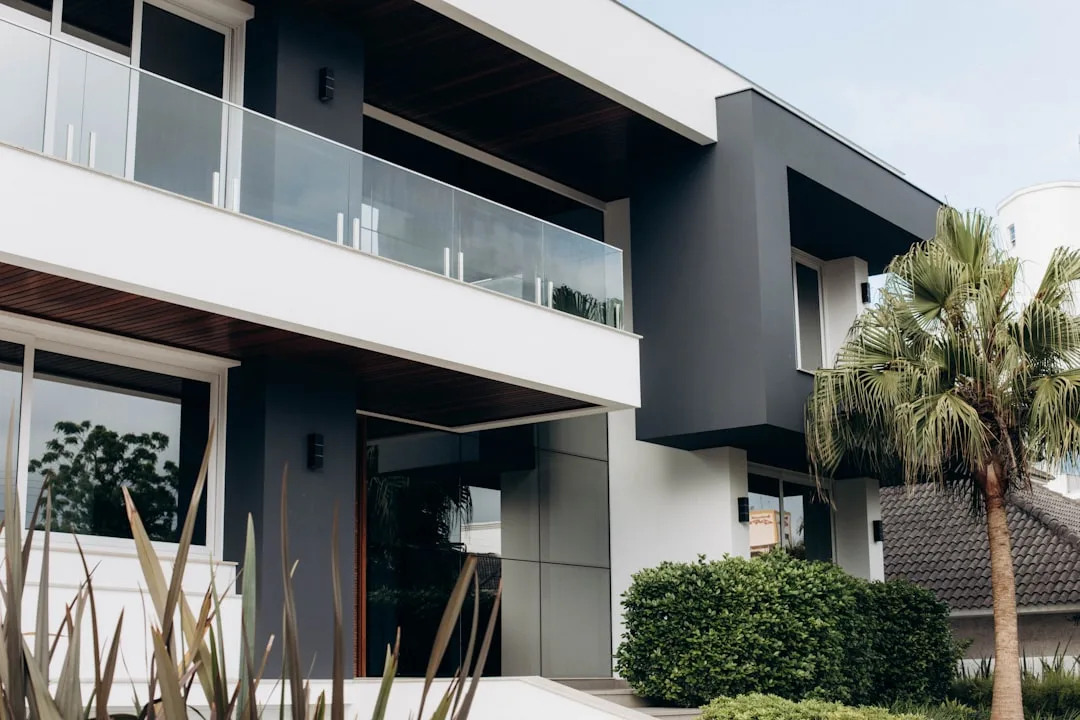
Horizontal outdoor wood panels are the default choice for modern facades. They’re also the fastest way to make a tall, narrow house look even more like a shoebox. Use horizontal boards on facades that are already wider than they are tall — on a two-story skinny lot build, vertical paneling or a mixed-direction composition does more interesting visual work. I own two projects where switching the panel direction from horizontal to vertical added four feet of perceived height without touching a single structural element.
Black walnut finishes in a penetrating oil are my go-to for modern exterior panels when the client wants drama without paint. The wood darkens to near-espresso on first oiling, then lightens slightly over a season to a warm chocolate brown. Teak is the other classic — you’ll find Teakworks4u and TeakCraftsman both ship pre-finished panels at around $18 per square foot, which lands you a material with a 50-year exterior track record in maritime climates. Don’t cheap out on the fixings: use hidden stainless-steel clips rather than face-screwing, or you’ll spend the next decade staring at rust streaks on your beautiful facade.
Modern outdoor wood panels also do real thermal work. Wood’s natural insulating value — roughly R-1 per inch of thickness — adds meaningful resistance when installed as a ventilated rainscreen over existing cladding. A 25mm air gap between the panel and the wall structure keeps moisture from accumulating and can cut your summer cooling load by 8 to 12 percent in south-facing walls. That’s the kind of number that shows up in energy bills, not just in brochures.
Don’t Do This with Outdoor Wood Wall Panels
- Don’t install horizontal boards without a 3° back-bevel. Flat horizontal panels pool water at the top edge and rot from the back face — the damage is invisible until the board falls off.
- Don’t use pine for a sun-facing facade. Pine’s resin bleed in summer heat will stain every board below it orange. I watched $4,000 worth of knotty pine siding ruin itself in one Arizona summer.
- Don’t apply a film finish like polyurethane to exterior wood panels. It peels at every joint, and the peeling accelerates moisture intrusion. Penetrating oils only.
- Don’t skip the end-grain sealer. End-grain absorbs moisture at ten times the rate of face grain. That’s where every rot failure starts.
FSC-Certified Outdoor Paneling Costs More Upfront and Saves More Over a Decade
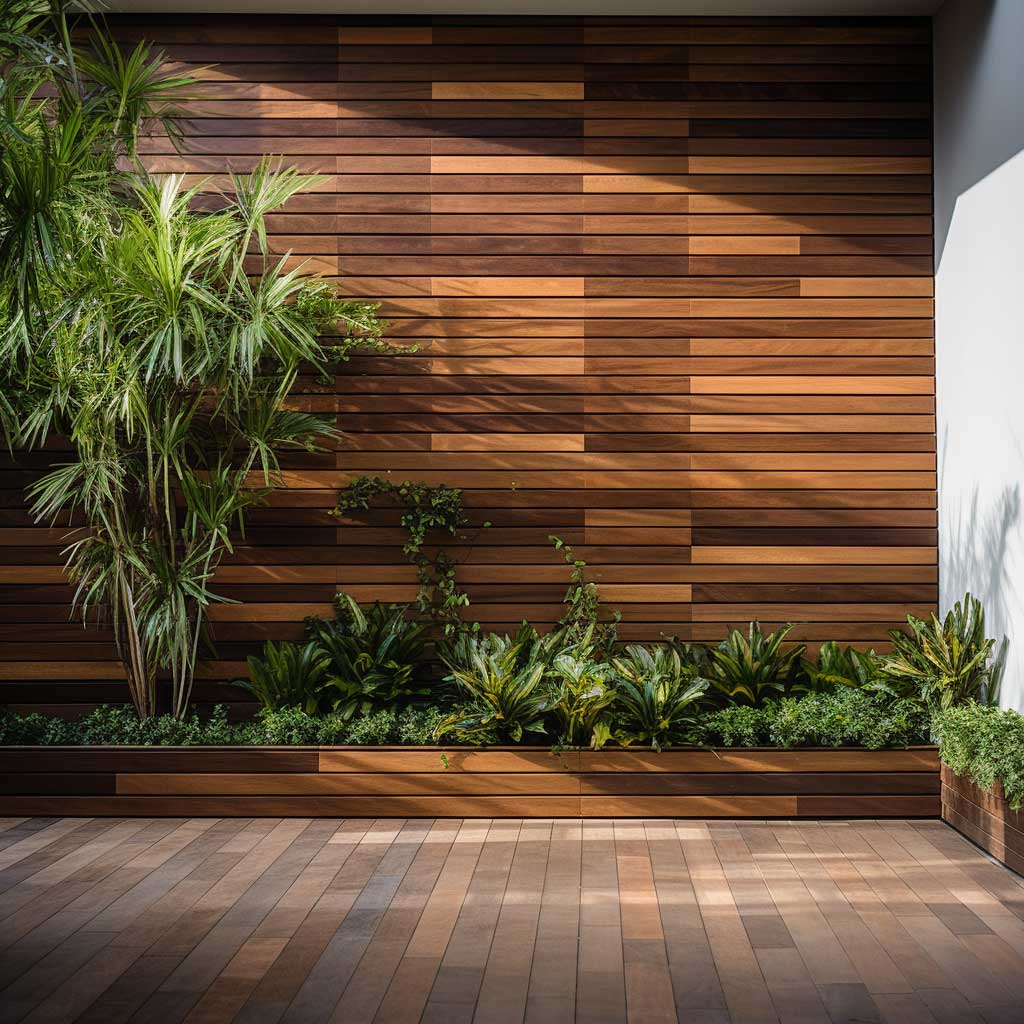
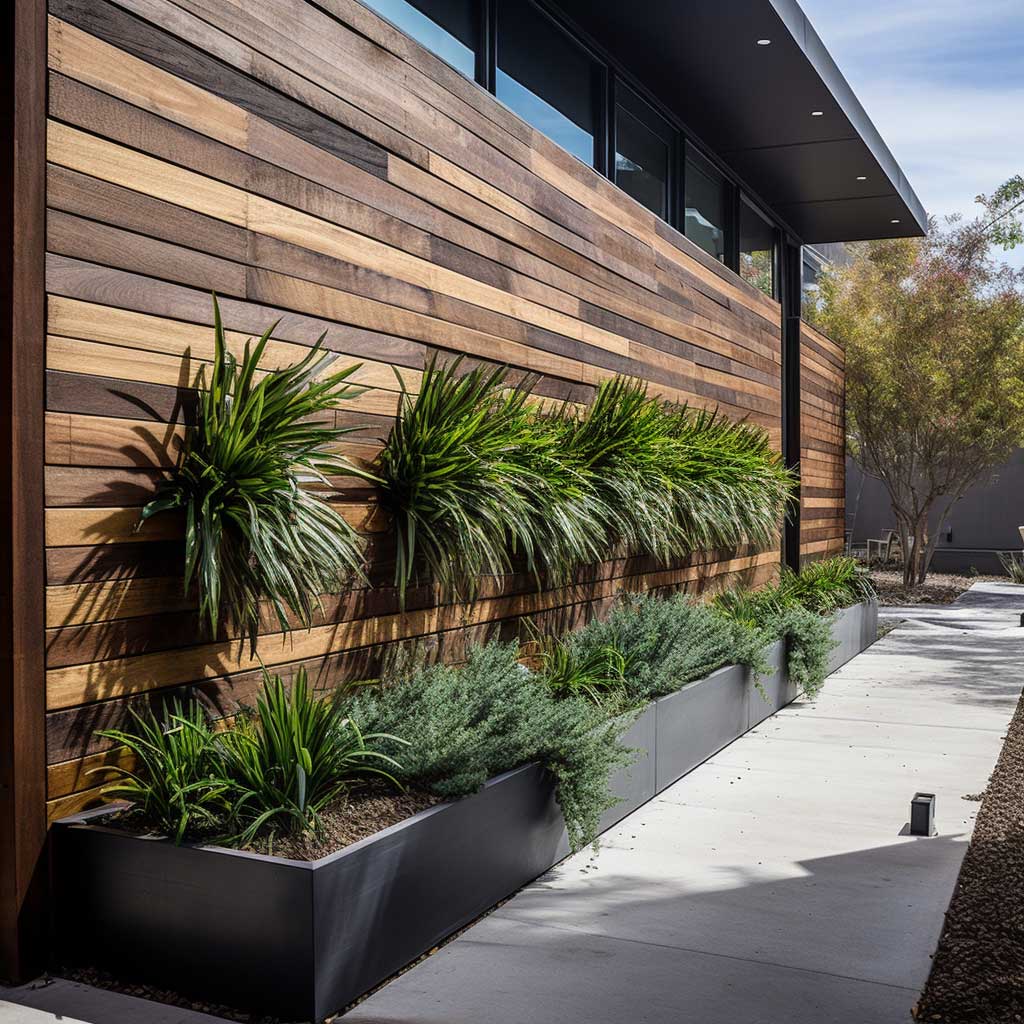
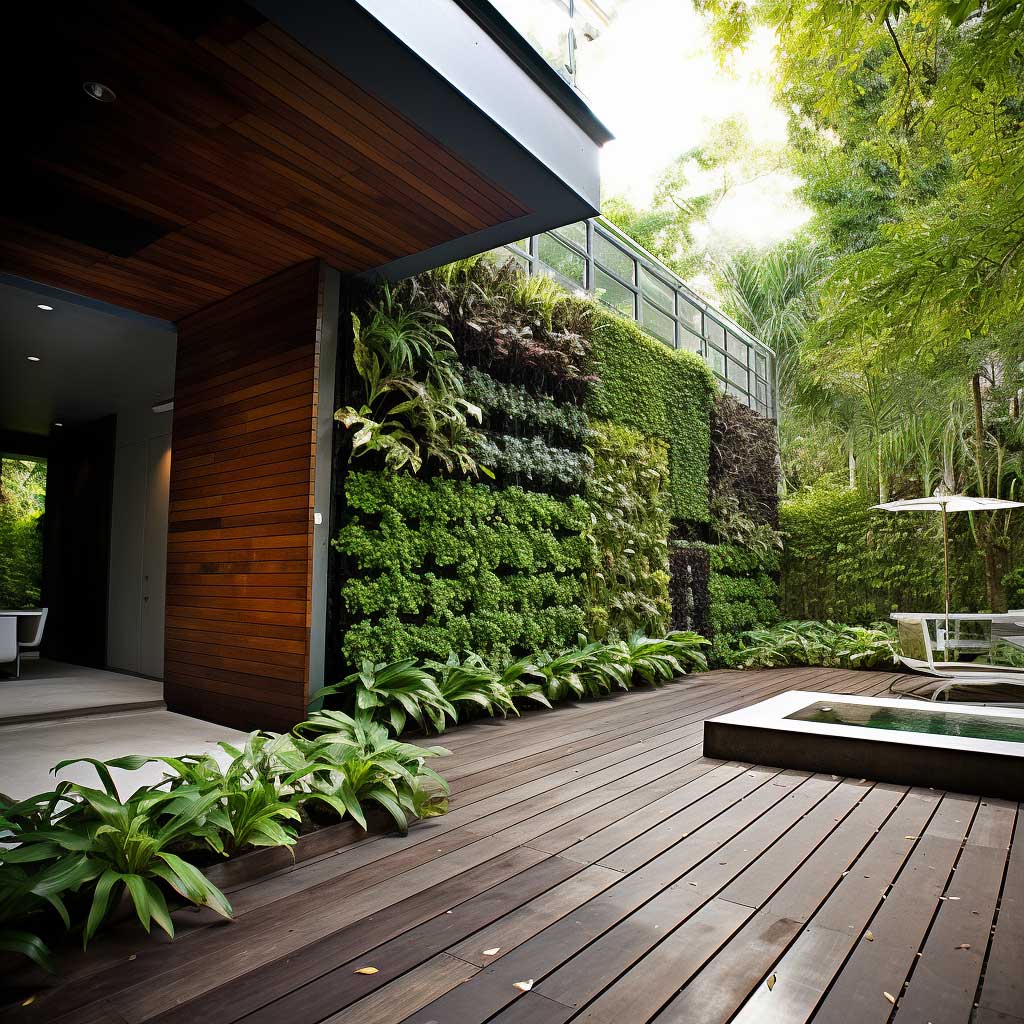

FSC-certified outdoor paneling from Accoya currently runs about $28 to $35 per square foot installed — roughly $8 per square foot more than kiln-dried Western Red Cedar. Over a 25-year horizon, that math flips. Accoya’s thermally modified acetyl structure resists rot and dimensional movement so well that Kebony (a similar modified wood product) offers a 30-year outdoor warranty on their facade grades. Cedar at the same age is on its third stain cycle and showing checking in the worst-exposed boards. I’ve done the side-by-side on two neighboring cabins and the difference at year twelve is not subtle.
What does FSC actually mean in practice? The Forest Stewardship Council certification verifies the chain of custody from forest to mill to your site — workers paid, replanting mandated, harvest rates matched to regrowth. It’s not a green-washing label; third-party auditors check the supply chain annually. For panels sourced from Siberian larch or thermally modified ash, you can usually request the CoC certificate number and verify it at info.fsc.org before the lumber leaves the yard. You need that paper trail if you’re targeting LEED credits for a commercial project.
My practical recommendation for most climates is Siberian larch at around $12 to $16 per square foot delivered. It’s denser than Western Red Cedar, takes a UV-stable oil beautifully, and weathers to a silver-grey patina that looks expensive rather than neglected. See how designers are applying sustainable wood cladding across different facade styles — the larch examples in coastal builds are particularly convincing. Avoid tropical species without verified legal harvest documentation; cheap teak labeled “plantation-grown” is often neither.
Patio Wood Wall Ideas That Actually Solve a Problem, Not Just Cover a Surface
Patio wood walls serve three jobs simultaneously: privacy screen, wind buffer, and design anchor for the outdoor room. Most people design for only the third. I’ve built patio wood walls for clients in Chicago and Austin, and the wind-buffering function is not optional in either climate — an unblocked north wind kills a patio’s usability for six months of the year. The fix costs the same as a purely decorative panel installation if you plan for it at the start.
For patio applications, composite wood panels have earned their place alongside natural timber. SlatSolution’s exterior composite panels run around $199 per panel for teak-tone boards, are made from 60% wood and 40% polymer, and are rated all-weather resistant. They install horizontally or vertically, cut cleanly with a circular saw, and don’t need any finishing on installation day. Are they as tactile as real ipe? No. Are they still standing perfectly after a decade in a poolside environment where real ipe would require three re-oilings? Yes.
For a patio wood wall using natural timber, ipe is the benchmark species. Brazilian Lumber ships 5/4×6 ipe wall panels at current market rates around $22 per linear foot — dense enough to resist a Class A fire rating, stable enough not to gap more than 1/16 inch seasonally in most US climates. The color starts dark brown and silvers to a steel-grey over two seasons if left unoiled, which some clients prefer. If you want to maintain the brown, ExoShield Gold UV oil applied annually keeps it close to the original tone. Skip the annual oil and the grey is permanent — it’s not damage, it’s patina, but know which result you’re choosing before you decide.
What nobody tells you about patio wood walls is that the post structure matters more than the panels. A poorly set 4×4 post that moves seasonally will gap your panel joints unevenly within two years regardless of which timber you specified. Set posts in concrete to 18 inches below frost line, use post caps rated for ground contact, and give the whole structure a season to settle before you call the panel installation final. More on practical material selection for exterior wood walls at ArtFasad — the section on post-and-panel construction is worth reading before you buy a single board.
Wood Species Side by Side — Cedar, Ipe, Larch, and Thermally Modified Ash
| Species | Cost/sq ft (installed) | Maintenance Cycle | Expected Life | Best Climate |
|---|---|---|---|---|
| Western Red Cedar | $18–$24 | Every 3–4 years | 25–30 years | Pacific Northwest, Northeast |
| Ipe (Brazilian Walnut) | $28–$38 | Every 1–2 years to maintain color | 40–75 years | Any, especially coastal |
| Siberian Larch | $14–$19 | Every 4–5 years | 30–40 years | Northern and temperate climates |
| Accoya / Thermally Modified Ash | $30–$40 | Every 5–7 years | 50+ years (30yr warranty) | Any, including high-humidity |
| WPC Composite (e.g. SlatSolution) | $12–$18 | Minimal — occasional cleaning | 20–25 years | Any, poolside, coastal |
Garapa is the sleeper pick nobody talks about. At $14 to $18 per square foot installed, you get a wood that starts golden-yellow and oiled to a warm amber, has a Janka hardness score of 1,650 (harder than white oak), and resists rot and insect damage at a level that earns it Class 1 durability under European standards. Mataverde Decking ships it as a vertical rainscreen panel product. I used it on a client’s outdoor studio wall in coastal Georgia two years ago — zero issues, zero color change beyond a slight deepening of the amber tone. It’s my current recommendation for anyone who wants hardwood performance without the ipe price tag. See Mataverde’s full hardwood siding comparison — the Garapa and Machiche profiles are particularly well-documented for exterior wall applications.
Final Word
Outdoor wood wall paneling is a 20-year commitment, not a weekend project — pick the species before you pick the style.
The visual you choose lasts one season in your memory. The species you install lasts two decades on your facade. Cedar is forgiving and beautiful and will need attention every three to four years. Ipe is demanding to install and almost impossible to kill. Accoya removes the maintenance question entirely at a premium. WPC composite handles the poolside and patio environments where even ipe struggles.
Patio wood wall construction specifically rewards post quality over panel quality. Spend the money on proper post setting before you spend it on the wood species.
Save this post — and check the species table before your next materials order.
Related Topics