A modern coastal living room earns its reputation not from shells on a shelf but from a precise tension between restraint and warmth — crisp, contemporary structure paired with the kind of softness that makes you want to kick your shoes off. Color, texture, and light do almost all the work, and when they’re calibrated right, the result reads as serene without feeling sterile. The style has staying power because it solves a real problem: how to make a room feel genuinely relaxed without sliding into clutter or kitsch.
The rooms that pull it off share a recognizable logic. The palette anchors everything — sandy neutrals, soft blue-greens, and clean white — and nothing competes for attention. Furniture stays low-profile and functional. Natural materials earn their place through texture, not decoration. Get those three variables right and the coastal feeling follows almost automatically, whether the home is two blocks from the beach or two time zones away from it.
What collapses the look is usually the opposite of what you’d expect: too much coastal signaling. Anchor motifs on every cushion, a gallery wall of seascapes, a jute rug layered under another jute rug. The trick here is editing down, not piling on. A room with four well-chosen elements always reads more coastal than one with fourteen obvious ones.
– The color palette does most of the heavy lifting — Sherwin-Williams Sea Salt (SW 6204) and Benjamin Moore Chantilly Lace are two proven coastal anchors.
– Linen upholstery, jute rugs, and light-wood furniture frames are the material trifecta that makes the look feel cohesive.
– Nautical accents work best in small doses — one rope mirror or a single navy throw, not a themed room.
– Natural materials like driftwood and sea glass add texture without adding visual noise.
– Lighting is the multiplier: maximize natural light first, then supplement with warm pendant fixtures in clear glass or neutral shades.
Color Builds the Foundation of a Modern Coastal Living Room

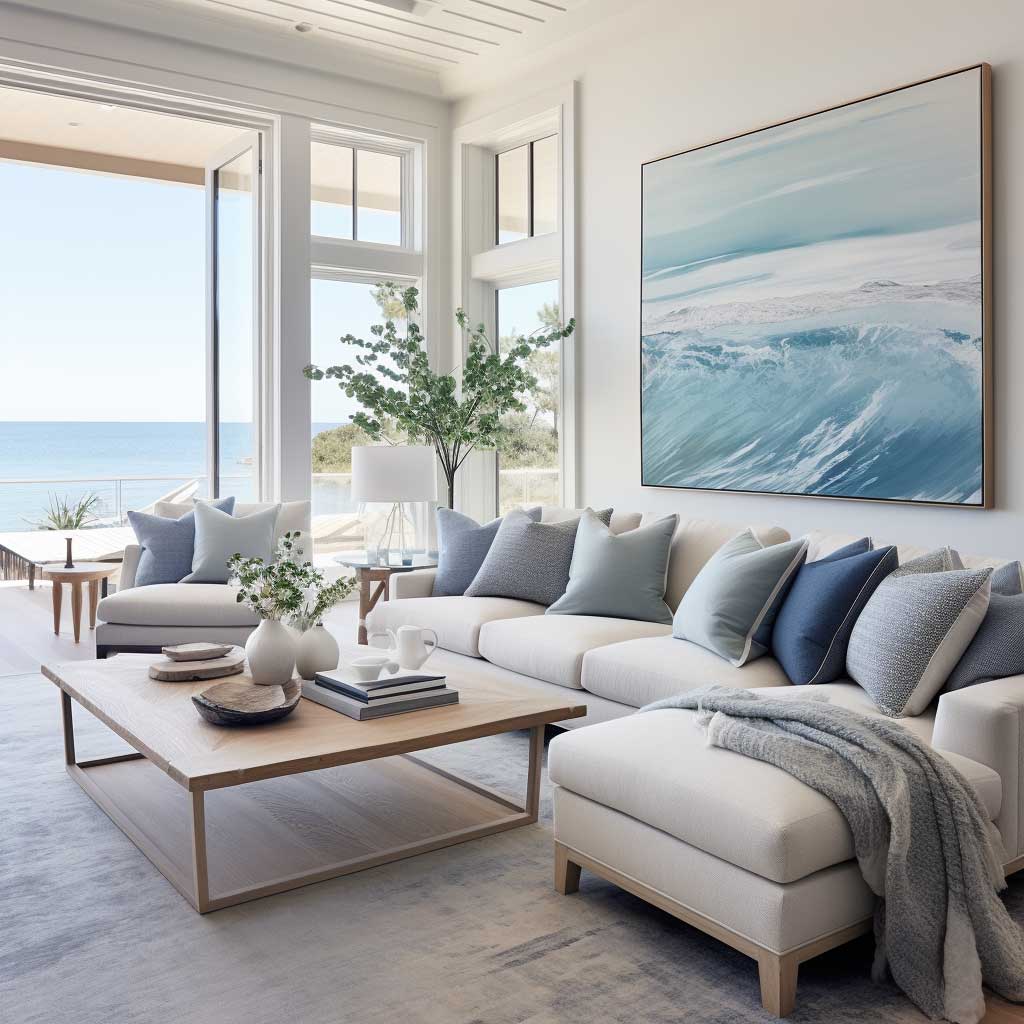


Paint is where most modern coastal living room projects get decided — not at the furniture stage. Sherwin-Williams Sea Salt (SW 6204) is the most consistently recommended color in this category: a soft green-blue-gray that shifts subtly depending on light, pulling toward sea-green at midday and cooler blue-gray in the evening. At roughly $81.49 per gallon for Sherwin-Williams Emerald Interior, it’s a premium investment that holds its color for years without yellowing. Benjamin Moore Chantilly Lace offers the opposite approach — a clear, bright white with just enough warmth to avoid feeling clinical — and pairs with almost any coastal accent without competing.
What does a coastal color palette actually need? Three tones working together: a dominant neutral (white, warm sand, or soft taupe for the walls), a secondary coastal color (blue-green, pale slate, or sky blue for textiles and accents), and a grounding dark (navy, driftwood brown, or charcoal for cushions or a single furniture piece). Stylists recommend keeping the dominant neutral on at least 70% of the visual field and letting the coastal accent appear in only two or three places so it reads as intentional rather than scattered.
The mistake that dates a coastal color scheme fastest is oversaturation. Painting walls, ceiling trim, and the built-in shelves all in the same medium blue creates something closer to a beach bathroom than a contemporary living room. You’ll notice the rooms that age well use coastal color as punctuation — a pair of throw pillows, a side table, a lampshade — not as wallpaper applied to every surface. One confident coastal-colored element in an otherwise neutral room carries more visual weight than five tentative ones.
Can you do a coastal living room in zero blue? Yes, and it often looks sharper. Sandy beige walls, raw linen sofas, and a palette that references the beach at low tide — warm tones, no bright saturated hues — creates a sophisticated coastal feel without any obvious color signaling. The coastal identity comes from texture and material, not paint.

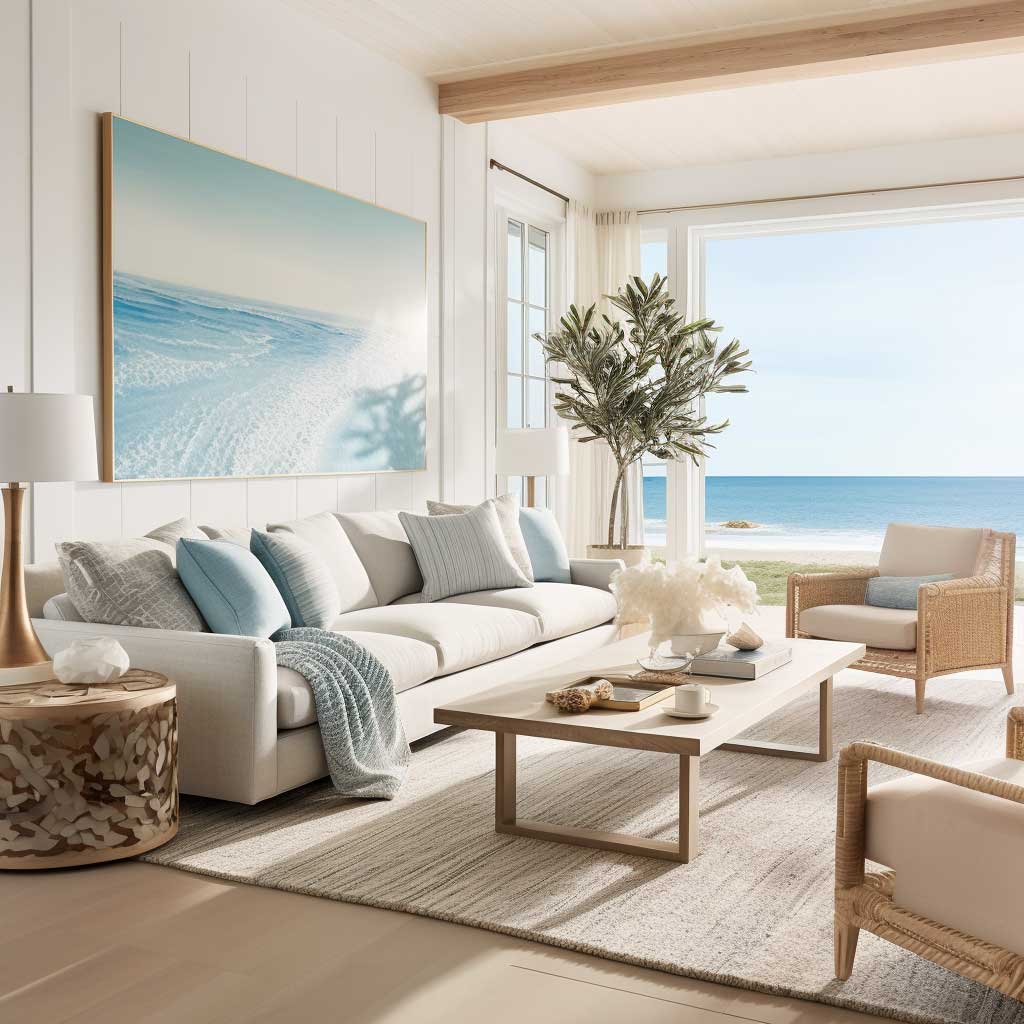

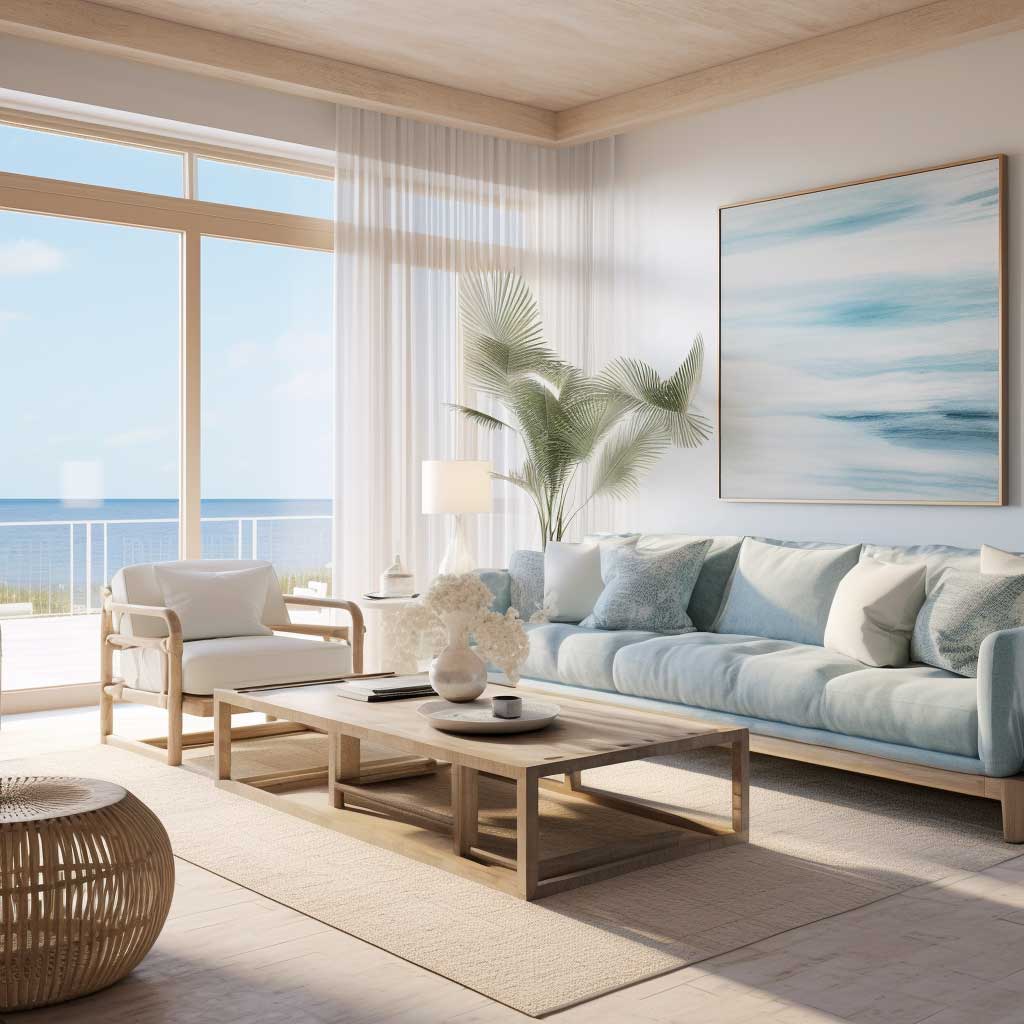
Lighting amplifies or undermines the palette you build. Large windows left unobstructed by heavy curtains are a non-negotiable in a coastal room — the goal is the kind of flat, bright natural light you’d find on a covered porch ten feet from the water. For evening lighting, clear-glass or light-shade pendants keep the room from going dark and heavy after sundown. Avoid warm amber bulbs that shift the blue-green tones toward an olive or brown hue; a 3,000K daylight-balanced LED maintains the palette from morning to midnight. Pair a good linen sofa — the West Elm Harris in Alabaster Performance Linen starts at $1,998 — with proper lighting and the setup photographs as well as it lives in.
Nautical Accents Land Differently in a Modern Coastal Room
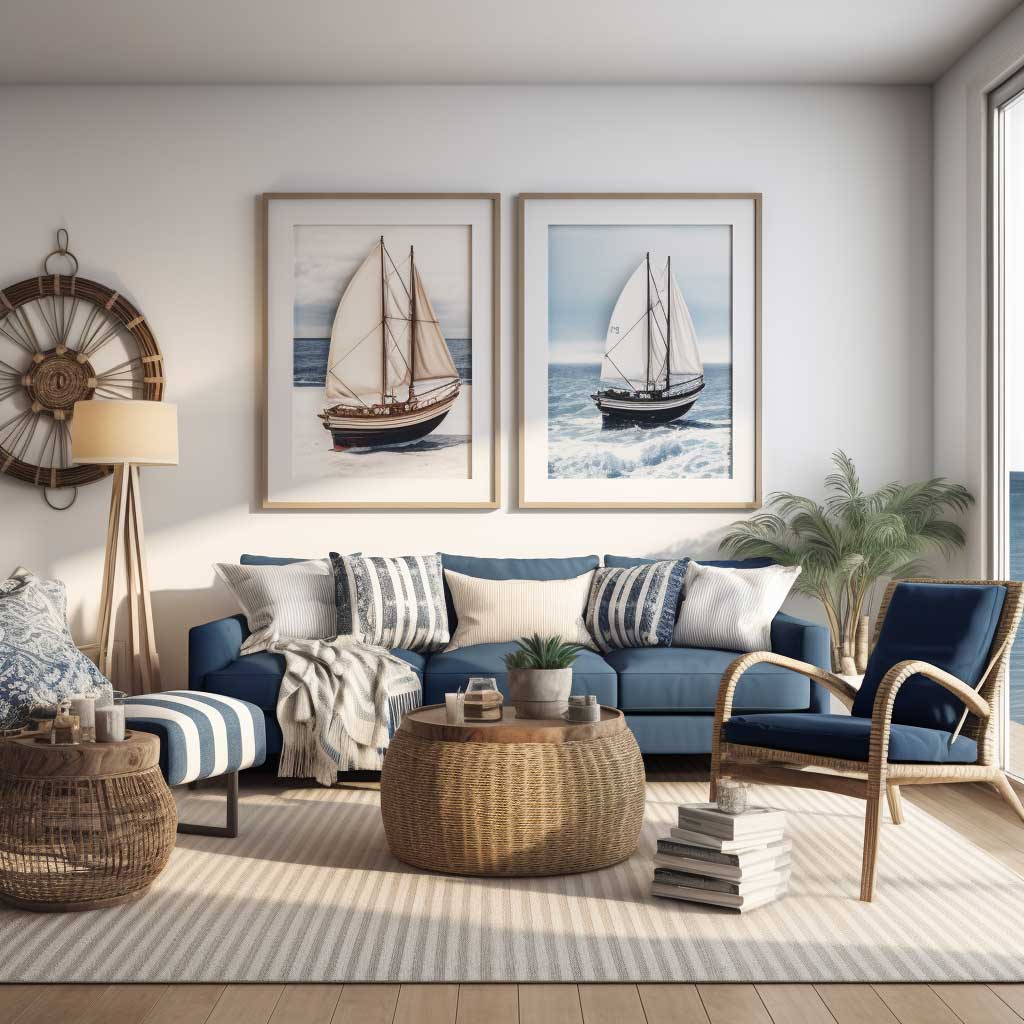


Nautical accents in a contemporary coastal room follow a strict budget: spend them carefully or they tip the whole space into theme-park territory. The difference between a modern coastal living room and a seaside gift shop is usually a matter of three or four objects. Navy blue does more work than any anchor motif — a pair of navy cushions against a white linen sofa and a navy throw draped over an armchair covers the nautical reference thoroughly and cleanly, without a single rope in sight.
When physical texture is the goal, a rope-framed mirror is the single highest-yield nautical piece available. A 20-inch round rope mirror runs between $35 and $80 on Amazon and Wayfair; positioned above a console table or sideboard, it adds tactile interest without any additional decorative clutter around it. Think of it like a stone dropped in still water — the object is small but the ripple covers the whole composition. The rule here is one statement piece per surface, not one statement piece per wall.
Striped textiles — the Breton stripe of the coastal world — are another tool, but require restraint. A single striped rug in navy and cream carries a nautical signature through the whole floor plane without adding visual noise at eye level. Try striped curtains in the same room and the effect collapses: it reads as a theme, not a design. Keep stripe patterns on horizontal surfaces (rugs, throws) and leave curtains, upholstery, and walls in solid or lightly textured neutrals.
Artwork is where stylists find the most leverage. A single large seascape or a pair of abstract pieces in coastal hues — cool blue, pale green, warm sand — functions as the room’s emotional anchor in the same way a horizon line organizes a photograph. Avoid groupings of five or more small coastal prints; they read as a collection display, not a considered design. What does a curated coastal gallery wall need? Two or three pieces maximum, with meaningful negative space between them.
Don’t anchor-motif everything. Anchor on the cushions, anchor on the throw, anchor on the doormat — and the room stops being a living room and starts being a maritime museum retail section. Pick one nautical motif maximum per room, use it once, and let the color palette and materials carry the rest of the coastal identity.
Don’t use artificial seashell collections as decor. A bowl of resin shells on the coffee table signals “coastal theme” while a bowl of actual smooth stones or sea glass signals “someone with taste who happened to live near water.” The material difference reads instantly.
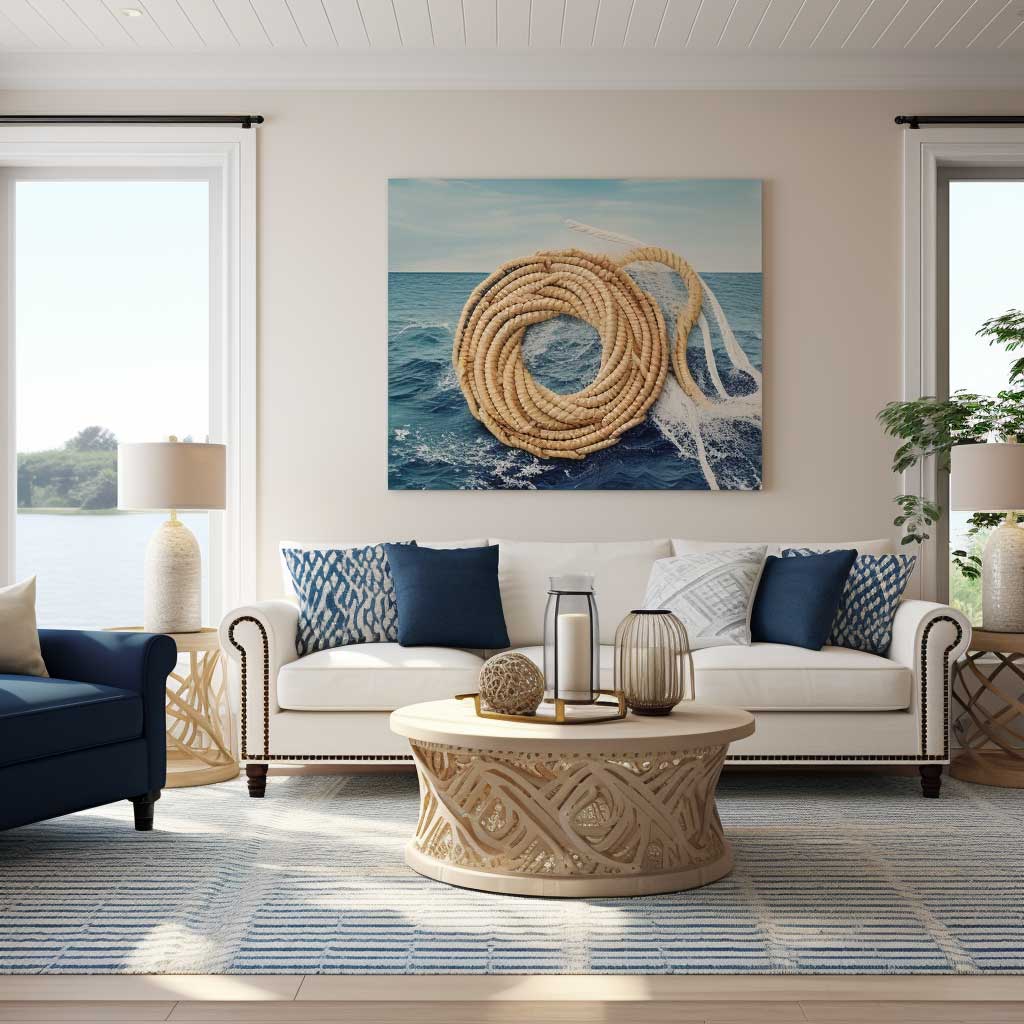
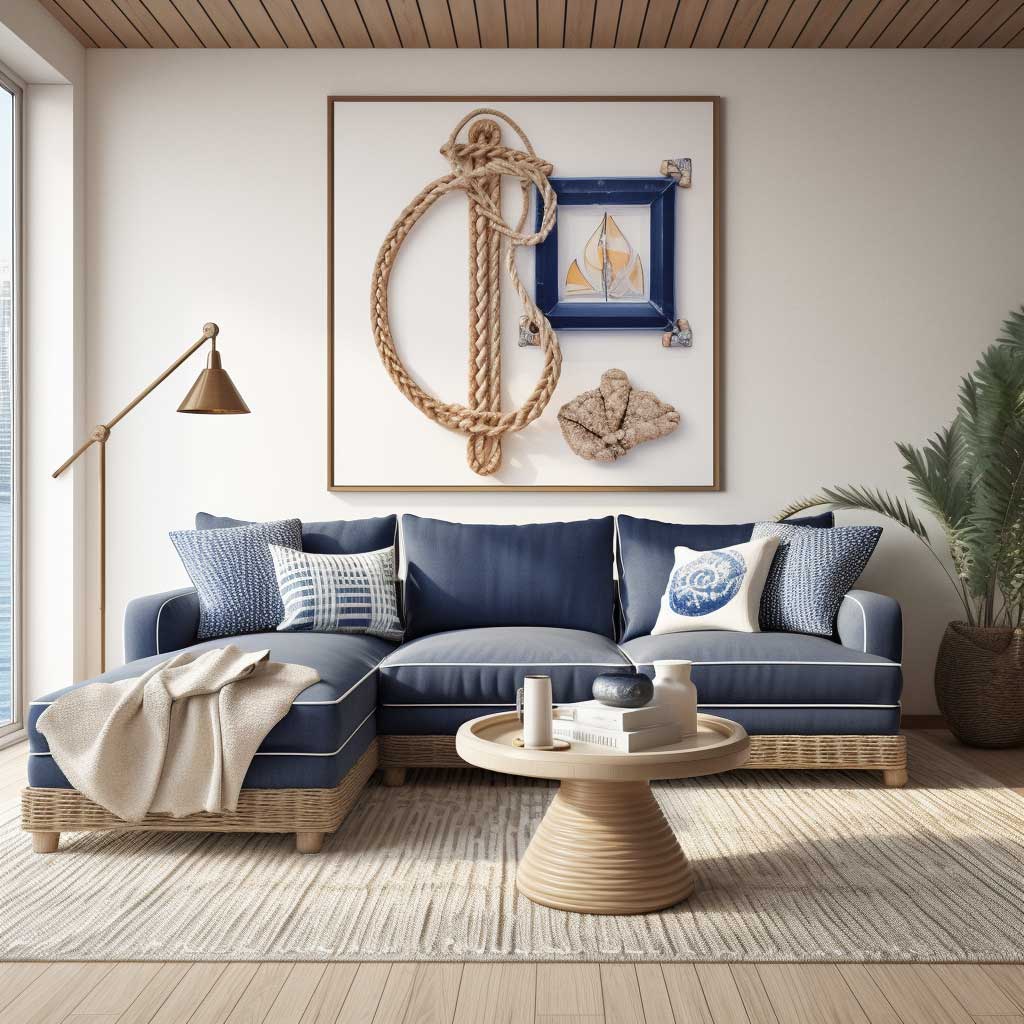

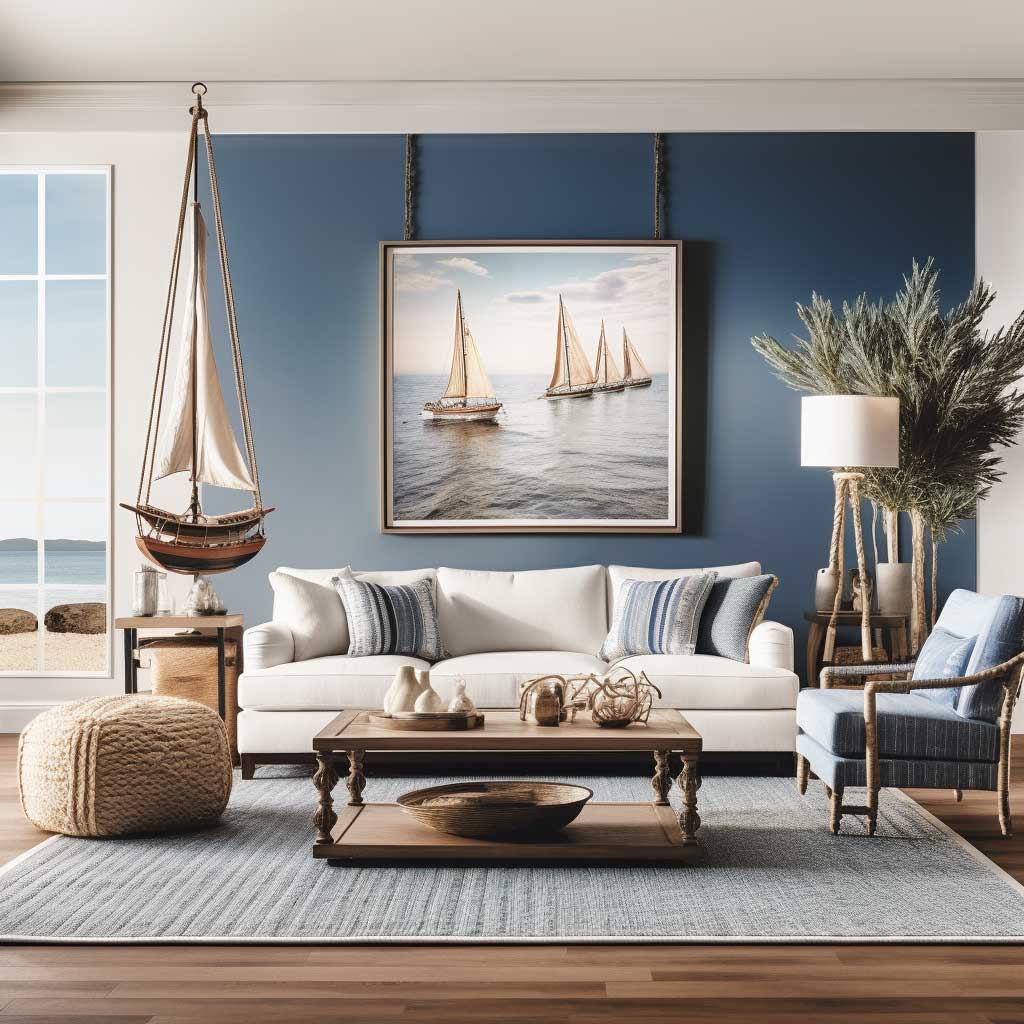
Furniture material in a nautical-inflected coastal room works best when it references maritime forms through finish rather than silhouette. Light ash or whitewashed oak frames on a sofa or armchair echo driftwood and ship decking without imitating them directly. Metal hardware in a matte nickel or brushed brass adds the industrial edge that real nautical hardware has — practical, unfussy, slightly worn in. Avoid chrome: it reads as bathroom fitting, not coastal contemporary.
For coastal hanging wall decor that goes beyond framed prints, woven seagrass panels and macramé pieces bring texture to vertical surfaces without any literal nautical reference. They’re the most common high-performing alternative to anchor-and-rope decor for people who want the coastal feeling without the maritime costume. The practical test: could this piece exist in a well-designed non-coastal room? If yes, it belongs in a modern coastal one.
Organic Materials Make a Modern Coastal Living Room Ideas Sheet Feel Real
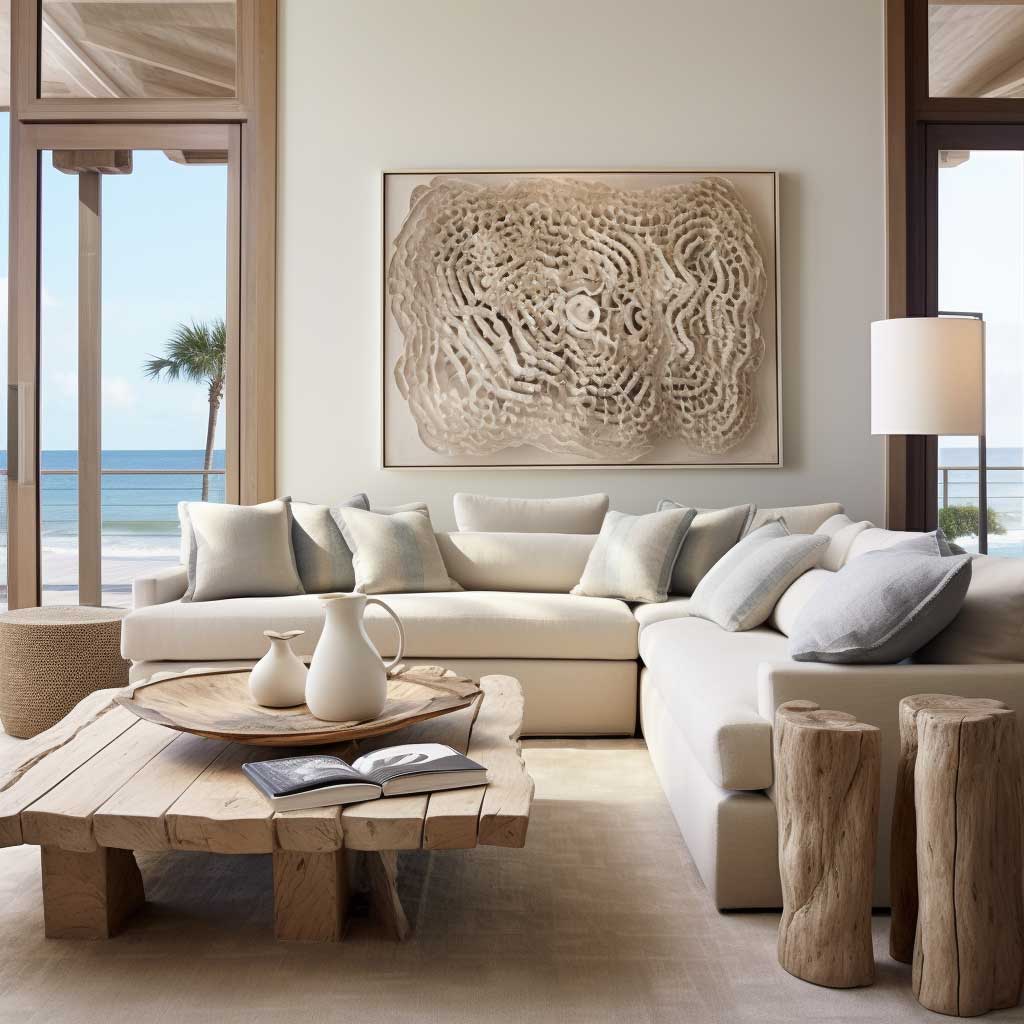
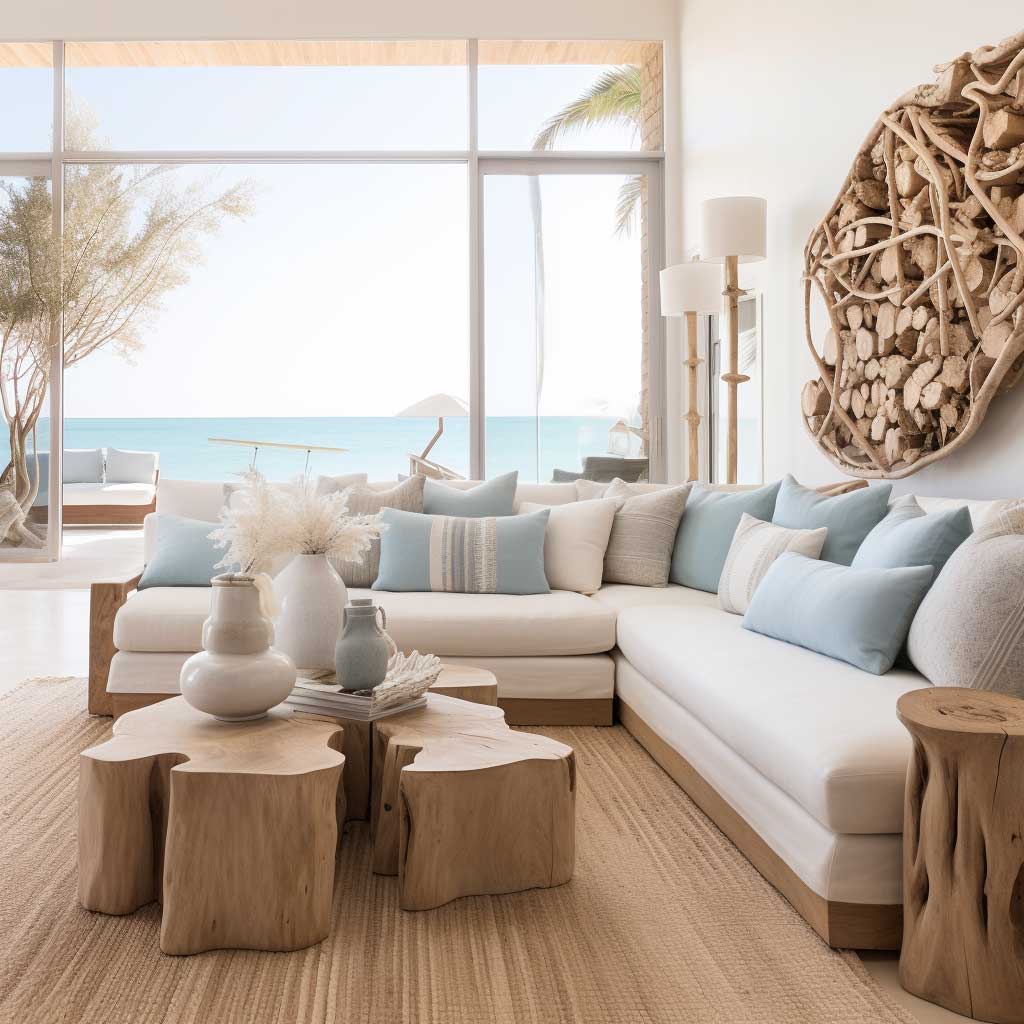


Modern coastal living room ideas that hold up in practice almost always build their tactile layer from three organic materials: driftwood (or reclaimed light wood), linen, and something translucent — sea glass, frosted glass accents, or sheer curtains that diffuse rather than block light. Each material earns its place through function: driftwood grounds and warms, linen softens and breathes, translucency keeps the room from feeling sealed off from the outside world. Remove any one of the three and the composition loses a register.
Linen is the most load-bearing of the three. A linen sofa in a warm natural tone does more for a coastal living room than any decorative accent — it changes how the whole room feels from across the threshold. Performance linen blends, like those used in West Elm’s coastal collections, are oil- and water-resistant while maintaining the texture and drape of the natural fiber, making them practical for a room meant to feel lived-in rather than preserved. For window treatments, unlined linen panels hung floor-to-ceiling add height and diffuse afternoon light in a way sheer polyester never replicates. The material is like a second skin on the room: subtle but present in every photograph, every glance.
Driftwood objects — a coffee table, a sculptural piece, a framed panel — introduce the specific gray-silver tone that most painted or stained wood can’t replicate. It’s a natural weathering that reads as time and salt air. A driftwood coffee table acts as the room’s visual anchor, its organic form keeping the clean-lined furniture around it from feeling cold. What doesn’t work: multiple driftwood pieces competing for attention in the same sightline. One driftwood element per zone, positioned where it terminates a line of sight, is the ratio that holds.
For natural living room ideas beyond coastal specifics, the same material logic applies: pair one rough texture with one smooth, keep color within two or three related tones, and add a living element — a plant, fresh flowers, or greenery in a simple ceramic vessel. In a coastal context, a potted fiddle leaf fig or a low-maintenance snake plant in a white or terracotta pot adds the one element no object can fake: actual organic life responding to the light the room was designed around.


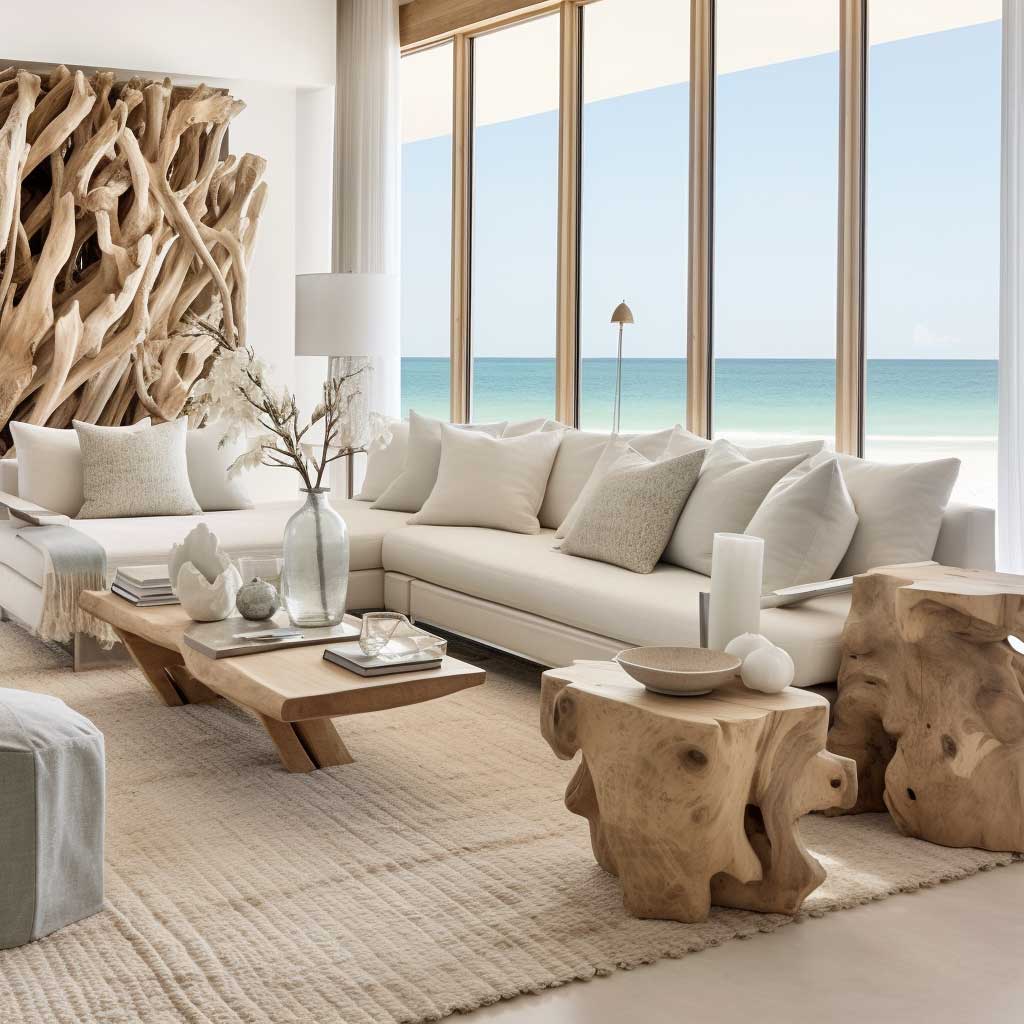
Sea glass — or frosted glass pieces in similar soft hues — adds the translucent accent that completes the material triad. Used in a shallow decorative bowl, a pendant light shade, or a set of votives, sea glass catches and scatters light in a way solid objects don’t. The color range (pale aqua, soft sage, frosted white) maps directly onto a coastal palette without requiring any deliberate color coordination. What stylists recommend against: using sea glass as the primary decorative element in a room. It performs best as a supporting character — a small bowl on a coffee table, a cluster of pieces in a glass jar — not as the room’s focal point. The moment a single material becomes the room’s main story, the design stops breathing.
A practical note on coastal living room paint colors: the organic material palette in the room changes how wall color reads. A sandy beige that looks flat in an empty room gains warmth and depth once linen curtains, natural fiber rugs, and light wood are layered in. Always sample paint with the room’s major material elements already in place — even a swatch of linen fabric taped next to the paint chip shifts the perception of the color significantly.
THE TAKEAWAY
Color anchors, materials do the feeling, and restraint does the editing.
Sherwin-Williams Sea Salt (SW 6204) and Benjamin Moore Chantilly Lace are the two starting points for a modern coastal palette that won’t date. Budget ~$81.49/gallon for Emerald Interior to hold the color long-term.
Linen upholstery, driftwood accents, and one organic plant are the material trio that separates a considered coastal room from a themed one. Nautical objects get one slot in the room — spend it on something with real texture, like a rope mirror, not a printed anchor motif.
Save this post before you head to the paint store or sofa showroom — the palette and material decisions connect and the sequence matters.