
Wall lights for a living room do more than fill a dark corner — in a Hamptons-style space, they define the mood, pace, and perceived quality of the entire room. The Hamptons aesthetic trades on layered light: a pendant overhead, table lamps at seated height, and wall sconces that wash the walls in warm, even glow. Get the combination right and the room feels like a private retreat. Get it wrong and even the most expensive furniture looks flat.
The short answer to “which Hamptons lighting works best?” is this — no single fixture type wins. Pendant lights establish visual hierarchy and draw the eye upward. Table lamps supply the soft pools of light that make a room feel inhabited. Wall sconces frame architectural moments and extend the light plan to the walls. Used together, these three types create the layered, coastal-luxe atmosphere that defines the style. Each one is covered below, with practical guidance on materials, placement, and what to avoid.
This page covers all three fixture types found in a well-lit Hamptons living room: pendant lights, table lamps, and wall sconces. If you’re planning a full lighting refresh or replacing one element at a time, the sections below give you a framework for decisions — including the most common mistakes that undercut an otherwise well-designed room. For more on how to build a cohesive living room around a single strong design choice, see this look at family room lighting and decor ideas that work across bold colour schemes.
- Pendant lights define zones and establish the room’s visual hierarchy — hang them 65–75 cm above a coffee table for balance.
- Table lamps with ceramic or wood bases and linen shades are the most versatile Hamptons fixture, working beside sofas, consoles, and armchairs.
- Wall sconces are the most underused Hamptons lighting tool — a pair flanking a fireplace or artwork adds symmetry and architectural depth.
- Warm white bulbs at 3000K or lower keep the coastal-relaxed tone intact; cooler temperatures read as clinical in this style.
- Dimmable fixtures across all three types give you a single room that shifts from bright and functional to intimate with one adjustment.
- Brushed nickel, antique brass, and matte black are the three finishes that appear most consistently in well-executed Hamptons living rooms.
Pendant Lights That Anchor a Hamptons Living Room


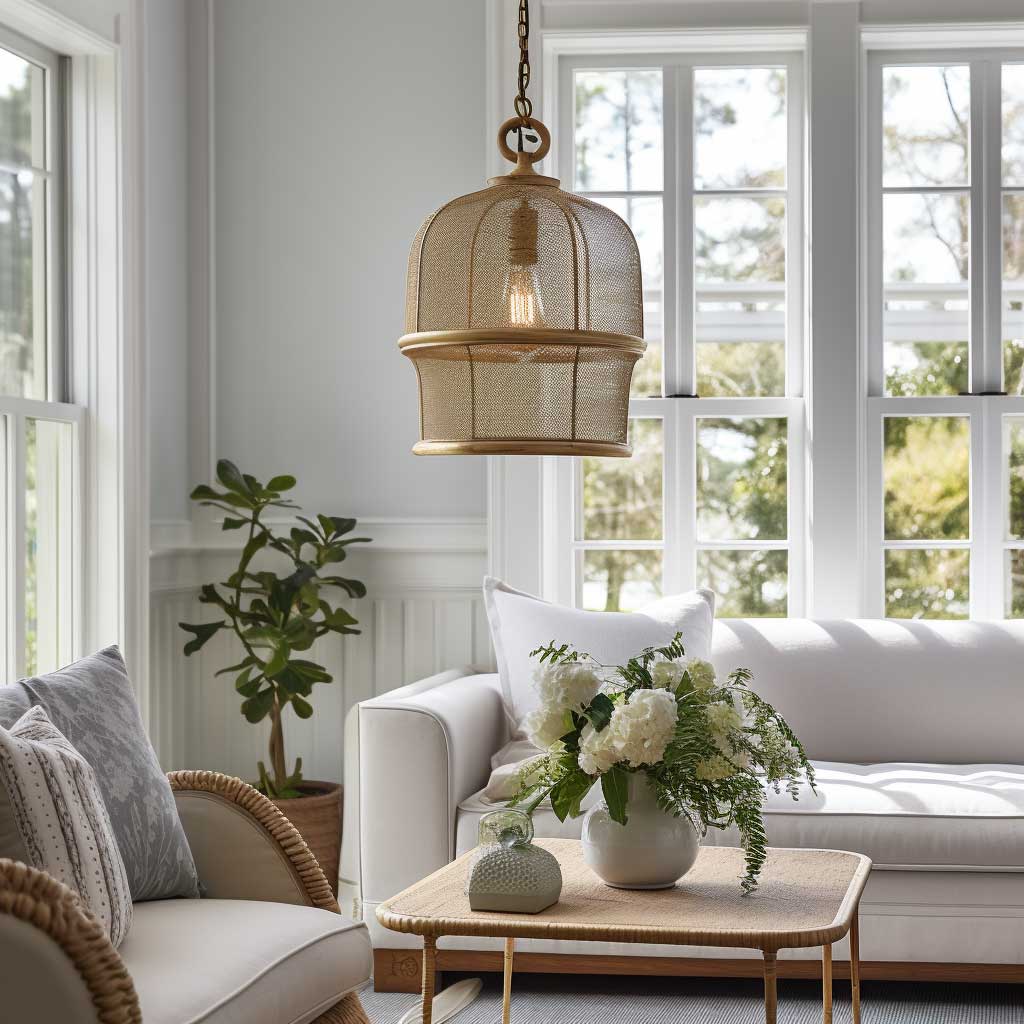
A pendant light over the seating area of a Hamptons living room does something no floor lamp can replicate — it pulls the room upward, creating a natural focal point at ceiling height while throwing light downward into the conversation zone below. The best Hamptons pendant lights work in materials that read as coastal without being literal: woven rattan, opal glass, brushed metal, and occasionally driftwood-toned timber. These materials diffuse light softly rather than projecting a hard beam, which keeps the atmosphere relaxed even at full brightness.
What height should a pendant hang in a Hamptons living room? The standard recommendation is 65–75 cm from the bottom of the shade to the surface directly below it — typically a coffee table or a low console. Lower than 65 cm and the light source competes with sightlines across the room. Higher than 80 cm and the pendant loses its connection to the space below, reading instead as a ceiling fixture that happens to hang slightly lower. Do not hang a pendant so that its cord is visible from the main seating position — route it neatly or use a canopy that conceals the wiring at the ceiling plate.
The wrong move in this section: choosing a pendant that is too small for the room’s ceiling height. A 30 cm shade in a room with 3-metre ceilings looks like a placeholder, not a statement. Scale up. A single well-proportioned pendant at 45–55 cm in diameter makes a stronger visual contribution than a cluster of undersized ones. If the room has double-height or vaulted ceilings, consider a statement lantern pendant — a box or cage silhouette in wrought iron or bronze suits Traditional and Farmhouse Hamptons, while a slimmer brass-and-glass format reads as Modern Hamptons. Average retail prices for quality Hamptons-style pendants sit roughly between $200 and $600, depending on material and size.
Can one pendant do the job on its own? In a Hamptons living room, probably not. Think of the pendant as the conductor — it sets the tone and the visual height, but it needs the table lamps and wall sconces below to fill the room with light. A pendant alone produces top-down illumination that flattens texture and leaves the room’s lower third in shadow, which works against the layered, welcoming atmosphere that Hamptons design depends on.
Table Lamps for Hamptons Living Room Warmth


Table lamps are where Hamptons living room lighting does most of its practical work. Positioned at seated eye level — typically on side tables, console tables behind sofas, or beside armchairs — they provide the soft, localised pools of light that make a room feel active and inhabited rather than coldly lit from above. The classic Hamptons table lamp formula is a ceramic or timber base (often inspired by ginger jars, coral forms, or plain turned columns) paired with a linen or cotton drum shade that diffuses light gently. This combination works because the diffused shade casts no harsh shadows — the light spills outward and downward in equal measure.
The single most effective placement for table lamps in a Hamptons living room is symmetrical: one lamp on each side table flanking the main sofa. Symmetry is a core design principle in the Hamptons style — it creates balance and a sense of formal ease without rigidity. If the sofa is backed against a wall, a pair of taller lamps on a console table directly behind it can substitute. Avoid placing just one lamp on one side of a sofa — asymmetry in Hamptons design reads as unfinished rather than intentional, unlike in more contemporary or eclectic interiors.
Material selection matters here. Metal bases in a chrome or antique brass finish introduce a harder edge that can read as too formal for a coastal room; ceramic or wood bases are more forgiving and carry warmth. The shade fabric is equally important — white or off-white linen produces a warm, amber-tinged light when lit, whereas bright white cotton shades produce a cooler, cleaner tone. For a Hamptons room, linen shades are the better call because they reinforce the natural-texture palette the style depends on. A practical note: test the scale of the shade against the base before buying. A shade that is too wide looks top-heavy; a shade too narrow looks afterthought.
A question worth answering directly: do table lamps in a Hamptons room need to match perfectly? They do not need to be identical, but they should rhyme. Two lamps with the same base material but different heights work well. Two lamps with matching shades but different base styles can create an eclectic-within-traditional effect that suits a lived-in Hamptons room. What does not work is pairing a very modern lamp with a very traditional one on the same side table — the tonal conflict breaks the room’s coherence. The same logic applies to finishes across the room: if the pendants are brushed nickel, the lamp bases should ideally pick up that metal or complement it rather than introduce a third competing finish.
How Wall Lights for a Living Room Define the Hamptons Look
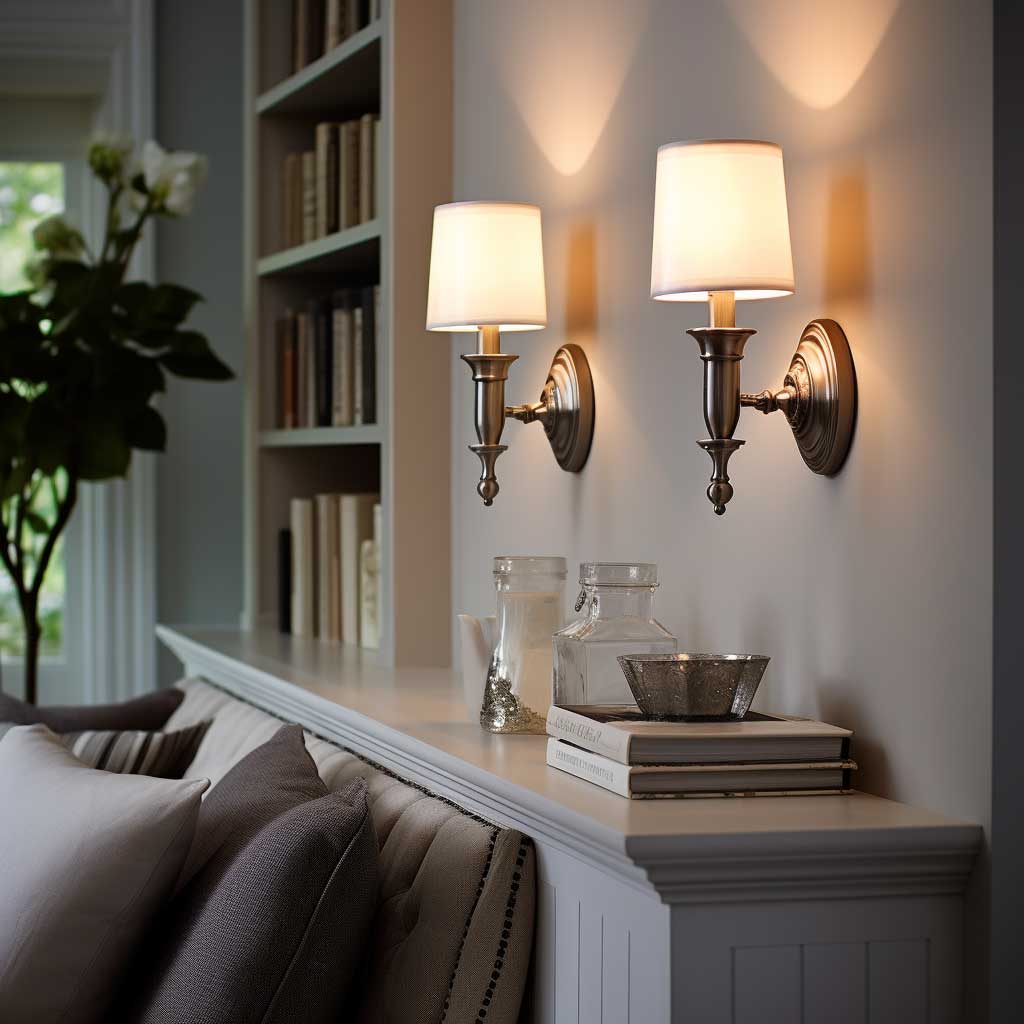


Wall lights for a living room in the Hamptons style serve a different purpose from both pendants and table lamps — they illuminate the vertical surfaces of the room, which is exactly where a Hamptons interior carries its most important visual information: panelling, framing, artwork, and architectural detail. A pair of sconces either side of a fireplace or a significant piece of art does something light from above or below cannot do: it places the wall itself in the light plan, making the room feel taller and more considered. Think of a sconce as a frame for the wall, not just a light on it.
Finish choices for Hamptons wall sconces tend toward nickel, antique brass, wrought iron, and, in Modern Hamptons interiors, matte black. Frosted glass or fabric shades are the most common shade options; both diffuse light softly and avoid hot spots. The typical retail price range for quality Hamptons-appropriate sconces runs from around $150 to $550 per fitting, with most mid-range options in the $200–$350 band. Entry-level versions below $150 tend to use thinner metals and plastic diffusers that read as cheaper in situ — worth noting before deciding to save on this fixture type. For a comprehensive overview of how finish selection, colour temperature, and four distinct Hamptons sub-styles interact, the Lighting Collective’s Hamptons lighting guide covers the subject in detail.
Placement rule: mount wall sconces at approximately eye level when standing — around 150–165 cm from floor to the centre of the fitting. This height distributes light across the mid-zone of the wall and keeps the sconce visible as a design element without positioning it so high that it reads as a ceiling fixture. Flanking a door, window, or piece of art with symmetrical sconces reinforces the formal-yet-relaxed balance that is central to Hamptons style. Adjustable-arm sconces offer more flexibility — the arm can swing to direct light toward a reading chair or away from a screen wall, making them a practical choice for rooms where the furniture arrangement may shift.
The most common mistake with wall sconces in a Hamptons living room is using them sparingly — one sconce in an asymmetrical position on a large wall looks like an oversight. Sconces work in pairs. If the wall is long or the room is wide, two pairs at even intervals make a stronger statement than a single pair clustered on one end. Another anti-pattern worth naming: selecting a sconce with a directional spot-style beam for a Hamptons room. Spots create pools of harsh light that break the soft, diffused atmosphere the style requires. A sconce with an upward or bidirectional distribution — or a fabric-shaded fitting that casts light in all directions — is the appropriate choice. The IES recommends ambient residential lighting at 10–20 footcandles; wall sconces used alongside table lamps typically achieve this range without adding harsh overhead sources.
Comparing the Three Fixture Types for a Hamptons Room
Each fixture type in a Hamptons living room plays a different role in the lighting hierarchy. The table below shows the key practical differences to help prioritise where to invest first — or where to make changes if an existing scheme is falling short. For a broader look at how layered lighting interacts with furniture and decor across living and family rooms, this resource on living room design choices that anchor a space through architecture and colour is worth reading alongside.
| Fixture type | Primary role | Typical height/placement | Best Hamptons finish | |
|---|---|---|---|---|
| Pendant light | Visual hierarchy; zone definition | 65–75 cm above surface below | $200–$600 | Rattan, opal glass, brushed nickel |
| Table lamp | Task and ambient light at seated level | On side/console table; shade base ~120–140 cm from floor | $100–$400 | Ceramic or timber base; linen shade |
| Wall sconce | Architectural framing; wall illumination | Centre of fitting ~150–165 cm from floor | $150–$550 | Antique brass, nickel, matte black |
Dont Do This — Common Mistakes That Break Hamptons Lighting
- Relying on a single overhead source. Recessed downlights alone produce flat, functional light with no atmosphere. A Hamptons room needs at least two of the three fixture types working together.
- Choosing cool-white bulbs. Bulbs above 3500K read as clinical in a Hamptons room. Warm white at 2700–3000K is the standard recommendation for this style.
- Mixing too many finishes. Three or more different metal finishes in one room create visual noise. Choose one primary finish and allow a single complementary accent.
- Scaling down to save money. A pendant or sconce that is too small for the room looks like a budget decision, not a design one. Scale matters more than price in Hamptons lighting.
- Skipping dimmers. Fixed-brightness fixtures at full power all evening works against the relaxed, coastal atmosphere. Dimmers are inexpensive additions relative to the fixtures themselves and make a material difference to how the room feels after 6pm.
- Placing table lamps asymmetrically. One lamp on one side of a sofa reads as unfinished in a Hamptons context. Symmetry is part of the grammar of this style.
The Final Call on Hamptons Lighting
A Hamptons living room’s lighting plan is not complicated, but it does require commitment to the layered approach. No single fixture type carries the room on its own.
Start with the pendant if the room lacks a visual anchor. Add table lamps next — they deliver the most immediate change to how the room feels at evening hours. Finish with wall sconces, particularly if the room has a fireplace, artwork, or panelling worth illuminating.
Keep finishes consistent: choose one main metal across all three fixture types and allow one complementary accent. Use warm white bulbs throughout. Put everything on dimmers. That combination — more than any individual fixture choice — is what gives a Hamptons living room its characteristic quality of light.
Living room wall lighting ideas look best when the fixtures are slightly larger than instinct suggests and slightly fewer in number than a room full of small lamps. Restraint in quantity and confidence in scale are the two decisions that separate a Hamptons room from a collection of individual lighting choices that happen to share a space.
Complete guide
The Living Room Design Ideas Vault Every Home Needs Right Now
Color, walls, furniture, layouts, styles, smart tech — 300+ ideas in one place
Complete guide
Interior Lighting Ideas That Make Every Room Feel Alive
LED panels, smart systems, pendants, chandeliers, biophilic design — all in one place
You Might Also Like
Related Topics