LED panel design for small bedroom spaces works because flat fixtures add light without taking a single inch of floor. A 10 x 10 ft room needs only about 1,000–2,000 lumens in total, which two slim ceiling panels or one dimmable strip run can deliver. Does it actually make the room look bigger? Yes, when the light lands on the ceiling and walls instead of pooling in the middle. Start with warm 2700–3000K light and a dimmer, because those two choices matter more than the fixture style.
The efficiency case is just as clear. Residential LEDs use at least 75% less energy than incandescent bulbs and last up to 25 times longer, and many strips carry a 50,000-hour rating, roughly 27 years at five hours a night. An edge-lit panel under 2 inches deep vs a hanging pendant also leaves nothing to duck under in a room with a low ceiling. Plan the layout in three zones: ceiling, wall behind the bed and storage.
The sections below cover corner lighting, slim ceiling fixtures and lit headboard or wardrobe walls, then compare every option by output, power and price in one table. Typical figures come from manufacturer spec sheets and current cost guides. Read the warning box before buying, since the most common mistake is simply putting an office panel in a bedroom.
- A bedroom needs about 10–20 lumens per sq ft, so 1,000–2,000 lm covers a 100 sq ft room.
- Warm 2700–3000K light suits sleep; 4000–5000K panels belong in offices and kitchens.
- LEDs use at least 75% less energy and last up to 25 times longer than incandescent bulbs.
- One standard 2×2 ceiling panel at 3,100–4,000 lm can exceed a small room’s entire need.
- Basic LED strip costs $0.50–$3 per ft; an aluminum channel with diffuser adds $2–$12 per ft.
- A 50,000-hour strip runs about 27 years at five hours a night.
- One lit wall behind the bed changes perceived space more than a brighter center fixture.
Dark Corners Disappear Under Small Room LED Lights


Small room ideas with LED lights start in the corners, because a dark corner pulls the walls inward and makes a 100 sq ft room read smaller than it is. An LED strip along the ceiling edge or behind the bed frame washes those corners with indirect light, the way a lamp behind a curtain makes the whole window glow. Accent light around furniture needs only about 180 lumens per foot, far less than the 365–850 lm per foot used for general lighting lines. Aim the strip at the wall, not at your eyes, so the corner glows instead of the diodes.
Bright corners vs a single bright center fixture is the core trade-off. A center light leaves a ring of shadow at the edges, while perimeter LED design for bedroom ceilings spreads brightness evenly, so the walls seem to step back. Can corner strips replace the main light? In a room under 120 sq ft they often can, as long as the total reaches roughly 1,000–1,200 lumens. Skip the cheapest RGB tape for this job, because low-cost strips can drift toward a blue or purple tint after hours of use.


Recessed strips look cleaner than surface tape, and the routed-groove method used for MDF wall panels with built-in LED channels works just as well on a bedroom feature wall. Basic strip costs about $0.50–$3 per foot, so a 12 ft corner-to-corner run lands near $6–$36 before the power supply. An aluminum channel with a diffuser adds roughly $2–$12 per foot and hides the dotted look of bare diodes. Budget for the channel first, because it decides whether the line reads as light or as a row of beads.
Warm 2700K corners vs neutral 4000K corners change the mood more than brightness does. Warm white feels like evening sun on plaster, while 4000K reads closer to an office corridor. Bedroom lighting guidance generally points to 2700K for relaxation, with 3000K as the comfortable upper limit for ambient light. Match every strip and panel in the room to one color temperature so the corners never look patched together.
Flat Ceiling Fixtures Behind a Simple LED Panel Design for Small Bedroom Layouts
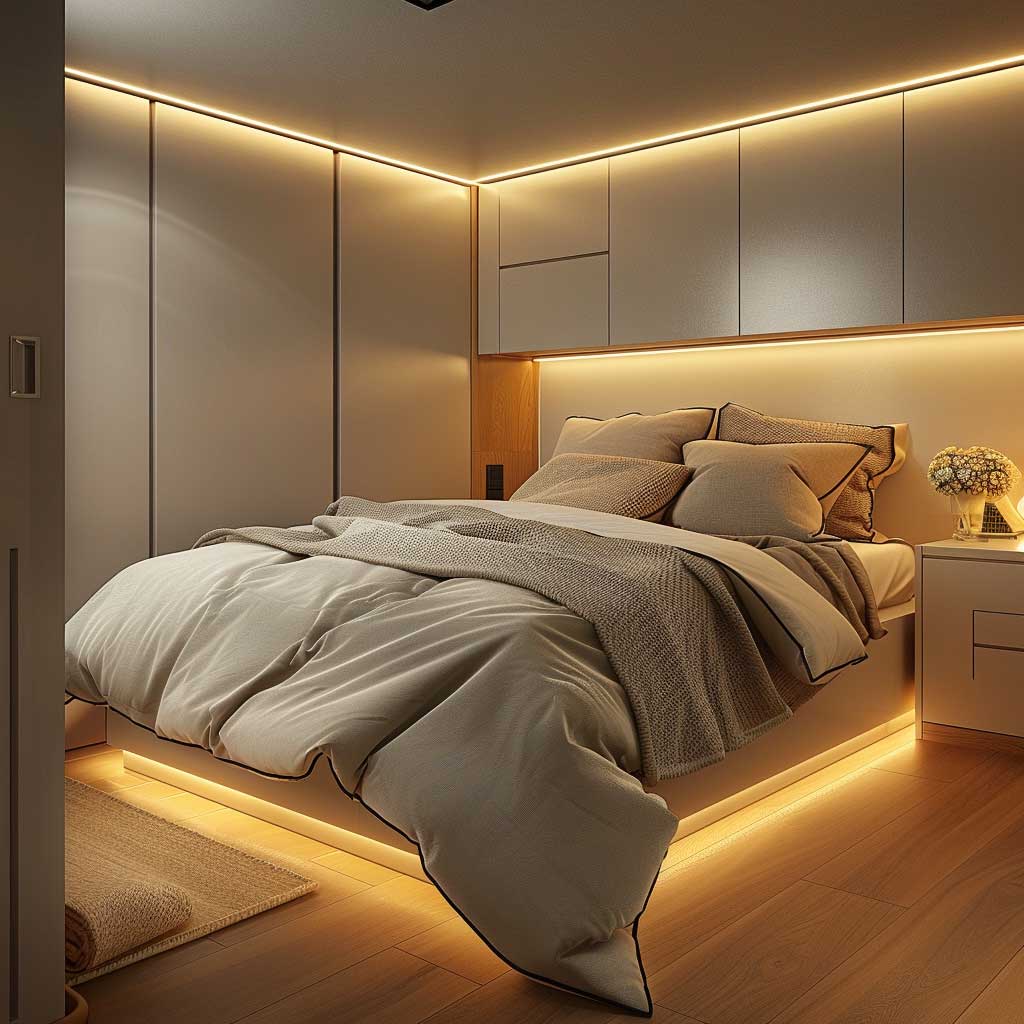


A simple LED panel design for small bedroom ceilings relies on edge-lit fixtures that sit under 2 inches deep, so a low ceiling keeps its full height. Some surface-mount 2×2 models measure just 0.68 inch thick, about the depth of a paperback spine. A flush panel vs a pendant also removes the swing zone above the bed. Choose a surface-mount or recessed small LED panel when the ceiling is under 8 ft, and save pendants for rooms with height to spare.
Brightness is where most buyers overshoot. A standard 2×2 panel produces 3,100–4,000 lumens at 30–40 W, while a 100 sq ft bedroom needs only 1,000–2,000 lumens in total. Is one big panel enough, then? It is too much without a dimmer, so pick a dimmable model or two smaller fixtures that split the load. Never install an undimmable 5000K office panel over a bed, since it lights the room like a supermarket aisle.
- 80 sq ft bedroom: about 800–1,600 lumens in total
- 100 sq ft bedroom: about 1,000–2,000 lumens in total
- 120 sq ft bedroom: about 1,200–2,400 lumens in total
- 144 sq ft (12 x 12 ft) bedroom: about 1,440–2,880 lumens in total


Efficiency is the quiet reason panels suit compact rooms. The U.S. Department of Energy LED lighting guide reports that residential LEDs use at least 75% less energy than incandescent lighting, while incandescent bulbs release about 90% of their energy as heat. In a closed 100 sq ft room, that heat gap is noticeable on a summer night. Look for ENERGY STAR rated fixtures, since the savings figures are strongest for that class of product.
Bedroom LED panel layout matters as much as wattage. One central panel vs two offset panels changes the shadow map: a single fixture leaves the corners dim, while two smaller panels light the bed and the wardrobe evenly. At typical LED efficacy of 80–100 lumens per watt, 2,000 lumens costs only about 20–25 W in total. Put the panels on one dimmer circuit rather than separate switches, so a single slider sets the whole room.
Headboard Walls and Wardrobes Carry the Boldest LED Wall Design for Bedroom


LED wall design for bedroom spaces works best on one surface, usually the wall behind the bed, where a backlit panel or a strip in a groove turns the headboard into the main glow. A dimmable 3000K strip at about 110 lumens per foot gives a low wind-down light, while a 240 lm-per-foot strip suits a wall that doubles as general lighting. One lit wall vs four lit walls keeps wiring to a single run and stops the room from feeling like a showroom. Mount the strip below eye level when lying down so the light hits the panel, not your face.
Is a lit headboard bright enough to read by? For most people it is not, since indirect light spreads thin across a wide surface. Pair it with a focused sconce or a small task light on each side, and keep the wall glow as ambient fill. Think of the headboard light as the stage backdrop and the sconce as the spotlight. Skip mirror-finish panels behind the bed, because they bounce the diodes straight back into your eyes.


An almirah with LED panel design solves a different problem: finding clothes in a dark wardrobe without waking the room with the ceiling light. A strip drawing about 1.5 W per foot uses roughly 6 W along a 4 ft door frame, close to the draw of a phone charger. Strips that cut every 4 inches fit almost any shelf depth. Choose a door-triggered switch or motion sensor, because a wardrobe light left on all day burns through its 50,000-hour rating for nothing.
Wall finish decides how the light lands. Matte panelling diffuses a strip into a soft halo while gloss shows every hot spot, so the textures in these bedroom wall panelling upgrades for a feature wall behind the bed pair naturally with hidden LEDs. A 3/8 inch strip disappears behind a slat or a shallow ledge. Test the strip with painter’s tape for one evening before fixing it, since a 2 inch shift in position can turn a smooth wash into stripes.
- Don’t fit a 3,100–4,000 lm office panel in a 100 sq ft bedroom without a dimmer; the room needs only 1,000–2,000 lm.
- Don’t mix 2700K strips with 5000K panels in one room; warm vs cool light makes the space look patched.
- Don’t stick bare tape on a wall when a $2–$12 per ft channel with diffuser removes the dotted look.
- Don’t seal the 18–60 W power supply behind a fixed panel; leave an access point inside a cabinet or near the floor.
- Don’t rely on unbranded RGB tape for main light; cheap strips can shift toward a blue tint over time.
Choosing an LED Panel Design for Small Bedroom Budgets and Ceilings
Picking an LED panel for a small bedroom comes down to output, depth and price per foot, and the numbers vary more than product photos suggest. A single 2×2 ceiling panel can deliver twice the lumens a 100 sq ft room needs, while a basic strip gives about 110 lumens per foot and scales to the exact length you buy. Is a strip cheaper than a panel? Per fixture yes, but a full perimeter with channels can cost more. Compare the rows by the job each option does, not by the sticker price.
| Option | Profile | Light output | Power or color range | Typical cost | Best spot |
|---|---|---|---|---|---|
| Edge-lit 2×2 ceiling panel | Under 2 in deep; some 0.68 in | 3,100–4,000 lm | 30–40 W | About $40 per unit in wholesale listings | Rooms over 150 sq ft, or dimmed in smaller ones |
| Basic LED strip | 3/8 in wide | About 110 lm per ft | 1.5 W per ft | $0.50–$3 per ft | Ceiling perimeter, corners, under bed |
| Premium tunable strip | 3/8 in wide | About 240 lm per ft | 2200–5500K adjustable | About $67–$99 per 48–96 in length | Headboard wall used as main light |
| Strip with aluminum channel | Recessed groove or surface profile | Same as strip, softer spread | Needs 18–60 W driver | Adds $2–$12 per ft | Wardrobe, almirah, wall grooves |
| Wardrobe sensor strip | Cut every 4 in to fit shelves | About 440 lm per 4 ft | About 6 W per 4 ft | Under $15 in strip for one door | Almirah or closet interior |
Two patterns stand out from the table. Strips win on flexibility, since they cut every few inches and dim to a whisper, while panels win on install time and even light from one box. A 40 ft perimeter run with channels lands around $100–$600 in parts, compared with roughly $40 for one wholesale-listed 2×2 panel. Combine one dimmable panel with one strip zone if the budget allows both, and let the strip handle the evenings.
Where the Light Should Go First
LED panel design for small bedroom rooms pays off fastest when 1,000–2,000 warm lumens are spread across ceiling and walls instead of pushed out of one bright box. That shift alone makes a 100 sq ft room feel wider than a brighter but centered fixture would. Spread beats power every time in a tight space.
For the ceiling, choose a dimmable edge-lit panel under 2 inches deep at 2700–3000K. If the only option is a 3,100 lm 2×2 panel, run it on a dimmer at well under full output. Two smaller fixtures beat one oversized panel in rooms under 120 sq ft.
For corners and the headboard wall, budget $0.50–$3 per foot for strip and $2–$12 per foot for a channel. A 12 ft run with a diffuser stays under about $180 in parts. Keep every source in the room on one color temperature.
For the wardrobe, a 4 ft sensor strip at around 6 W lights every shelf without touching the main switch. Across the whole room, LEDs use at least 75% less energy than incandescent bulbs, so a fully layered setup still draws only about 20–25 W for 2,000 lumens. Start with the wall behind the bed, then add the ceiling and the almirah as budget allows.