Black sofa living room ideas earn their reputation because they solve a problem most neutral sofas can’t: they hold the room steady while everything around them changes. Style the walls beige one season, paint them deep navy the next — the black sofa doesn’t flinch. Interior designers reach for black seating precisely because it functions like a fixed point, the way a full stop anchors a sentence no matter what comes before it.
The resistance to black is usually about fear of heaviness. The trick here is that heaviness comes from surrounding darkness, not from the sofa itself. Pair a black sofa with warm neutrals, layered textiles, and natural light, and the room feels grounded, not gloomy. The three themes below show how that works across minimalist, bohemian, and industrial living rooms — each starting from the same dark anchor and arriving at a completely different atmosphere.
What follows isn’t about one style being correct. It’s about understanding why each approach works so you can adapt it to the room and budget you actually have.
– A black sofa holds its visual weight in minimalist, bohemian, and industrial rooms without redesigning for each style.
– Colour scheme is the single biggest variable: warm neutrals soften it, jewel tones dramatise it, and grey-white keeps it sharp.
– Fabric choice matters as much as colour — leather reads industrial and retro; velvet reads maximalist and warm; tight-weave performance fabric keeps it clean for daily living.
– Benjamin Moore’s 2026 Color of the Year “Silhouette” — a warm espresso-charcoal with violet-grey undertones — pairs naturally with a black sofa at around $65–75/gallon for Regal Select.
– The comparison table below gives a side-by-side read on all three looks before you scroll.
Minimalism Runs Harder with Black Sofa Living Room Ideas at Its Core
Black sofa living room ideas land differently in a minimalist setting than in any other style, because here the sofa does all the decorative work. Minimalism strips the room down to the things that earn their place — clean wall colour, light wooden floors, a few deliberate shapes — and the black sofa becomes the room’s only real statement. Everything else steps back to let it read.
Wall colour is the first decision that makes or breaks this. Stylists recommend warm whites rather than stark cool whites against a black sofa — the warmth stops the room from reading as a showroom. Benjamin Moore’s White Dove OC-17 is the reliable standard here, and their 2026 Color of the Year “Silhouette” takes it further, offering an espresso-charcoal with violet-grey undertones that works as a wall colour itself when you want depth without darkening the whole room. Benjamin Moore Regal Select runs $65–75 per gallon and covers approximately 350–400 square feet, so a standard living room typically needs two gallons for two coats. Does the sofa need cushions? In a strict minimalist room, two cushions in a slightly different texture — boucle against a leather sofa, for instance — is enough. Twelve cushions in competing patterns is a different style.
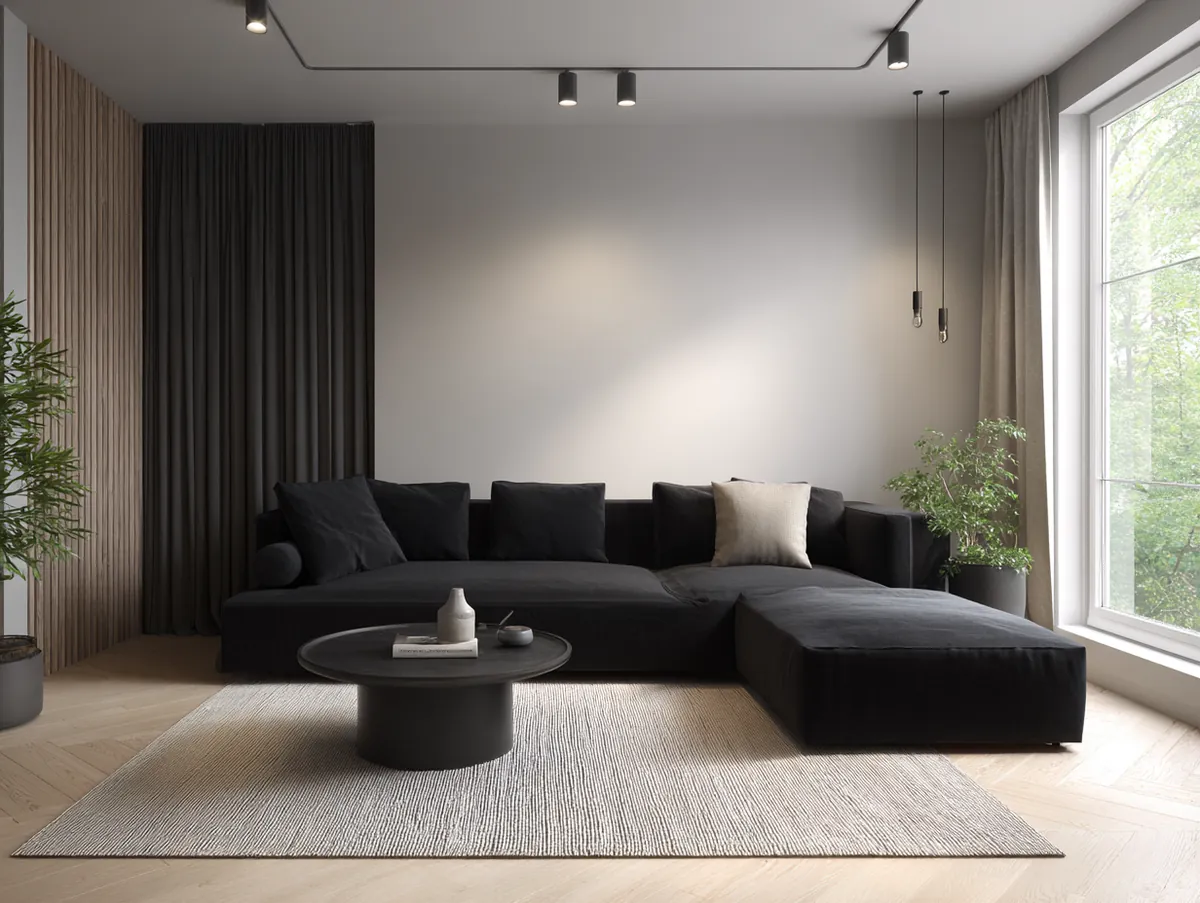
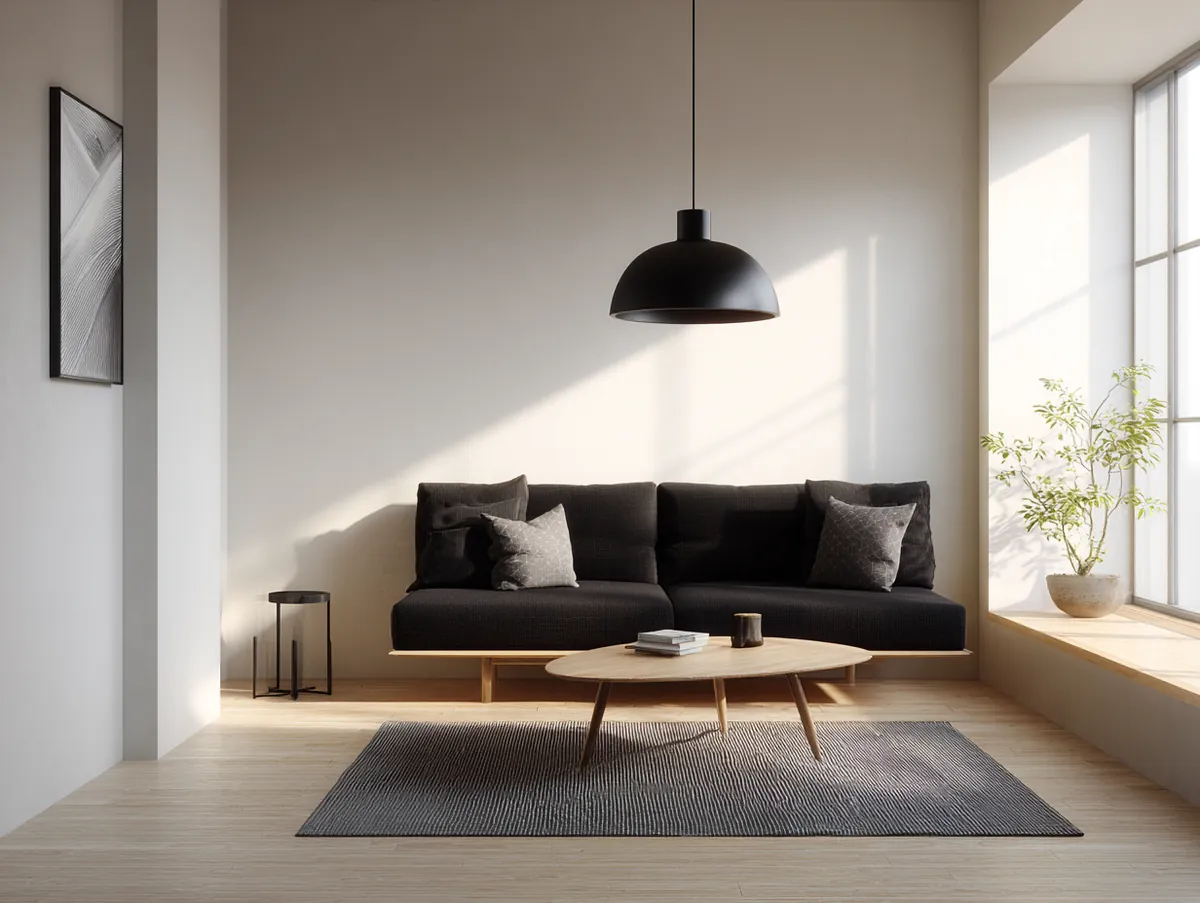

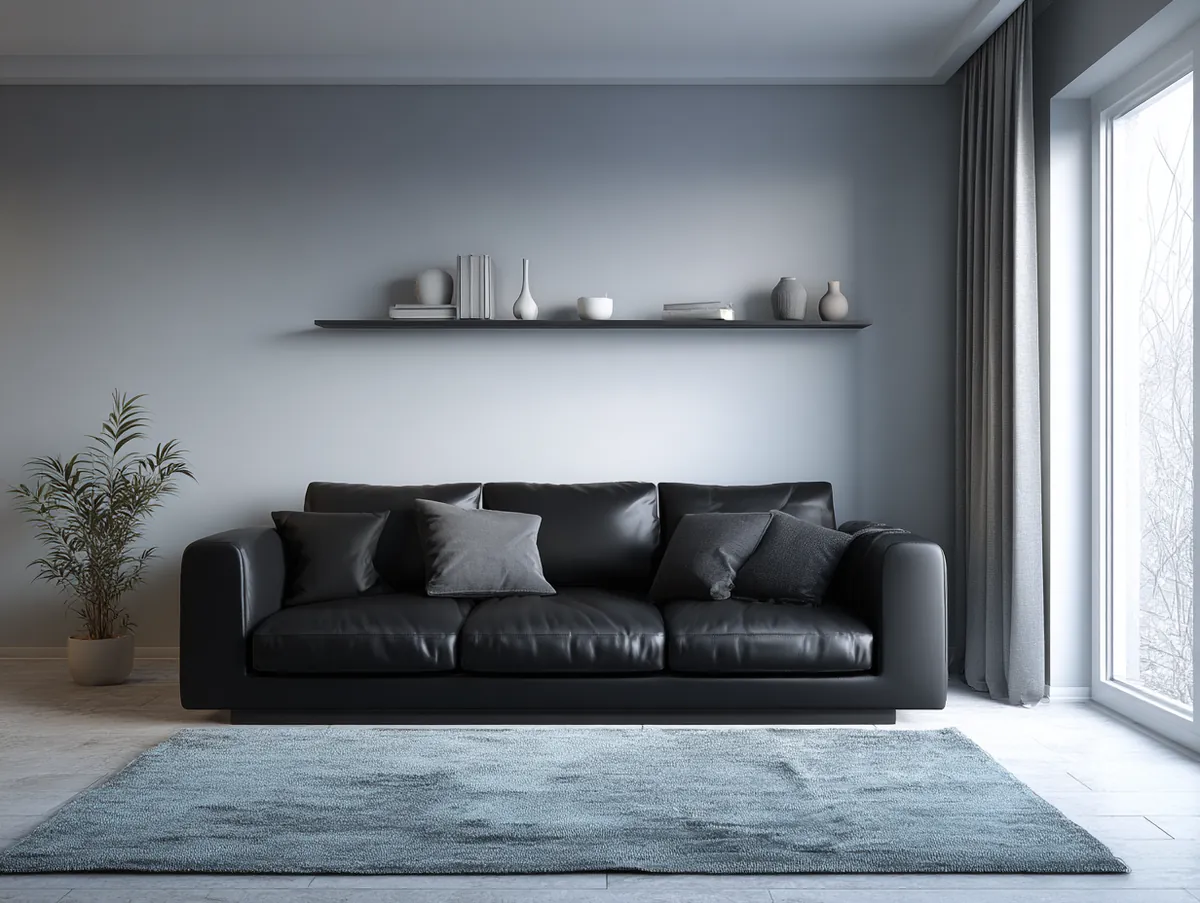
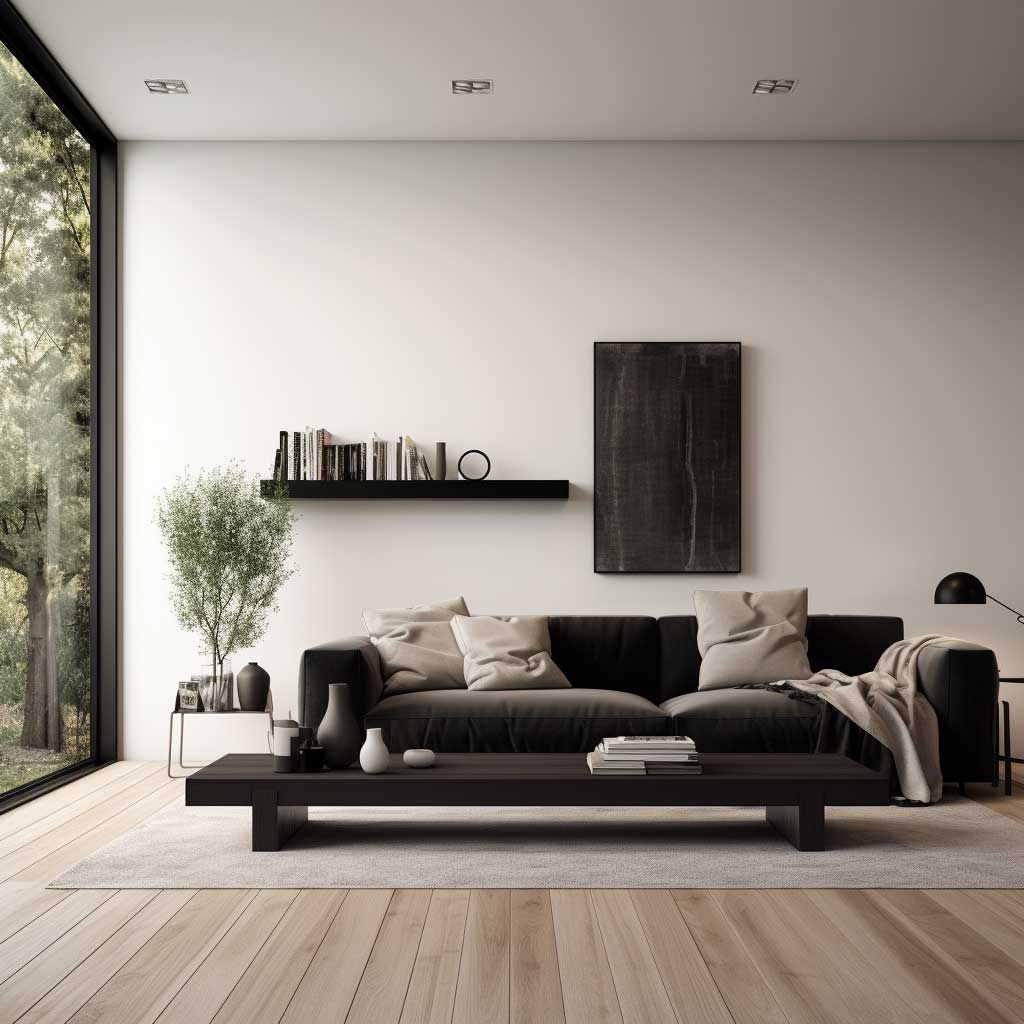
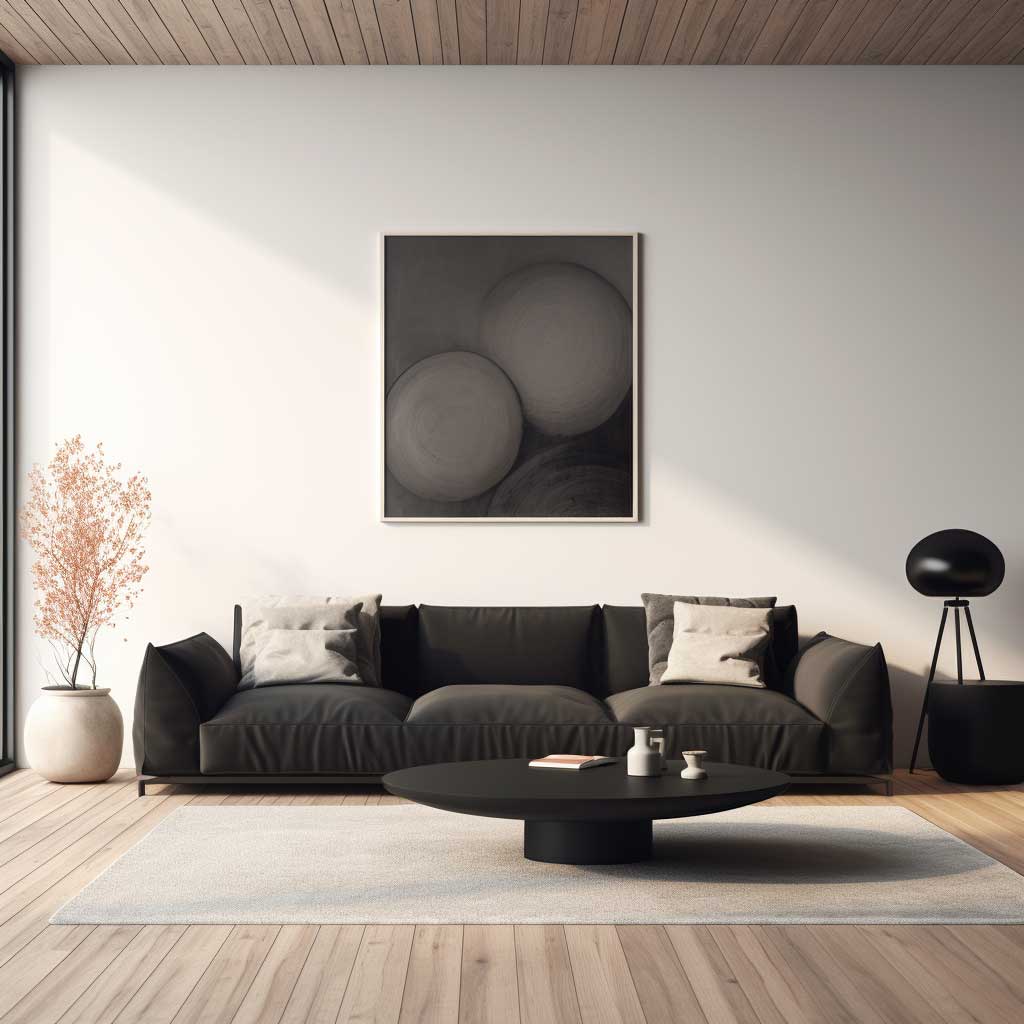


Texture is the secret layer that keeps a minimalist black sofa room from feeling like a waiting room. A woven jute rug underfoot, a soft throw folded over one arm of the sofa, and a single potted plant in the corner are the three additions that shift the room from styled to lived-in. The trick here is that each element should introduce a different material — jute, wool, ceramic — not just repeat the same visual note. If you’re wondering what colours go with a black sofa in a minimalist scheme, the answer is to stay within a four-shade palette: one deep (the sofa), one warm neutral (wall), one light accent (rug or cushion), one natural material (wood or stone).
Anti-advice for this style: avoid adding colour because the room “feels cold.” That instinct sends people toward too many accent pieces at once, and the minimalist discipline collapses. Instead, adjust the warmth through lighting — a floor lamp with a warm 2700K bulb does more for a cold-feeling minimalist room than any throw pillow. The Article Sven 88″ tufted leather sofa in Oxford Black at $1,699 is a good reference point for what this style of sofa looks like in practice: tight lines, visible tufting, a profile that holds its shape rather than inviting you to sink into it. For living room colour schemes to pair with this kind of sofa, see these Hampton living room colour schemes — the neutral and pastel palettes translate directly.
Black Couch Boho Living Room — Where Dark Grounds the Colour Storm
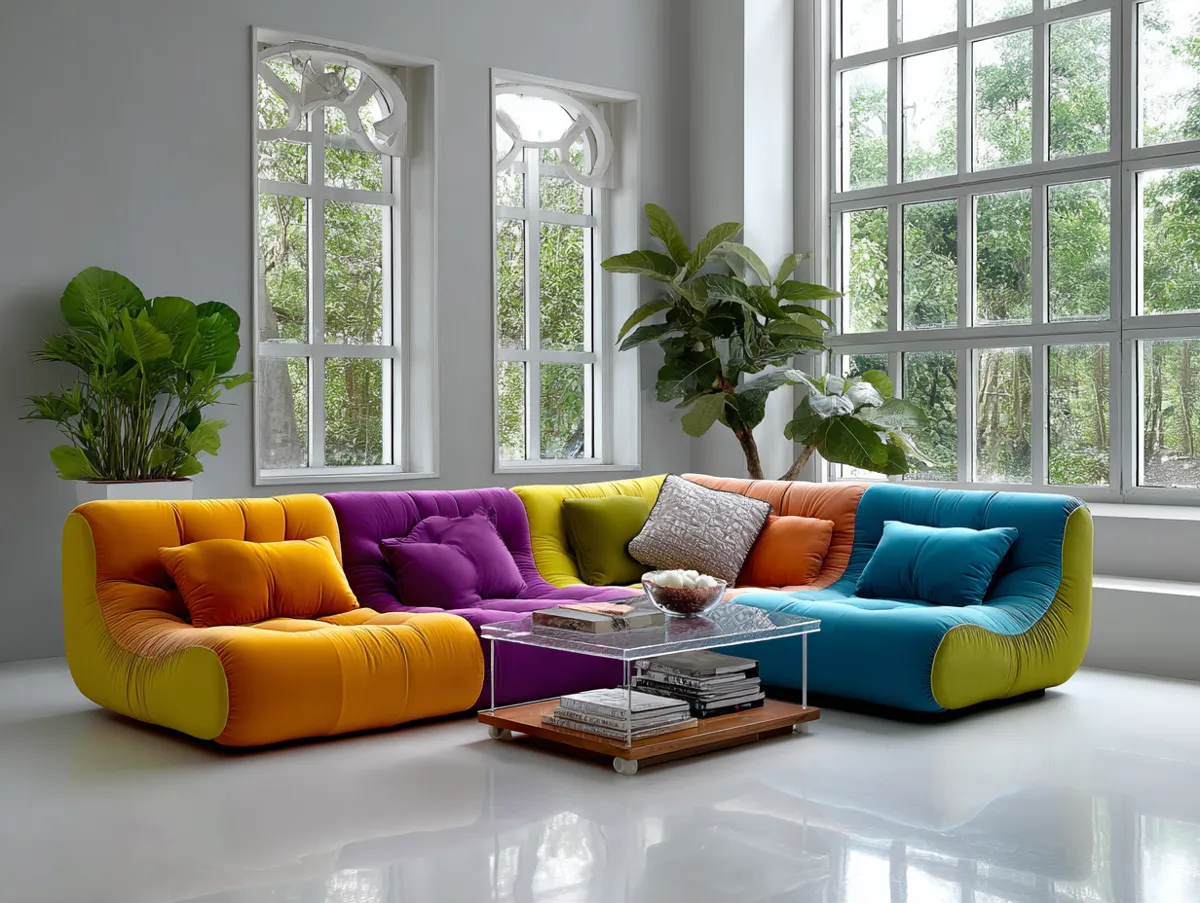
A black couch boho living room works because bohemian style’s biggest problem is visual chaos, and a black sofa solves it. All the pattern, texture, and competing colour that defines boho design needs something to stop the eye — a fixed, neutral anchor that lets everything else move around it. Black does this better than any other colour because it absorbs contrast rather than adding to it.
The sofa fabric matters enormously here. A black velvet sofa raises the room’s richness level immediately — velvet catches light, adds visual depth, and reads as intentional luxury rather than neutral utility. Black leather does the opposite: it reads as structure, which grounds an otherwise maximalist space in a way that feels editorial rather than chaotic. The choice depends on which direction you want the room to lean. If the room is already full of warm pattern — kilim rugs, macramé wall hangings, patterned throw pillows — leather is the better call. If the room is more restrained in its pattern but strong on texture, velvet adds what’s missing.
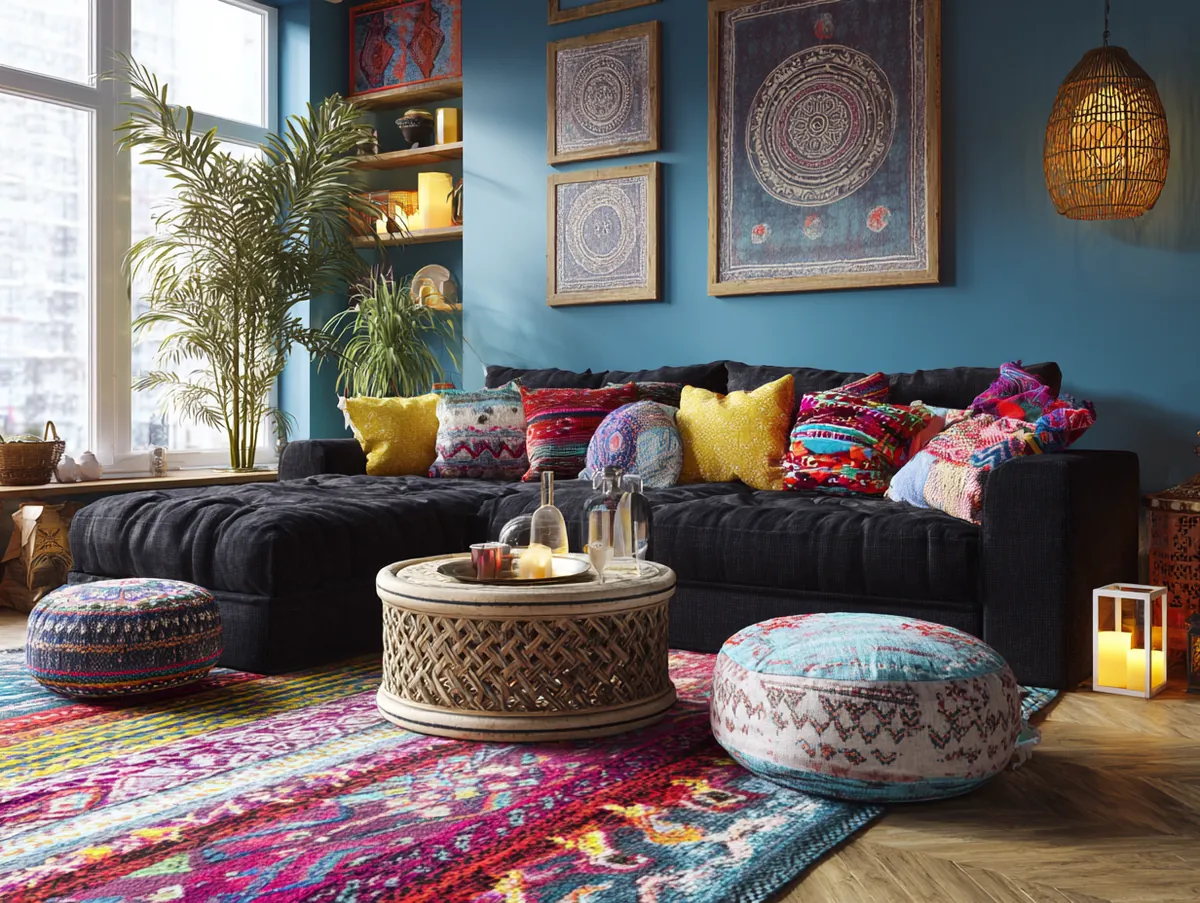
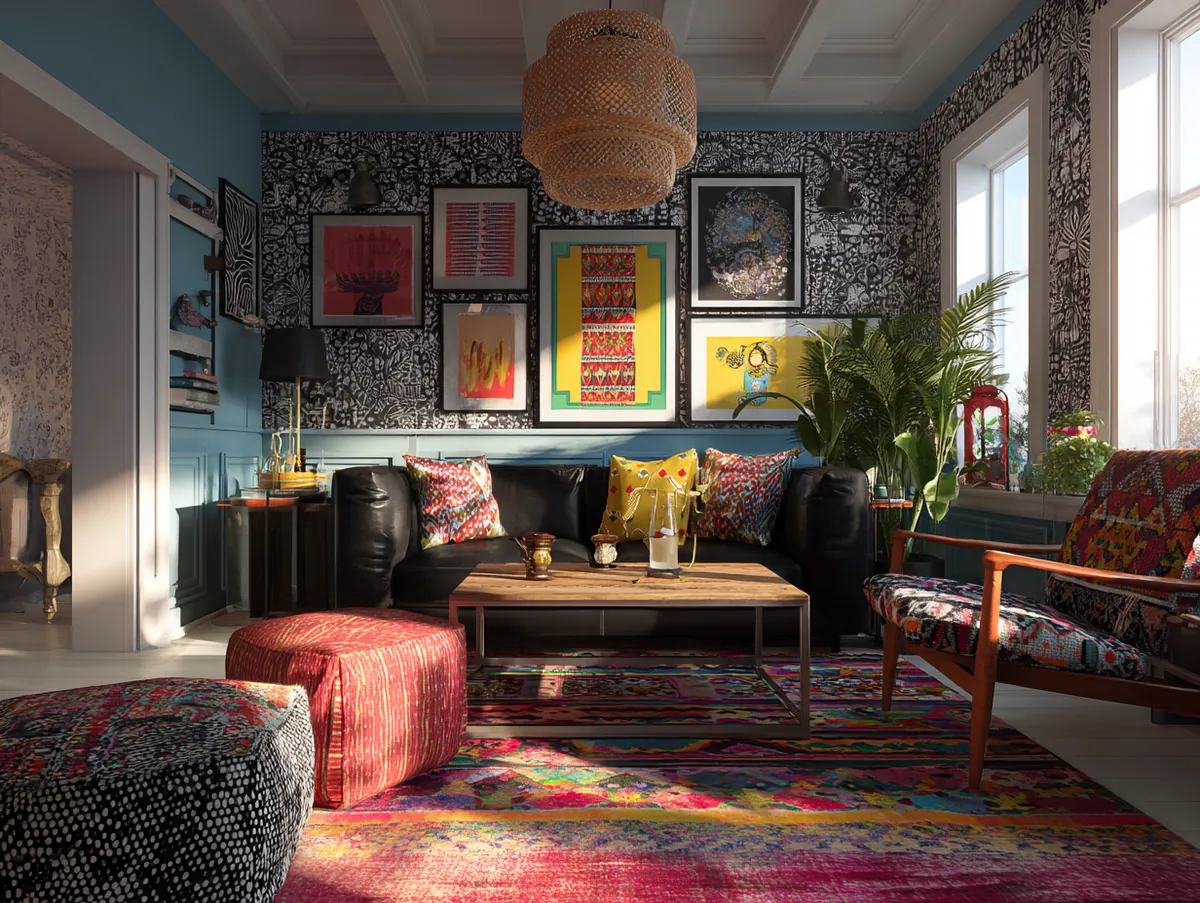
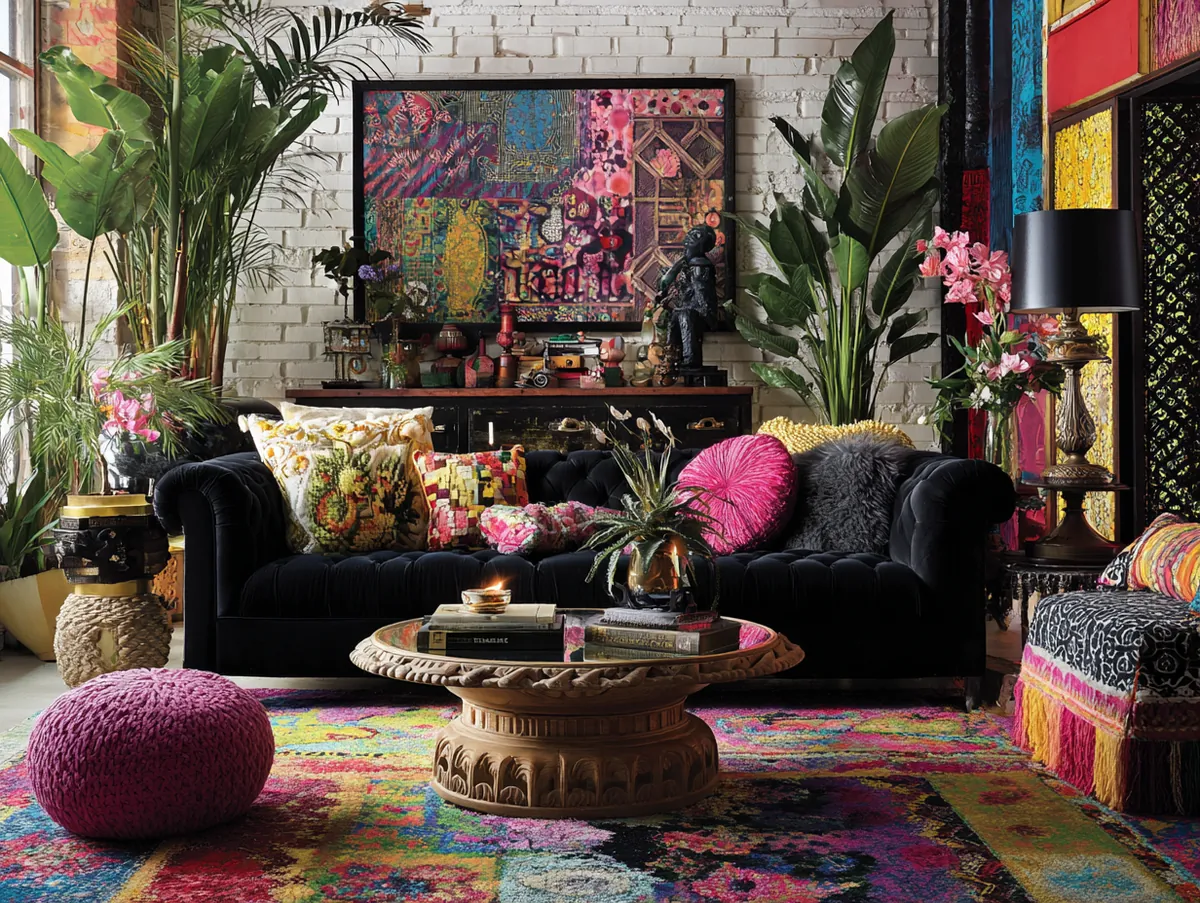
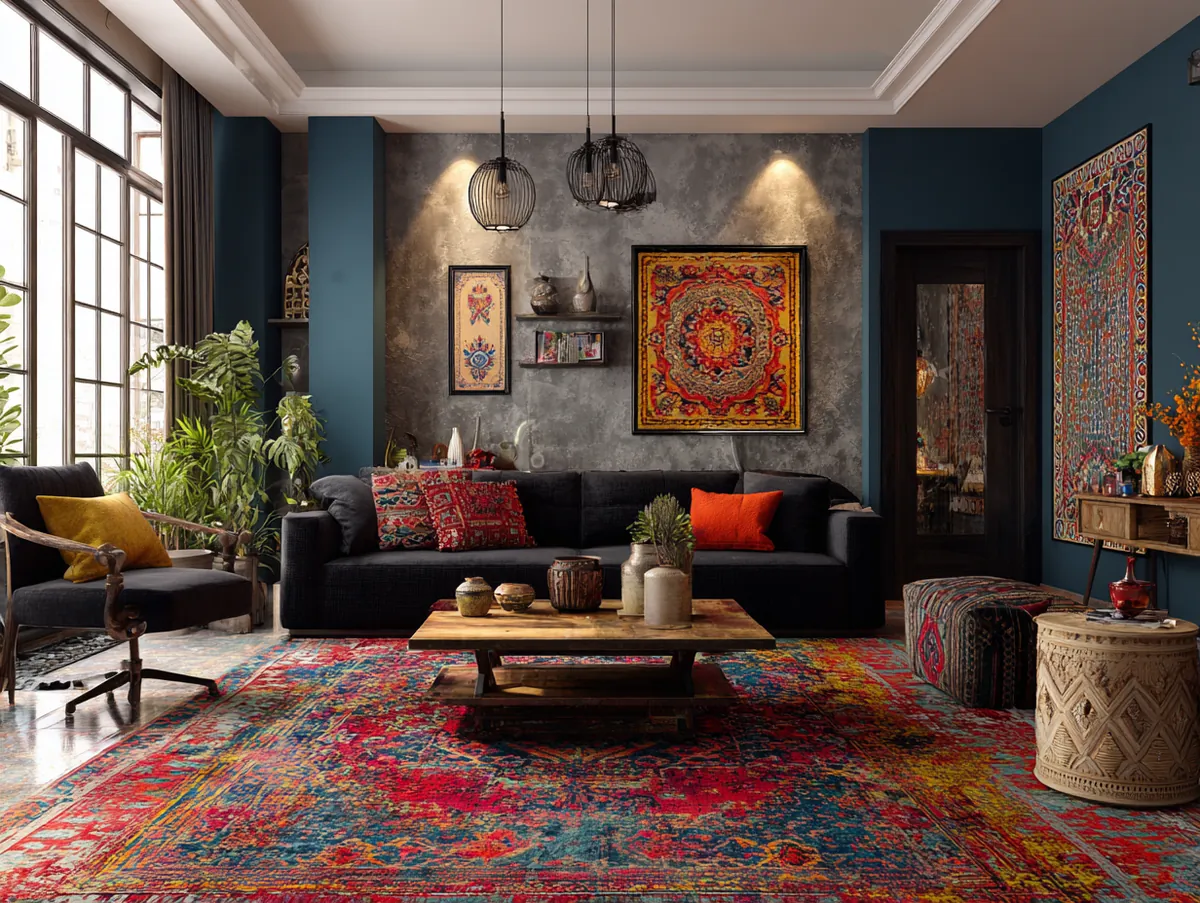

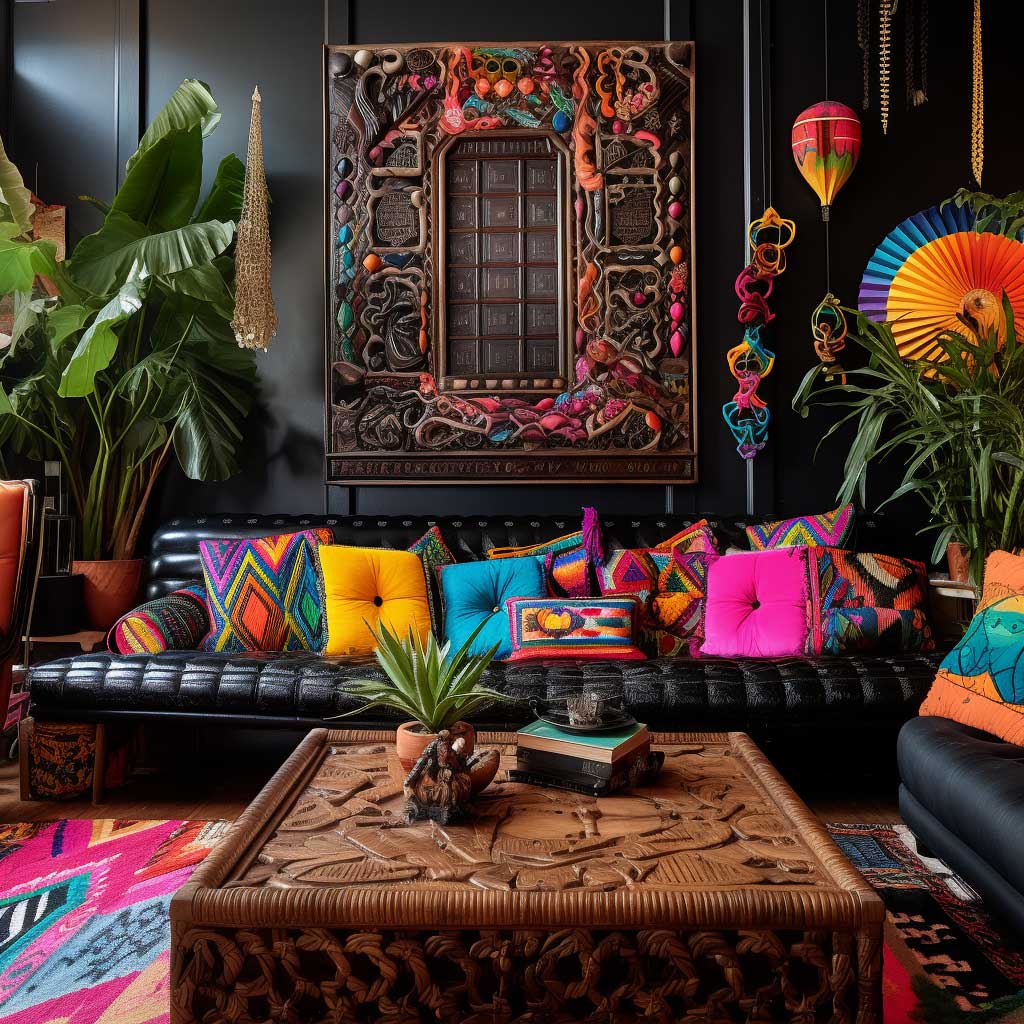
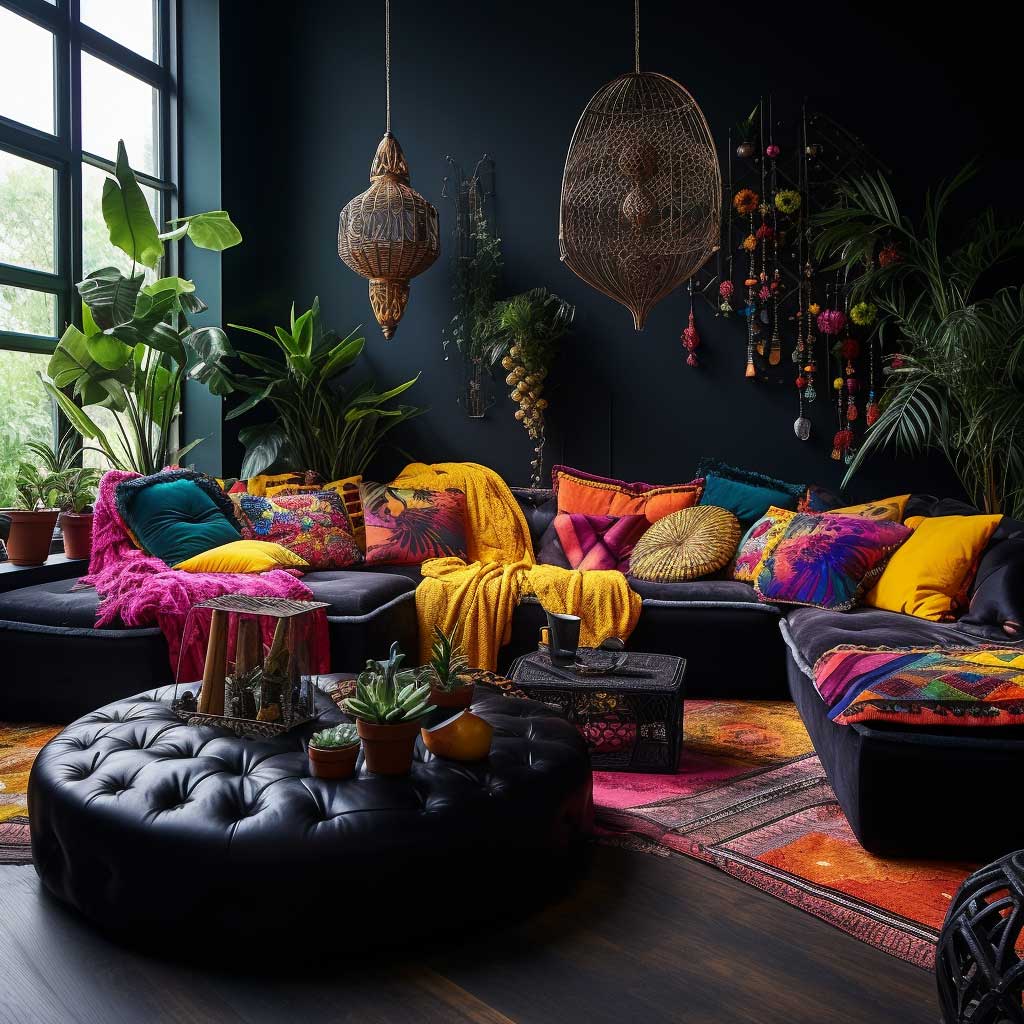

Around the sofa, the layering happens in order of scale: large rug first, then mid-scale pattern on cushions, then small-scale detail in decor objects. Stylists consistently recommend starting with a natural-fibre rug — jute or sisal — as the base, then layering a smaller patterned kilim on top. IKEA’s LANGSTED jute rug runs around $49 and holds up better than most budget alternatives. The kilim layered on top is where pattern can be bolder, because the neutral base absorbs the contrast. What doesn’t work: buying a full matching boho set — cushions, rug, and throw designed to coordinate — because coordinated sets read as a costume rather than a collection.
For the black sofa living room colour scheme in a boho room, terracotta, dusty teal, and mustard are the three colours that consistently read as warm without fighting each other. They share earthy undertones, which means they’ll coexist with the black sofa rather than competing for attention. The wall colour question is easy here: a warm greige or a terra-cotta-adjacent hue lets all the pattern in the room do its work without adding another layer of competition. For more on how these colour decisions play against eclectic decor, these boho industrial living room ideas show exactly how the palette holds up against raw materials and mixed textiles.
– Don’t hang a macramé wall hanging that’s undersized for the wall — anything narrower than 24 inches reads as an afterthought, not a design choice.
– Don’t buy matching cushion sets marketed as “bohemian” — the matching is exactly what makes the look feel fake.
– Don’t use a pure white wall in a boho room anchored by a black sofa — white makes the dark sofa feel disconnected rather than grounded. Warm off-white at minimum.
– Don’t stack every boho accessory on the sofa itself — the coffee table and floor need pattern too, or the sofa becomes the only working element in the room.
Raw Concrete Meets Black Sofa — Industrial Living Room Design That Holds
Industrial living room design with a black sofa works because the two share a visual language: both lean dark, both favour raw over refined, and both get more interesting with age. A black leather sofa against exposed brick or poured concrete doesn’t look like a contrast — it looks like the room was always supposed to be this way, the way a well-worn jacket looks better than a new one.
The industrial skeleton — exposed ductwork, concrete floors, steel-framed windows or a brick feature wall — determines what the sofa needs to do. In a room already heavy with hard materials, the sofa’s job is to introduce comfort without softening the room’s edge. This means choosing a sofa profile that reads as structure: tight arms, clean silhouette, a leg style with visible metal. What doesn’t work here is a deep, low-slung sectional with plush pile cushions — it reads as comfort furniture in the wrong room, like wearing slippers to a studio. The black sofa that earns its place in an industrial room has something slightly architectural about it.
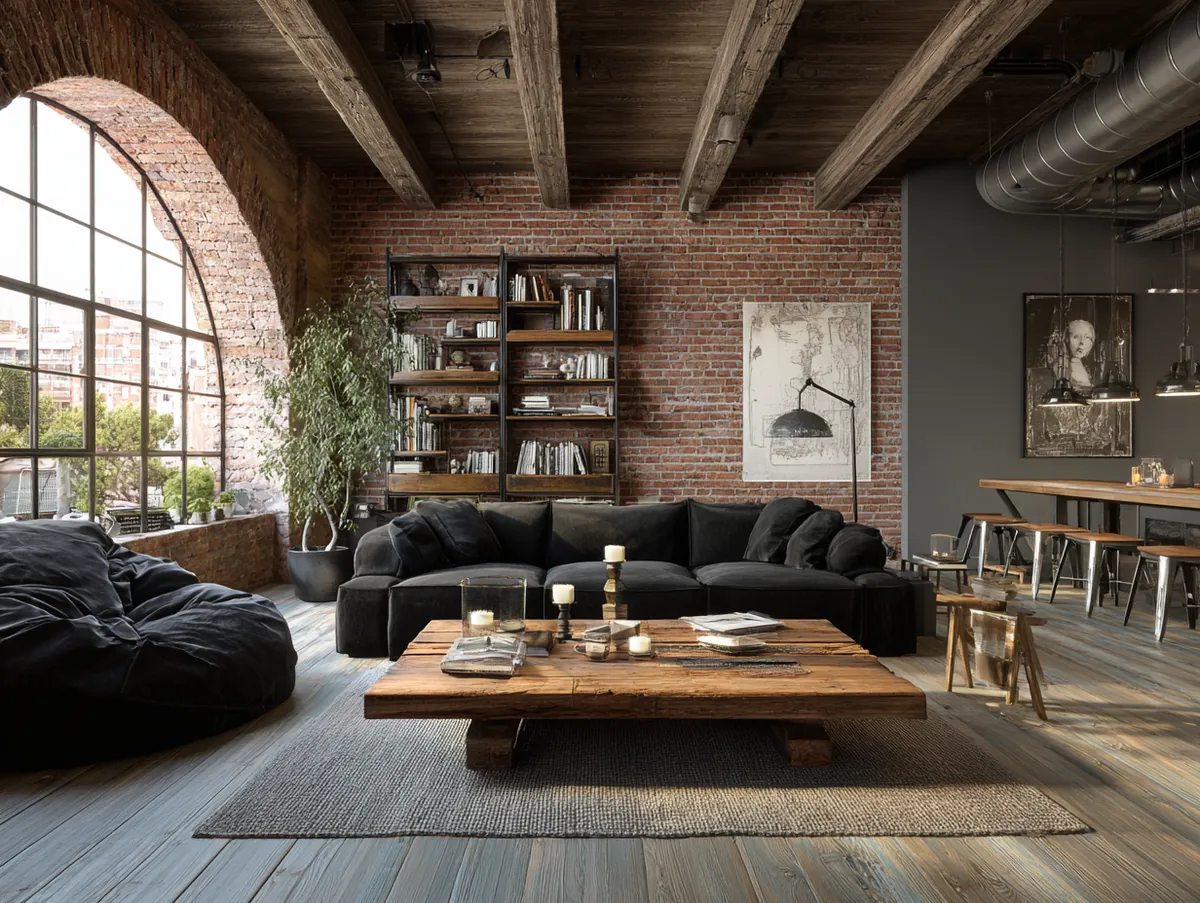

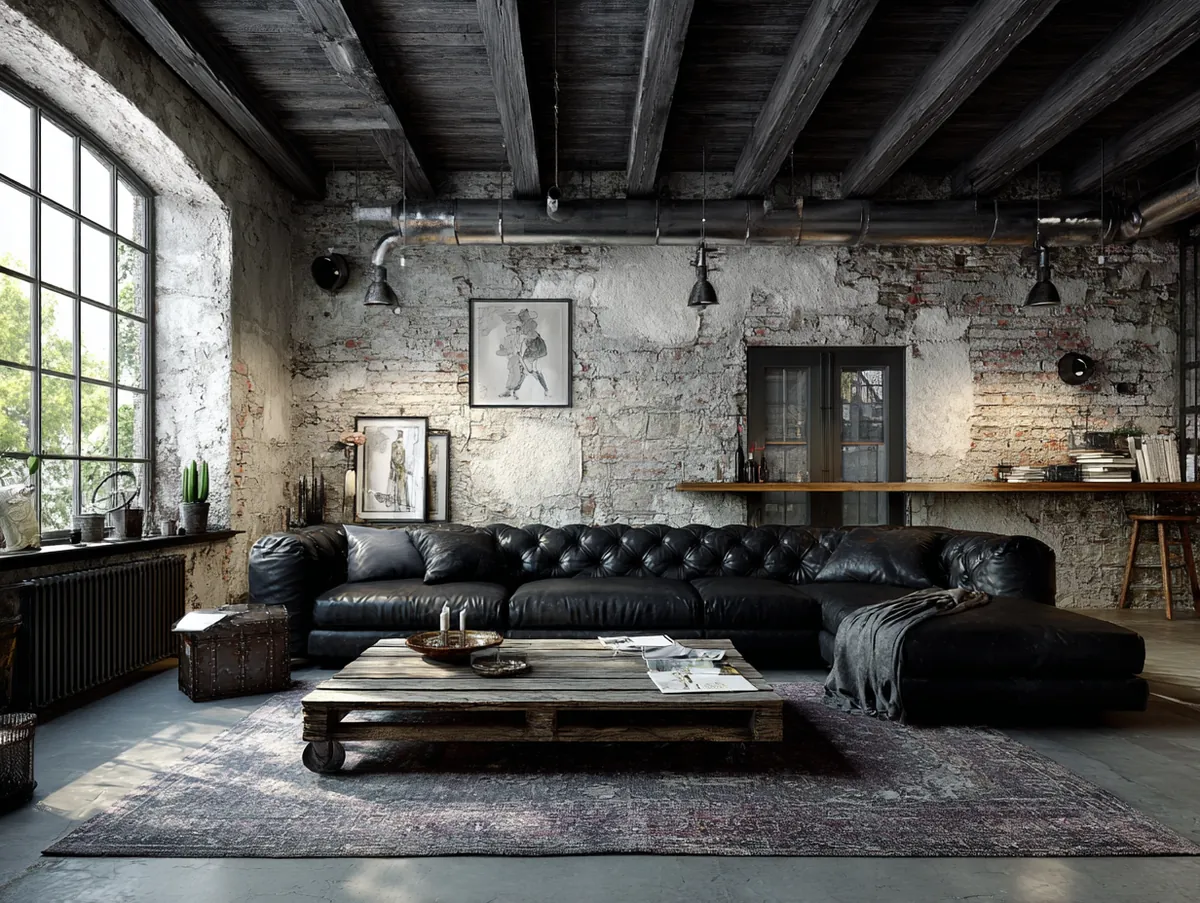
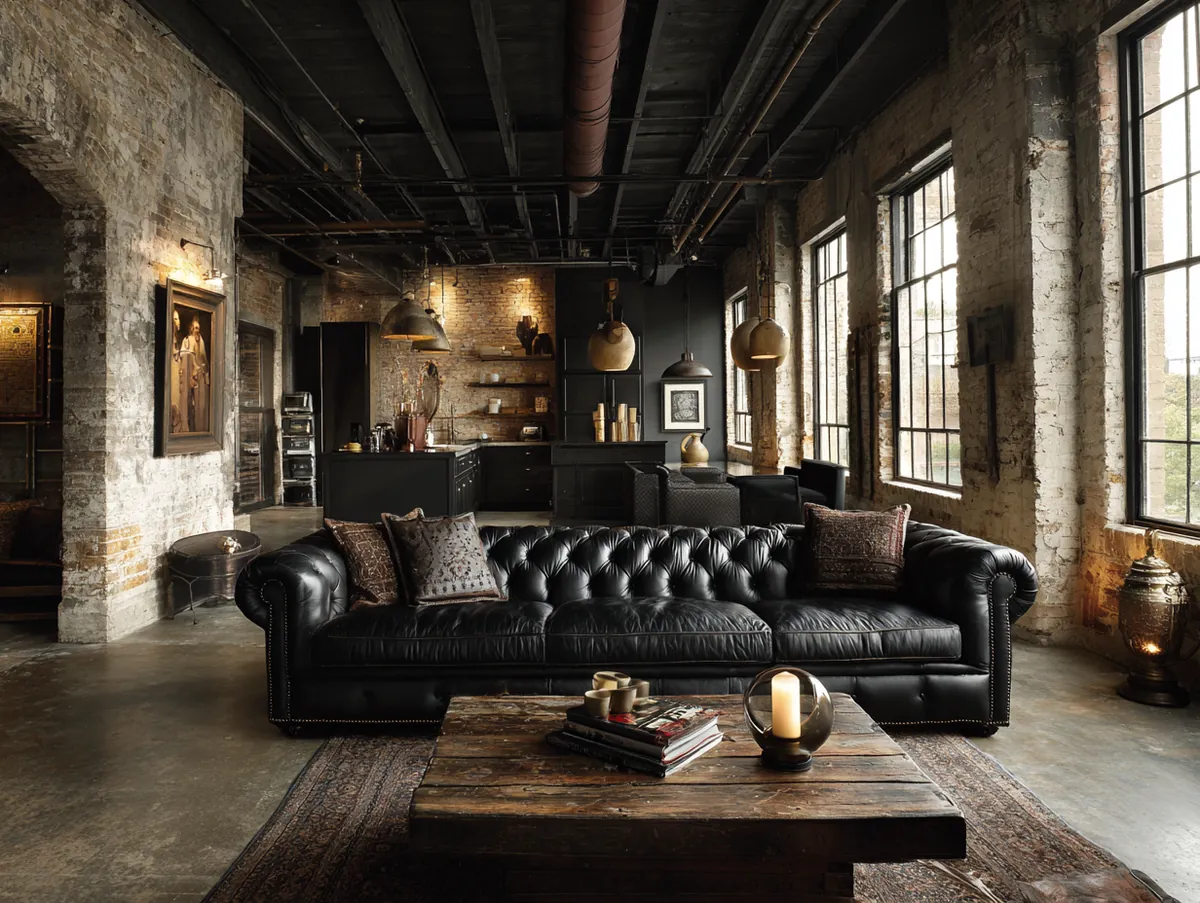


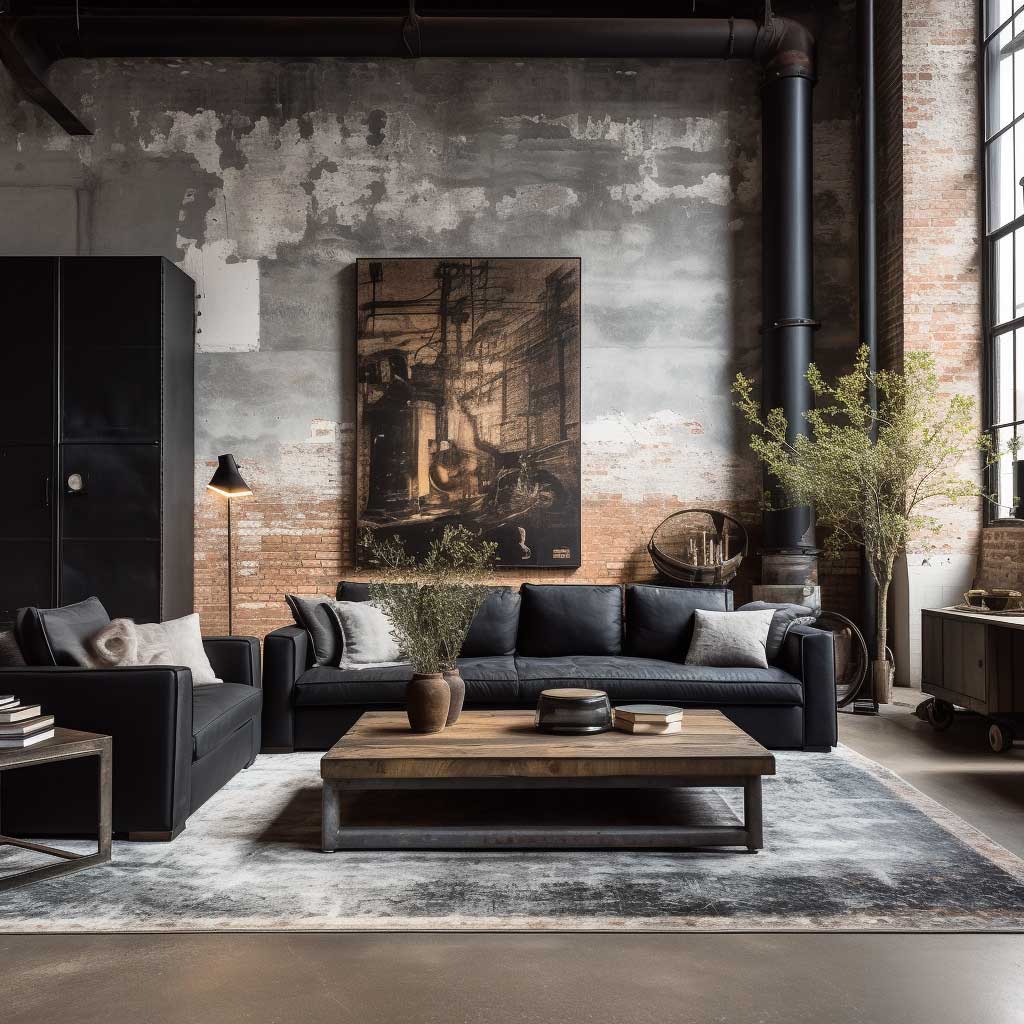

The living room colour scheme in an industrial room anchored by a black sofa stays in the warm grey range: charcoal, aged steel, warm concrete tones, and the natural colour of reclaimed wood. Benjamin Moore Revere Pewter HC-172 at around $60 per gallon is a consistent recommendation for industrial interiors because it shifts between warm grey and near-taupe depending on the light, which means it reads differently at noon and at 9pm — exactly what an atmospheric industrial room should do. A wall colour like this gives the black sofa contrast without introducing a colour that competes with the natural tones of brick or concrete.
Lighting is the element that separates an industrial room that works from one that just looks unfinished. The formula is: one hard industrial source — a black cage pendant or exposed-filament cluster above the coffee table — paired with one warm ambient source, usually a floor lamp with a rattan or linen shade. Feit Electric warm-filament four-packs run about $14 at Home Depot, and the shift from standard LED white to 2200K filament changes the entire mood of the room. The soft furnishings — a cotton throw, a single rug, two cushions — are enough to prevent the space from feeling cold without pulling it toward a different style entirely. What’s the one thing people consistently get wrong in industrial living rooms? Recessed lighting as the only source. It flattens every surface in the room and kills the atmospheric depth that makes the industrial look worth choosing. Furniture & Choice’s colour guide for black sofas covers the full colour-pairing logic across styles including this industrial neutral palette.
| Style | Best Wall Colour | Key Fabric | Main Risk |
|---|---|---|---|
| Minimalist | White Dove OC-17 or warm off-white | Tight-weave leather or performance fabric | Room reads too stark without texture |
| Bohemian | Warm greige or terracotta-adjacent | Velvet or textured fabric | Pattern overload without a neutral anchor |
| Industrial | Revere Pewter HC-172 or warm concrete | Structured leather with metal legs | Only recessed lighting — kills the atmosphere |
The Bottom Line
Black sofa decorating works when the room decides what the sofa is doing — not the other way around.
In a minimalist room, it anchors. In a bohemian room, it grounds the colour. In an industrial room, it completes the aesthetic logic. The mistakes happen when the sofa gets treated as the problem to solve rather than the starting point to build from.
Fabric, wall colour, and lighting do more for the final result than any accessory you add later. Get those three right first.
Save this post before your next furniture run — the comparison table is worth having open when you’re choosing wall paint.