Navy blue living room ideas work because navy behaves like a dark neutral rather than a loud color, so it carries modern, coastal, glam and vintage rooms with equal ease. Popular navy paints sit at a light reflectance value (LRV) between 4 and 9, which means they absorb most of the light that hits them. That depth reads as cozy and tailored when the rest of the room stays light. Pair a navy wall or sofa with white, grey, wood or gold and the result looks deliberate instead of dim.
Does navy make a living room feel smaller? Only when it covers everything with nothing pale to bounce light back. The classic 60-30-10 split solves this: about 60% of the room in one main color, 30% in a supporting shade and 10% in accents. Navy can play any of those three roles, from a full wall to a few cushions. Start by deciding which role navy gets before buying a single can of paint.
The budget side is predictable too. One gallon of interior paint covers roughly 350–400 square feet per coat, and deep shades often need a second or even third coat for even color. Below are the four strongest navy looks, the exact shades worth testing and the pairings that keep the room balanced. Pick one look, not four, and the room will read as finished.
Quick Scan
- Navy paints run from LRV 4 (Sherwin-Williams Naval, inky and saturated) to LRV 9 (Benjamin Moore Newburyport Blue, softer and lighter).
- Hale Navy at LRV 8.36 reflects roughly twice the light of Naval at LRV 4, so it suits darker rooms better.
- Use the 60-30-10 rule: navy as 60% for drama, 30% for balance or 10% for a low-risk accent.
- Budget 350–400 sq ft per gallon per coat and plan for 2–3 coats with deep navy.
- Navy and white gives the sharpest contrast, navy and grey the calmest, navy and gold the most luxurious.
- An 8×10 rug with 18–24 inches of bare floor around it keeps a navy room from feeling boxed in.
Picking the Right Navy Blue Paint for Living Room Walls
Choosing a navy blue paint for a living room starts with one number on the paint chip: the LRV. Sherwin-Williams Naval sits at LRV 4 and reads as a true, saturated navy, while Benjamin Moore Hale Navy is listed at 8.36 and leans blue-grey. That gap looks small on paper but is obvious on a wall, much like the difference between black coffee and an espresso with a splash of milk. North-facing rooms usually look better with the lighter, greyer option.
Which navy colour is closest to “classic”? Naval and Benjamin Moore In the Navy both share an LRV of 4, so they give the deepest, most committed look. Farrow & Ball Hague Blue lands around LRV 7 with a slightly greener cast, and Newburyport Blue at LRV 9 is the quiet option for anyone nervous about dark walls. Do not choose from a phone screen; paint two large sample boards and view them at noon and at night.
| Shade | Brand | LRV | Undertone | Best use in a living room |
|---|---|---|---|---|
| Naval SW 6244 | Sherwin-Williams | 4 | Cool, true blue | Bright south-facing rooms, crisp white trim |
| Polo Blue | Benjamin Moore | 5.67 | Grey-blue, near charcoal | Moody media rooms, black accents |
| Hague Blue No. 30 | Farrow & Ball | ~7 | Blue with a green hint | Wood-heavy and vintage rooms |
| Hale Navy HC-154 | Benjamin Moore | 8.36 | Blue-grey | Grey palettes, low natural light |
| Newburyport Blue | Benjamin Moore | 9 | Soft, muted blue | Small rooms, first-time dark walls |
Quantity planning follows simple math. Measure wall length times height, subtract doors and windows, then divide by about 350 square feet per gallon for one coat. A 12 x 20 foot room with 8-foot ceilings has roughly 470 square feet of wall after one door, so two coats of navy need close to 3 gallons, not 1. Buy all the paint from one batch so the top coat matches from corner to corner.
Sleek Modern Accents for a Navy Blue Living Room
Modern navy blue living room ideas rely on one dark statement surface surrounded by clean lines, pale upholstery and a little metal. A single navy feature wall behind the sofa usually does more than four painted walls, because the eye gets one clear focal point. Think of it as a dark suit with a white shirt: the contrast is the whole point. Keep the sofa light grey or ivory so the navy reads as backdrop, not bulk.


Glass, chrome and lacquer earn their place here because they bounce light around a dark wall. A glass coffee table weighs nothing visually, while a heavy dark-wood block next to navy can make the center of the room feel like a hole. Geometric rugs in navy and white add pattern without new colors. Avoid matching every pillow to the wall shade; two tones of blue look richer than one.
Lighting decides whether a modern navy room looks sharp or flat after sunset. Hang a pendant about 65–75 cm above the coffee table and use warm white bulbs in the 2700–3000K range, since cooler bulbs turn navy grey and clinical. Pendant, table lamp and sconce should work together, as shown in this layered pendant, table lamp and wall sconce plan for a living room. Put every fixture on a dimmer and the same wall shifts from crisp to cocooning.
Grey Brings the Calm to a Navy Palette
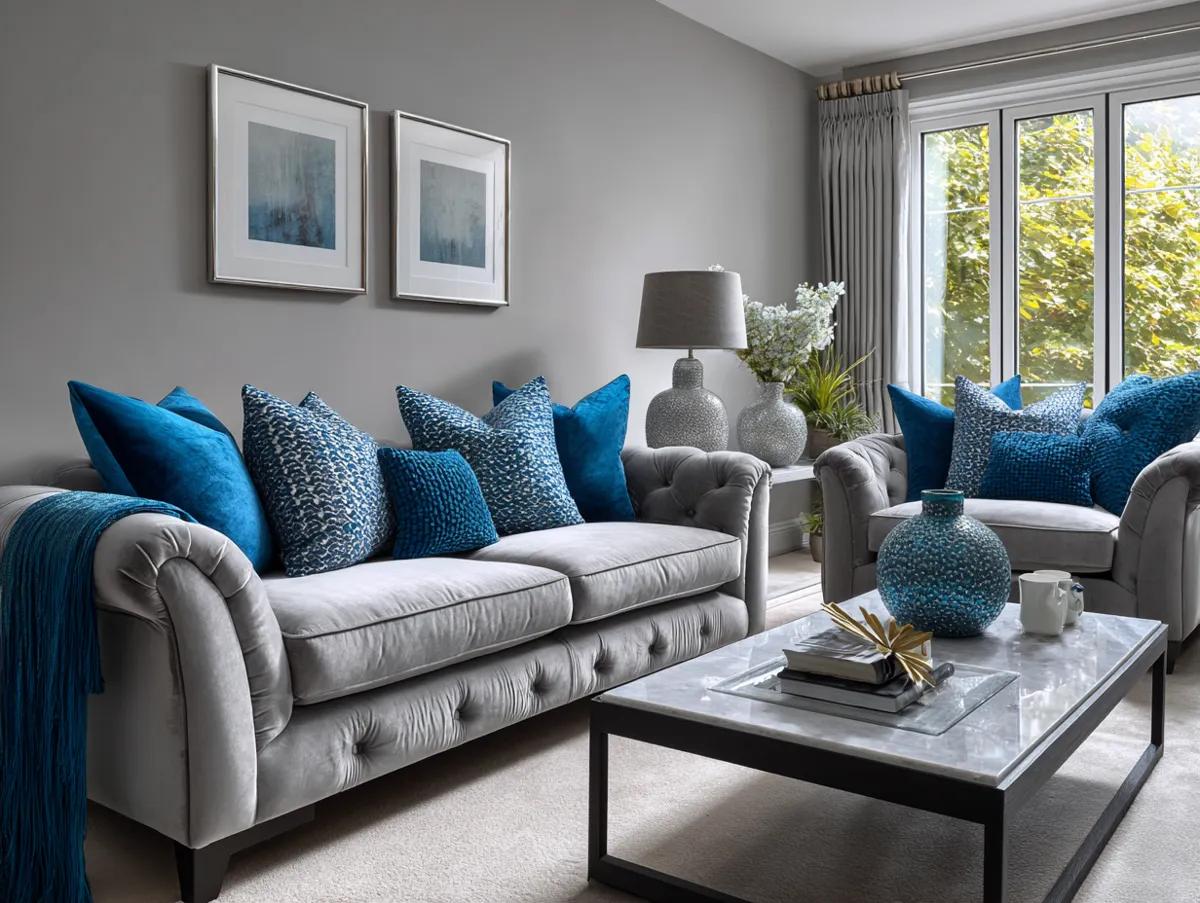
A navy blue and grey living room is the easiest combination to live with every day, because both colors are cool and quiet. Navy acts as the anchor and grey softens the jump between dark walls and white ceilings. Interior designers often compare navy to denim: it goes with almost everything, and grey is its natural white T-shirt. Pick a grey with the same cool undertone as your navy to avoid a muddy clash.
How much grey is enough? A balanced version uses light grey on 60% of the surfaces, navy upholstery and curtains on 30%, and 10% in white or silver accents. A darker take flips it: navy walls with charcoal and dark grey textiles, which suits a TV room but needs strong lamps. Benjamin Moore itself suggests pairing Hale Navy with Coventry Gray HC-169 and White Dove OC-17, a ready-made three-color plan. Skip mixing warm greige with cool navy, since the greige will look dirty beside it.
- Light grey + navy: 60% pale grey walls, 30% navy sofa, 10% white; best for small rooms.
- Dark grey + navy: navy walls, charcoal sofa, chrome lamps; best for evening media rooms.
- Grey + navy + wood: walnut or oak furniture adds warmth that pure grey cannot.
Texture keeps a two-color scheme from looking like an office. Mix a nubby boucle chair, a wool rug and linen curtains so the grey has depth, and introduce pattern only in tone-on-tone stripes or herringbone. Wood is the secret weapon: oak or walnut legs break up a cool palette the way a wooden cutting board warms a steel kitchen. Add at least one wood piece per seating zone.
Coastal Navy and White Living Room With Sea-Air Calm
A coastal navy and white living room borrows the palette of a harbor: deep water, white sails, sand and weathered wood. The contrast is strong by design, since a bright trim white like Sherwin-Williams Extra White sits near LRV 86 against Naval at LRV 4. That 82-point gap creates the crisp, striped-awning look coastal rooms are known for. Use it on trim and ceilings first, then decide how much navy the walls really need.


Sand and wood do the warming. A beige or oatmeal sofa in front of a navy wall echoes a beach, and a driftwood or reclaimed-oak coffee table adds grain that pure navy and white lack. Natural jute or sisal rugs ground the scheme; an 8×10 size fits most standard seating groups with the front sofa legs on the rug. Leave 18–24 inches of bare floor around the edges so the room breathes.
Is it possible to go coastal without anchors and seashells everywhere? Yes, and it looks more grown-up. Limit themed objects to two or three per shelf, then let sheer white curtains, striped cushions and lantern-style lights carry the mood. Too many props turn a living room into a gift shop. Choose texture over souvenirs every time.
Navy and Gold Bring Hotel-Bar Luxury Home
Navy and gold home decor is the go-to luxury color combination for a living room because warm metal glows against cool, dark blue. Gold reads brighter next to navy than next to white, the way a candle looks stronger in a dark room than in daylight. A navy velvet sofa, a brass floor lamp and a gold-framed mirror already make the full look. Start with those three pieces before adding anything smaller.


The ratio matters more than the shopping list. Keep gold to roughly 10% of what the eye sees, with navy as the 30% or 60% color and cream or ivory filling the rest. Past that point the room tips from hotel bar to costume jewelry. Choose one metal finish, brushed or antique brass for example, and repeat it at least three times so it looks planned.
Want the gold on the wall instead of on the furniture? Metallic plaster or mica finishes can cover one accent wall, typically for $400–$700 installed, compared with $60–$100 for the same wall in standard paint, and they last about 8–12 years. This look at warm metallic wall finishes in brass, copper and aged gold covers how those surfaces behave in different light. Never pair a metallic wall with a navy wall in the same sightline; one statement surface is plenty.
Vintage Pieces Inside a Contemporary Navy Living Room
A contemporary navy living room with vintage flair mixes a clean, modern base with a few pieces that carry history, giving a navy retro look without feeling like a museum. Navy is the glue: an antique carved side table next to a sleek navy sofa looks intentional because the color calms the clash of eras. Picture a modern gallery hanging one old oil painting on a dark wall. Limit vintage items to about one in every three pieces so the room stays fresh.


Begin with one big navy element: the wall, the sofa or a large rug. A standard 8×10 rug measures 96 x 120 inches and fits a three-seat sofa of about 84 inches with two accent chairs, front legs on. Then layer vintage wood, aged brass lamps or an old gilt mirror on top. Hague Blue-style navies with a green hint flatter aged wood better than the cooler, inkier Naval.
Can mismatched antiques still look tidy? They can, if they share a material or a finish, such as all warm wood or all brass. Leave about 18 inches between the sofa and coffee table so the mix feels open, and keep surfaces about half empty. A crowded vintage room reads as storage, not style. Edit one object out of every shelf before calling it done.
Color Pairings Behind the Best Navy Blue Living Room Ideas
The navy blue color palette for a living room changes character completely depending on its partner color. White makes navy crisp, grey makes it calm, gold makes it rich, and black or silver make it dramatic. Yellow and navy is the boldest option, closer to a sports jersey than a quiet lounge, so it works best as a 10% accent. Choose the partner color by the mood you want at 9 p.m., not at noon.
| Pairing | Mood | Suggested split | Contrast level | Best light conditions |
|---|---|---|---|---|
| Navy + white | Fresh, coastal | 60% white / 30% navy / 10% wood | Very high (LRV ~86 vs 4) | Any, including small dim rooms |
| Navy + grey | Calm, modern | 60% light grey / 30% navy / 10% white | Medium | Cool north light |
| Navy + gold | Luxe, warm | 60% cream / 30% navy / 10% gold | High, warm | Evening rooms with lamps at 2700–3000K |
| Navy + black | Dramatic, moody | 60% navy / 30% neutral / 10% black | Low (LRV 4–6 vs black) | Bright south-facing rooms only |
| Navy + silver | Cool, glamorous | 60% white / 30% navy / 10% chrome | High, cool | Daylight-heavy rooms |
| Navy + yellow | Bold, playful | 60% white / 30% navy / 10% yellow | Very high | Family rooms with strong daylight |
Is navy and black too dark together? Not if the black stays in thin lines, such as picture frames, lamp bases and table legs, and the walls stay navy rather than both. Navy with LRV 4–6 sits so close to black that large blocks of both turn the room into a cave. Silver is the cooler cousin of gold; chrome reads modern, polished nickel reads classic. Use black for outlines and metals for highlights.
Dont Do This
- Painting all four walls in an LRV 4 navy in a north-facing room with one window; pick an LRV 8–9 shade or paint one wall.
- Buying one gallon for a full room; two coats on about 470 sq ft of wall need close to 3 gallons.
- Using cool daylight bulbs above 3500K, which turn navy grey and flat.
- Letting gold climb past roughly 10% of the room, which reads gaudy instead of luxe.
- Choosing a 5×7 rug for a full sofa group; an 8×10 with 18–24 inches of border floor anchors the seating.
- Mixing three or more metal finishes in one room; stick to one main metal and one accent.
Navy Wins When the Ratio Holds
Navy succeeds in a living room when it takes one clear role, 60%, 30% or 10%, and the rest of the palette supports it. A navy wall at LRV 4 with white trim looks sharper than a whole room at the same depth, and Hale Navy at 8.36 forgives low light far better than Naval.
For a first navy project, test two sample boards of different LRVs side by side for 48 hours before committing. Budget about 350 sq ft per gallon per coat and plan two coats as standard.
Pick the partner color by mood: white for fresh, grey for calm, gold for luxe. Keep metals at roughly 10% and repeat a single finish three times or more.
Finish with warm lighting at 2700–3000K and an 8×10 rug with 18–24 inches of bare floor around it. Those two details turn a dark color into a room that feels wrapped, not shrunk.