Front porch ideas for red brick house projects fail or succeed on one decision: whether the style fights the brick or works with it. Red brick carries its own palette — warm terra-cotta undertones, rough texture, weight — and a porch that ignores all that ends up looking like two different houses welded together. The good news is that brick is one of the most forgiving backdrops you can design around, provided you start from what it already offers.
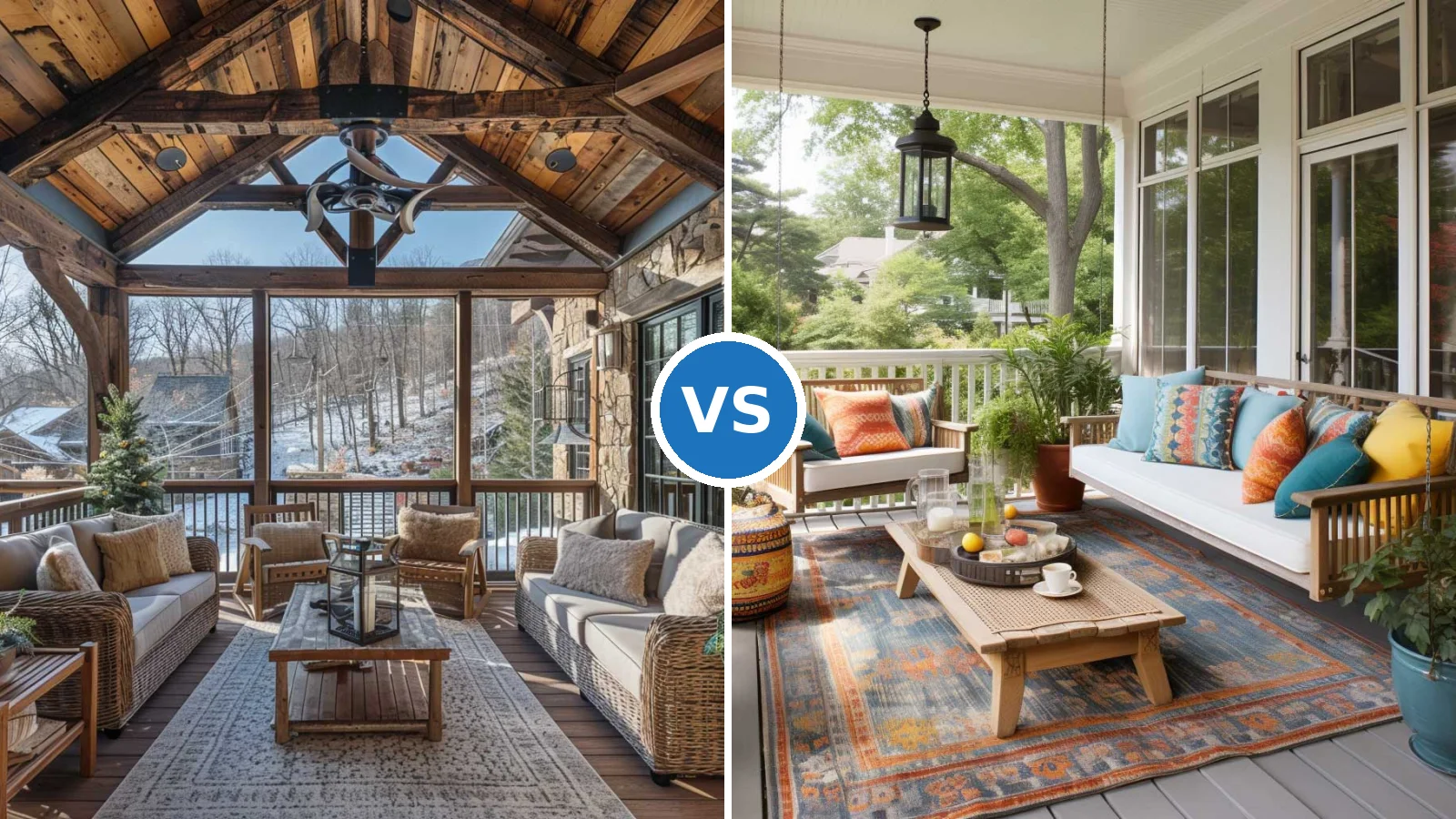
Three distinct approaches actually hold up on real red brick homes: the classic swing porch that leans into nostalgia without turning sentimental, the clean-lined modern porch that uses contrast on purpose, and the wood-heavy rustic setup that matches brick’s earthiness material for material. Each has clear wins and clear traps. What follows covers all three, with real product prices and the mistakes that show up most.
Brick fades over decades, which means matching new porch materials to old brick is harder than it looks on Pinterest. Knowing which materials age similarly — and which ones make five-year-old brick look brand new next to thirty-year-old brick — is half the battle before you spend a dollar on furniture or lumber.
Traditional swing porch: Cedar swings start around $229–$649; position the swing to face the yard, not the street.
Modern porch: Trex Transcend® in Carmel (taupe) or Lava Rock pairs with red brick without competing. Installed deck runs $10,500–$21,000 for 300 sq ft.
Rustic porch: Reclaimed wood + rocking chairs; skip painted brick entirely — the texture is the point.
Don’t: Match red cushions to red brick, use gray mortar on existing red masonry, or add a wood deck in a color too close to the brick tone.
Deck color for red brick house: Trex recommends Lava Rock (warm contrast) or Carmel (soft taupe that lets the brick lead).
Cedar Swings and the Traditional Red Brick House Front Porch


A traditional front porch on a red brick house works best when the swing is the room’s anchor, not an afterthought pushed against the wall. Magnolia Porch Swings sells handcrafted cedar and pine options starting at $229, with the cedar builds being the stronger call for uncovered or partially covered porches — cedar’s natural oils resist moisture and insects without annual sealing. Texas Cedar Co.’s traditional roll-back red cedar swing from The Porch Swing Company runs $629, pre-finished and ready to hang. What does the extra $400 buy? Contoured slats that support your lower back on long evenings, and wood that won’t split within three seasons.
What color should the swing be on a red brick house? Not red, not terracotta — those fight the brick instead of complementing it. A white or natural-cedar finish acts like a frame: it separates the swing from the wall visually and gives the eye a place to rest. A swing stained to match the brick reads as an accident, not a design choice. The trick here is contrast handled quietly — same tonal family, different material, different finish.
Cushion fabric matters more than most people expect. Solid navy or charcoal cushions pull out the darker mortar lines in the brick and make the whole porch look intentional. Avoid patterns with red, orange, or brown — they either clash with the brick’s variation or disappear into it. Cushion covers with a slight texture (canvas or outdoor woven fabric) hold up better than smooth polyester, which shows every crease and gets slippery in humid weather. The Porch Swing Company carries matching outdoor cushion sets sized to their swing frames, which removes the guesswork on fit.


Lighting placement on a swing porch changes how the whole facade reads after dark. A single overhead fixture directly above the swing flattens everything. Two smaller sconce-style lights flanking the door — or a strand of warm-white Edison bulbs run along the ceiling perimeter — give the porch depth and make the brick texture visible instead of washing it out. Avoid cool-white LEDs outdoors on warm brick; they turn the facade a muddy gray-green. Warm 2700K bulbs are the call, every time.
For small brick house front porch setups where a full swing won’t fit, a 4-foot two-person swing hung at an angle across the corner often works better than abandoning the idea entirely. It keeps floor space usable while preserving the porch’s social function. Porches shorter than 6 feet deep need a swing with a low-arc hang — ceiling mounts positioned 14–16 inches from the wall rather than the standard 18 — to avoid hitting the wall on every backswing.
Matching the cushion color to the brick. Red or orange cushions against red brick don’t unify the look — they make the porch feel like one undifferentiated mass of warm color. Navy, charcoal, or forest green create contrast that makes both the brick and the cushions read clearly.
Hanging a swing without checking the ceiling joist rating. A 6-foot cedar swing loaded with two adults and cushions can hit 600 lbs of dynamic load in motion. Screw into a joist rated for at least 800 lbs total, not just drywall anchors or porch decking boards.
Choosing a swing finish that’s too close to the brick color. A brown-stained cedar swing against red-brown brick disappears. The swing should contrast with the wall, not camouflage against it.
Clean Lines Work on a Modern Red Brick House Porch — If You Pick the Right Materials


Modern brick house porch design lives or dies by the deck color decision. Trex — the leading composite decking brand — specifically recommends Transcend® Lava Rock and Transcend® Lineage Carmel for brick homes. Lava Rock is a warm, striated brown that contrasts with lighter brick and reads as deliberate. Carmel is a soft taupe that lets the brick do the talking without the deck competing. Trex Transcend boards carry a 50-year limited residential warranty and run $5–$16 per square foot in materials; a 300-square-foot installed deck comes in at roughly $10,500–$21,000 depending on complexity and labor market. Avoid gray composite decking on red brick — the combination looks like a color-theory mistake, not a design decision.
Why does gray fail on red brick? Red and gray sit in direct tension on the color wheel — neither warm nor cool enough to bridge, they read as a mistake rather than contrast. Think of it like pairing a charcoal suit with brown shoes: technically close, perceptually off. Taupe, warm beige, and dark brown all work because they share the brick’s underlying warmth without fighting its saturation. Tonal agreement matters more than exact color matching.
Railings are where most modern porch projects overspend or under-think. Frameless glass railings cost $150–$250 per linear foot installed — they look clean, but one hail storm or a falling branch ends that look immediately. Cable railings from brands like Feeney run $80–$120 per linear foot installed, give the same open sightline, and hold up measurably better in humid climates. For a red brick house specifically, black powder-coated cable railings do more for the modern look than glass — the dark lines echo the mortar joints in the brick, creating a visual echo that glass ignores entirely. For more on color pairings that work against brick, the door color picks for red brick houses on ArtFasad cover the same principle applied to the front door.
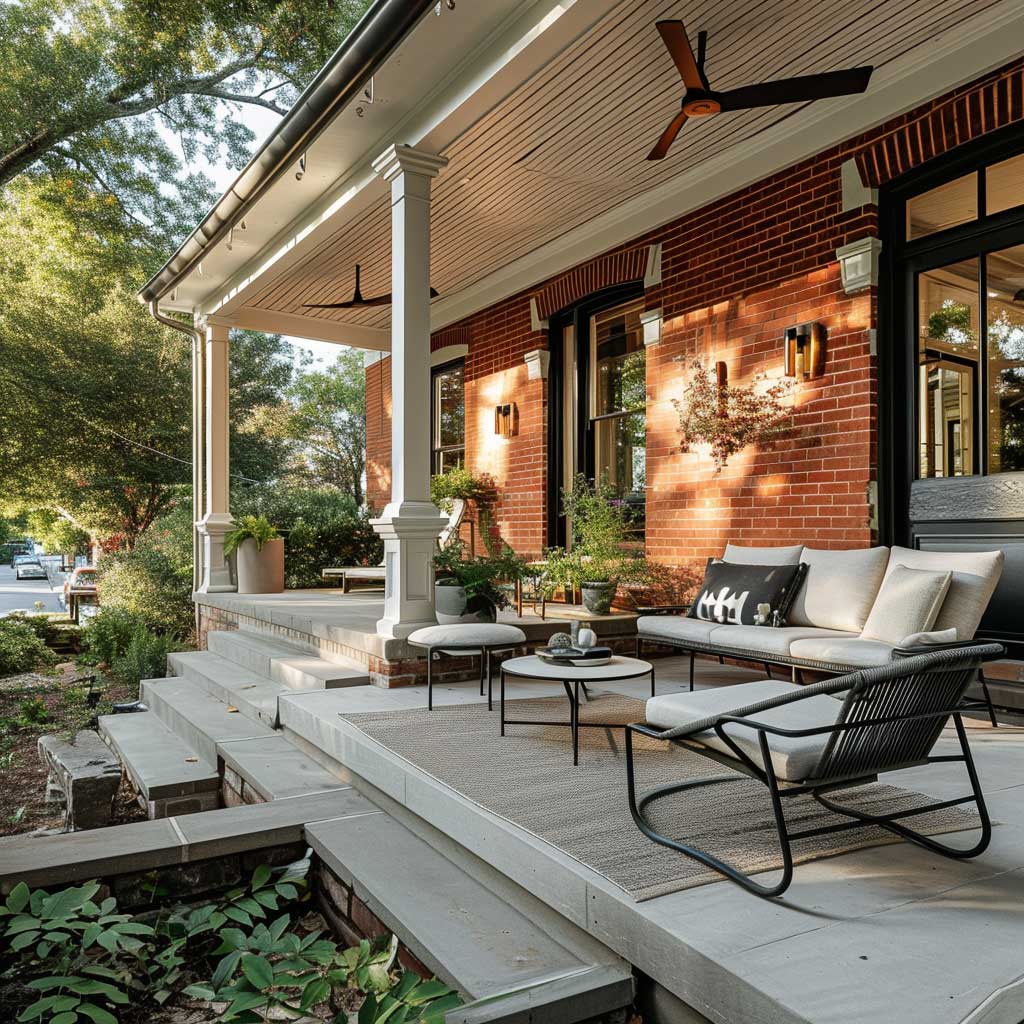


Furniture on a modern brick porch should have low profiles and straight lines — pieces that sit below the brick’s visual weight rather than competing with it. A single low sofa and two side chairs beats a full sectional that crowds the sightlines. Concrete planters in simple cylindrical or rectangular forms work better than terracotta pots, which blend into the brick color and disappear. The goal is that the eye reads furniture as furniture and brick as brick — no merging, no camouflage.
Smart home features like programmable porch lighting add measurable value on modern setups. A Lutron Caséta outdoor dimmer switch runs around $55–$70 and lets you shift from bright entry lighting to a low ambient setting without changing fixtures. Motion-sensor integration means the porch activates when you arrive and dims after you’re inside — functionality that reads as intentional design rather than forgotten automation. Avoid colored smart lighting on brick: red-tinted smart bulbs against red brick look like a bar, not a home.
Rustic Porch Elegance on a Red Brick House — Where Wood and Brick Share the Work


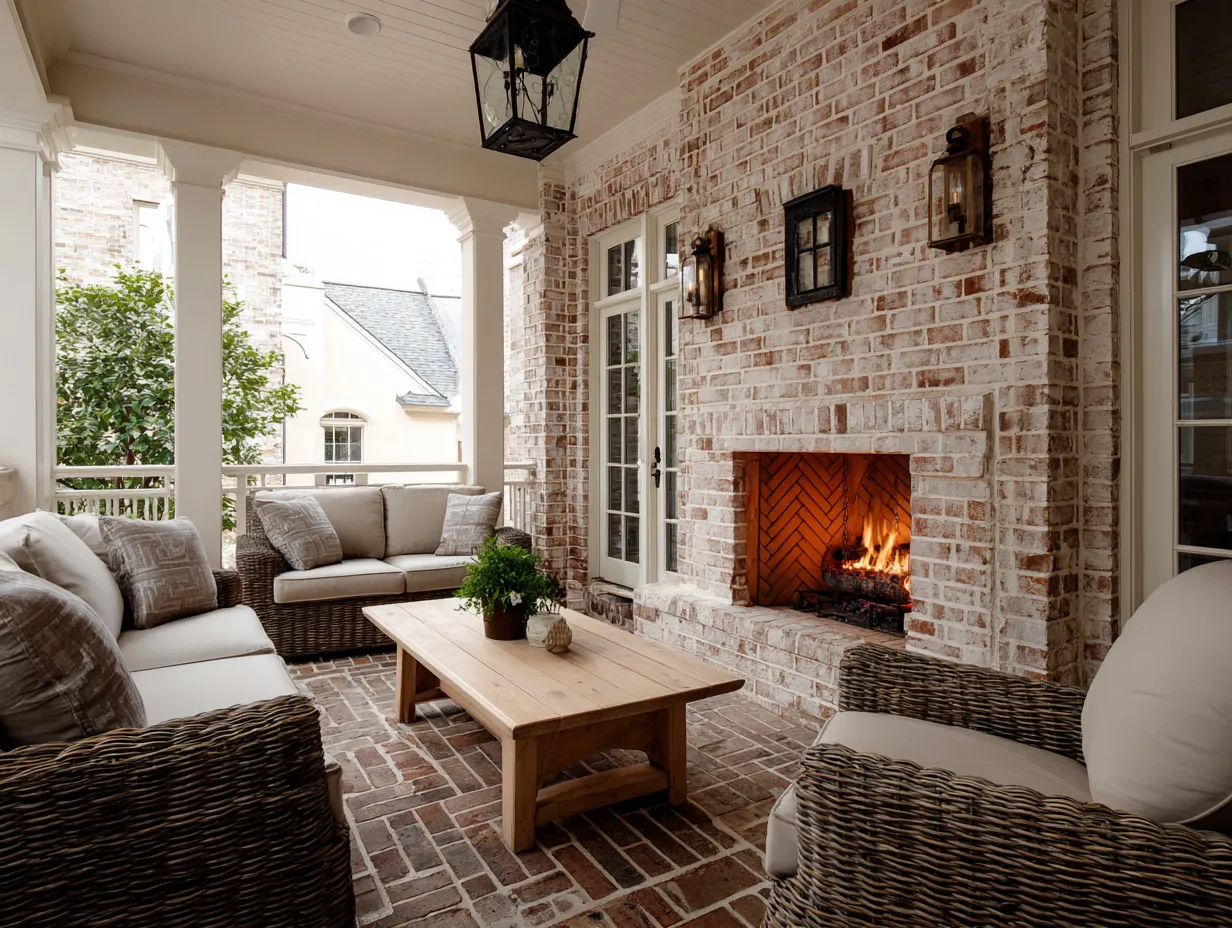
Rustic front porch ideas for a red brick house work because brick and weathered wood share the same visual language — natural materials that age in place, show their history, and look better with time rather than worse. The pairing isn’t nostalgic by accident. Brick is essentially compressed earth; reclaimed wood carries decades of grain and color variation. Put them together and the porch reads as something that grew from the site, not something installed onto it. That’s the effect every rustic porch is chasing, and it’s only achievable when both materials are allowed to remain visually honest — no paint on the brick, no polyurethane high-gloss on the wood.
What wood tones work best against red brick? Medium to dark browns — walnut, weathered teak, or air-dried oak — create contrast without fighting the brick’s warmth. Light pine or whitewashed wood tends to wash out against red brick in direct sun, looking bleached rather than intentional. Rocking chairs in natural red cedar, which costs roughly $300–$500 for a quality Amish-built pair, develop a silver-gray patina over two to three seasons outdoors that actually improves the rustic look rather than degrading it. You’ll notice the contrast between the silver wood and the red brick gets sharper over time — it’s a design that matures rather than fades.
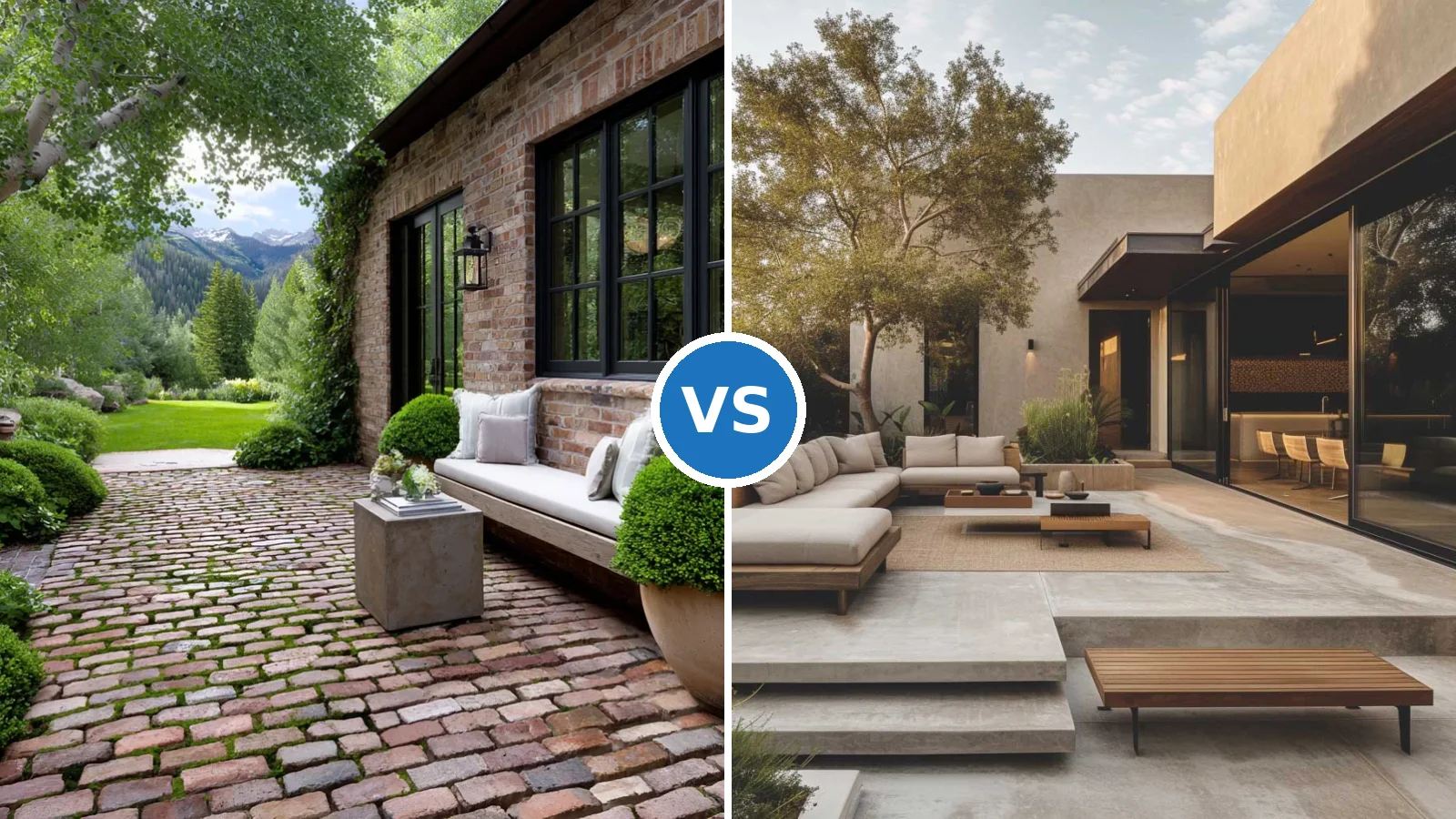
For a red brick house patio adjacent to the porch, the same material logic applies. Terracotta pavers, natural flagstone, or reclaimed brick create a ground plane that reads as part of the same material family as the house. Concrete pavers with a smooth finish create a jarring visual break — they belong in a different design system. A narrow band of ornamental grasses or low boxwood along the patio edge separates it from the lawn without fencing it off, and the green reads as the natural complement to both brick red and wood brown. The brick front porch ideas on ArtFasad go deeper on specific paving patterns that pair with different brick house styles.


Red brick back porch setups often have more room to work with than front porches, which changes the furniture strategy. A back porch can support a full outdoor dining table in reclaimed pine or oak, a small container herb garden along the railing, and a fire pit or chiminea as a focal point — without feeling crowded. Front porches are more constrained and need one clear anchor element. The mistake is putting too much on a front porch and having none of it read clearly from the street. Think of the front porch as a billboard: one message, legible at 30 feet.
Lighting on a rustic porch follows the same logic as the materials — it should look like it could have been there for decades. Vintage-style Edison bulbs in black cage pendants or wrought-iron wall sconces cost $30–$80 per fixture and suit the aesthetic without looking forced. String lights work here too, but only when run along the ceiling perimeter or overhead beam, not draped loosely like a holiday decoration. A loosely draped string light on a rustic porch is the visual equivalent of an unfinished project. Taut lines, consistent spacing, warm 2200K Edison bulbs — that’s the version that works.
| Porch Style | Best Wood/Deck Color | Key Material | What to Avoid |
|---|---|---|---|
| Traditional Swing | Natural cedar / white painted | Western red cedar swing | Matching swing stain to brick color |
| Modern / Deck | Trex Carmel or Lava Rock composite | Composite decking + cable rail | Gray composite on red brick |
| Rustic Elegance | Weathered teak / air-dried oak | Reclaimed wood furniture | Smooth concrete pavers, high-gloss finishes |
Front porches on red brick homes rarely need all three styles at once — the sharpest results come from committing to one approach and editing out anything that belongs to a different design system. A traditional swing porch with a Trex composite deck reads as two design decisions that couldn’t agree. Pick the system, then be ruthless about what stays.
FINAL WORD
The porch doesn’t improve the brick — it works with what the brick already offers.
Red brick gives you warmth, texture, and a material that ages better than almost anything you’ll put next to it. Choose porch materials that share those qualities — cedar, composite in taupe or brown, reclaimed wood — and resist anything that competes on its own terms.
Deck color is where most projects go wrong. Trex Transcend Carmel or Lava Rock are the two most reliable starting points for brick homes. Gray composite looks like a color error, not a design choice.
Lighting and cushion color are cheap, high-impact fixes: 2700K warm white bulbs and navy or charcoal cushions transform any red brick porch in an afternoon. Save this post.
Related Topics
FAQ
What are the best front porch ideas for a red brick house?
What deck color works on a red brick house?
How much does a porch swing cost for a brick house?
What color cushions look best on a red brick house porch?
What are good brick house patio ideas for the back?
How much does a Trex composite deck cost on a brick house?
Complete guide
Brick in Every Room and Facade Worth Seeing
Exteriors, interiors, patios, bathrooms, colors, patterns, materials — all in one place
Complete guide
Patio and Yard Ideas That Turn Any Backyard Into a Living Room Outside
Flooring, furniture, shade, pools, kitchens, fire pits, courtyards — all in one place