Eclectic bedroom decor is the design approach where pieces from different eras, materials, and aesthetics share one room — and it works. The style doesn’t mean “anything goes”; it means choosing things that feel personally meaningful and arranging them so the room reads as intentional rather than chaotic. When done right, an eclectic bedroom is one of the most distinctive rooms in any home.
The core question most people have is whether an eclectic room can look pulled together rather than cluttered. It can — but it requires a shared thread: a recurring color, a consistent material, or a tonal range that connects pieces from otherwise unrelated worlds. Think of it like a playlist where songs span decades but all share the same mood.
According to industry research, bedroom furniture accounts for roughly 25% of the home decor market by segment, and demand for personalized, non-matching room designs has been driving that growth steadily. More people are deliberately mixing styles rather than buying matched sets, which puts eclectic bedroom design squarely at the center of where modern decorating is headed.
- Eclectic style works when one unifying element — color, material, or tone — connects otherwise mismatched pieces.
- Antiques and contemporary furniture coexist best when they’re roughly the same visual weight in the room.
- Colorful textiles (bedding, rugs, pillows) are the lowest-risk way to add eclectic personality without committing to expensive furniture.
- Art placement matters more than art style: a gallery wall can hold both a classical print and a neon sign if the spacing is consistent.
- Don’t make every surface a statement — neutral zones give the eye room to rest and make statement pieces hit harder.
- Furnishing a bedroom from scratch averages around $5,800 according to retail research; eclectic styling lets you spread that budget across thrift finds and investment pieces.
Blending Antiques and Contemporary Pieces in Eclectic Bedroom Design


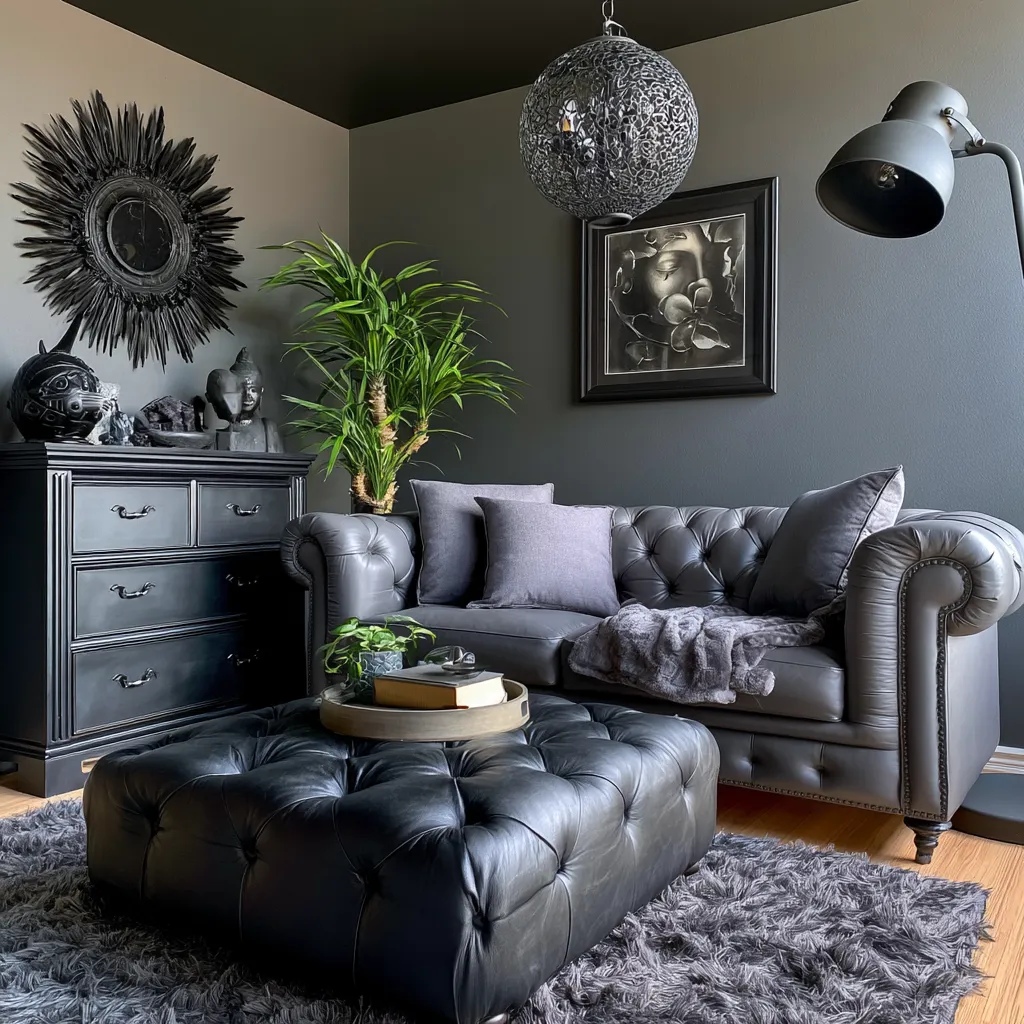
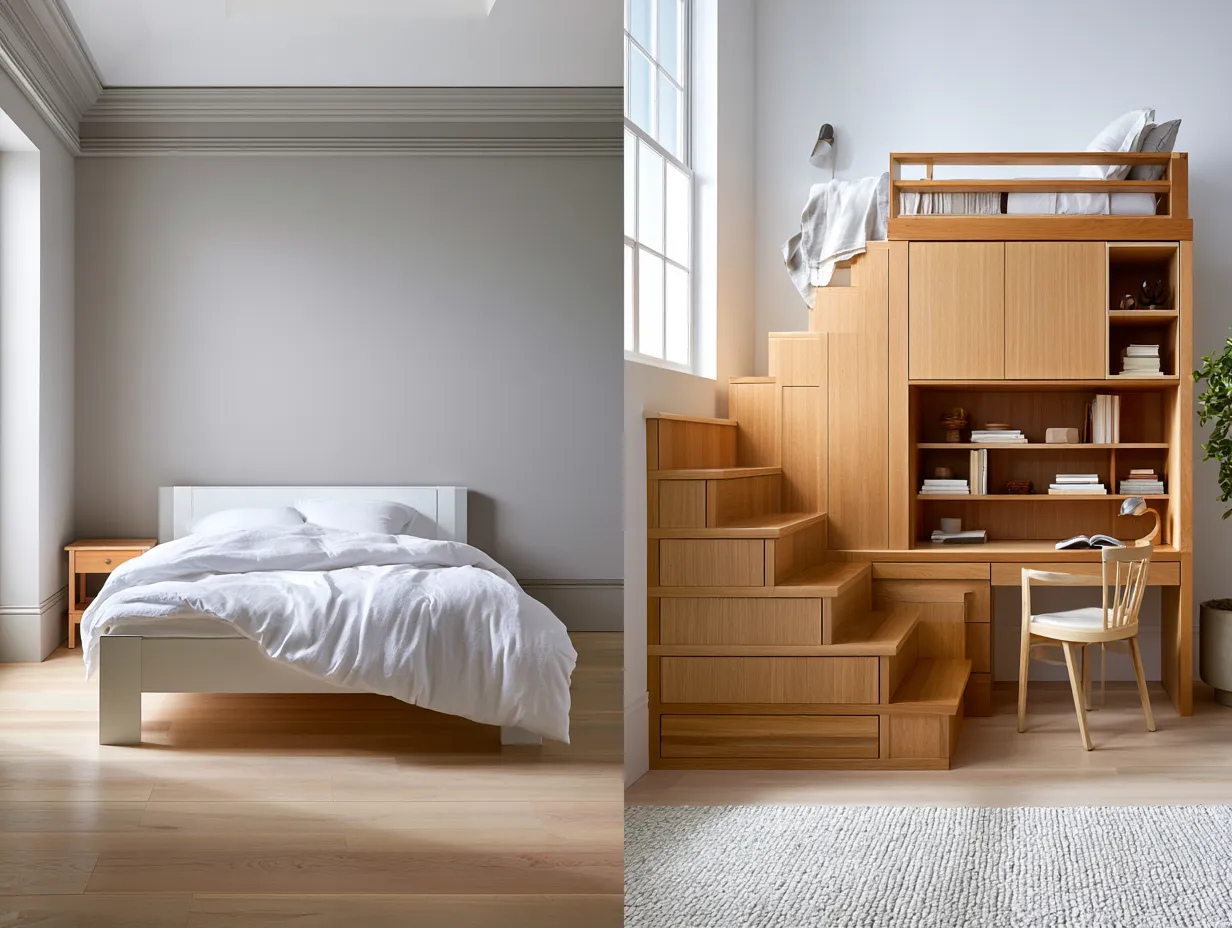
Mixing antiques with contemporary pieces in an eclectic bedroom decor scheme works the way counterpoint works in music — the contrast makes both elements more interesting. A vintage dresser with ornate hardware looks more deliberate beside a low, minimalist platform bed than it ever would in a room full of matching antiques. The gap between the two eras creates tension, and that tension is exactly what makes people stop and notice the room.
The practical question is how much antique versus how much contemporary. A useful starting point is the 30/70 split: let one era own roughly 70% of the furniture mass and let the other show up as accent pieces. If the bed, wardrobe, and primary seating are contemporary, a single inherited side table or a flea-market lamp becomes the room’s character piece rather than a competing voice. Flip the ratio and the room leans vintage, which works equally well with one or two modern art prints to cut the nostalgic mood. For more ideas on making bold bedroom design choices across contrasting color palettes, the black bedroom interior design examples on ArtFasad show how dramatic rooms stay cohesive.
What doesn’t work is treating every piece as equally important. When a vintage ornate mirror, a sleek modern dresser, three different headboard styles, and a patterned vintage rug all compete for attention, the room stops reading as eclectic and starts reading as unsettled. Pick two or three focal points — the bed, one statement lamp, one art piece — and let everything else serve them quietly.


Material continuity is the most reliable bridge between eras. If the antique piece is walnut, choose a contemporary bed frame or side table that echoes that warm wood tone — even if the profiles are completely different. Shared material reads as shared intention. The same logic applies to metal finishes: brass hardware on a vintage piece connects naturally to a modern brass pendant lamp, making two very different objects feel like they were chosen together. For bedroom furniture in the contemporary side of an eclectic pairing, explore Structube’s bedroom collection for pieces that hold their own alongside vintage finds.
A common mistake is buying antiques purely for their age. Not every old piece earns space in an eclectic room — only ones with strong silhouettes or distinctive material quality. A mediocre side table doesn’t become interesting just because it’s 80 years old. The best antique additions to an eclectic bedroom decor scheme are pieces with a distinct personality: an unusual shape, an exceptional material, or a genuinely beautiful surface.
How Colorful Textiles Define an Eclectic Bedroom
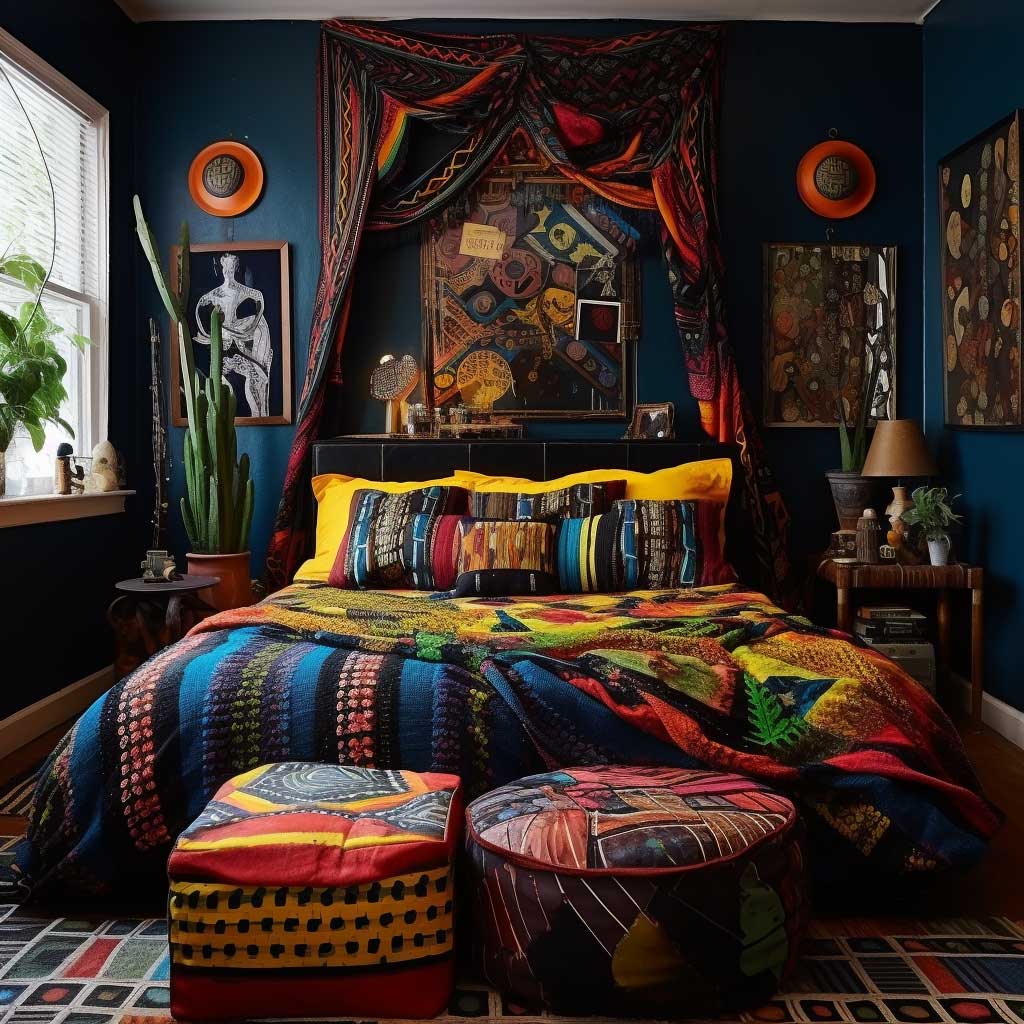
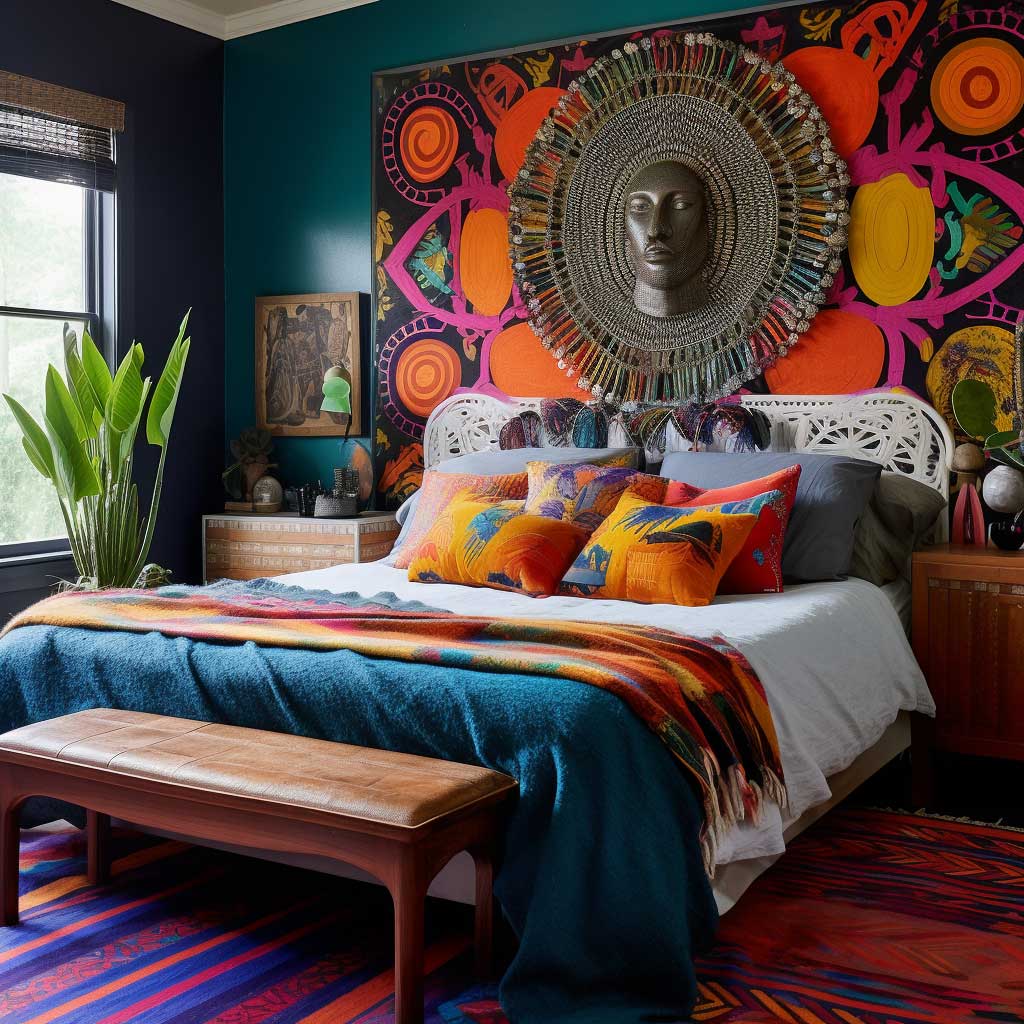


Colorful textiles in eclectic bedroom decor do most of the heavy lifting at a fraction of the cost of furniture. A boldly patterned duvet, a layered set of throw pillows in clashing prints, or a jewel-toned area rug can shift a room’s entire personality without a single furniture purchase. Textiles are also reversible — if a combination stops working, swapping a duvet cover costs far less than replacing a dresser.
The most reliable method for mixing textile patterns without chaos is the three-pattern rule: one large-scale pattern (often the duvet or curtains), one medium-scale pattern (a throw or accent pillow set), and one small-scale pattern (cushion covers, a decorative runner). The patterns don’t need to match — a large Moroccan print works beside a medium stripe and a small geometric as long as at least two of the three share a color. That shared color is what makes the combination read as chosen rather than random.
What to avoid: mixing three equally large-scale patterns at the same visual volume. When a bold duvet, bold curtains, and a bold rug all compete, none of them wins and the room feels agitated. One dominant pattern carries the room; the others support it. A good test is to stand at the bedroom doorway and identify which textile claims the most attention in three seconds. If you can’t tell, the patterns are fighting rather than cooperating.
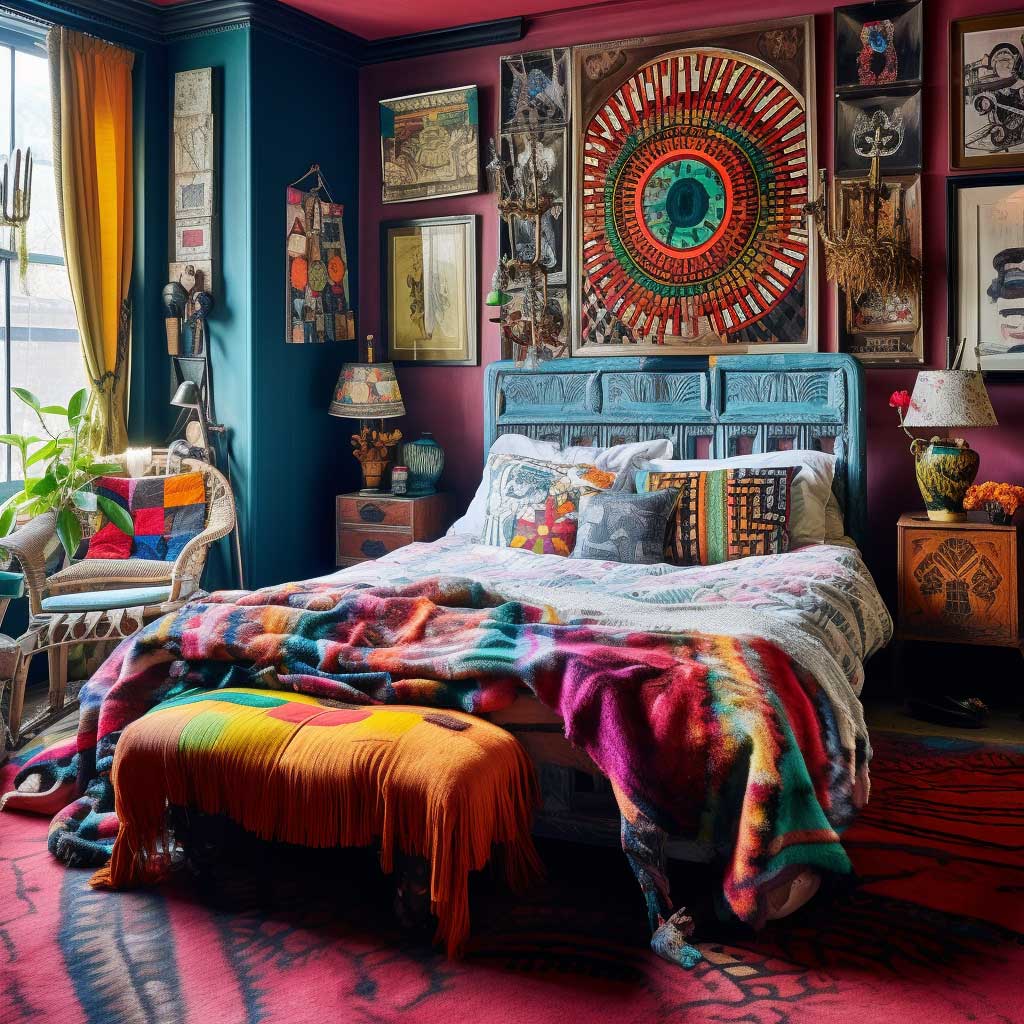
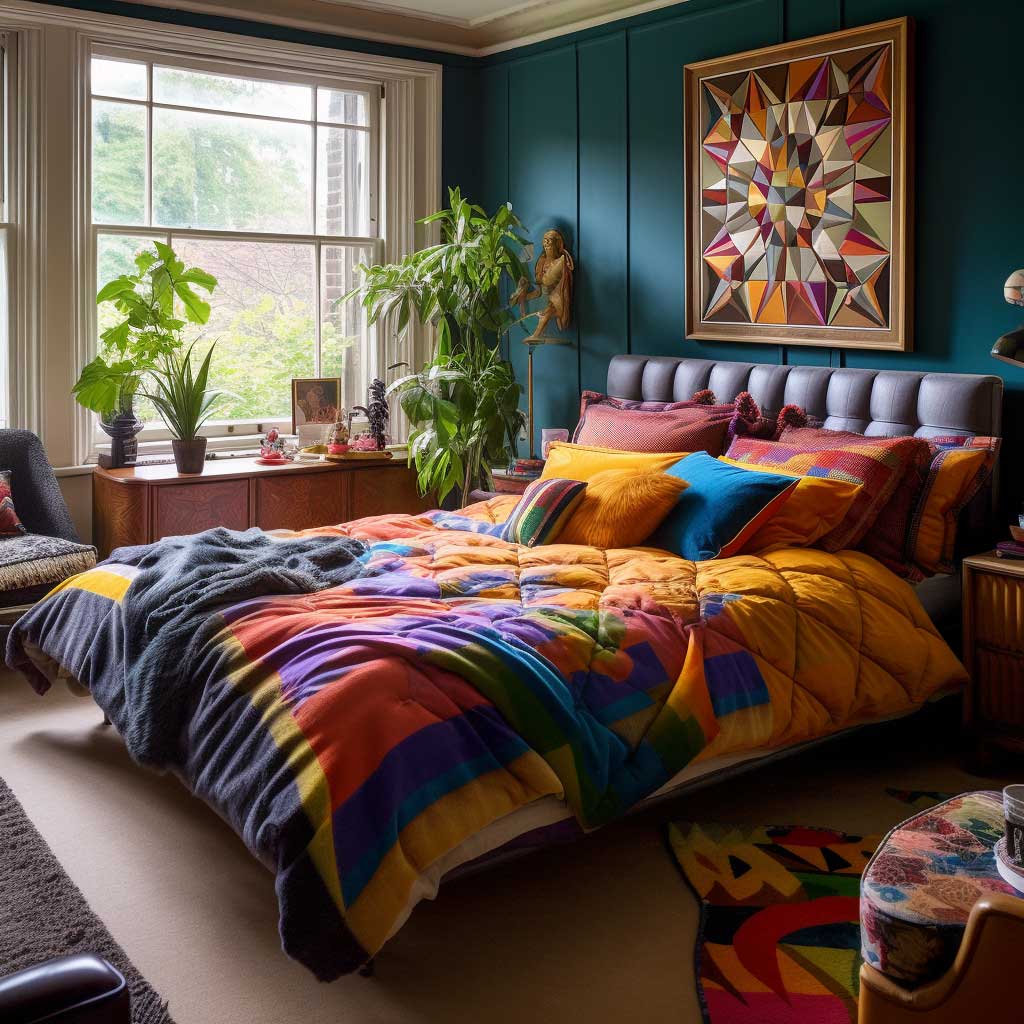
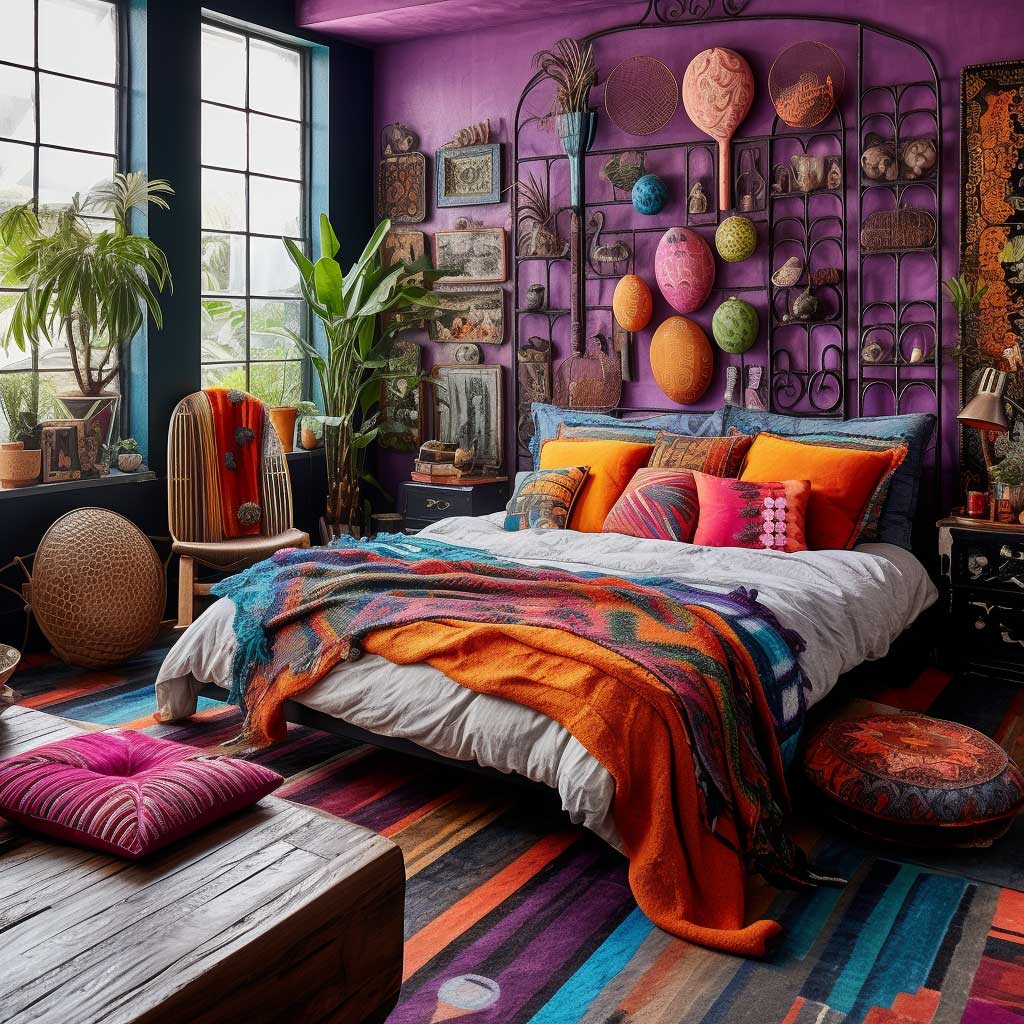
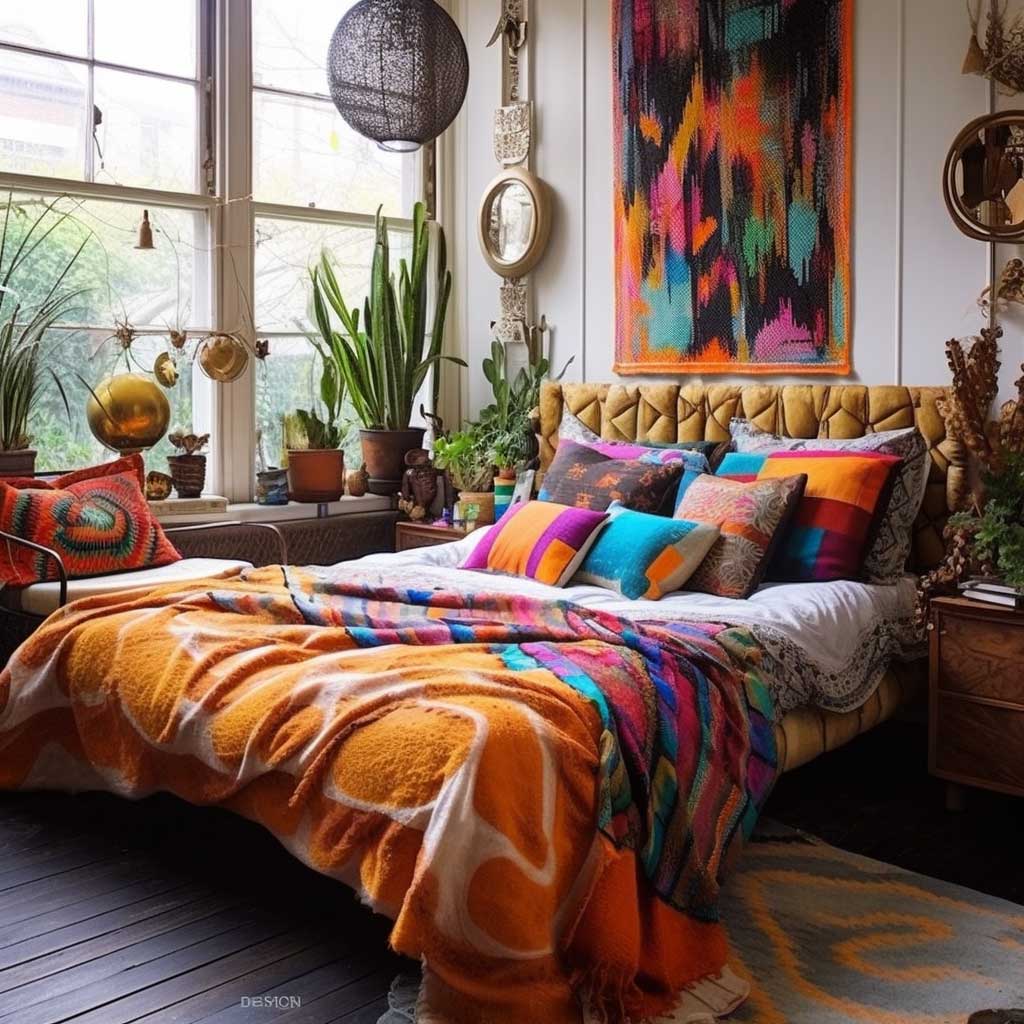
Texture variation matters as much as pattern and color. An eclectic bedroom built on flat, similarly-weighted fabrics looks flat even if the colors are exciting. Mixing velvet with linen, wool with cotton, or a chunky woven throw with smooth satin pillowcases creates physical depth that photographs well and feels even better to live with. Interior designers routinely note that rooms with high texture contrast read as more expensive than they are — the variety of surfaces signals curation.
The bed is where textile decisions matter most in any bedroom, eclectic or otherwise. It occupies the largest visual footprint and is the first thing visitors — and the person sleeping there — register. A considered bedding choice sets the room’s character before any other textile has a chance to. Whether that’s a vintage-print quilt, a graphic-stripe modern duvet, or a jewel-tone linen set, the bed covering is effectively the room’s opening statement. For an expanded range of patterned and colorful bedding options to build an eclectic scheme around, Bed Bath & Beyond Canada carries a wide selection suited to mixing and layering.
Using Art to Anchor an Eclectic Bedroom Decor Scheme


Art in an eclectic bedroom doesn’t need to follow a single period or school — in fact, mixing art styles is where the approach is most liberating. A Renaissance-style portrait beside a bold abstract canvas makes both pieces more interesting; the contrast highlights what each one does well. The condition is that they share the wall, not the spotlight. One piece should read as primary (larger, more central, or more visually arresting), while surrounding works play supporting roles.
Gallery walls are the format most associated with eclectic decor bedrooms, and for good reason: they accommodate art of different sizes, mediums, and eras in a way that single-piece placements can’t. The key to a gallery wall that looks intentional rather than arbitrary is consistent spacing — typically 2 to 3 inches between frames — regardless of how varied the frames or images themselves are. Consistent gaps create the visual grid that holds the arrangement together. If spacing is uneven, even the most carefully selected art combination looks like it was hung in a hurry.
Scale is where most people go wrong when mixing art styles. A room full of small-to-medium pieces creates a museum-catalogue feeling rather than an eclectic one. At least one piece in the 24-by-36-inch range or larger should anchor the room, ideally above the bed or on the wall facing the doorway. Smaller works build around it rather than competing with it. Think of it as a solar system: one dominant piece with others orbiting at appropriate distances. For designs where mixing design eras requires careful style navigation, the comparison of mid century modern and Scandinavian bedroom styles on ArtFasad offers useful reference on how different aesthetics can share space without conflict.


Classic artworks bring depth and a sense of history to an eclectic room; contemporary pieces inject energy and relevance. Neither is more “correct” for this style. The room’s personality emerges from how they’re placed relative to each other rather than from what they depict. A classical figurative painting hung beside a bright abstract print doesn’t look confused — it looks like someone with broad taste and the confidence to act on it.
Art shouldn’t be treated as a finishing touch dropped in after the room is done. In an eclectic decor bedroom, a strong piece of art can serve as the starting point — the piece that dictates the room’s color palette and tone. Pulling colors from a key artwork into bedding, cushion covers, or a rug is one of the most reliable methods for making an eclectic room feel harmonious without being too deliberate. For diverse original artworks suited to this mixing approach, Art Interiors Canada carries pieces ranging from classic to contemporary.
What Sets an Eclectic Bedroom Apart From a Room That Just Looks Cluttered
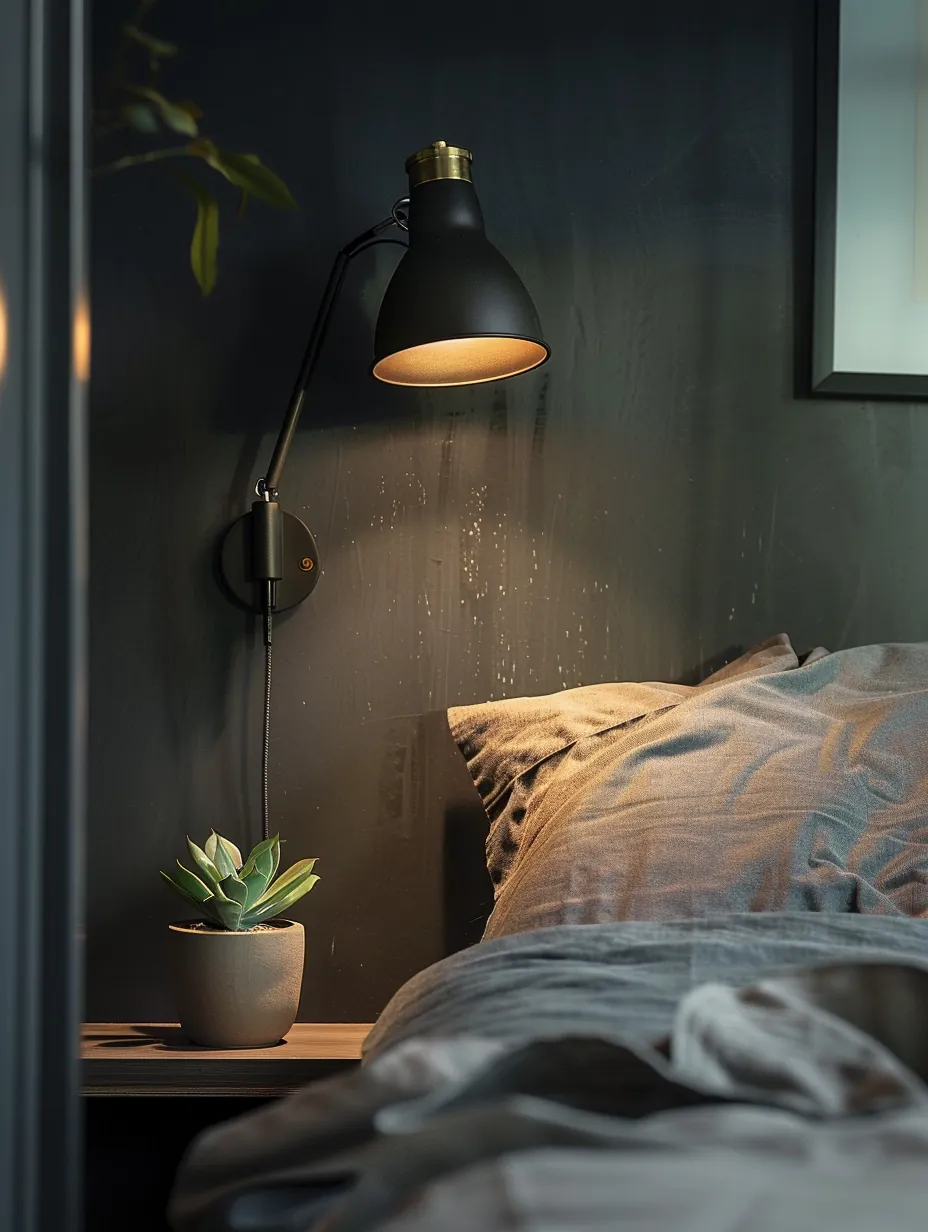
The line between “eclectic” and “cluttered” is cleaner than most people think, and it comes down to restraint in editing rather than in collecting. An eclectic bedroom can hold a lot — mixed furniture periods, bold textiles, varied art — as long as each surface has at least some negative space. A nightstand with one lamp, one book, and one meaningful object reads as eclectic. The same nightstand buried under eight items reads as clutter. The objects themselves may be identical; the difference is density.
- Eclectic rooms edit ruthlessly. Keep the pieces with personality and remove the ones that simply fill space.
- Every item should earn its place. If it has no visual purpose and no personal meaning, it belongs in storage.
- Neutral zones are mandatory. Plain walls, clear surfaces, and solid-color textiles give the eye room to rest between statement pieces.
- Color counts matter. A room with five different accent colors across furniture, art, and textiles reads as chaotic. Three accent colors — even in a colorful eclectic bedroom — read as deliberate.
- Repeated elements signal curation. When the same brass finish, the same warm wood tone, or the same shade of terracotta appears in three different places in the room, it looks like a design decision rather than a coincidence.
Clutter usually accumulates slowly, which means the solution is a periodic audit rather than a one-time edit. Walk into the bedroom as if seeing it for the first time every three months. Anything that stops the eye for the wrong reason — because it’s out of place, not because it’s beautiful or meaningful — is a candidate for removal. Eclectic rooms age well when they’re curated, and age badly when they’re simply accumulated.
Eclectic bedroom decor earns its name when the mix feels like a personal edit rather than a random accumulation. The style is permission to break matching-set conventions — not permission to ignore composition. A room that holds Victorian side tables, a modern platform bed, graphic textile prints, and gallery-wall art can be more coherent than a room built around a single catalog collection, as long as someone has made deliberate choices about weight, color, and space. That deliberateness is the whole craft.
The Final Verdict on Eclectic Bedroom Style
Eclectic bedroom decor works for almost any space because it scales from minimal to maximal without losing its defining character. The style is not about how many different things are in the room — it’s about whether those things have been chosen with intention and arranged with some awareness of how they interact.
Start with one strong piece — a significant antique, a bold textile, or a large artwork — and build the room around it. Let that piece dictate the color range and the material vocabulary. Then add pieces that either contrast or complement it, being honest about which role each addition plays.
Textiles are the most forgiving starting point for anyone new to the style. They’re affordable, reversible, and immediately transformative. A well-chosen duvet and two complementary throw pillows can shift a generic bedroom into recognizably eclectic territory in an afternoon.
The one rule that holds across every version of this style: edit more than you add. The rooms that look most confidently eclectic are the ones where someone clearly said no to at least as many pieces as they said yes to.