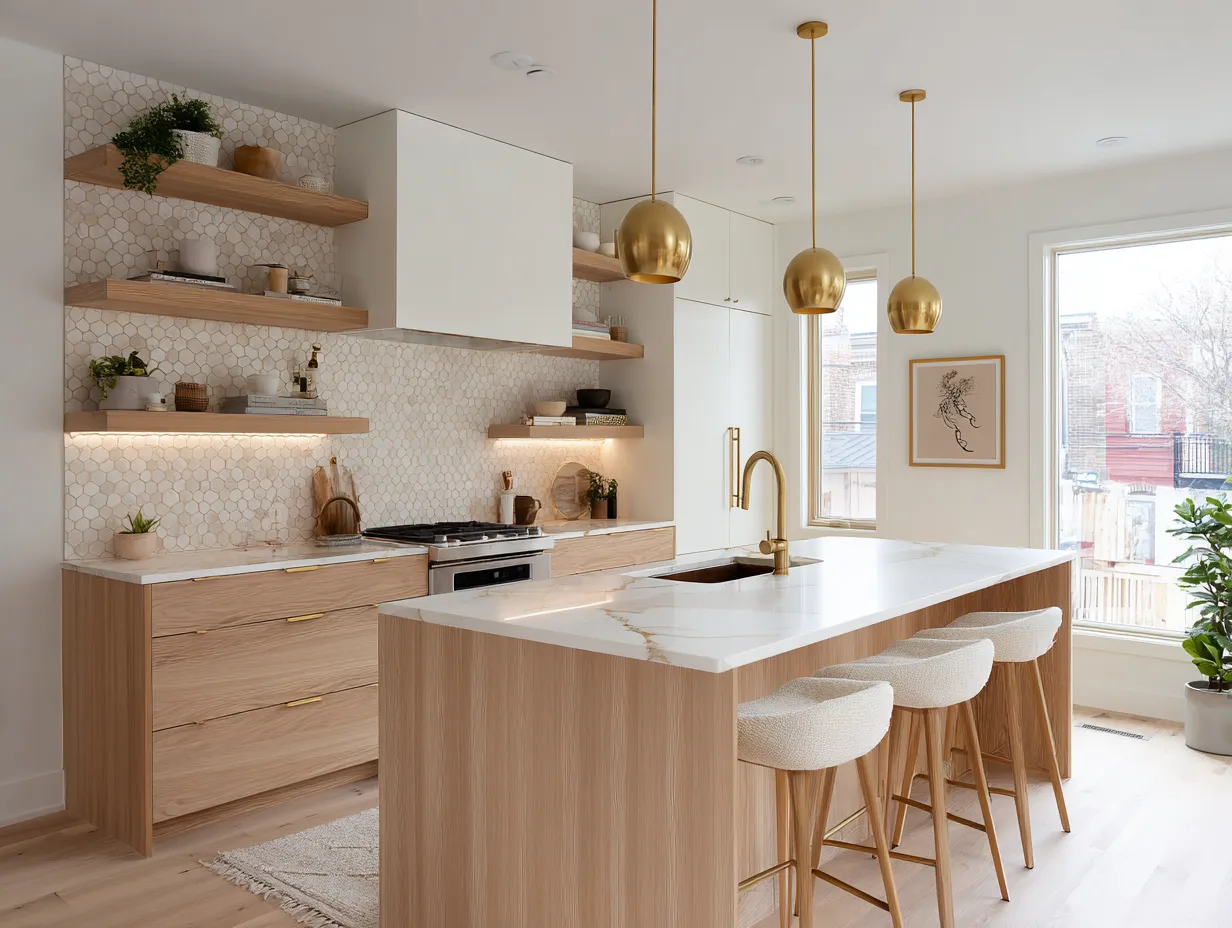
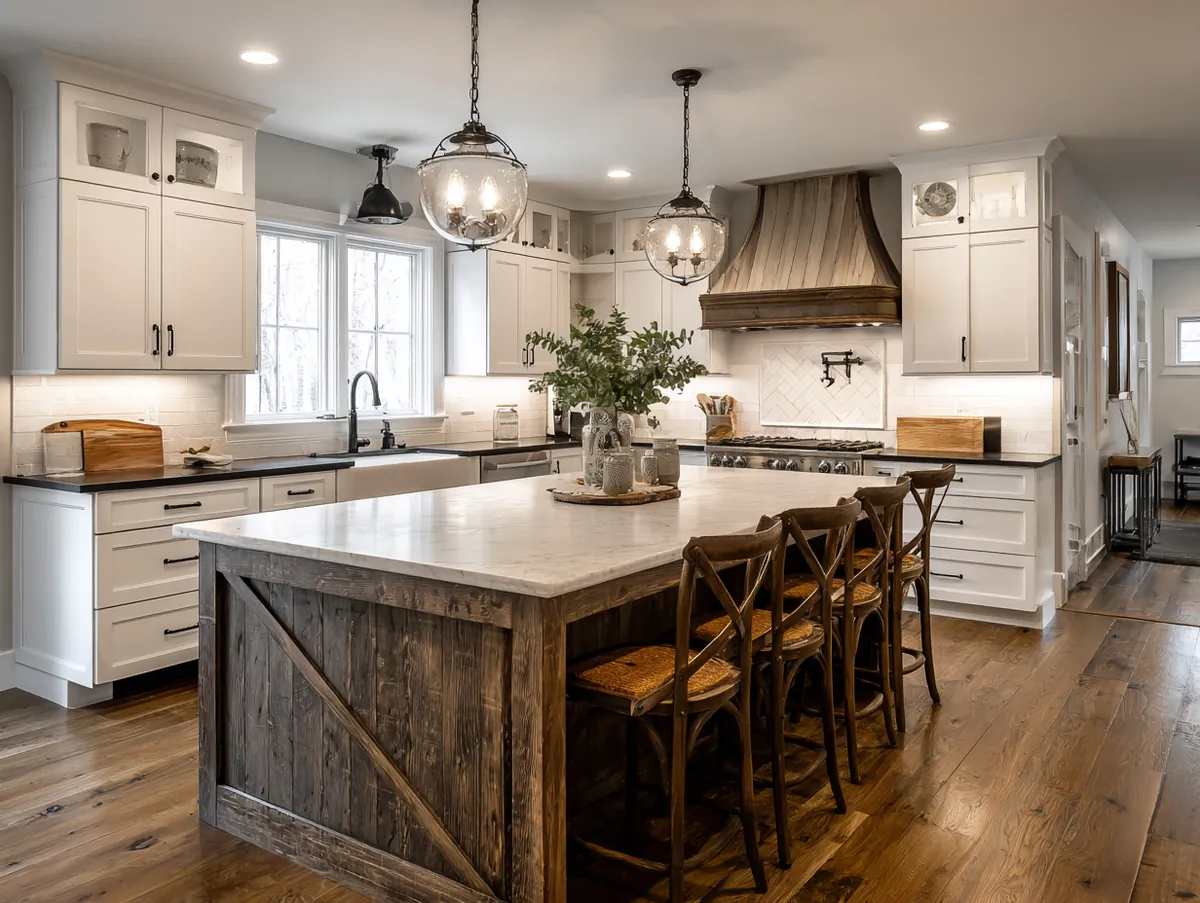
Modern farmhouse kitchen decor works because it refuses to pick a side. You get reclaimed wood overhead and a $1,400 Bosch dishwasher underneath — and somehow both look like they belong. I’ve redesigned two kitchens in this style and the formula is more specific than most people expect: it’s not rustic with a coffee maker, it’s a deliberate tension between raw material and precise finish. The rooms that fail this look treat farmhouse as a vibe. The ones that land it treat it as a structural argument.
Pull the wrong element and the whole thing reads like a Pinterest board that never got off the laptop. The sections below break down each layer of modern farmhouse kitchen decor — from ceiling to hardware — so you know exactly what to buy, what to skip, and what looks great in photos but falls apart in real life.
Quick Scan
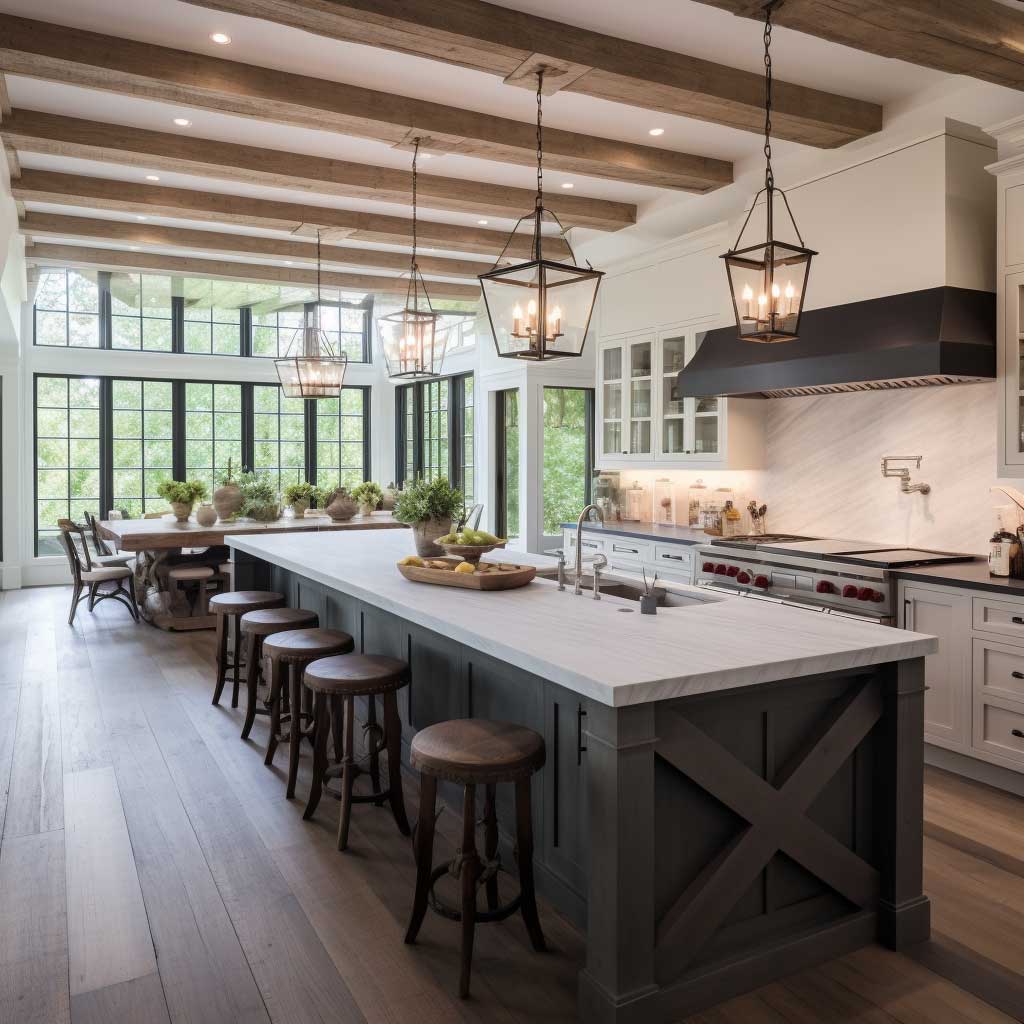
- Exposed wood beams: the anchor of the whole room — pick reclaimed over new-cut every time
- Shaker cabinets in off-white or sage work; full white reads sterile without texture to break it up
- Apron-front farmhouse sink runs $400–$900 at IKEA HAVSEN or Ruvati — non-negotiable for authenticity
- Hardware matters more than you think — matte black or unlacquered brass, never chrome
- Pendant lights over the island: exposed-bulb cage style, $80–$250 per fixture at Rejuvenation or similar
- Open shelving is not for everyone — it punishes clutter, rewards curation
Reclaimed Wood Beams Earn Their Keep in Ways Paint Never Will
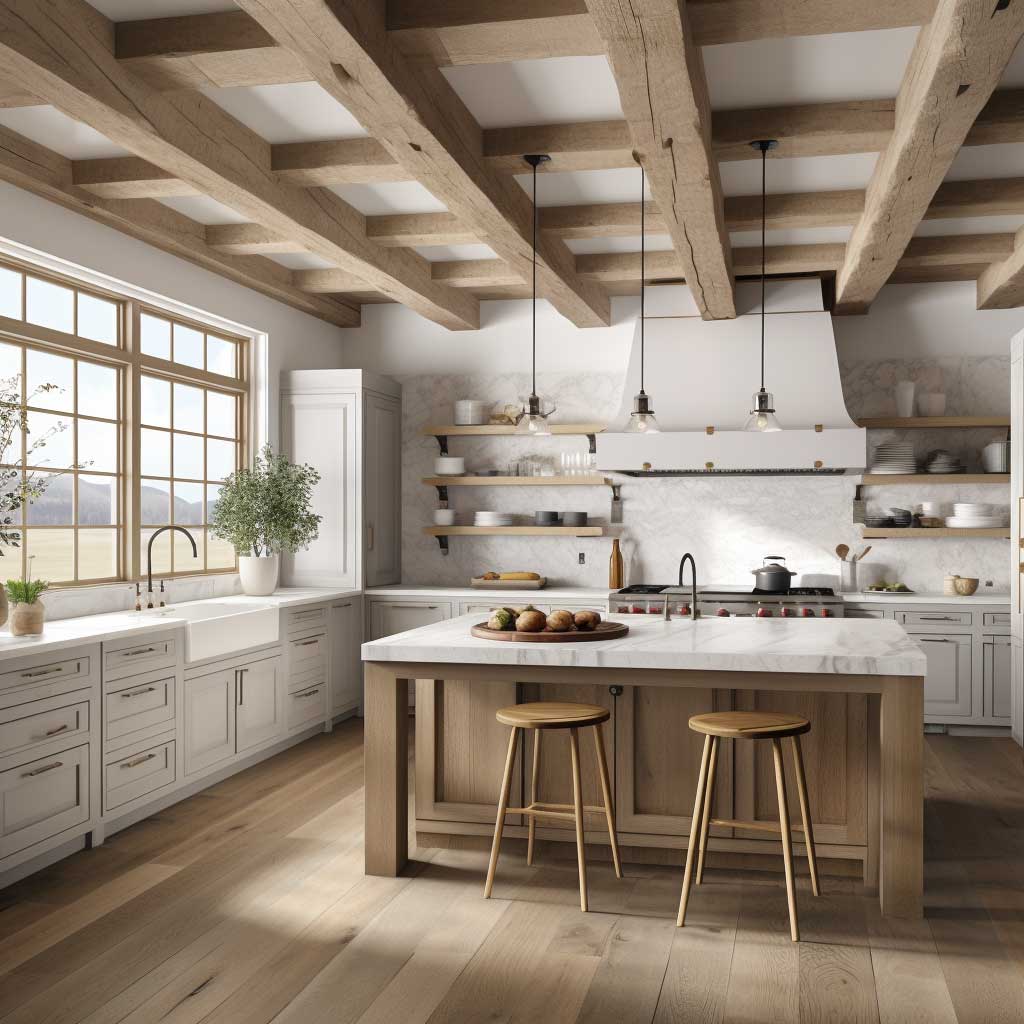
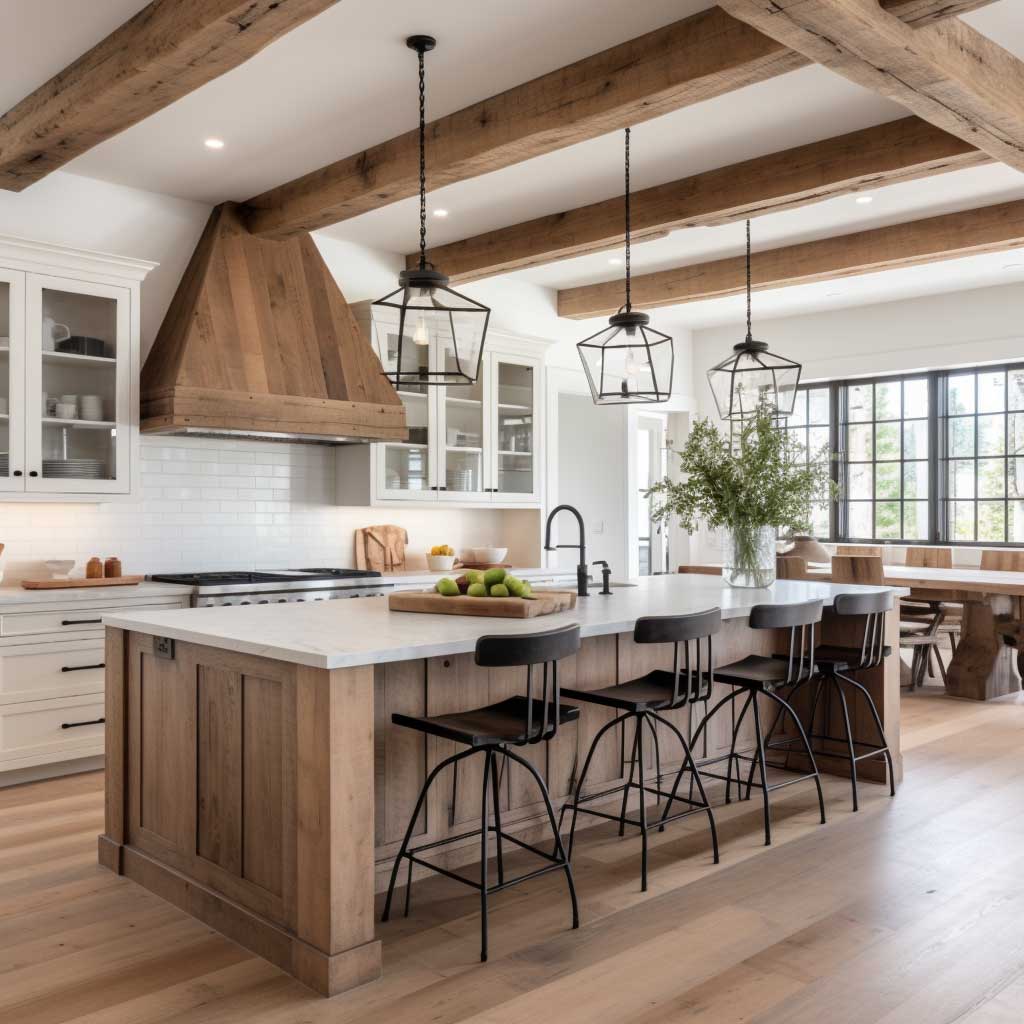
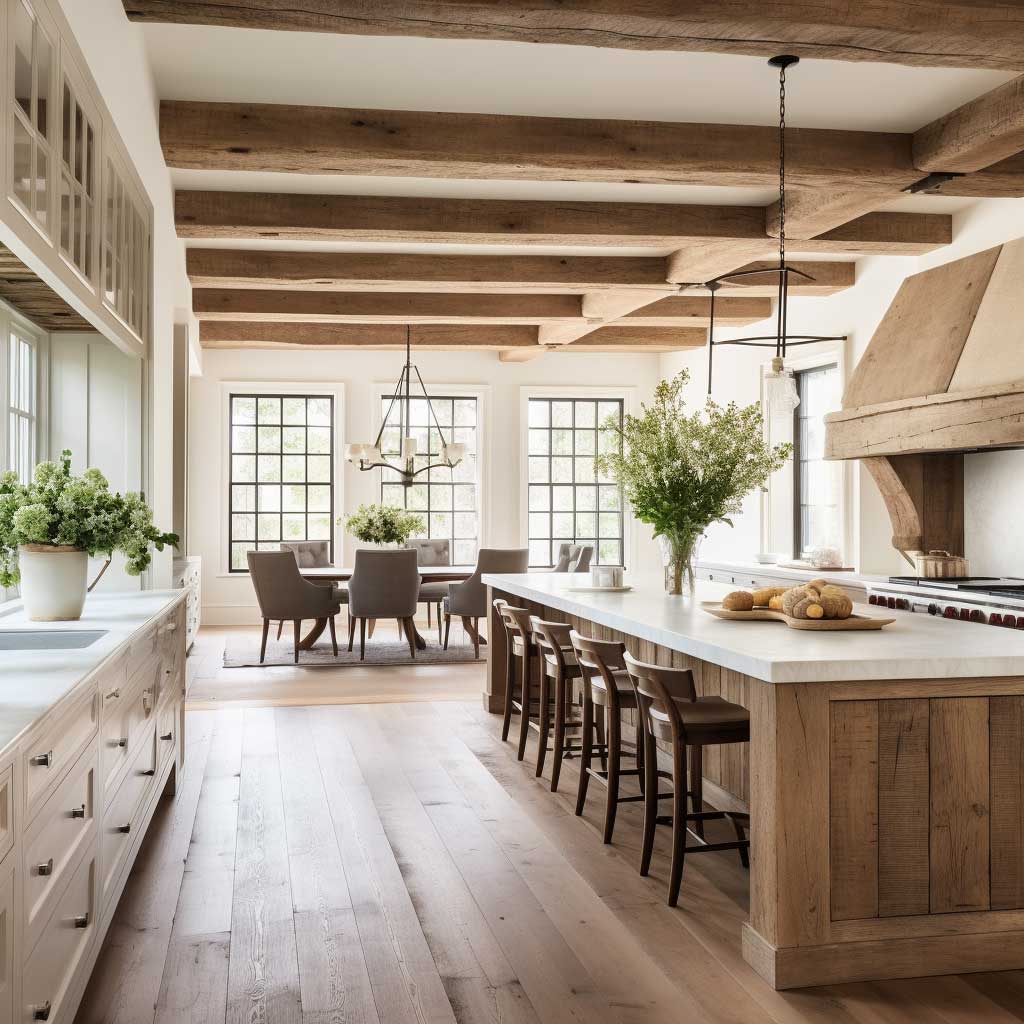
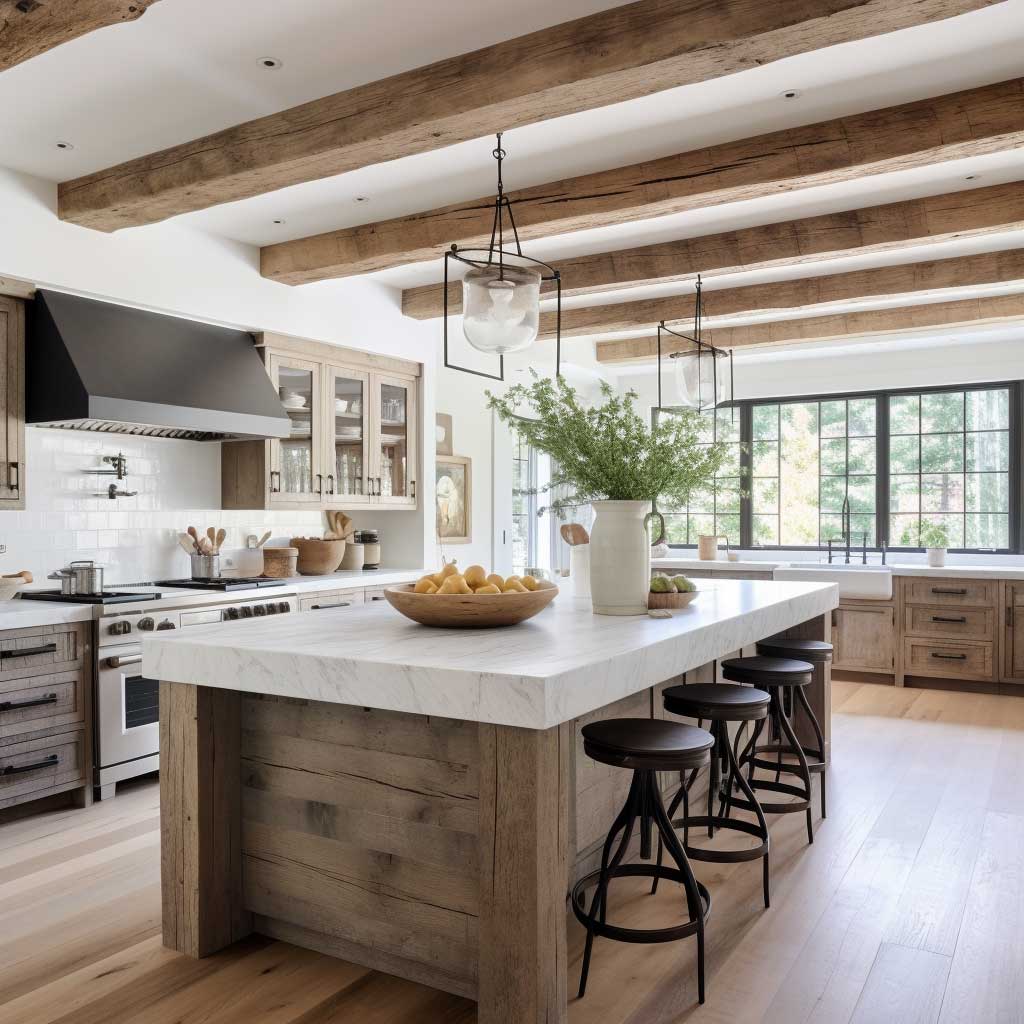
The ceiling is the one surface in your kitchen that has zero functional job — it just exists. That’s exactly why a wood beam up there hits so hard. Reclaimed Douglas fir or oak, sourced from barn demolitions or architectural salvage dealers, arrives with cracks and nail holes already in it. You don’t sand those out. You leave them. They’re the difference between a beam that looks aged and one that looks like it was printed yesterday at a lumber yard.
I bought my beams from a salvage dealer in Ohio — rough 6×8 oak, about $12 per linear foot. New-cut beams from Home Depot run half that, but they look fake against proper modern farmhouse kitchen decor because they’re too uniform. Real wood has variation in color, width, grain. That inconsistency is the point. If you’re adding beams to a house that never had them, hollow steel LVL wraps from companies like Voight Brothers run $300–$600 installed and pass the visual test from ground level.
What doesn’t work: painting beams bright white to match ceiling trim. I’ve seen it done. The beam disappears and you’ve lost the contrast that makes the room feel grounded. Stain to a medium walnut or leave natural — those are your two moves. Everything else is a mistake.
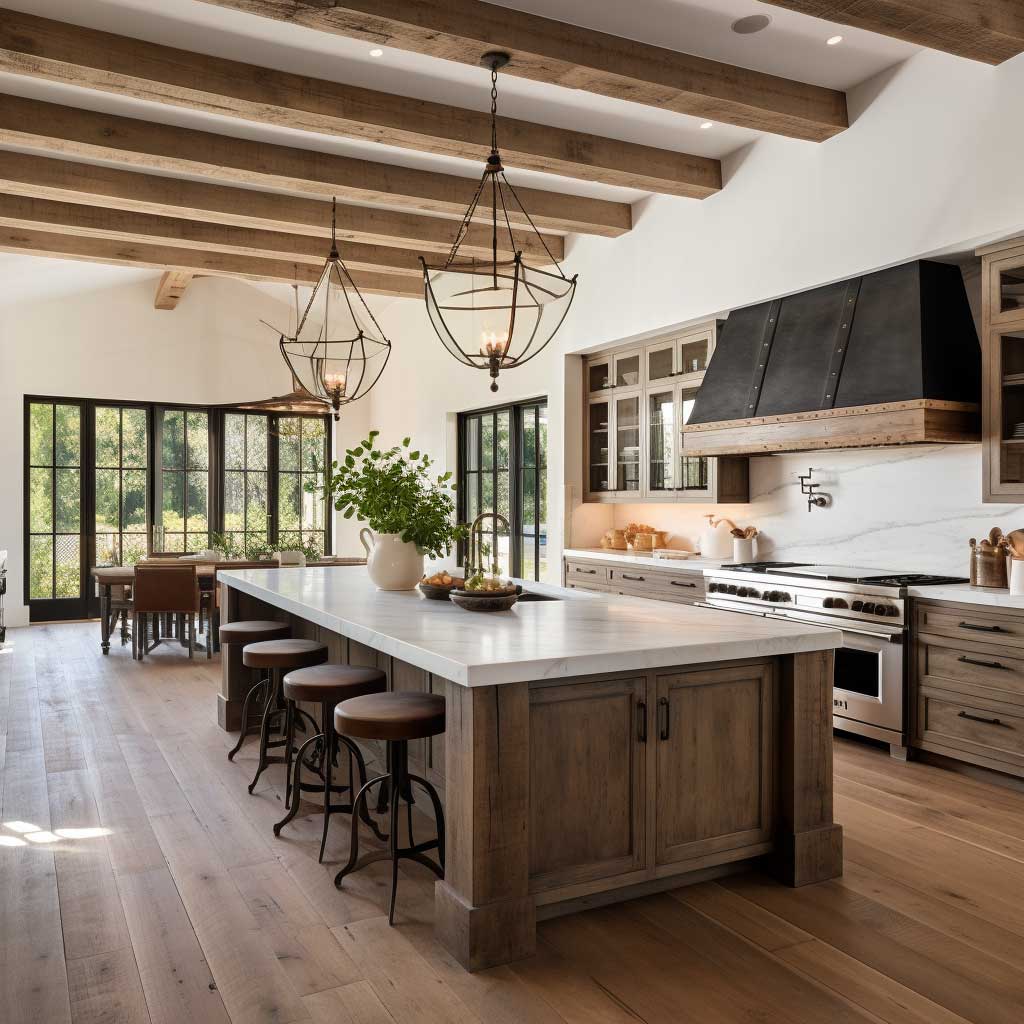
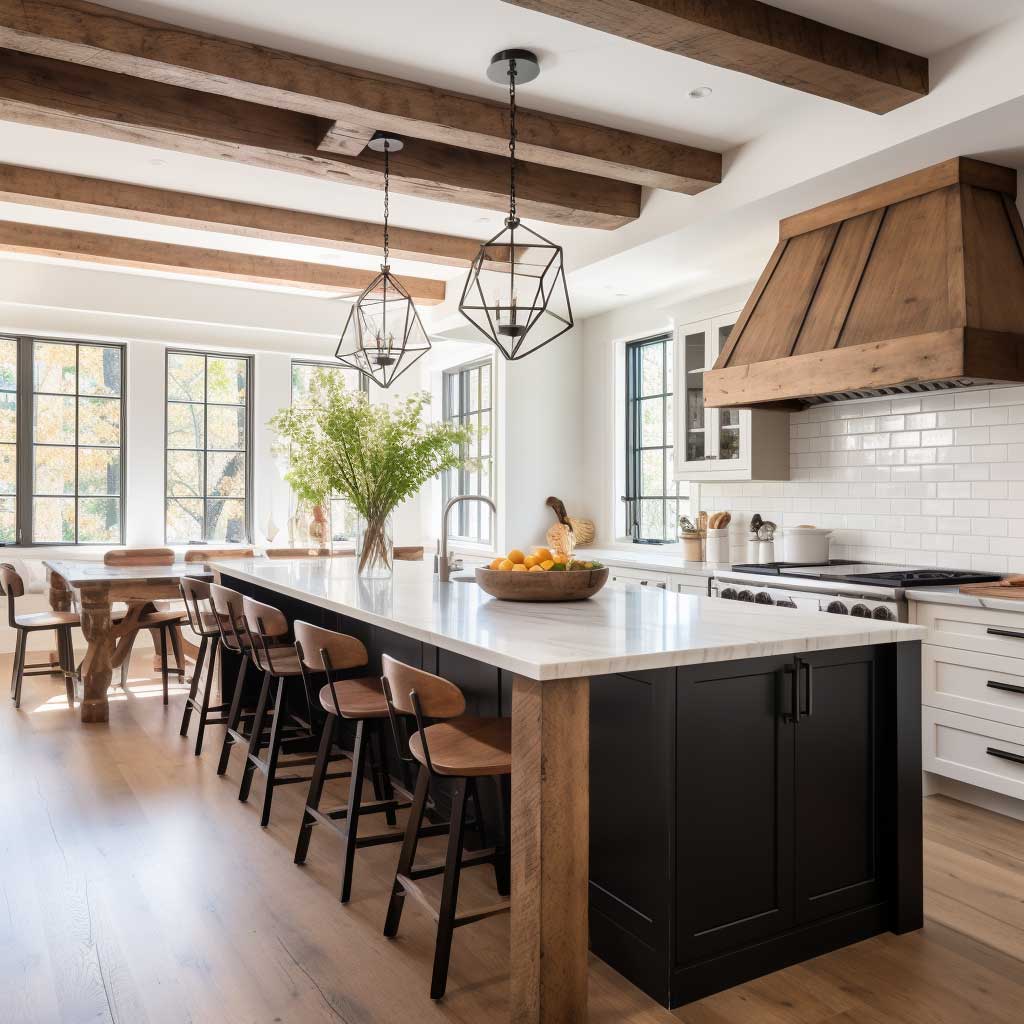


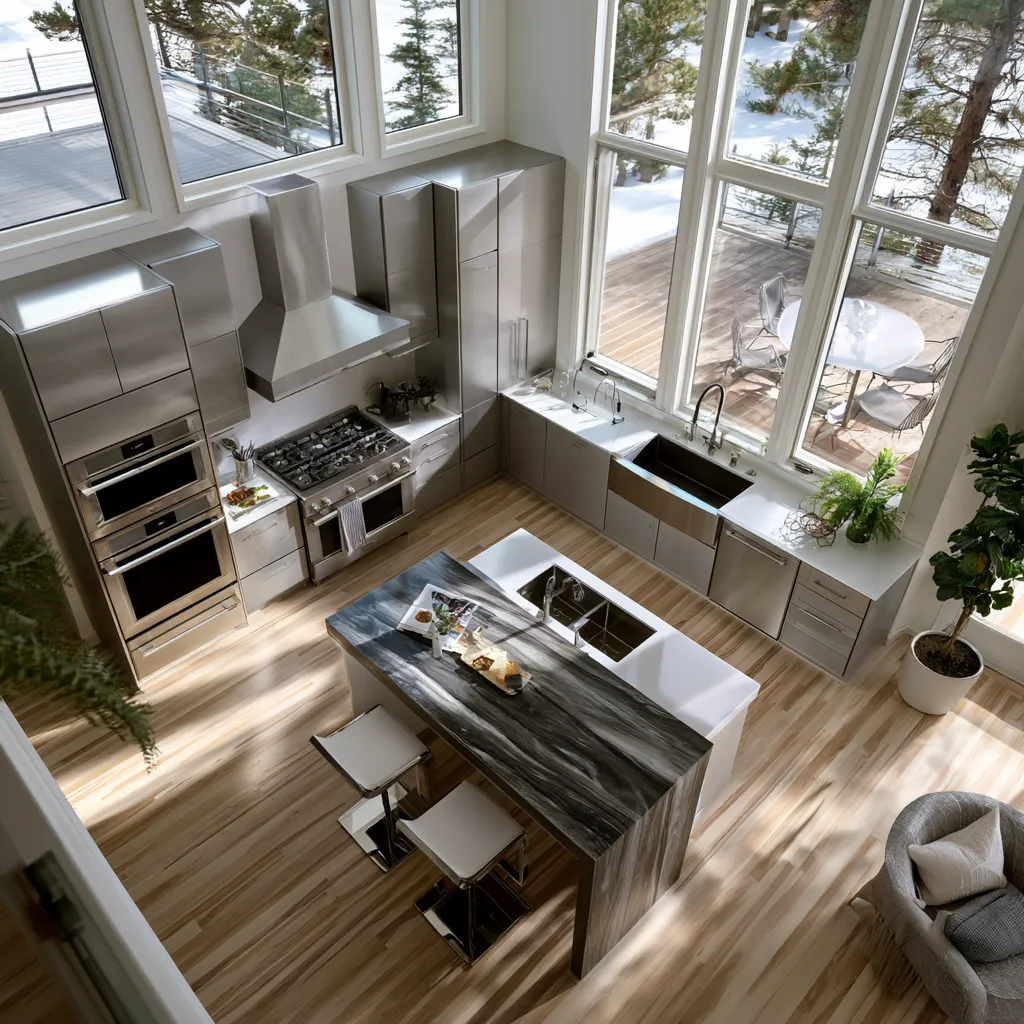
Stainless steel appliances are the modern farmhouse kitchen’s straight man. They show up clean, do nothing decorative, and let the beams and cabinets do the talking. My go-to pairing is reclaimed beam overhead plus a 36-inch KitchenAid or Bosch range in stainless — around $1,800–$2,500 — positioned directly below. That vertical stack from raw timber to precision metal is the whole aesthetic compressed into one wall. Countertops in Calacatta quartz (not marble — marble stains, quartz doesn’t) close the triangle at roughly $65–$90 per square foot installed.
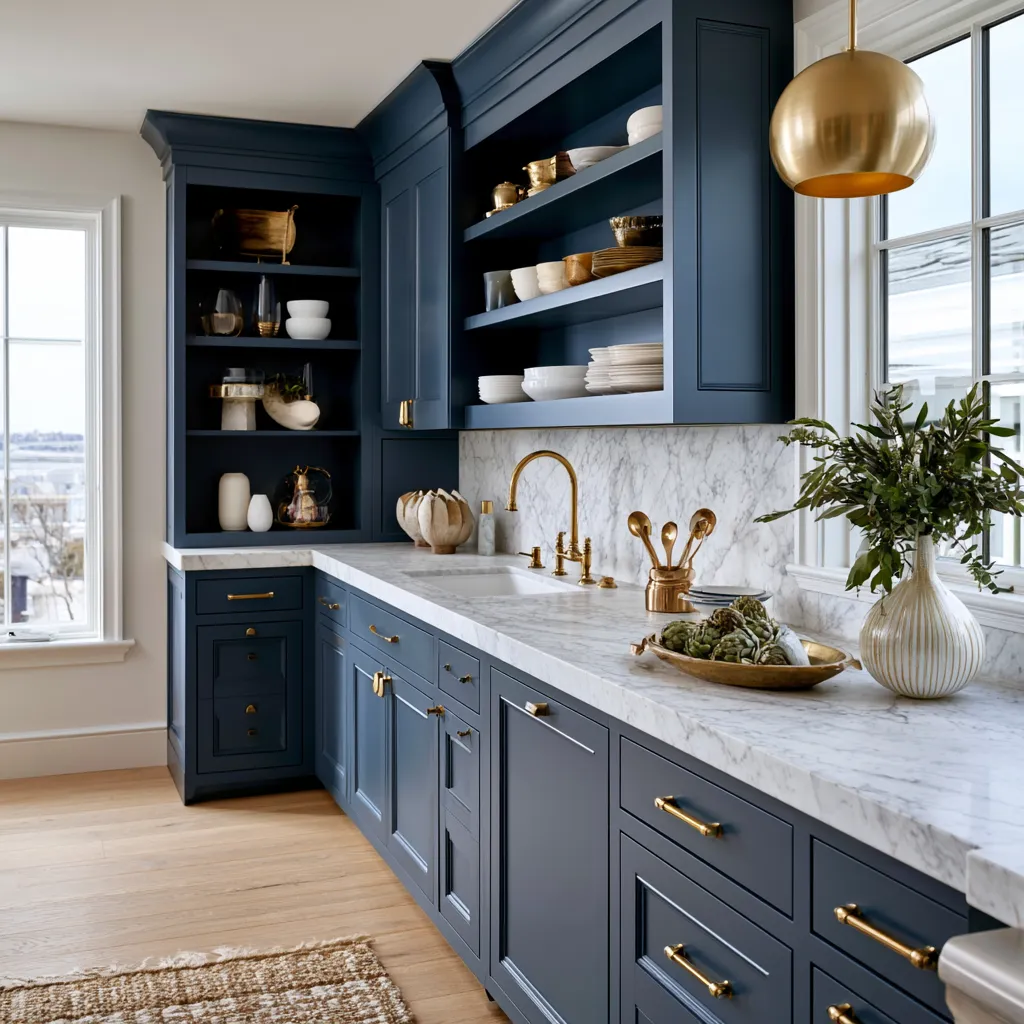
Hardware ties the room together faster than any other variable. Brushed brass drawer pulls at $4–$8 each from Rejuvenation or House of Antique Hardware warm up white or sage shaker cabinets without competing with them. Chrome hardware is the one thing I’d tell you to avoid entirely in a modern farmhouse kitchen — it reads as bathroom, not kitchen, and cancels out every rustic element you’ve spent money on. Open concept layouts amplify the beam-to-appliance contrast even further — if you’re working with a connected living space, the proportions change everything.
Open Shelving Rewards the People Who Actually Put Things Away
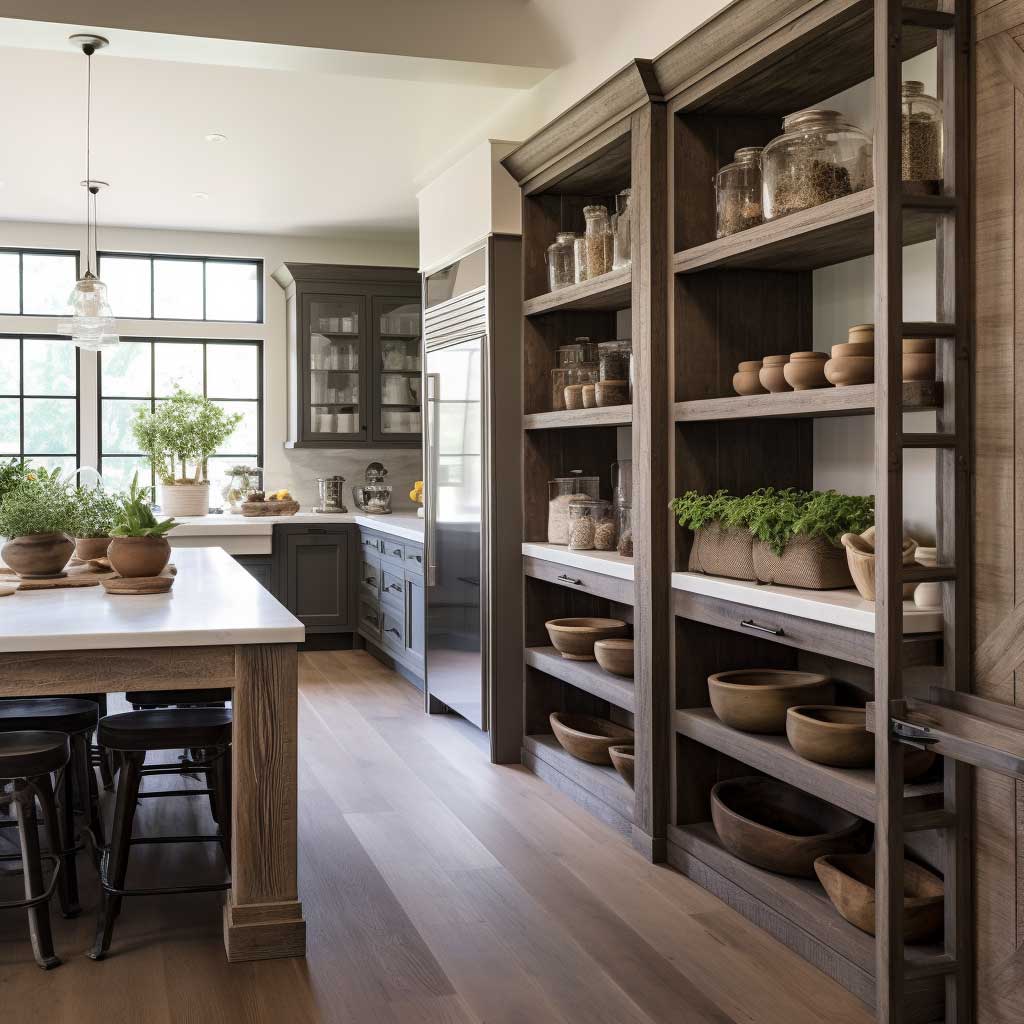
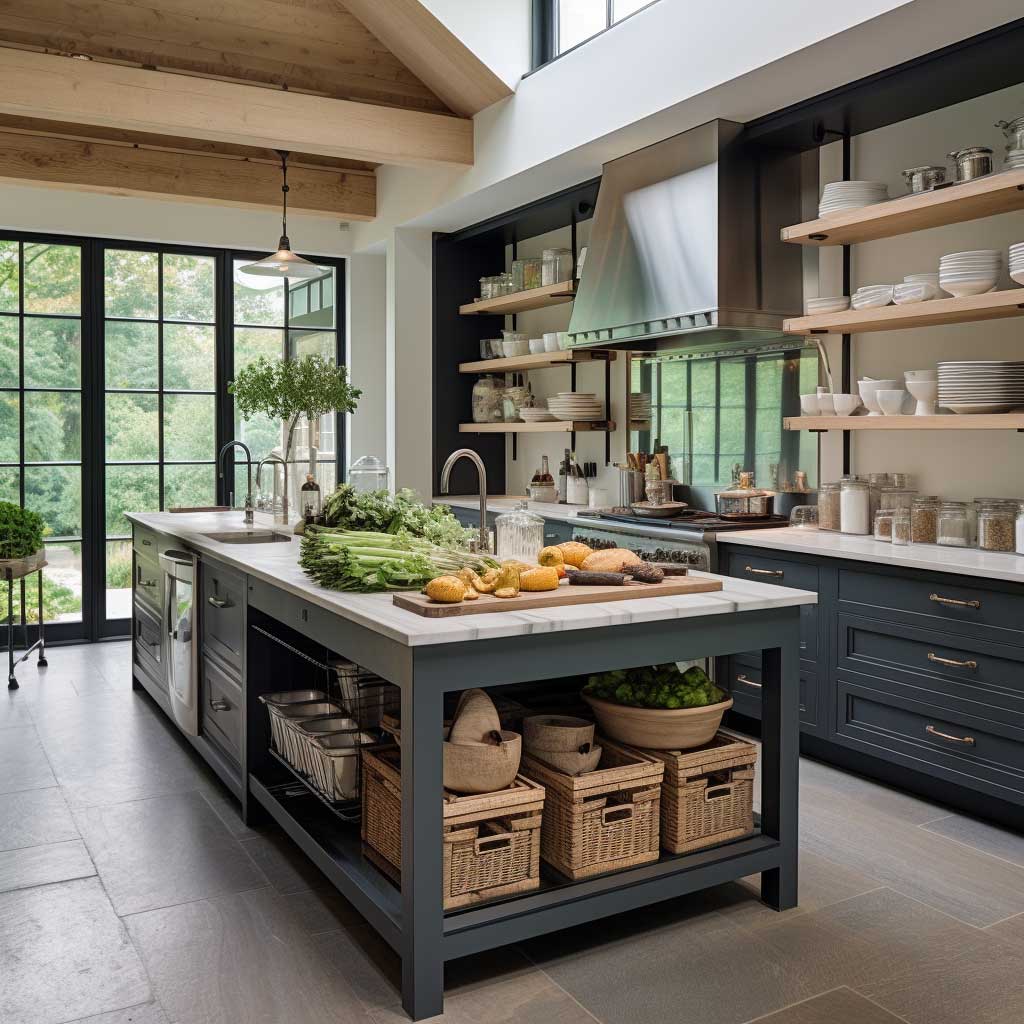

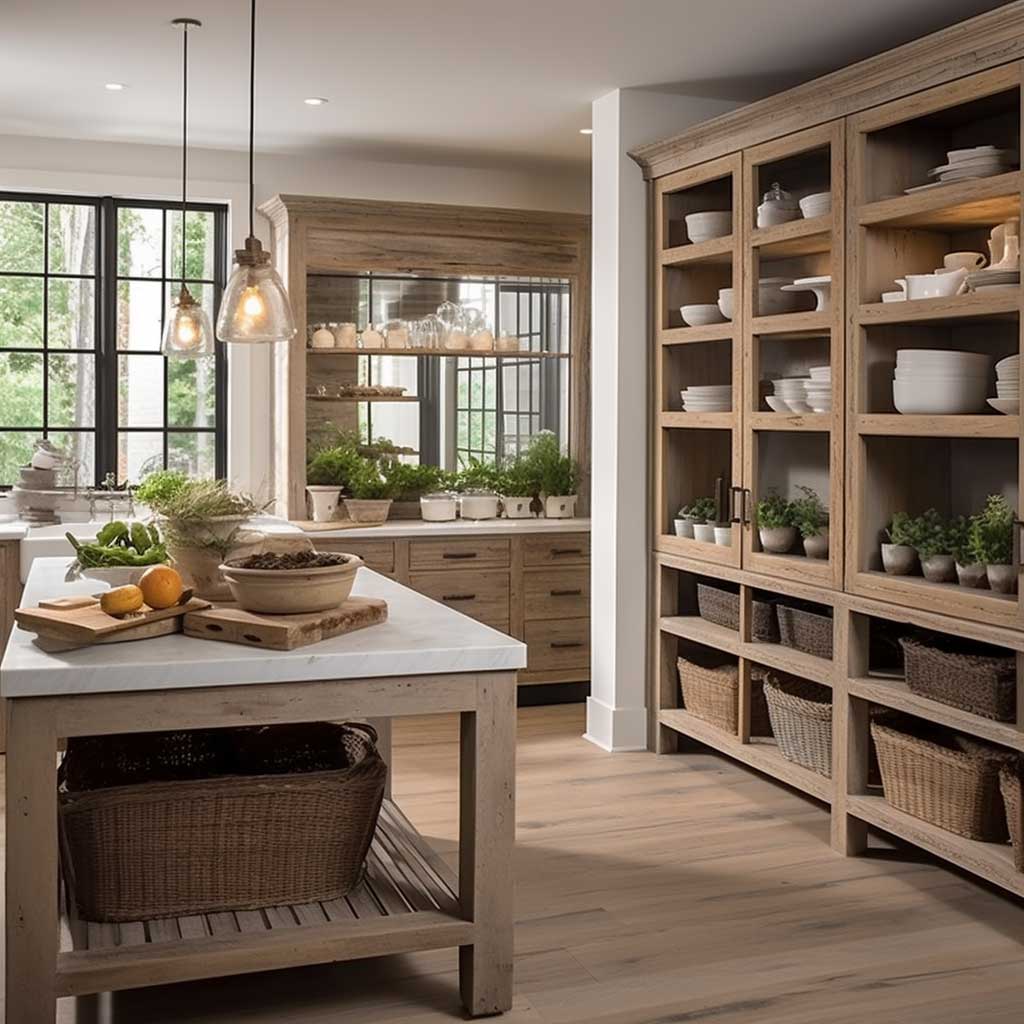
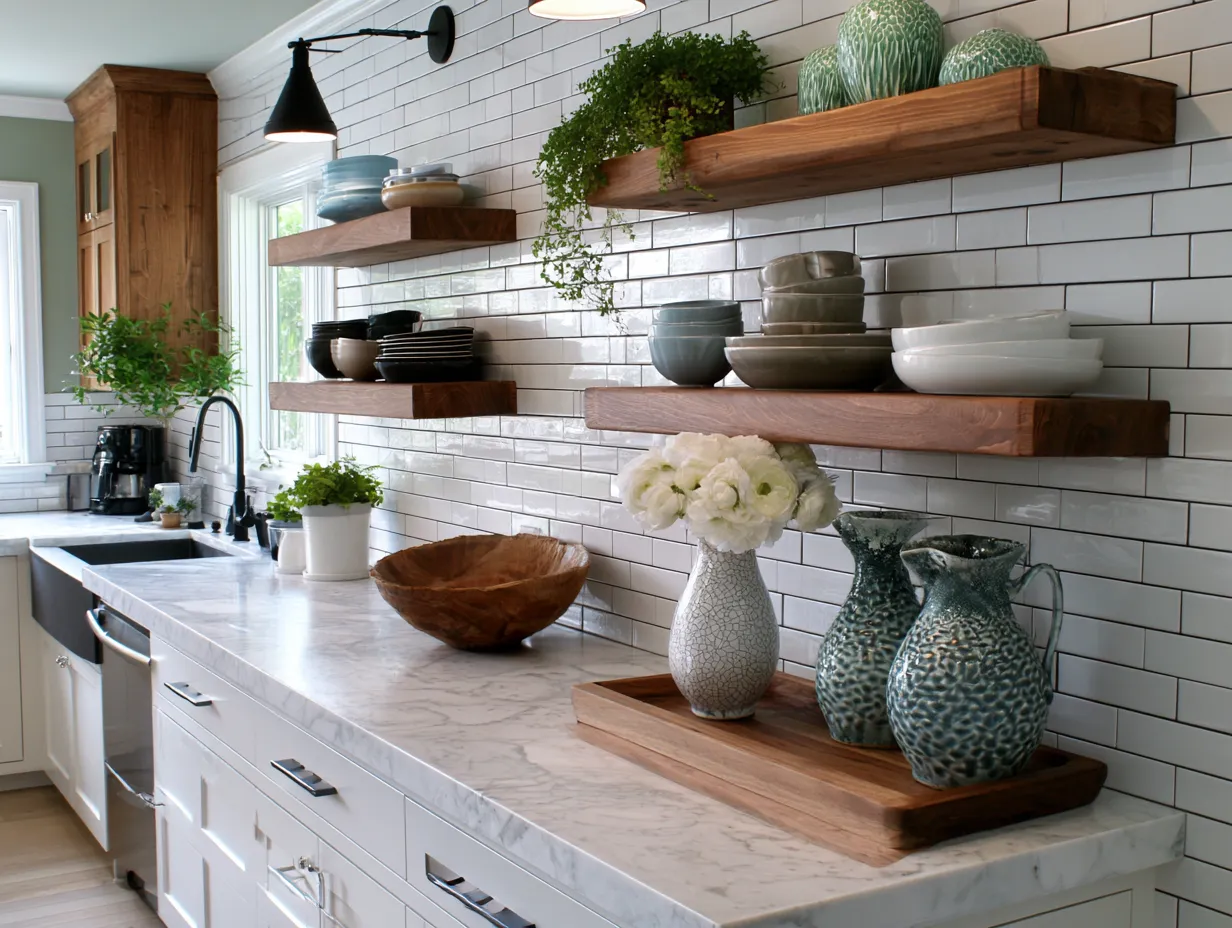
Open shelving in a modern farmhouse kitchen decor scheme is not a storage decision — it’s a curation decision. You’re agreeing to display whatever lives on those shelves, permanently, every day, for guests and family alike. I’ve had open shelves in two kitchens. The first time I loaded them with mismatched mugs and random jars. Looked terrible within a week. The second time I committed to white dishes, two or three cast iron pieces, and a row of decanted dry goods in matching glass. That version looked like a magazine. Same shelves, completely different outcome.
Floating shelf material matters. Reclaimed pine or walnut in 2-inch thickness, supported on black iron pipe brackets from places like Pipe Decor ($45–$80 per bracket), gives you the farmhouse look without the sagging issue cheaper wood develops over time. Ikea’s BOAXEL system works as hidden structure behind thicker slabs if you need more adjustability. Don’t use MDF wrapped in contact paper — it swells near steam and the edges delaminate.
The kitchen island is the other storage anchor in this style. A butcher block top runs $200–$600 for a standard 4×2 foot surface at IKEA or Lumber Liquidators. Pair it with shaker-paneled base cabinets — not furniture legs — and you get storage underneath without the wobbly feeling some freestanding islands develop. Smaller kitchens can still work this look with compact island proportions — the key is keeping the butcher block and not scaling down to a rolling cart.
Pull-out drawer inserts for pots and pans are the invisible upgrade most modern farmhouse kitchens skip. Rev-A-Shelf makes deep pull-out organizers for $80–$120 per drawer that fit inside standard shaker base cabinets. You’d never know they’re there from the outside, but you’d feel the absence immediately if you removed them. Cabinetry built around a lazy Susan in a corner cabinet — another $60–$90 upgrade — means you stop losing spatulas in the back left corner of a dead cabinet. Functional specificity is what separates a modern farmhouse kitchen from a kitchen that just has some vintage jars on a shelf.
Don’t Do This
- Don’t mix open shelves with cluttered everyday storage. If cereal boxes and dish soap bottles end up on your open shelves, the farmhouse look collapses into visual noise. Either commit to a display-only discipline or keep those items behind closed cabinet doors.
- Don’t install a kitchen island that blocks traffic flow. The standard clearance is 42 inches on working sides, 36 inches minimum. A beautiful butcher block island that forces you to shuffle sideways every time you open the oven will make you resent the room.
- Don’t skip the apron-front sink trying to save $200. It’s the single most recognizable marker of farmhouse kitchen decor. A drop-in stainless sink in a farmhouse kitchen reads like wearing dress shoes with a flannel shirt — nothing is wrong exactly, but nothing is right either.
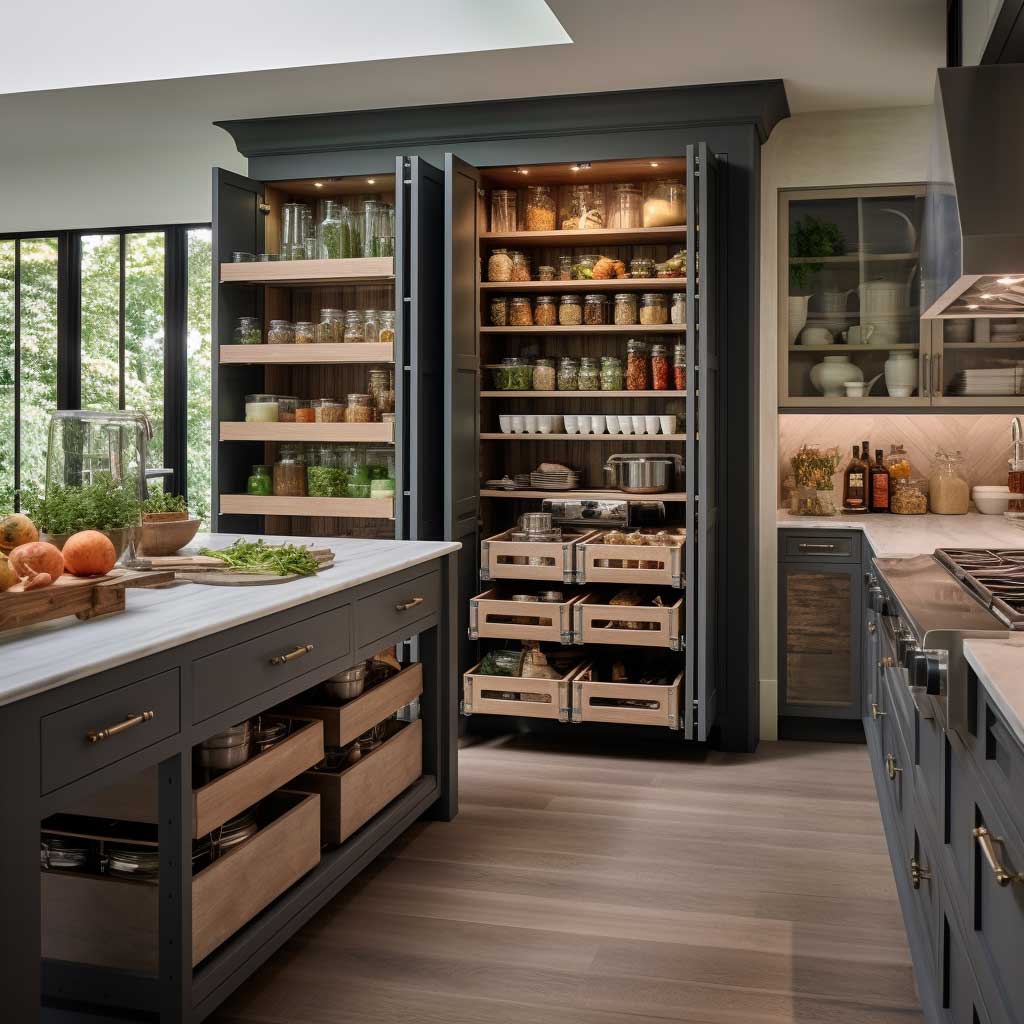
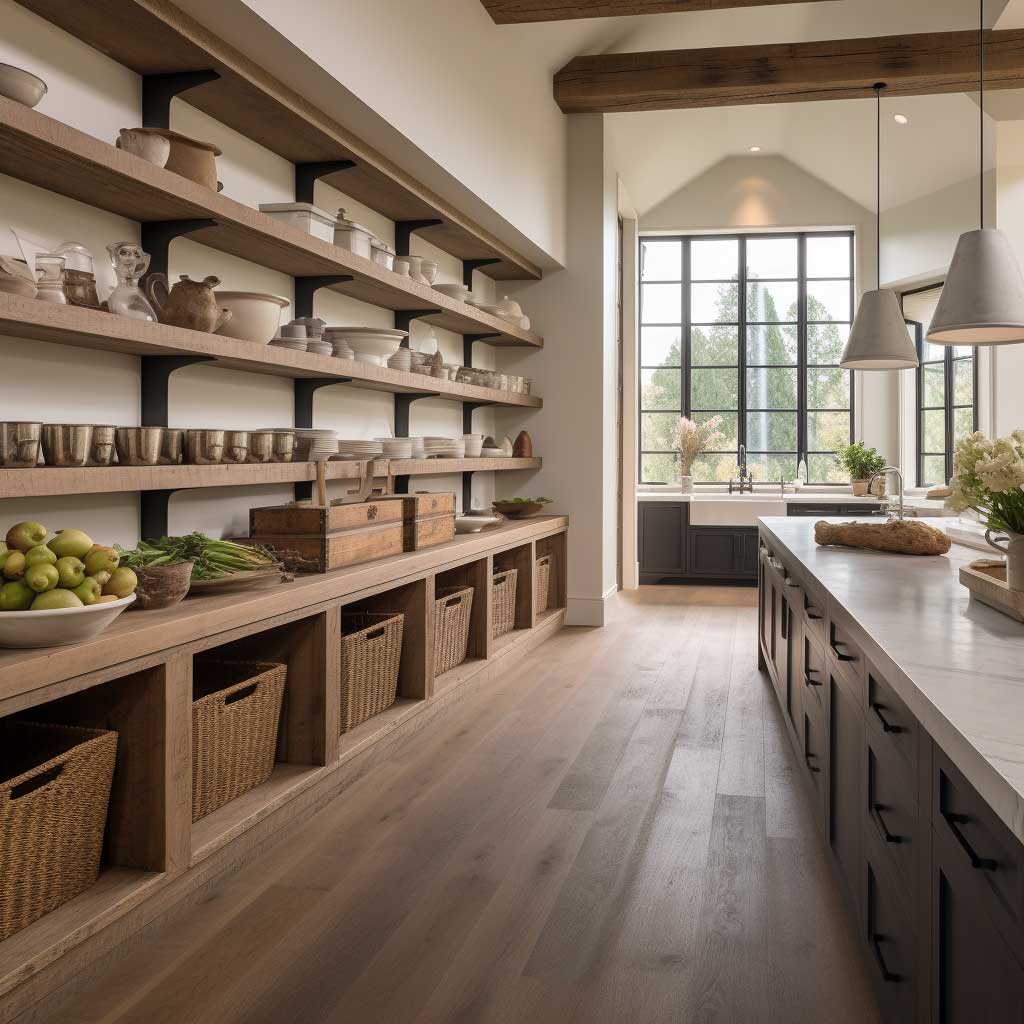
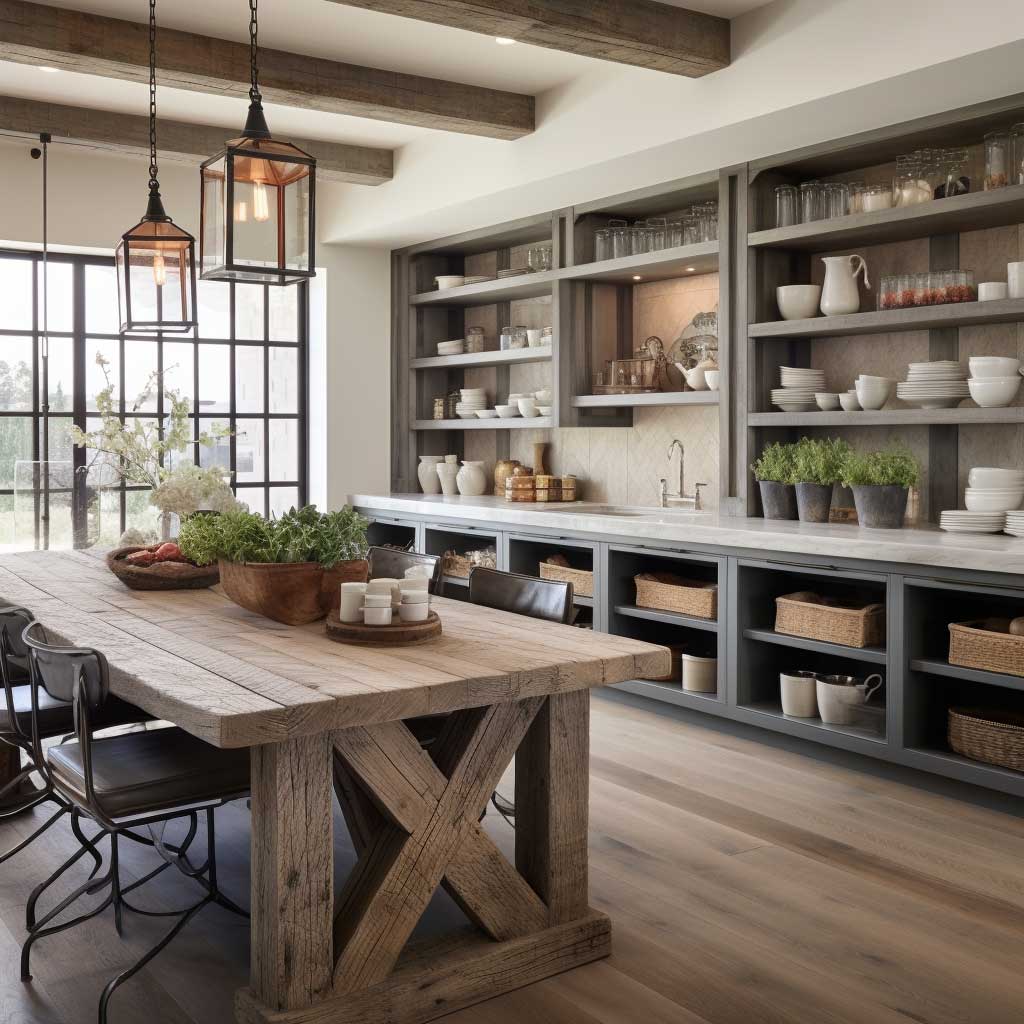
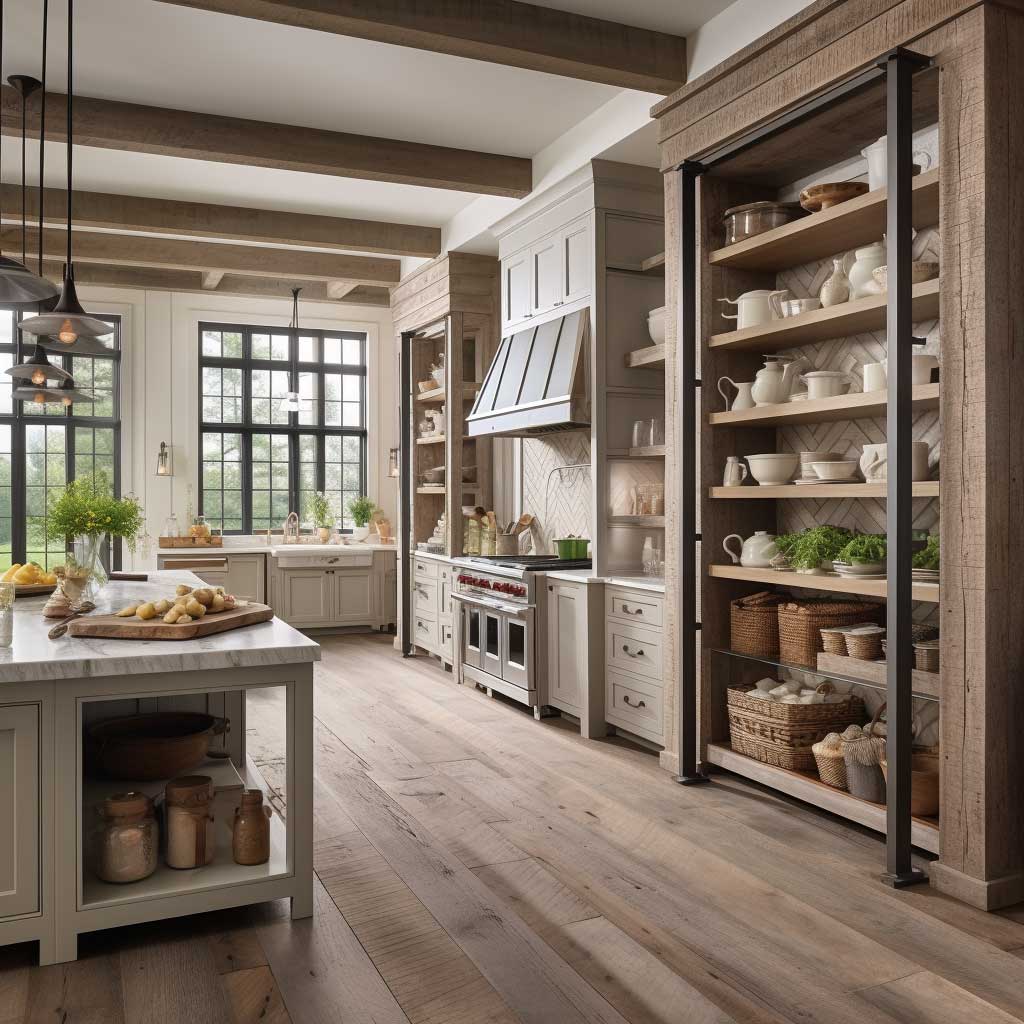
What I’d warn you off of in the island department: the kitchen island with furniture-style decorative legs. They photograph beautifully. In real life, the floor around those legs is impossible to clean, and the structure wobbles when you lean on it. Shaker-panel base cabinets on the island look slightly less editorial but hold up to actual use over the years. I’ve had both. I kept the shaker version.
For those looking at a complete storage overhaul, IKEA’s kitchen storage range has every component — open shelving brackets, base cabinet pull-outs, and island frames — that you can spec for a farmhouse kitchen without hiring a custom millwork shop. The SEKTION cabinet system starts around $150 per base unit and takes standard shaker fronts from dozens of compatible vendors.
Pendant Lights Do Half the Decorating Before You Hang a Single Thing on the Walls
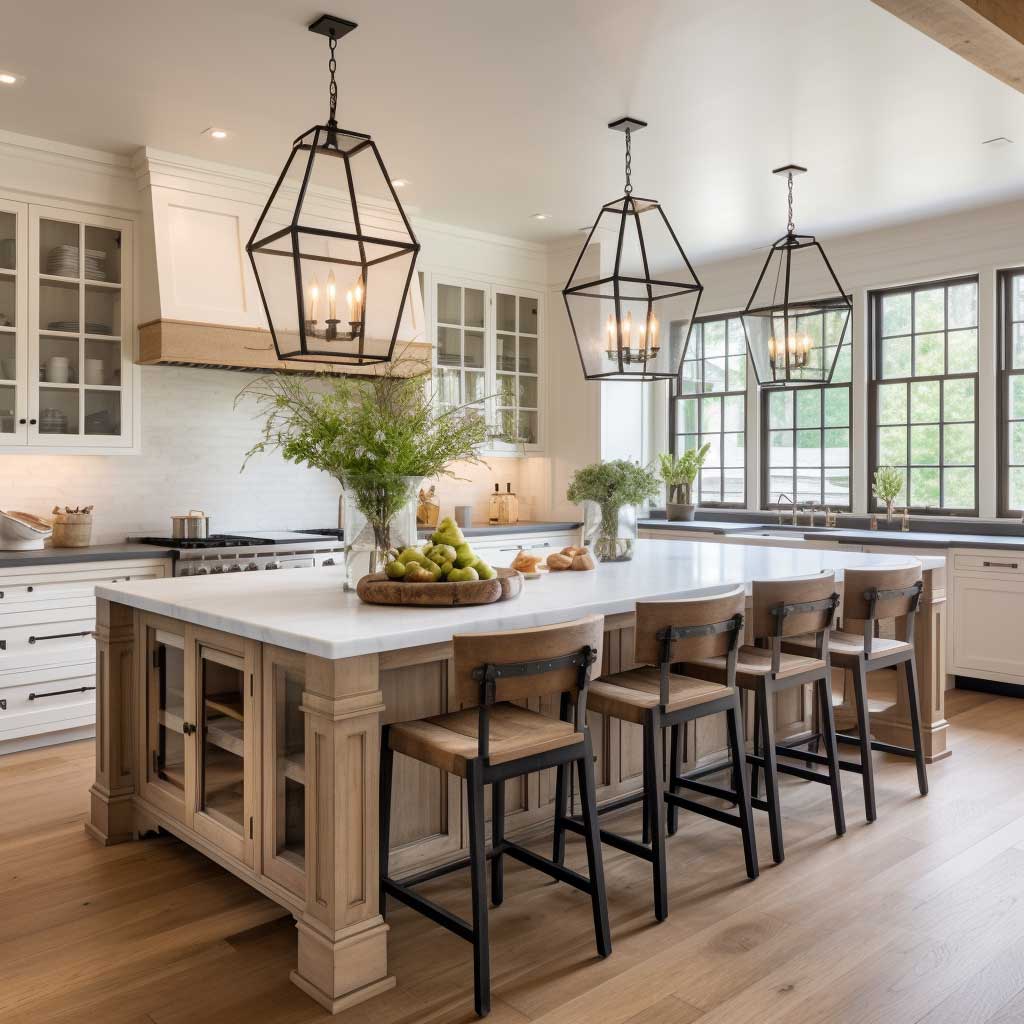
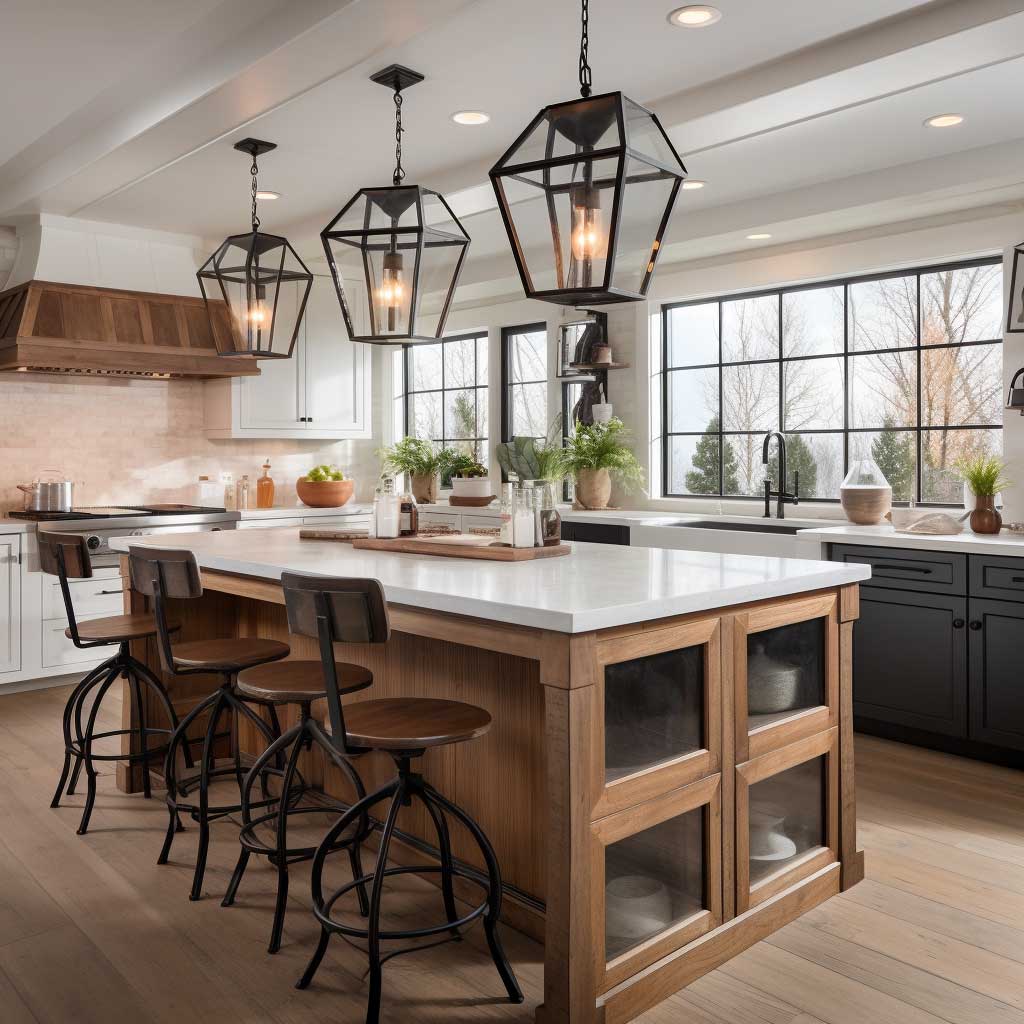
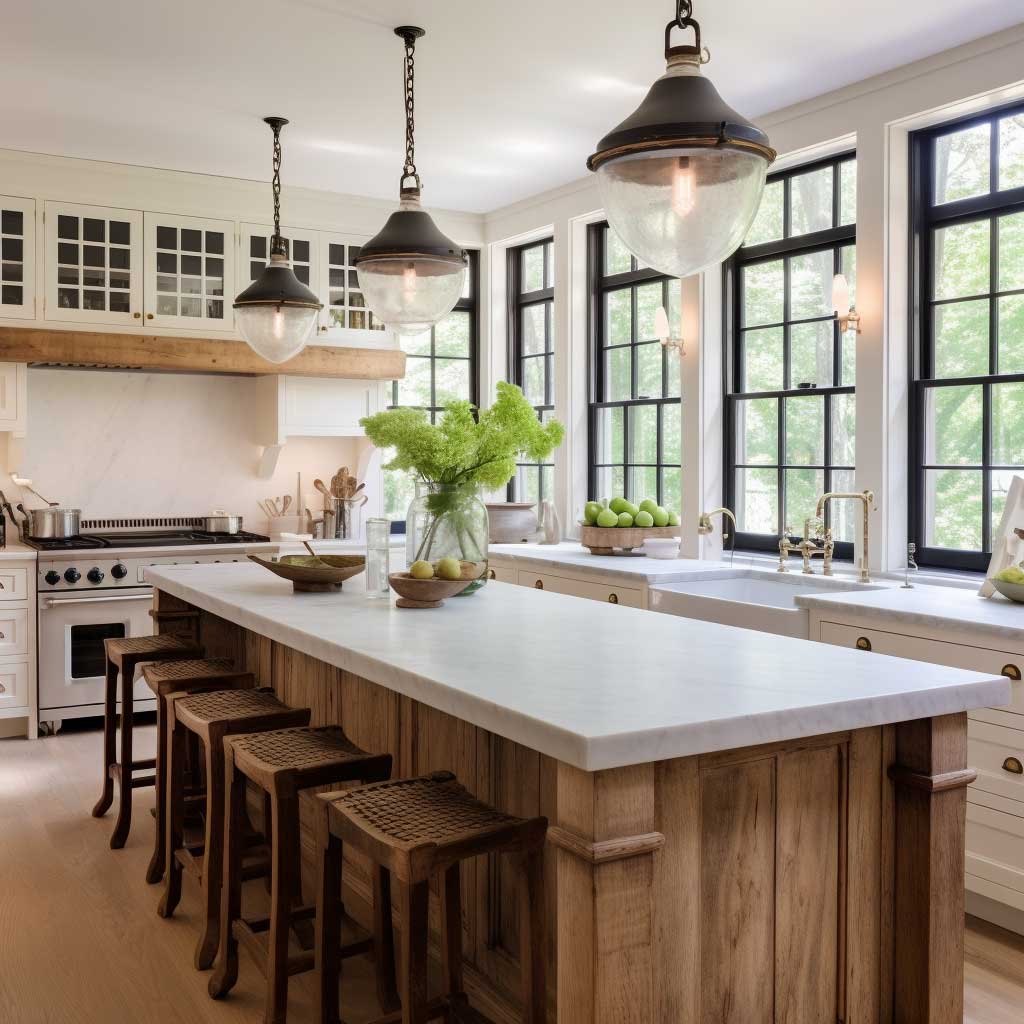
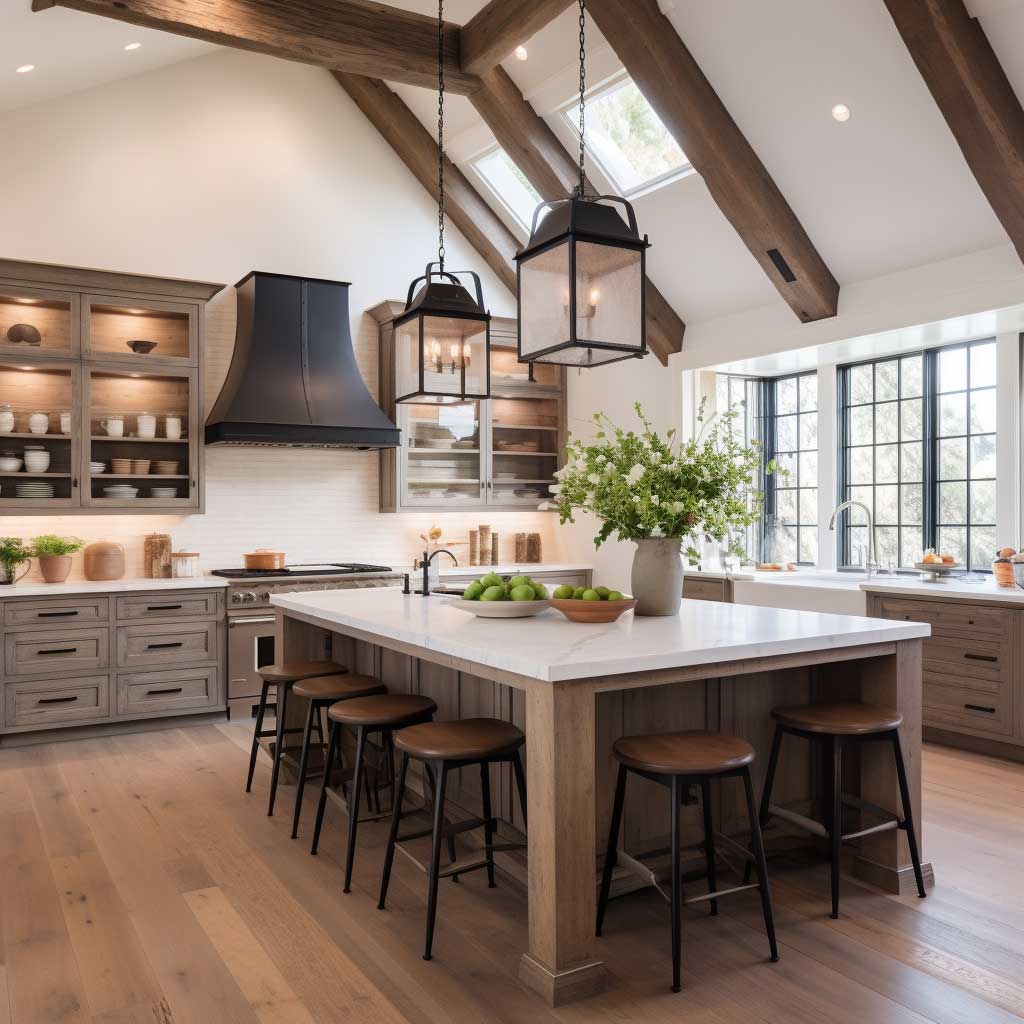
Lighting in a modern farmhouse kitchen decorating scheme is where most people spend too little and then wonder why the room feels flat. Two pendant lights over a kitchen island — cage-style, Edison bulb, black iron or aged brass — run $90–$250 each from Rejuvenation, Visual Comfort, or even Amazon’s Stone & Beam line. Hang them at 30–36 inches above the countertop surface. Too high and they become ceiling decor. Too low and you’re constantly ducking. I stole this measurement from a lighting showroom contractor who told me most DIY hangs end up 6 inches too high.
Under-cabinet lighting is the upgrade that costs $80 and changes the entire usability of the room. You’ll notice it most when you’re prepping at 6am or 10pm and the overhead can lights aren’t on. Plug-in LED strips from Brilliant Evolution or hardwired puck lights from Lutron run around $30–$80 for a full counter run. Use 2700K color temperature — warm white, not daylight. Daylight under-cabinet lighting in a farmhouse kitchen looks like a laboratory. Warm white looks like a kitchen that someone actually cooks in.
Decorative accents are the last layer and the most personal. Vintage jars filled with dry pasta or fleur de sel, a large ceramic crock next to the range holding wooden spoons, a linen runner across the island — these are the details that make a kitchen feel inhabited rather than staged. Fresh herbs in terra cotta pots on a windowsill cost nothing and read as farmhouse immediately. What doesn’t work: those printed “EAT” or “GATHER” wooden signs. They are farmhouse decor signaling farmhouse decor instead of actually being it. Skip the signs. Add a $15 ironstone pitcher from an antique market instead.
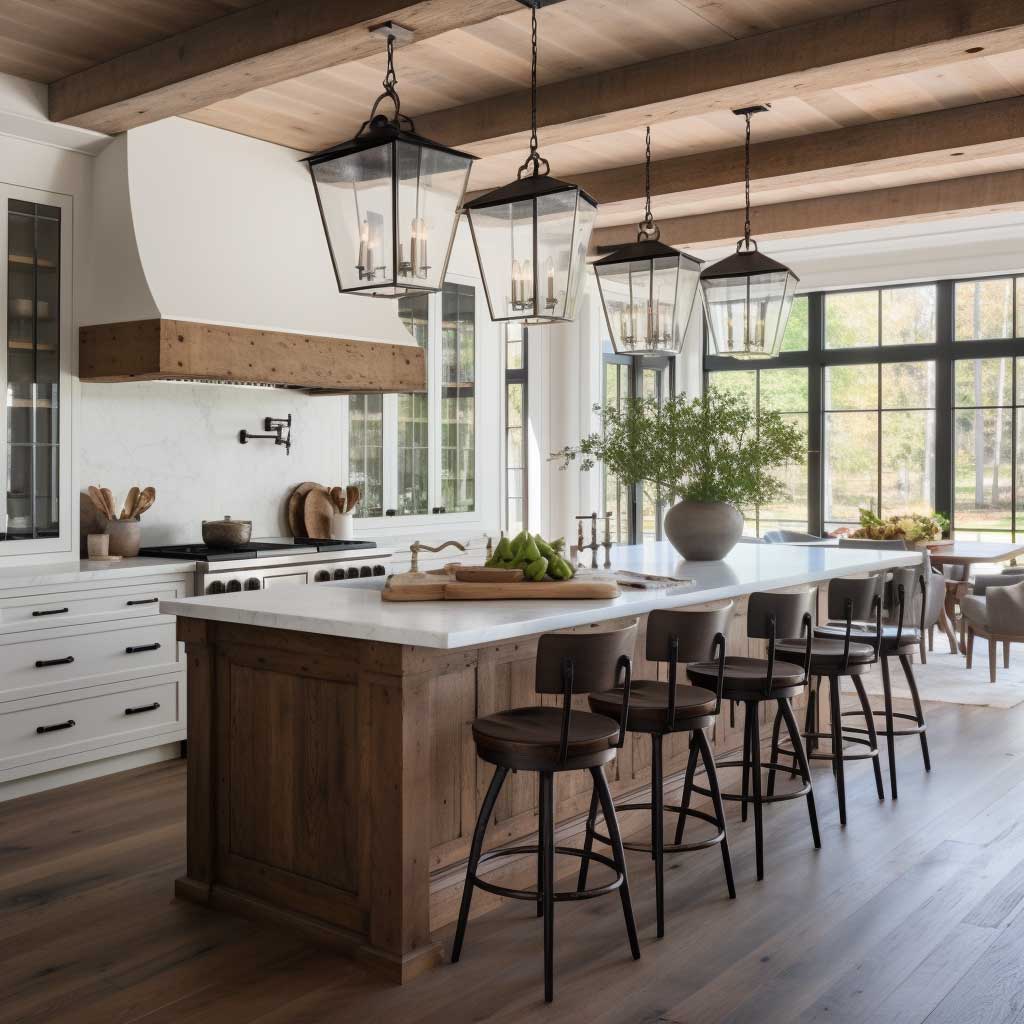


Textiles are underused in farmhouse kitchen decorating ideas. A cotton rag rug in front of the sink — $40–$80 from Dash & Albert or similar — adds warmth underfoot and breaks up hard surfaces. Linen curtains rather than blinds on the window above the sink let in diffused light and move slightly with kitchen air movement in a way that no blind does. Woven pot holders on a hook, a checked linen hand towel folded over the oven handle — all of it contributes to the lived-in quality that separates a finished modern farmhouse kitchen from an interior design concept. Lighting over a farmhouse dining table deserves the same level of attention as what’s over the island — the two fixtures should speak to each other in finish and scale.
For a wider look at how the modern farmhouse style applies color, material, and texture across the whole room, Curated Interior’s farmhouse kitchen breakdown is one of the more specific references available — it covers apron sinks, hardware finishes, and architectural details without the usual vague advice.
The Takeaway
Modern farmhouse kitchen decor isn’t rustic with a modern appliance dropped in — it’s a calculated contrast between raw material and precise finish, repeated at every scale from the ceiling beam to the cabinet pull.
Buy the reclaimed beam, the apron-front sink, and the cage pendant lights first. Those three items do more work than any decorative accessory you’ll ever add.
Shaker cabinets in off-white or sage, Calacatta quartz countertops, and matte black or unlacquered brass hardware close the foundational layer at a total project cost of $8,000–$25,000 depending on kitchen size — still a fraction of a custom millwork renovation.
Save this post before you head to the lumber yard or the salvage dealer.