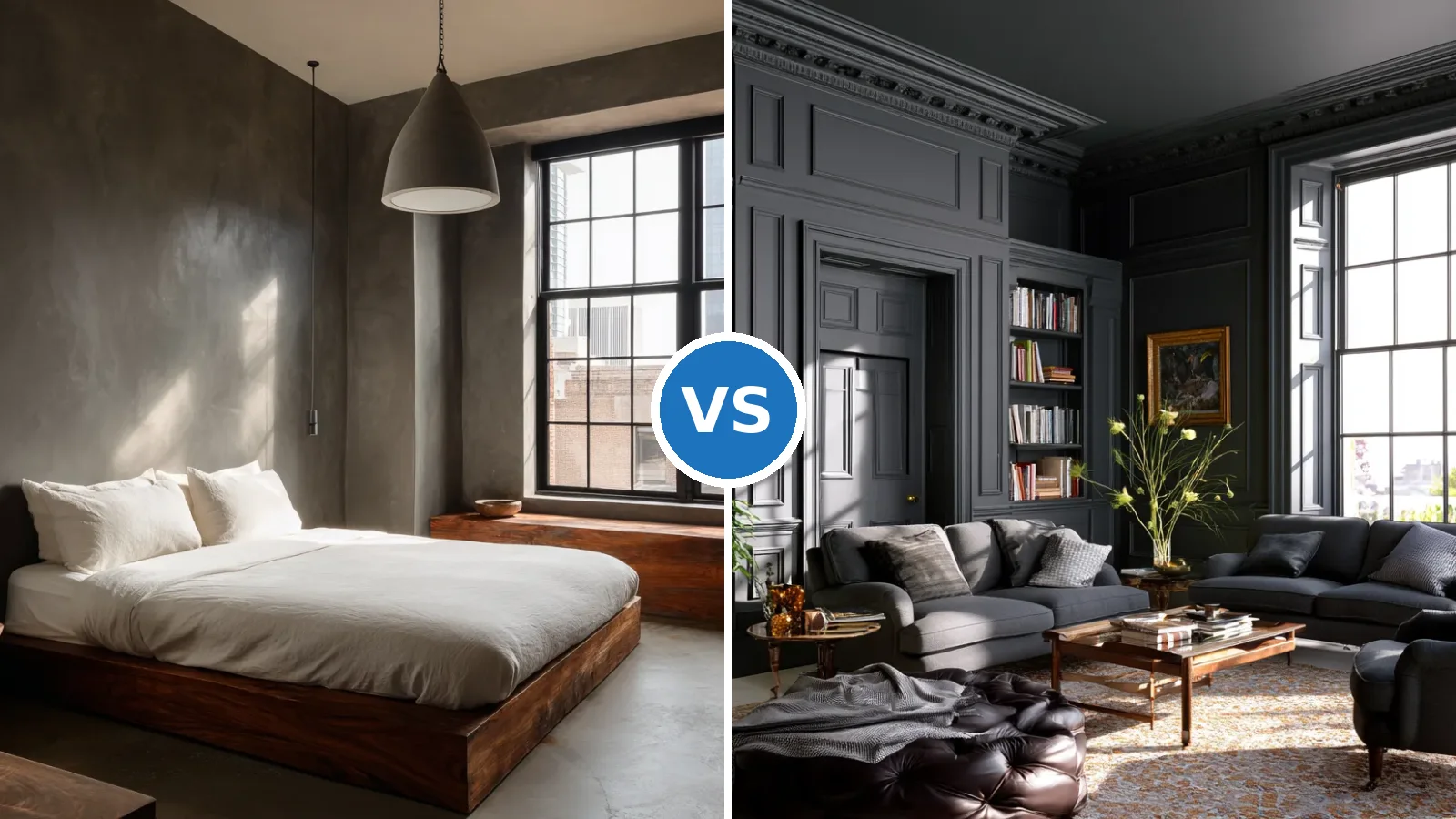
Brutalist interior design works when every surface earns its place without pretending to be something it isn’t. Exposed concrete, raw steel, and unfinished wood don’t hide their origins — and that’s the point. I’ve watched people dismiss this style as cold and clinical, then walk into a well-executed brutalist living room and immediately ask who the designer was. The style rewards restraint and punishes decoration that has no reason to exist.
The term traces back to the French béton brut — raw concrete — and the mid-century architectural movement that built entire cities around the idea that structure itself is ornament. Indoors, those same principles produce spaces with a particular weight and seriousness you won’t find in any other style. Modern brutalist interior design has softened the hard edges just enough to make it livable, without losing what makes it distinct.
What you’ll find in this article:
- How raw materials create a brutalist living room that isn’t cold
- What a brutalist bedroom actually needs — and what to leave out
- The monochromatic kitchen formula that makes concrete feel intentional
- Material comparison: concrete vs. steel vs. raw wood in brutalist spaces
- FAQ covering characteristics, organic and minimalist variations, and futuristic takes
A Brutalist Living Room Earns Its Concrete Walls
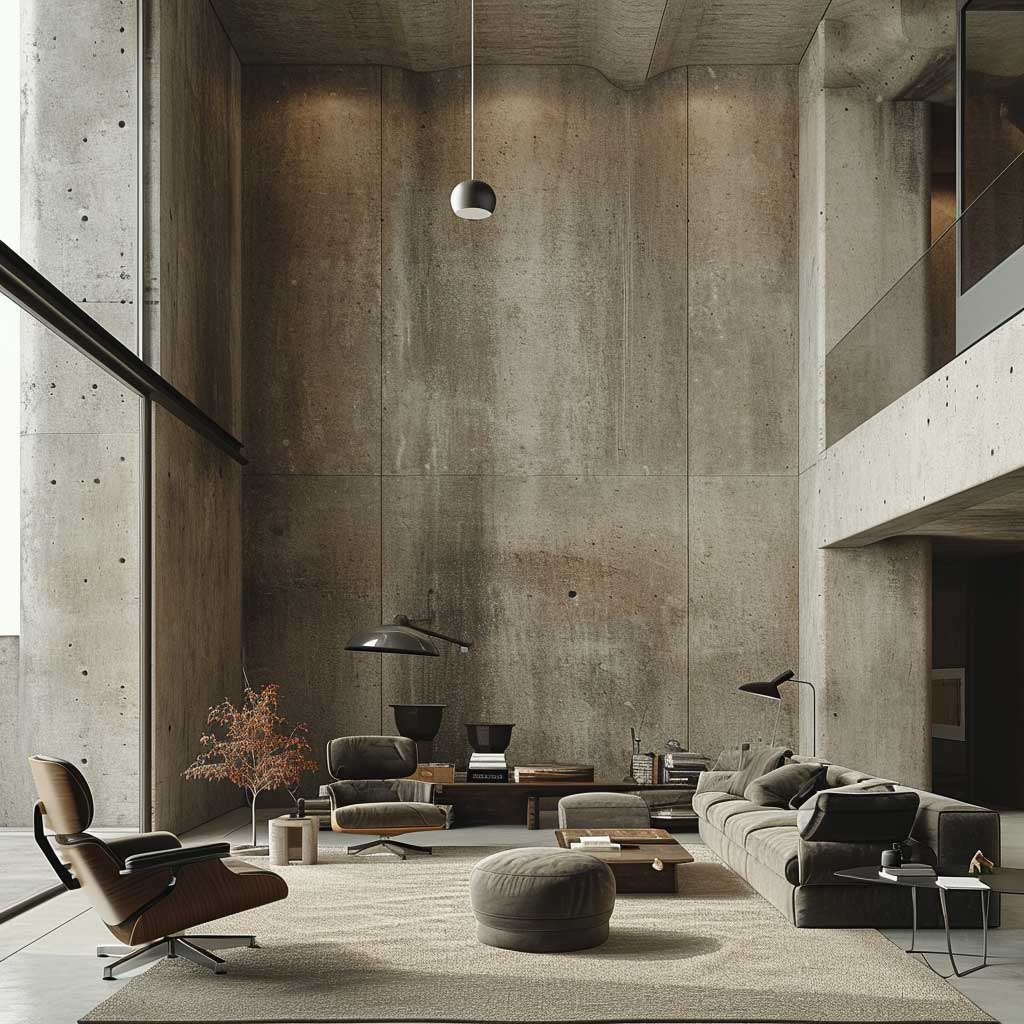
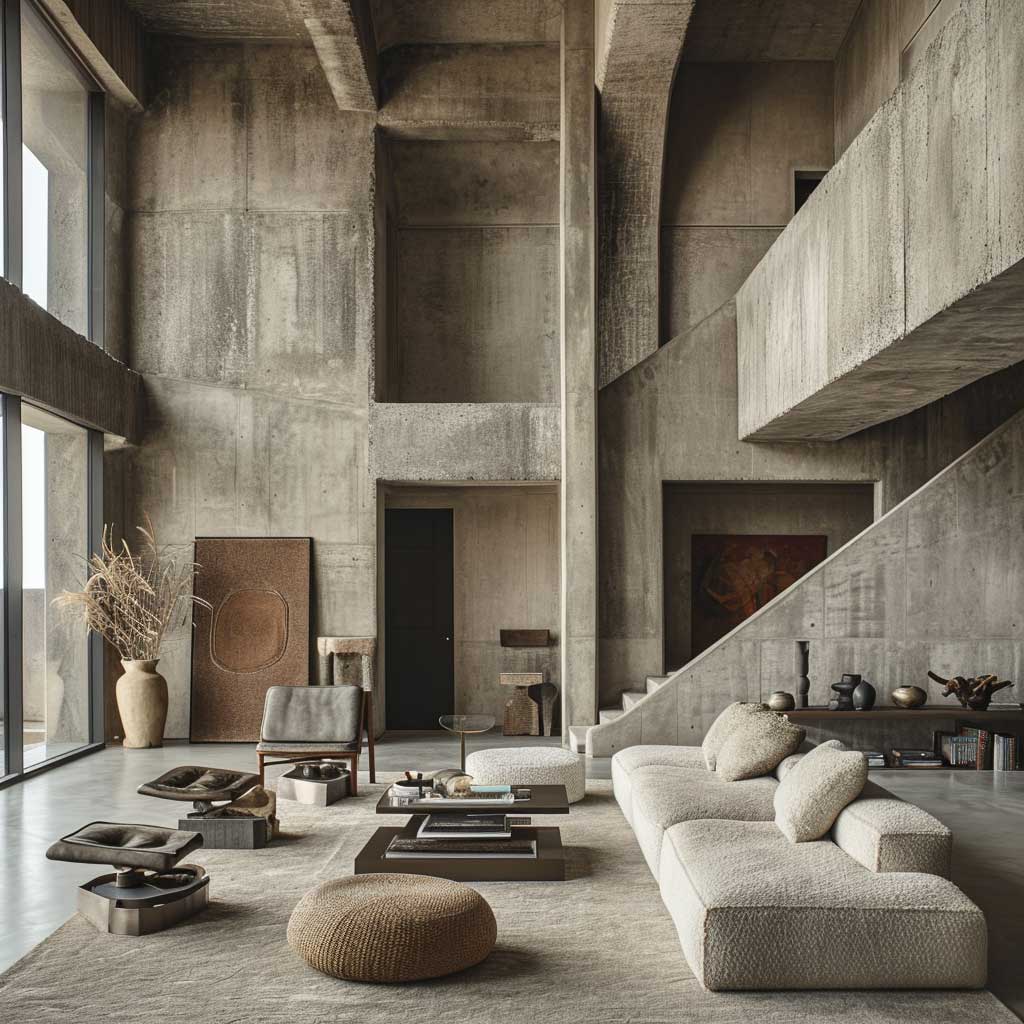

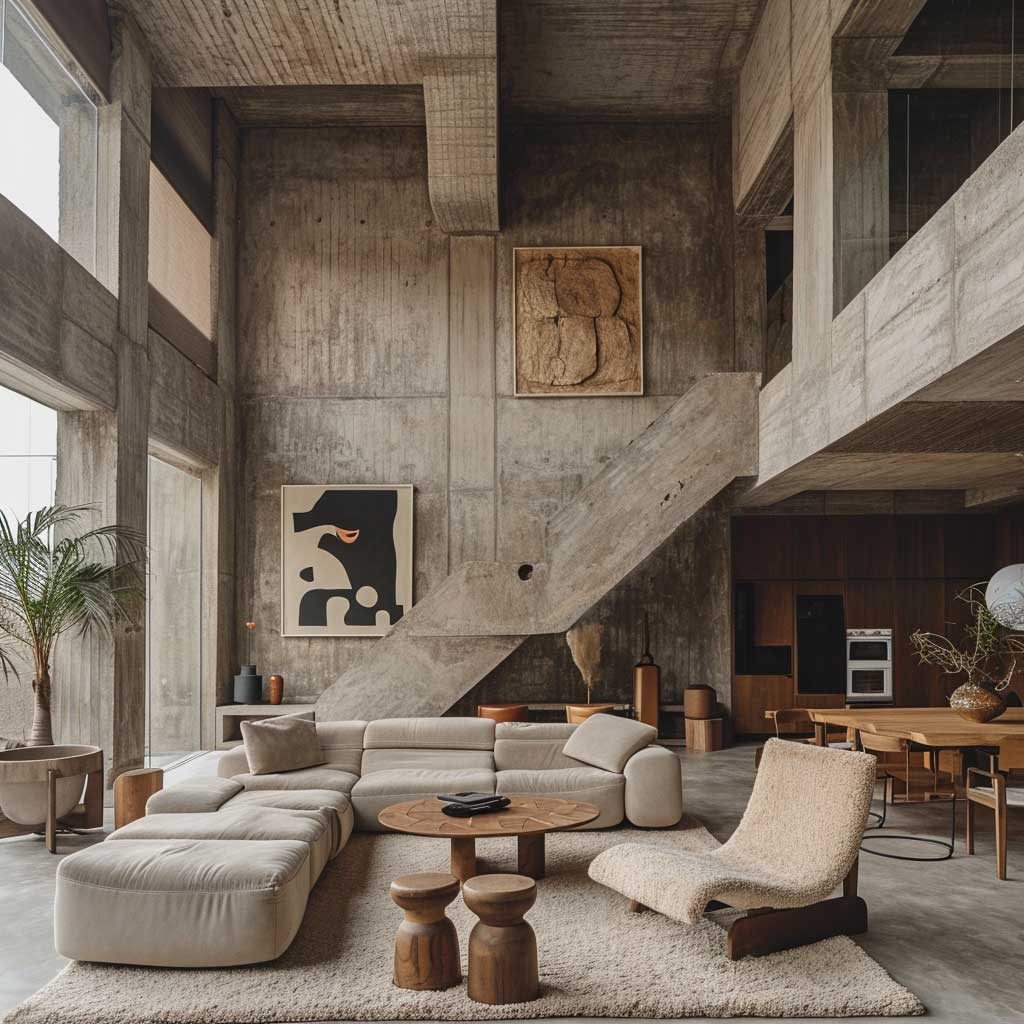
Brutalist interior design in a living room starts with one rule: if you’re covering the concrete, you’re doing it wrong. The unfiltered surfaces of cast concrete, exposed steel beams, and large plate-glass windows are the design — not the backdrop for it. You’ll notice immediately that natural light does most of the heavy lifting here; a floor-to-ceiling window facing south will transform a raw concrete wall from oppressive to architectural in a matter of hours. High ceilings above three meters make this feel spacious rather than bunker-like. Below that threshold, proceed carefully.
Furniture should land in the space like it was poured there. Cassina’s LC2 sofa in charcoal or a Knoll Saarinen Womb Chair in a dark wool upholstery — pieces with geometric weight and zero decorative fussiness — hold their own against a board-formed concrete wall. Avoid anything with tapered legs or ornate stitching; the material contrast looks like a mistake. I’ve made this error myself: a rattan side table I thought would add warmth looked like it had wandered in from a beach house. It lasted four days.
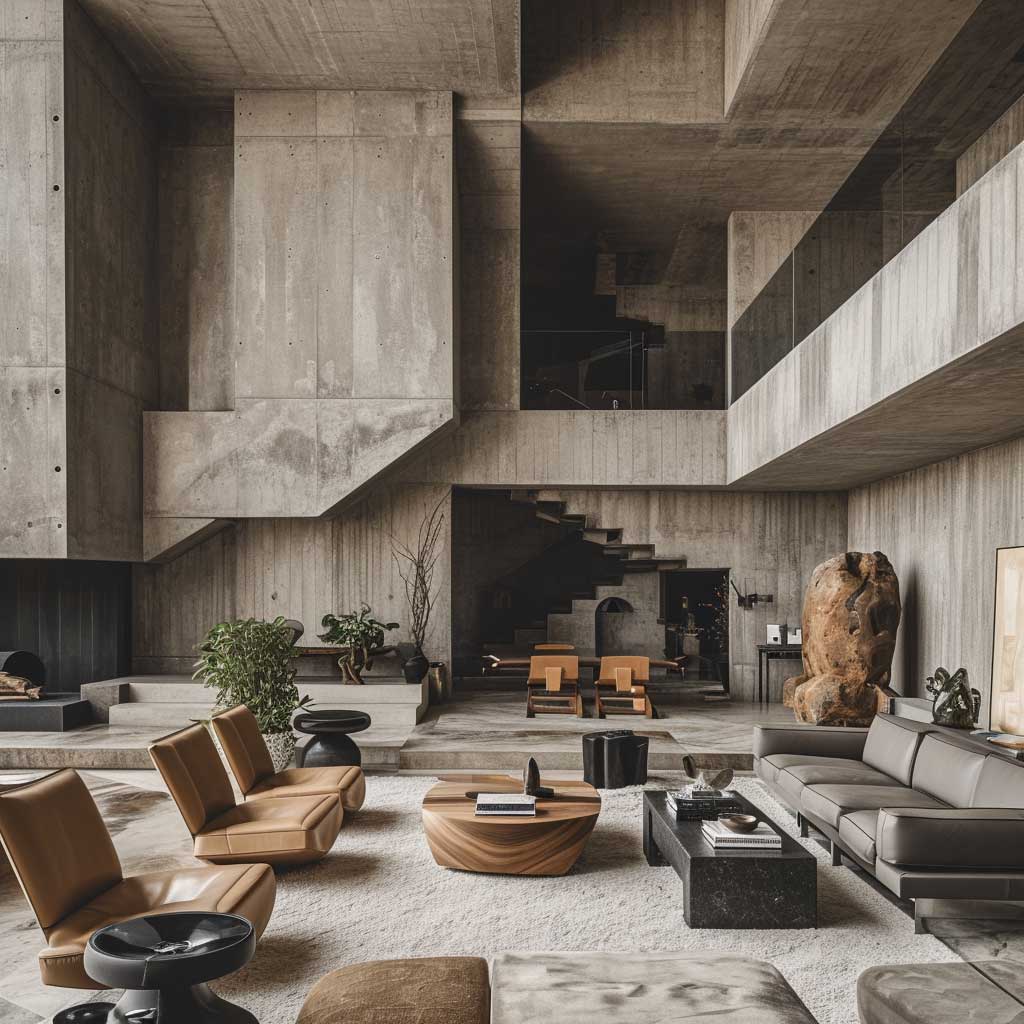


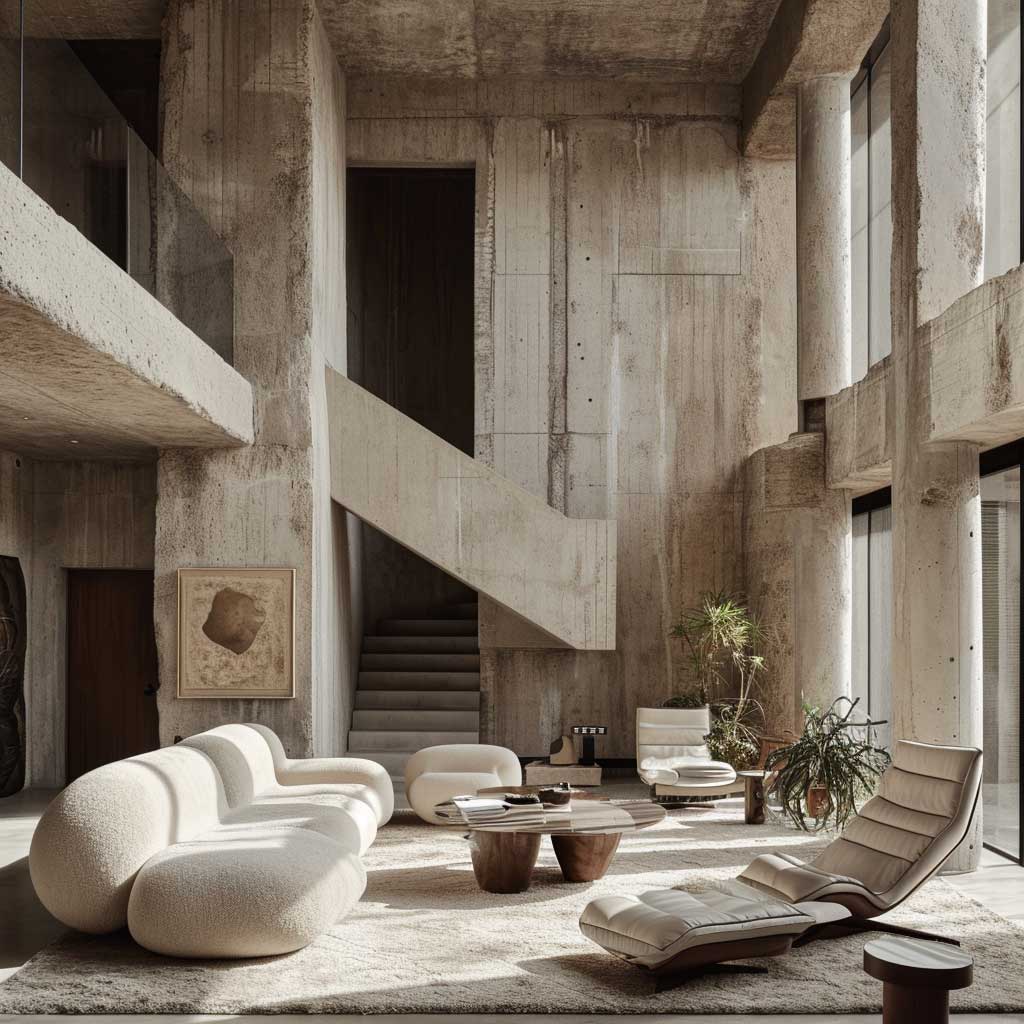
Greenery is the one exception to the no-softening rule. A single Monstera deliciosa in a cast-concrete planter, or a low-maintenance Sansevieria cluster in a steel vessel around $40 from IKEA’s FEJKA line — the living material creates a contrast that makes the concrete look more deliberate, not less harsh. Think of it the way a museum hangs one painting on a large white wall. One is a statement. Four is noise.
Lighting in a brutalist living room shouldn’t announce itself. A Flos Kelvin LED desk lamp repurposed as a floor lamp, or a Tom Dixon Beat pendant in black around $380, provides directional warmth without competing with the architecture. Avoid warm-toned Edison bulbs — the amber glow fights the cool grey palette and produces exactly the cozy-farmhouse look you’re trying to avoid. Concrete as an interior material has specific lighting needs that differ from plaster or painted walls, and getting the color temperature right around 3000K makes the difference between a space that reads as intentional and one that reads as unfinished.
The Brutalist Bedroom Doesn’t Need Your Comfort Objects
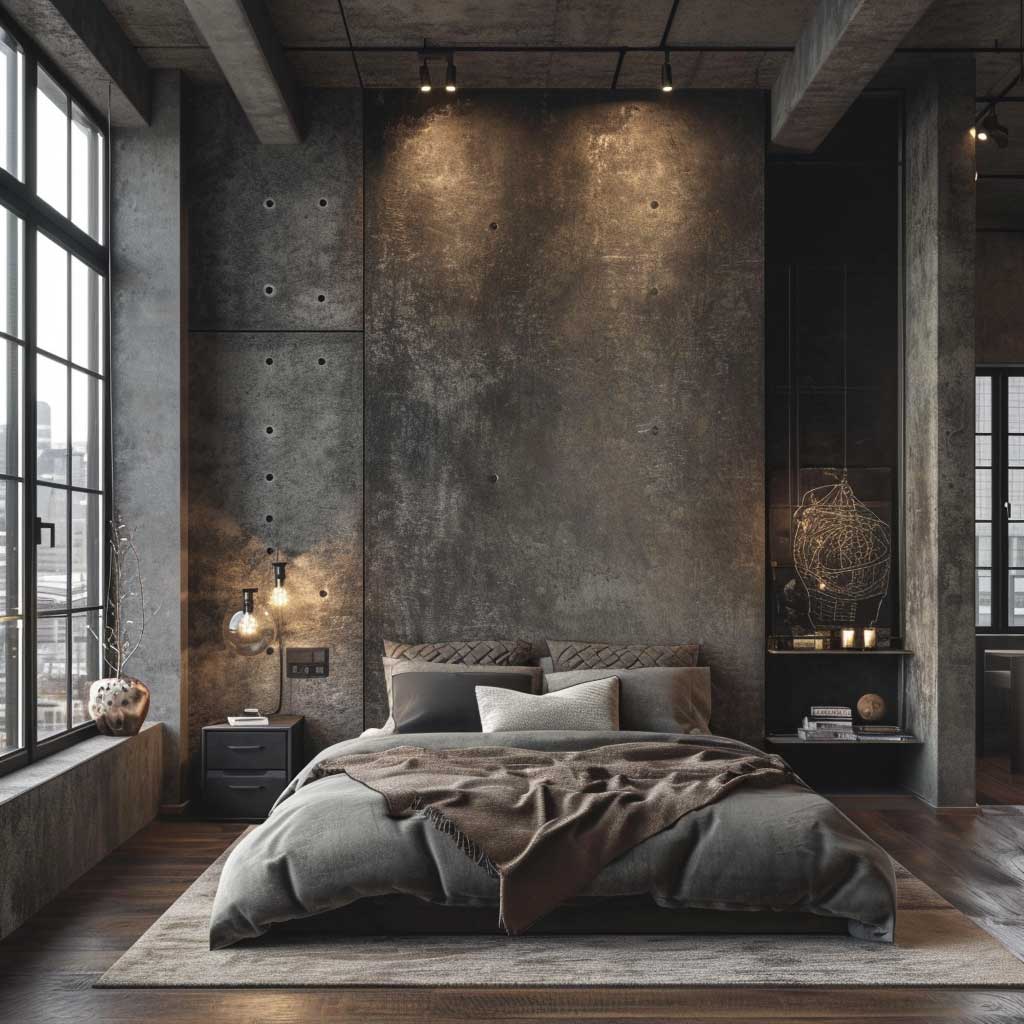
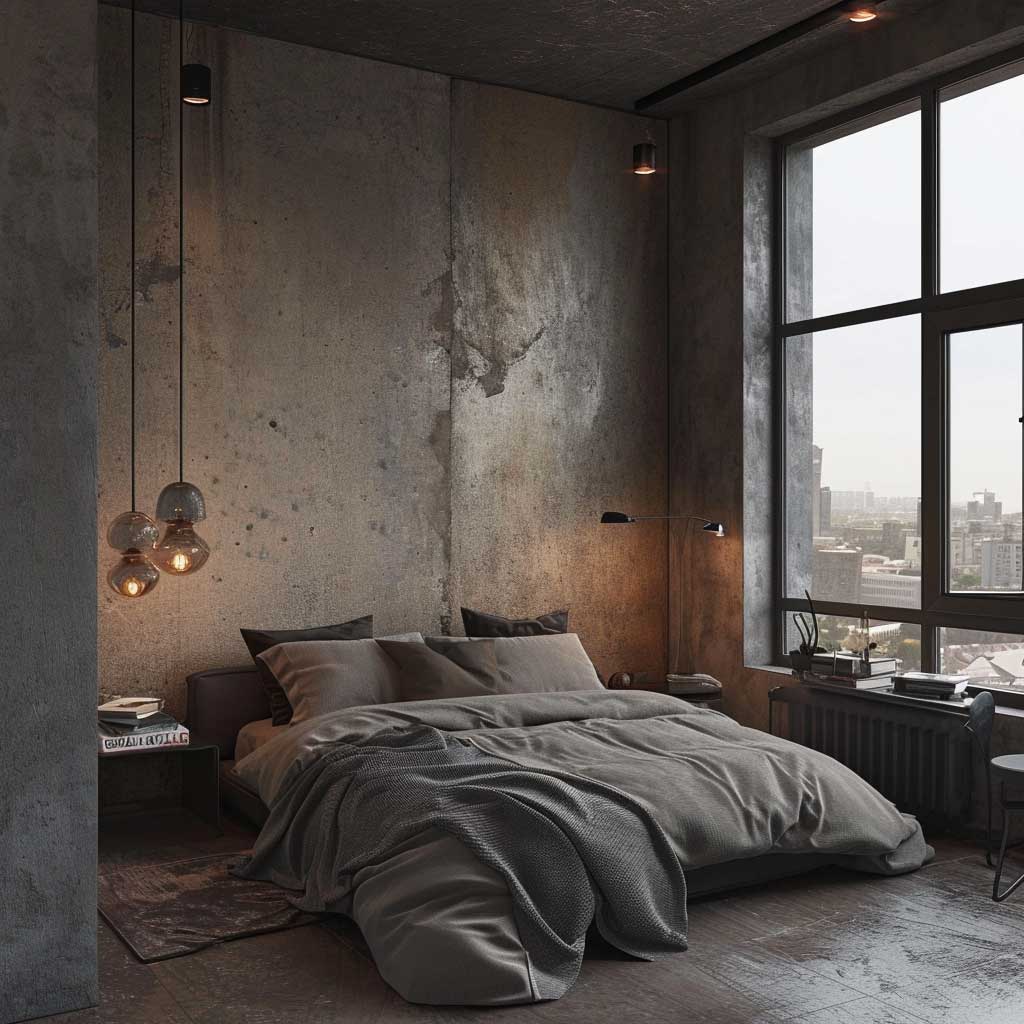

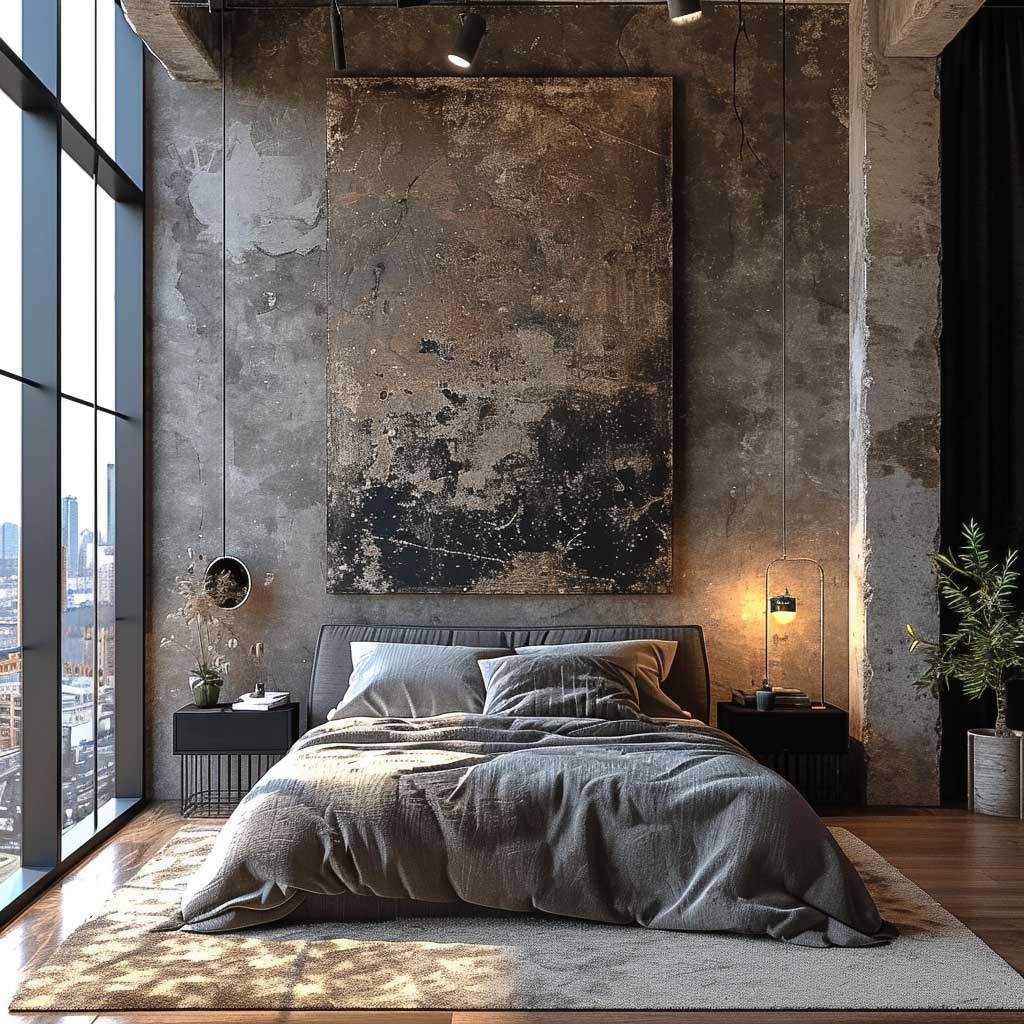
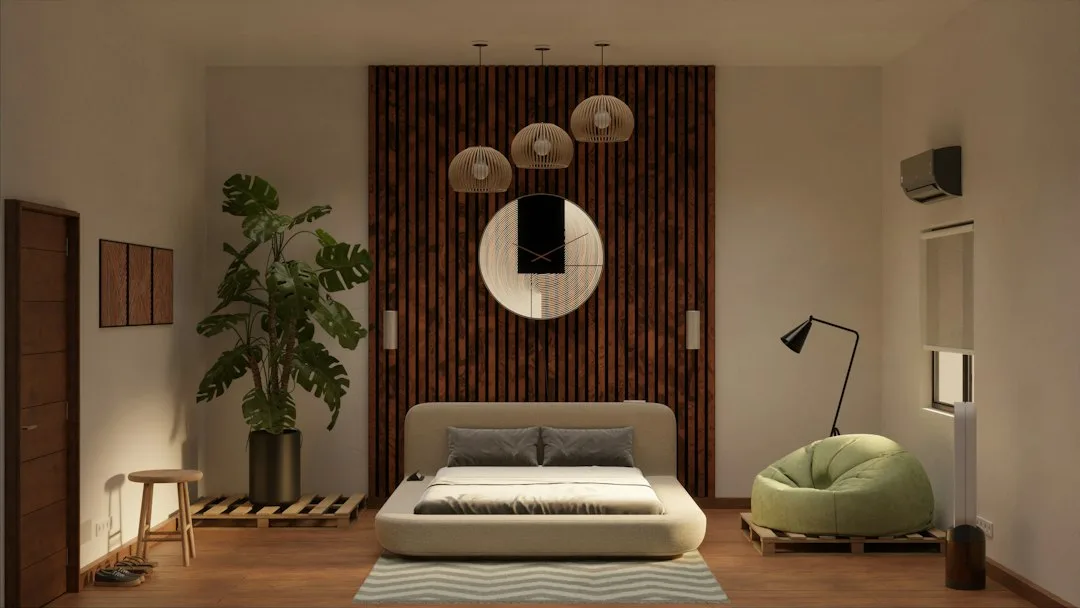
A brutalist bedroom isn’t cruel — it just has a different definition of comfort. The sanctuary isn’t cushion-pile deep; it’s the kind of quiet you get when there’s nothing left to distract you. Walls left as raw concrete or textured plaster with formwork marks intact, floors in polished screed or dark-stained oak — these surfaces carry the visual weight so the rest of the room doesn’t have to. The color palette writes itself: grey, charcoal, warm brown, and the occasional matte black accent. You won’t need to choose anything.
Platform beds in a brutalist bedroom should read as monoliths. Muuto’s Compile Bed in a matte black steel frame at around $1,200, or a custom poured-concrete base with a floating mattress, keeps the geometry honest. What doesn’t work — and I’ve seen this mistake across a dozen renovation photos — is pairing a raw concrete wall with a padded upholstered headboard in dusty rose. The contrast reads as indecision, not contrast. Pick a lane and stay in it.
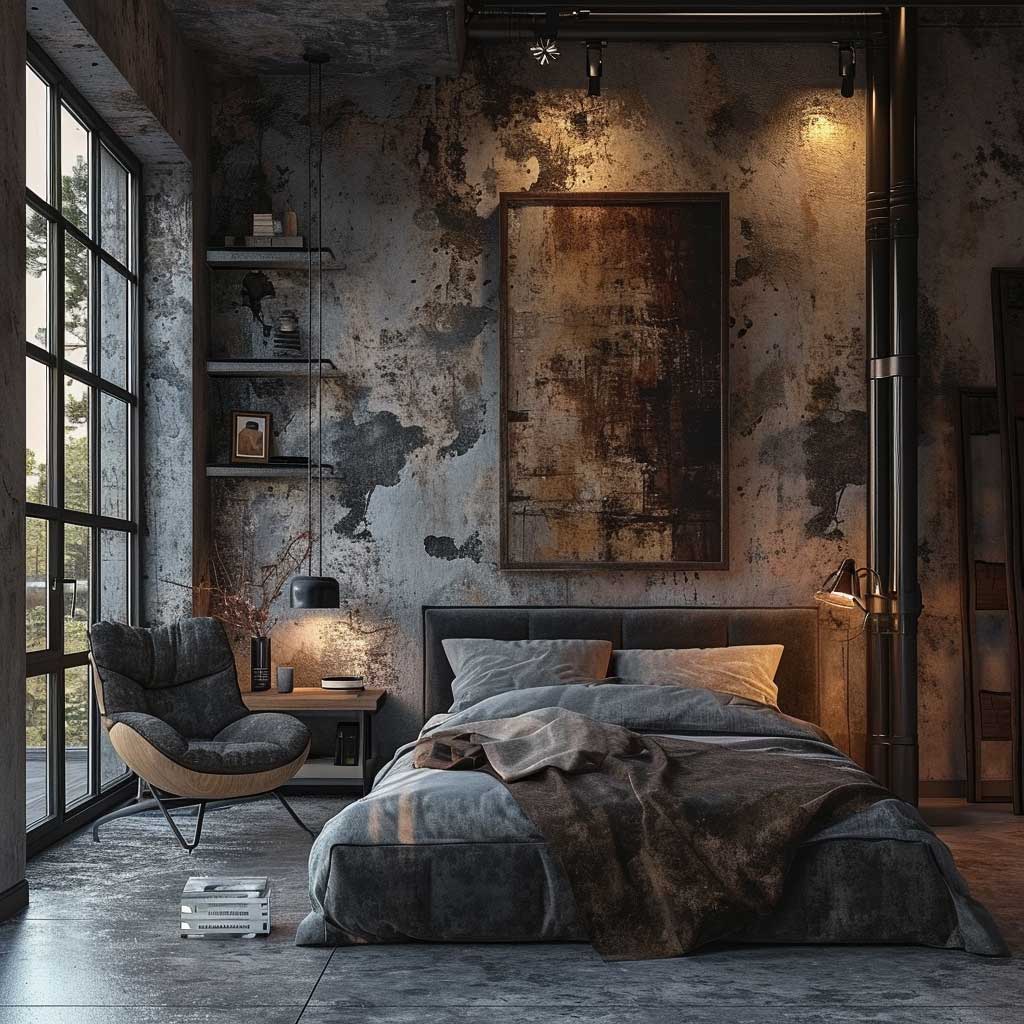

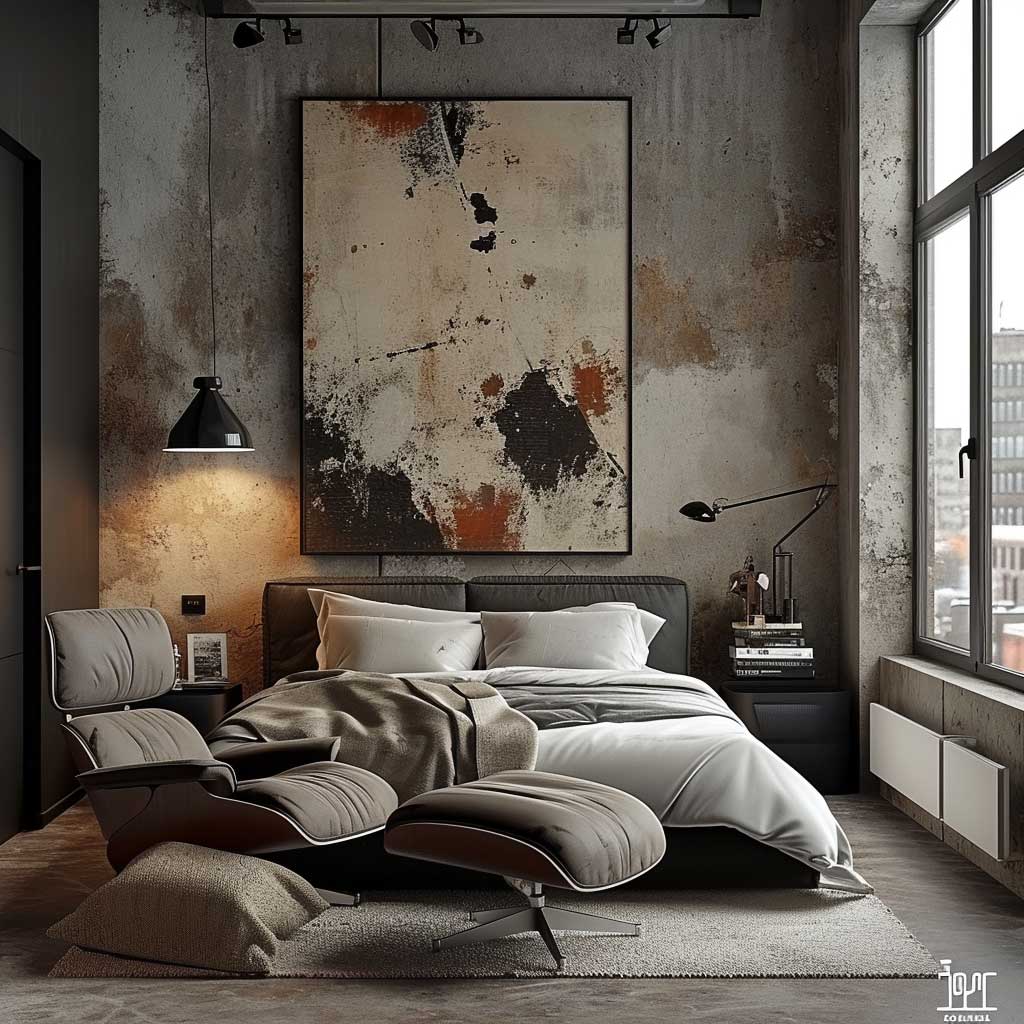
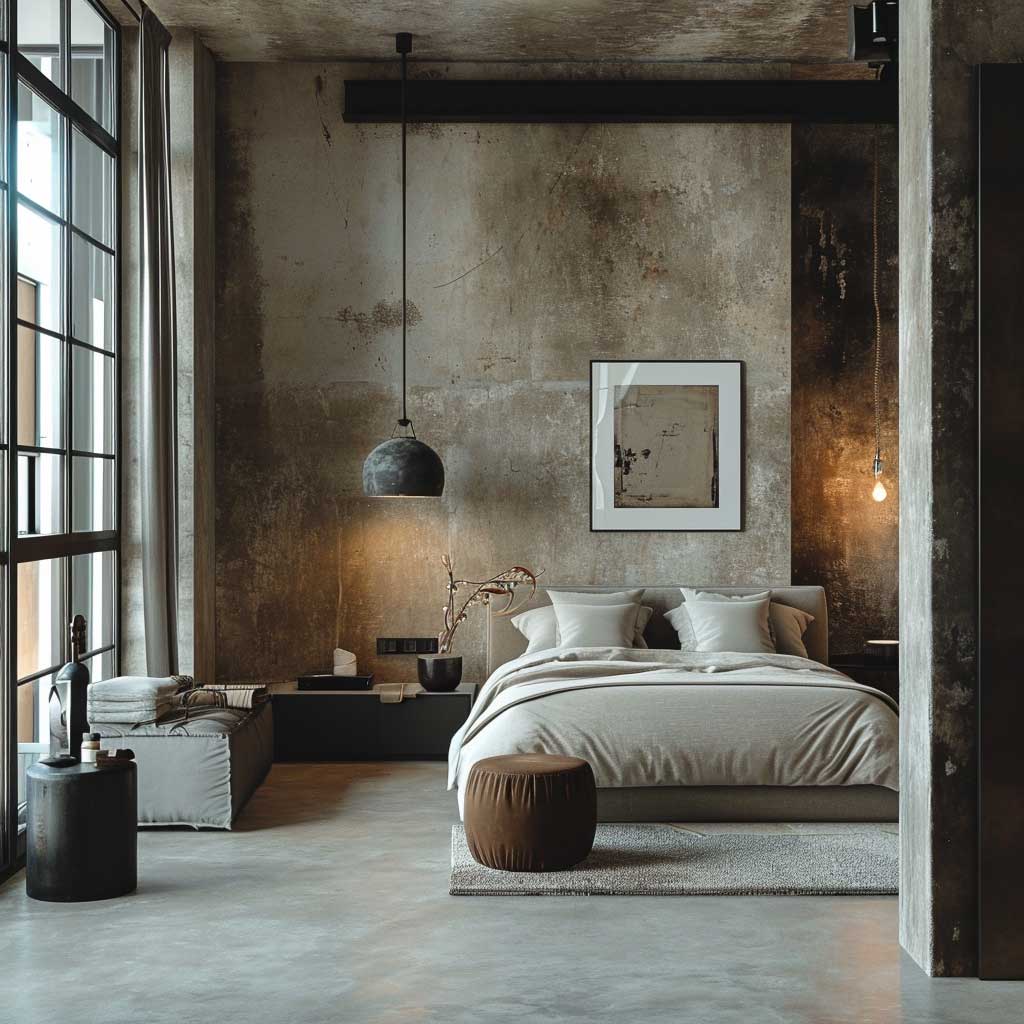
Bedding texture is where you earn the room back. Heavy linen in stone, oat, or slate — Cultiver’s linen quilt covers run around $180 — adds tactile warmth without breaking the palette. A single wool throw in dark charcoal over the foot of the bed reads like a punctuation mark. Strip out the throw pillows. Every unnecessary pillow costs you visual clarity, and in a brutalist bedroom, clarity is the whole point. Is this extreme? Yes. Does it photograph at a completely different level? Also yes.
Lighting stays functional. A Anglepoise Original 1227 Brass in matte black finish around $220 mounted flush to a concrete wall works as both bedside reading light and sculptural object. Avoid floor lamps with fabric shades — the domestic softness lands wrong. Wardrobes should be flat-fronted, handleless, and dark. IKEA’s PAX frame with custom Superfront fronts in graphite brings this in under $600 and doesn’t compromise the room’s logic.
Don’t Do This in a Brutalist Space
Adding gallery walls with mixed frames and art prints is the fastest way to undo a brutalist interior. The style lives or dies on visual restraint — one oversized piece of abstract work or nothing. Mixed-frame gallery walls, chevron-pattern rugs, and macramé wall hangings have all shown up in spaces claiming to be brutalist. They aren’t. They’re maximalist interiors that happen to have one concrete wall. The distinction matters because the concrete wall alone won’t save the room if everything else contradicts it. Skip the gallery wall entirely, or commit to a single canvas — 120cm x 90cm minimum — in a monochromatic palette.
Concrete Countertops, Flat Fronts and Why the Brutalist Kitchen Actually Functions
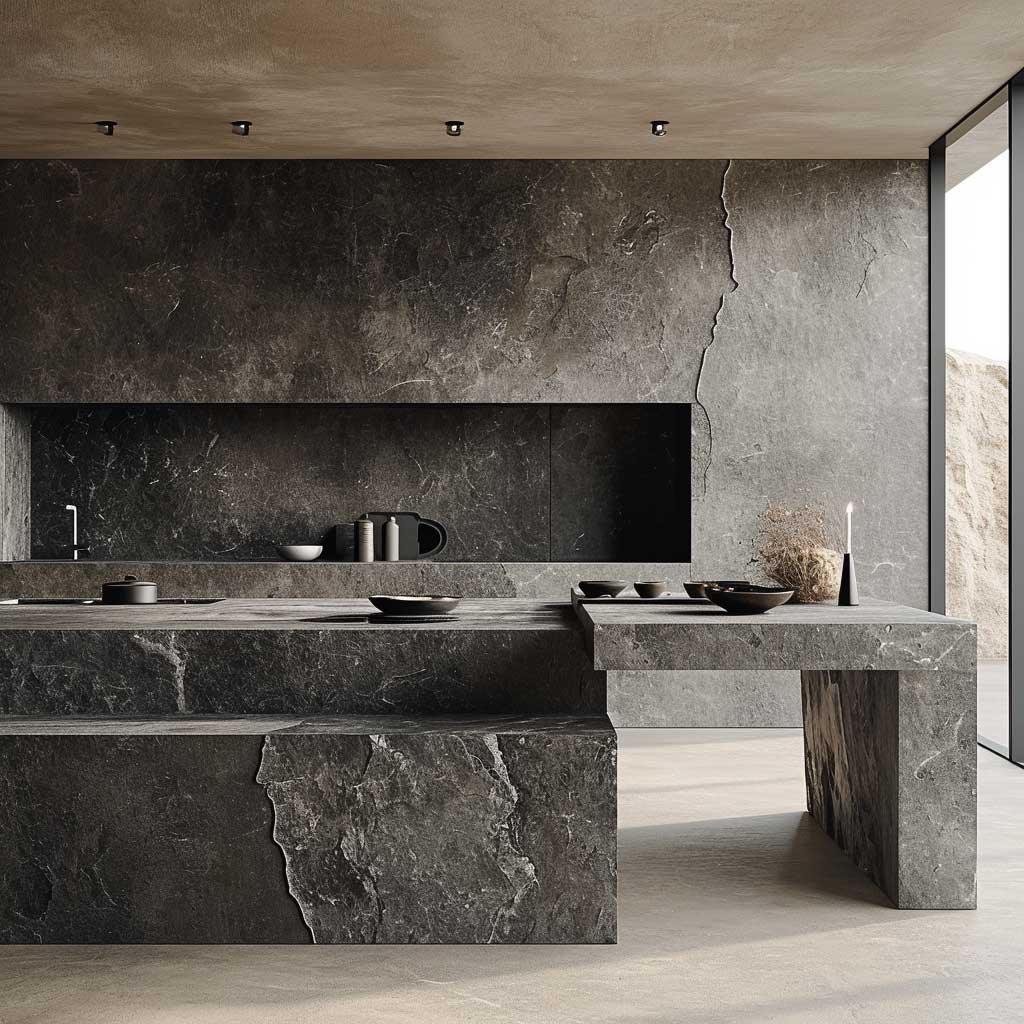


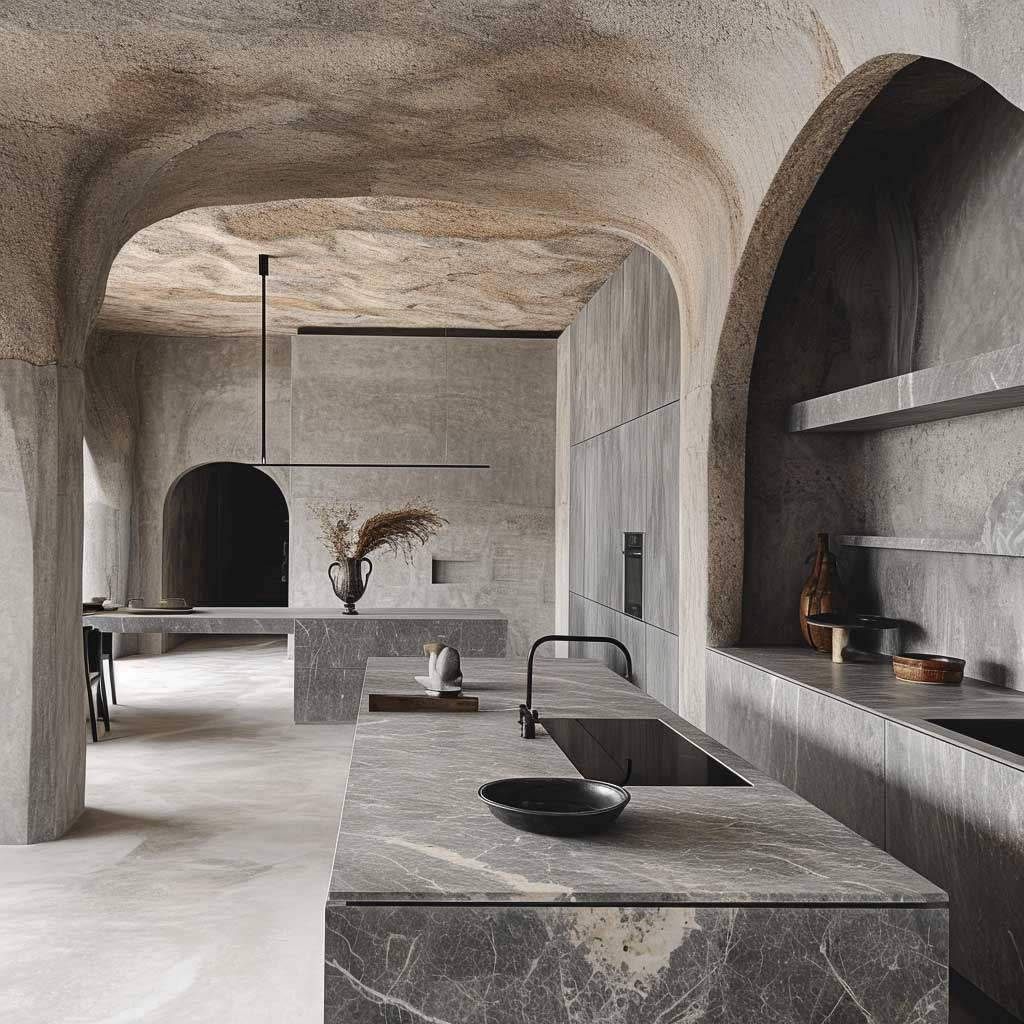
The brutalist kitchen is where the style proves it isn’t just aesthetic posturing. A poured-concrete countertop sealed with a penetrating epoxy sealer — expect $150 to $250 per linear meter installed — is harder-wearing than most quartz alternatives and develops a patina over years of use that no manufactured surface replicates. Cabinets with flat, handle-free fronts in dark matte lacquer or raw MDF with a graphite oxide finish keep the eye moving without stopping. The moment you add a shaker panel or a cup pull handle, you’ve left brutalism and entered something else entirely.
Open steel shelving instead of upper cabinetry is both a functional and visual choice. You need discipline — every object on that shelf is visible and therefore part of the design. Falcon Enamelware in cream or jet black around $25 per piece, a small stack of matte black cast-iron skillets, a set of uniform glass storage jars. Nothing else. The brutalist kitchen is like a well-organized tool shed that happens to cost a lot: every item has a place, a purpose, and a visual role. Decorative bowls and seasonal wreaths do not have a role.
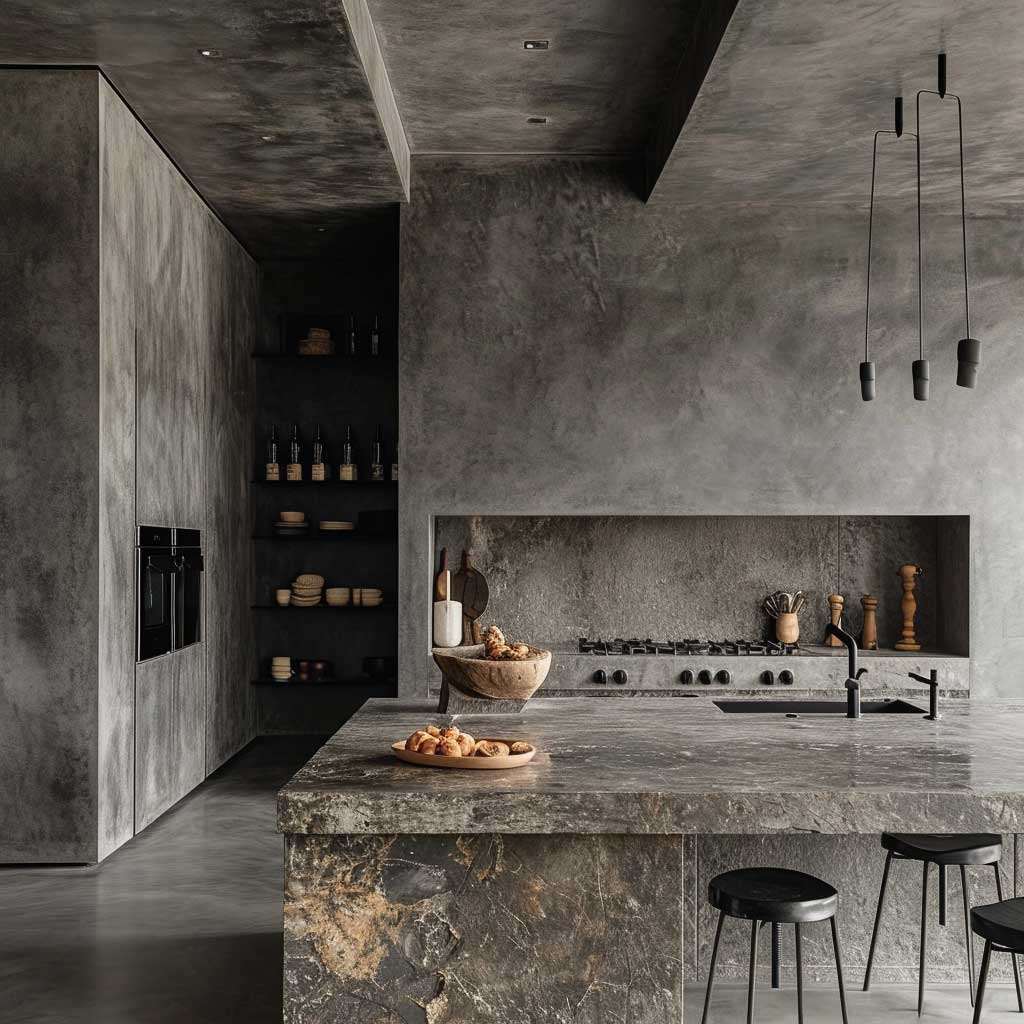

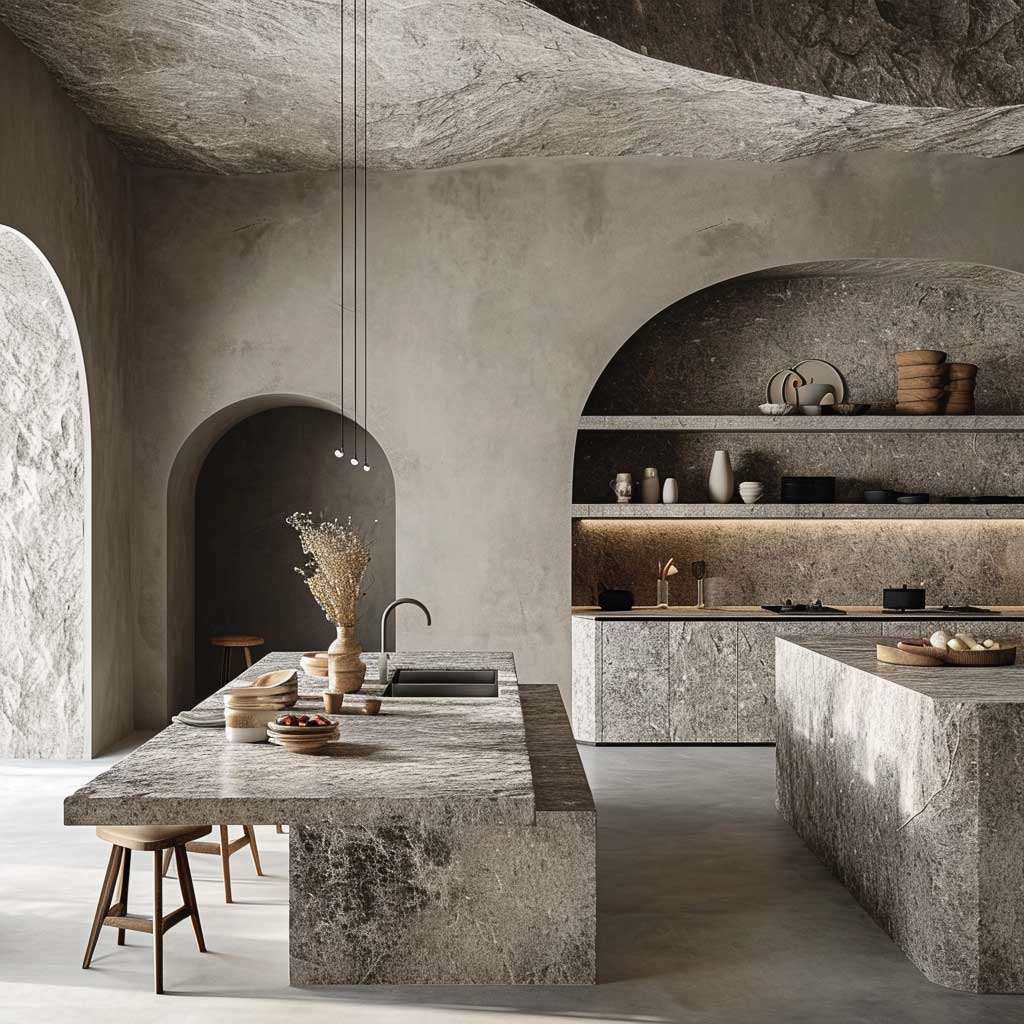
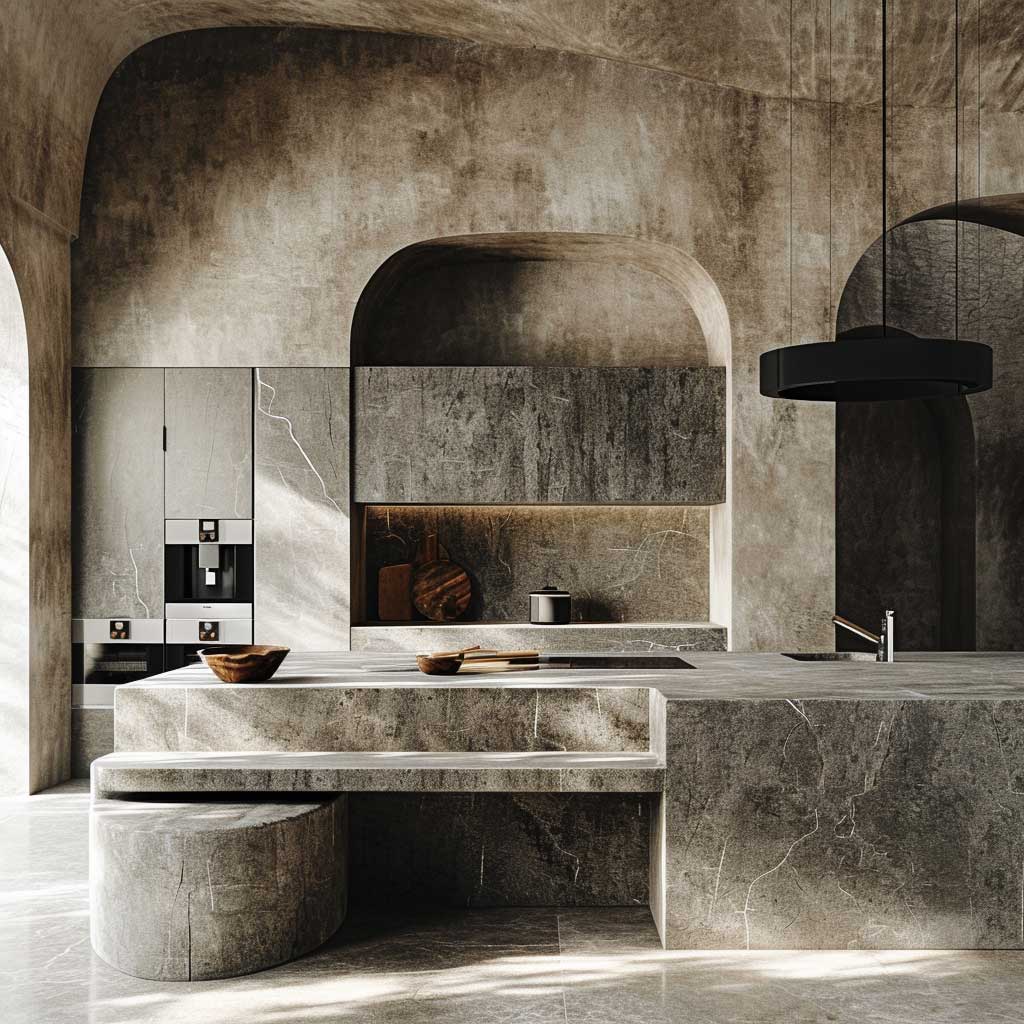
Appliances in a brutalist kitchen should disappear or dominate — nothing in between. A Smeg FAB refrigerator in cream would look absurd here; a fully integrated Bosch panel-ready fridge or a freestanding Lacanche range in matte dark grey at around $6,000 earns its presence. The Lacanche in particular has the visual weight of a piece of industrial sculpture. It’s the one appliance I’d tell you to spend money on before the countertop. Concrete worktops in industrial-style kitchens follow their own logic of maintenance and sealing that’s worth understanding before you commit to the material.
Lighting over a brutalist kitchen island should be singular and architectural. A single Apparatus Studio ARC pendant or a comparable raw-steel linear pendant around $400 to $600 centers the space without cluttering it. Recessed downlights in a 2700K warm white temperature fill the working surfaces. What you don’t want is a cluster of four identical pendants at graduated heights — that’s a hospitality trend that has no place in a space built around structural honesty. One fixture. Make it mean something.
Material Comparison for Brutalist Interiors
| Material | Cost (per m²) | Visual Weight | Maintenance | Best Use |
|---|---|---|---|---|
| Poured Concrete | $120–$250 | High | Annual sealing | Floors, countertops, feature walls |
| Raw Steel | $180–$350 | Medium-High | Rust treatment | Shelving, frames, fixtures |
| Raw Timber | $80–$160 | Medium | Oil annually | Contrast element, floors, furniture |
| Polished Screed | $60–$100 | Medium | Low | Floors throughout |
| Glass (large pane) | $200–$500 | Low — structural | Minimal | Windows, partitions, skylights |
The organic brutalism and minimalist brutalist interior design variations approach the same foundation from different angles. Organic brutalism softens the palette with earth tones — warm beige concrete, raw travertine, unfinished terracotta tile — and brings in curved architectural forms rather than hard angles. Bold geometric forms and concrete textures in modern homes show how far this material language can stretch without losing its structural integrity. Minimalist brutalism strips the space even further: fewer materials, larger planes, almost no furniture. Both interpretations share the same refusal to ornament what doesn’t need ornamentation. The futuristic take adds polished black metal and integrated LED strip lighting at the junctions between planes — it photographs well and costs significantly more to execute cleanly.
Final Word
Brutalist Interior Design Doesn’t Ask Permission
Raw materials, zero decoration, and structural honesty — these aren’t constraints. They’re the design. Every room covered in this article earns its aesthetic through what it removes, not what it adds.
You don’t need a complete renovation to feel the shift. Start with the concrete wall, get the lighting temperature right at 3000K, and clear every surface that isn’t holding something with a function. The room will tell you what it needs next.
Save this post before you begin your next interior project — the material costs and brand references here will save you hours of research.
External source on brutalist interior design characteristics: Homes & Gardens — What Is Brutalist Interior Design offers an expert breakdown of the style’s defining material and spatial logic.