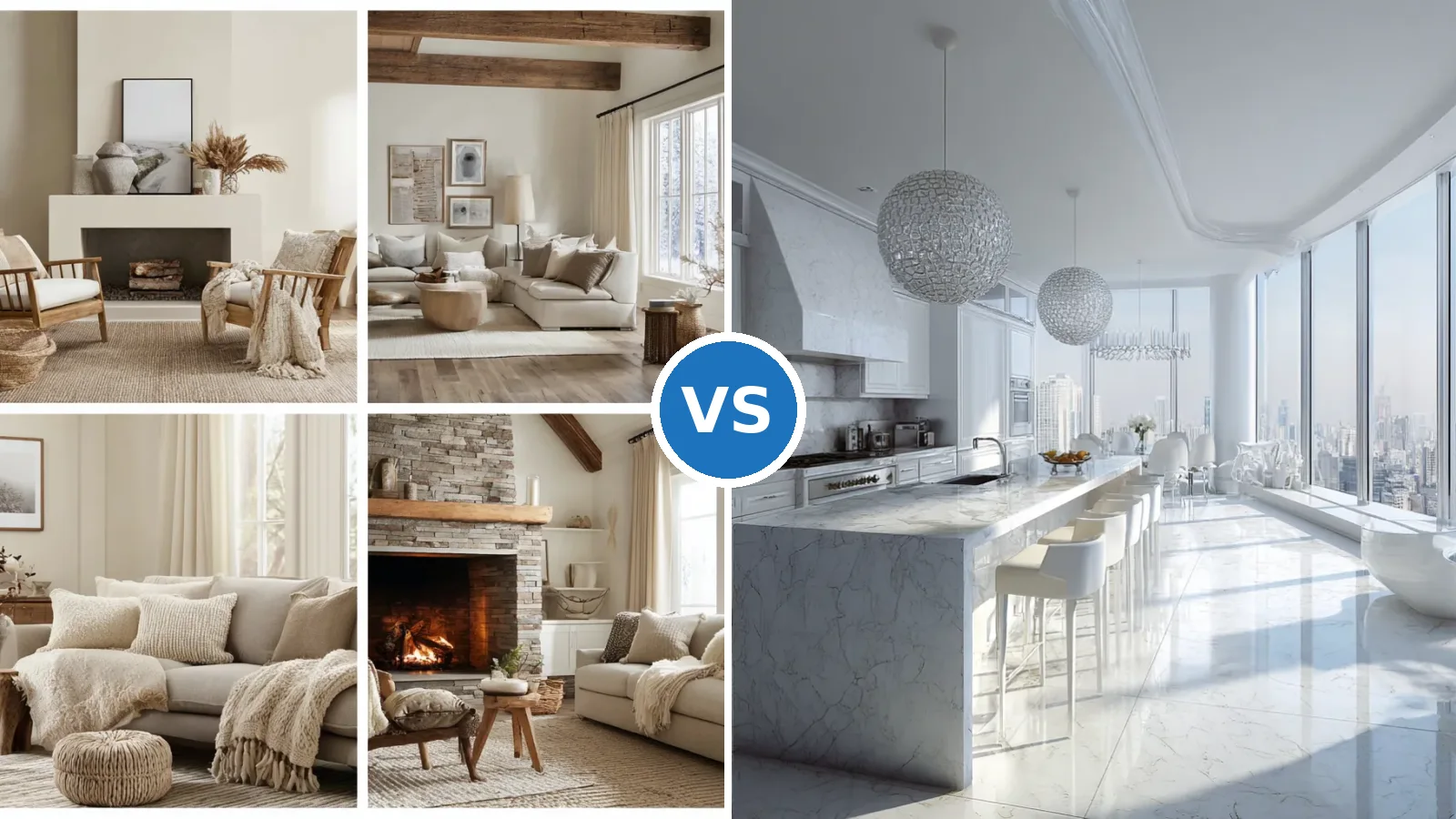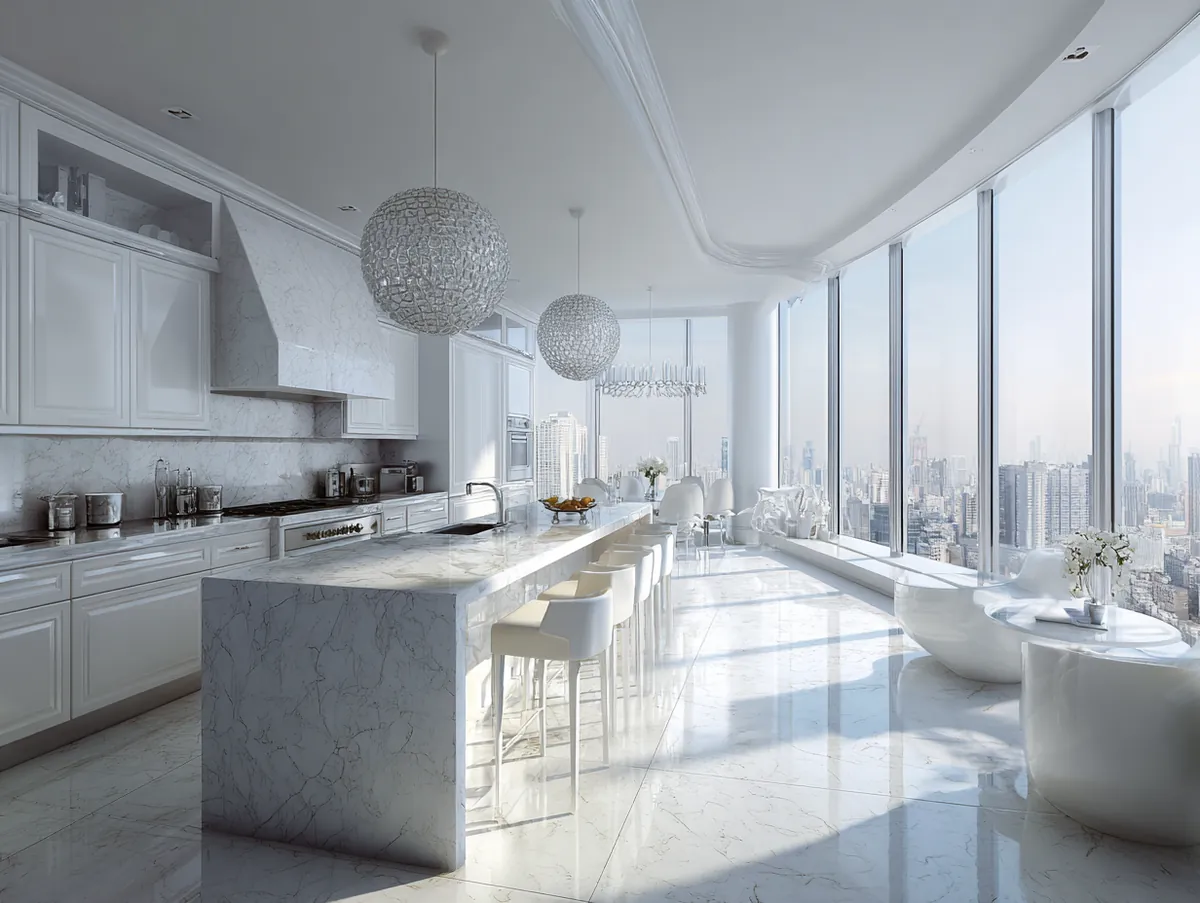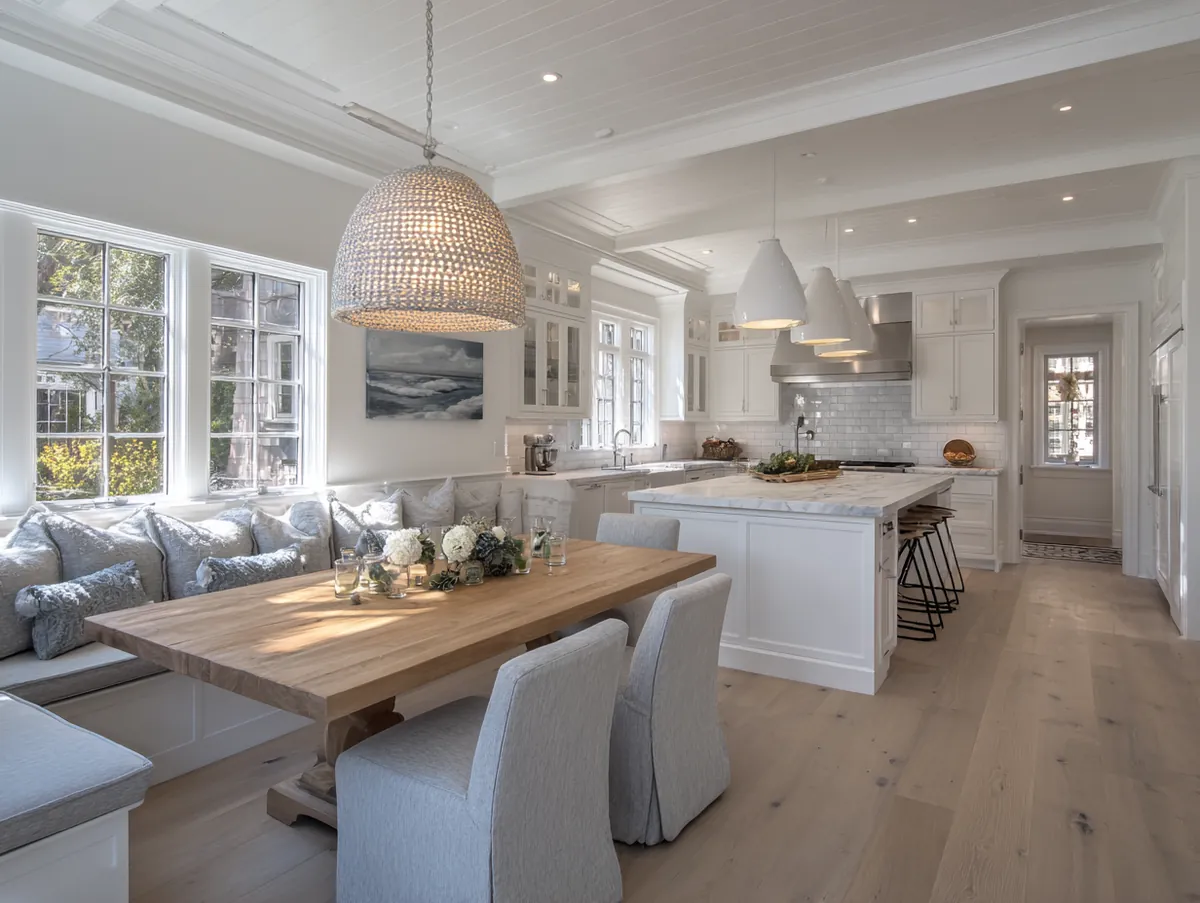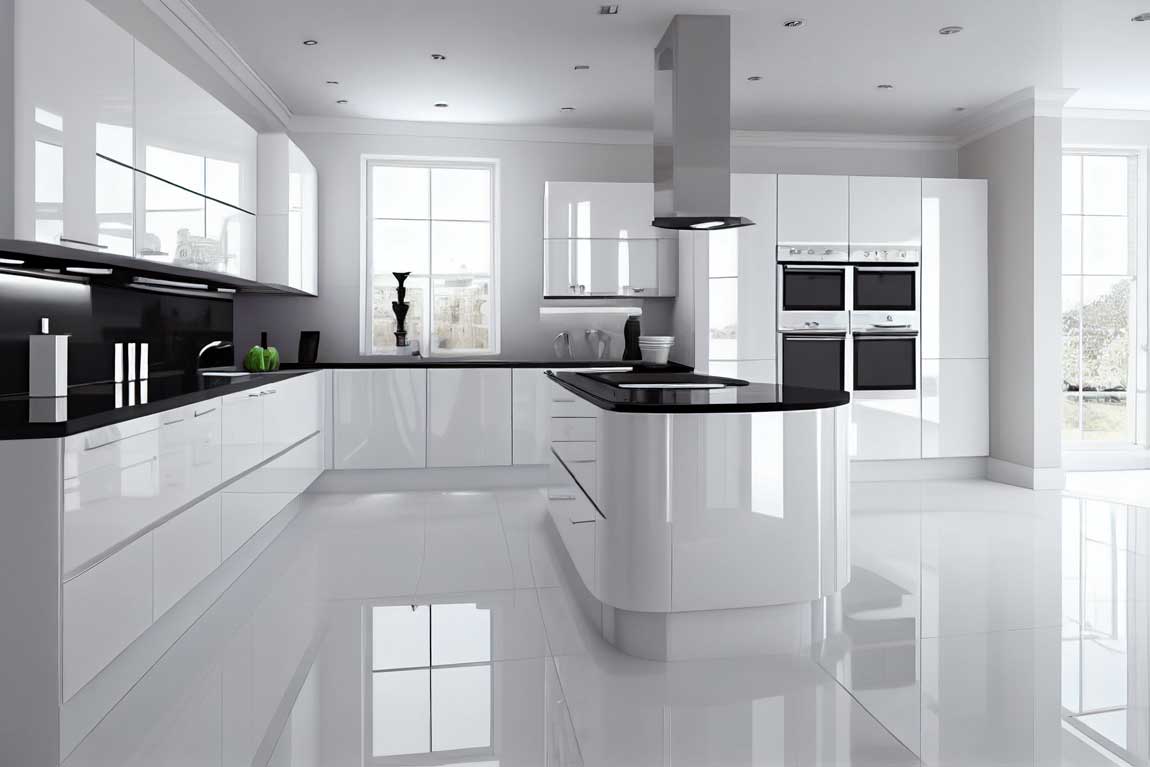
White gloss kitchen ideas have dominated renovation mood boards for a reason that has nothing to do with fashion: the reflective surface bounces light around the room like a mirror, and in a cramped galley or a London flat with one north-facing window, that matters. I’ve spent the last three years photographing renovated kitchens, and the rooms that photograph brightest — and sell fastest — are consistently the ones with high-gloss white cabinets. You’ll notice the difference the moment you walk in. The finish isn’t just cosmetic; it’s structural light engineering on a flat-pack budget.
None of that means gloss is foolproof. Glossy white surfaces punish bad lighting and lazy layout decisions harder than matte ever would. This article covers what actually works, what looks terrible in practice, and the worktop and colour combinations that move a white gloss kitchen from clinical to genuinely liveable.
Quick Scan
- White gloss kitchen ideas work hardest in small spaces — the reflective surface adds perceived square footage
- Best worktop pairings: Calacatta quartz (~$60–$90/sq ft), dark grey granite, solid oak
- High-gloss lacquer cabinets from brands like Pronorm, Häcker, and Leicht start around $8,000 for a 10×10 layout
- Modern white and grey gloss kitchens dominate new builds — grey quartz at mid-tone is the most popular combination
- Small white gloss kitchen ideas rely on handle-free (push-to-open) doors to cut visual clutter
- Avoid: all-white surfaces with no contrast, blue-toned white in rooms with cool north light
Why Gloss White Cabinets Make a Room Feel Larger
High-gloss white kitchen cabinets work like a continuous mirror wall — they catch and redirect every photon that enters the room. My go-to way to explain this to clients is to hold a sheet of gloss white laminate in a dark corner and watch the corner disappear. In a 7×9 galley kitchen, that effect does more work than a skylight. You’ll notice that rooms with gloss cabinets consistently photograph brighter, which is exactly why every kitchen showroom uses them.
The physics are simple: matte finishes scatter light diffusely, while gloss finishes reflect it directionally. That directed reflection creates depth. I’ve walked through identical floor plans — one fitted with matte shaker doors, one with high-gloss handleless — and the difference felt like a room extension. Gloss isn’t subtle. It’s a spatial trick that costs the same as matte and does three times the work.
Don’t buy pure bright white gloss if your kitchen faces north. I made that mistake. The blue-white tone reads cold and clinical under grey British daylight and makes the space feel like a dental surgery. Warm white — think Dulux Timeless or RAL 9010 — adds enough cream to read as crisp rather than sterile. That single decision changes how the finished kitchen feels every morning.
Modern White and Grey Gloss Kitchen Combinations Worth Copying
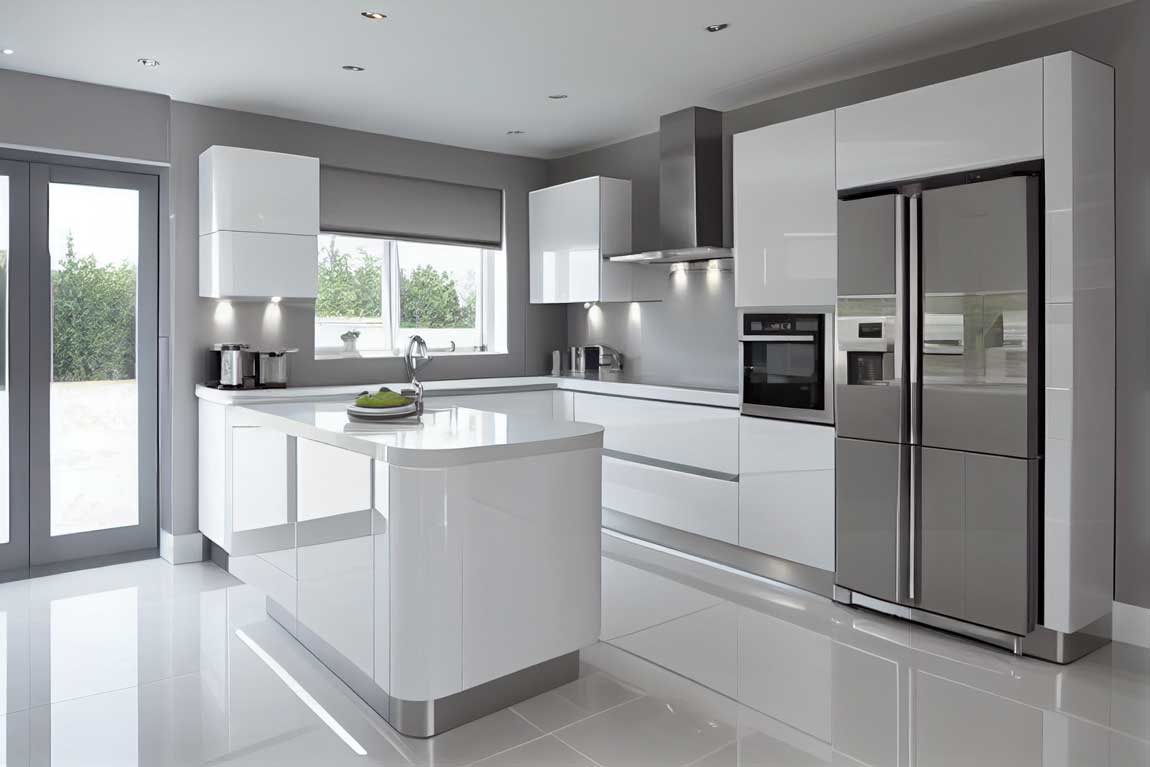
Grey is the most reliable partner for white gloss cabinets because it absorbs where gloss reflects — the two finishes balance each other the way a matte lip colour balances a full smoky eye. I own a Pronorm Largo handleless kitchen in gloss white with a Silestone Cygnus worktop (a mid-grey with faint silver flecks, around $72/sq ft installed) and four years in, it still looks like the showroom photo. The key is choosing a grey with the same undertone as the cabinet white — warm grey under warm white, cool grey under pure white.
Mid-grey quartz from Silestone or Caesarstone dominates new-build specifications right now. The price runs $55–$85 per square foot installed depending on edge profile. Avoid ultra-dark graphite unless your kitchen has serious natural light — charcoal worktops in a north-facing room flatten the whole scheme. For a modern white and grey gloss kitchen that avoids the clinical trap, add one warm element: a walnut breakfast bar section, brass tap, or terracotta pendant.
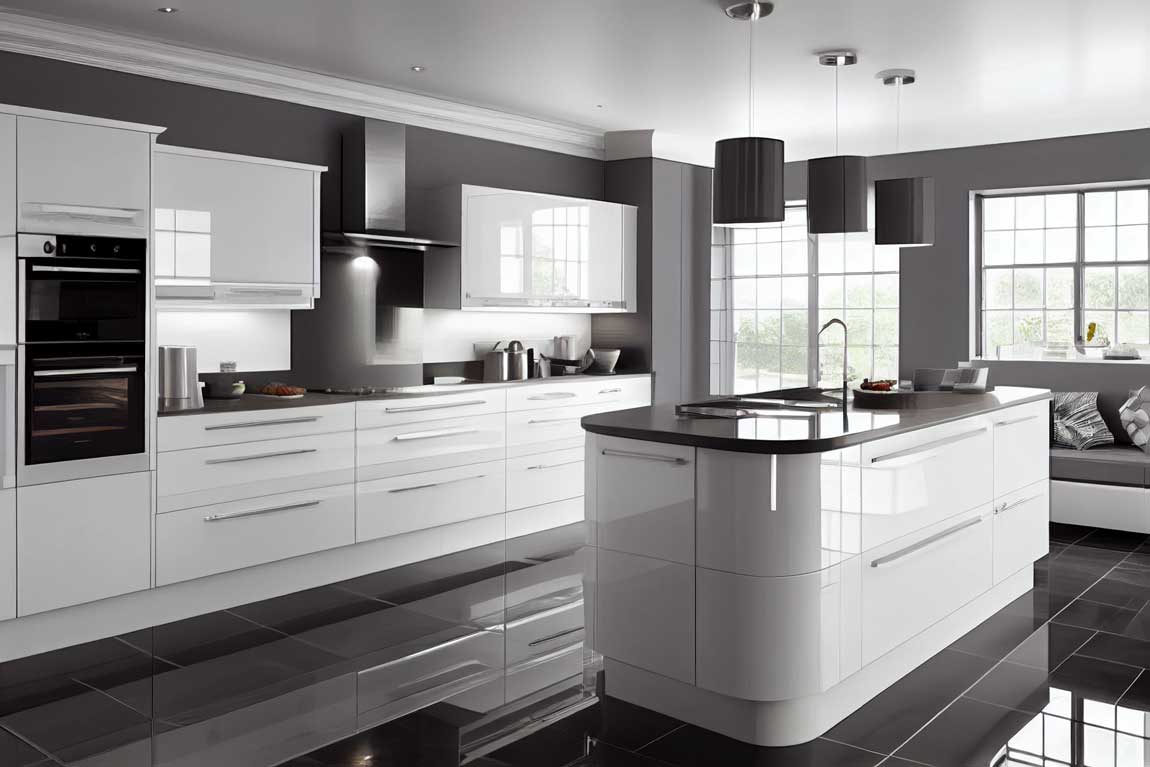
A grey and white gloss kitchen also forgives fingerprints better than a pure white scheme. Smudges on gloss surfaces catch the light — that’s physics, not negligence — and a contrasting dark grey worktop means the eye is drawn to the drama of the surface rather than the fingerprint on the door. Wipe with a damp microfibre cloth every two days and the kitchen looks perpetually new. Avoid spray cleaners with alcohol — they dull the gloss finish over time, and that damage is irreversible.
What Colour Worktop Actually Works With White Gloss
The worktop question is where most white gloss kitchen projects go sideways. I’ve seen beautiful cabinets destroyed by the wrong surface. Here’s what I’ve tested: Calacatta quartz ($60–$90/sq ft, Silestone or Compac) gives you marble drama without the maintenance anxiety — I stole this choice from three different kitchen designers I interviewed and bought it myself. The white background with grey veining ties directly into the cabinet colour while adding movement and warmth.

Oak and solid walnut worktops ($45–$75/sq ft installed) are the best choice when you want the kitchen to feel warm rather than architecturally spare. The grain introduces organic texture that gloss surfaces lack entirely. Ikea’s solid oak Karlby at $299 per 8-foot run looks nearly identical to bespoke workshop timber. You’ll need to oil it twice a year — that’s the trade-off. Black granite works brilliantly in large, well-lit kitchens but shrinks small rooms fast. If you’re working with under 120 sq ft, stay in the grey-to-oak range.
Don’t Do This
Don’t pair gloss white cabinets with a pure white worktop unless the room gets strong natural light all day. I’ve photographed four kitchens with all-white schemes — every one read flat and institutional in photos, and owners of two had already changed the worktop within 18 months. The gloss surface needs contrast to show off its reflective quality. Without it, you just have an expensive surgery. And skip cream-coloured laminate worktops entirely — the yellow undertone turns the white cabinets blue by comparison, which looks like a malfunction rather than a design choice.
For a detailed breakdown of worktop pairings, Ideal Home’s guide to worktops for white kitchens covers material durability and the current contrast trends from leading UK kitchen designers.
Small White Gloss Kitchen Ideas That Don’t Feel Cramped
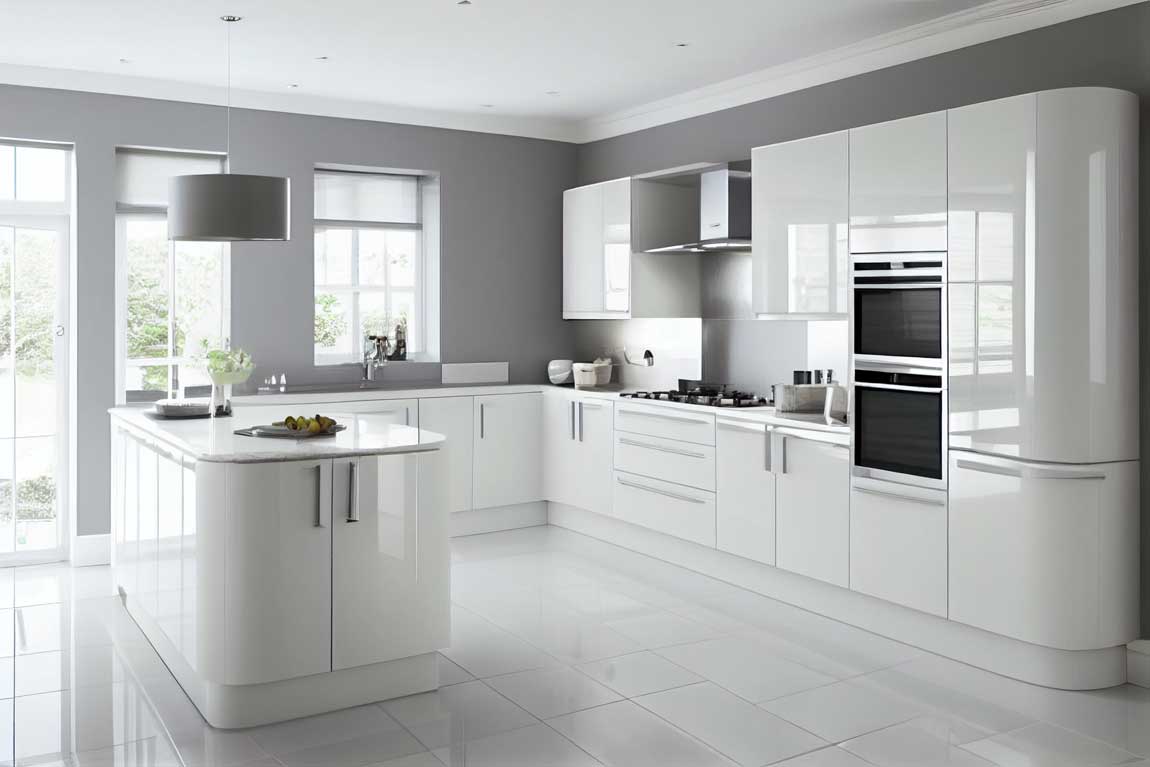
Small white gloss kitchen ideas live or die on one decision: handle-free doors. Push-to-open or J-pull handleless cabinets remove 30–40 horizontal lines from the room in one move. Every handle is a visual break that makes the eye stop. Removing them makes the cabinets read as one continuous reflective surface, which is exactly the spatial trick a narrow kitchen needs. Häcker’s AV6040 handleless range starts around $9,500 for a compact galley layout including installation.
Ceiling-height cabinets are the second move. Most standard kitchen cabs stop 12–18 inches short of the ceiling, leaving a dead zone that the eye reads as a lid pressing down on the room. Run the gloss doors all the way to the cornice and you get a height-exaggerating vertical line that pulls the ceiling up visually. I’ve seen this trick add what feels like a full foot of height in 8-foot-ceiling flats. Use the top section for storage — it’s dead space otherwise and can hold appliances you rarely use.

Under-cabinet LED strips ($16–$40 per metre, Philips Hue or Sensio) do more for a small gloss kitchen than any pendant light. The strip hits the worktop directly and bounces off the gloss surface above — the room appears lit from inside the cabinet rather than from a bulb in the ceiling. Pair with a dimmer switch. Don’t skip this because it seems like a finishing touch; it’s structural lighting that changes how the room reads at 6am. You need it, especially in spaces that don’t have natural light above the worktop. For more small kitchen layout strategies, see these small open concept kitchen designs that use light and reflection to expand tight footprints.
High Gloss Kitchen Design Without the Fingerprint Problem
High gloss kitchen designs attract fingerprints — that’s non-negotiable. The question is how much that bothers you on a Tuesday morning. I own two high-gloss surfaces in my kitchen and clean them with a damp e-cloth every two days; the whole job takes 90 seconds. What nobody tells you before you buy: the fingerprints are only visible under direct task lighting. Under ambient or pendant light, the surface reads as a clean reflective plane even when it technically isn’t.
The maintenance routine that actually works: microfibre cloth, warm water, done. Skip the spray cleaners marketed specifically at gloss kitchens — most contain alcohol or ammonia that strip the surface finish over 12–18 months of use. Method Multi-Surface spray at $4 a bottle is what several cabinet manufacturers recommend unofficially. For deeper marks, a dot of washing-up liquid on a damp cloth, no scrubbing. Never use scouring pads, abrasive cream cleaners, or rough sponge backs — scratches in gloss are permanent and irreparable, not something any polish will fix.

Heat is the other gloss killer. Never place a hot pan directly on a gloss worktop or adjacent to a gloss cabinet end panel — the lacquer blisters and bubbles, and the damage shows badly. Silicone trivets cost $8. Use them. Also: steam from a kettle positioned too close to a cabinet door is a slow-burn version of the same problem — I’ve seen delamination from steam exposure over two years that voided the manufacturer warranty because it wasn’t classified as a defect.
Colour Schemes That Rescue the All-White Gloss Kitchen From Feeling Sterile
A pure white gloss kitchen without contrast looks like a lab, not a home. The fix isn’t complicated. Introduce one material with visible grain or pattern — a brick-format backsplash tile in subway format ($3–$6 per tile, Topps Tiles or Fired Earth), a single section of open shelving in solid oak, or a pendant light in brushed brass above the island. The gloss cabinets remain the dominant surface; the contrast element is just enough texture to stop the room reading as a showroom rather than a kitchen someone actually uses.

For colour: navy works. Deep navy island cabinets against white gloss wall units is a combination I’ve seen in three different kitchen designer portfolios and it works for the same reason a navy blazer works against a white shirt — the contrast is formal but not harsh. Benjamin Moore Hale Navy (HC-154) at around $60 a litre is the shade I’ve seen used most. Sage green island units achieve the same result at lower visual intensity — better if the room is small and you want to avoid two strong competing focal points.
Black hardware is the cheapest route to visual contrast: cabinet handles or bar pulls in matte black cost $4–$12 each (Hafele, Ikea Eneryda). On a 15-cabinet kitchen, that’s a $60–$180 upgrade that transforms the look from vanilla to considered. The contrast between black hardware and a gloss white door reads crisp in a way that brushed steel or chrome doesn’t — the matte-on-gloss opposition does something to the eye. Don’t go polished brass on pure white gloss though; it makes both look cheaper than they are. See how high gloss white kitchen cabinets pair with different hardware finishes and colour accents for a fuller picture of what works room by room.

Layout Formats for Modern High Gloss Kitchen Designs
Galley layouts are where gloss white does its best work. Two facing runs of gloss cabinets create a light-bouncing tunnel effect that makes narrow rooms feel wide. The reflective surfaces facing each other double the perceived light. In a 7-foot-wide galley, gloss white cabinets on both walls with a pale grey quartz worktop and concrete-effect floor tile is about the most spatially generous combination I know — it’s a formula that works in 300-square-foot flats as well as 600-square-foot period kitchens.
L-shaped modern high gloss kitchen designs suit mid-size rooms where you want counter run without occupying the whole perimeter. The corner junction is where most L-shape kitchens go wrong: standard corner cabinets waste about 40% of the internal space. Specify a Le Mans corner unit (pull-out carousel, $400–$600 extra) or a magic corner system. It’s the single upgrade that makes the difference between a kitchen you enjoy using and one you silently curse every time you need the roasting tin. What position the sink goes in matters too: sink under a window, hob on the longer run, fridge at the L-junction near the door.

Island layouts are the aspirational format but require at least 36 inches of clear walkway on each side — that means the kitchen footprint needs to be at least 14 feet wide before an island is anything other than an obstacle. I’ve seen too many gloss white kitchens with islands installed in rooms that couldn’t accommodate them properly; the owner regrets it within six months. A peninsula (three-sided island attached to wall) achieves 80% of the island function in a footprint 40% smaller. For rooms under 180 square feet, consider a peninsula over a freestanding island every time.

Lighting and Accessories That Finish a White Gloss Kitchen Properly
Pendant lights above a kitchen island or peninsula are the one place to spend money on design rather than function. The gloss surfaces below will reflect the pendant shape back — you effectively get two of the light for the price of one. Matte black pendants ($80–$200, Tom Dixon Beat or Industville clones) work against gloss white in the same way the hardware discussion above suggests. Stay away from chrome or polished steel pendants over a gloss white kitchen — too many reflective surfaces competing makes the room feel restless rather than calm.
Open shelving is the accessory trend that splits opinion. I have one shelf in my kitchen — a single 120cm solid oak floating shelf above the breakfast bar — and it’s the most photographed corner of the room. The rule I follow: one shelf, curated, not a storage shelf. Maximum six to eight objects, consistent heights, no clutter. Two or three open shelves is where it tips from editorial to chaotic. The shelf introduces the warm wood grain that the gloss kitchen lacks, and the objects on it give the room personality. Skip the second shelf. It never looks as good as the first.

Bar stools at a breakfast bar are where most people overspend. You don’t need designer stools in a gloss white kitchen — the kitchen does the visual heavy lifting. I bought four Connubia by Calligaris Hoover stools in white at $180 each; they disappear visually against the cabinets and the counter reads as cleaner for it. The mistake is buying statement stools in a strong colour to “add personality” — it adds noise, not personality. One curated accessory tells a design story. Four high-visibility stools just mean you spent money on chairs.
Gloss White Kitchen Costs by Cabinet Brand and Finish
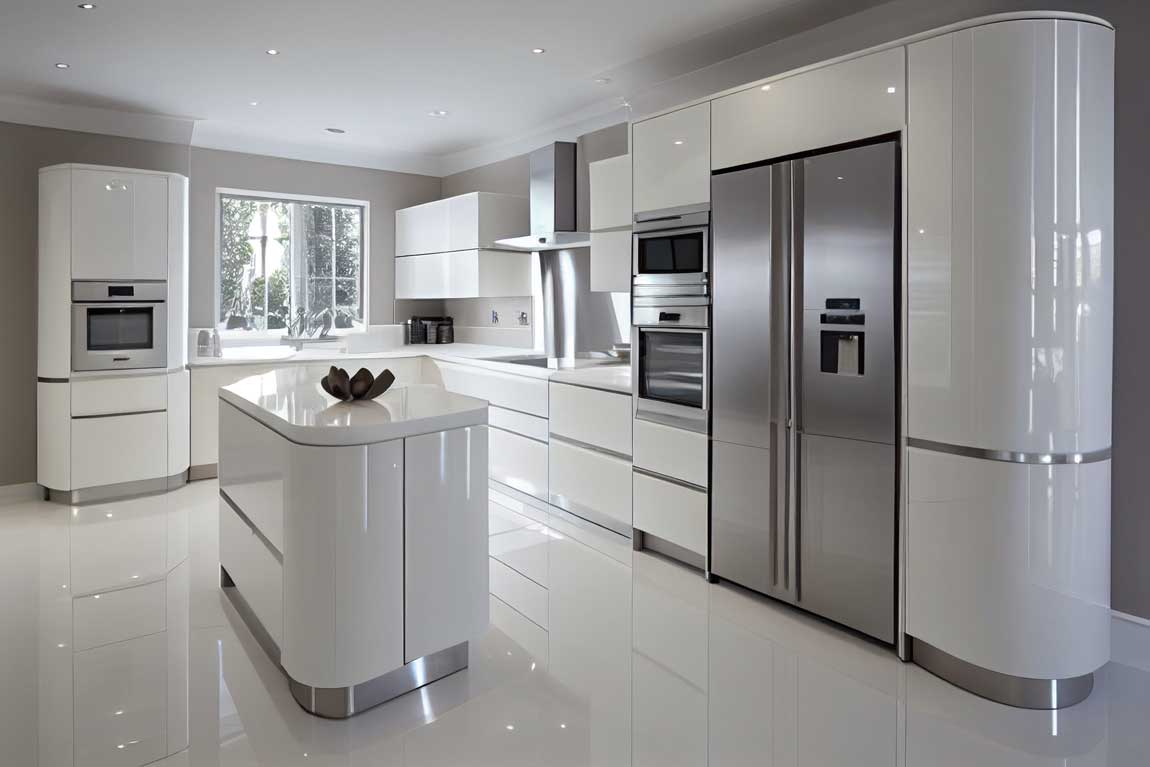
Ikea Ringhult (high-gloss white, $2,600–$3,200 for a 10×10 base layout) is the entry-level benchmark. The doors are lacquered MDF and photograph well but show wear at the edges within five to seven years of daily use. They’re a legitimate option for rental properties or first kitchens where budget matters more than longevity. The handles are the weak point — the included hardware feels cheap; replace with Hafele or Viefe bar pulls for $8–$12 each and the cabinet reads considerably better.
Mid-range: Howdens Gloss White J-Pull (around $6,000–$8,000 installed for a standard kitchen) is what I’d buy if I was doing a family home renovation. The cabinet carcass is thicker than Ikea and the door edge is properly sealed — that matters for longevity in rooms with steam and cooking grease. Pronorm, Häcker, and Rotpunkt all offer German-manufactured gloss white options starting $10,000–$15,000 installed; the difference is in the hinge mechanism, the finish durability, and the custom sizing flexibility. For more on how high-gloss white cabinetry investment pays off across different room sizes, these modern white kitchen design inspirations show how the finish scales from compact flats to large open-plan kitchens.

Bottom Line
White Gloss Kitchens Earn Their Reputation — If You Get the Worktop Right
The reflective surface does genuine spatial work in any room under 200 square feet. The cabinet brand matters less than most people think; the worktop choice matters more. Grey quartz or Calacatta pattern is the combination I’ve seen work consistently across the most different room sizes and light conditions.
Maintenance is 90 seconds, twice a week, with the right cloth. The fingerprint anxiety is mostly pre-purchase — after two weeks of ownership it becomes background noise you stop noticing.
Avoid all-white surface combinations, blue-toned whites in north-facing rooms, and islands in kitchens under 14 feet wide. Get those three decisions right and the rest is details. Save this post before your kitchen shopping starts — the worktop and cabinet brand notes above will save you at least one expensive regret.