Bespoke traditional kitchen designs are the clearest dividing line between a room that photographs well and one that actually holds its character for thirty years. I’ve spent a lot of time visiting kitchens at every price point, and the pattern is consistent — off-the-shelf cabinetry in a period home always reads as a costume. The proportions are wrong. The hardware sits too tight. The paint colour, however thoughtfully chosen, can’t rescue a door with the wrong raised-panel depth. Handcrafted kitchens built to the dimensions of the room don’t have that problem because there’s no standardised module to fight against.
Luxury traditional kitchens aren’t a single aesthetic. You’ll notice that the best ones share a structural logic rather than a surface style — deep carcasses, solid timber frames, joinery techniques borrowed from furniture-making rather than flat-pack production. That structural honesty is what makes them age gracefully. The range-cooker alcove stays crisp after a decade; the island doesn’t wobble; the paint takes a touch-up the same way it took the original coat.
At a glance
- Target keyword covered: bespoke traditional kitchen designs — in H1, intro, two H2s
- deVOL Classic English starts at £40,000 (~$51k); Neptune Henley from £25,000 (~$32k)
- Handcrafted solid-hardwood carcasses outlast MDF by 15–20 years in a working kitchen
- Stone countertops (Calacatta marble, honed granite) run $80–$150/sq ft installed
- A range cooker alcove with plastered surround costs $3,000–$6,000 to build out correctly
- The biggest mistake: choosing the colour before fixing the cabinet profile
What Bespoke Traditional Kitchen Designs Actually Get Right
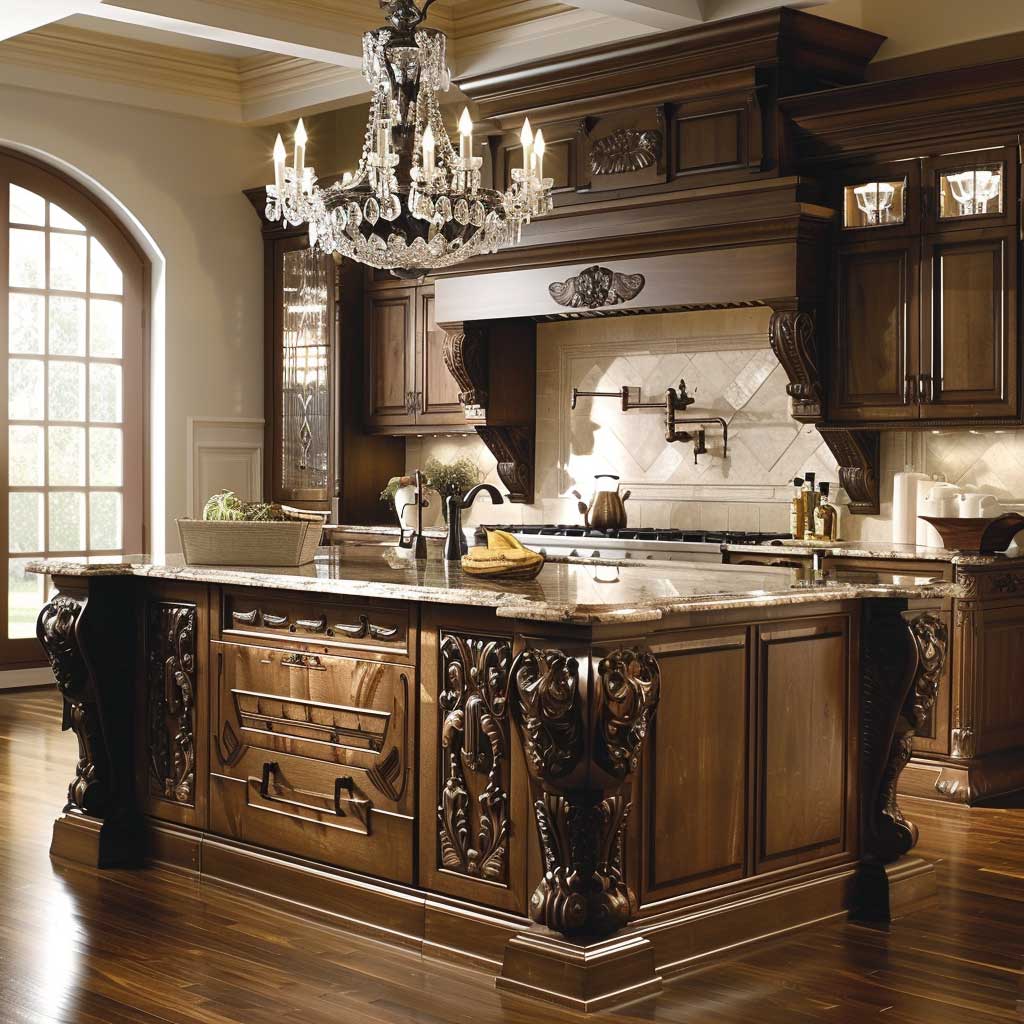
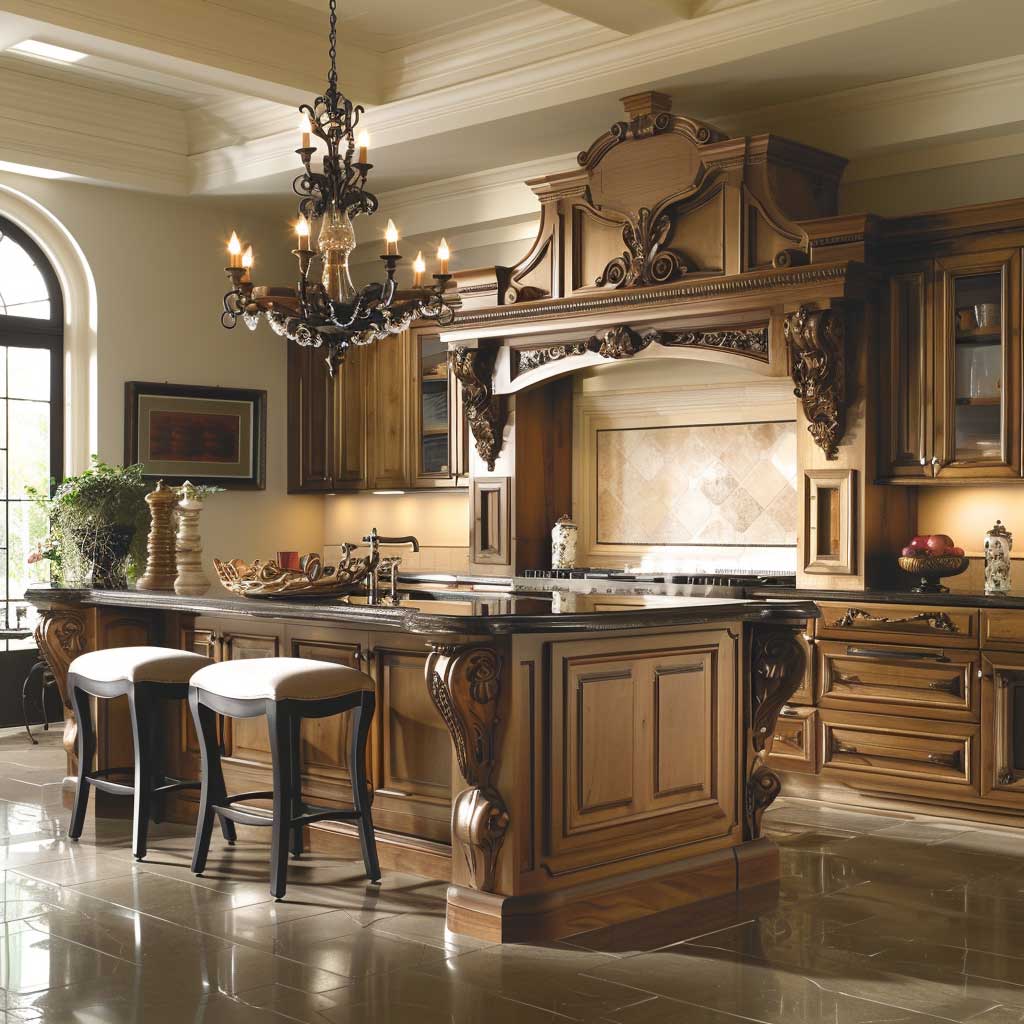
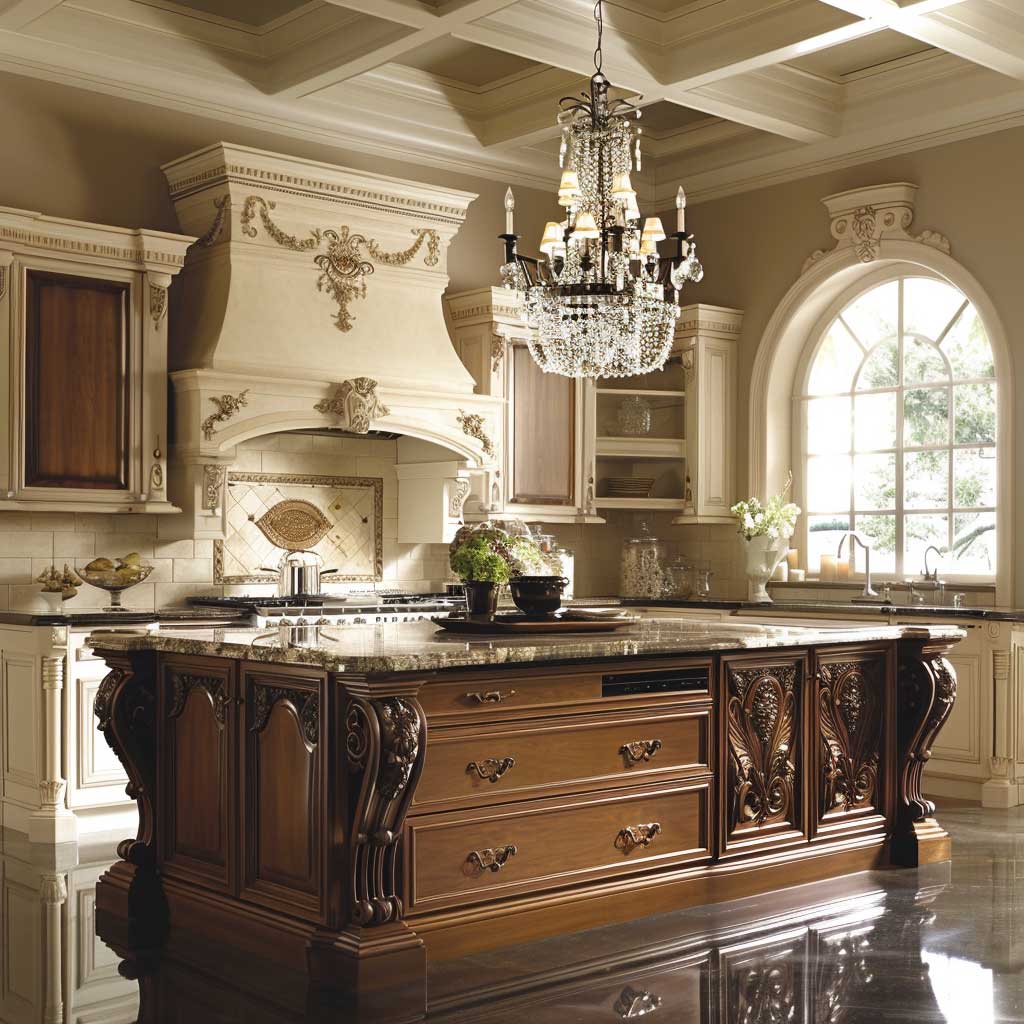

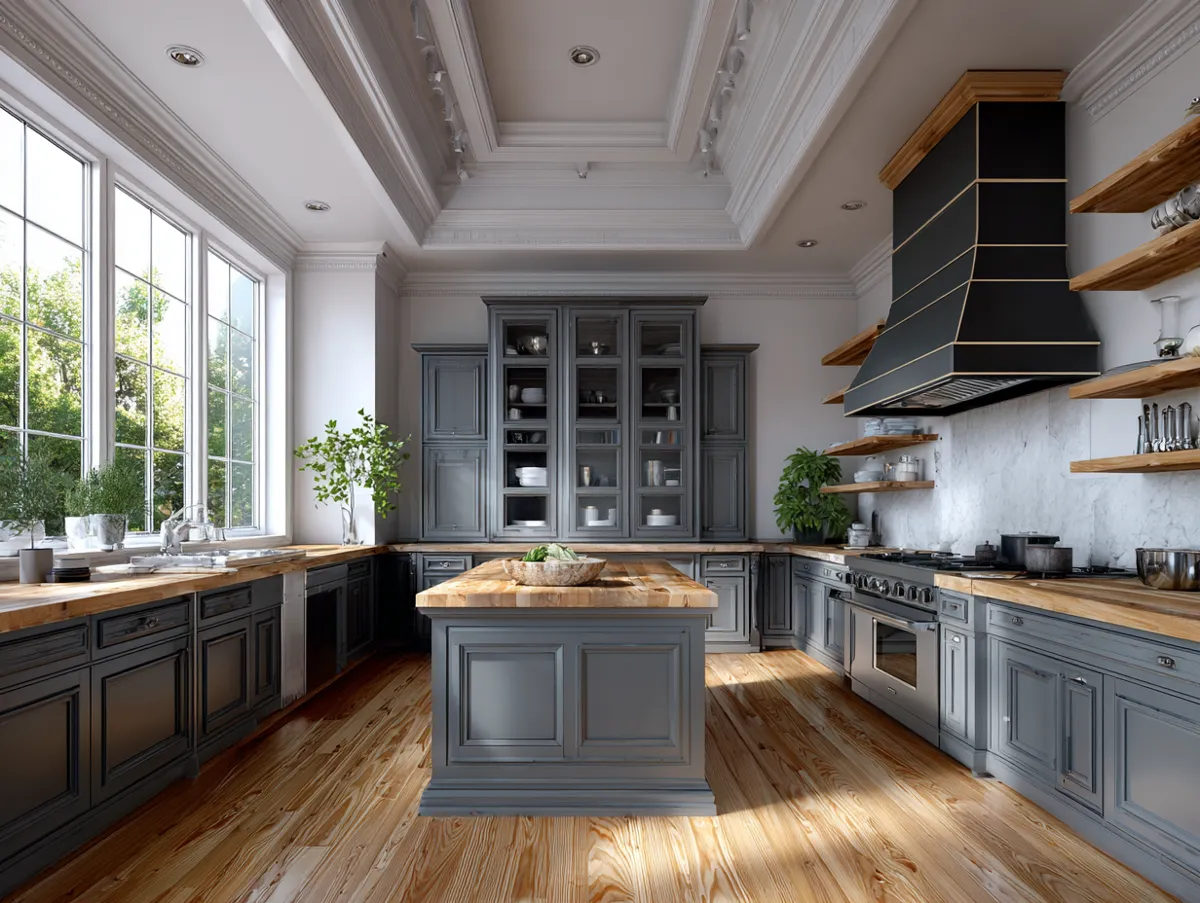
The word “bespoke” gets diluted badly in kitchen retail. You’ll find semi-custom ranges branded as bespoke because they offer seventeen door colours. Real bespoke traditional kitchen designs start with the room’s existing geometry — its ceiling height, its alcove depths, its structural columns — and build the cabinet specification around those constraints. deVOL’s Classic English range, which starts around £40,000 ($51k) before appliances, is a reasonable marker: every carcass is hand-built to measure in their Leicestershire workshop, solid hardwood throughout, no MDF anywhere in the structure. The difference is obvious when you run your hand along the drawer’s interior. It feels like furniture, not flatpack.
I own a kitchen with inframe cabinetry and the detail that makes or breaks the look is the frame-to-door reveal — the gap you see around each door when it’s closed. On a good traditional kitchen it’s 4–5mm, consistent across every door, painted as a continuous surface. Buy a budget “traditional-style” kitchen and that reveal wobbles by 2mm from panel to panel. Nobody who doesn’t know to look for it consciously notices; everybody unconsciously notices. It’s the visual equivalent of a slightly off-centre painting that you can’t stop adjusting.
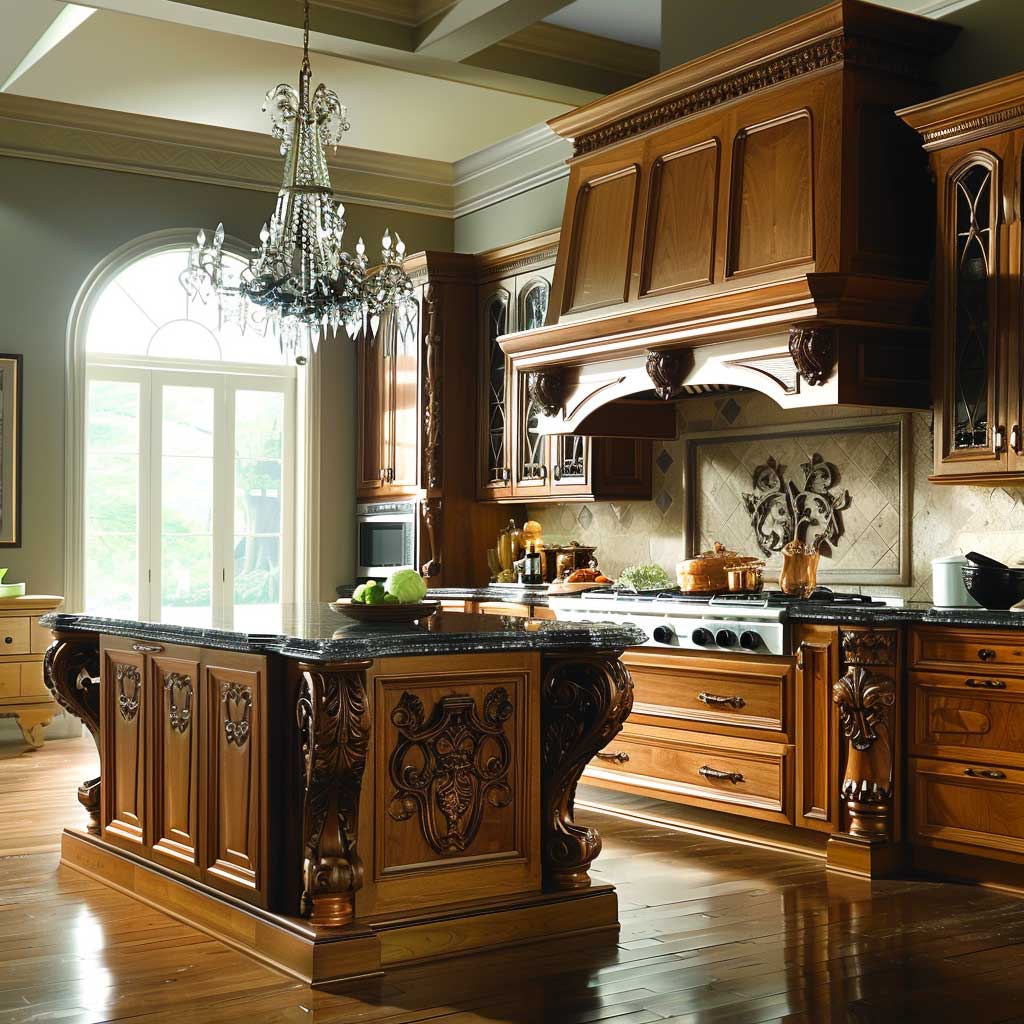
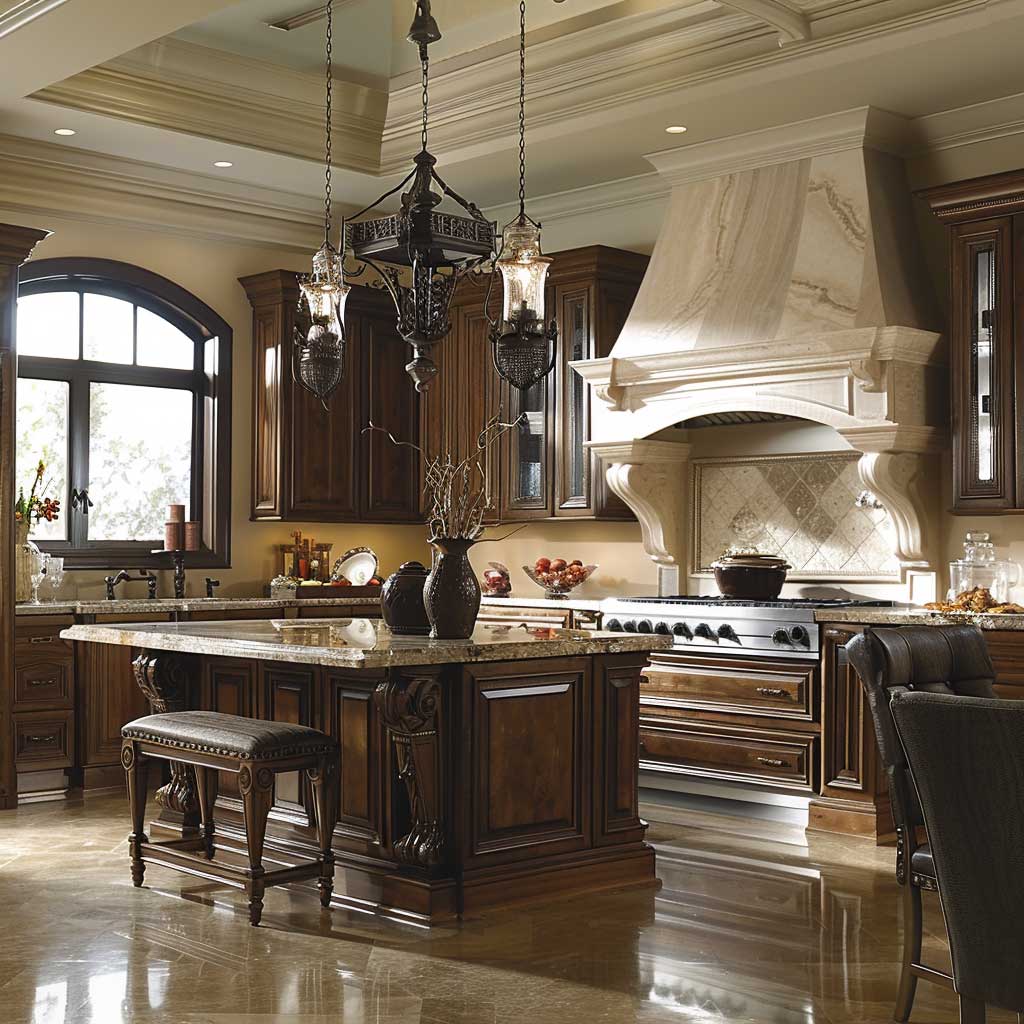
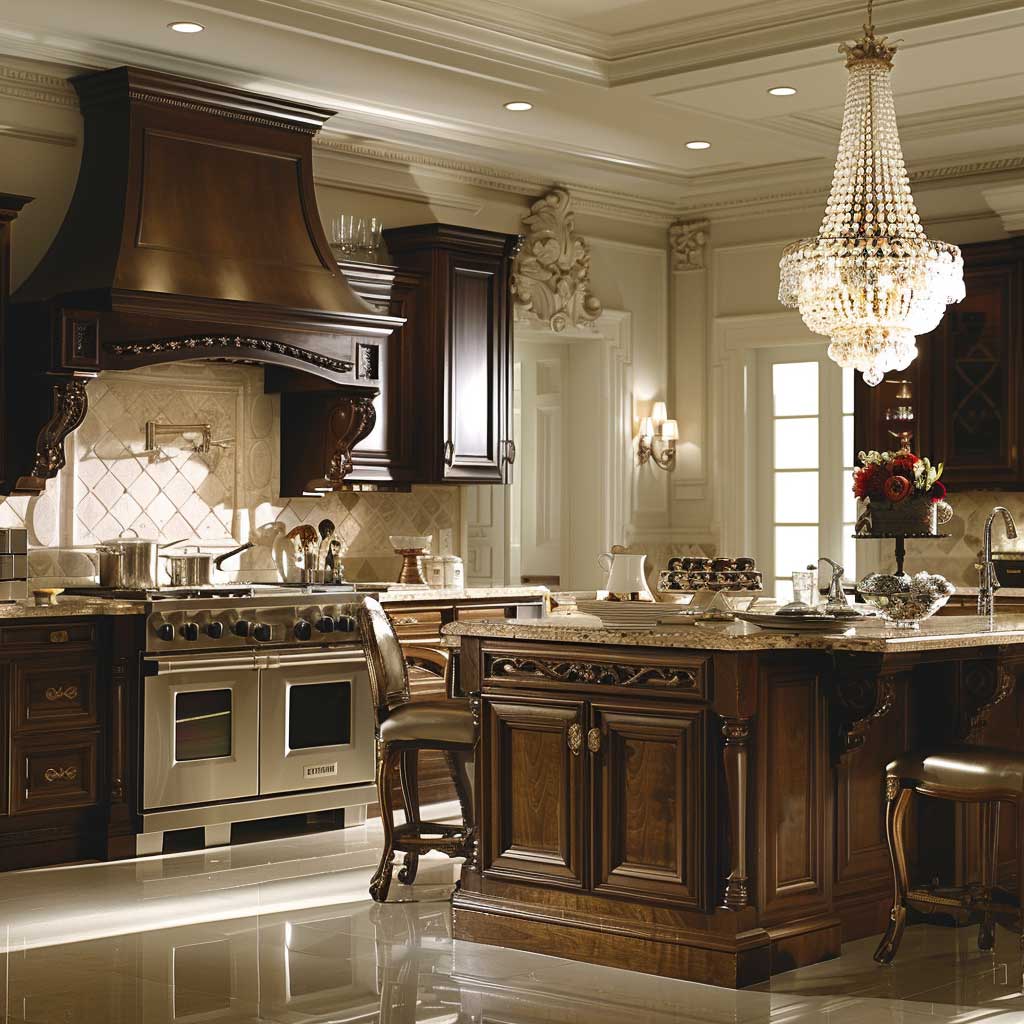
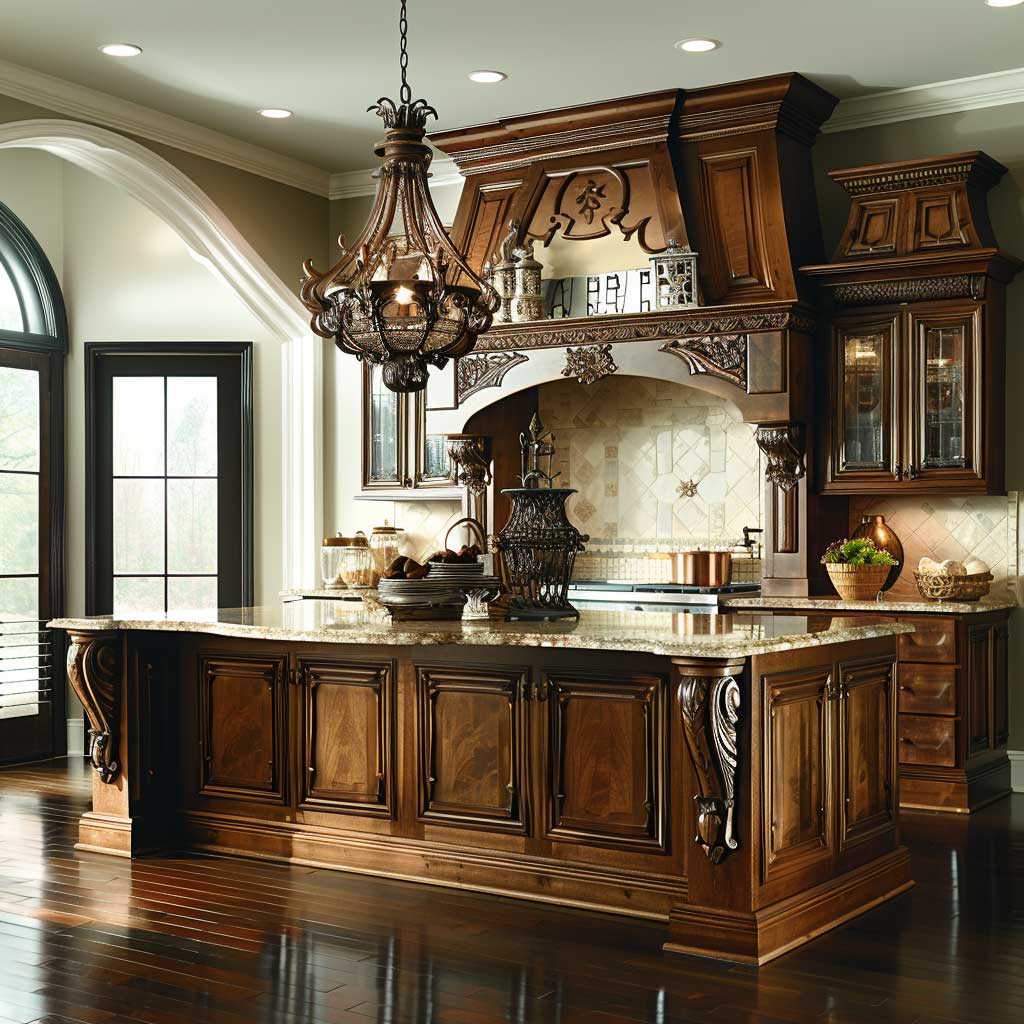
The anti-advice here is this: don’t spec your countertop material before you’ve finalised the cabinet profile. I’ve seen people fall in love with Calacatta marble at $120/sq ft, then choose a door with too much movement in the moulding and watch both fight for attention. Quieter cabinet profiles — a simple raised-and-fielded panel or a plain shaker — let the stone countertop do its work. Busier profiles need a plainer stone. Neptune’s Chichester range with honed Carrara marble is a combination that holds that balance without either element apologising for itself.
Don’t do this
Painting traditional-style flat-pack cabinets to look bespoke. The proportions of the cabinet bodies are factory-standard and the eye reads this immediately — paint just draws more attention to wrong-sized panels. You’ll spend £2,000–£4,000 on a spray-paint job and the kitchen still looks like what it is. If the budget doesn’t reach handcrafted cabinetry yet, use open shelving with quality brackets and spend the money on a genuinely good countertop and range cooker. That reads far better than painted flatpack.
Skip glass-fronted wall cabinets unless the items inside are worth displaying. A row of mismatched Tupperware behind glass panes in a traditional kitchen is the visual equivalent of a black-tie dinner with an anorak on top.
Handcrafted Traditional Kitchen Layouts That Actually Function
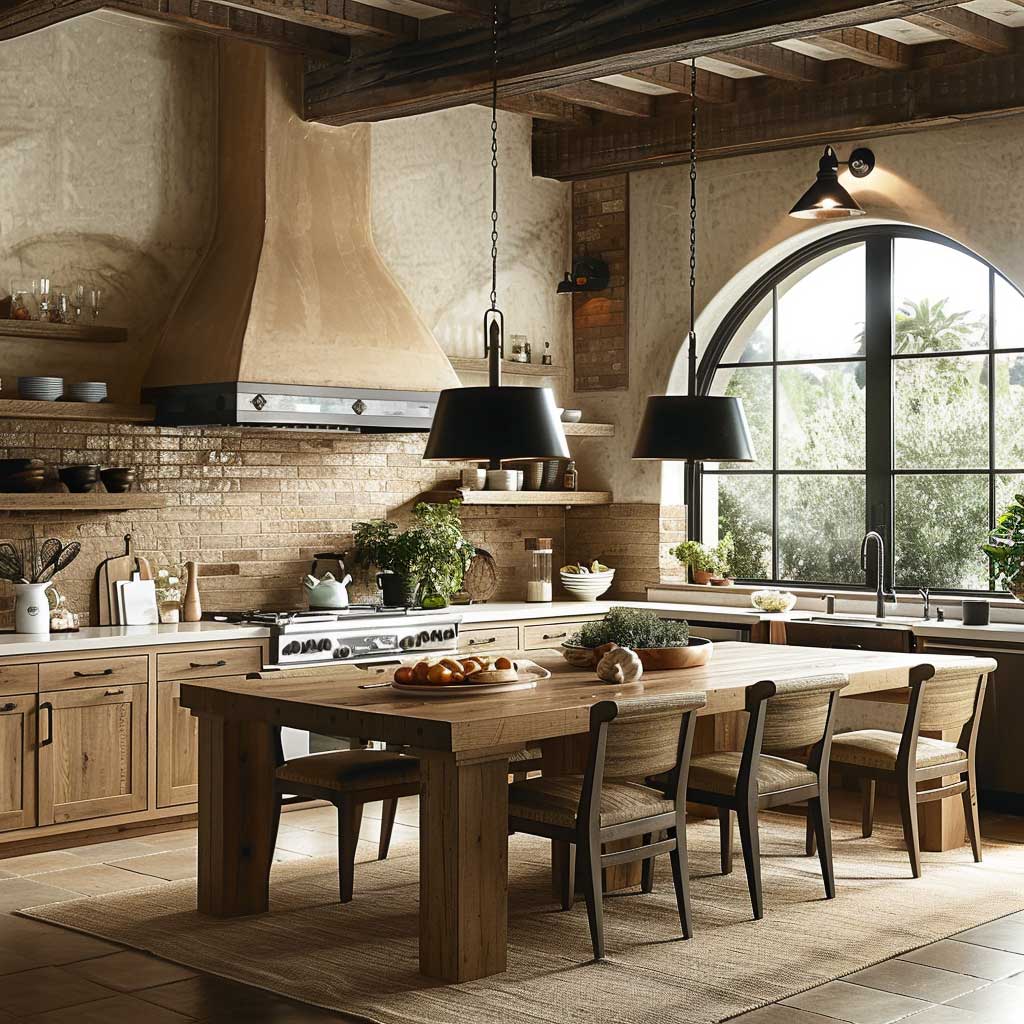
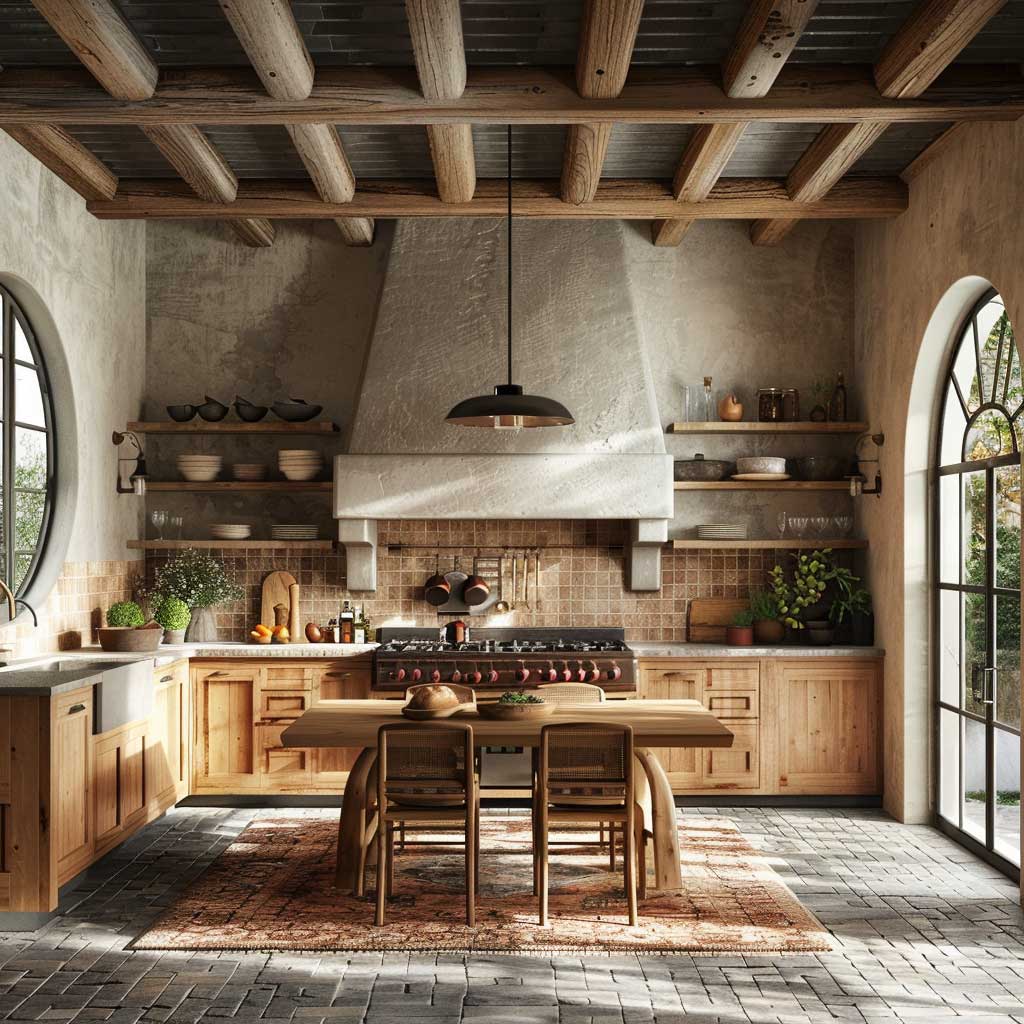
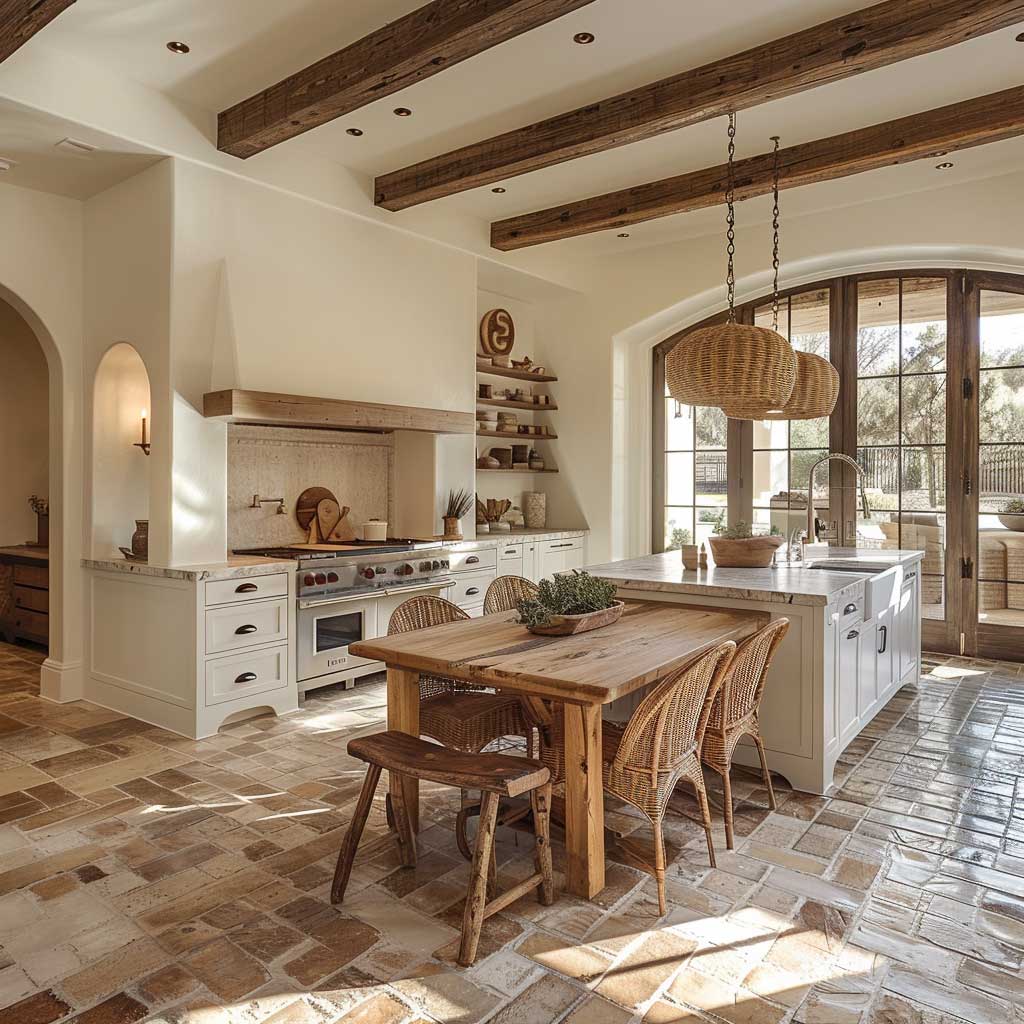
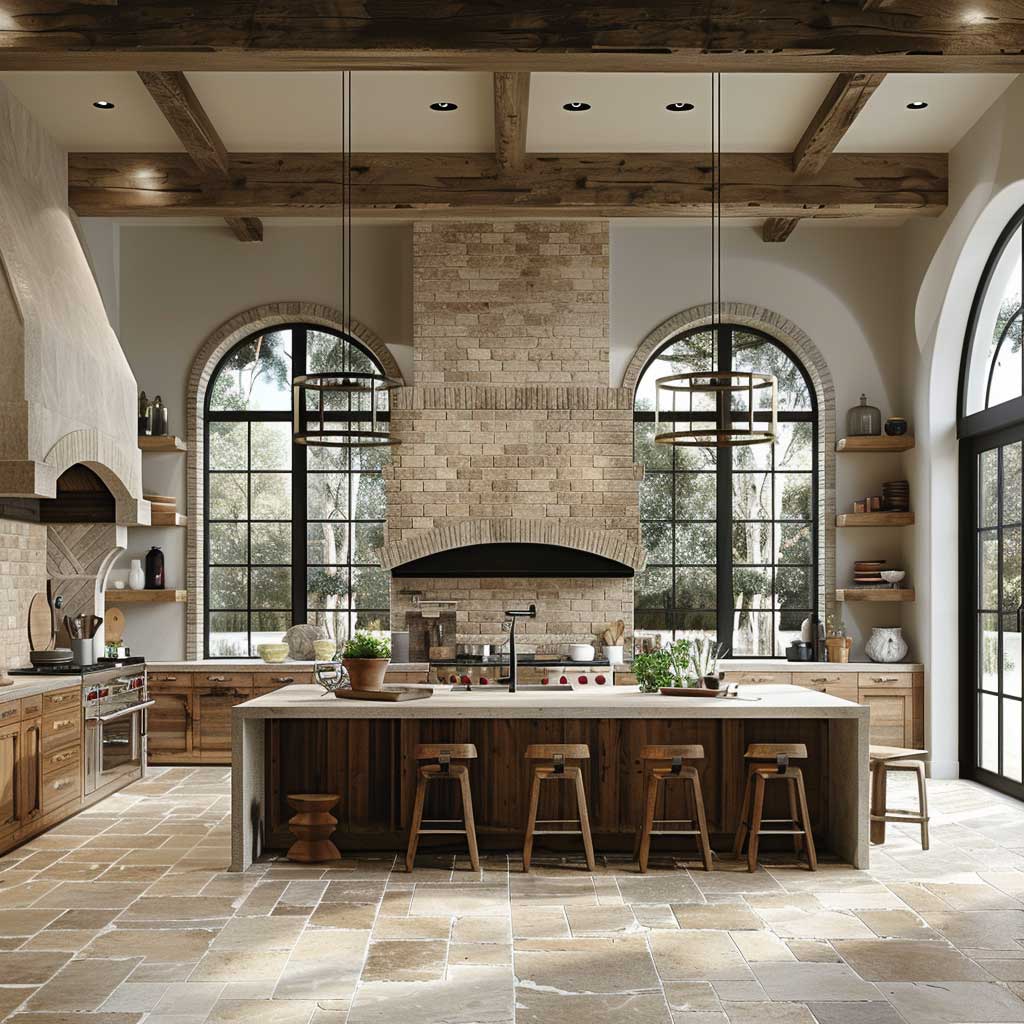
Traditional kitchen layouts have a reputation for prioritising atmosphere over workflow — and a lot of them deserve that reputation. The instinct to fill every wall with cabinetry, add a large island, and then squeeze in a range cooker wherever it fits produces a kitchen that photographs beautifully and functions like an obstacle course. The working triangle — sink, cooker, fridge, each within 4–9 feet of the other — was established as a planning rule in the 1940s and it holds. A kitchen built around exposed beams and hand-painted tiles but planned with the working triangle in mind will cook better than one with the same aesthetic squeezed around fixed structural elements nobody wanted to move.
What’s your single most-used countertop zone? For most people it’s the stretch immediately to the right of the cooker. In a bespoke traditional kitchen, that run should be at least 24 inches wide, countertop material continuous without a seam, and high enough clearance above to reach the back of a deep roasting pan. You’ll notice that kitchens which have been properly designed for a specific family always have that detail resolved. Kitchens designed for a “generic traditional home” often have the island positioned where it interrupts exactly that zone.
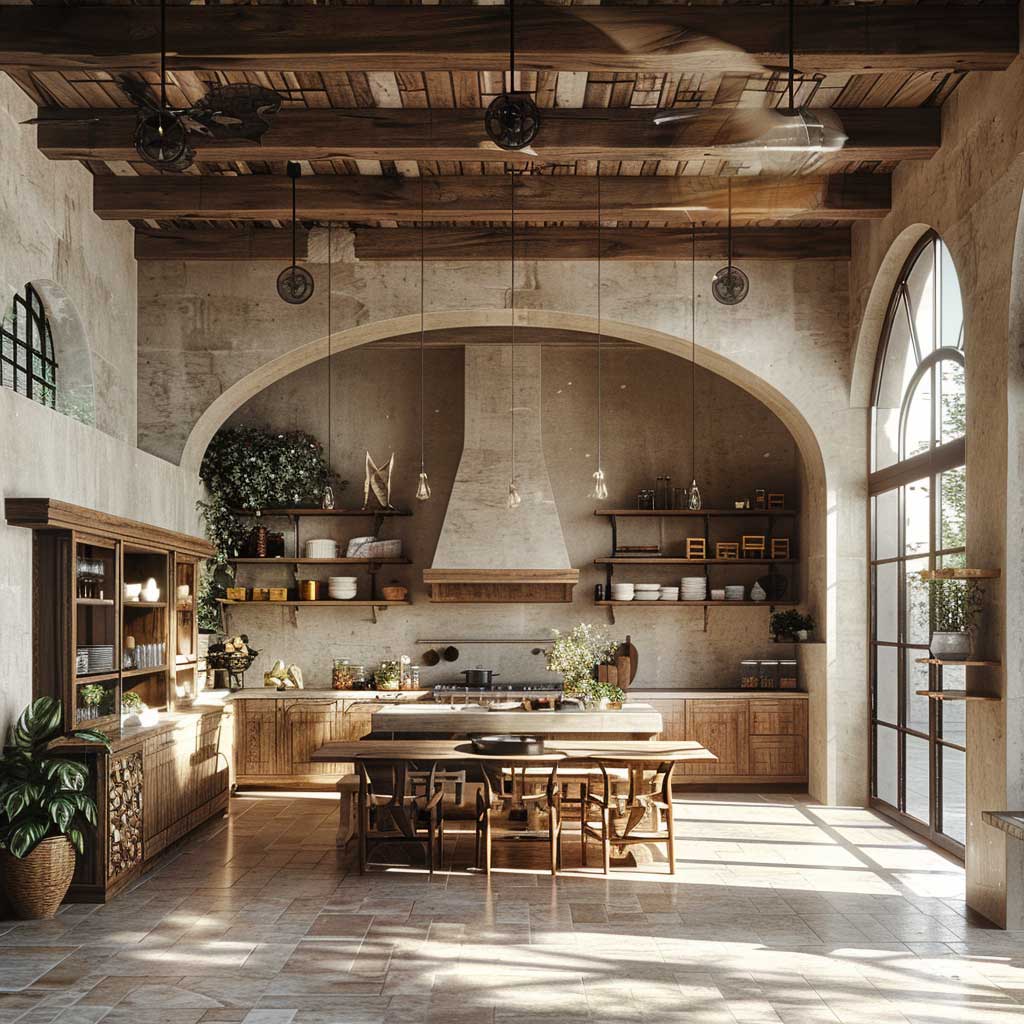
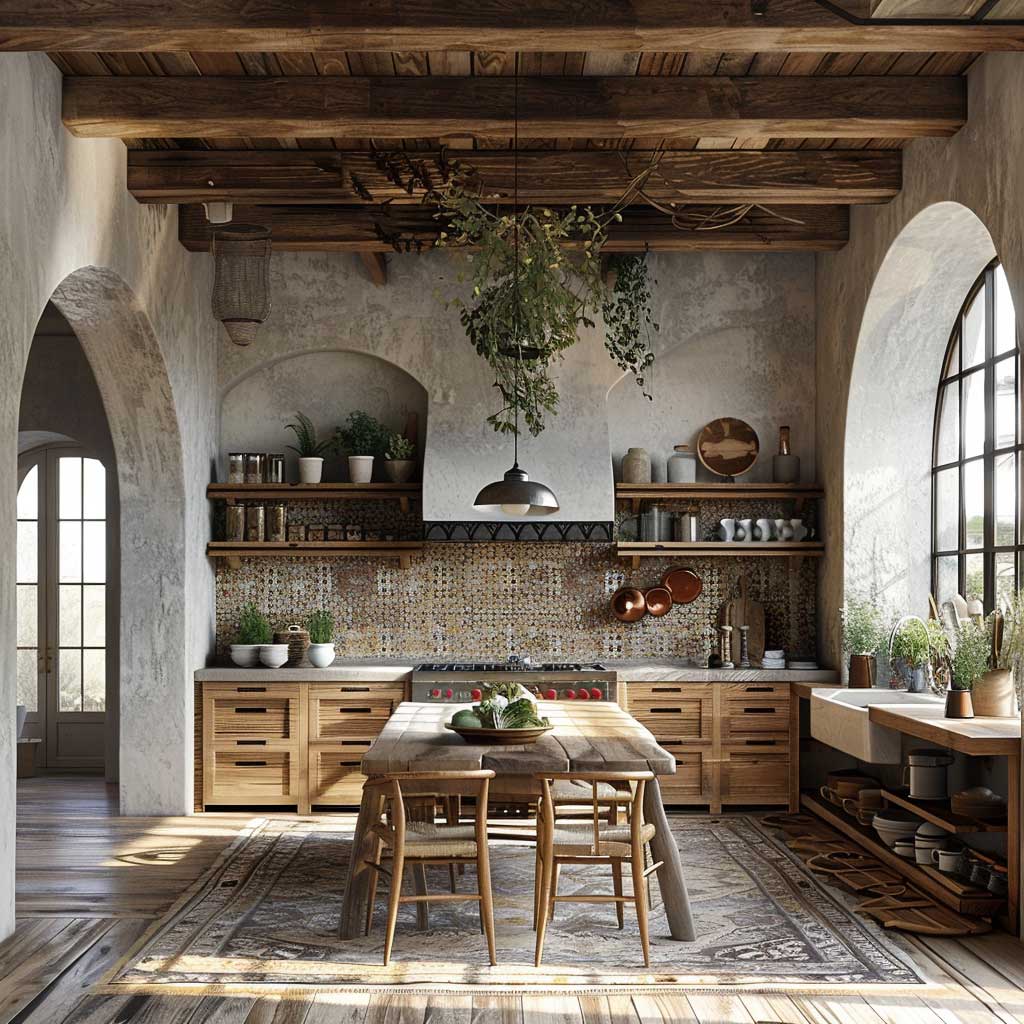
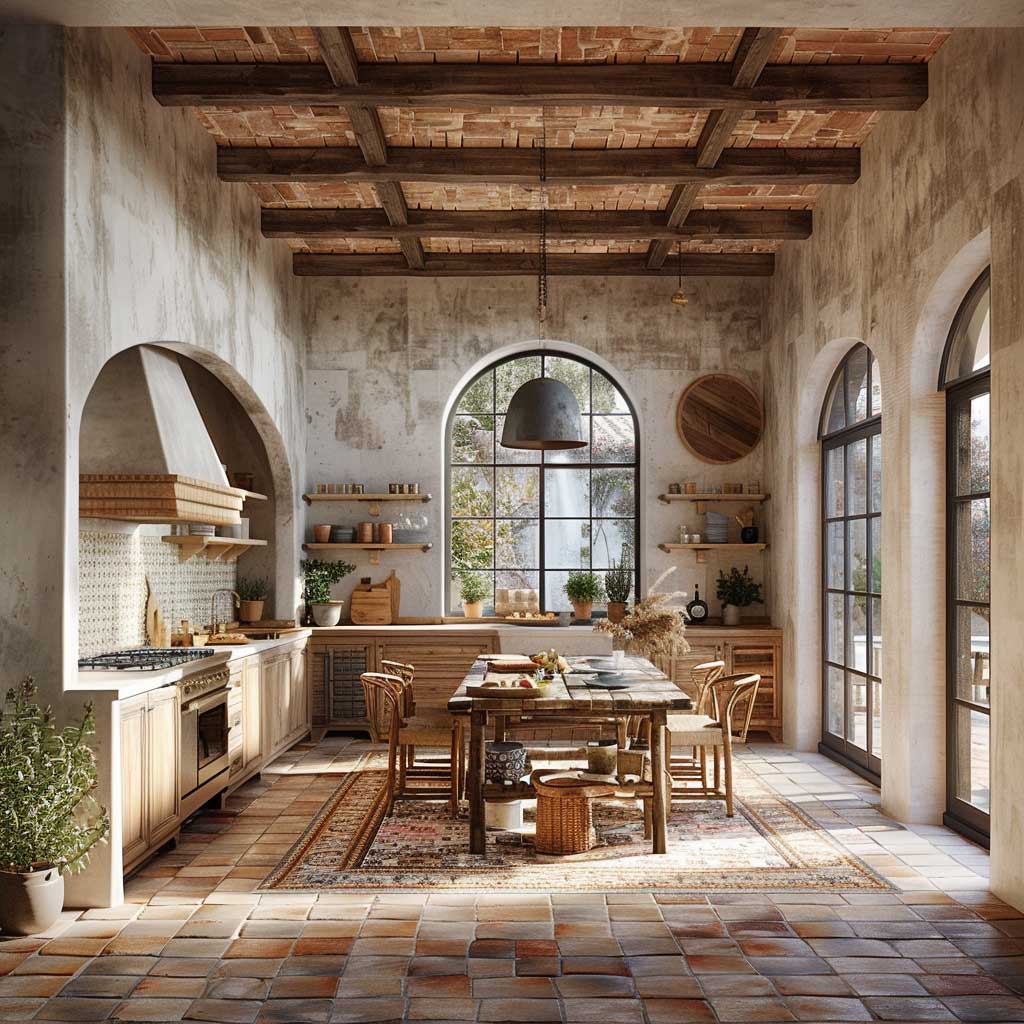
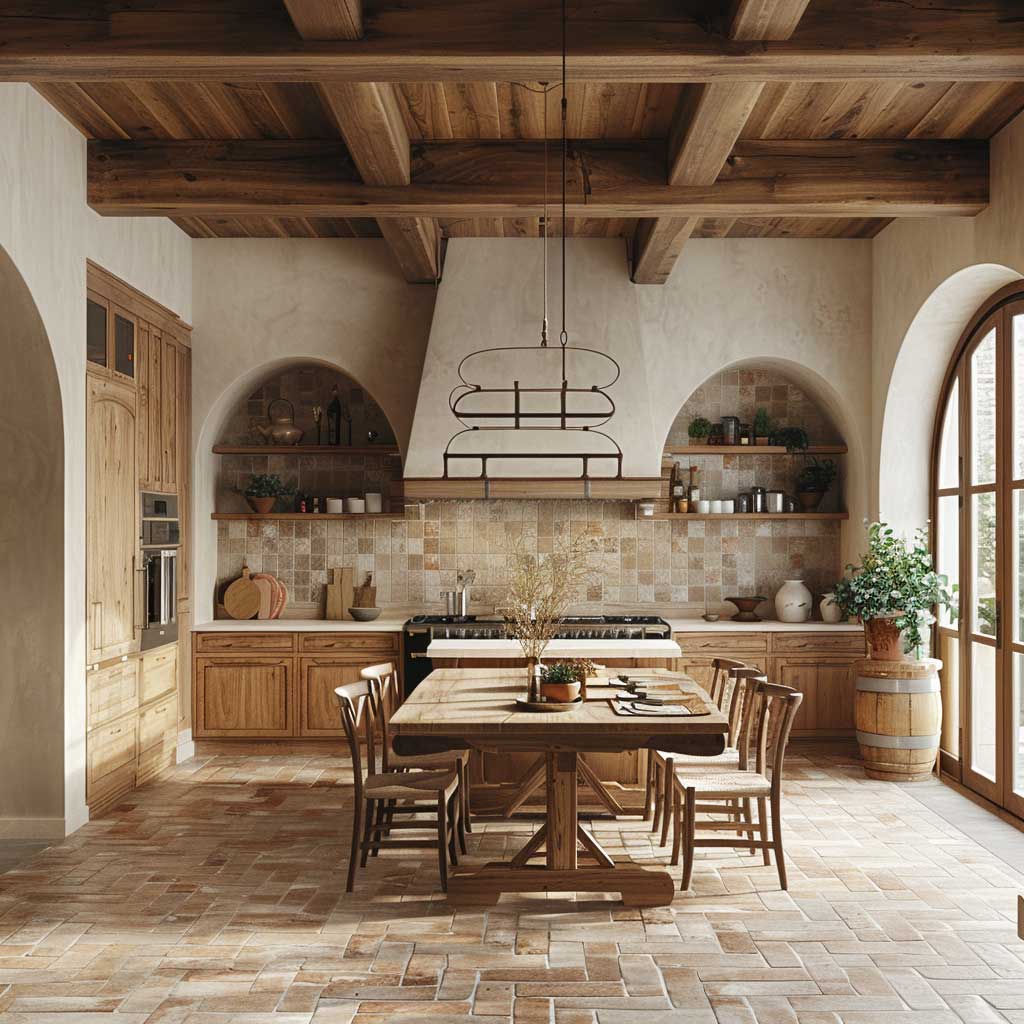
The large rustic dining table in the kitchen centre is a look I’ve always found romantic and a layout I’ve watched fail repeatedly in rooms under 18 feet long. It turns the kitchen into a dining room with a cooker bolted on. My go-to alternative for a kitchen that seats people without sacrificing workflow is a banquette built into an alcove on the wall opposite the run — 24 inches deep, cushioned, with lift-up storage underneath. It holds six people at a push, disappears visually when not in use, and costs a fraction of the square footage a freestanding table demands. Arched doorways and exposed beams can carry the whole traditional atmosphere without requiring a floor plan that fights itself. For more on how to balance old-world atmosphere with modern layout logic, this breakdown of modern-traditional kitchen planning covers the key decisions in order.
Luxury Traditional Kitchens and the Materials That Age Without Apology

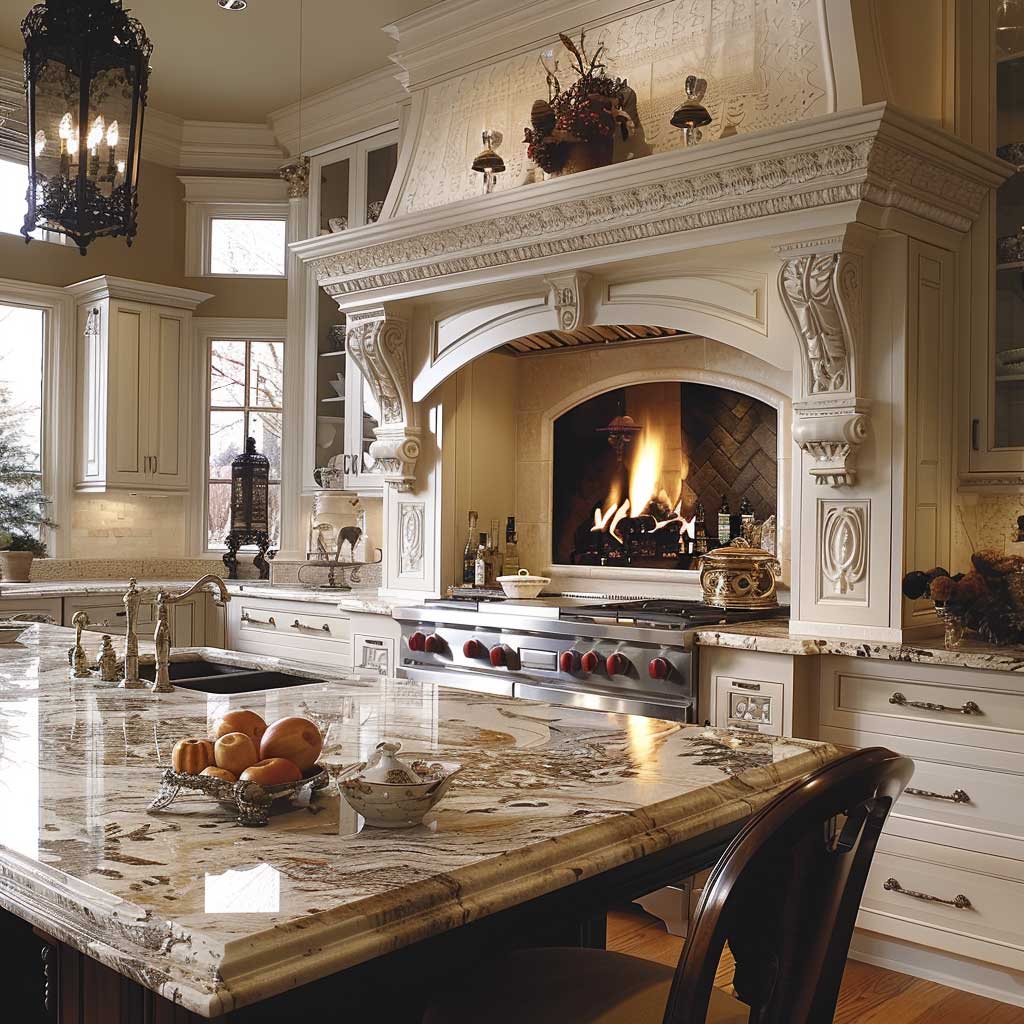
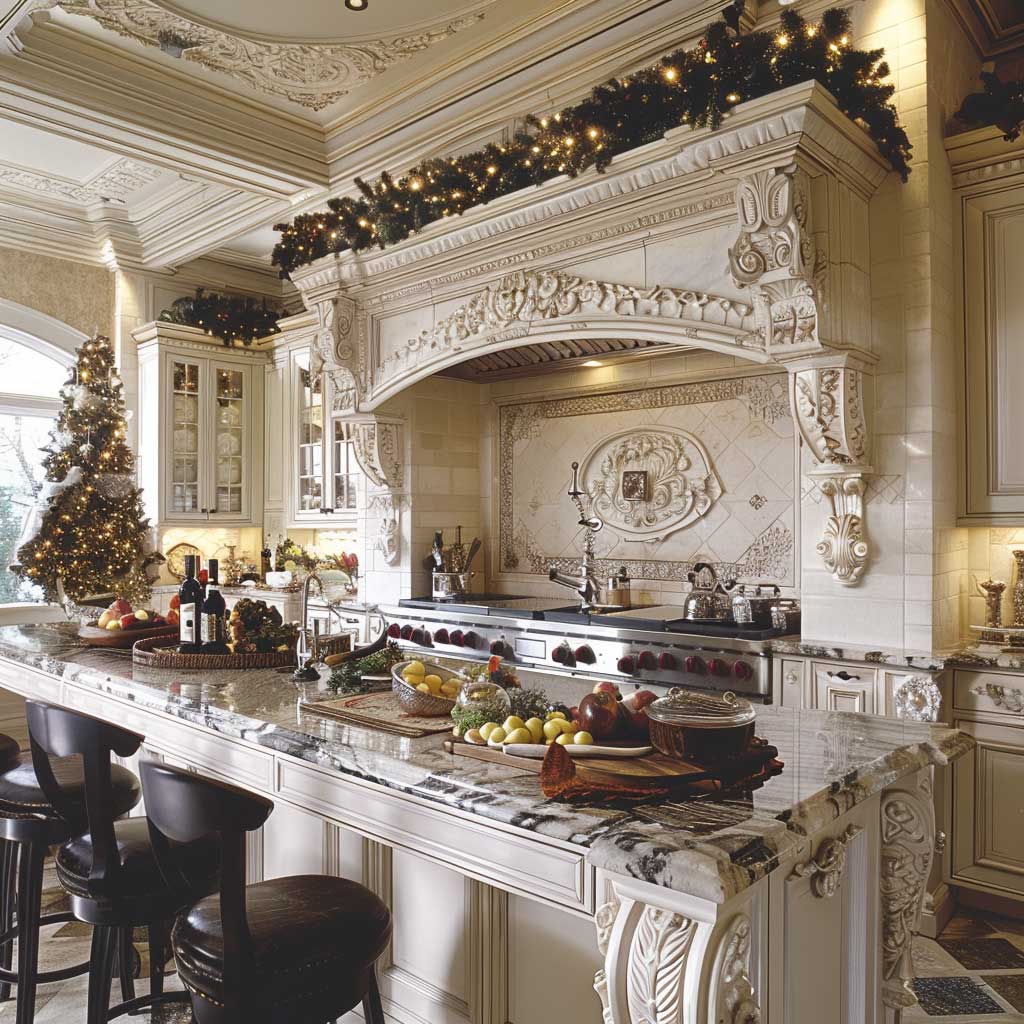
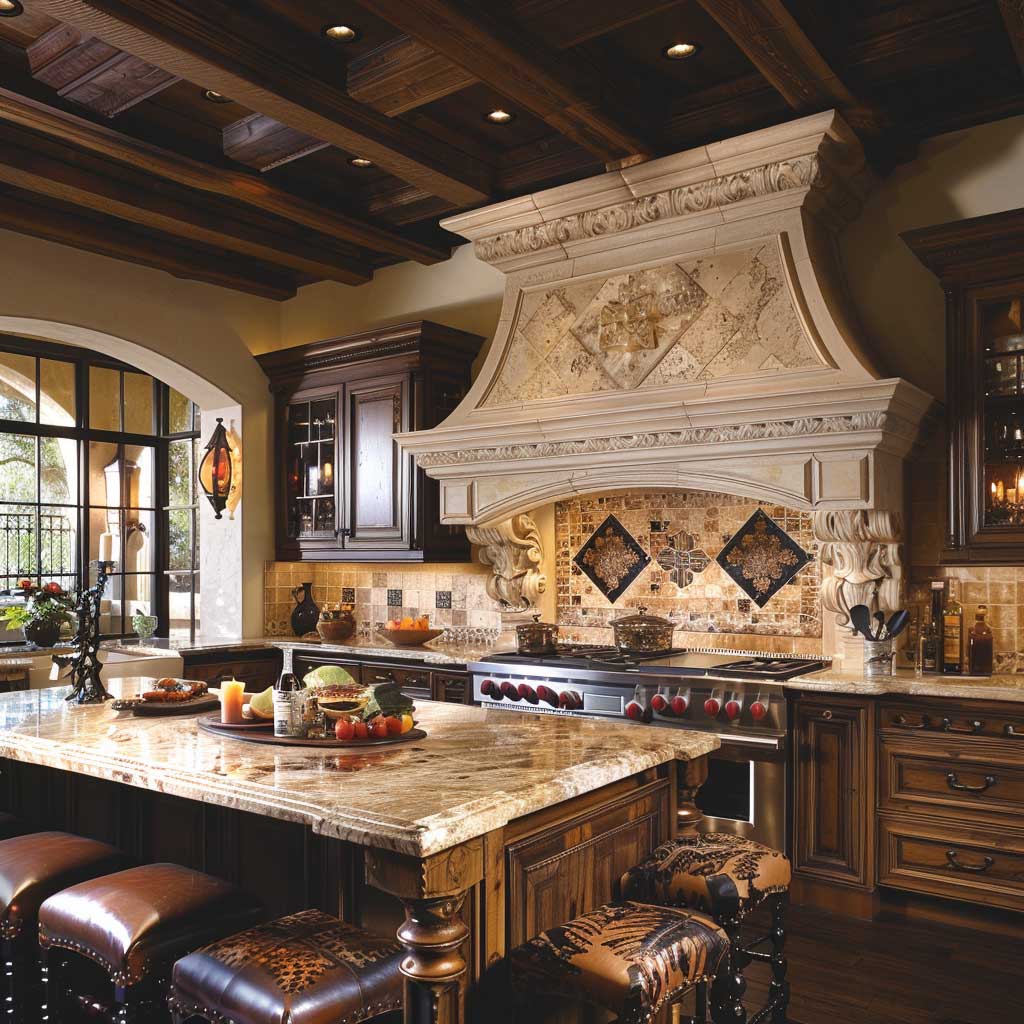
Marble in a traditional kitchen is a subject that generates more anxiety than it deserves. Yes, it etches if you leave a lemon on it for twenty minutes. Yes, it stains. It also develops a patina that no engineered quartz can replicate — a lived-in surface that looks like it belongs to the house rather than having arrived in a delivery van. Calacatta marble with strong grey veining runs $100–$150 per square foot installed in the US; Carrara honed is closer to $80–$100. The alternative I’d reach for if marble feels too high-maintenance is a soapstone countertop at $70–$90/sq ft: it scratches, you oil it back, the scratches disappear. It looks like it has been in a Georgian kitchen for two centuries. Engineered quartz looks like it arrived last Tuesday.
Lighting in a luxury traditional kitchen is where most people spend too little and regret it. The chandelier over the island gets specified correctly; then the cabinet-interior lighting, the under-shelf task lighting, and the plinth lighting get value-engineered out. I stole this trick from a kitchen designer in London: run a continuous warm LED strip (2700K, not 3000K — the cooler tone kills the wood) behind the cornice on the upper cabinets. It bounces light off the ceiling and gives the room an after-dark atmosphere that no overhead recessed downlight can match. Budget $800–$1,200 for the strip and dimmer system. The room looks completely different at 8pm than it would with ceiling-only lighting.
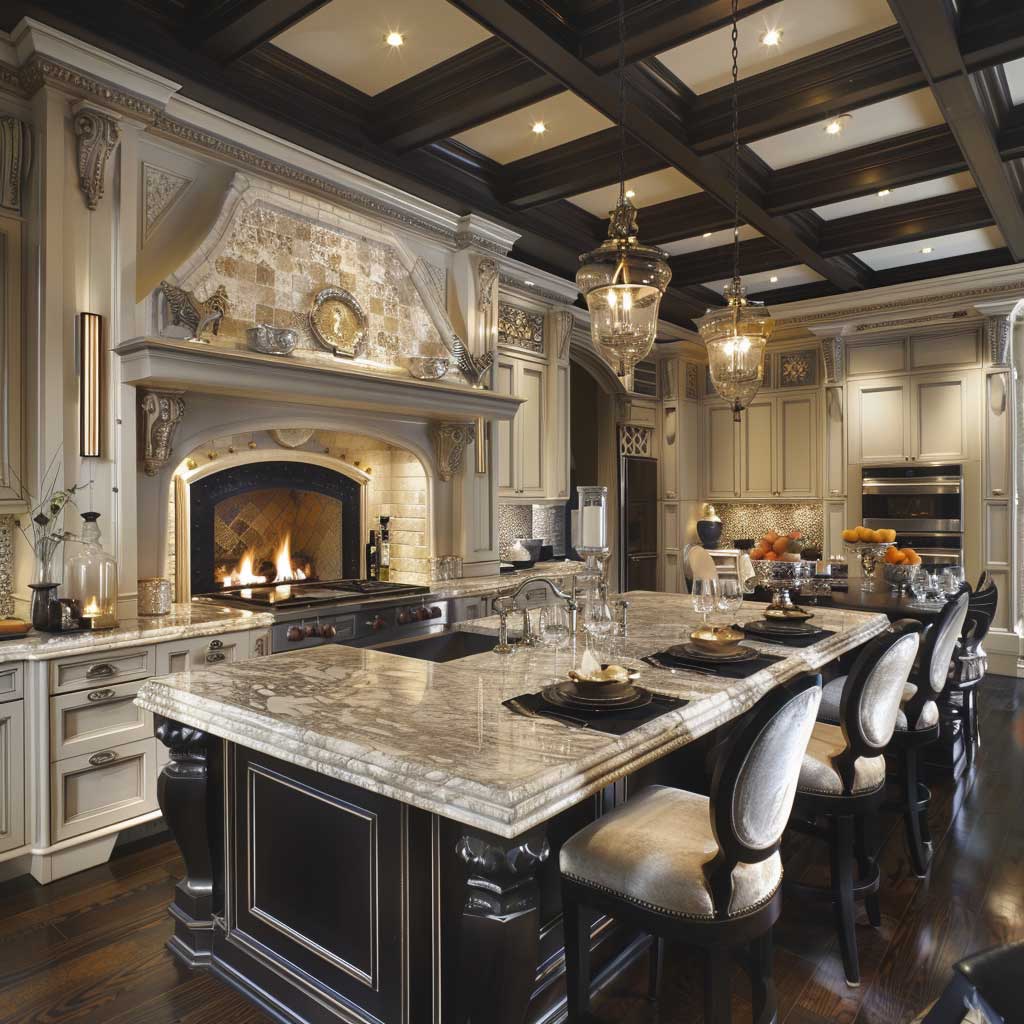
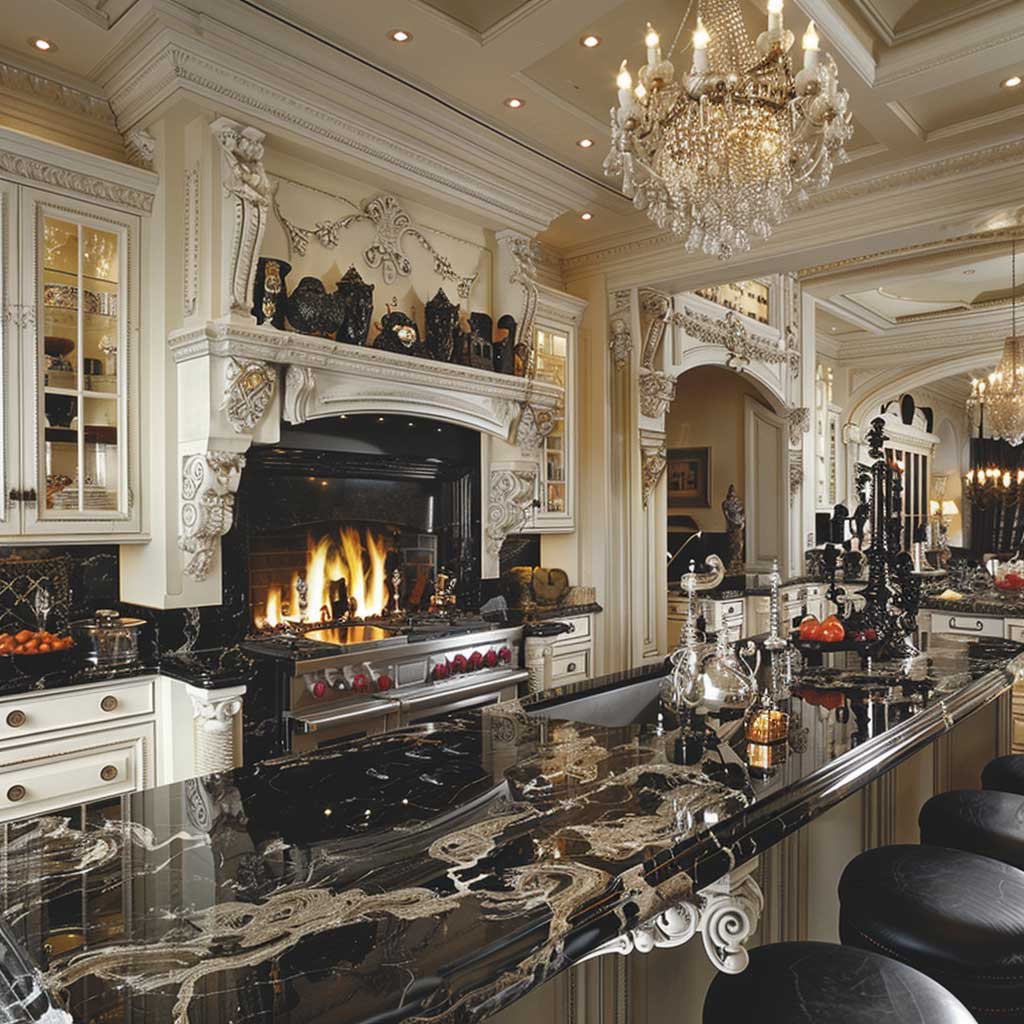
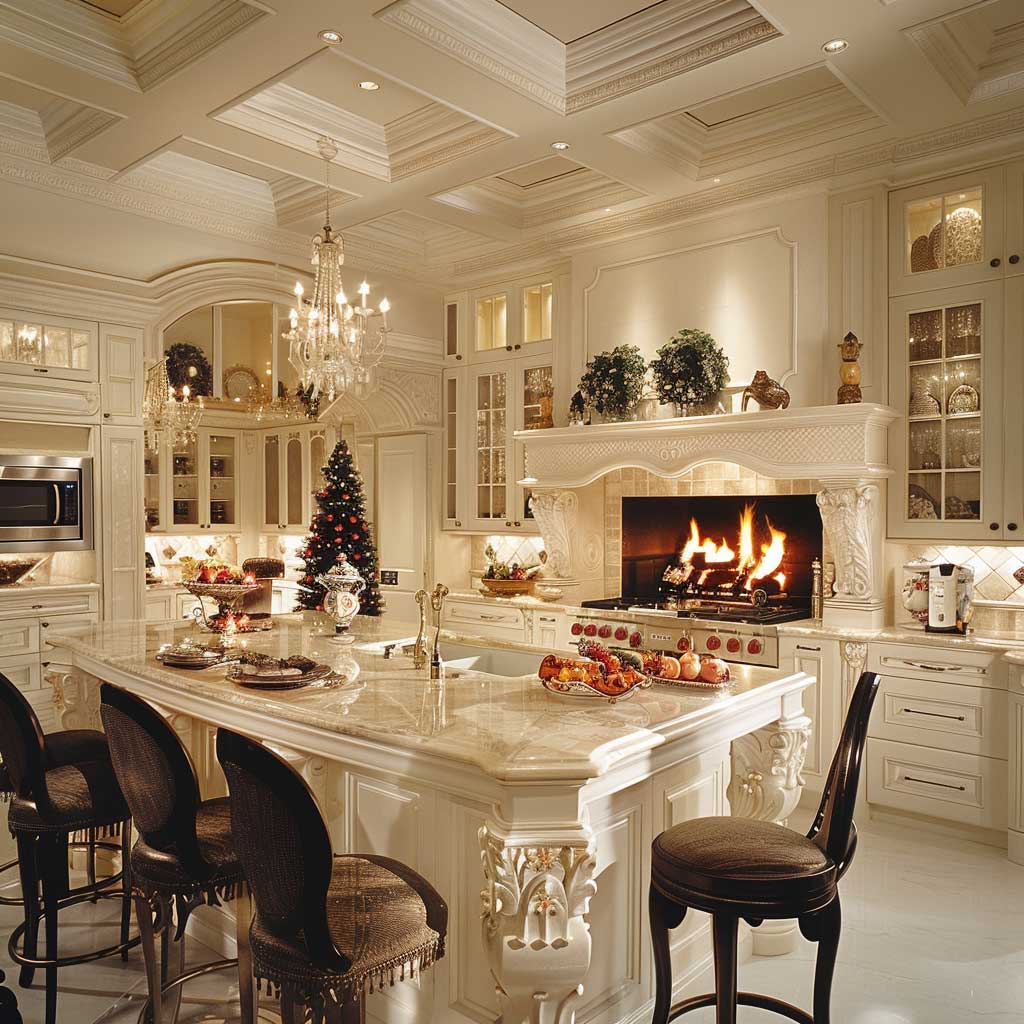
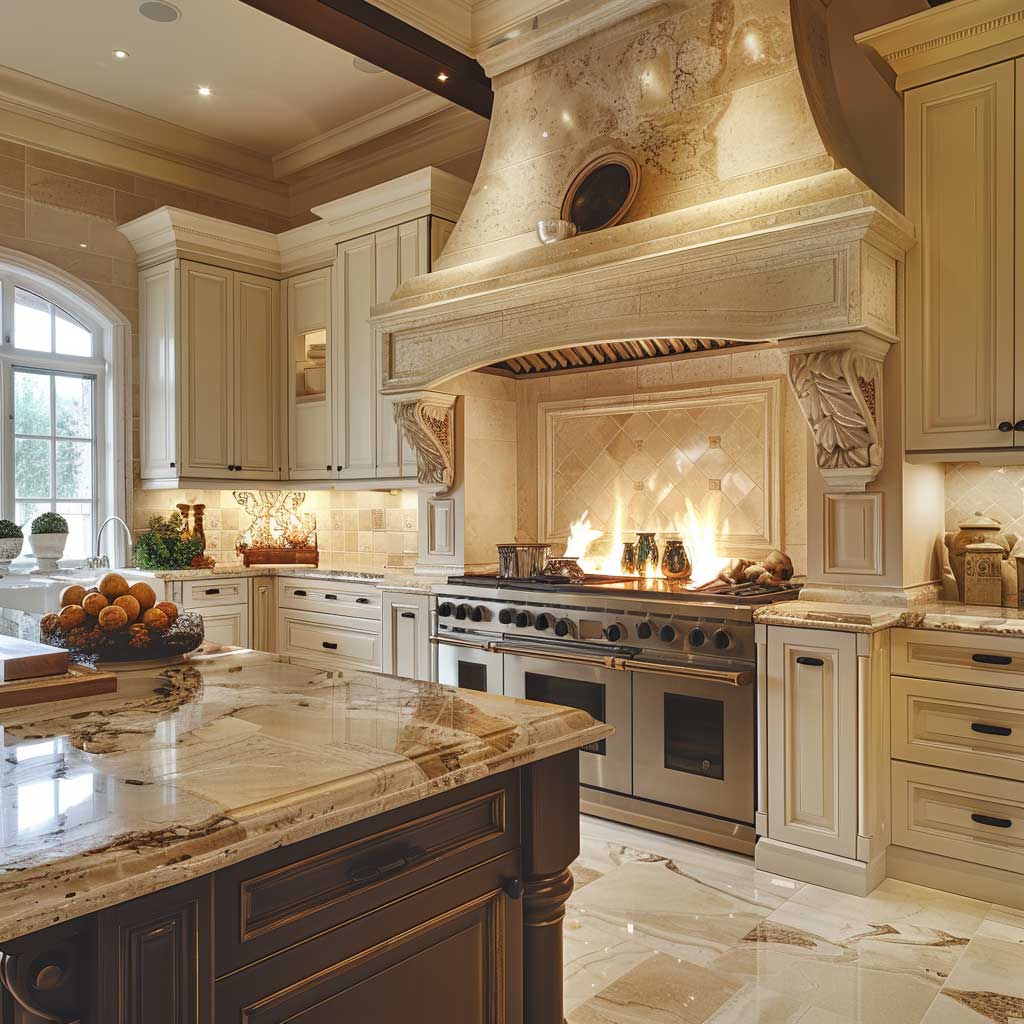
The fireplace in a traditional kitchen is a period detail that earns its square footage. Beyond the obvious warming effect, a working or decorative hearth with a plastered surround gives the range cooker alcove its natural visual equivalent — suddenly the Aga or La Cornue feels like it grew out of the architecture rather than having been inserted into it. A cast-iron Aga in a two-oven configuration runs around $8,000–$12,000; the La Cornue Château 120 starts at $30,000. The look you’re after doesn’t require either. A good quality Lacanche range cooker from $5,500 inside a properly plastered alcove with a limestone hearth achieves the same atmosphere for a fraction of the cost. For reference on how traditional kitchen interiors translate across different room scales, these modern-traditional kitchen interiors show how the material choices shift when the room is smaller.
Hardware is the detail that most people treat as an afterthought and then agonise over in the showroom for forty minutes. My rule: unlacquered brass on painted cabinetry, and aged bronze on wood-stained cabinets. Both will patina naturally. Both read as period-appropriate without looking like a stage set. Polished chrome on a traditional kitchen is the one I’ve watched designers regret most — it conflicts with the hand-applied paint finish and turns every fingerprint into a design statement. Skip it.
Material Comparison for Bespoke Traditional Kitchens
| Material | Cost (installed, US) | Longevity | Best for | Avoid if |
|---|---|---|---|---|
| Calacatta marble | $100–$150/sq ft | Generations with care | Perimeter countertops, islands | Heavy daily cooking use |
| Honed Carrara marble | $80–$100/sq ft | Generations with care | Pastry prep, island tops | High-acid cooking households |
| Soapstone | $70–$90/sq ft | Excellent — self-heals with oil | Working kitchens, low maintenance | Those who dislike visible patina |
| Honed granite | $60–$100/sq ft | Excellent | High-use perimeters | Strong veining needed visually |
| Solid hardwood (oak) | $50–$80/sq ft | Good — needs oiling annually | Island tops, preparation zones | Around sinks — water damage risk |
| Engineered quartz | $55–$90/sq ft | Very good | Utility areas, budget runs | Period properties — reads synthetic |
British brands deVOL, Neptune, and Plain English have done more to define what a bespoke traditional kitchen looks like in 2024 and 2025 than any trend cycle. Homes and Gardens’ overview of classic British kitchen brands shows how each approaches the balance between heritage craftsmanship and daily practicality — worth reading before you commit to a design direction. Neptune’s Henley collection, which combines solid white oak bases with painted upper cabinets, starts at roughly £25,000 (~$32k) and gives you solid timber joinery at a price point a full rung below full bespoke. It’s my recommendation for people who want the look without the full deVOL commitment.
Final thought
A bespoke traditional kitchen costs more upfront and less over thirty years.
The maths works because a solid-hardwood cabinet that can be repainted, rehinged, and refitted outlasts three cycles of flatpack replacements. The countertop that develops character instead of showing wear stays on the list of things you love about your house rather than things you plan to change.
Spend on the structure — the carcasses, the joinery, the stone — and treat everything else as finishings you can update. That’s the logic every kitchen designer with a good reputation will give you if you press them.
Save this post before you book your first kitchen showroom appointment.