Kitchen window covering ideas solve a problem most kitchens have but nobody names out loud: the window does too much at once. Kitchen window covering ideas that actually work separate light control from privacy control, and the best ones do both without making the room feel smaller. I’ve tested every option from floor-length linen panels to motorized solar shades, and the difference between a kitchen that feels finished and one that feels awkward is almost always the window treatment. Not the cabinets. Not the backsplash.
Small kitchen windows and large kitchen windows have opposite problems. Small ones need treatments that don’t eat visual space. Large ones need layering so morning sun doesn’t bleach the counters by 9 a.m. Neither problem gets solved by hanging whatever came with the house.
Quick Scan
- Sheer curtains — softens light, adds no bulk, works for any size window
- Roman shades — best for color, folds flat, fits small windows without shrinking them visually
- Roller blinds — cleanest look, easiest to wipe down, holds up near the sink
- Layered treatments — sheers plus a blind gives you full control over light and privacy at every hour
- Large window fix — mount outside the frame, go ceiling-to-counter, treat it like a wall panel
- Small window fix — mount above the frame to fake height, skip valances entirely
Sheer Curtains Lie About How Much Work They’re Doing
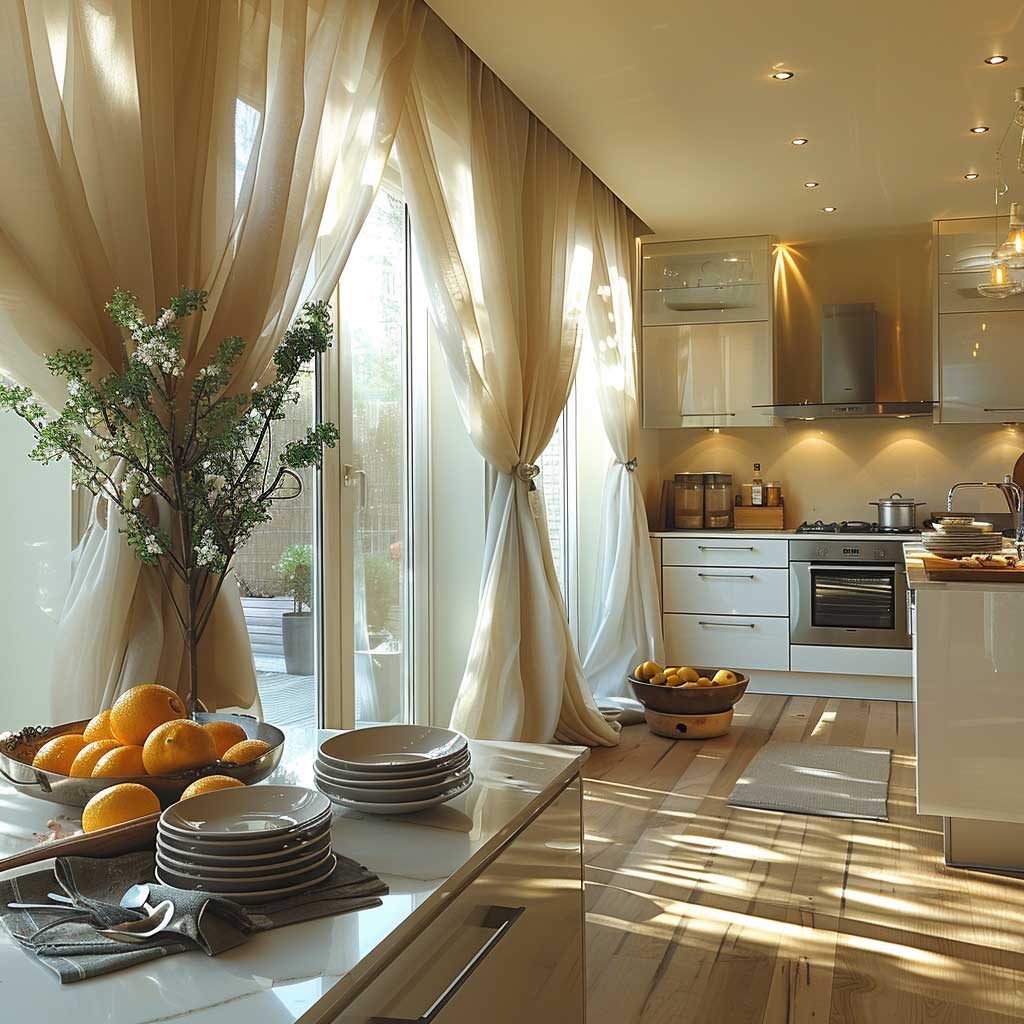
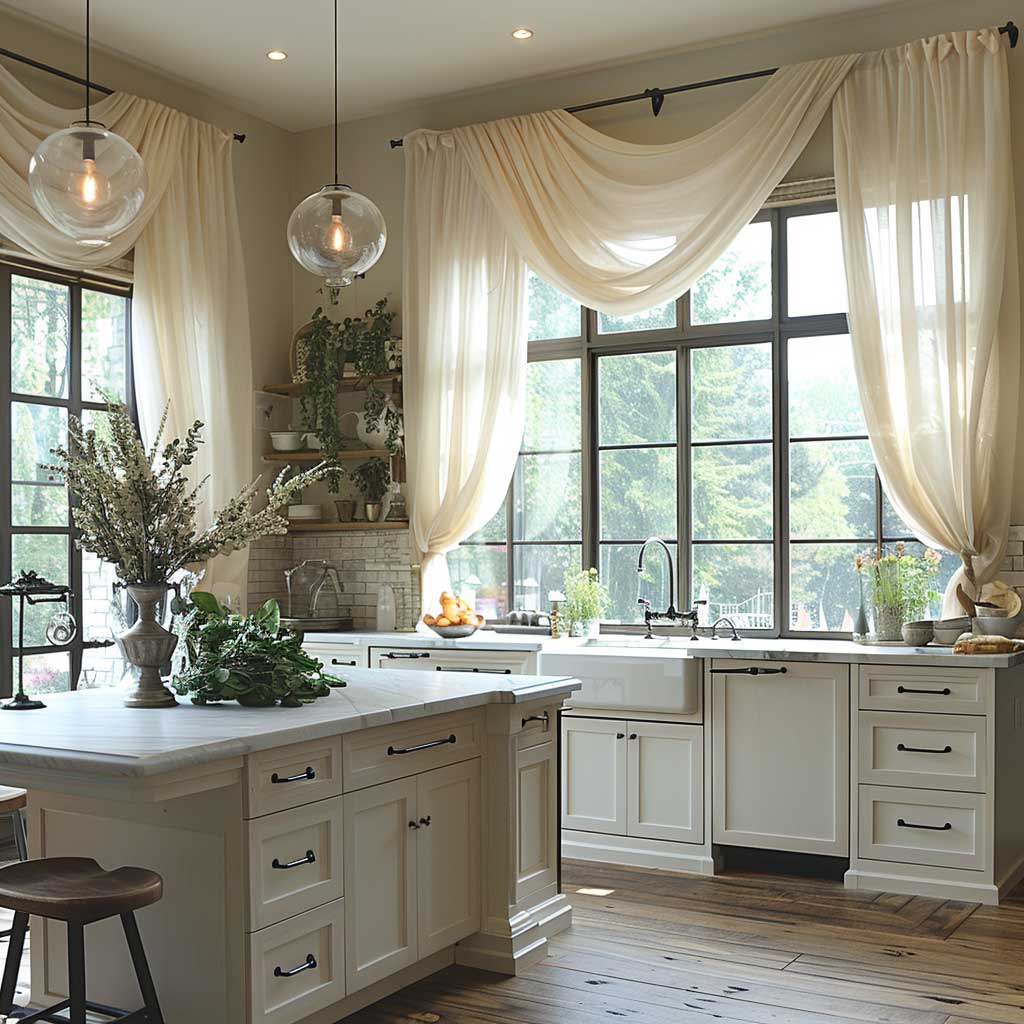
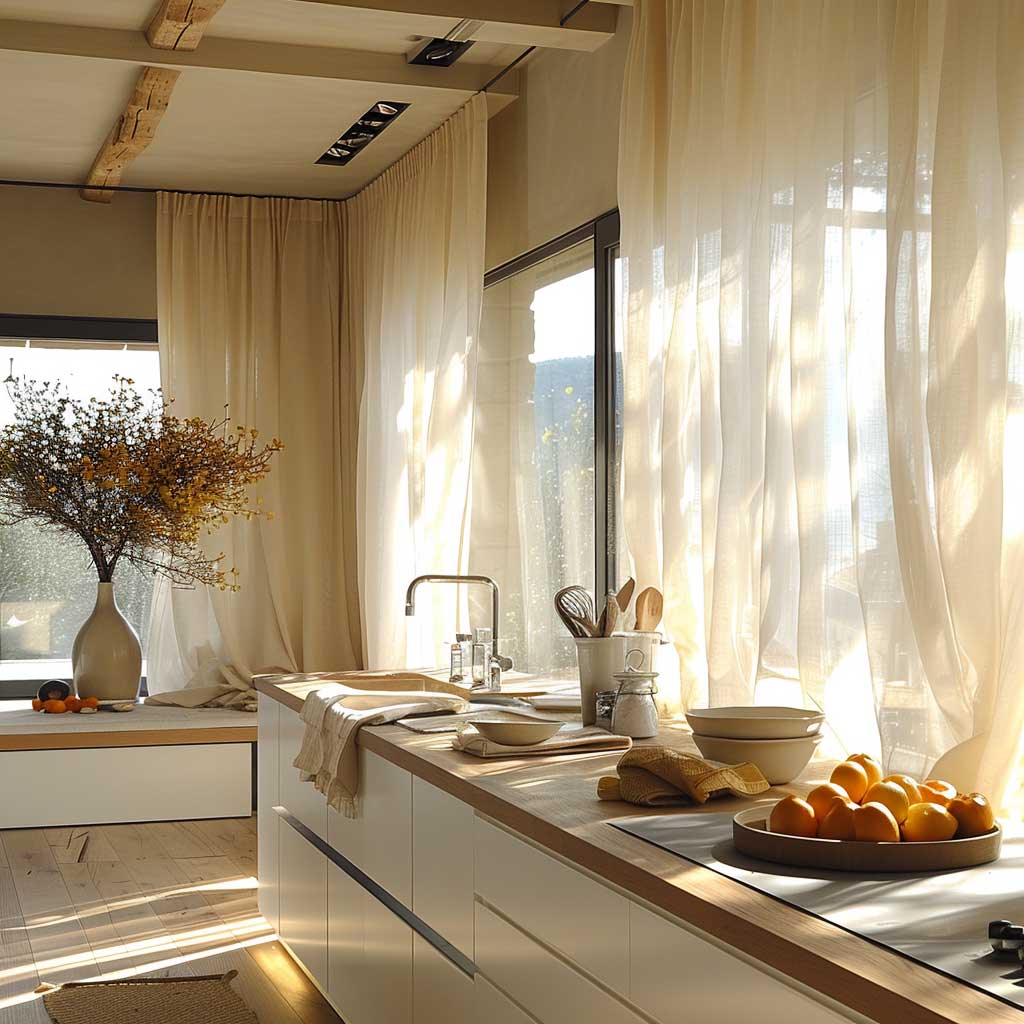
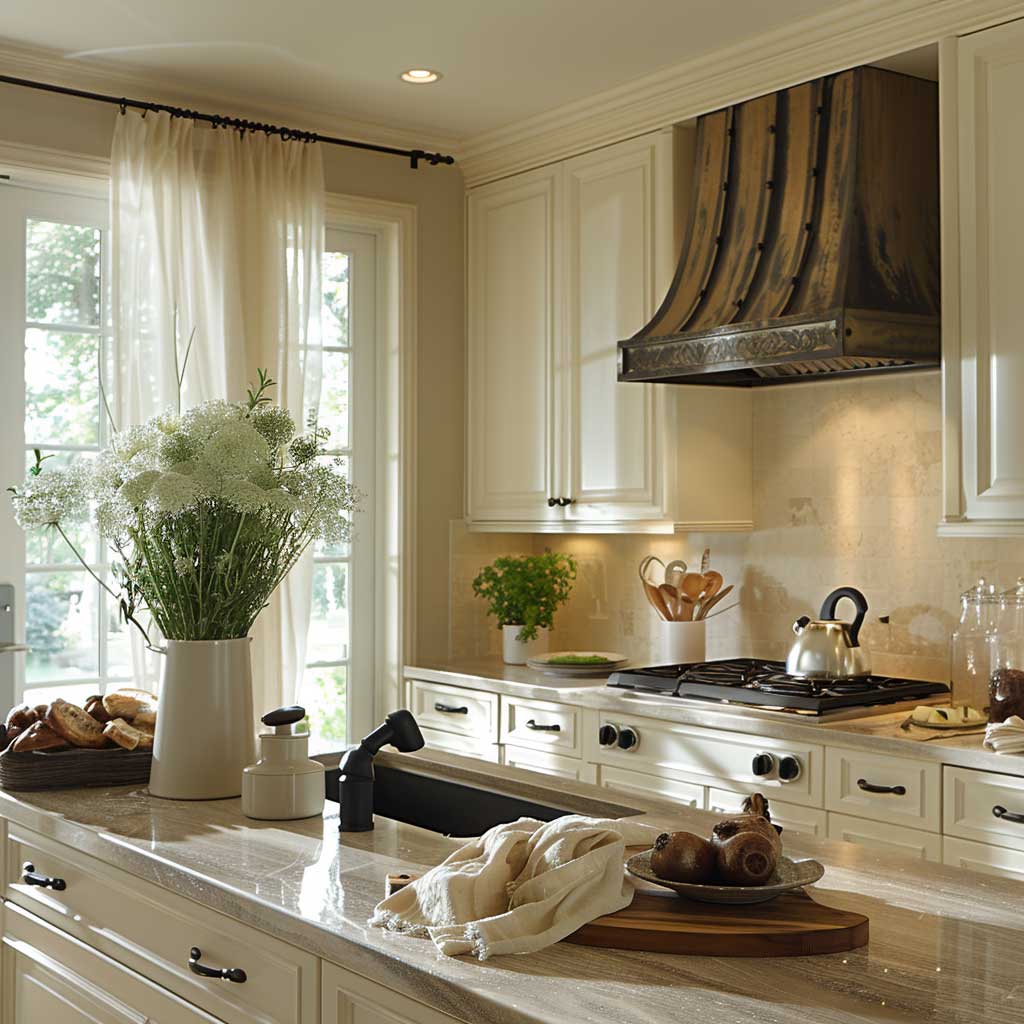
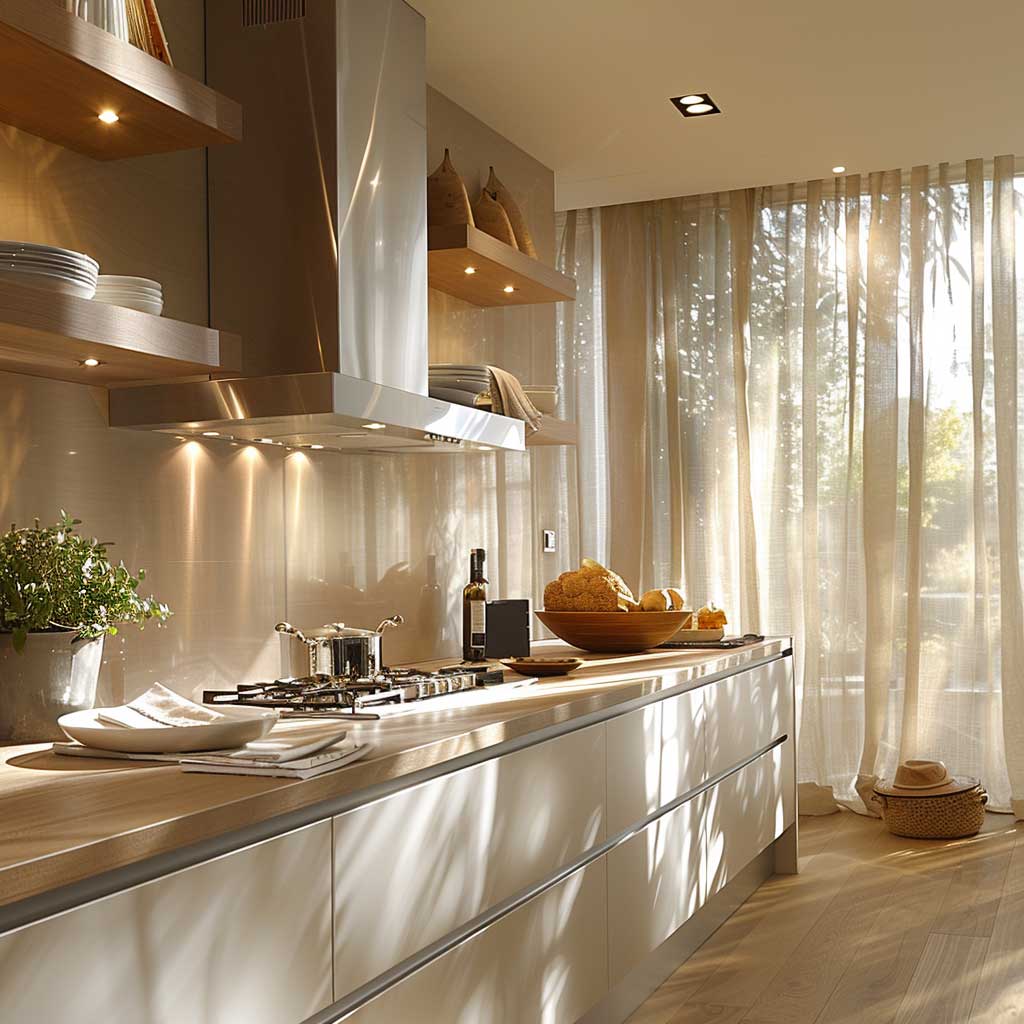
Sheer curtains look passive. They’re not. A good sheer — I use the IKEA LILL panels at $6.99 a pair as a base layer, then replace the rod with something solid — cuts glare by about 40% while the room reads as fully lit. You won’t notice the effect until you remove them and the south-facing window turns your kitchen into a greenhouse at noon. That’s when you realize sheers were doing real work the whole time.
Fabric weight is everything. Poly voile is cheap and yellows fast near cooking steam. Linen-cotton blends hold color, wash well, and diffuse light with a warmer tone — closer to a candle glow than a fluorescent strip. I bought a set from Pottery Barn (the Belgian Flax Linen Sheer, around $89 per panel) and the difference versus the IKEA version is real: the linen doesn’t balloon in a draft and the seams stay straight after washing. For most kitchens, the $6.99 version is enough. Save the linen for rooms you care about more.
The mistake people make is hanging sheers inside the window frame. Don’t. Mount the rod 4–6 inches above the frame and extend it 6 inches past each side. The curtain looks like it’s framing a bigger window because it is — you’ve redefined the window’s edges. Small kitchen window treatments live or die by this trick. A 24-inch window can read as 36 inches wide with nothing but rod placement.
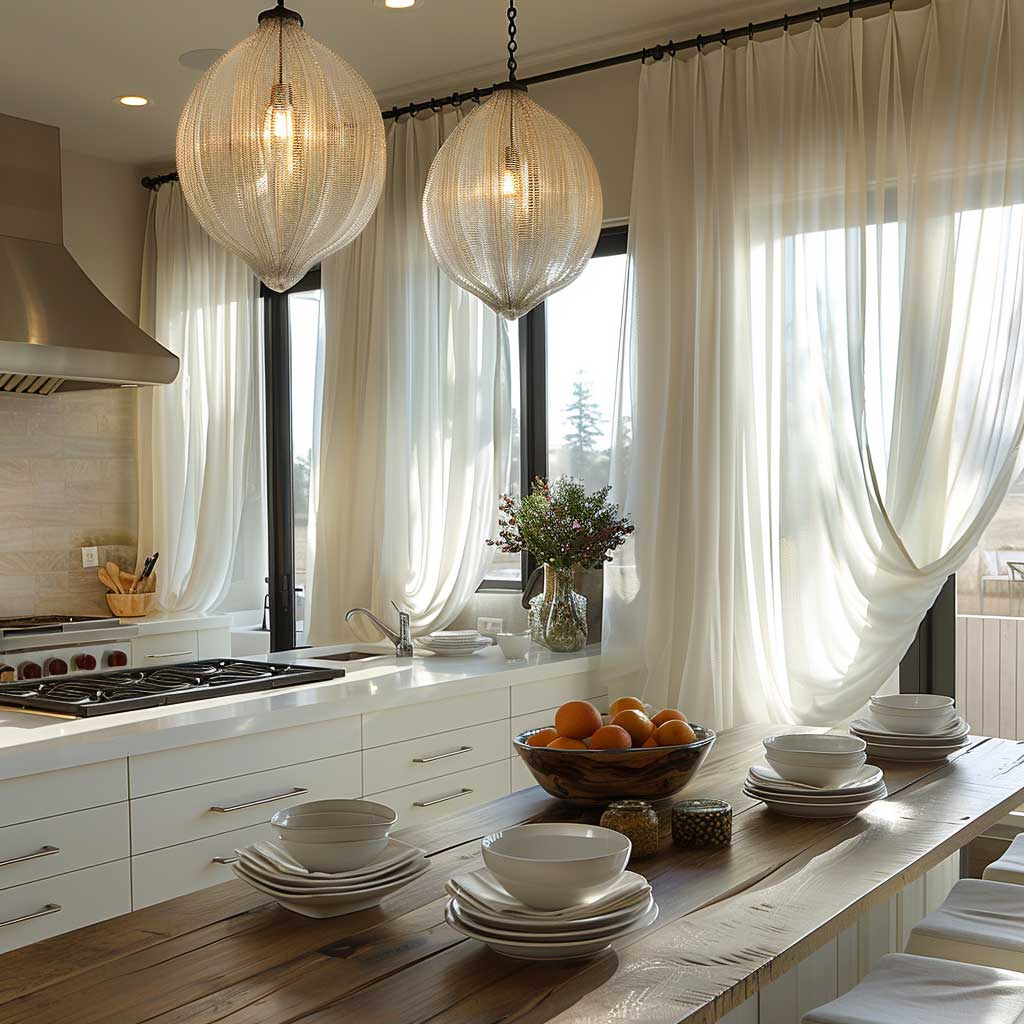
What doesn’t work: patterned sheers in small kitchens. I tried a printed voile with a small botanical print and the window looked like a gift-wrapping station. Patterns read well on Roman shades or heavier drapes where the fabric sits flat. Sheers move, so patterns ripple, and rippling patterns are visually chaotic in a room where counters, backsplash, and cabinet hardware are already competing for attention. Solid sheers only in kitchens under 150 square feet. That’s my rule and I’m keeping it.
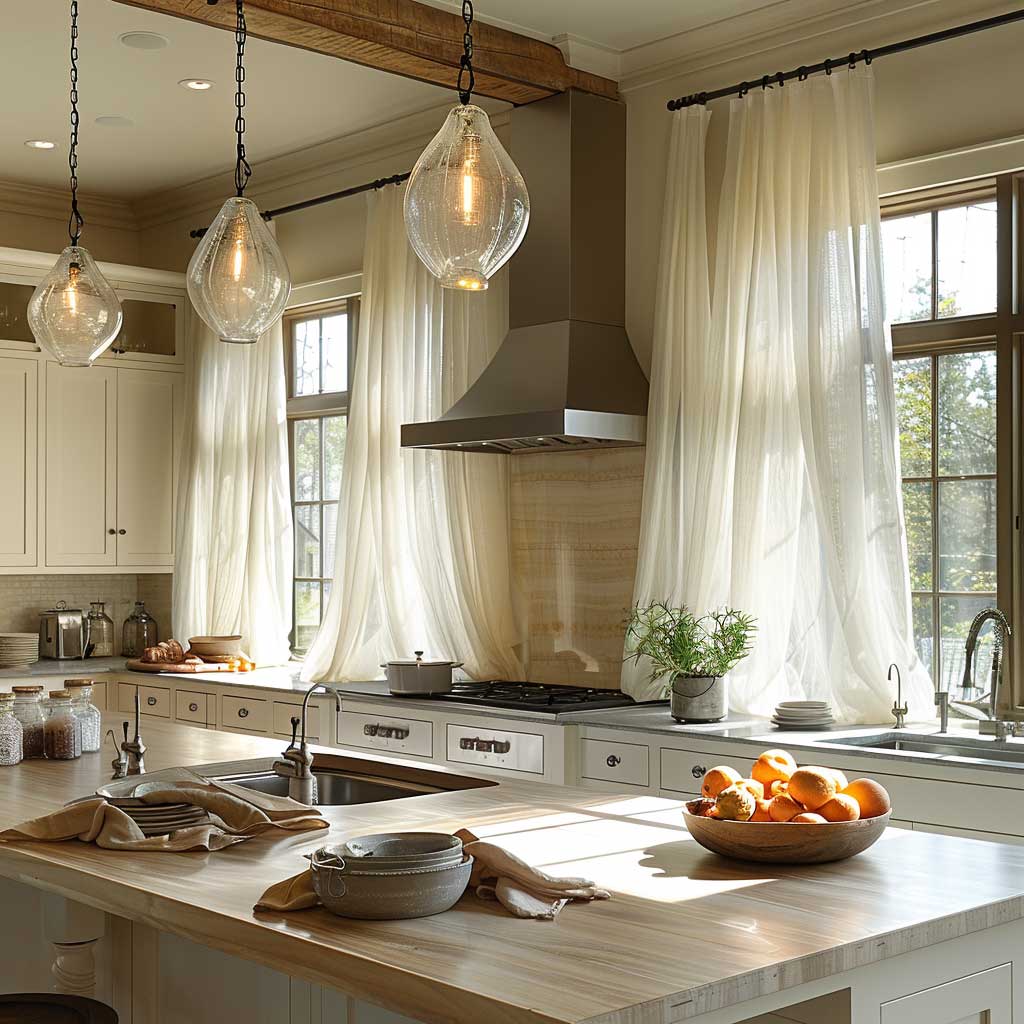
Layering sheers over a roller blind is the move for large kitchen window treatments. The blind handles the functional work — blackout in the morning if you need it, solar-filter fabric during the day. The sheer sits in front and softens the whole composition so the blind doesn’t look industrial. Pull the sheer back with a $12 clip ring when you want full light. This costs under $80 total if you use a budget roller and IKEA panels, and it photographs better than anything three times the price.
Roman Shades Do the Color Work So the Rest of the Kitchen Doesn’t Have To
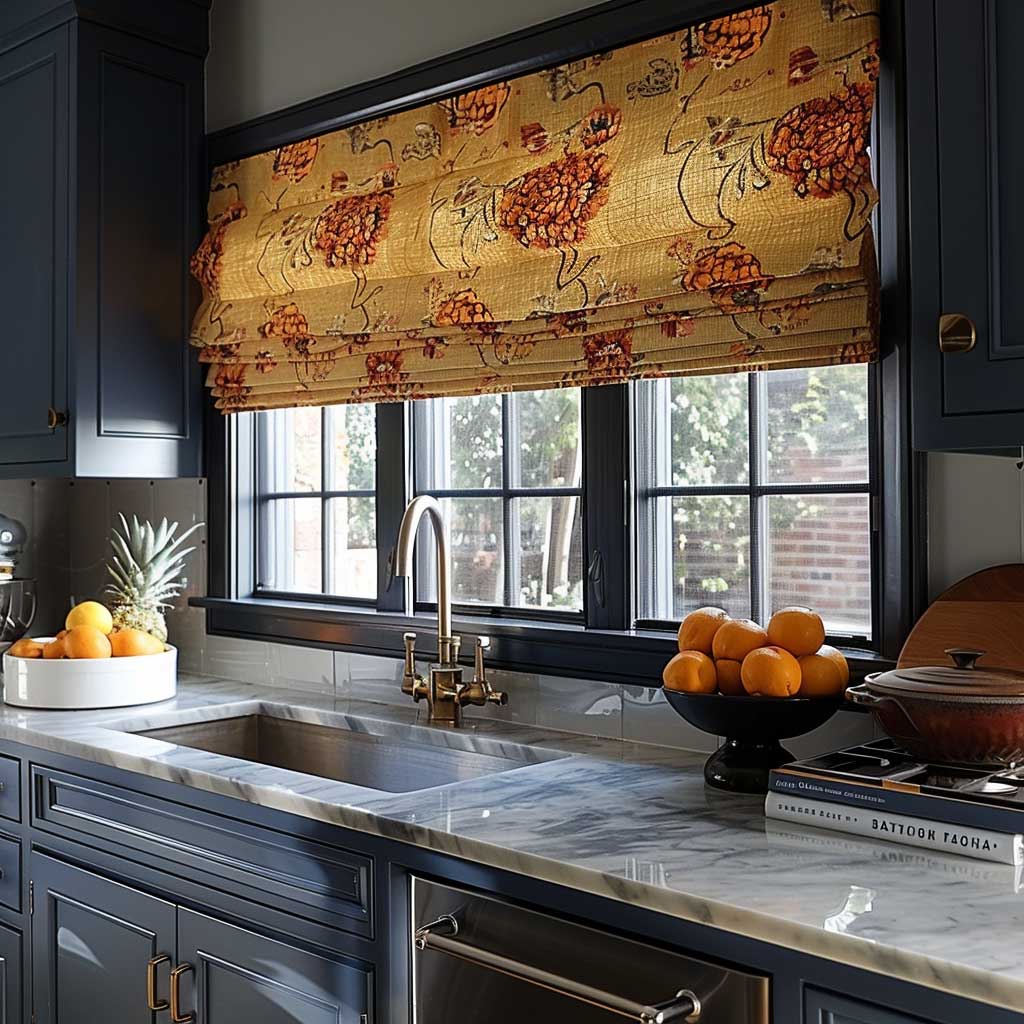
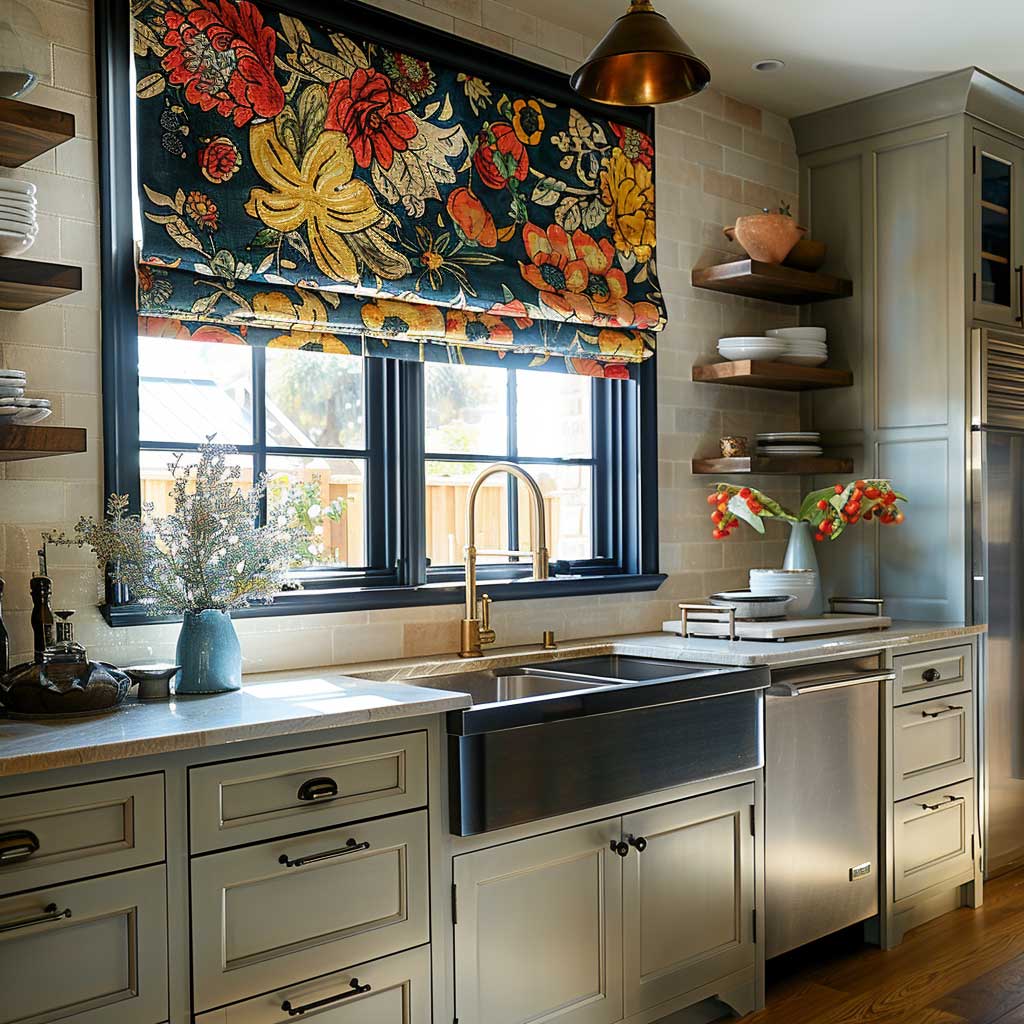
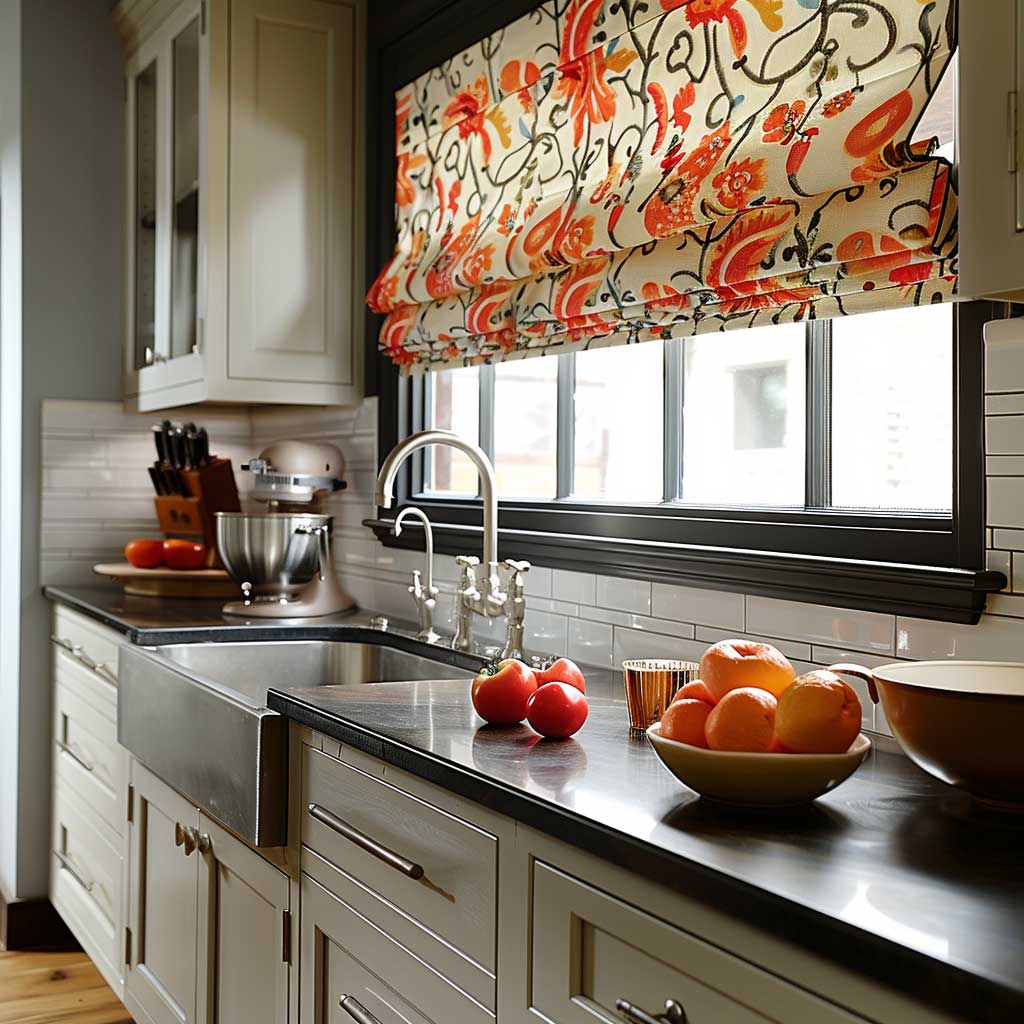
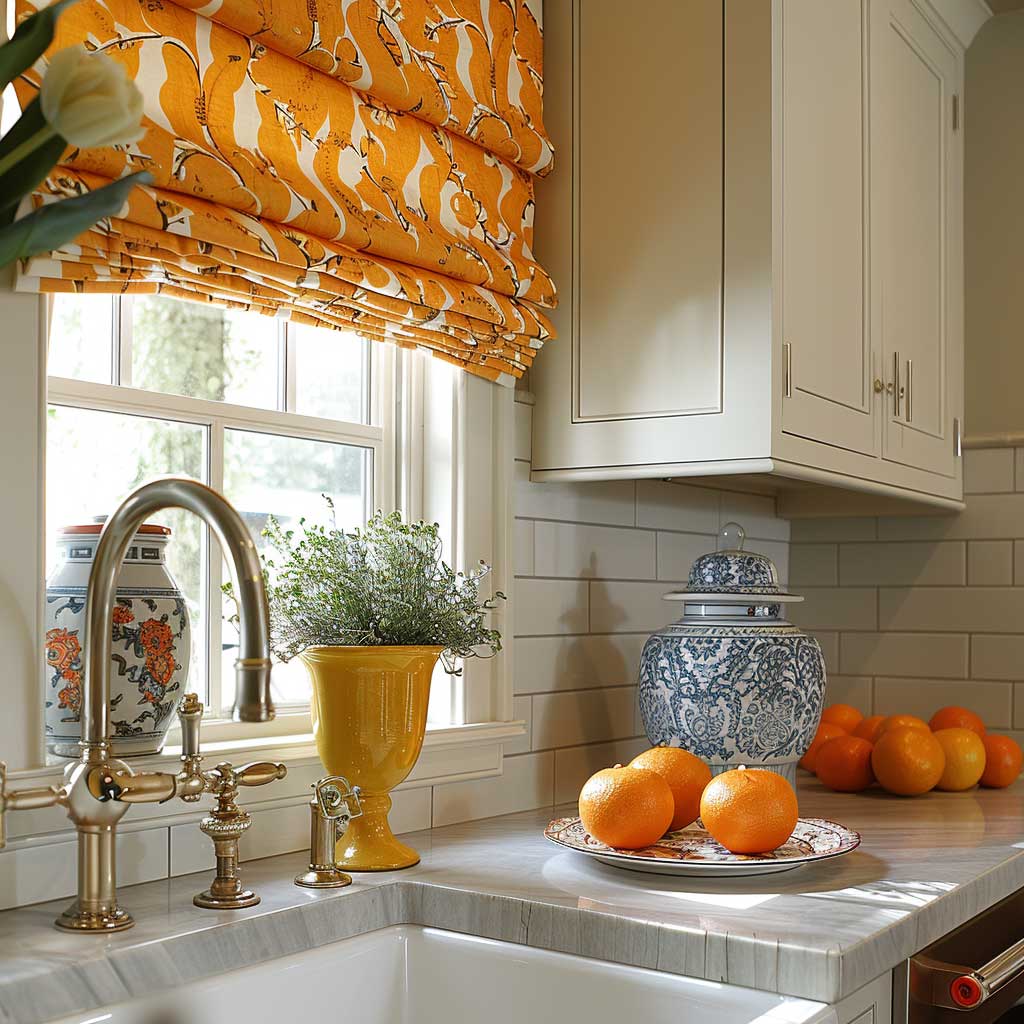
Roman shades are the most efficient color delivery system in kitchen window dressing. A flat-fold Roman in a saturated color — deep sage, terracotta, navy — does more for a neutral kitchen than a full repaint. I’ve seen a $220 custom Roman from Smith & Noble transform a white IKEA kitchen into something that looks intentional. The flat surface holds color, pattern, and texture in a way curtain fabric never does because the fabric doesn’t move. It hangs. It folds. It stays put.
Fabric choice here matters more than color. Linen Romans fold beautifully and age well. Cotton-poly blends are cheaper but wrinkle at the fold lines after a few months and start looking sad by year two. Blackout Roman shades exist for a reason — if your kitchen faces east or west and you cook early or late, the blackout lining earns its extra $30. I own two of these in my kitchen: one standard linen for the main window, one blackout for the smaller window above the range where afternoon glare hits the counter directly.
Sizing is where most people go wrong. Mount outside the frame. Add 2 inches of overlap on each side. The shade should cover the frame completely when closed — if you can see daylight around the edges, you’ve measured inside the frame like a rookie. Width matters for privacy in kitchen window ideas: a shade mounted inside a frame leaves a gap at both sides where the neighbor can see straight in. Outside mount eliminates that gap entirely.
Don’t Do This
Don’t hang a Roman shade on a tension rod inside the window frame when the window is above the sink. Steam and moisture from washing up warp the rod, and the shade starts tilting within six months. Use a proper wall-mount bracket screwed into the frame above the window — tension rods are for closets and café curtains, not rooms with daily moisture. Also, avoid blackout Roman shades in rooms that face north. You’ll block the only light you have, and the kitchen will feel like a break room.
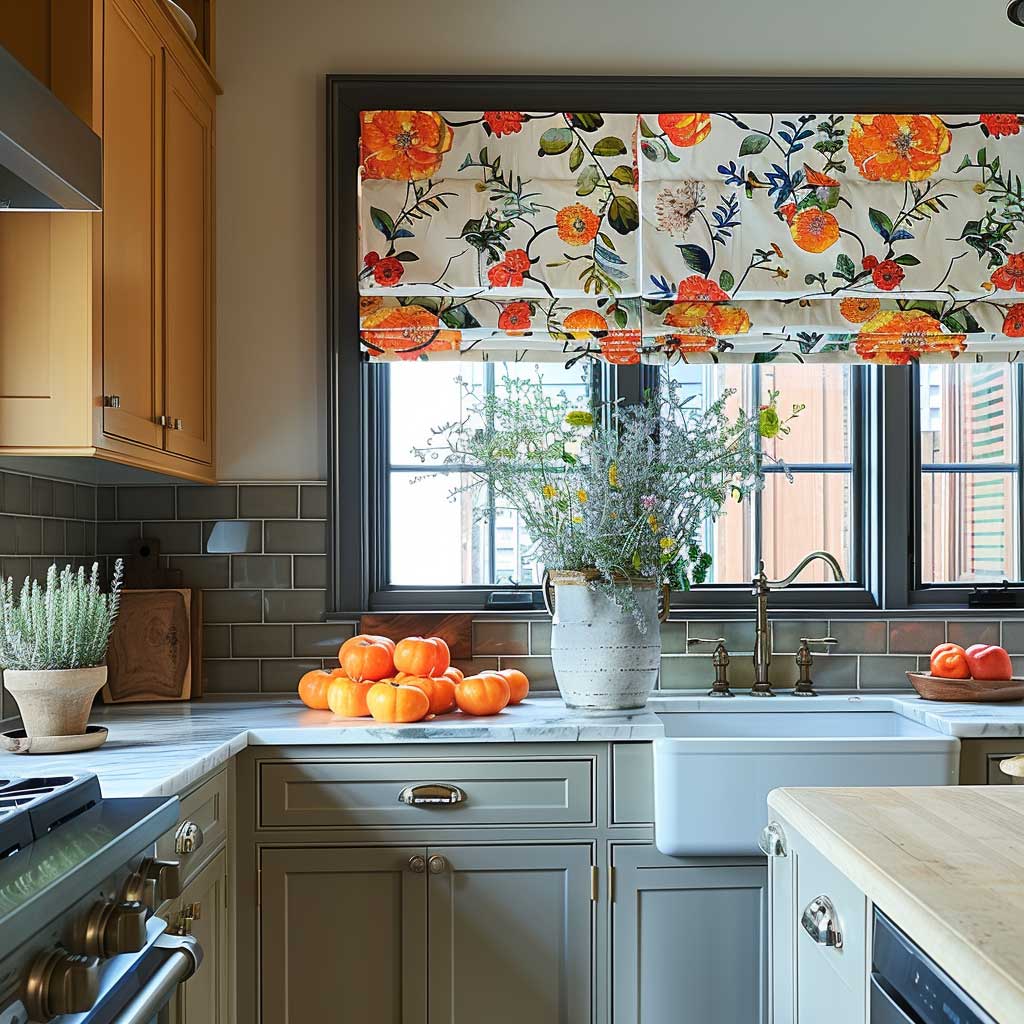
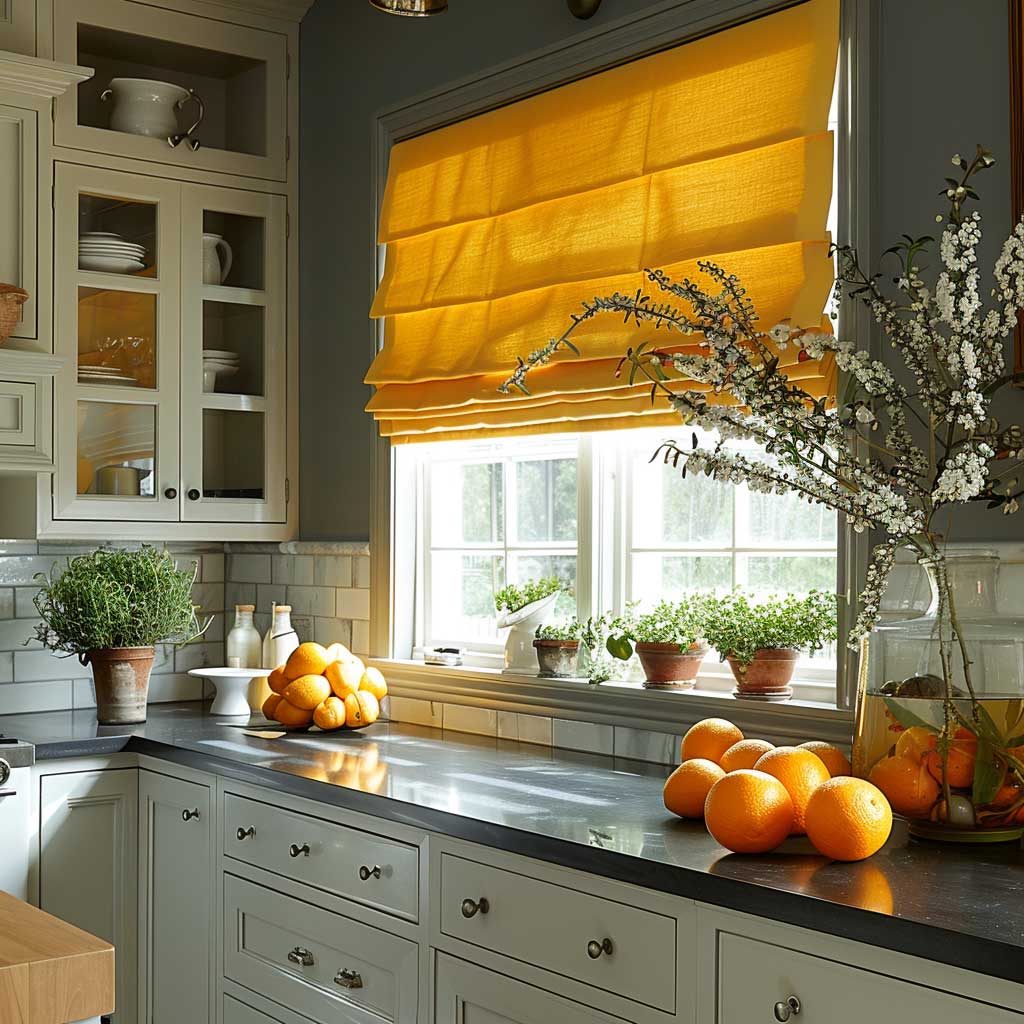
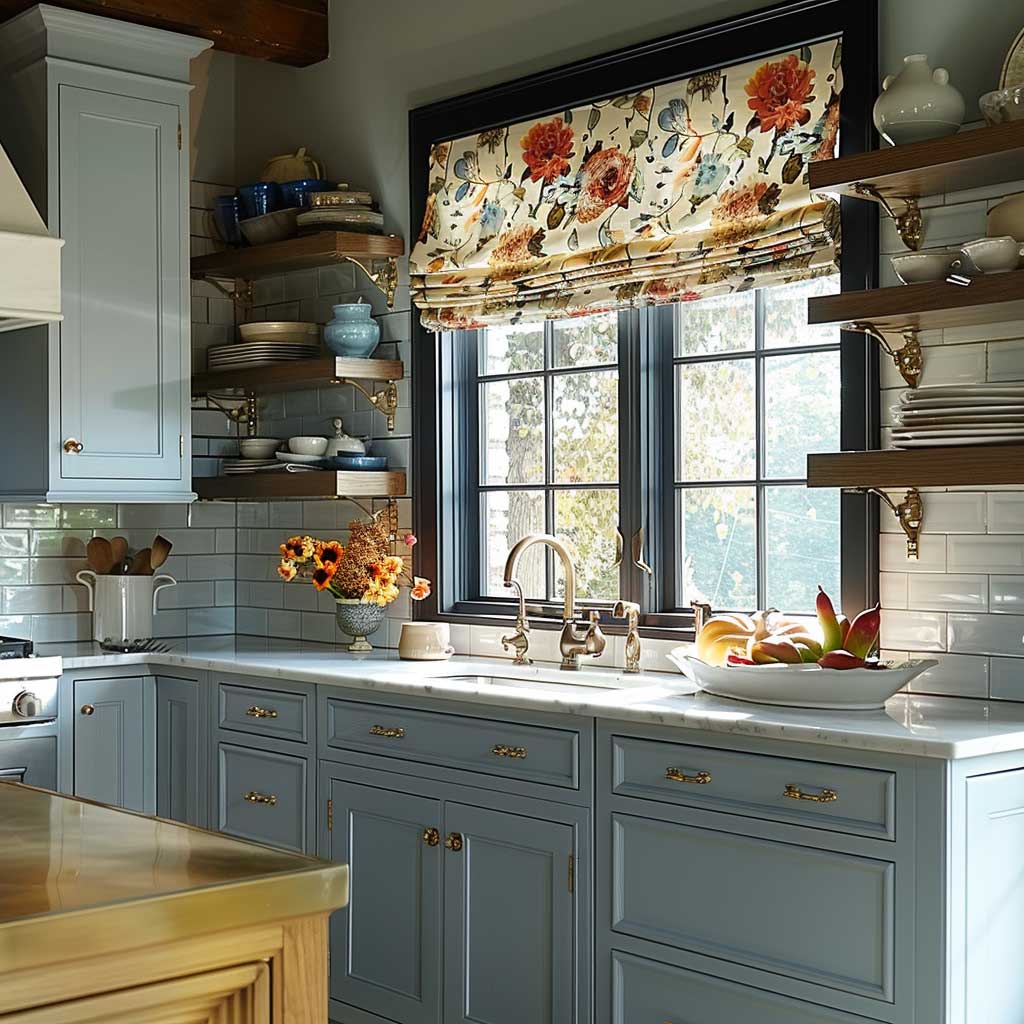
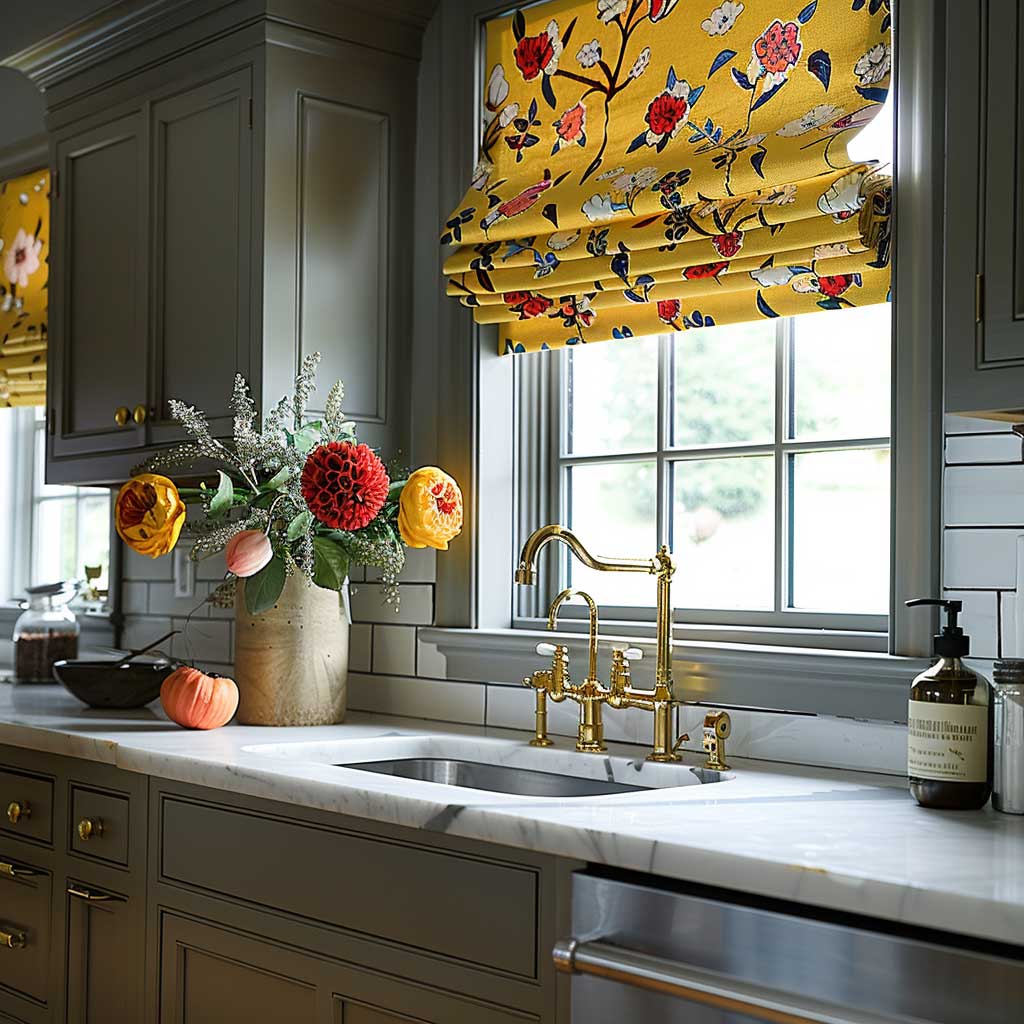
For large kitchen window treatments, Roman shades can look undersized if you order one wide panel. Go with two narrower shades side by side instead of one wide one — they stack higher when raised, so you lose less of the view, and the center seam reads as intentional structure rather than a limitation. Schoolhouse Electric makes good ones in this format. Expect to pay $180–$280 per shade for their standard fabric options. Custom fabrics run $350 and up, but you can use their mounting hardware with fabric you source yourself and cut the price significantly.
For ideas on how Roman shades coordinate with different kitchen cabinetry finishes, this kitchen cabinet color ideas resource covers the pairings that actually photograph well versus the ones that only look good in person.
Roller Blinds Near the Sink Get Graded on Different Criteria
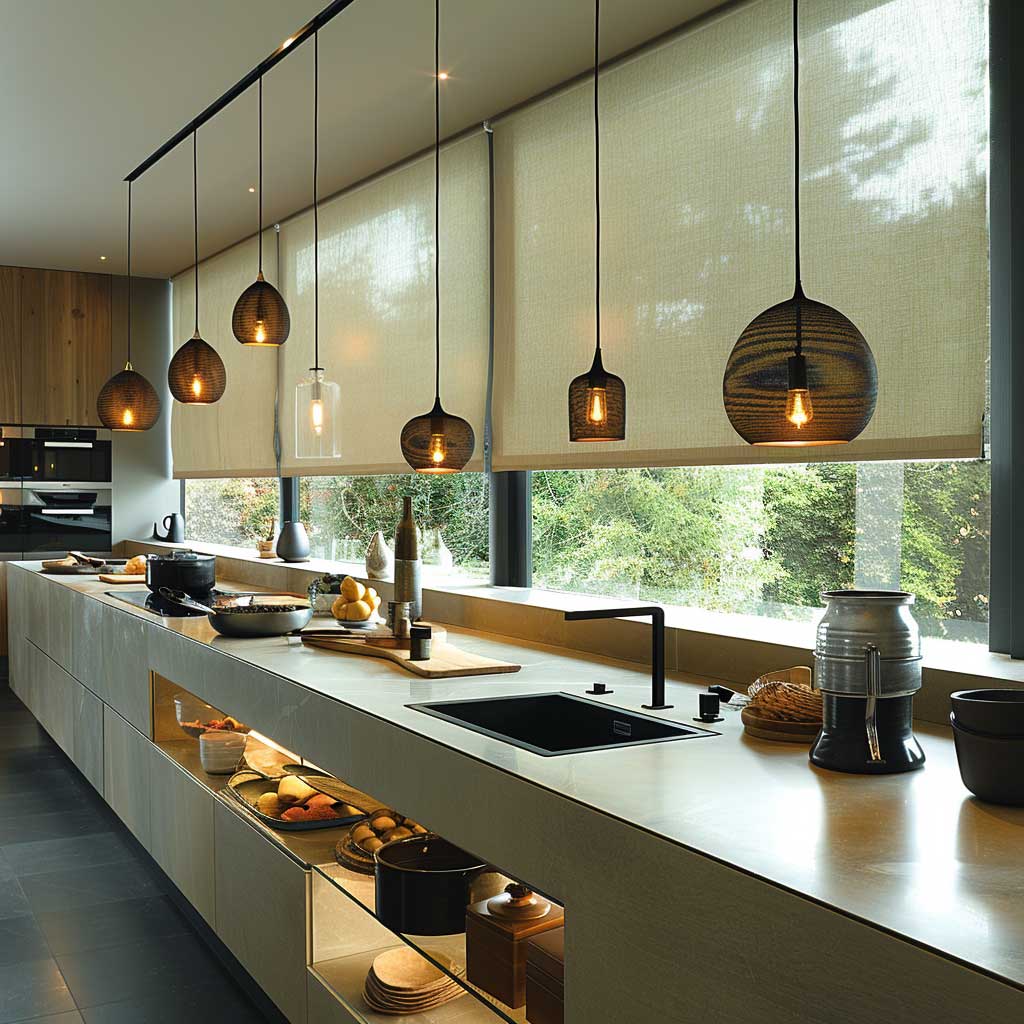
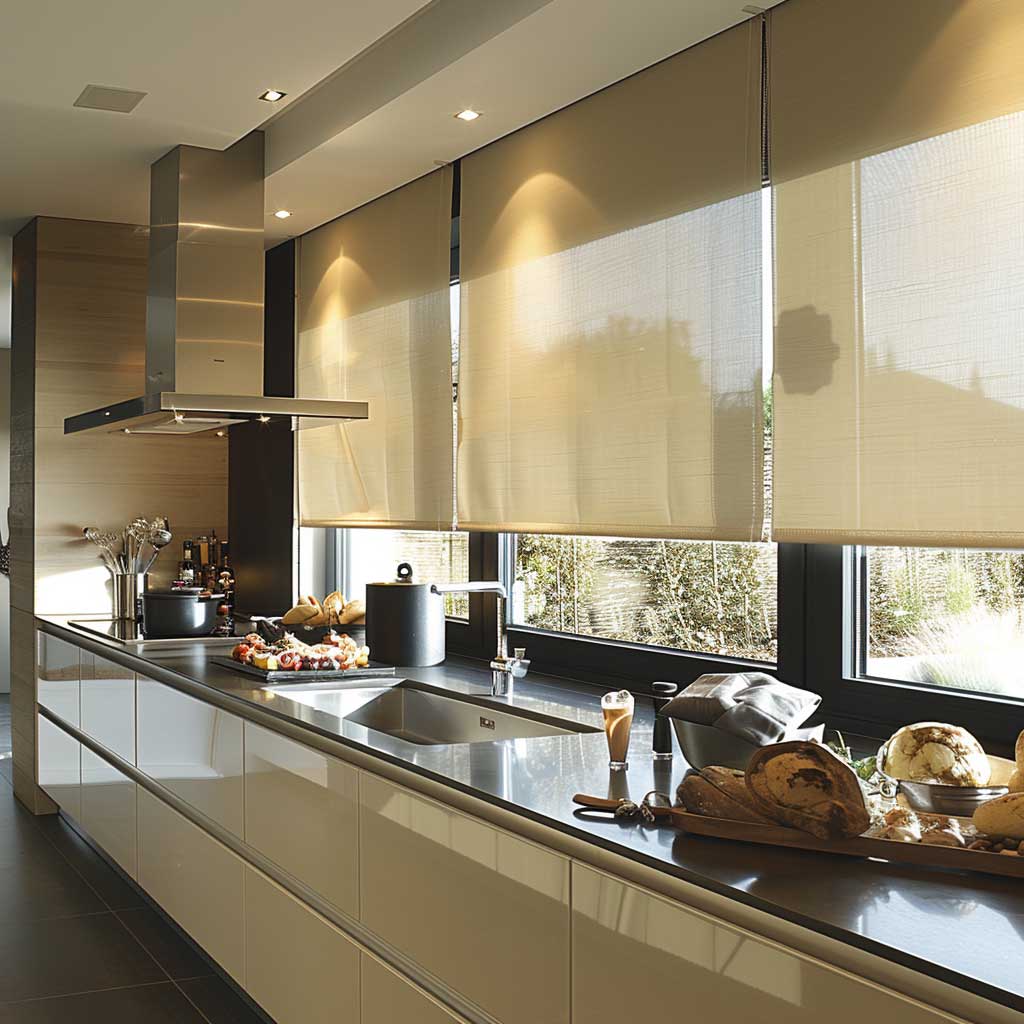

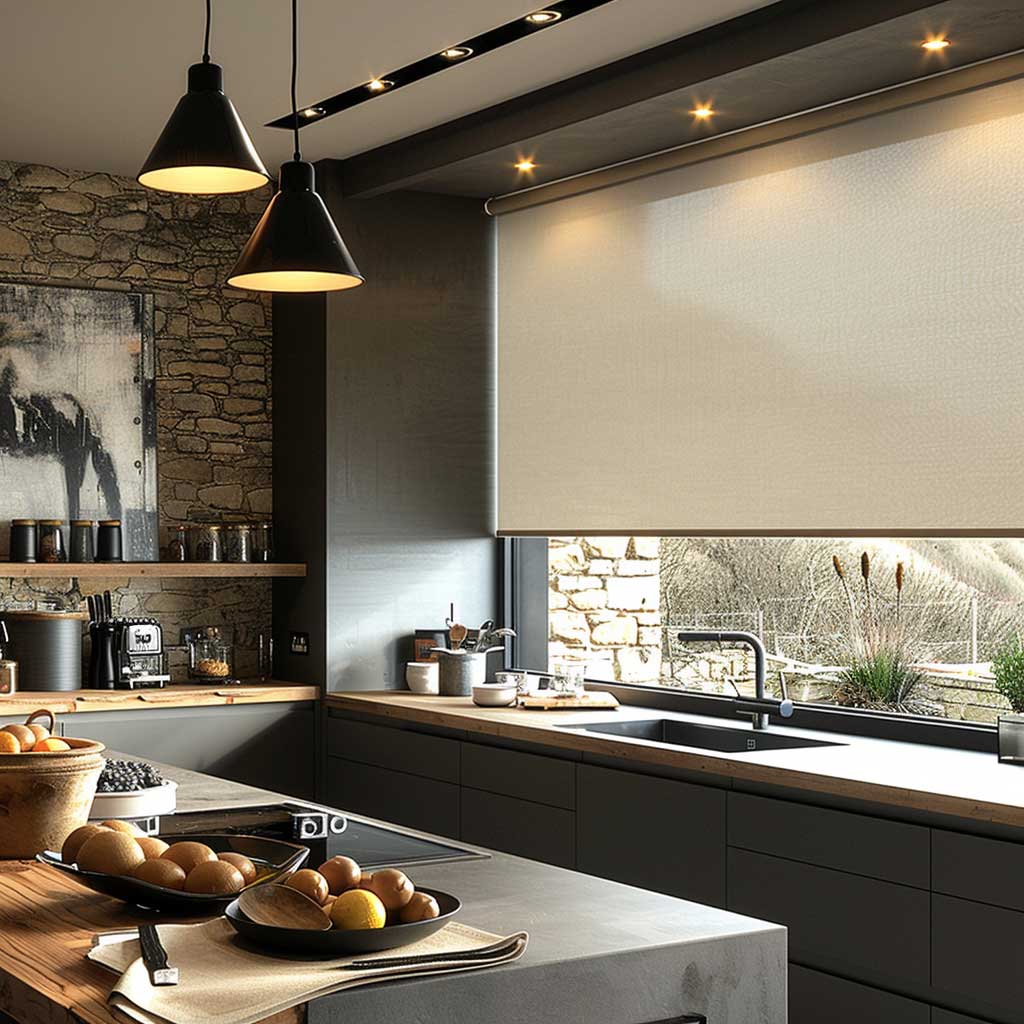
Roller blinds get chosen for kitchens because they’re easy to wipe down. That’s the whole pitch, and it’s a good one. Near the sink, every other window covering eventually loses. Fabric curtains absorb steam. Roman shades pick up grease particles in the fold lines. Roman shades in particular — I had one over my range for 18 months before I gave up and switched to a roller. The first wipe with a damp cloth told the whole story. The roller blind came clean in 30 seconds. Done.
Solar fabric is the right call for kitchen window coverings in rooms with a view. A 5% openness factor lets you see outside clearly while cutting UV and glare. Bali Blinds sells these in 25 colors starting around $70 for a standard 36-inch width. The 10% openness fabric looks more casual, slightly more transparent, and works in rooms where you want more light. The 3% openness is nearly opaque during the day and fully opaque at night when interior lights are on — not ideal unless privacy from the street is the main problem.
Cordless is worth the extra $15. Cords age badly in humid kitchens — they yellow, stiffen, and eventually snap. Most brands charge a small upgrade for cordless operation. Take it. If you’re covering a window over 48 inches wide, look at motorized rollers. Hunter Douglas makes a reliable motorized roller (the Sonnette series, around $400–$600 installed) that’s genuinely useful when the window is above the counter and reaching the chain means leaning over the sink.
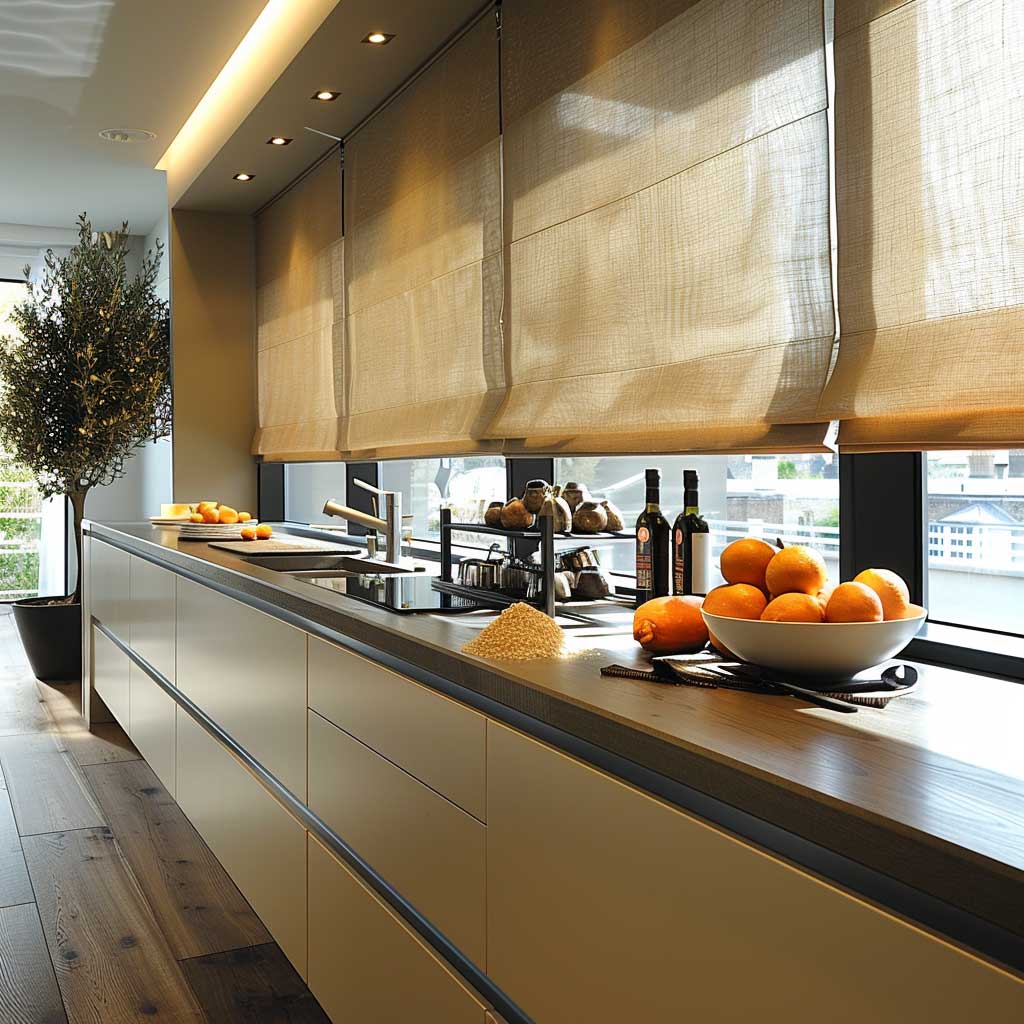

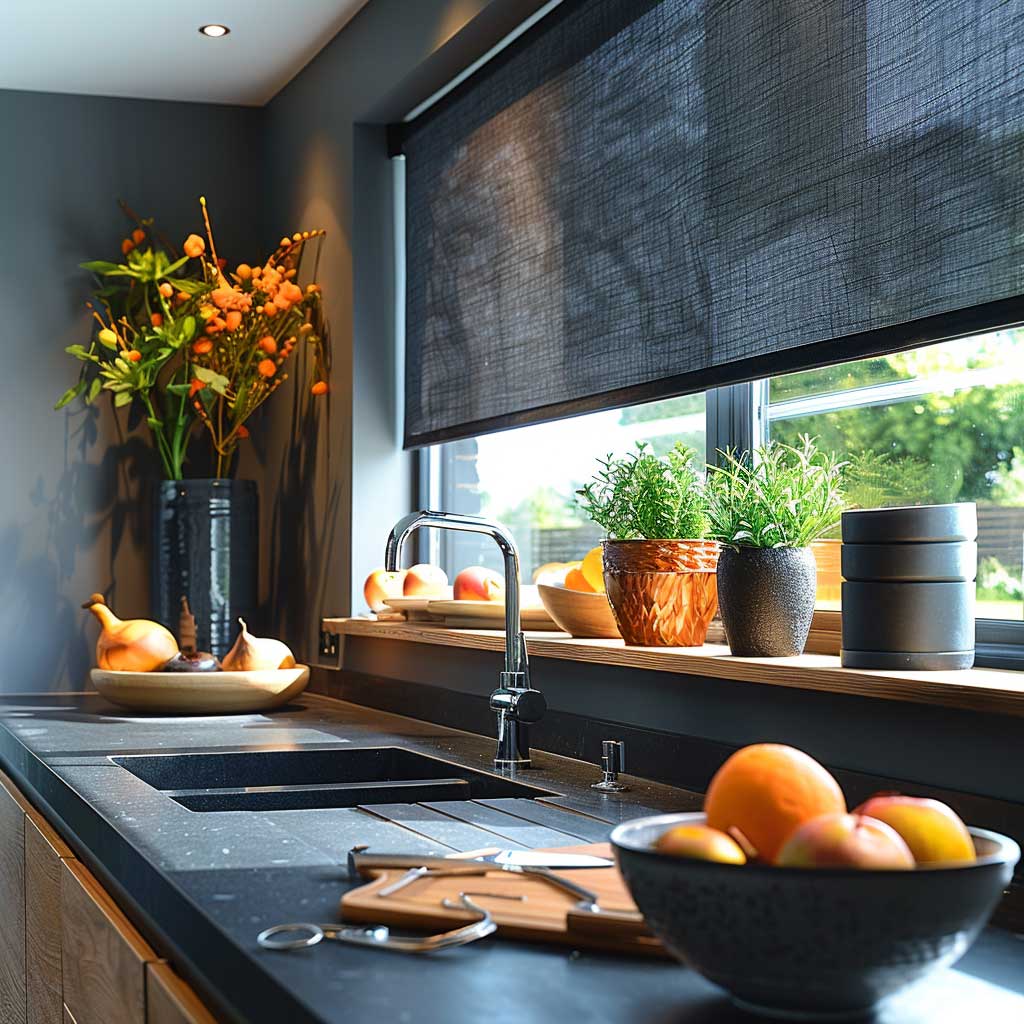
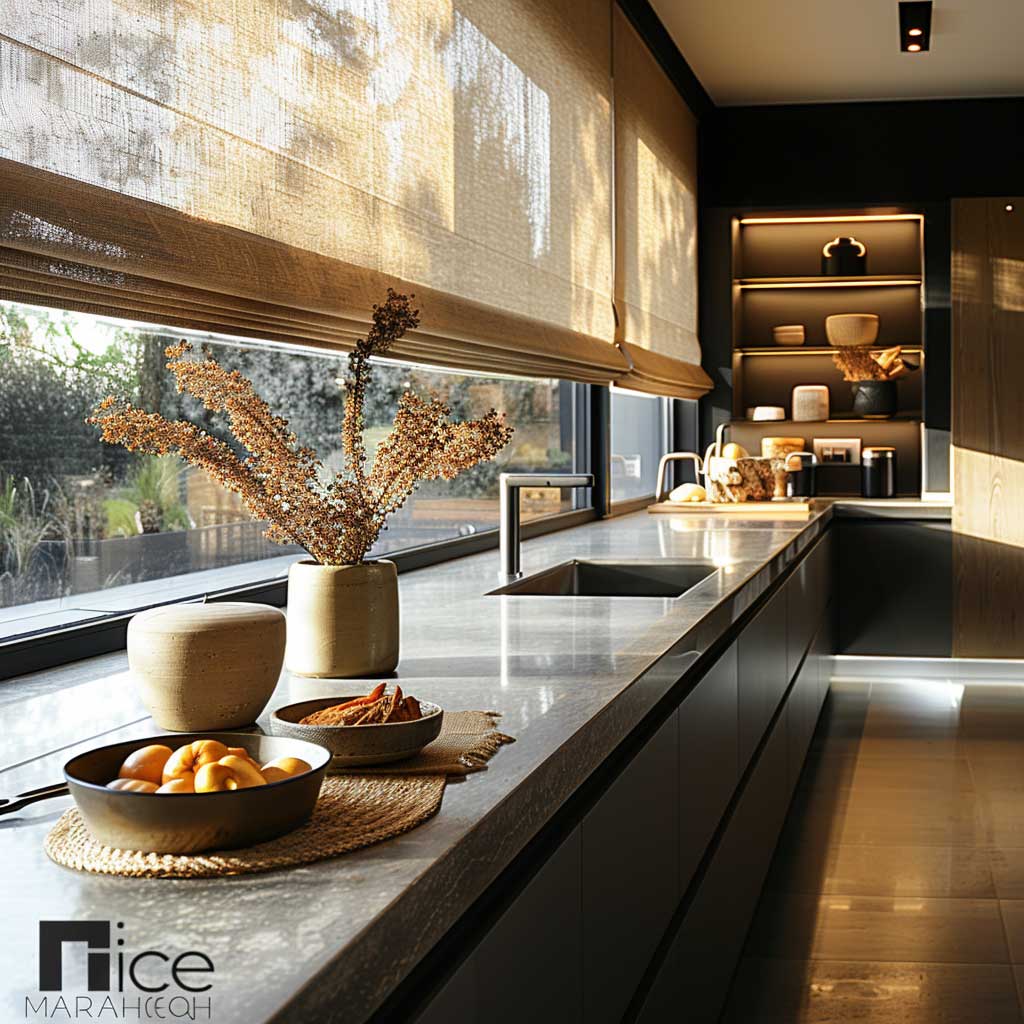
The main criticism of roller blinds in kitchen design is that they read as an office supply. That’s a valid complaint about cheap poly rollers in beige. It stops being valid when you use a textured fabric — bouclé weave, grasscloth-look solar, woven wood-effect fabric — or when you pair the roller with a linen valance at the top. The valance doesn’t have to be elaborate. A 6-inch flat panel of linen in a color that matches the roller fabric covers the hardware and adds the visual warmth that makes the blind feel residential instead of institutional.
For large kitchen window treatments, dual rollers are the answer: one solar blind for daytime and one blackout blind on a second headrail for night. Both roll independently. The system costs more — expect $150–$250 for a basic dual setup from SelectBlinds — but you get the equivalent of two window coverings in one clean installation. No layering, no swapping panels between seasons. You just pull the one you need. I stole this setup from a restaurant renovation I consulted on, and it’s the best functional decision I’ve ever applied to a residential kitchen.
Coordinating roller blinds with the rest of the kitchen’s hard materials — countertops, cabinet hardware, appliance finishes — works the same way coordinating a tile does. This breakdown of kitchen countertop ideas by material and finish includes color pairing notes that translate directly to blind fabric selection.
Large Kitchen Windows Punish Every Covering Mistake at Scale
Large kitchen window treatments are a different conversation from small ones. A 72-inch-wide window over the range or spanning the breakfast nook isn’t just a bigger version of the sink window — it’s a wall element. Treat it like furniture. The covering needs to have visual mass, proper mounting hardware rated for the weight, and enough fabric to hang without puckering or pulling toward the center.
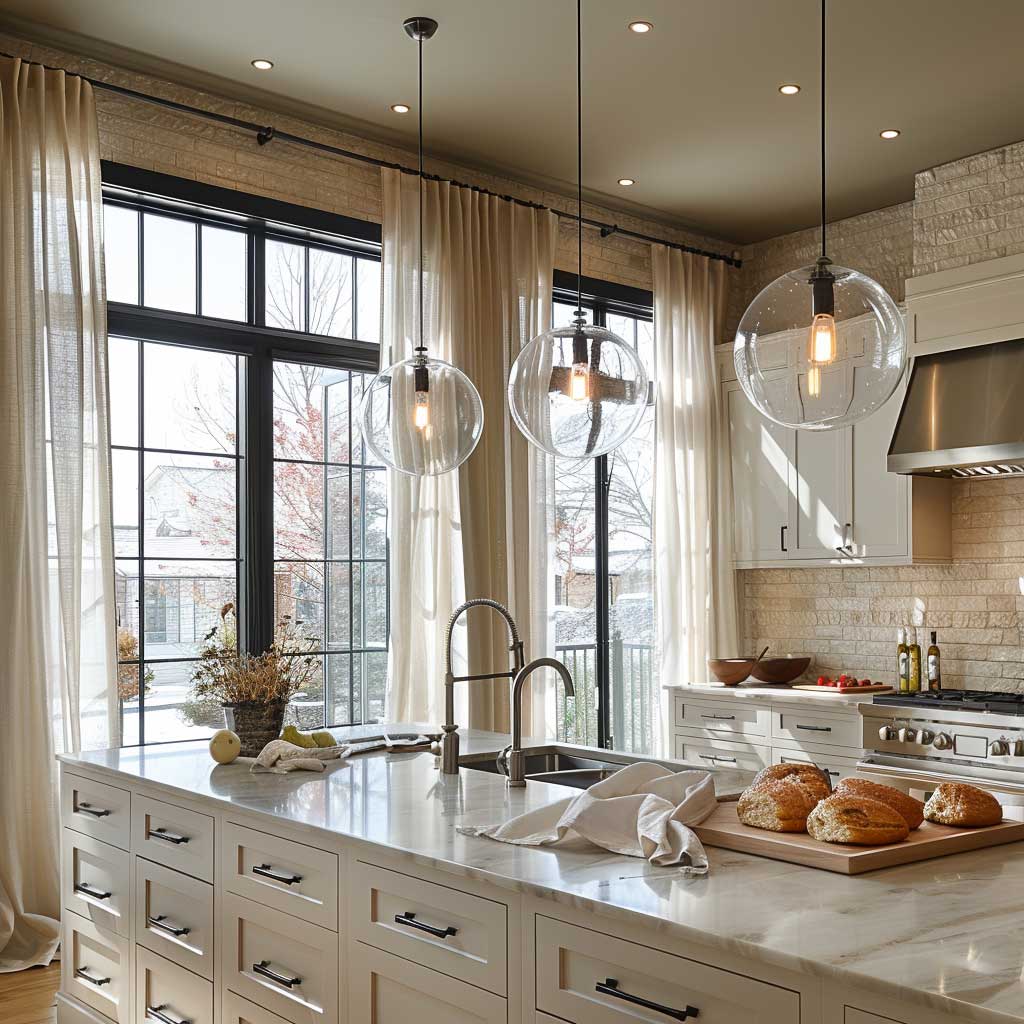
Ceiling-to-counter is the rule for large window dressing in kitchens. If the window runs from countertop height to near the ceiling, mount the rod or bracket at ceiling height and let the treatment drop to counter level. The eye reads this as a tall vertical element, which makes the room feel higher. Stopping at the window frame instead makes the wall above the frame look stranded — like a forehead with no eyebrows. Architecturally incomplete.
What doesn’t work on large windows: single café curtains. A café curtain covering only the lower half of a 60-inch window looks charming on a 24-inch window. On a large window it looks like you ran out of fabric. The top half of the glass turns into an uncovered expanse that reads as an oversight, not a style decision. Commit fully or use a different treatment.
Width also needs to be generous. For a 72-inch window with curtain panels, the combined fabric width when panels are open should be at least 1.5 times the window width — ideally 2x. This means each panel has enough fabric to gather and look full rather than stretched flat. Stretched-flat panels on a large window look like a shower curtain. Full, gathered panels look like a room designed by someone with a budget. The fabric cost difference is real but the visual return is immediate. According to Better Homes & Gardens, the most common large-window mistake is underscaling the treatment — going too narrow, too short, or too thin in fabric weight — and the fix costs less than the original installation.
Small Kitchen Window Treatments Live by the Mount, Die by the Mount
Small kitchen window treatments have one enemy: the inside-frame mount. Mount inside and the window looks like a porthole. Mount outside, extend the rod past the frame, and you’ve redefined the window’s footprint without touching the glass. This is a $0 upgrade that changes everything about how a small kitchen reads.
Café curtains are the honest choice for small windows over the sink. A single panel on a tension rod, hung at mid-window, gives you privacy at eye level while keeping the upper half of the glass open for light. The IKEA RAFFROLLO panel at $19.99 works. The Anthropologie version at $98 works better and holds its pleat longer. What doesn’t work is a full-length curtain on a 20-inch window — it eats the frame, blocks the light source, and makes the window disappear into the wall.
Hardware scale matters more on small windows than large ones. A thick 1.5-inch rod on a narrow window looks like scaffolding. Use a 0.5-inch or 0.75-inch diameter rod and simple clip rings. The hardware should be invisible when the curtain is hanging. If you notice the rod before you notice the fabric, the rod is wrong. My go-to is the STORSLAGEN rod from IKEA — thin, matte black, $12, fits almost any bracket configuration.
For kitchen window privacy ideas specifically — when the small window faces a neighbor or a pathway — cellular shades are the most effective option. The honeycomb structure provides genuine privacy even in translucent options, because the cell geometry scatters light in a way that flat fabric doesn’t. Levolor and Bali both sell these starting around $60 for a standard small window. The additional insulation benefit in a small kitchen window is real — cellular shades can reduce heat loss at the glass by 40% in winter according to manufacturer testing. Good for utility bills, genuinely good.
Material Comparison for Kitchen Window Coverings
| Treatment | Best For | Price Range | Wipe-Clean | Light Control |
|---|---|---|---|---|
| Sheer curtains | Any size, light layering | $7–$90/panel | No — machine wash | Diffuse only |
| Roman shades | Color, pattern, small windows | $80–$350/shade | Spot clean only | Good with lining |
| Roller blinds | Sink area, high-moisture zones | $40–$600 | Yes — damp cloth | Excellent |
| Cellular shades | Small windows, privacy, insulation | $60–$180 | Spot clean only | Good |
| Café curtains | Sink windows, lower-half privacy | $20–$100/panel | Machine wash | Lower half only |
Final Word
The window treatment you skip is the reason the kitchen never looks finished.
Start with the mount point, not the fabric. Get the hardware position right and every treatment you hang will look better than it cost. Layer a roller with a sheer and you’ve covered every lighting scenario without rearranging furniture.
For small windows, stay outside the frame and go thin on hardware. For large ones, go full ceiling-to-counter and never underscale the fabric width.
Save this post before you measure anything — you’ll need the material comparison table when you’re standing in the store.