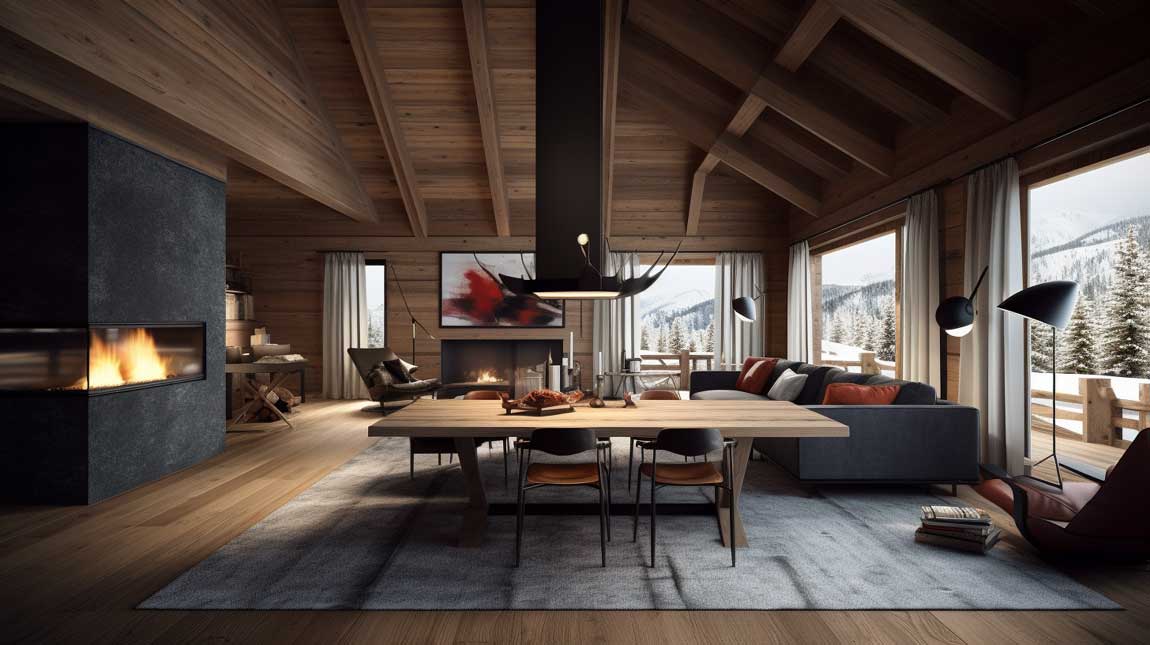
Chalet style interior design isn’t a mood board exercise — it’s a material argument. Raw oak against whitewashed plaster. Hand-hewn beams overhead. A fireplace that actually pulls the furniture toward it instead of sitting in the corner like an afterthought. I’ve walked through a dozen Swiss chalets and the ones that land hard all share the same logic: every surface is doing double duty, carrying both structural weight and visual temperature. You’ll notice the difference within three seconds of stepping inside. The rooms that miss it are the ones where someone swapped real reclaimed timber for laminate and called it alpine.
Modern Swiss chalet interior design sits at a specific intersection — not full rustic, not cold Scandinavian. Think Ligne Roset sofas next to hand-carved balustrades. Think Hans Wegner chairs at a dining table below a vaulted pine ceiling. The formula sounds contradictory until you see it. Then it’s the only thing that makes sense in the mountains.
What you’ll find in this post:
→ Why timber is a non-negotiable in chalet style interior design — and which wood species hold up
→ The floor-to-ceiling window rule alpine architects use that most remodels get wrong
→ How to layer textures without making a room feel like a craft store
→ The fireplace placement mistake that kills the whole space
→ Statement lighting picks that don’t look like ski lodge clichés
→ Why open-concept chalet rooms fail without one specific anchor
→ Outdoor living spaces: what separates a terrace from a proper alpine extension
→ Spa bathrooms, alpine artwork, bold color and what to skip entirely
Wood Is the Load-Bearing Argument for Everything Else
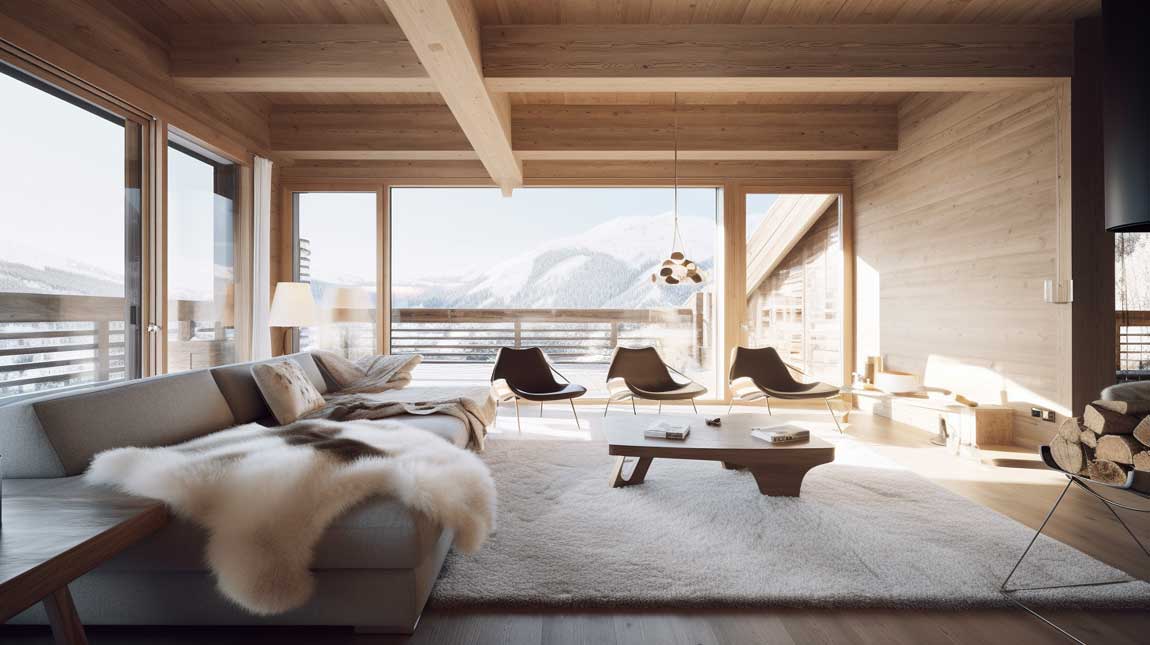
Reclaimed European larch runs around $12–$18 per board foot installed — and it’s the single material that justifies every other decision in a chalet interior. I’ve bought both larch and Douglas fir for mountain projects, and larch wins on stability every time, especially at altitude where humidity swings hard between seasons. You’ll notice that chalets using locally sourced timber feel grounded in a way that imported veneer panels simply can’t fake. The grain reads differently. The smell reads differently. Don’t underestimate that.
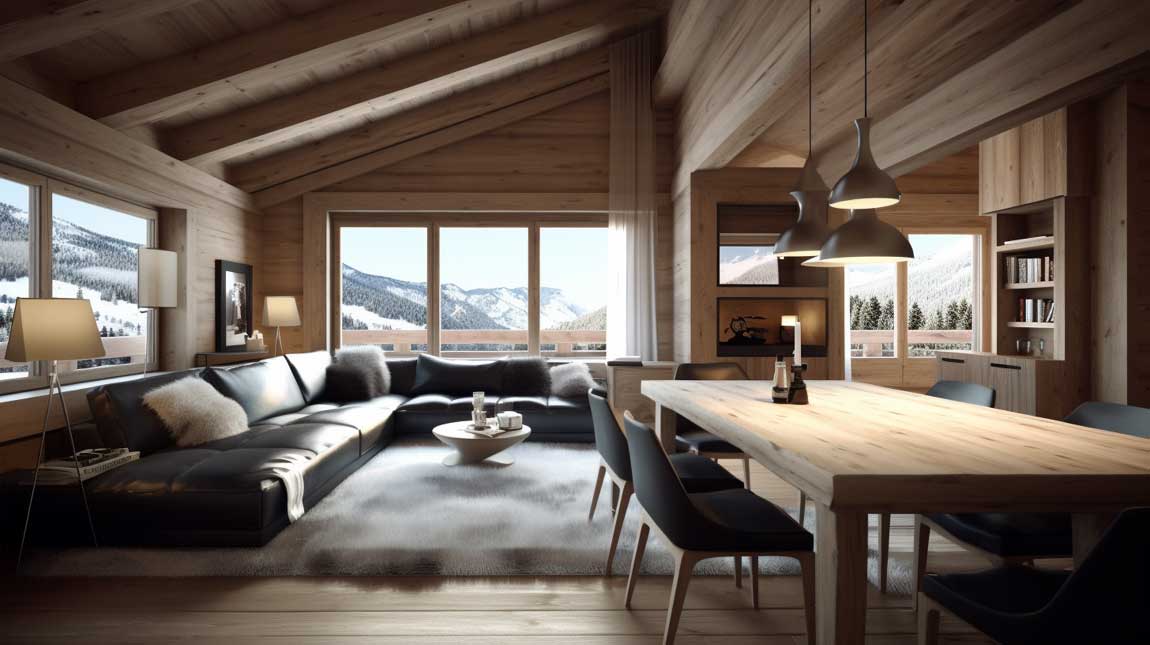
Exposed ceiling beams are the move, but beam diameter matters more than most people realize. Too thin and they read decorative rather than structural, which kills the whole honesty of the space. My go-to spec is a minimum 8-inch face on any exposed beam in a chalet living room — anything smaller disappears into the ceiling plane. Exposed wood beams in interior design are a design tool for zoning and atmosphere, not just a nod to tradition. Skip the pre-finished hollow beam wraps entirely — they telegraph fake from across the room.
Floor-to-Ceiling Windows Pull the Mountain Inside
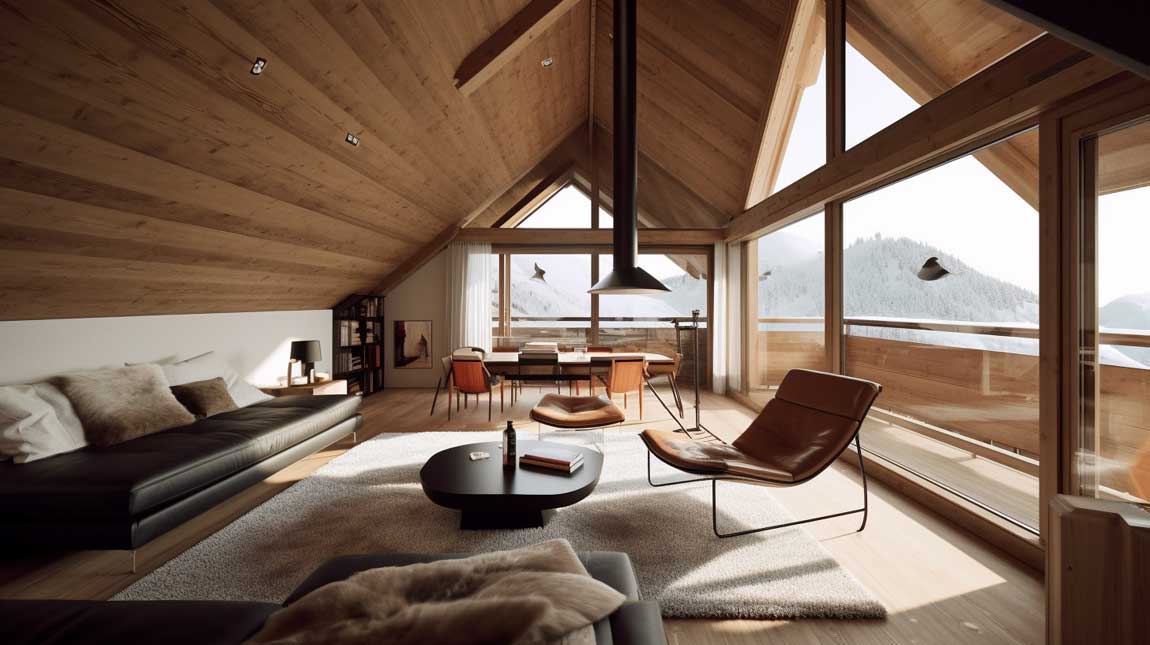
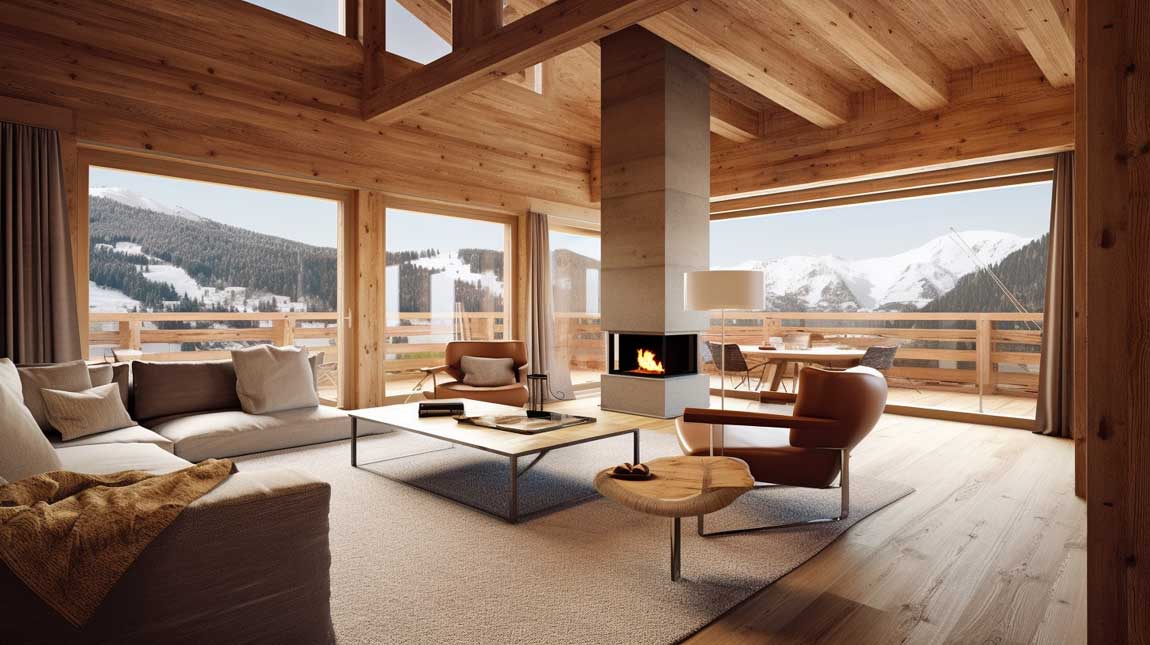
Alpine architects treat panoramic glazing as a fifth wall — not a feature. In a proper chalet style interior design, the window line starts at floor level and runs to the ridge, framing the view the way a museum frames a painting. I stole this trick from a Montalba Architects project in the Valais: every seating arrangement in the living zone was oriented toward the glass, not toward the TV. The mountain is the TV. That reorientation costs nothing and changes everything.
Thermal performance is the constraint that separates ambition from execution here. Triple-glazed units from Schüco or Internorm run $800–$1,400 per square meter installed in Alpine regions. Worth every franc. The mistake I see constantly is installing standard residential double-pane glass in a mountain exposure and then fighting condensation all winter — that battle drags out for years and the glass always wins. Specify low-e coatings on the interior face. Full stop.
Mixing Traditional and Modern in a Chalet Without Picking a Side
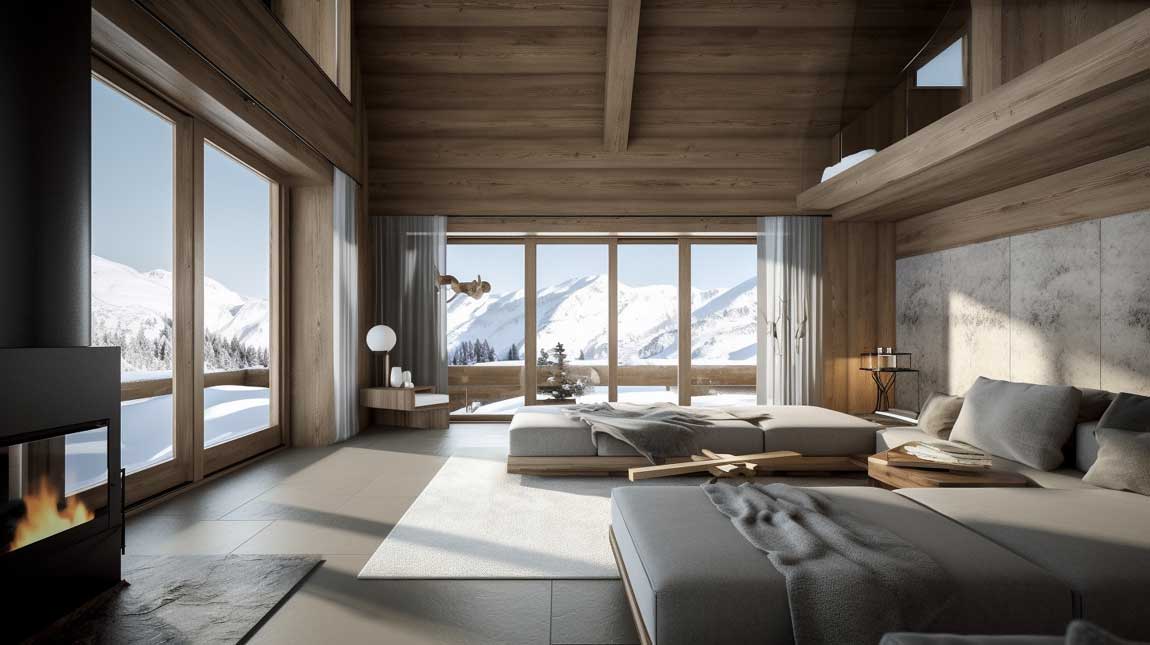
Sheepskin throws on a Vitra couch. A Zara Home wool blanket draped over a mid-century lounge chair. Chalet style interior design handles this collision better than almost any other residential idiom because the material palette is pre-agreed — wood, stone, wool, leather — and within those materials, the era of the furniture becomes irrelevant. I own two of these Hans Wegner Wishbone chairs and they look exactly right under a timber-frame ceiling even though they’re Danish and seventy years old. The shared naturalness unifies everything.
What doesn’t work: mixing chalet cues with overly industrial elements like raw steel shelving or poured concrete accent walls. I’ve seen this attempted in Verbier and Grindelwald properties and it reads as identity crisis, not sophistication. Concrete is fine as a structural backdrop — floors, exterior shell — but once it starts competing with the wood for visual dominance indoors, the warmth collapses. Pick one dominant material and let it win.
Don’t Do This:
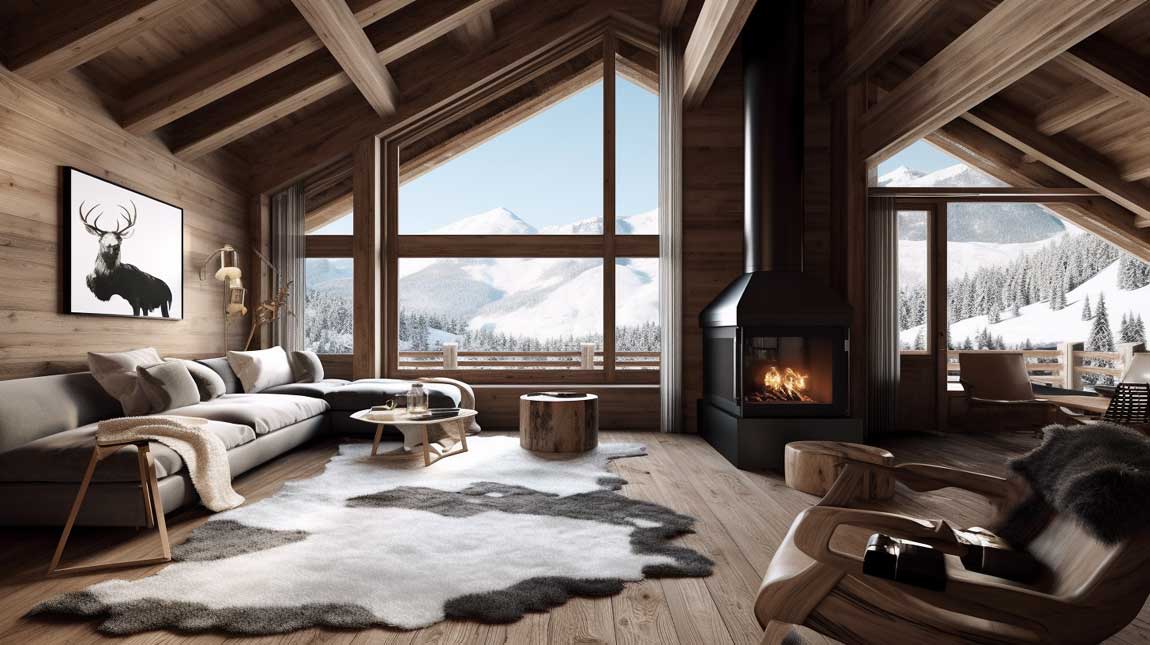
Layering faux fur, faux leather, and printed-graphic “cozy” textiles in the same room. It reads as a set, not a home. I’ve walked into chalets where the owner bought the entire “alpine” collection from a single retailer — matching reindeer cushions, matching lodge-print throw, matching geometric rug — and the result looked like an Airbnb staged for photos, not a space anyone actually wanted to spend a winter in. Real chalet style interior design collects over time. One heirloom wool blanket from a Swiss market does more work than twelve matching cushions from a big-box store. Buy single pieces with history, not sets.
Open-Concept Chalet Rooms Need an Anchor or They Drift
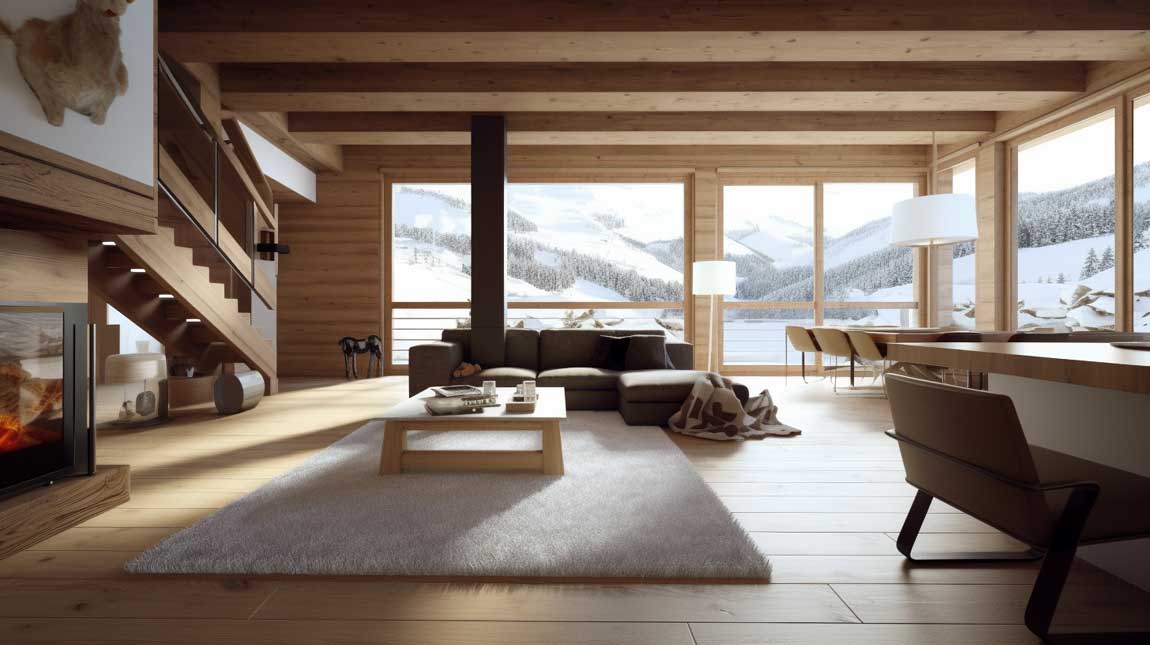
Open-plan alpine interiors fail when there’s no single element that holds the space together. I’ve consulted on three open-concept chalet renovations in the past few years and the fix in every case was the same: define the anchor first. Usually that’s the fireplace. Sometimes it’s a structural column clad in local stone. The kitchen island doesn’t count — it’s too utilitarian to carry emotional weight. You need something with mass, something that radiates heat both literal and visual.
Double-height ceilings in open-plan chalets create a specific acoustic problem: conversations at the dining table compete with the living zone and the kitchen simultaneously. The solution isn’t a false ceiling — it’s heavy textiles. A large-scale wool rug ($400–$900 for a 3x4m from Ikea Höjet or similar) absorbs enough mid-frequency noise to make the space feel habitable at dinner. Bare concrete or hardwood floors throughout an open-plan chalet will make your guests raise their voices by dessert.
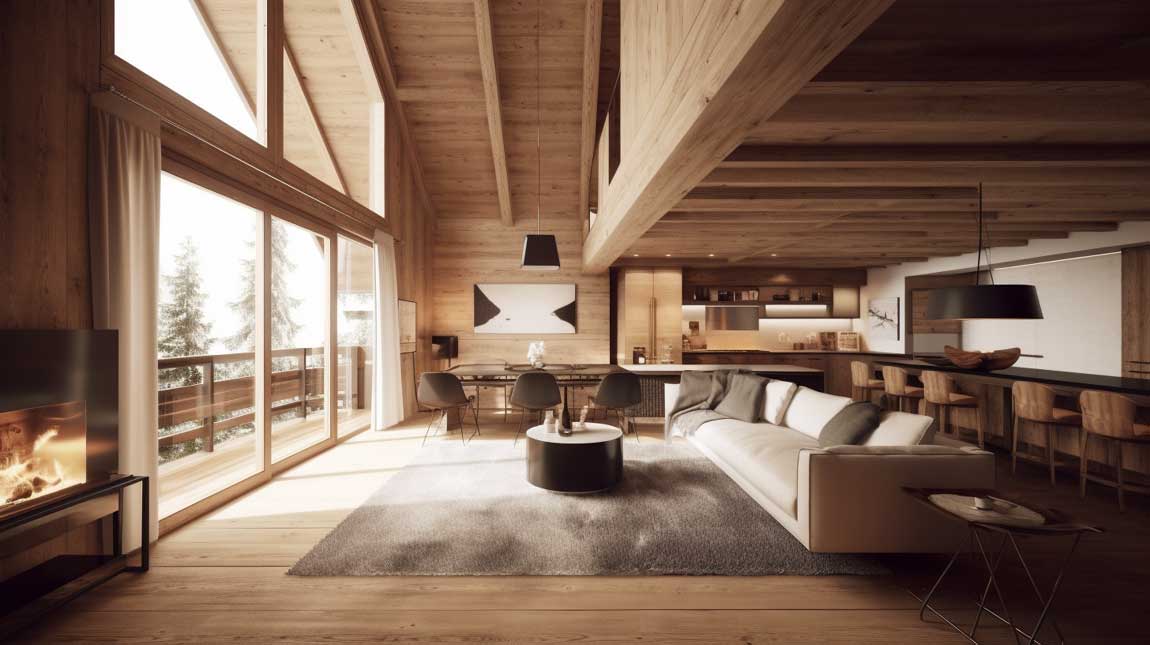
Fireplaces in Chalet Interiors Placed Wrong Half the Time
The fireplace placement mistake I see constantly in Swiss chalet interior design: centering it on an exterior wall with the seating arranged in a U in front of it. That turns the fireplace into a performance, not a gathering point. In the chalets that feel genuinely warm — the ones in Appenzell and Zermatt that I’ve spent evenings in — the fire is positioned so at least two seating groups relate to it, not just one. Corner placement or a freestanding double-sided unit in a room divider position solves this instantly.
Stone surround versus wood surround is a real debate. My preference is stone for anything structural — a floor-to-ceiling fireplace wall in Vals quartzite or Jura limestone runs roughly $180–$350 per square foot installed and it ages better than any wood finish near heat. Wood surrounds are fine for ornamental inserts, but they’ll check and darken within two seasons if they’re close to a high-BTU fire. Don’t skip the heat shield just because it’s hidden.
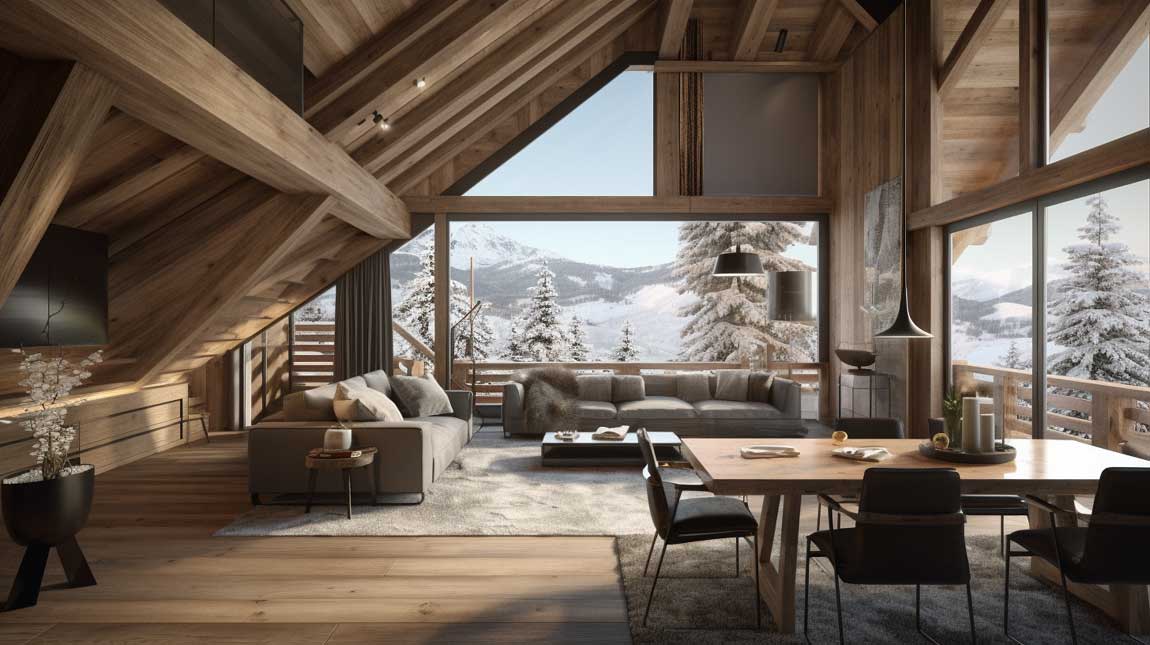
Layering Textures in Chalet Style Without Making It Feel Chaotic
Texture layering in chalet interiors follows a three-tier logic: structural (stone, timber, concrete), mid-layer (wool rugs, linen curtains, leather upholstery), and accent (sheepskin, knit throws, ceramic vessels). I’ve seen this collapsed into one tier — everything soft, everything layered, everything beige — and the result is a room that looks like the inside of a cloud. Contrast is the mechanism. You need at least one hard, cold surface in every room to make the warm ones register.
Bouclé is having its moment in alpine interiors right now — Roche Bobois runs a bouclé sofa line starting around $4,200 — but it photographs better than it lives in a mountain house. It collects dog hair, ski jacket fluff, and wood dust from the fireplace within a week. My go-to for chalet seating fabric is a tight-weave wool tweed or a performance wool blend from Maharam or Kvadrat. Both hold up to actual mountain-house life without looking institutional.
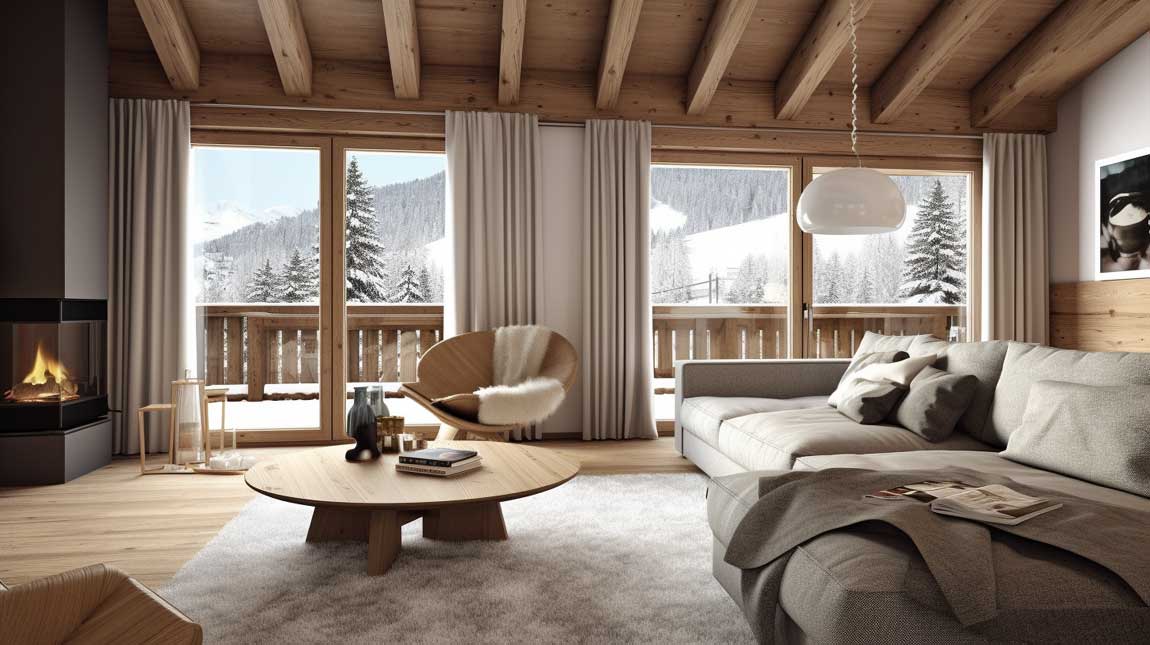
Statement Lighting in a Chalet Shouldn’t Look Like It Came From a Ski Lodge
Antler chandeliers are a no. I know they’re everywhere on Pinterest alpine boards but they read as costume, not design. What works in chalet style interior design is lighting that references natural form without imitating it literally — think Apparatus Studio’s branch-form pendants ($1,800–$3,500), or Ochre’s organic glass clusters, or a simple blackened steel ring chandelier that lets the timber ceiling do the aesthetic heavy lifting. The fixture is a punctuation mark, not a headline.
Warm color temperature is non-negotiable in a chalet. 2700K maximum on any bulb — I run 2400K in the main living spaces because higher temperatures wash out the amber in the wood and make stone surfaces look clinical. Dimmer circuits on every zone. The mood of a chalet interior changes more from 6pm to 9pm lighting than from any furniture choice you’ll ever make. Get this right before you spend another dollar on soft furnishings.
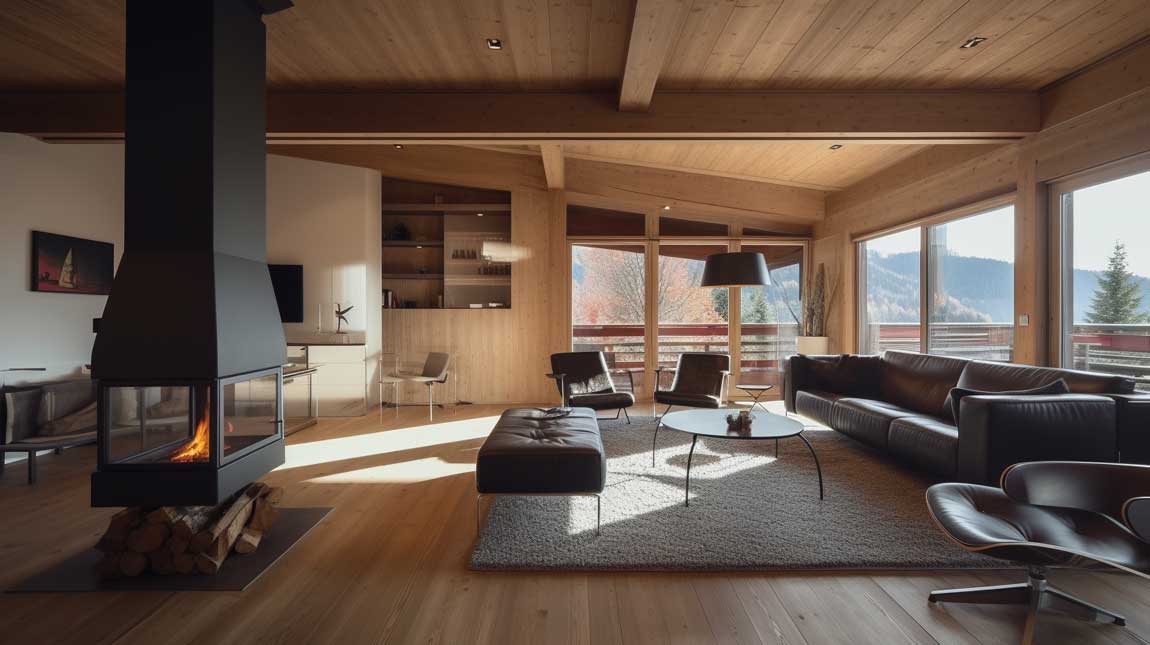
Outdoor Living Spaces That Actually Extend the Chalet, Not Just Frame It
A chalet terrace is not a deck with a view. The outdoor spaces in the strongest Swiss chalet interior design projects I’ve seen treat the terrace as a room that happens to lack a roof — same material palette, same level of finish, continuous flooring that reads through the glazing from inside. Larch decking that matches the interior floor color creates that blur between inside and outside that every alpine architect talks about. It works. Wide-plank larch deck boards run around $35–$55 per square foot installed in Switzerland, closer to $22–$30 in North American mountain markets.
Hot tubs on alpine terraces are overrated unless you’re in a climate where you actually use them in winter. I’ve toured six chalet properties with hot tubs and four of them were drained by February because the maintenance overhead — chemistry, covers, heat cost — outweighed the occasional soak. An outdoor fireplace or a well-positioned propane fire table does more for actual terrace use hours than a hot tub at a fraction of the cost and zero chemistry overhead.

Eco-Friendly Chalet Design Where Sustainability Earns Its Place
Swiss building codes in alpine cantons already mandate strong thermal performance — U-values below 0.17 W/m²K for walls in new construction — so sustainability in modern chalet interiors isn’t idealism, it’s compliance. What I find interesting is how this constraint actually improves the aesthetic: thick walls with deep window reveals, triple glazing with wide frames, heavy insulation under larch cladding. All of those things look better than thin-wall construction. The energy envelope and the visual language are aligned.
Reclaimed timber sourcing in the Alps has a real market now — suppliers like Rosenholz in Switzerland and Boisflottés in France stock reclaimed fir, oak, and chestnut at $8–$22 per board foot depending on species and grade. You get documented provenance, genuine aging, and no manufacturing carbon. New “distressed” timber from big-box suppliers runs similar prices and has none of those properties. The reclaimed route isn’t the expensive option anymore — it’s the same price with better results.
Alpine Artwork That Earns Its Wall Space
Vintage ski race posters — original lithographs, not reprints — from Wengen, Zermatt, or Gstaad races run $200–$800 at auction and do more for an alpine interior than any generic mountain photograph. I’ve seen a 1955 Kandahar poster by Brun framed in raw oak do more work on a chalet wall than a $2,000 landscape photograph from a gallery. The authenticity reads in the room in a way that’s hard to articulate but immediate to feel. Provenance matters in alpine art the same way it matters in alpine timber.
What to skip: generic “mountain” canvas prints sold by home decor retailers, anything with a moose that didn’t come from an actual Swiss or Austrian source, and oversized abstract art that could hang in a hotel lobby in any city in the world. A chalet wall should tell you exactly where you are. A hand-carved wooden panel from the Bernese Oberland, a cow bell mounted as sculpture, local ceramics — these things cost less than gallery art and land harder. Swiss chalet interior design inspiration comes from material specificity, not generic alpine mood.
Color Accents in Chalet Interiors Work on One Condition
Bold color in a chalet interior works only when the neutral base is truly neutral — not beige-gray, not warm white, but the specific off-white that reads as bone or cream in natural light. Against that base, a deep spruce green (try Farrow & Ball’s Calke Green at $120 per gallon) on a single accent wall reads like a forest edge, not a paint experiment. I’ve tested this personally in a Graubünden property. The room looked like a Pinterest mistake until we reset the adjacent wall to a strict bone white, then the green clicked into place.
Colors to skip in alpine interiors: terracotta (too Mediterranean), navy blue used as a base tone (it competes with the view outside rather than complementing it), and anything yellow-adjacent. The landscape through your windows already has enormous chromatic range — your interior job is to hold the palette together, not compete with it. Forest green, slate gray, deep burgundy through textiles only — that’s the playbook.
Chalet Bathrooms Where Natural Stone Does the Heavy Lifting
The spa bathroom trend in alpine interiors peaked around 2019 and what survived the hype is actually the correct approach: stone floors, stone walls, wood ceiling or cladding on one wall maximum, and one piece of plumbing that’s genuinely good — a deep soaking tub from Boffi or Agape, starting around $2,800. The rest should be simple. I’ve stayed in chalet bathrooms with six types of tile, a rain shower, a steam unit, heated floors, a towel warmer, and a built-in TV, and they all felt like hotel spas with no personality. Pick one luxury and make it excellent.
Jura limestone for floors and walls runs about $85–$130 per square foot installed and it’s the material the Swiss have used in alpine bathrooms for forty years for one reason: it handles thermal cycling without cracking. Marble is beautiful and wrong for mountain houses. I’ve watched a white Calacatta marble bathroom floor develop a network of fine cracks over two alpine winters because the slab moved with the heat cycling and the grout didn’t. Limestone moves less. Use limestone. Rocky Mountain Hardware’s overview of Swiss chalet interior design covers hardware finishes for alpine bathrooms in detail if you’re specifying bronze or unlacquered brass fixtures.

Architectural Details That Separate Real Chalet Style From a Renovation Approximation
Hand-carved woodwork is the detail line that separates an authentic Swiss chalet interior design from a hotel-room approximation of one. Carved balustrades, hand-mortised joinery at beam connections, decorative motifs on window frames — these details cost real money ($80–$180 per linear foot for custom carved millwork from Swiss craftspeople) and they’re what you notice six months after moving in, when everything else fades into background. You’ll stop seeing the sofa. You’ll never stop seeing a beautifully carved stair newel post.
Traditional Swiss decorative motifs — Bauernmalerei painted furniture, Appenzell geometric carving patterns, embroidered textiles from the Graubünden region — are underused in modern chalet interiors because designers fear they’ll look folksy. Wrong framing. In a room with clean-lined contemporary furniture, one painted armoire or one piece of carved joinery reads as cultural specificity, not costume. It’s the same logic as a Japanese lacquer cabinet in a minimalist apartment. One piece of authenticity grounds the whole room.
Storage in a Chalet Interior Built to Disappear Into the Wall
Custom built-in storage in a chalet interior is not optional — it’s structural. A mountain house collects gear: ski boots, helmets, wet layers, hiking equipment, extra firewood. If you don’t design storage for all of that before the walls close, you’ll spend your entire ownership fighting clutter that the architecture wasn’t built to handle. My rule: budget 15% of total interior fit-out cost to joinery and built-in storage. That number sounds high until you try to live in a chalet without it.
The best chalet storage solutions I’ve seen use the transition zones — entries, hallways, under-stair cavities — as the primary storage volume and keep the main living spaces completely clear. A full-height built-in in larch or oak with inset panels and invisible hardware (Rocky Mountain Hardware’s bronze lever sets work beautifully here) runs $600–$1,200 per linear foot custom, or $250–$450 per linear foot for quality semi-custom from Swiss joinery firms. It’s furniture that doesn’t fight the room for attention.
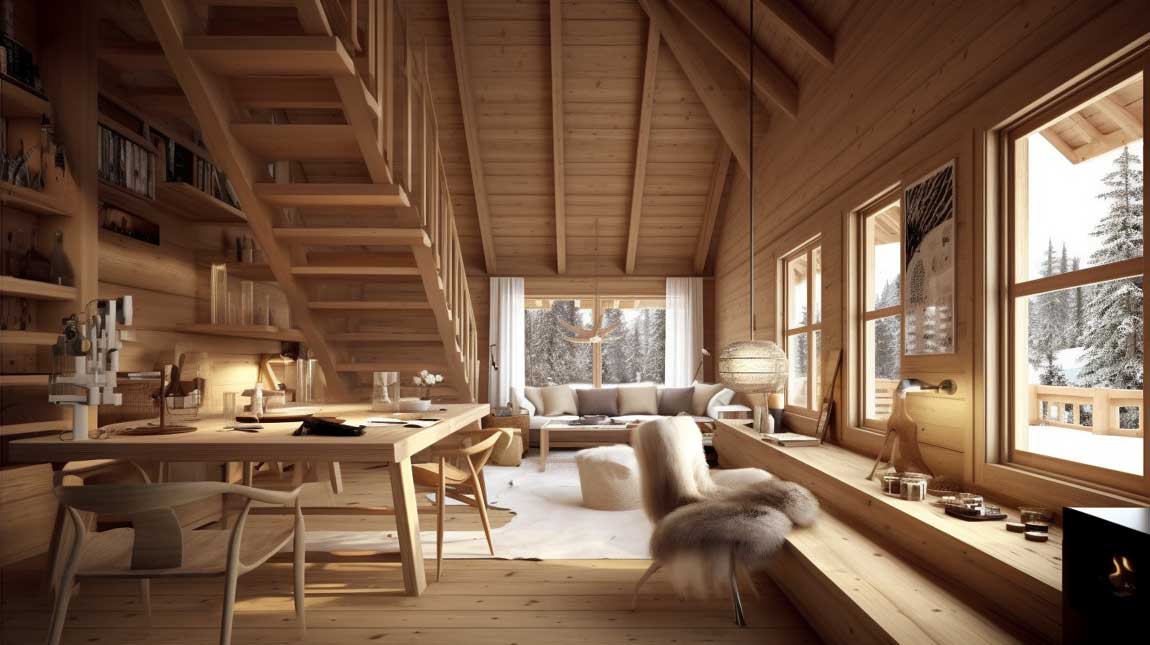
Nature Framed by the Architecture, Not Decorated On Top of It
The final move in chalet style interior design is the most counterintuitive: stop decorating the windows. I’ve been in chalets where the designer layered roman blinds, sheer panels, and blackout curtains on a floor-to-ceiling glass wall facing a Bernese Alps panorama and the net effect was a room that looked inward, not out. The view is the decoration. Your job is to frame it, not compete with it. Clean glazing, simple reveals, nothing across the glass line that reduces the view from 100% to 80%.
Plants inside a chalet work when they’re regional — dwarf conifers, alpine succulents, ferns found in mountain understories. A fiddle-leaf fig in a Swiss chalet reads as incongruous as an antler chandelier reads as cliché. Bring nature in through the window and reinforce it with materials native to that ecosystem. That’s the entire philosophy of chalet style interior design compressed into one sentence. Everything else is execution.
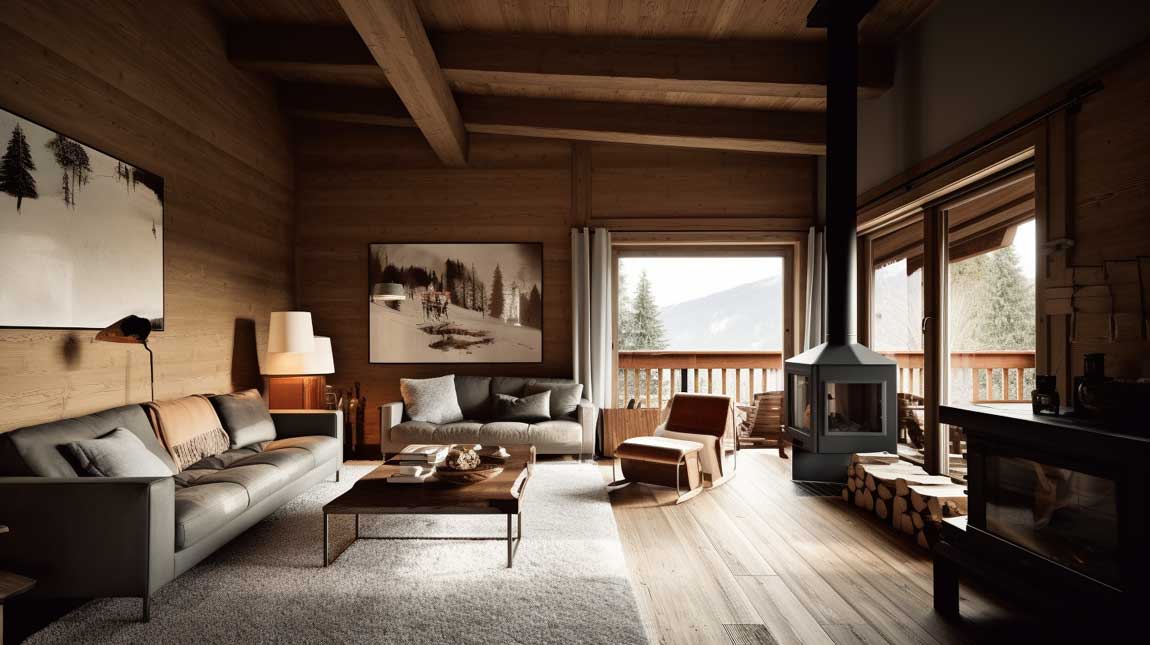
Final Takeaway
Chalet Style Interior Design Starts With Material Honesty
Every element in a real Swiss chalet interior earns its place by being what it claims to be. Solid timber, not laminate. Cut stone, not tile printed to look like stone. Wool from an animal, not polyester. The rooms that fail chalet style fail that test first.
Pick one structural material — reclaimed larch is the reference — and let every other decision answer to it. The fireplace, the glazing, the lighting: all of it should make the wood look better, not compete with it.
Save this post before your next mountain renovation — the material specs and price ranges are worth keeping.