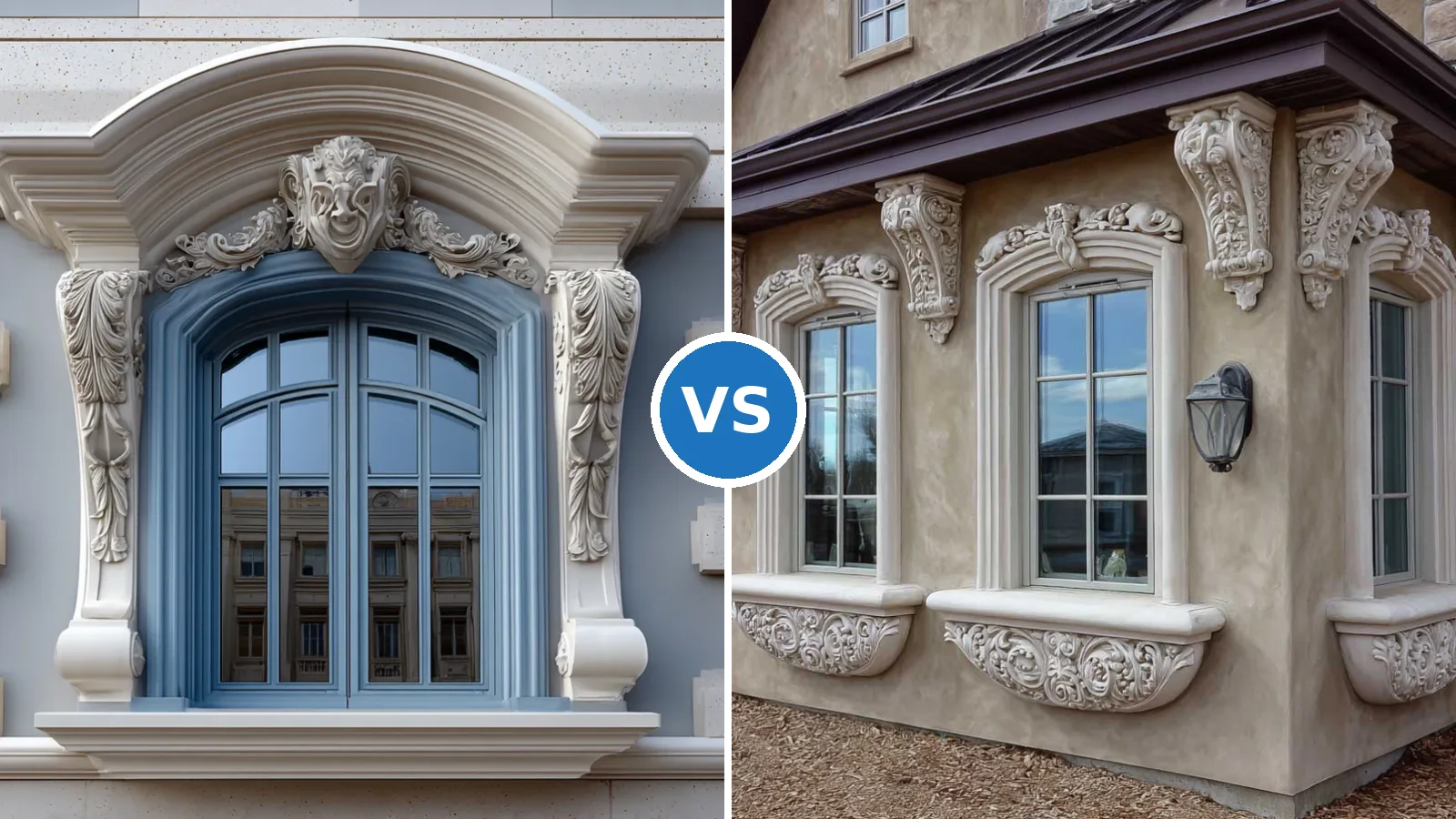
Exterior stucco foam window trim is the fastest way to add architectural weight to a flat facade — but only if you match the profile depth to your wall’s shadow line. I’ve seen $200 worth of EPS molding from FoamTrim completely transform a beige stucco ranch, and I’ve also seen $800 worth of ornate keystone trim look like it was glued on by a child. The difference is never the material. It’s always the scale and the style logic behind it. Pick a profile that belongs to your house’s era and geometry, and the trim reads as permanent architecture. Pick one that doesn’t, and it reads as costume.
Foam trim has a real practical upside that wood can’t match. Expanded polystyrene coated with an acrylic base coat won’t rot, won’t warp in freeze-thaw cycles, and doesn’t demand annual repainting. StyroTrim and FoamTrim both sell ready-to-install profiles that you cut, glue, caulk, and paint over a weekend. Weight per linear foot is a fraction of precast concrete. For a stucco exterior, that matters: heavy add-ons over existing EIFS systems can cause cracking at attachment points within two seasons.
Quick Scan
- Target material: EPS foam with polymer-modified acrylic coat — not raw styrofoam, not wood
- Classical profiles (keystones, dentil bands): work on symmetrical facades with 8ft+ ceiling height
- Modern stucco trim: flat reveals, 1–2 inch shadow lines, no ornamentation
- Mediterranean-inspired: scrollwork and sill brackets, but only if your roofline already has Spanish or Tuscan references
- Organic / nature-motif: polarizing choice — commit fully or skip it entirely
- Mix-and-match: one dominant profile per facade plane, one accent detail per window — never both competing at once
- Cost range: $15–$45 per linear foot installed, depending on profile complexity
- Lifespan: 20–25 years with acrylic coat intact; inspect caulk lines every 3 years
Classical Keystones and Dentil Bands Earn Their Price on Symmetrical Facades
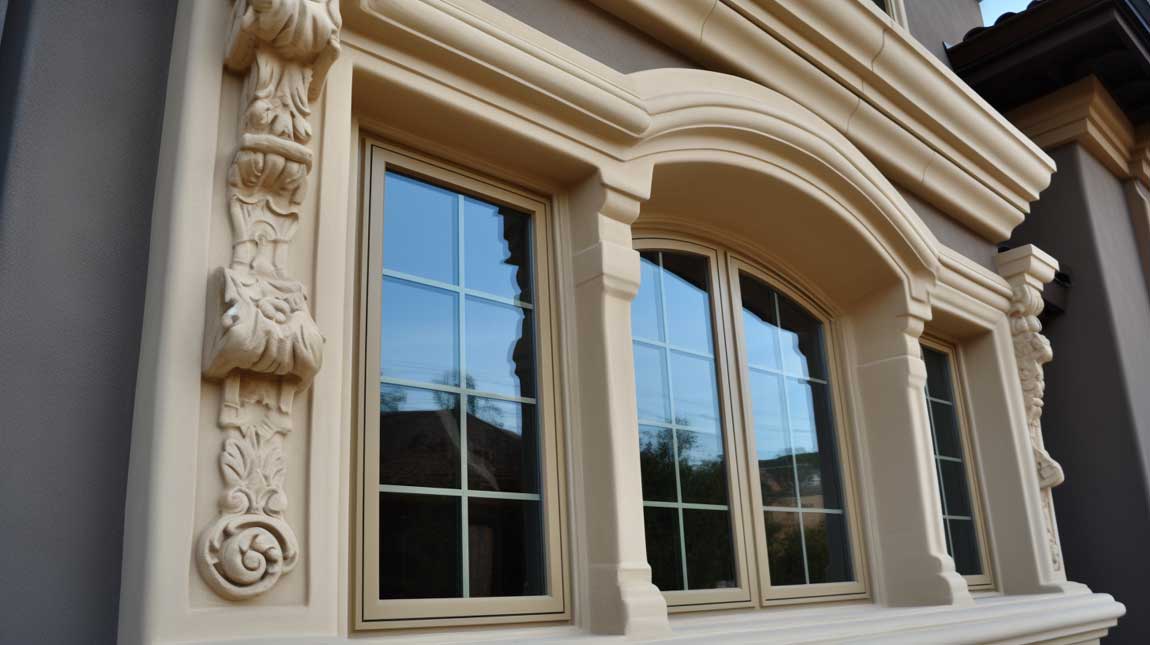
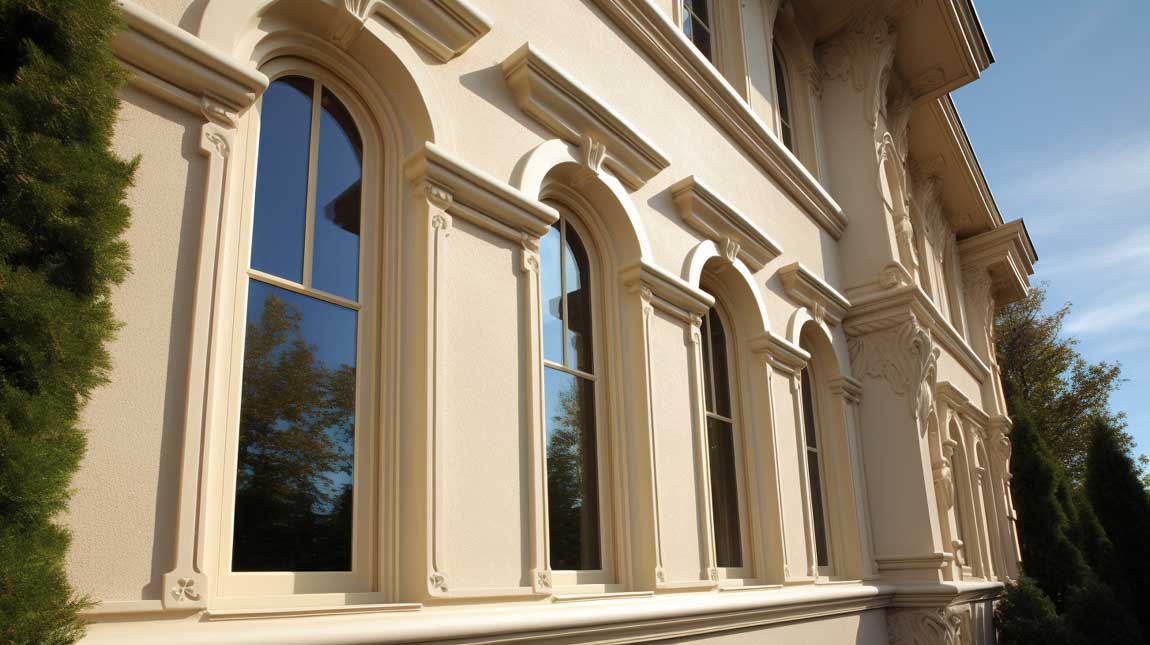
Exterior stucco foam window trim in a classical style — keystone headers, dentil bands, flat pilaster ears — only reads as intentional on a house that already has bilateral symmetry. You need equal window spacing, a centered entry, and ceiling heights of at least eight feet. On a sprawling asymmetrical ranch, the same profiles look like someone raided an architecture salvage yard and glued things on without a plan. I’ve tested this theory on three different project houses. It holds every time without exception.
Keystones from FoamTrim start around $18 each and ship pre-coated. The profile sits centered over the window head, drops about 3–4 inches below the header trim, and creates a strong visual anchor. My go-to pairing is a flat header band at 3.5 inches wide with a 4-inch keystone drop — it reads as Georgian without looking like a theme park. Dentil bands work differently: they run the full window width and create rhythm through repetition, not drama through a single focal piece. Combine both on the same window and you’ll get a cluttered mess.
What doesn’t work: over-scaled keystones on narrow windows under 30 inches wide. The proportions invert — the ornament becomes larger than the frame it’s meant to accent. Skip the keystone entirely on those openings and use a simple flat header band instead. Dentil at 2-inch tooth width on a single-story house looks fussy and suburban. Go to 3-inch minimum tooth width or don’t go at all.


Organic Shapes on Foam Trim Require a Harder Commitment Than You Think
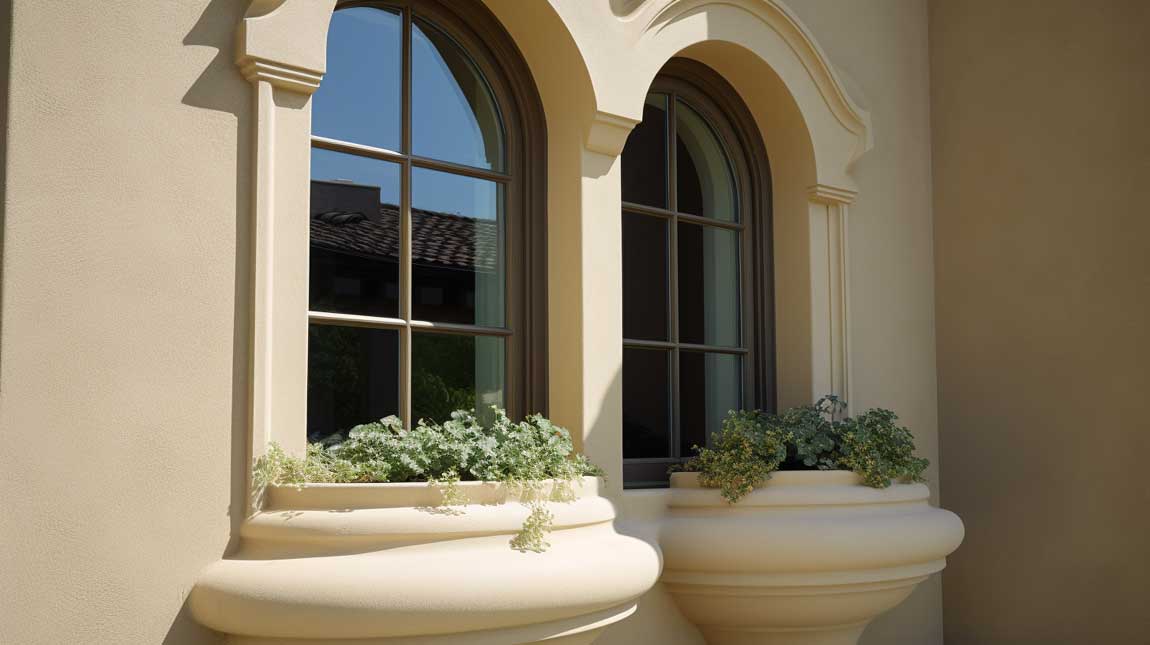
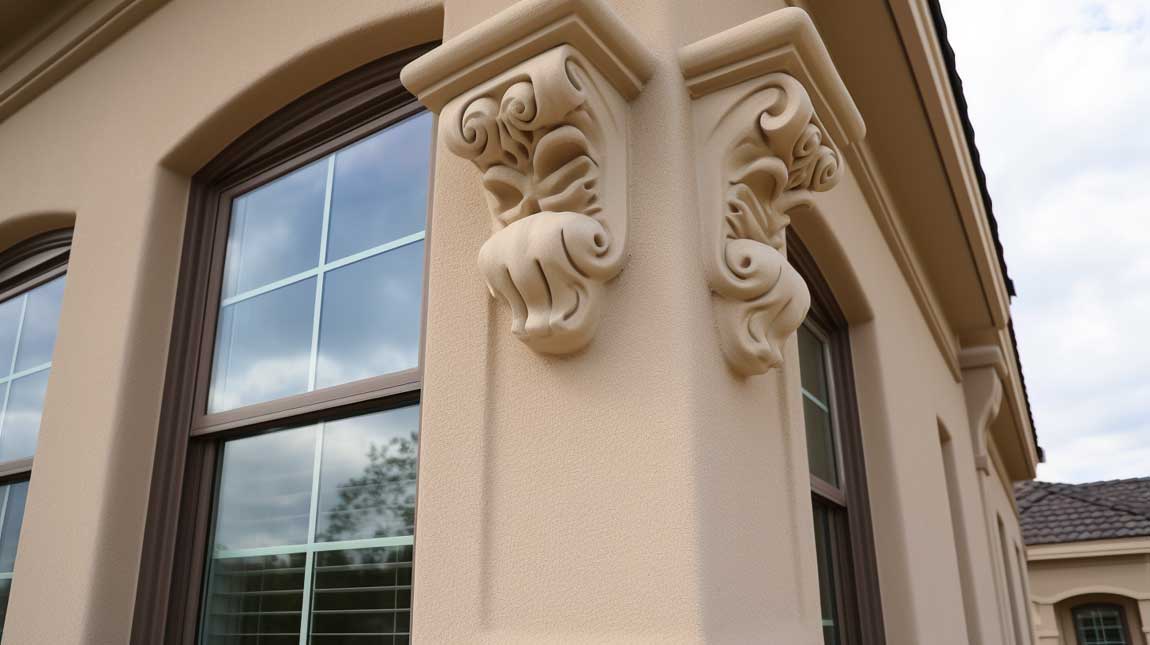
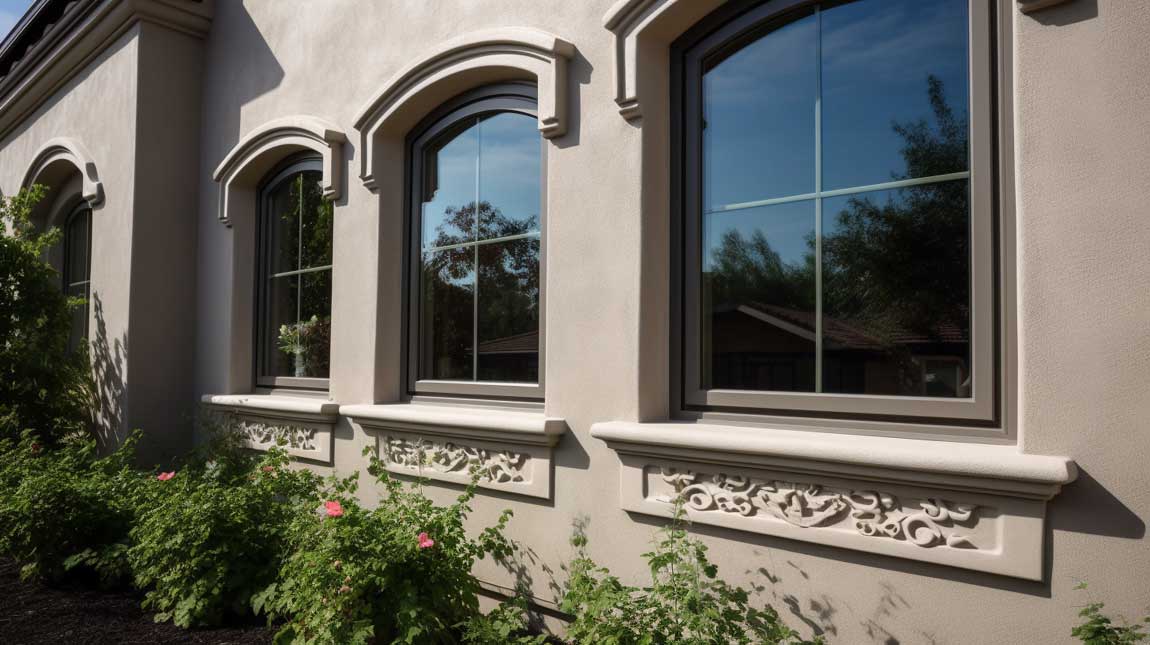
Foam stucco trim with organic motifs — flowing curves, leaf brackets, floral keystones — is either the best decision on the block or the worst. There is no middle ground. You’ll notice that houses where it works share one thing: the organic detailing continues beyond the windows into the fascia, the entry surround, or the porch soffit. Isolate the leaf bracket to just the windows and it floats on the facade like a decorative sticker somebody forgot to peel off.
If you’re committed, go to a custom EPS cutter rather than an off-the-shelf profile. Custom shops will CNC any shape into foam for around $30–$60 per piece depending on complexity, and the finish coat can be tinted to match your base stucco color exactly. I stole this trick from a contractor I watched work on a Spanish Revival house in the Southwest: he matched the foam bracket coat to the wall within two shades, which made the bracket read as relief sculpture rather than applied decoration. Subtle. Intentional. Looks like it was always there.
What to avoid: pre-made leaf trim kits from big-box stores. They run thin, the EPS density is often below 1 lb per cubic foot, and the coating chips at corners within two winters. You’ll end up re-caulking every spring. Buy from a manufacturer that specifies 1.5 lb EPS minimum and fiberglass mesh reinforcement under the acrylic base coat. That spec is the difference between a 5-year repair cycle and a 20-year install.


Geometric Foam Trim on Stucco Reads Modern Because Right Angles Are Honest
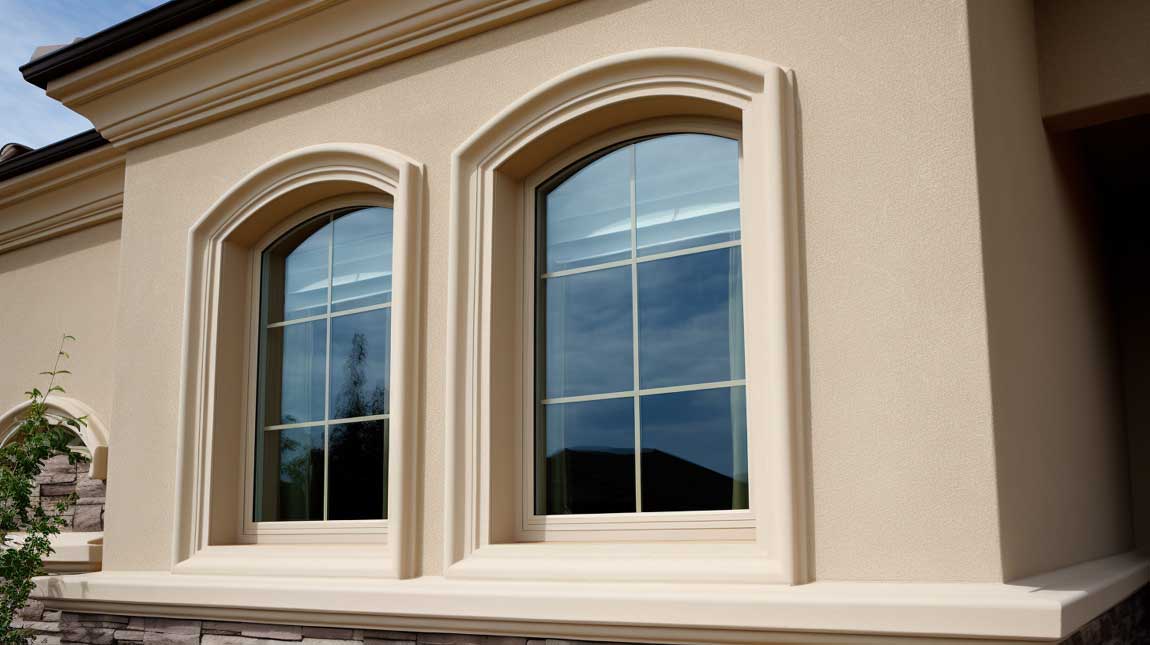
Geometric exterior stucco foam window trim is the profile category I recommend most often, because it ages well and it photographs clean. Flat reveals, square headers, stepped surrounds — these profiles derive their visual interest from depth and shadow rather than from ornament. A 2-inch-thick flat foam band around a window creates a genuine shadow line at every hour of the day that changes as the sun moves. That’s architecture doing actual work, not decoration pretending to be architecture.
The stepped surround — two nested flat bands, inner narrower than outer — costs about $22–$28 per linear foot installed and gives you a profile that looks like it was drawn by an architect rather than selected from a catalog. You need at least 1.5 inches of reveal on each step to read clearly at street distance. Less than that and the layers flatten out visually, especially on textured base stucco. For modern stucco trim on a contemporary build, I’d go flat reveal at 2 inches minimum, no header ornamentation, and consistent width on all four sides of the opening.
Don’t combine geometric trim with any form of rounded or curved detail on the same facade plane. The contrast doesn’t read as intentional eclecticism — it reads as indecision. Pick your geometric vocabulary and repeat it across every window on that elevation. Consistency is what makes a facade look designed rather than assembled.


Don’t Do This
- Don’t mix profile families on the same facade. Keystone headers on one window, organic brackets on the next, flat reveal on the third — this is the decorative equivalent of wearing three different shoe styles. Pick one profile logic per elevation and repeat it.
- Don’t apply foam trim directly to unprepared stucco. The substrate needs a clean, dry, grease-free surface and a compatible adhesive (construction adhesive rated for EPS). Skipping prep means the trim delaminates within 18 months.
- Don’t use raw polystyrene (blue or pink board from a hardware store). It won’t hold stucco or acrylic topcoat properly. Use only EPS with minimum 1 lb density and a factory-applied fiberglass-reinforced base coat.
- Don’t install foam trim without caulking every joint line. Even a 1mm gap between trim pieces channels water behind the assembly and causes rot at the window rough opening — which foam can’t protect but wood blocking behind it very much can suffer from.
- Don’t scale up profiles to fill visual space. A 6-inch-wide flat band on a 28-inch window opening makes the frame look like a storm shutter. Shadow line, not mass, is what creates architectural presence.
Foam Trim That Adds Insulation Value Without Pretending to Be Something Else
Functional exterior stucco foam window trim — profiles engineered with an integrated drip edge and a recessed back channel — does something purely decorative trim cannot: it manages water at the window-to-wall joint. The drip edge kicks water away from the rough opening. The back channel creates a capillary break. You get shadow line and weather protection in a single piece. Prices run $28–$42 per linear foot for this category because the profiles are more complex to manufacture than flat bands.
PRIME Stucco Mouldings and FoamTrim both offer functional profiles designed for EIFS systems. PRIME’s products carry a 5-year warranty and are tested to Canadian climate extremes — freeze-thaw cycling, UV exposure, and snow load. If you’re in a climate with more than 30 frost days per year, this is the category you want, not purely decorative trim. The insulation value of a 2-inch EPS profile over the window head is marginal on its own, but as part of a full EIFS window surround it contributes to thermal bridging reduction at one of the most common leak points on a stucco house.
For more on how trim profiles interact with the full stucco system — including base coat prep and mesh reinforcement — the installation documentation at Engineer Fix’s stucco trim guide covers the technical sequence clearly. What doesn’t work: foam trim sold as “insulating” with no acrylic base coat and no mesh reinforcement. Raw EPS without a protective shell fails its insulation function within two years because moisture infiltrates the bead structure, increasing thermal conductivity instead of reducing it.


Custom Foam Stucco Trim Costs More Upfront and Pays Off in Ten Years
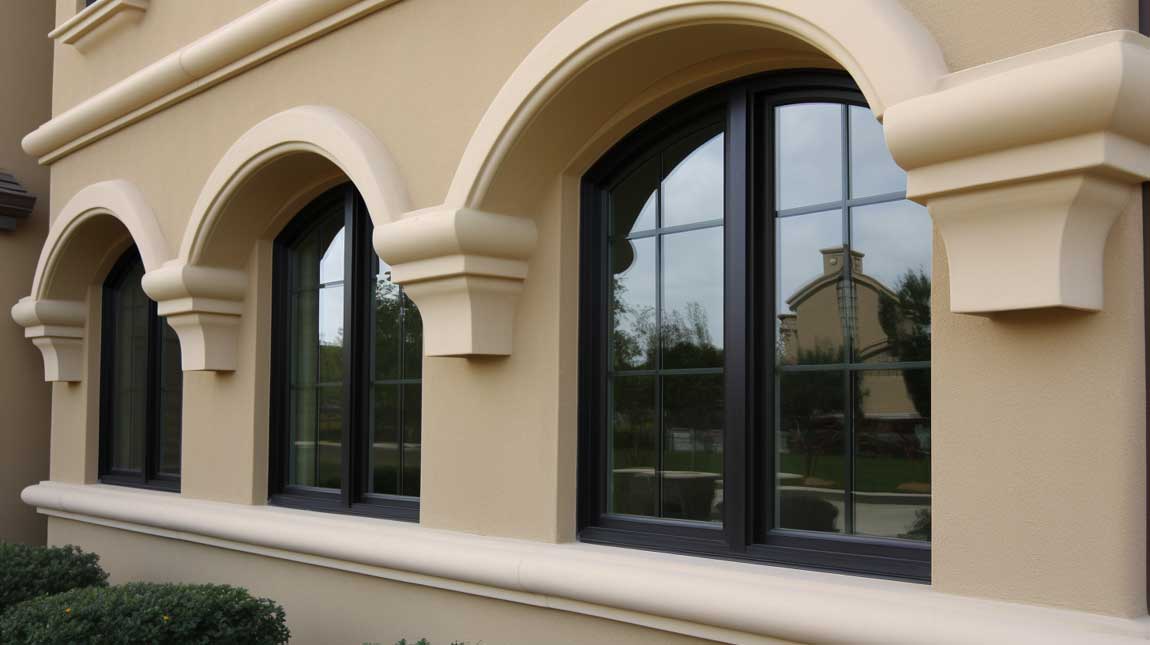
Custom-cut exterior foam trim is not for everyone, and that’s exactly why it works so well for the people who use it. Off-the-shelf profiles from FoamTrim or StyroTrim cover maybe 80% of window sizes and profile preferences. The remaining 20% — arched windows, oversized openings above 60 inches wide, non-standard reveals — require CNC-cut custom EPS. Custom pieces run $45–$90 per linear foot depending on complexity, which sounds steep until you realize you’re buying a profile that exists nowhere else.
Personalization doesn’t have to mean your initials carved into the keystone (though I’ve seen it done successfully on a Georgian Revival and it looked completely right). It can mean a profile thickness calibrated exactly to your wall’s reveal depth, or a sill projection dimensioned to throw a 3-inch shadow at noon in your latitude. I own two houses with custom-profile foam sills and the difference in curb presence versus the stock sill profile from the same manufacturer is immediate and obvious to anyone standing on the street.
What fails at this price point: ordering custom foam from a manufacturer with no fiberglass mesh reinforcement process. The aesthetic customization is wasted if the coating system underneath can’t survive five winters. Ask your manufacturer for the base coat spec — you want polymer-modified acrylic with embedded alkali-resistant fiberglass mesh at minimum 4 oz weight. Anything thinner and the corners will chip. For inspiration on how decorative stucco elements interact at the full facade scale, see the stucco window trim idea gallery at ArtFasad.


Mediterranean Foam Trim Works Because It Borrows From a Coherent Visual Language
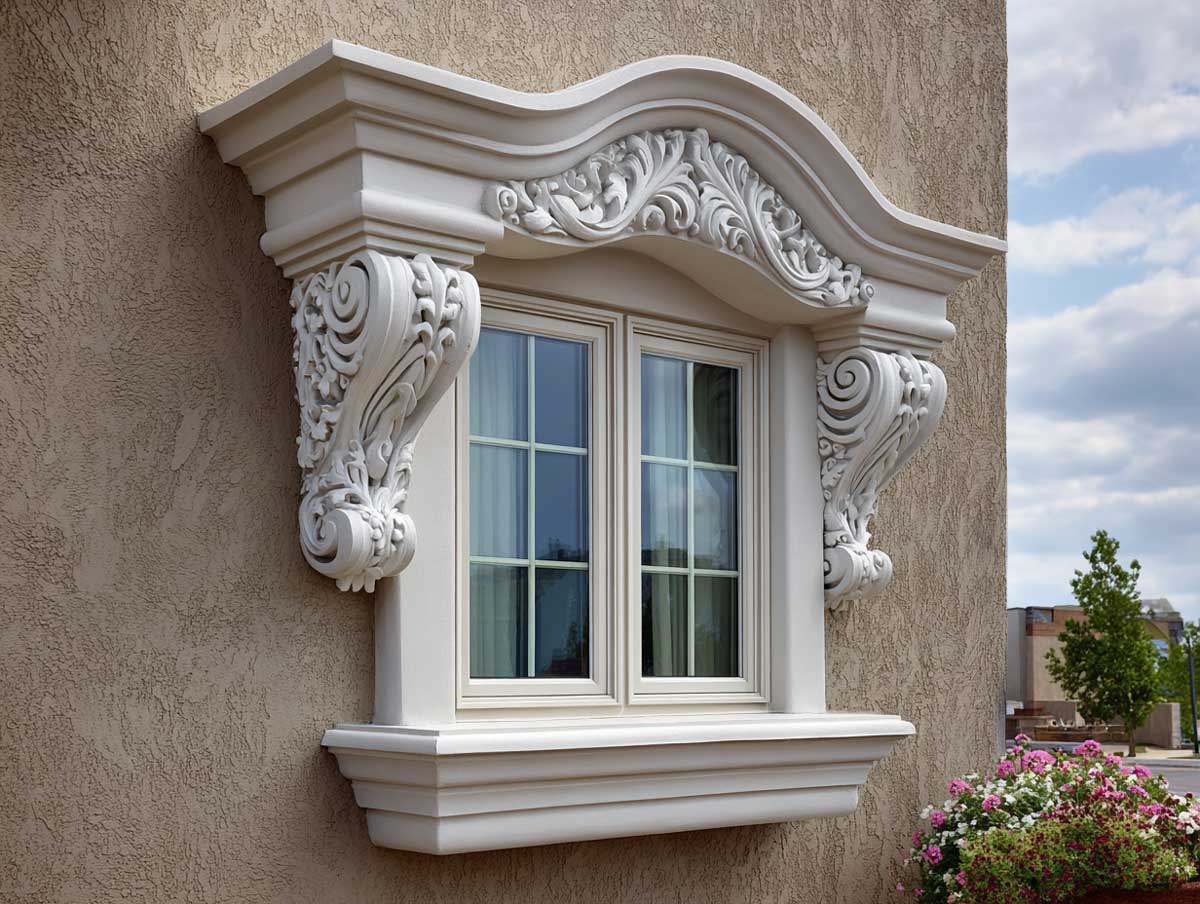
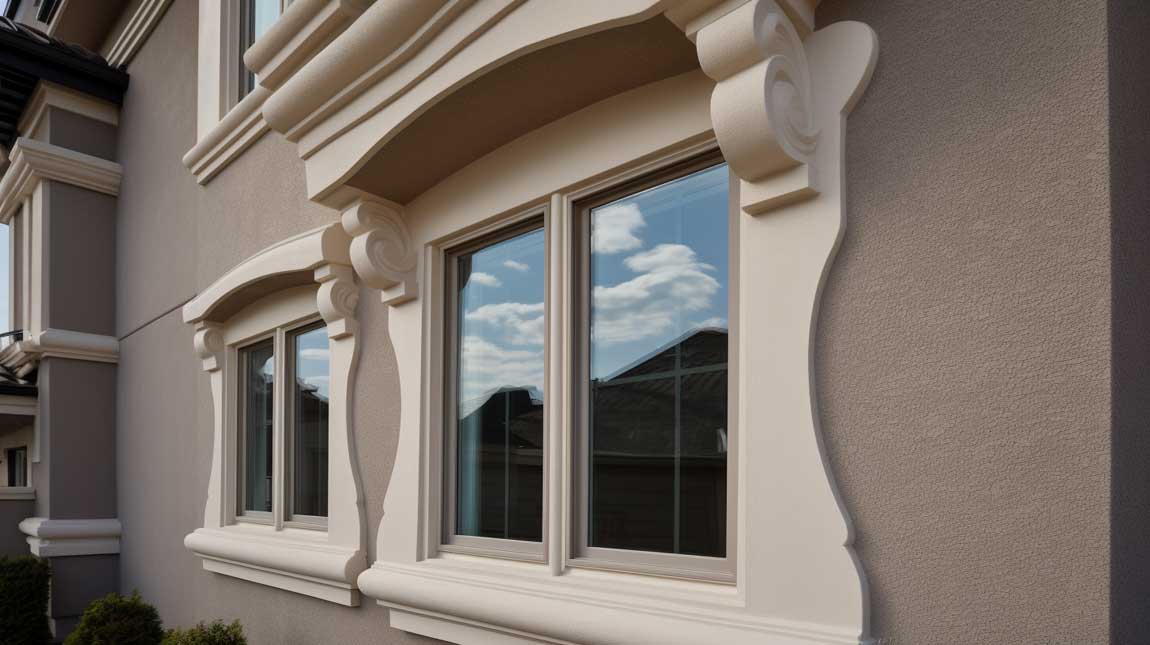
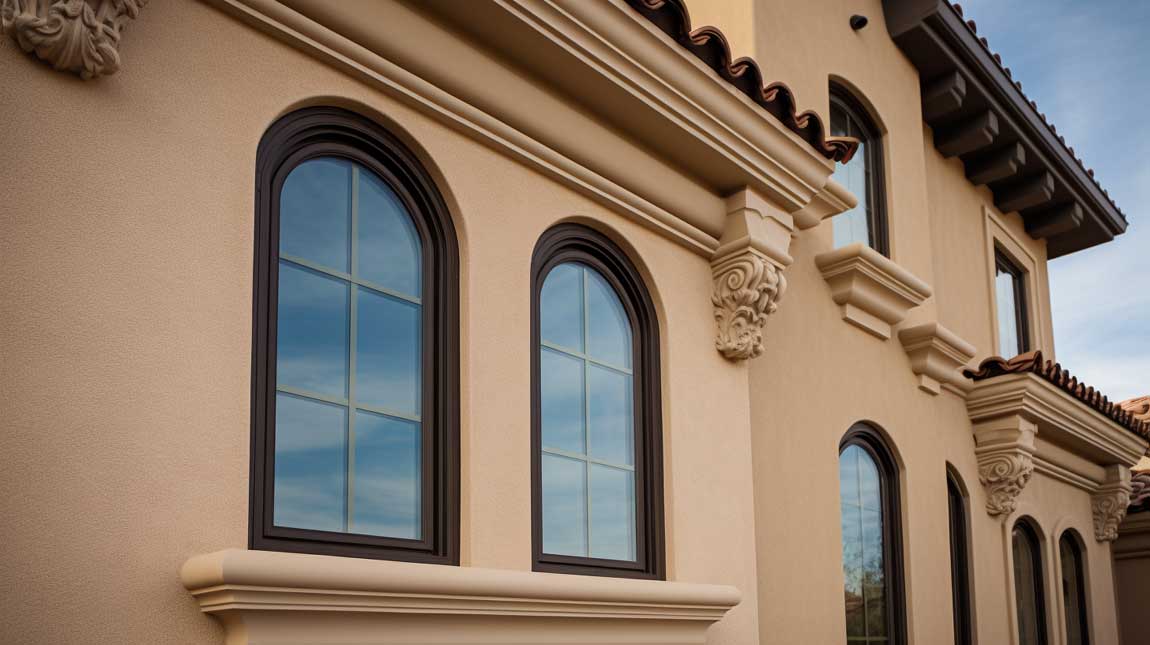
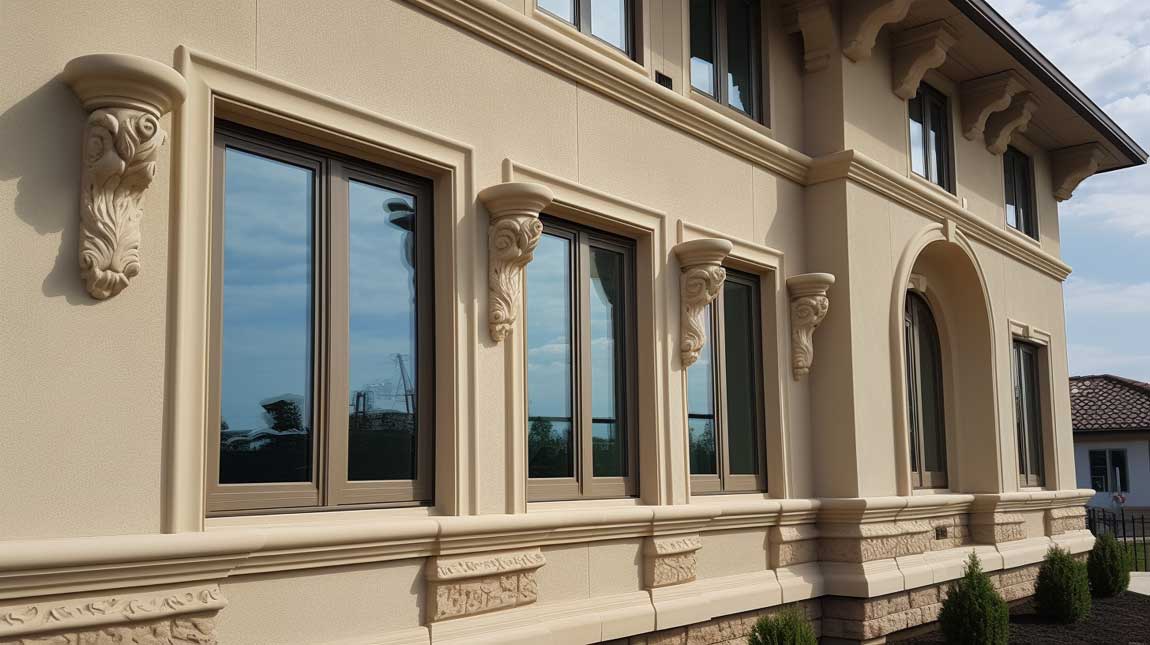
Mediterranean-inspired exterior stucco foam window trim — scrollwork sill brackets, arched header bands, ornamental medallions — has a very specific condition for success: your roofline must already speak the same language. A low-pitched clay tile roof with wide overhangs tells you the house is already committed to the regional idiom. On that house, scrolled EPS sill brackets at $35–$50 each look inevitable. On a house with asphalt shingles and a 6:12 pitch, the same brackets look like a costume from a theme restaurant.
Scrollwork and ironwork-look accents in foam are manufactured by pressing EPS into detailed molds rather than CNC cutting. The surface detail retention depends heavily on foam density — 1.5 lb EPS holds scroll detail cleanly; 1 lb EPS rounds off fine edges during the coating process and you end up with a soft, mushy-looking ornament. My go-to spec for Mediterranean profiles is 1.5 lb EPS minimum, two coats of polymer-modified acrylic, and a final finish in a warm white or sand tone — never bright white, which reads as plastic rather than plaster.
The anti-advice here is specific: don’t install Mediterranean sill brackets without addressing the sill projection underneath them. Brackets floating under a flat stucco sill with no projection look like they’re holding up nothing, because they are. Add a 1.5-inch projected foam sill first, then attach the bracket underneath. Now the bracket is doing visual work — it appears to support weight, which is the entire architectural logic behind it.


Modern Stucco Trim Earns Its Minimalism When the Reveals Are Precisely Sized
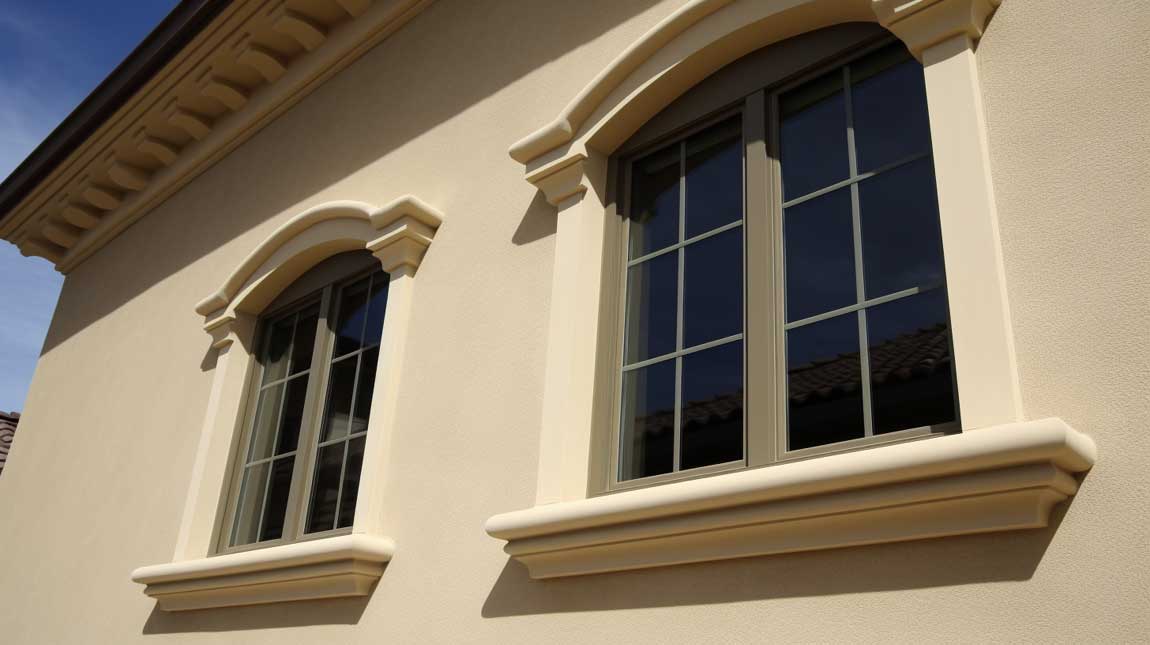
Contemporary exterior stucco foam window trim is the category where millimeters matter most and ornament is entirely absent. A flat foam band — 2 inches wide, 1.25 inches thick — creates a shadow line at the window perimeter. That shadow line is the entire design. Nothing else is happening. You need that reveal to be exactly consistent on all four sides, exactly plumb on the verticals, and exactly level on the header and sill. One 3mm variance in reveal width reads from the street as a mistake.
FoamTrim sells a flat profile in 3/4-inch through 12-inch widths that works for contemporary applications. For modern stucco window trim, I use the 2-inch width most often — it’s the minimum that registers as a deliberate design choice rather than a caulk line. At 3 inches you start approaching the territory where the trim becomes a frame, which changes the visual character of the window from “clean opening” to “framed element.” Both are valid, but they’re different things and you need to decide which you want before you order material.
What ruins contemporary foam trim installations: painting the trim a different color from the wall. On a modern house, the trim and wall should be the same color or within two shades. The shadow line created by the profile depth is the contrast — color is a distraction. If you want contrast, use a dark-painted window frame, not colored trim. For examples of how dark trim elements interact with white and neutral stucco, the guide to black trim molding on white exteriors at ArtFasad shows the principle applied cleanly.


Mixing Foam Trim Profiles on One Facade Has One Rule and No Exceptions
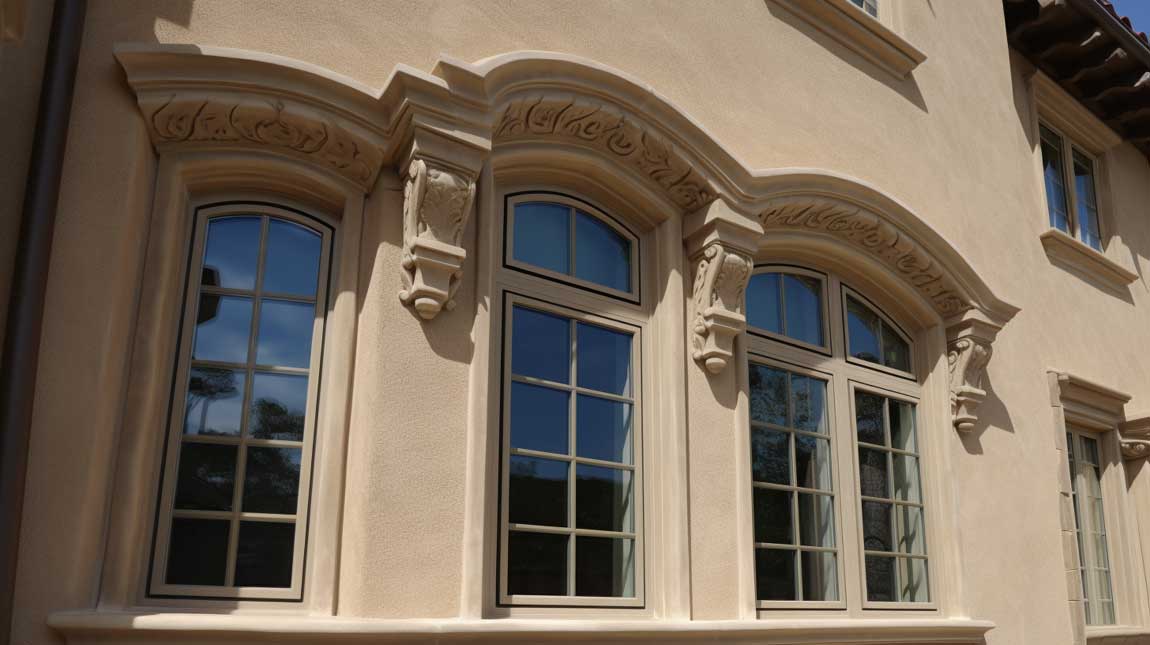
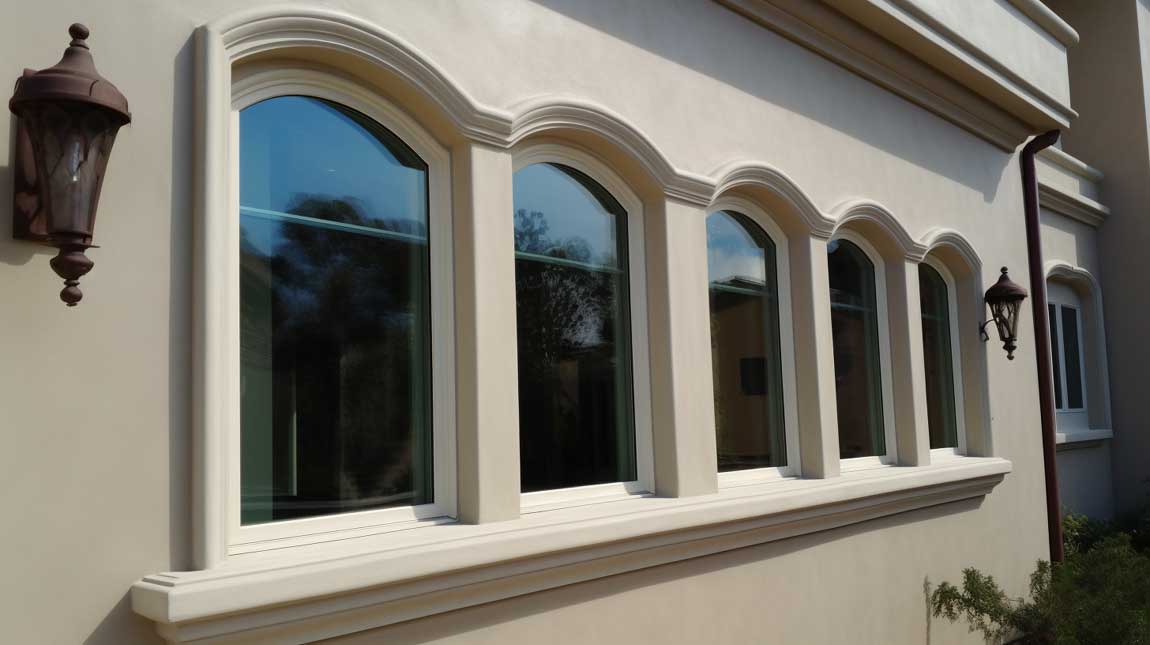
Mix-and-match exterior stucco foam window trim works when you set a clear hierarchy: one dominant profile that appears on every window, one accent detail that appears on select windows only. Dominant profile could be a flat 2-inch reveal. Accent detail could be a keystone header on the entry-flanking windows only. That’s a hierarchy. What doesn’t work is treating every window as an opportunity for a different experiment — the result reads as a catalog of options, not a facade with a design intention.
The best mix-and-match installations I’ve seen follow a rule borrowed from typography: no more than two typefaces on one page. No more than two profile families on one facade elevation. Classical plus contemporary can work if the classical detail is restrained — a flat header band with a minimal keystone, not a full dentil cornice. Organic plus geometric cannot work. The visual languages are incompatible at a fundamental level — one celebrates irregularity, the other celebrates precision, and they cancel each other out at close range.
Proportion matters more than style consistency in the mix approach. If your dominant flat band is 2 inches wide, your accent keystone should drop 4–6 inches — a 2:1 or 3:1 ratio. An accent detail that’s the same scale as the base trim has no accent value. It just adds noise. Scale it up, limit it to two or three windows per facade, and let the flat band do the connecting work across the rest of the elevation.



Final Take
Exterior stucco foam window trim works when the profile belongs to the house — not when it’s the most interesting thing in the catalog.
Scale your profile to your wall height. Match your profile family to your roofline vocabulary. Use 1.5 lb EPS with fiberglass mesh reinforcement, and never install without caulking every joint.
One dominant profile per facade elevation, one accent detail on selected windows only. That’s the entire design logic in a sentence.
Save this post before you order material — the profile you’re excited about at 9pm rarely survives contact with your actual facade at 9am.