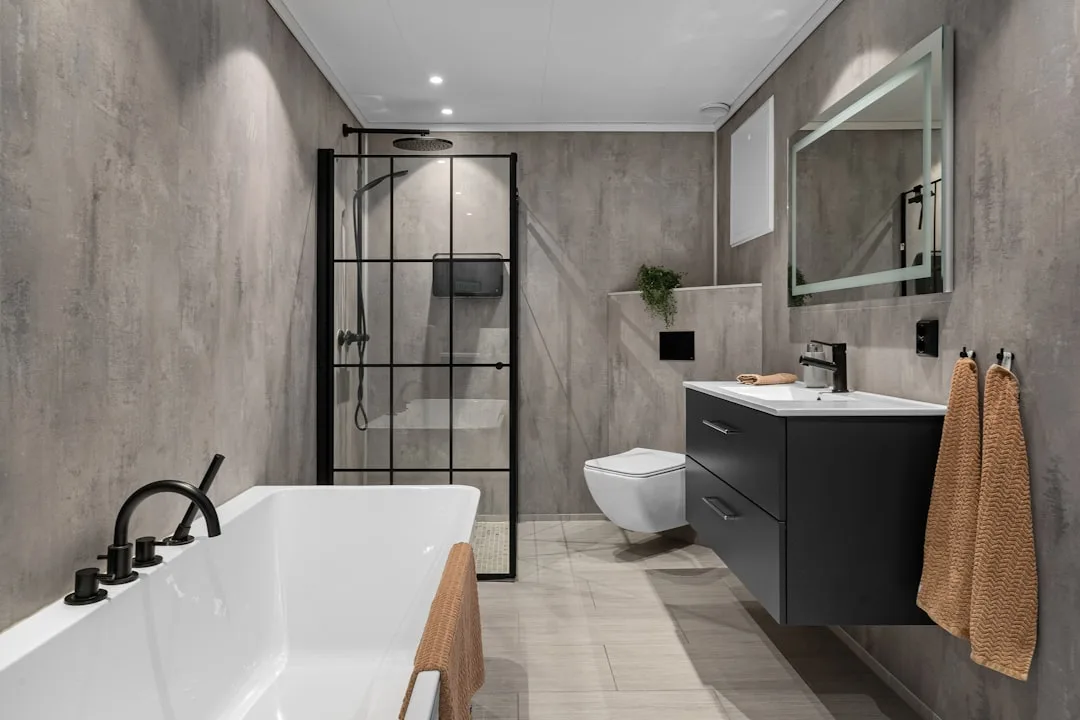
A scandinavian bathroom mirror isn’t decoration — it’s load-bearing. I’ve ripped out three bathroom setups over the years, and the single change that did the most work every single time was the mirror choice. Get it wrong and a Nordic-tiled, white-walled room still looks flat and forgettable. Get it right and the same space reads like a spa in a Malmö design hotel.
The rooms in this collection show sixteen-plus configurations that actually work — full-width frameless slabs, backlit panels, round wooden frames, and low-profile sconce pairings. You’ll notice the pattern fast: restraint in every category except scale. These mirrors are big, confident, and placed with intention.
What you’ll find in this article
- Wall-to-wall frameless mirrors and why they outperform smaller options
- Frameless mirror integration with matte black and chrome fixtures
- Wood-framed mirrors in birch, ash, and walnut — what each tone does to a room
- LED backlighting specs, color temperatures, and what to avoid
- FAQ covering wash basin mirror sizing, modern basin mirror design, and more
Full-Width Frameless Mirrors Earn Their Wall Space


Scandinavian interior design uses mirrors the way a photographer uses a wide-angle lens — to double what the room shows you. A mirror that runs the full length of the vanity wall isn’t bold, it’s correct. I measured the bathroom in my Kyiv apartment before and after swapping a 60 cm framed mirror for a floor-to-ceiling frameless panel: the room didn’t look bigger, it looked like it had a second room attached to it. The psychological trick works because your brain can’t locate the boundary.
Frameless or near-frameless is the only direction worth considering for this style. A chunky frame — even in white or chrome — interrupts the wall plane and drags the eye back to the mirror itself instead of letting it float. IKEA’s HOVET aluminum-frame mirror at $179 is the budget floor; above that, custom tempered glass panels from local glaziers in the $300–$600 range give you exact dimensions. Don’t size down to save money. A mirror that’s ten centimeters too narrow looks like you ran out of budget.
Pair the mirror with a floating vanity — wall-mounted, no legs touching the floor — and you get a second visual trick: the floor reads as continuous, making the room longer. Matte-finish faucets in brushed brass or gunmetal pair better here than polished chrome, which competes with the reflective surface. Add one small potted plant at vanity height, not on the mirror ledge. Everything else should disappear into the wall.
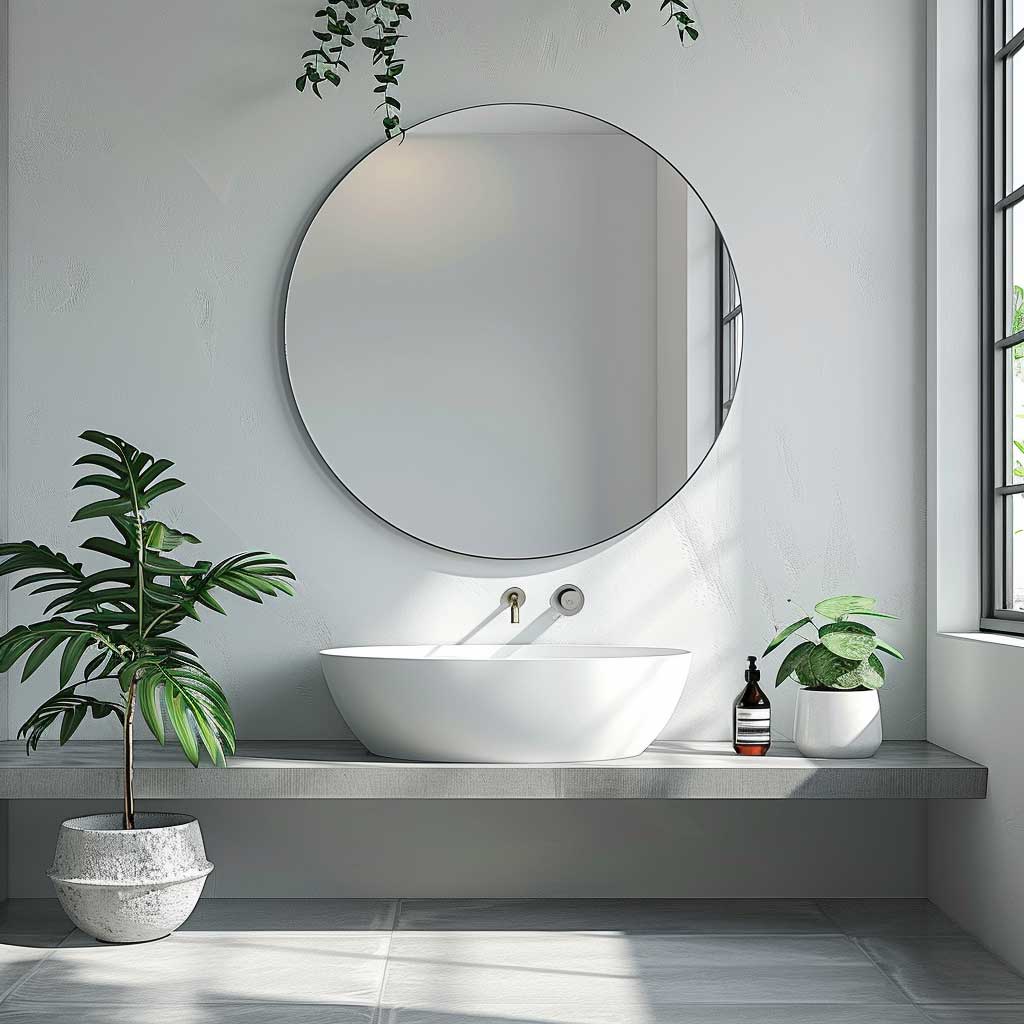


LED strip placement is the detail most people get wrong. Mounting the strip directly behind the mirror (backlit) gives you a halo glow at 2700K that reads warm and hotel-quality after dark. Mounting it above the mirror points light down at your face and creates shadows under your chin and eyes — unflattering and slightly clinical. I’ve tried both. The backlit version costs roughly $14 more in materials and looks $300 better. Stick with 2700–3000K; anything cooler makes white grout look grey and your skin look tired.
Anti-fog versions are worth the price premium if your bathroom ventilation is poor. The built-in heating element adds $40–$80 to mirror cost but saves the ritual of wiping condensation every shower. Brands like GETLEDEL and Neutype both offer 24-inch round backlit options under $200 with anti-fog included — solid entry points if you’re not ready to go custom.
Frameless Mirrors That Disappear Into the Wall


A frameless mirror at the right scale is one of the few design moves that reads expensive whether you spent $180 or $900. The reason is structural: without a frame, your eye has nothing to stop at. The reflection continues visually into the perceived space beyond. Think of it like a window into a duplicate room — that’s the Scandinavian spatial trick in its purest form. I first saw this done in a 4-square-meter bathroom in Copenhagen and immediately understood why the space felt three times that size.
Polished chrome fixtures are a common pairing mistake. Chrome catches too much light in too many directions and competes directly with the mirror’s reflective surface — you end up with competing shine instead of one calm focal point. Matte black or brushed nickel faucets, towel hooks, and toilet flush plates all recede visually and let the frameless mirror own the wall. Stick to one metal finish across every fixture in the room. Mixing finishes in a small bathroom looks like indecision, not eclecticism.
For sconce placement: two wall-mounted fixtures at eye level on either side of the mirror, 60–65cm apart, at 1.6m from floor height. This is the lighting spec most makeup artists recommend for shadow-free illumination and it translates directly to bathrooms. Skip the overhead downlight positioned in front of the mirror — it creates the worst possible angle for both grooming and general aesthetics.
⚠ Don’t Do This
Installing a medicine cabinet instead of a mirror in a Scandinavian bathroom. Medicine cabinets in this context almost always have visible hinges, recessed frames, or mismatched depth lines that destroy the flush-wall illusion. The storage isn’t worth losing the visual plane. If you need storage, build recessed niches into the shower wall or use a shallow floating shelf below the mirror. A mirrored cabinet belongs in a farmhouse or eclectic bathroom — not here.
Also avoid: framed mirrors with decorative details (rope edging, beveling, ornate corners), oval shapes in a rectangular room, and mirrors mounted lower than 1.4m from the floor. All three work against the Nordic aesthetic.


Marble countertops or high-fired ceramic tiles alongside a frameless mirror create the right material tension — reflective glass against matte stone, two extremes that cancel each other’s intensity. You’ll notice the rooms here use exactly this pairing. Surfaces touch but don’t compete. The result is a space that looks curated without looking labored. Grey minimalist bathrooms use this same mirror-and-stone logic to particularly strong effect.
High-quality grout color matters more than most renovation guides admit. Pure white grout shows every water mark by day eleven. A warm taupe grout — I’ve used Mapei Ultracolor Plus FA in Caramel at $9 per bag — reads clean against white tile and doesn’t show calcium deposits. Your mirror will reflect your grout lines constantly. Make sure they’re worth looking at.
Wood-Framed Mirrors Warm a Room Without Softening the Lines


Wood in a Scandinavian bathroom does what a cashmere sweater does in a minimal outfit — it prevents the whole thing from reading as a hospital corridor. The frame needs to be thin, though. Anything over 4cm wide starts looking farmhouse instead of Nordic, and those are different aesthetics with different outcomes. My rule: if the frame draws more attention than the reflection, it’s too much wood.
Pale birch and ash are the go-to species because they read light without looking washed out. Birch at roughly $220–$350 for a 70cm round mirror (Uniek’s Pao curved frame is a solid reference point) hits the right tone against white and grey palettes. Walnut costs more and does something different — it adds depth and a slight Nordic-rustic flavor that works better in a bathroom with warm tile tones or terracotta accents. Don’t mix wood species in the same room; the vanity and the mirror should speak the same wood language.
Round wood-framed mirrors over a rectangular sink create deliberate tension — soft geometry against a hard line. That contrast is what makes the room feel designed rather than assembled. Complement the frame with a light wood shelf below or beside the vanity. Keep ornamental detail off the shelf: one ceramic soap dish, one small succulent, nothing more. Scandinavian mirror design for a simple aesthetic covers exactly this approach in more depth.


Textiles are underused in this context. A pair of linen hand towels in undyed natural beige, hung on a simple wooden peg below the mirror, costs $18 and adds exactly the right amount of softness without becoming décor. Fluffy terry towels in bright white or ecru do the same job. Avoid printed or colored towels here — the mirror reflects everything, and a loud pattern doubles its own disruption.
What doesn’t work: oak with strong orange or yellow undertones. American red oak in particular photographs with a warmth that clashes hard against cool Nordic whites. Stick to European white oak, birch, ash, or pine with a clear matte finish — no varnish sheen. A glossy wood frame in a bathroom full of matte surfaces is the interior design equivalent of wearing a sequin top to a minimalist dinner party. Black and white Scandinavian bathroom concepts show how material restraint, including frame choice, carries the whole room.
Mirror Comparison by Frame Type
| Frame Type | Best For | Price Range | Watch Out |
|---|---|---|---|
| Frameless | Small rooms, maximum space illusion | $180–$600+ | Needs clean wall behind it |
| Thin metal (matte black) | Warm-toned or grey bathrooms | $80–$300 | Chrome version defeats the purpose |
| Wood (birch/ash) | Rooms that need warmth | $120–$400 | Avoid orange-toned oak |
| Backlit LED | Bathrooms with poor natural light | $150–$500 | Color temp above 3000K looks harsh |
For more Scandinavian bathroom inspiration with real photos and layout breakdowns, Houzz’s Scandinavian bathroom gallery is one of the strongest references online — over 6,800 indexed photos with designer credits and material specs attached.
Worth Bookmarking
The mirror is the one decision that can’t be an afterthought in a Scandinavian bathroom.
Pick the shape, frame, and size before you tile, before you order fixtures, before you finalize the vanity. Everything else is placed relative to the mirror — not the other way around.
For wall-spanning frameless options, measure the vanity first. The mirror should clear each edge by 2–4cm, no more. Wider than that and it looks like you meant to go floor-to-ceiling but ran out of glass.
Save this post before your next bathroom shopping trip — frame choice, LED spec, and wood tone all in one place.
Related Topics
FAQ
What size mirror works best over a wash basin in a Scandinavian bathroom?
What makes a mirror design work for a modern basin or wash basin area?
Are round or rectangular mirrors more authentically Scandinavian?
Can I use a Scandinavian bathroom mirror style in a very small bathroom?
What is the difference between a backlit and front-lit bathroom mirror?
How do aesthetic mirrors differ from standard bathroom mirrors and what should I pay?
Complete guide
Bathroom Design Ideas That Transform Every Space From Ordinary to Exceptional
Tiles, colors, fixtures, layouts, remodels, mirrors, decor — all in one place
Complete guide
The Complete Guide to Scandinavian Style Living
Bedrooms, kitchens, bathrooms, living rooms, Japandi, color — all in one place