Kitchen window treatment ideas fail most kitchens not because the fabric is wrong but because the mount point is. I’ve ripped out three sets of window treatments in two years chasing the same problem: a covering that looked right in the store but felt awkward once installed, usually because it was hung inside the frame instead of above it. Kitchen window treatment ideas that actually deliver — Roman shades, café curtains, roller blinds — all share one trait: they’re mounted to control the visual edge of the window, not just to cover the glass.
Your kitchen window does three jobs simultaneously: it manages light, it handles privacy, and it anchors the wall composition. Most treatments handle one of those jobs well and ignore the other two. The options below are chosen because each one handles at least two of the three, which is the minimum bar worth meeting in a room you use every single day.
Cost matters here too. Roman shades from Smith & Noble run $180–$280 per shade. Roller blinds from Bali start at $70. Café curtains from IKEA cost $19.99. The price gap is real, but the installation logic is identical across all three — and getting the logic right costs nothing.
- Roman shades: best for color and pattern delivery, outside mount eliminates privacy gaps at edges
- Café curtains: midpoint hang gives privacy without blocking upper light, ideal over the sink
- Modern roller blinds: wipe-clean surface survives grease and steam, solar fabric lets you see outside while cutting glare
- Mount point is the single variable that determines whether any treatment looks intentional or accidental
- Contemporary kitchen window treatments favor flat-fold fabrics over gathered fabric near cooking zones
- Fabric choice near the sink: woven vinyl or solar screen, not linen or cotton — grease particles embed in soft fibers
Roman Shades Deliver Pattern Without Making the Kitchen Feel Smaller
Kitchen window treatment ideas built around Roman shades work because the flat surface holds color the way stretched canvas holds paint — the fabric doesn’t move, so the pattern reads crisply instead of rippling like curtain fabric does in a draft. I own two Roman shades in my kitchen: a deep sage linen for the main window and a blackout cotton-poly blend for the smaller window above the range where afternoon glare hits the counter directly. The difference between them is not just light control — the linen one folds into clean horizontal lines when raised; the cotton-poly one wrinkles at the fold lines after six months and starts looking deflated by year two.
Smith & Noble’s flat-fold Roman shades ($180–$280 per shade in standard fabrics) are the benchmark for this price range. You can also order their mounting hardware and source your own fabric to cut costs significantly — the mechanism is what you’re paying for. For bold pattern work, a geometric or botanical print in a saturated color does more for a neutral white kitchen than repainting a cabinet. The bold choice pays off here specifically because the shade sits flat and still; your eye reads the pattern without distraction.

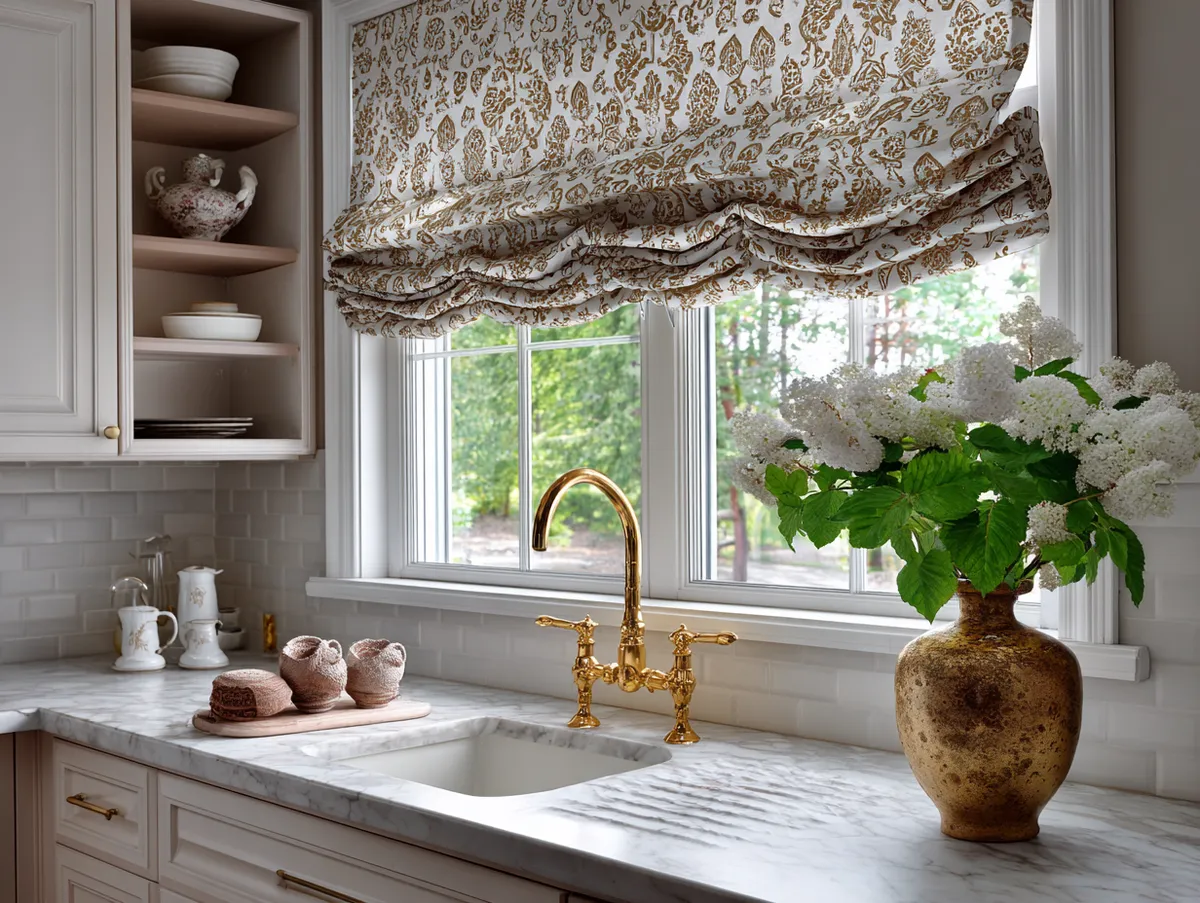


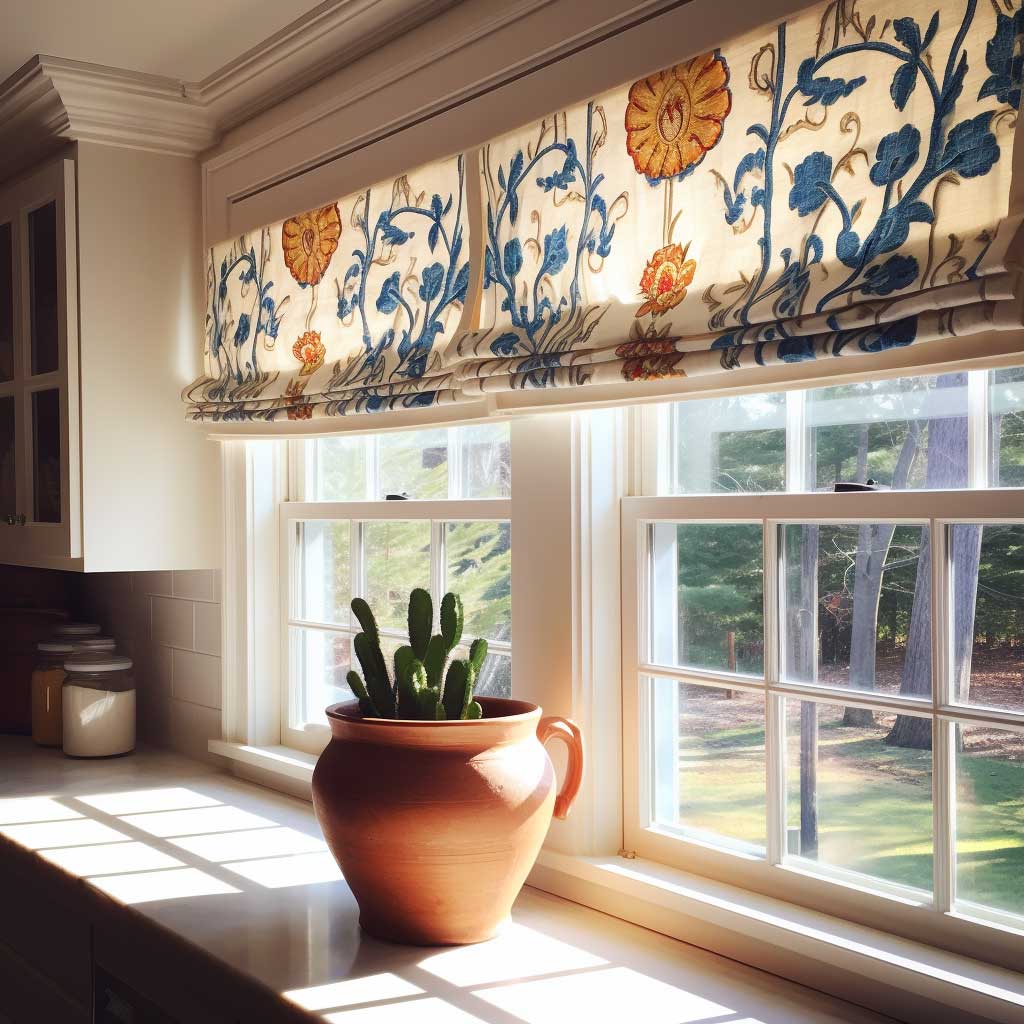
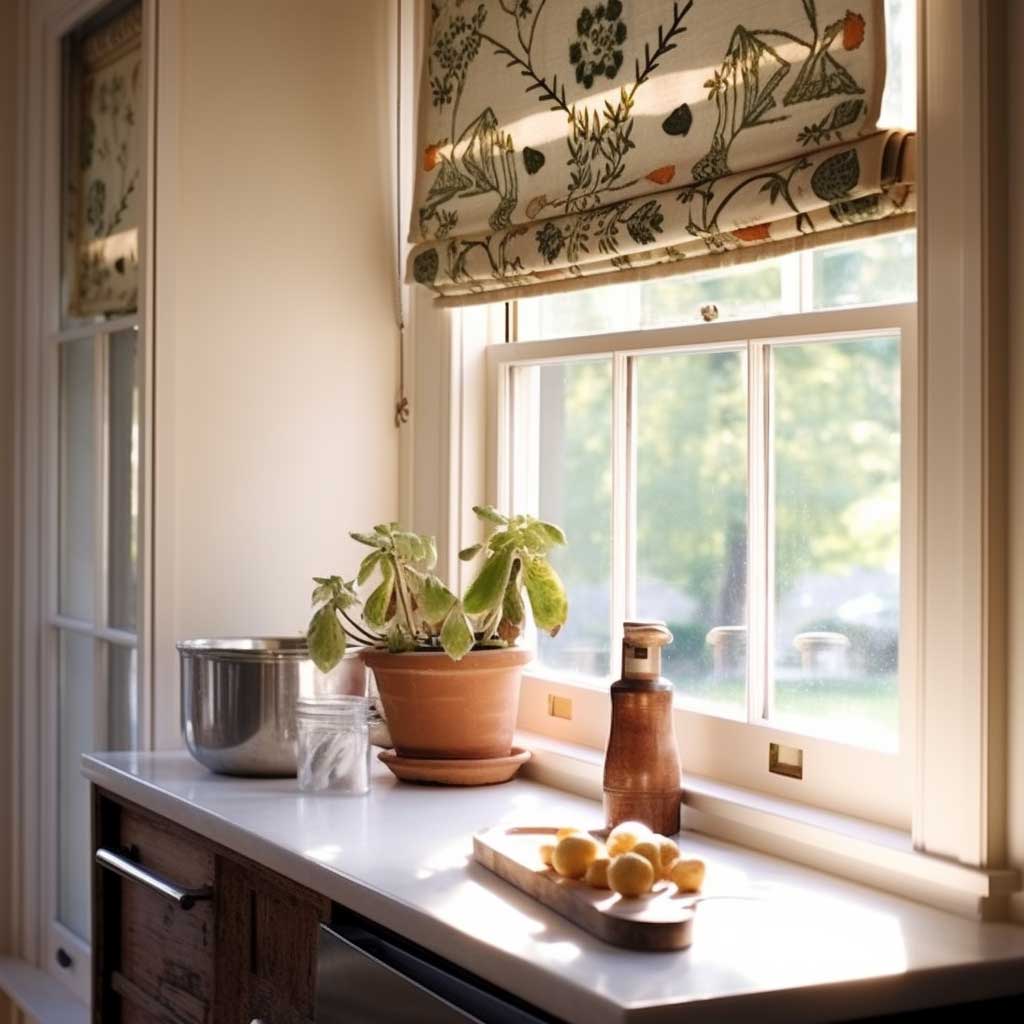
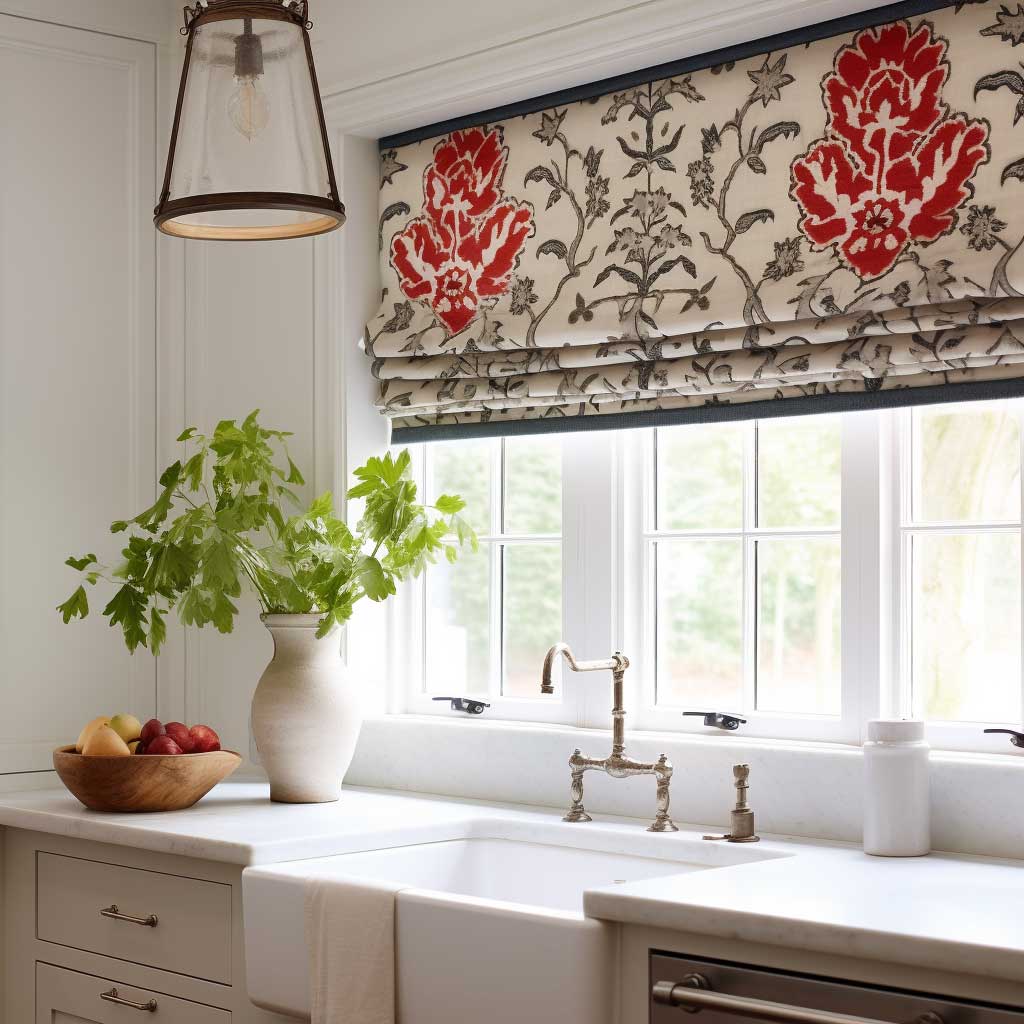

Sizing kills more Roman shade installations than fabric choice does. Mount outside the frame, overlap 2 inches on each side, and the shade covers the frame completely when closed. Mount inside and you’ll see daylight strips at both edges — which means your neighbor can see straight in even with the shade fully down. That’s not a style problem; it’s a geometry problem. Outside mount fixes it in one step. Add the extra 2 inches and the window looks wider without adding a single inch of actual glass.
Is blackout lining worth the extra $30? Yes, if your kitchen faces east or west and you cook before 9 a.m. or after 5 p.m. No, if the window faces north — you’ll block the only natural light the room gets, and north-facing kitchens already run dim. I made this mistake in my first apartment and spent six months wondering why the kitchen felt like a storage room at noon. The blackout lining was the problem. Switching to a light-filtering linen shade in the same mount position changed the room completely.
For large windows, order two narrower Roman shades side by side rather than one wide panel. Two shades stack higher when raised — you lose less of the view — and the center line reads as intentional structure. Coordinating the shade fabric with other window covering materials in the kitchen works exactly the way tile coordination does: match the undertone, not the exact color, and the room reads as composed rather than matched.
Don’t hang a Roman shade on a tension rod inside the window frame when the window is above the sink. Steam and dish-splashing moisture warp the rod within six months — the shade tilts, the fabric bunches at one side, and the whole thing looks broken without actually being broken. Use a proper wall-mount bracket screwed into the frame surround above the window. Tension rods belong in closets, not humid rooms. Also skip blackout Roman shades on north-facing windows — you’ll trade dim for dark, which is worse.
Café Curtains at Mid-Window Give You Privacy Where You Actually Need It
Kitchen window treatment ideas that use café curtains solve the specific problem of sink windows — the window where you stand the longest and feel the most exposed to outside sightlines. A café curtain hung at the midpoint of the window covers the lower half where eyes meet at street or neighbor level, while leaving the upper half completely open for light. You get privacy during washing up without losing the daylight that makes the kitchen feel less like a cave. That balance is harder to achieve with a full-drop curtain or a roller blind, both of which are all-or-nothing in operation.
IKEA’s RAFFROLLO panel at $19.99 works for this. Anthropologie’s café curtains at $88–$98 per panel hold their pleat longer after washing and use better quality fabric that doesn’t thin out after a year of humidity cycles. The honest answer is that for a window above the sink — a high-traffic moisture zone — the IKEA version is fine to replace every two years. For a kitchen window across the room from cooking and water, spend the money on a fabric that ages well. What doesn’t work regardless of price: full-length curtains on a window above a countertop. They hang in the work zone, catch grease vapor, and look wrong proportionally. Café height only, in this location.


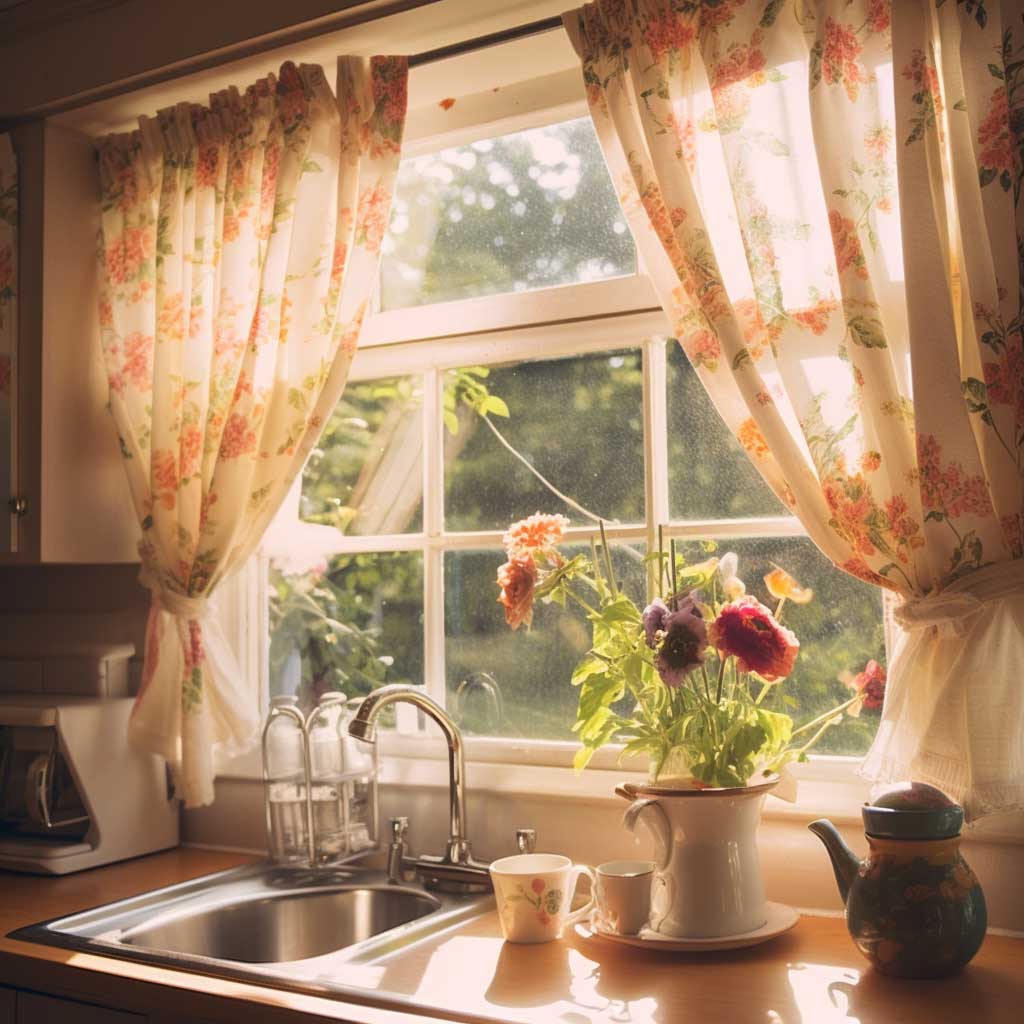
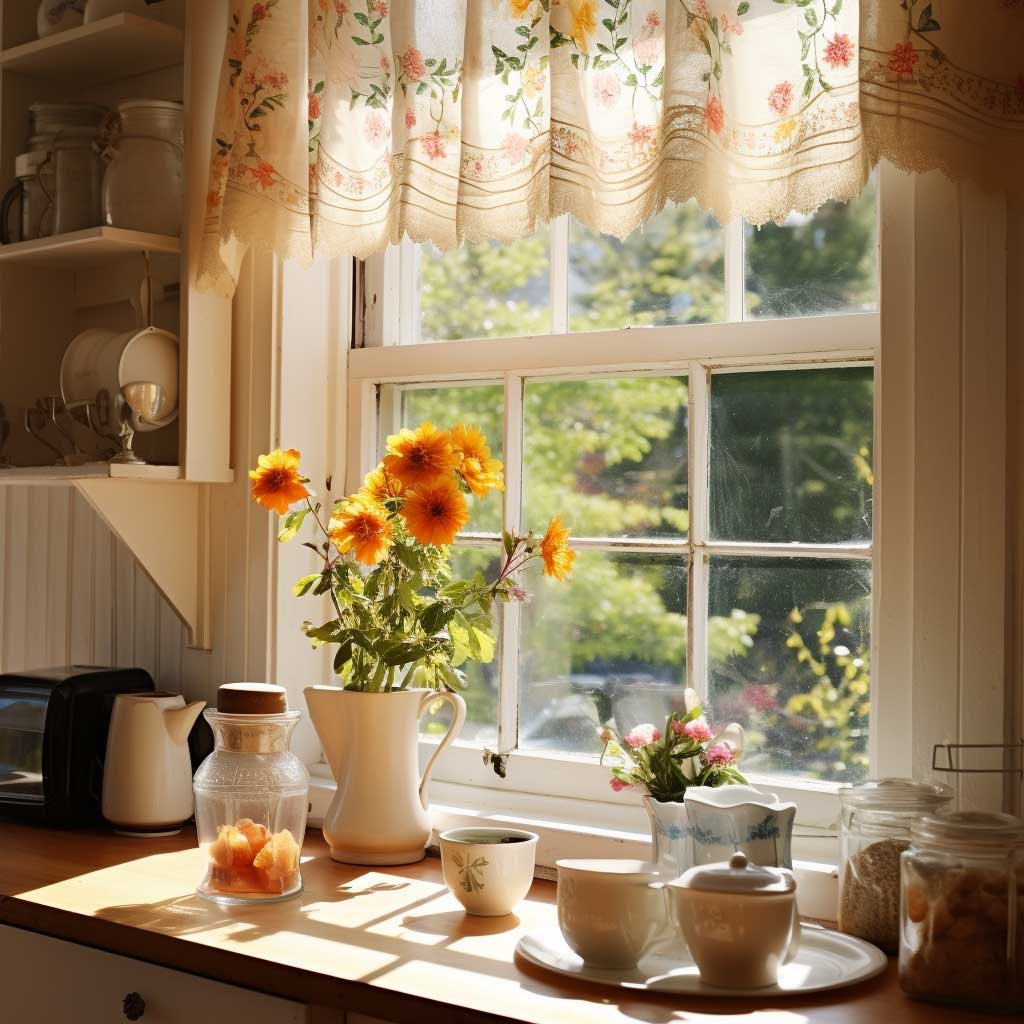
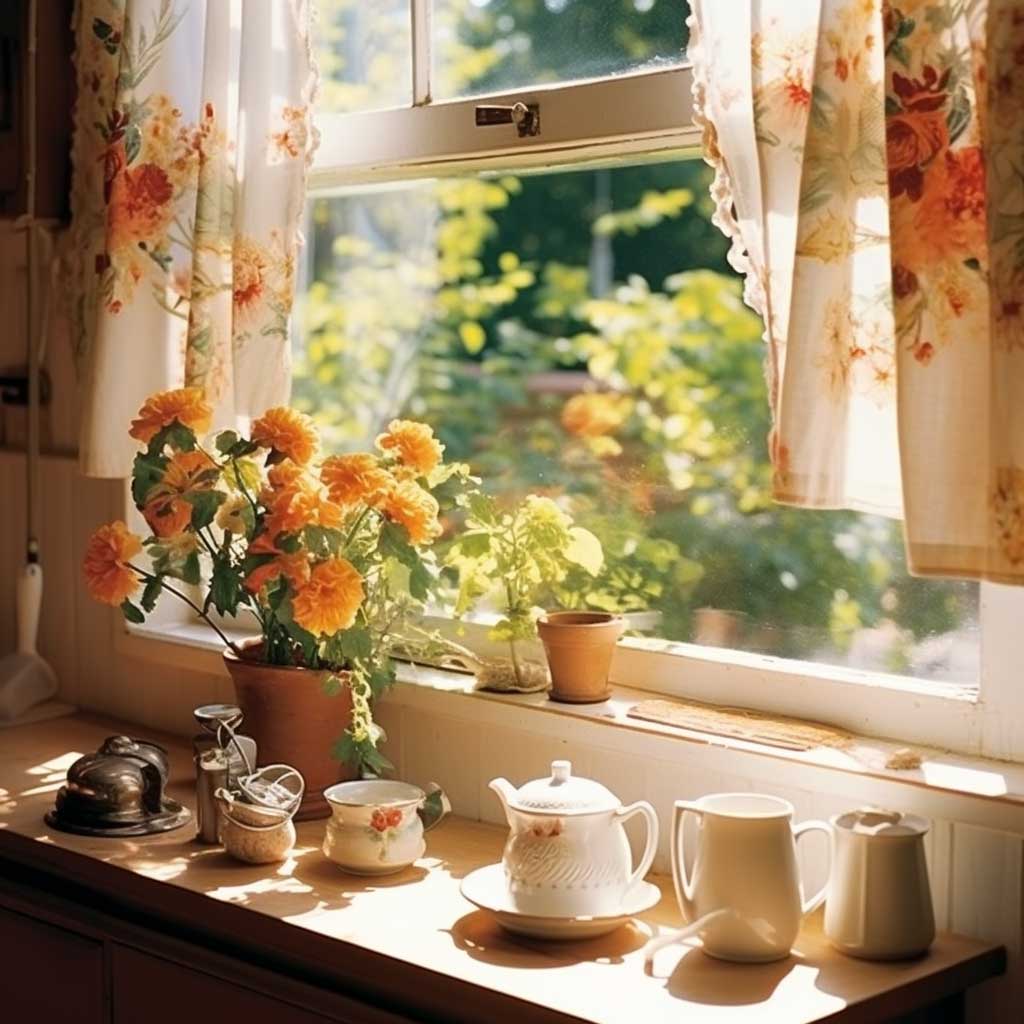
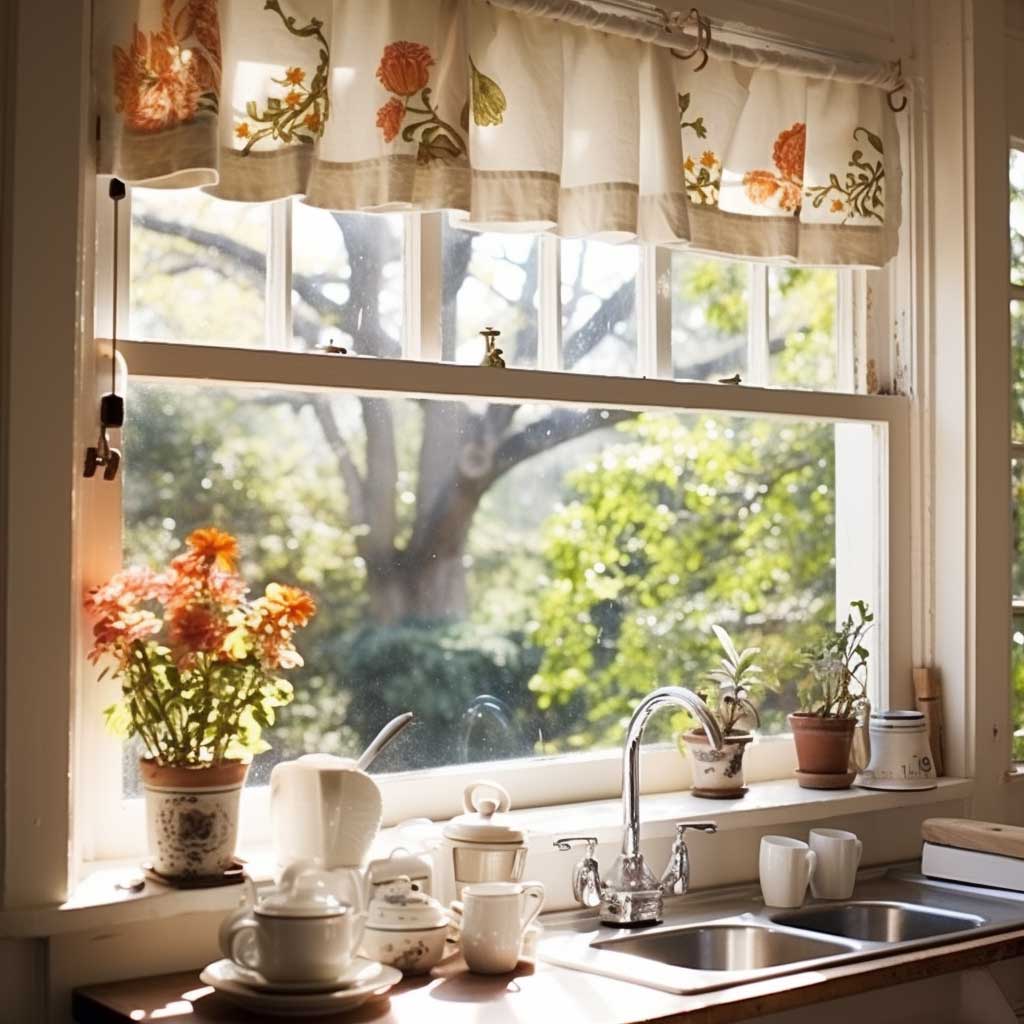
Hardware scale is where café curtains most often fail visually. A 1.5-inch rod on a 20-inch window looks like scaffolding. My go-to is the STORSLAGEN rod from IKEA — matte black, 0.5-inch diameter, $12 — because it disappears behind the fabric and lets the curtain itself do the talking. Use simple clip rings rather than rod-pocket panels; clip rings allow you to adjust the hang and take the panel down for washing without removing the rod. Rod-pocket panels have to come off rod and all, which means you’re untangling hardware every time you wash the fabric.
Fabric choice for café curtains near cooking should lean toward natural fibers — cotton or linen — that can go into the washing machine at 40°C without shrinking dramatically. Poly voile yellows near steam faster than any other common curtain fabric; I tested this side by side over a six-month period with two identical windows above adjacent counters, one poly and one cotton. The poly panel looked dingy by month four. The cotton panel washed back to white every time. If the fabric spec says “easy care synthetic,” skip it for kitchen use regardless of how it looks on the shelf. Farmhouse-style kitchens in particular benefit from linen café curtains — the natural texture reads as intentional in that design context rather than an afterthought.
Modern Kitchen Window Treatments Built Around Roller Blinds Survive the Sink Zone
Modern kitchen window treatments that perform over time near a sink are almost always roller blinds, because the wipe-clean surface is not a marketing claim — it’s physics. Fabric absorbs grease particles. Vinyl-coated solar screen does not. I had a Roman shade above my range for 18 months before switching to a roller; the first wipe with a damp cloth on the new roller cleaned the surface in 30 seconds. Cleaning the old Roman shade took 20 minutes of spot work and left a water ring I never fully removed. The roller blind won on maintenance alone, before I even counted the light-control advantages.
Bali Blinds sells solar rollers starting at $70 for a standard 36-inch width in 25 color options. The 5% openness factor is the right call for most kitchen window treatments — you see outside clearly during the day, UV and glare drop noticeably, and privacy at night requires a second layer since solar fabric is transparent once interior lights are on. The 3% openness fabric approaches blackout during the day and works well if the window faces a neighbor’s window directly at eye level. Cordless operation adds $15 and is worth every dollar: cords in humid kitchens stiffen and yellow within two years of installation.


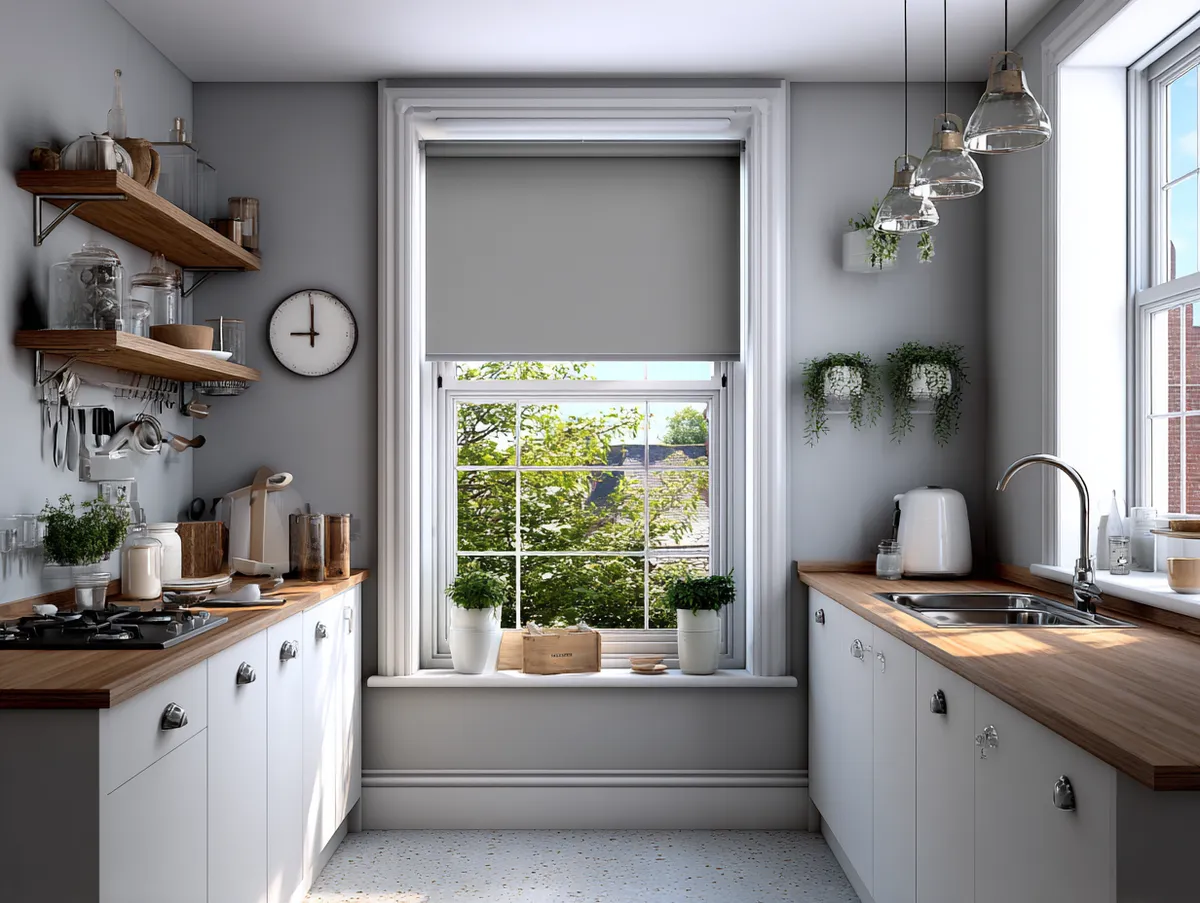
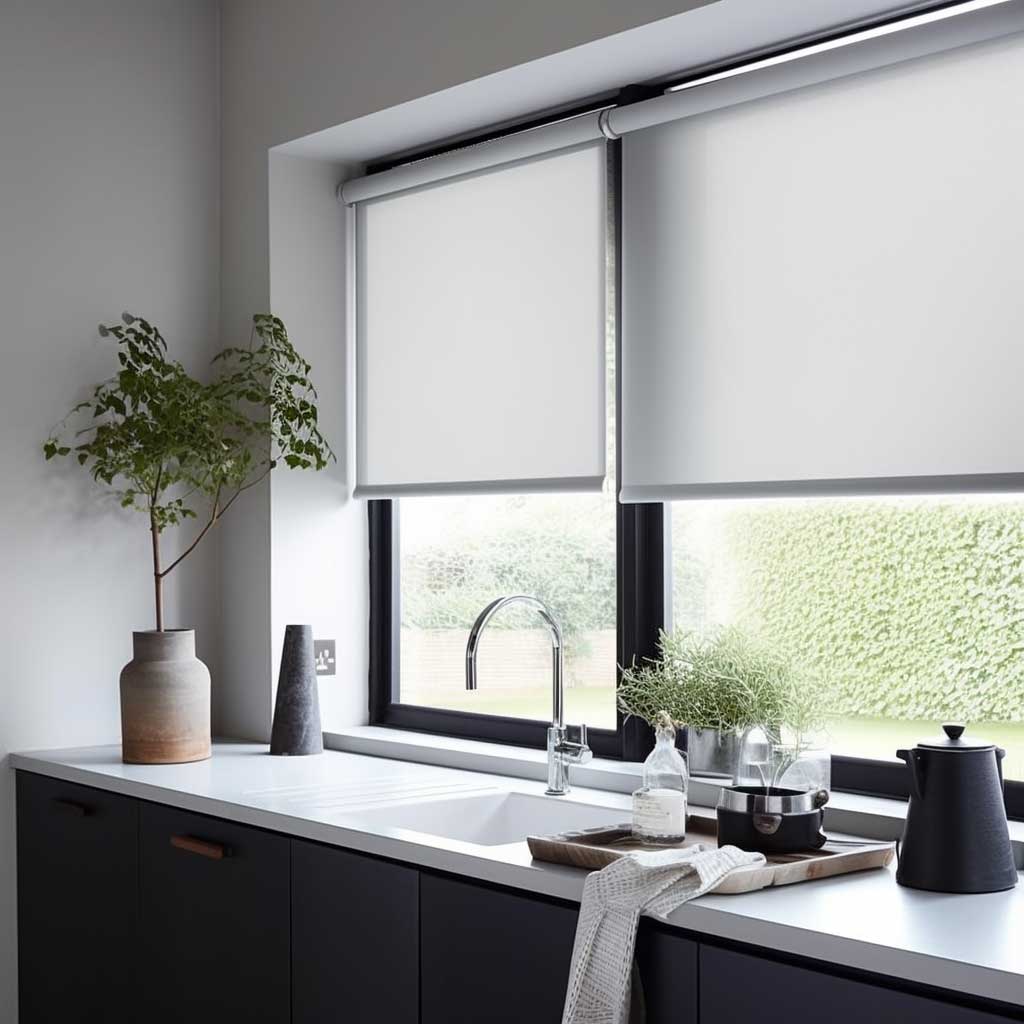

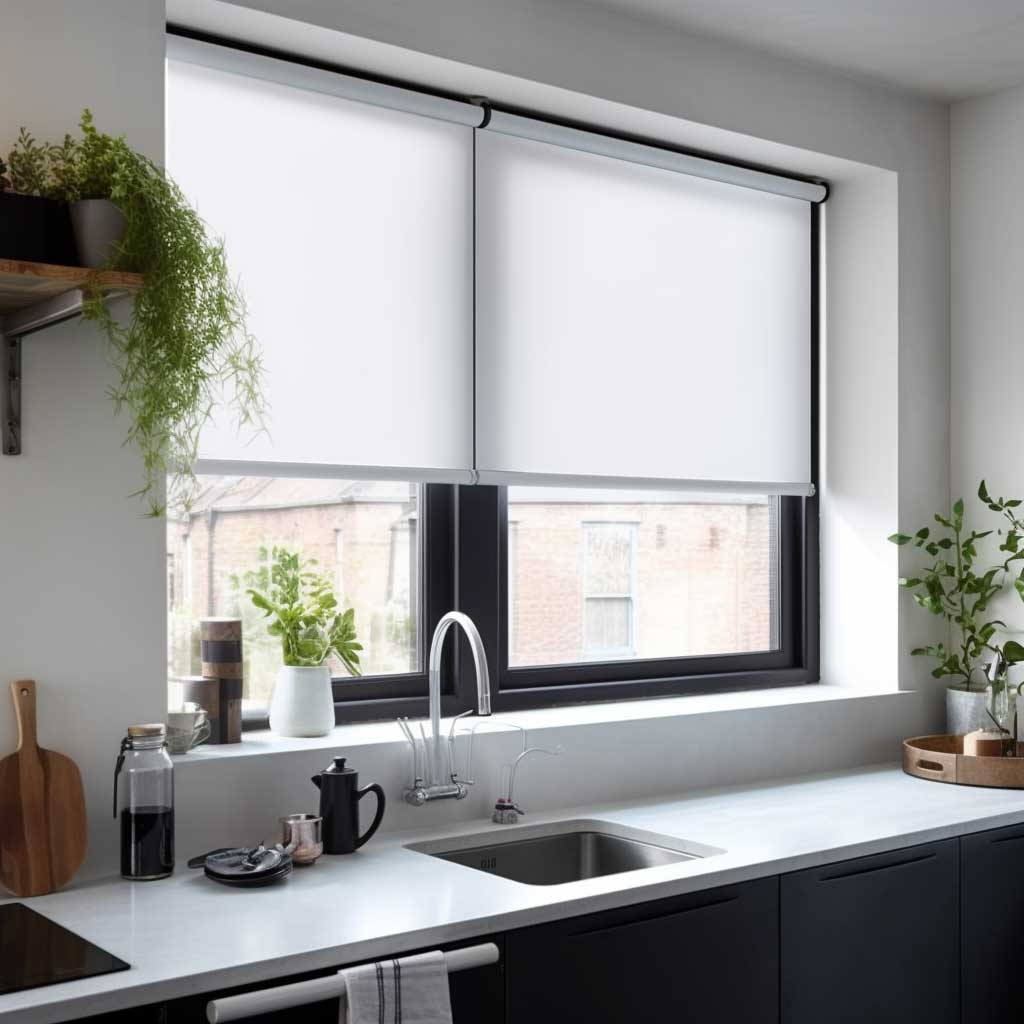
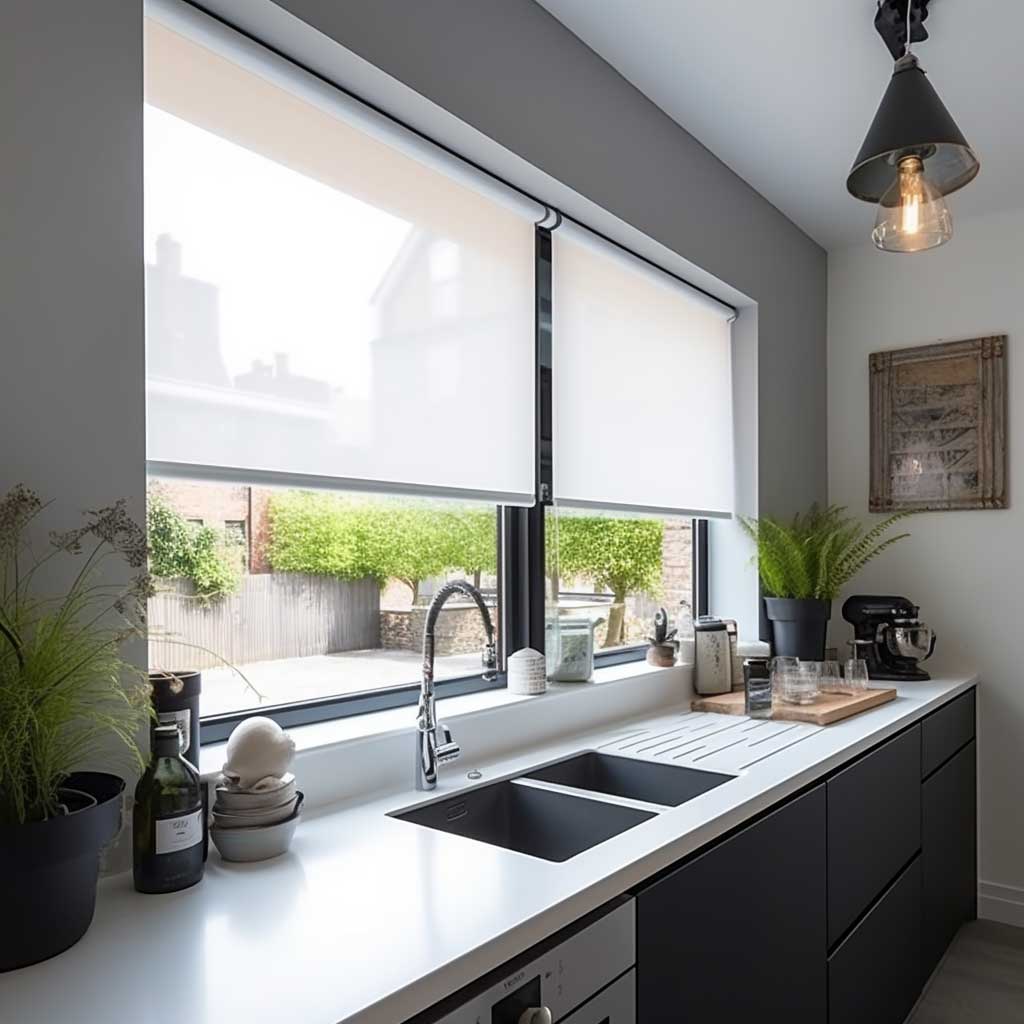
The main complaint about roller blinds in kitchen design is that they look institutional — office supply rather than home furnishing. That criticism applies specifically to cheap poly rollers in off-white. It stops applying when you use textured fabric: bouclé-weave solar screen, grasscloth-look woven material, or linen-effect vinyl. Add a flat 6-inch linen valance at the top to cover the hardware casing and the roller reads as a deliberate design decision rather than a default. The valance doesn’t need to be elaborate — a piece of linen cut to width and stapled to a board mount costs under $20 and changes the visual register of the entire installation.
Motorized rollers make sense for windows over 48 inches wide or mounted above counters where reaching the chain means leaning over the sink. Hunter Douglas Sonnette rollers ($400–$600 installed) are the reliable premium option. For large windows, the dual-roller system — one solar blind and one blackout on a second headrail — gives you independent control for day and night without layering two separate curtain systems. SelectBlinds sells dual headrail setups starting around $150 for standard large windows. According to the U.S. Department of Energy, cellular shades and roller systems with tight edge seals can reduce heat loss through windows by 40% or more in heating seasons — an argument for choosing quality hardware over the cheapest available option when replacing kitchen window treatments.
KITCHEN WINDOW TREATMENT IDEAS — FINAL WORD
The mount point matters more than the fabric.
Roman shades, café curtains, and roller blinds all work — but only when they’re mounted outside the frame with enough overlap to eliminate light gaps. Get this wrong and nothing else you choose will fix it.
Near the sink, roller blinds with solar fabric outperform every fabric option on maintenance alone. For pattern and color, Roman shades in flat-fold linen deliver results no gathered curtain can match. Café curtains at mid-window solve the specific privacy problem of a sink window without stealing daylight from the upper half.
Contemporary kitchen window treatments favor clean lines over decoration — the treatment should read as part of the architecture, not an accessory placed in front of it. Save this post before you measure anything.