Black and white wall paint designs for house exteriors hold their ground in a way no seasonal color trend ever manages. The contrast is structural — it doesn’t just decorate a facade, it defines every architectural line, from Victorian carved shutters to Colonial Revival symmetry to modern geometric corners. Sherwin-Williams Tricorn Black (SW 6258) costs $80–$90 per gallon and delivers a zero-undertone true black that holds its tone across lighting conditions, while a gallon of exterior white covers roughly 300–400 square feet per coat — two facts worth knowing before anything else.
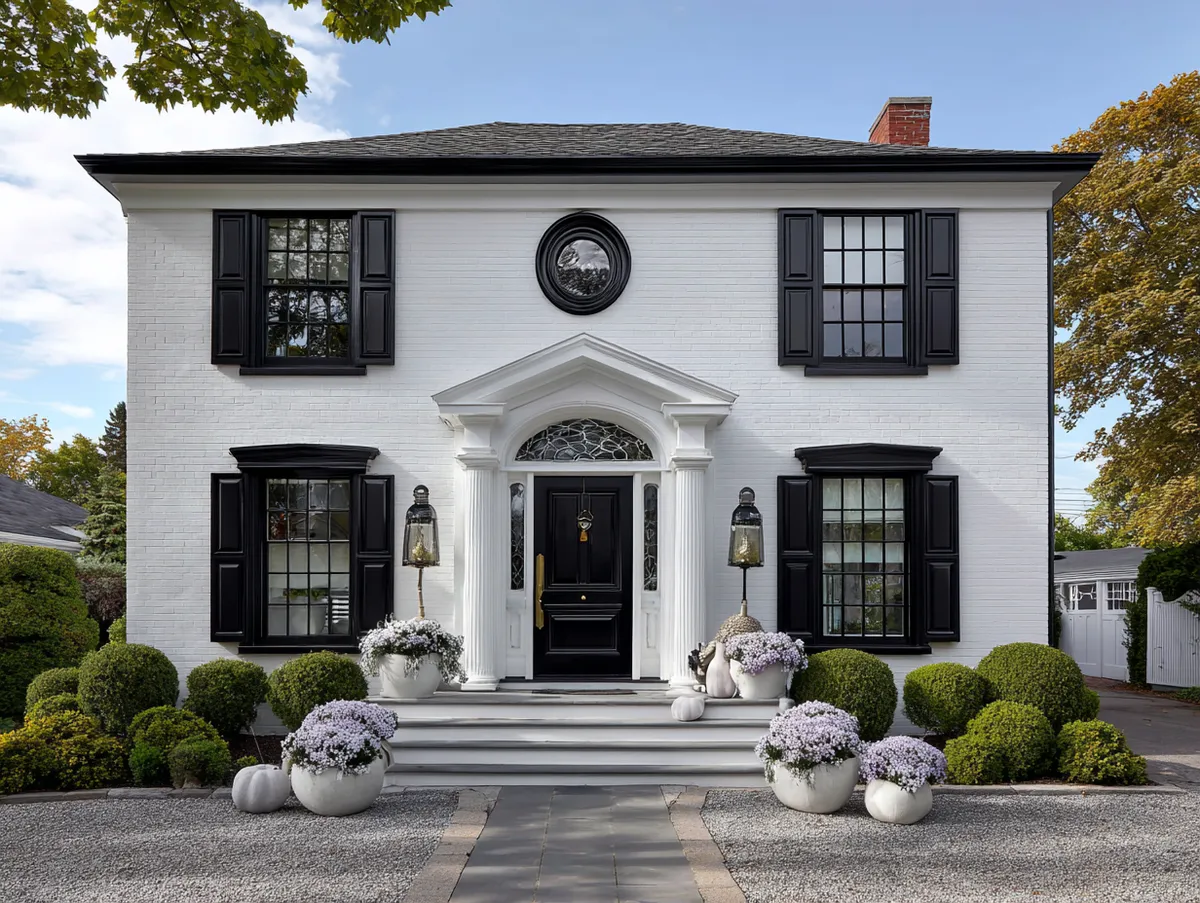
Three distinct design languages show up most in the GSC data for this topic: Victorian splendor with carved details and iron railings, monochrome minimalism with panoramic windows, and Colonial-heritage facades that use geometric two-tone blocking. Each handles the black-white ratio differently, and that ratio is where the real decisions live.
The common mistake is treating this palette as fool-proof. Black on south- or west-facing walls absorbs more heat and UV, which means in high-sun climates you should plan to repaint those elevations every 5–7 years rather than the standard 7–10 for moderate climates. Pair that with the wrong sheen — anything flat — and you’ve built yourself a mildew farm. Satin on body walls, semi-gloss on trim, no exceptions.
– Sherwin-Williams Tricorn Black (SW 6258): $80–$90/gal, LRV of 2.45 — as true-neutral a black as residential paint gets
– Exterior paint covers 300–400 sq ft per gallon on smooth siding; textured stucco drops to 200–300 sq ft
– South- and west-facing black walls fade and chalk faster — budget for repainting every 5–7 years in high-UV climates
– Victorian: black shutters + wrought iron on white body. Monochrome: black window frames + black front door on white. Colonial: geometric two-tone blocking at corners
– Flat sheen on a black exterior is a mistake — satin on body, semi-gloss on trim is the correct sequence
– Professional exterior painting averages $3,145 (Angi), with DIY materials running $500–$1,000
Victorian Black and White Exterior Wall Paint Designs Where Shutters Do the Work
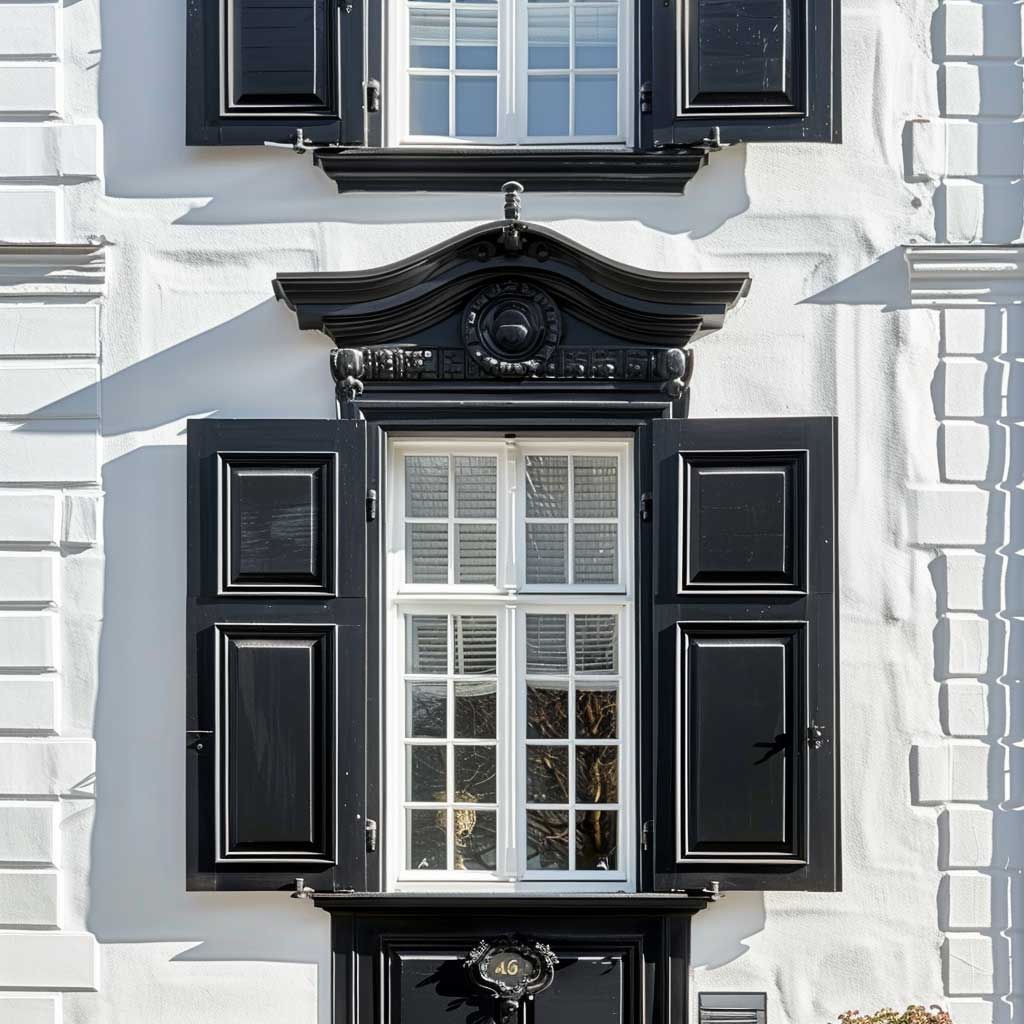
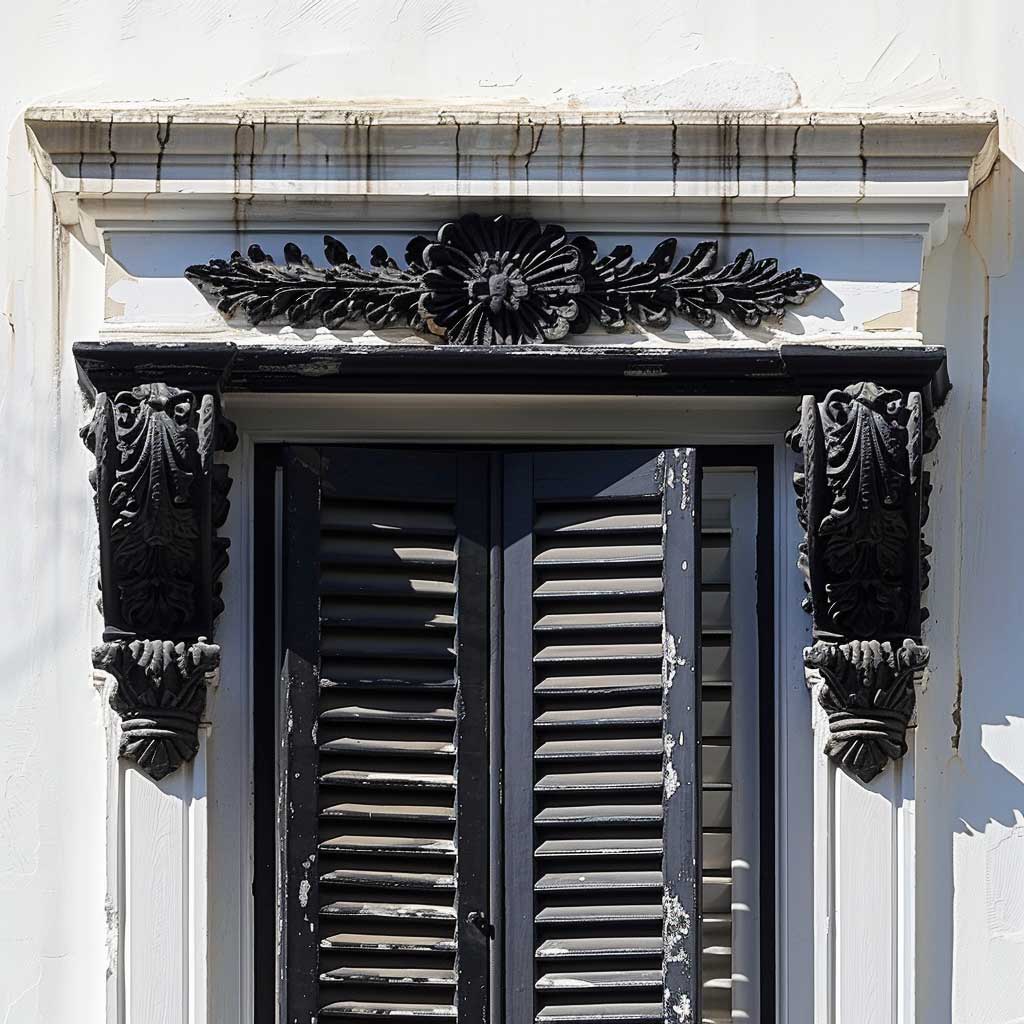

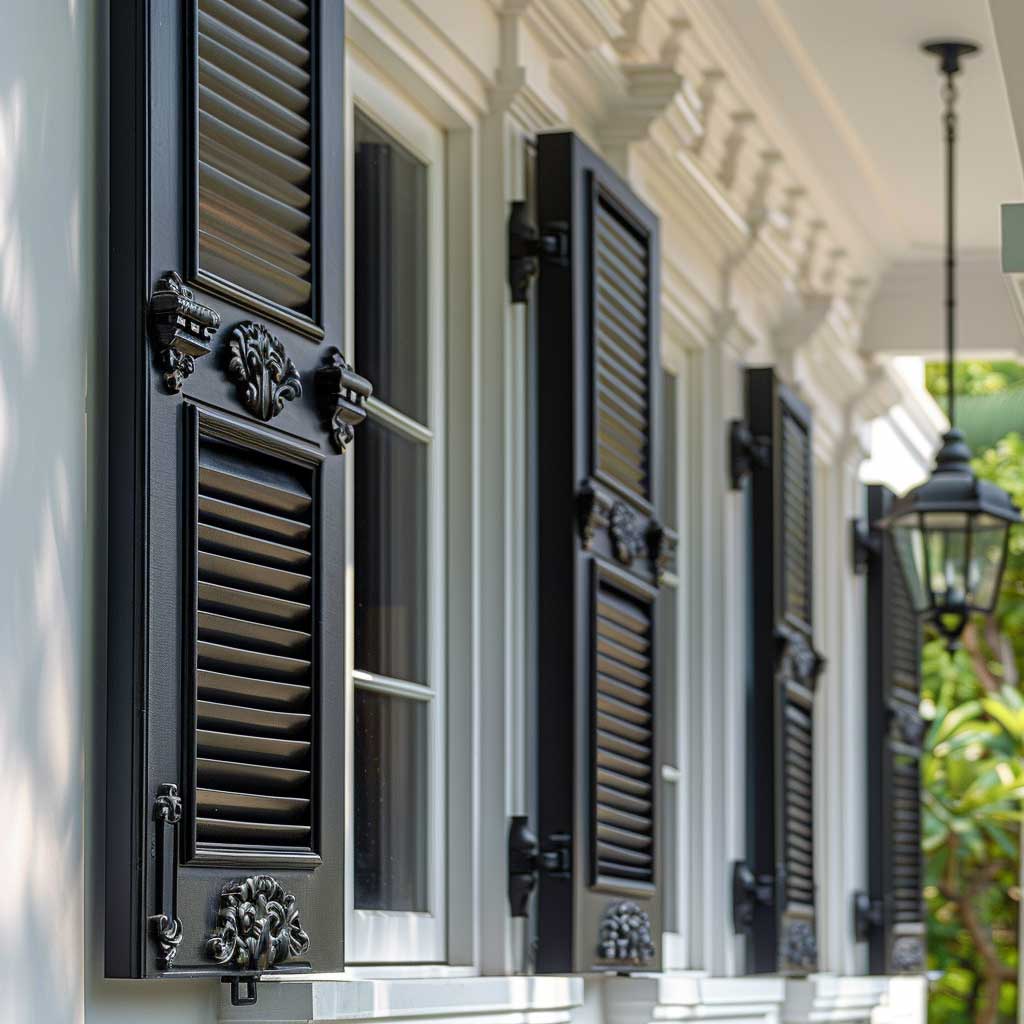
Victorian black and white exterior wall paint designs use shutters as the primary contrast engine — not the body color, and not the front door. The logic is architectural: Victorian facades carry carved wooden shutters, corbels, and bracketed cornices that reward a single bold accent color. Painted in a true black like Tricorn Black (LRV 2.45) against an immaculate white body, each shutter becomes a shadow-casting element that changes the facade’s texture throughout the day. A Catchlight Painting case study on a Victorian exterior in Brookline, MA documented a four-person crew spending nearly a month on prep, carpentry, and paint — the detail density on these homes is not a quick-weekend project.
Wrought iron railings are the second key element. Black railings next to white walls operate like drawing ink on paper — every curve and scroll becomes legible in a way it never would against a colored background. Stylists working with Victorian exteriors consistently recommend painting iron elements the same black as the shutters, not a near-black gray, because close-but-not-matching reads as a mistake rather than a deliberate choice. The trick here is consistency: window frames, railings, and shutters in the same black, the rest immaculately white.
What fails on this style is trying to add a third color. A burgundy door or copper hardware sounds appealing in theory but fragments the very contrast that makes Victorian black-and-white compelling. This style works because it’s binary. Adding a third tone dilutes the drama without offering anything a well-painted black door wouldn’t do better. A professional exterior painting job on a Victorian runs $3,145 on average according to Angi, but the material complexity of ornate millwork means the prep labor often pushes that higher — factor in an extra $500–$1,000 for carpentry repairs before paint even opens.
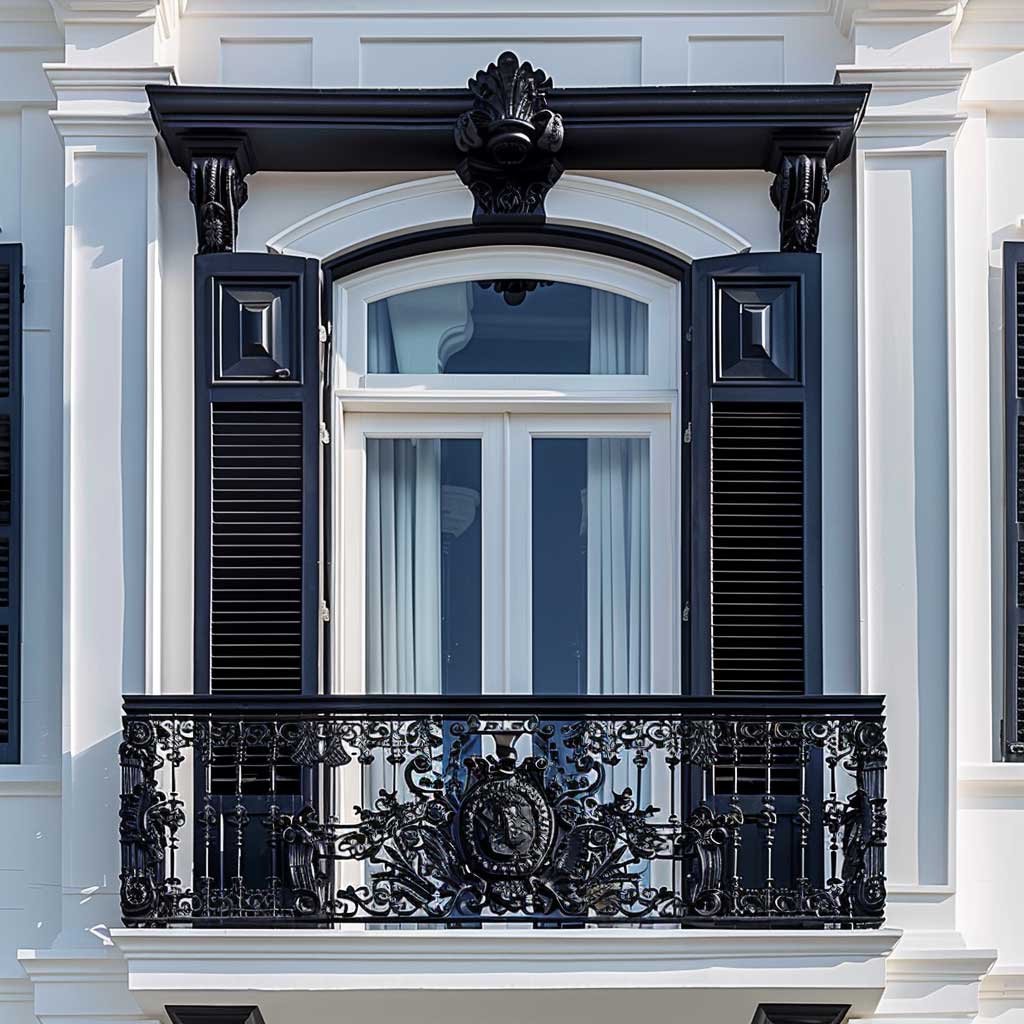
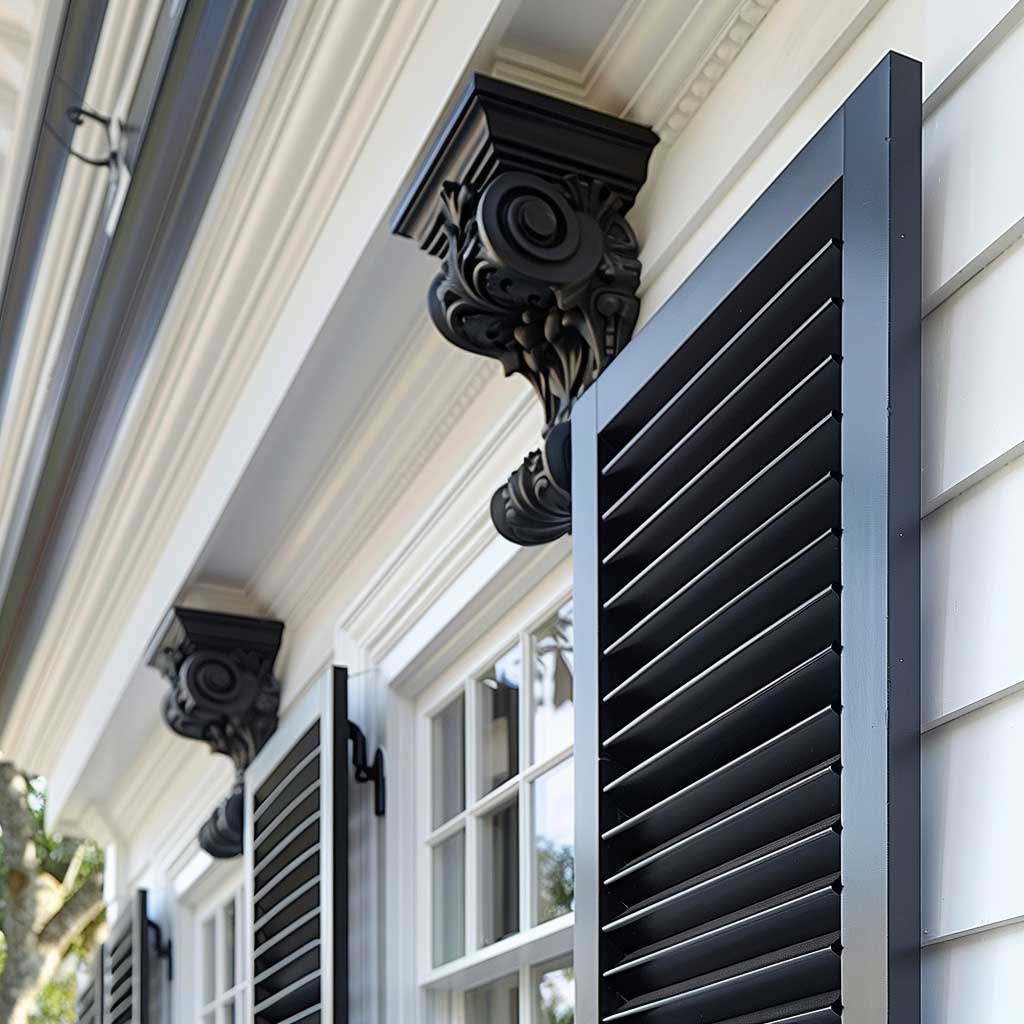

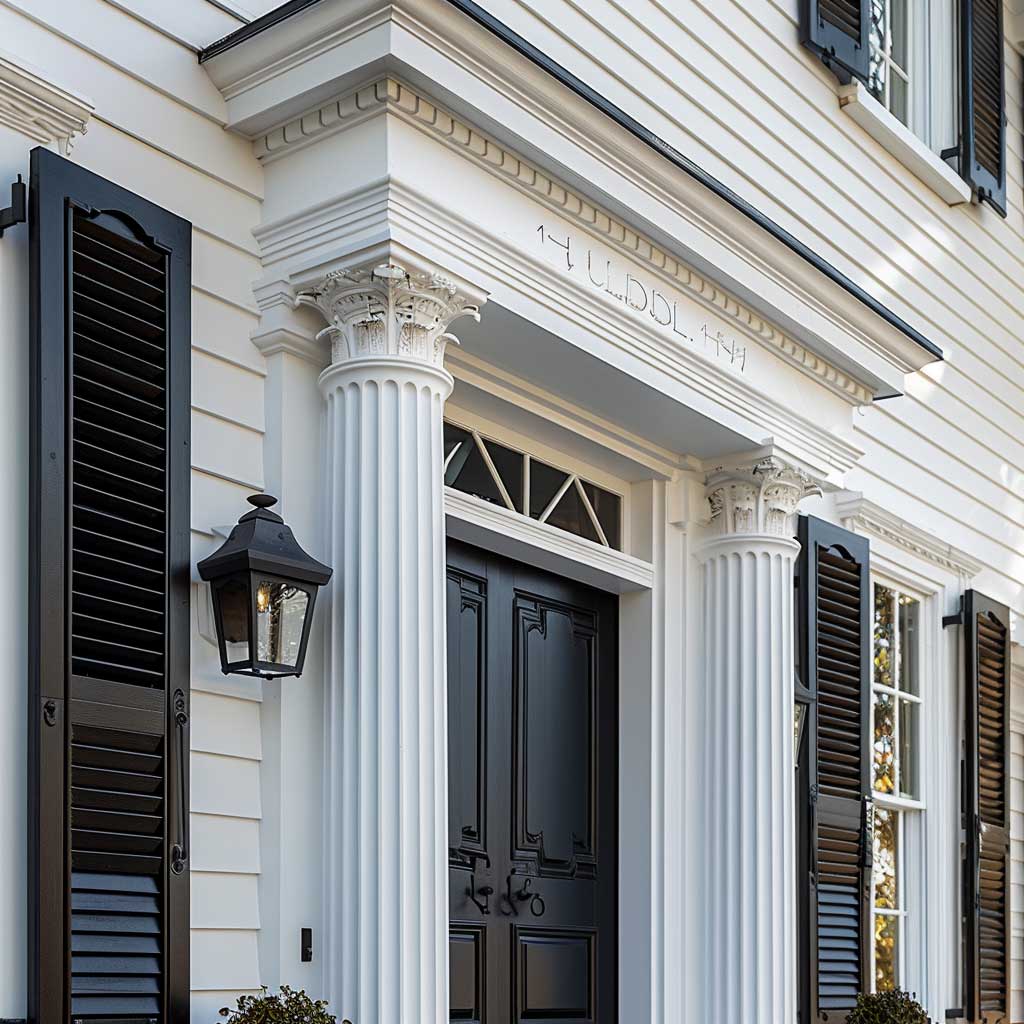
The sunlight variable is worth planning around rather than hoping for. Morning light softens the black accents and makes the whole facade feel warmer — almost gray at 7 AM. Midday sun punches the contrast to its maximum, where every carved detail pops. If your Victorian faces east or north, that morning light stays on the front face longest, which is actually a gift: the facade shows its most photogenic version during the hours it’s most likely to be seen. South-facing Victorian fronts are gorgeous but require UV-resistant 100% acrylic exterior paint to prevent the black from fading to charcoal within a few seasons.
Don’t paint Victorian shutters in a near-black like charcoal or dark gray when aiming for the black-and-white look. From the street, near-black reads as faded black — it looks like neglect, not restraint. Commit to a true black (LRV under 5) or don’t use black at all.
Don’t apply flat sheen to any black element on a Victorian exterior. The carved surfaces collect moisture and organic debris. Flat sheen holds it in. Satin minimum on body, semi-gloss on all trim and shutters — those sheen levels shed water and clean with a garden hose.
Monochrome Modern Wall Paint House Design — Black Windows, White Walls, Zero Filler
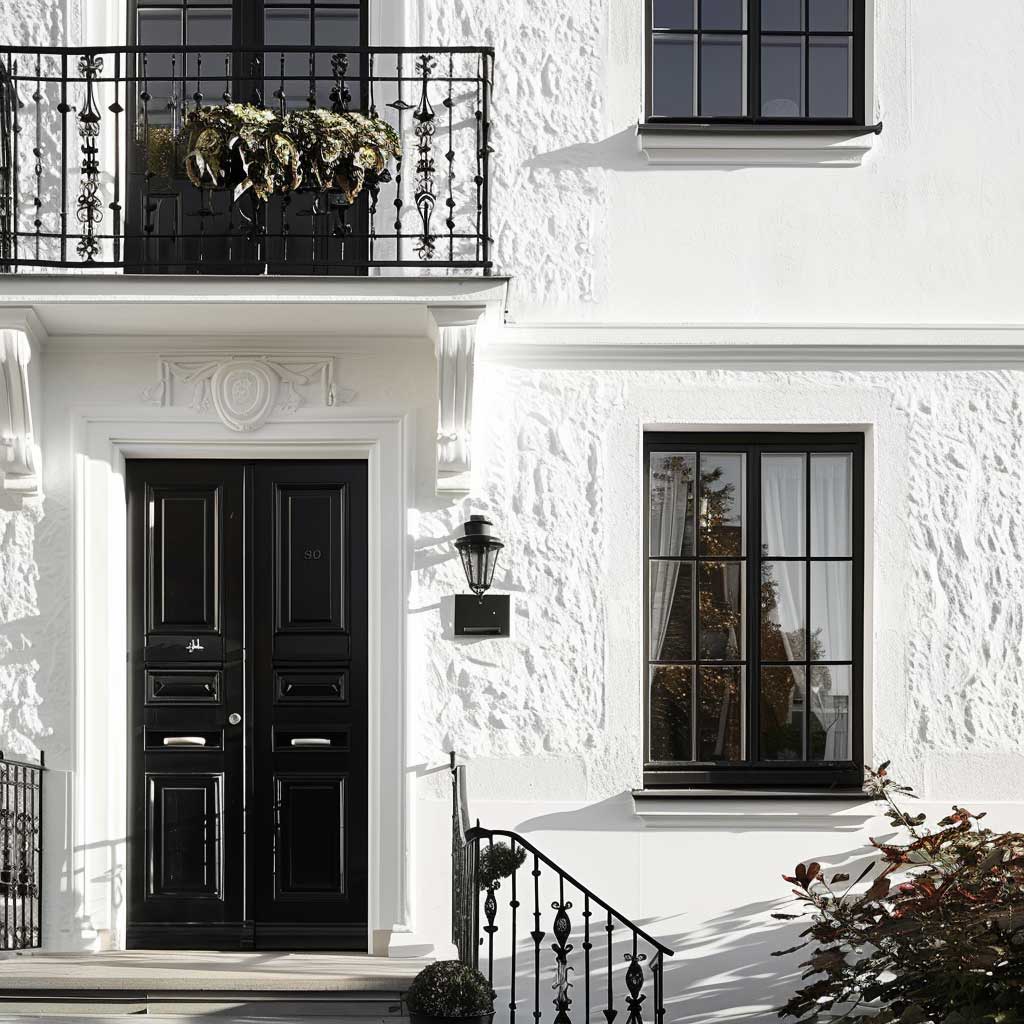
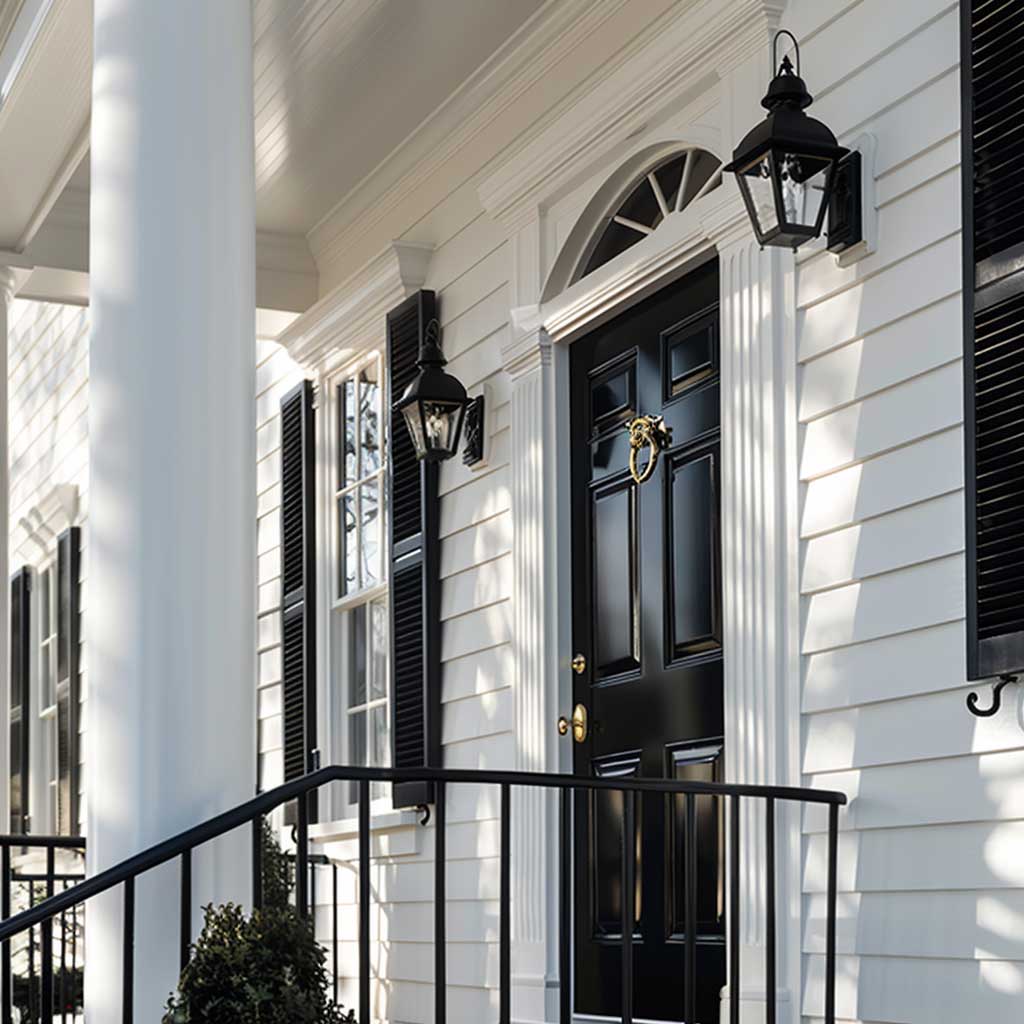
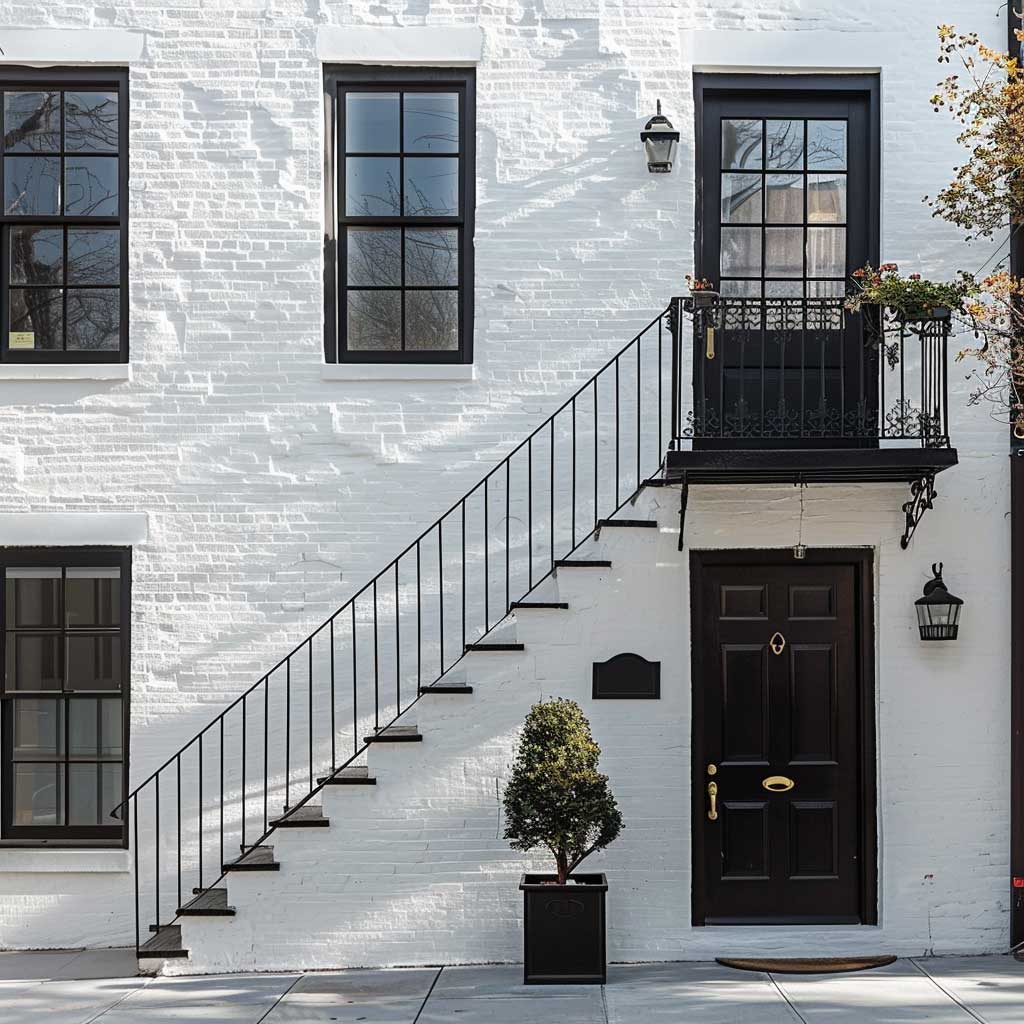
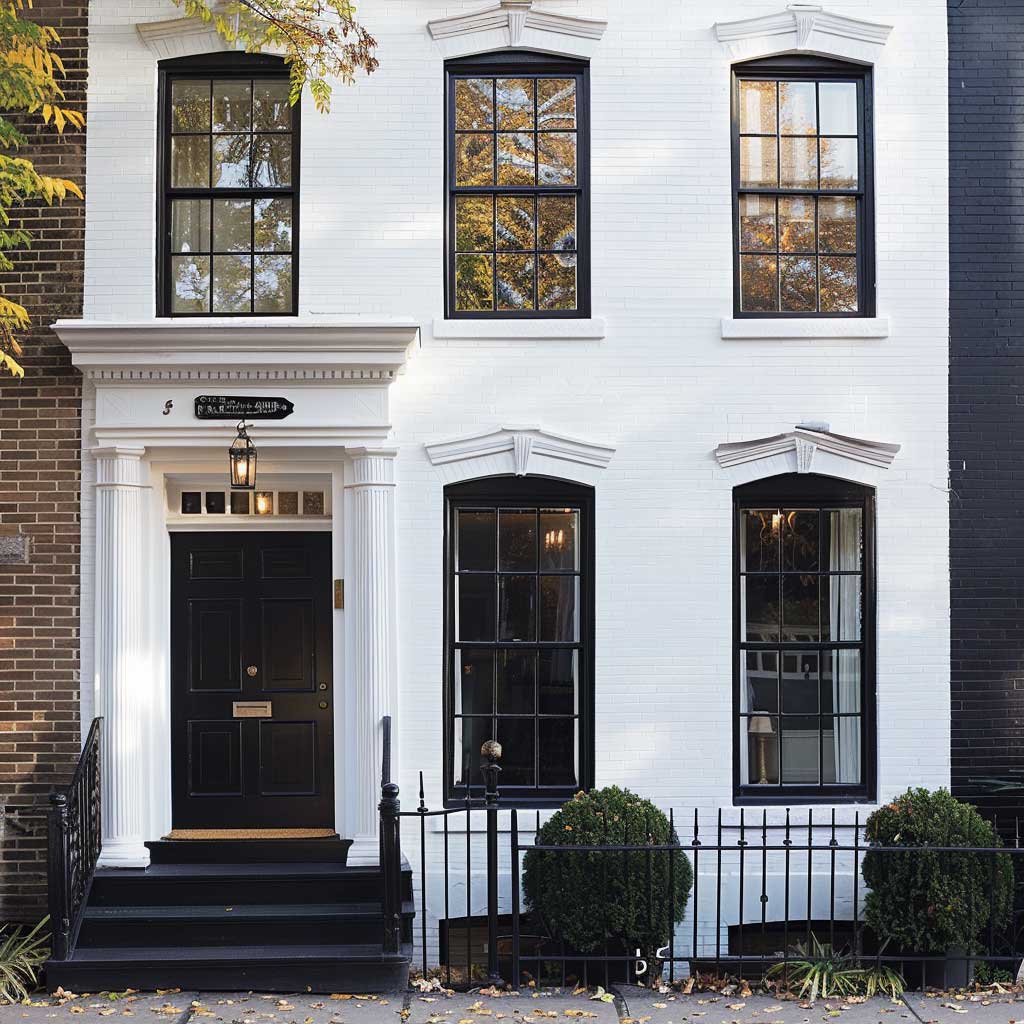
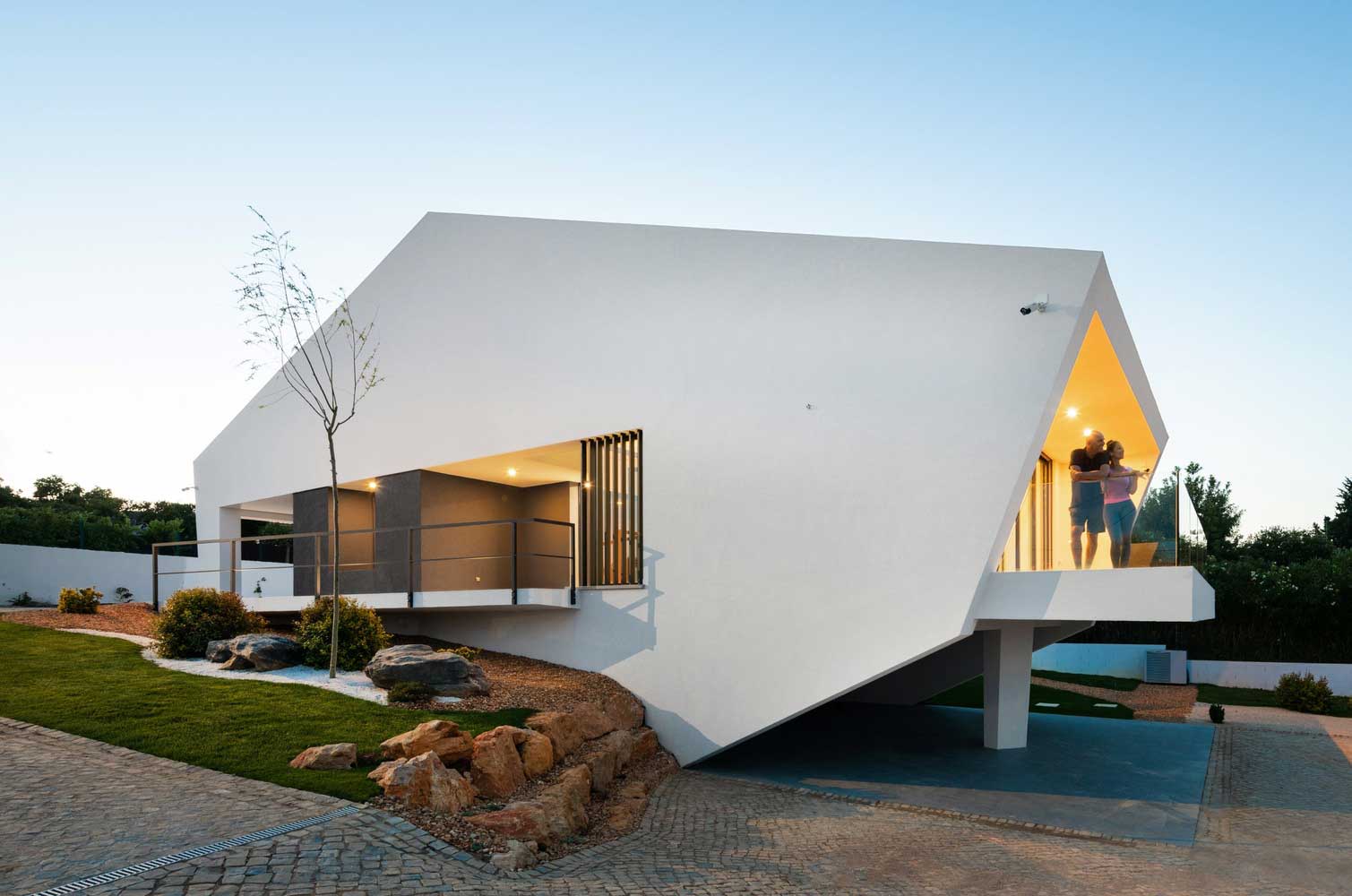
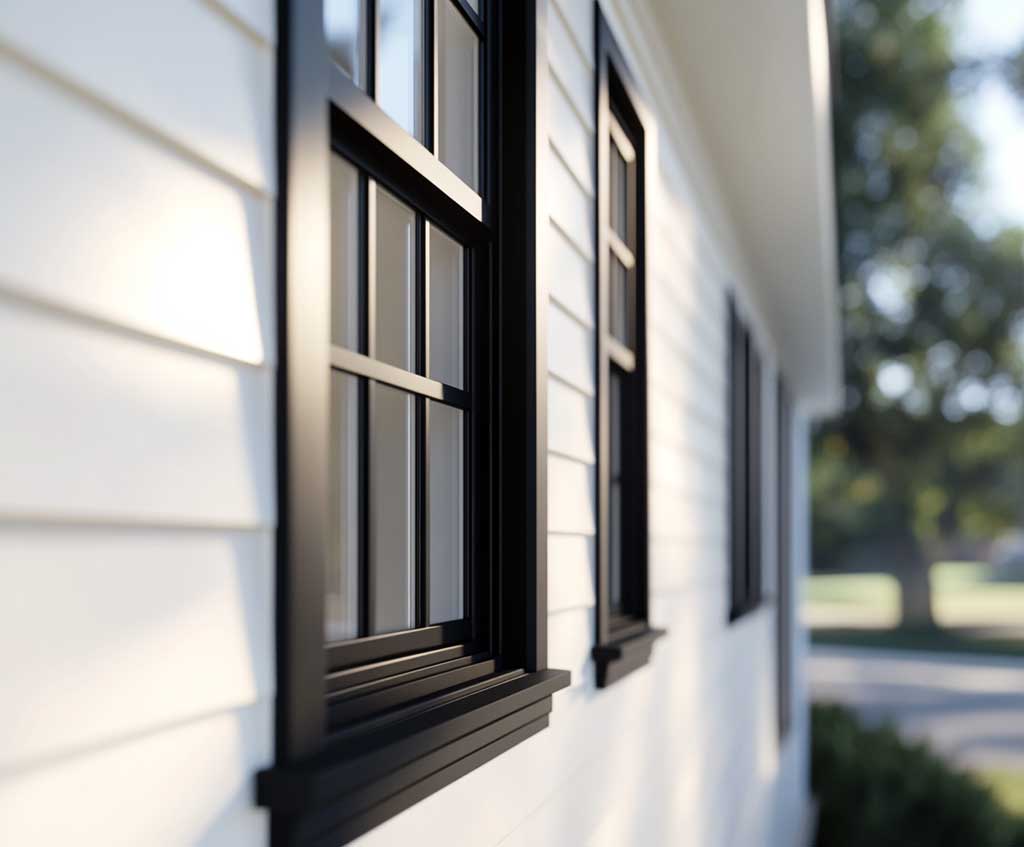
Modern monochrome wall paint on a house exterior concentrates all its contrast in two places: the front door and the window frames. The Vasco Lopes Arquitectos bureau demonstrated this approach on a published residential project where the white siding functions as negative space — it isn’t neutral so much as it’s deliberate emptiness. The black window frames and door become drawn lines on that empty canvas. No decorative shutters, no brackets, no moldings to compete. What remains is the house’s actual geometry, which either reads as confident or looks unfinished depending entirely on how clean those lines are.
Panoramic glazing accelerates this effect. Larger windows mean more black frame surface area, which means the contrast does proportionally more visual work. You’ll notice this in photographs: homes with standard 3×5 windows look tidy but mild in this palette, while homes with oversized windows become genuinely architectural. The black frames stop being trim and start reading as structural elements. Does that mean you need to replace your windows to pull off this look? No — but it does mean the scale of your frames matters, and painting them a heavier, deeper black rewards more than a thin layer of tinted caulk.
Exterior paint on white walls in this style needs to hold its brightness for years. White walls reflect up to eight times more UV than black, which means they don’t fade the same way — but they chalk and dirt-absorb. A 100% acrylic exterior paint in a satin finish is the recommendation from paint professionals in high-UV environments, and it’s a sound choice regardless of climate. One gallon covers 300–400 square feet per coat on smooth siding; factor two coats, add 10% for waste, and calculate accordingly. For a 2,000 square foot exterior body you’re looking at roughly 12–14 gallons for the white body alone before touching trim. See more on black and white house exterior design approaches for a deeper look at how architectural bureaus balance the proportion of black to white across different building footprints.
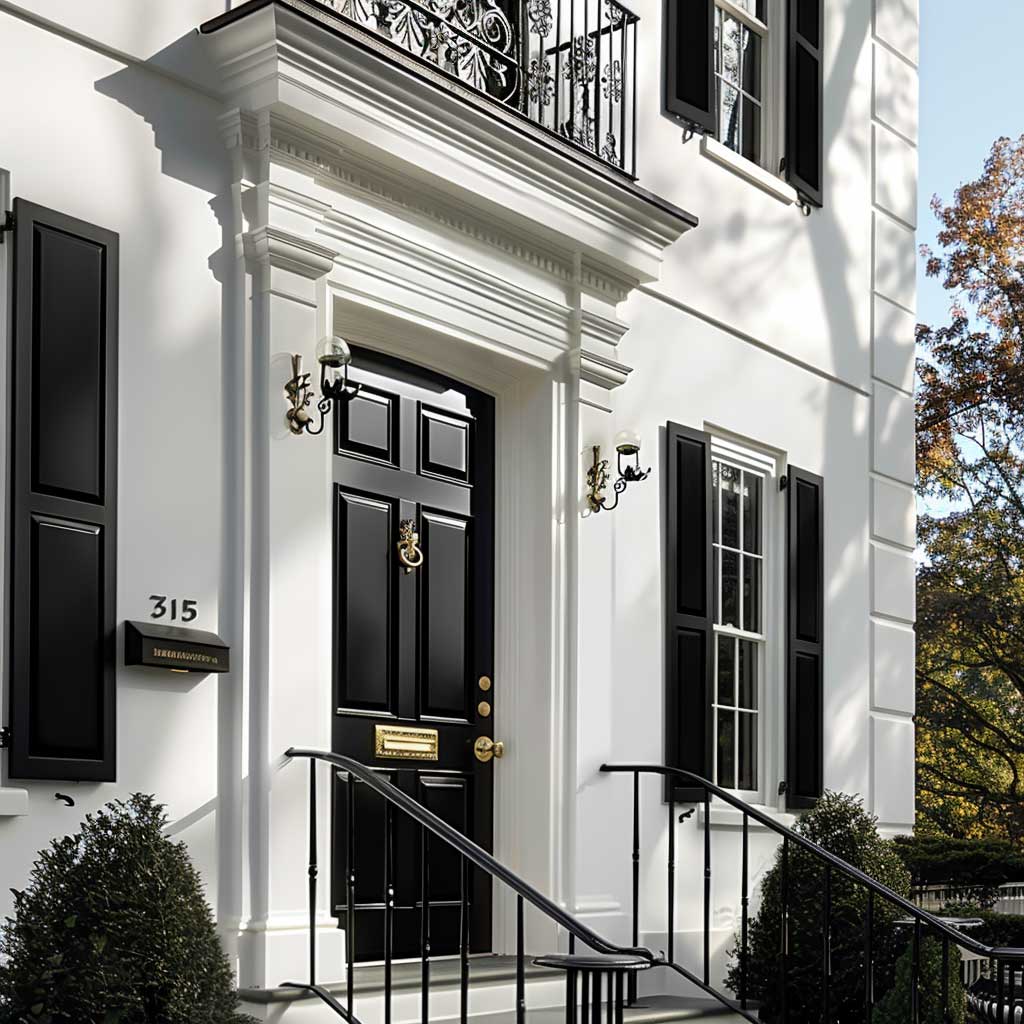
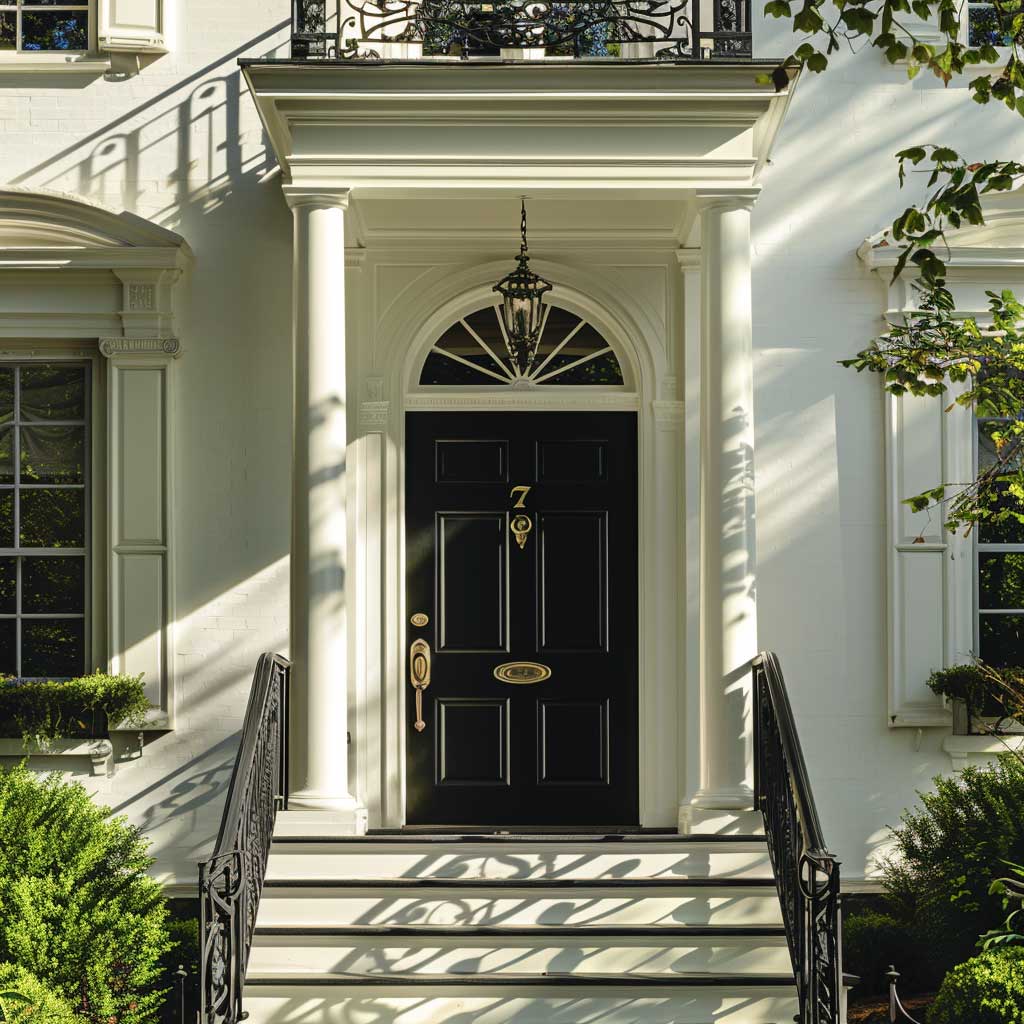
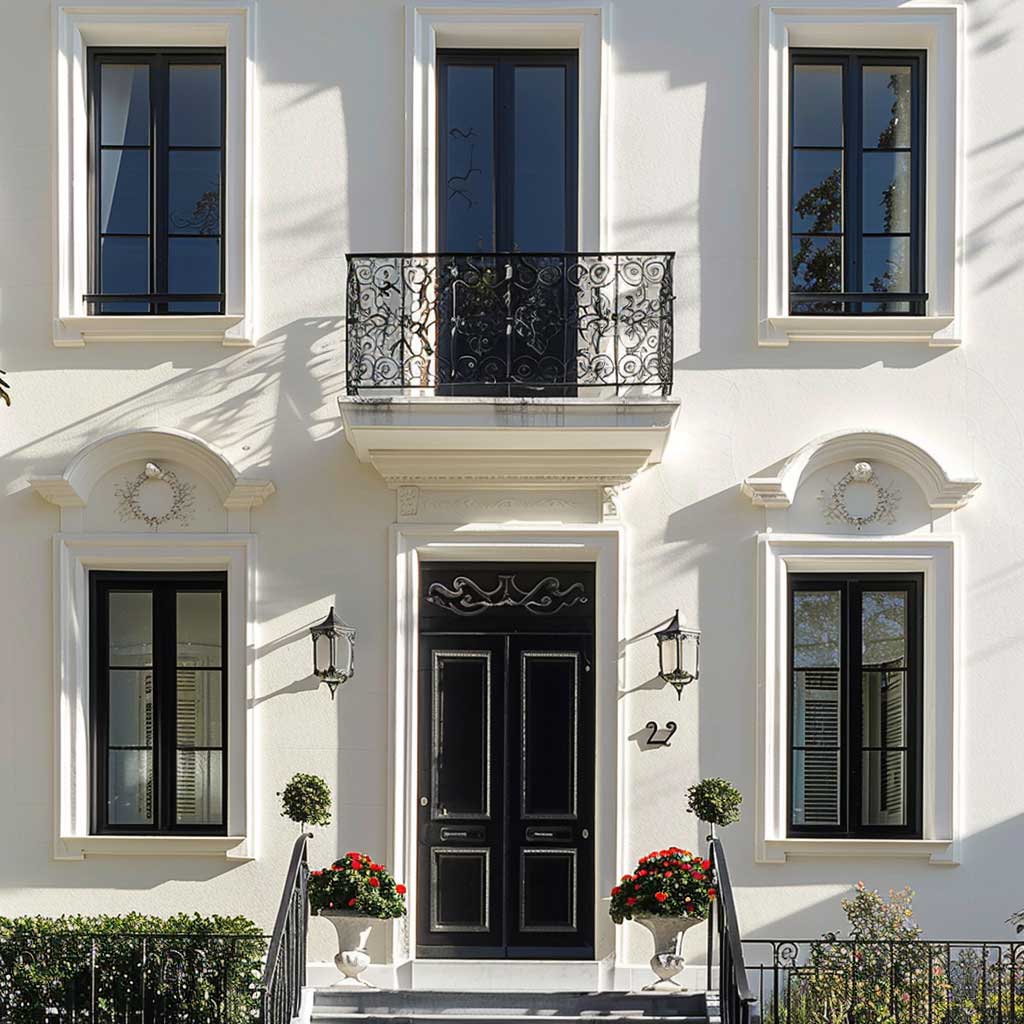
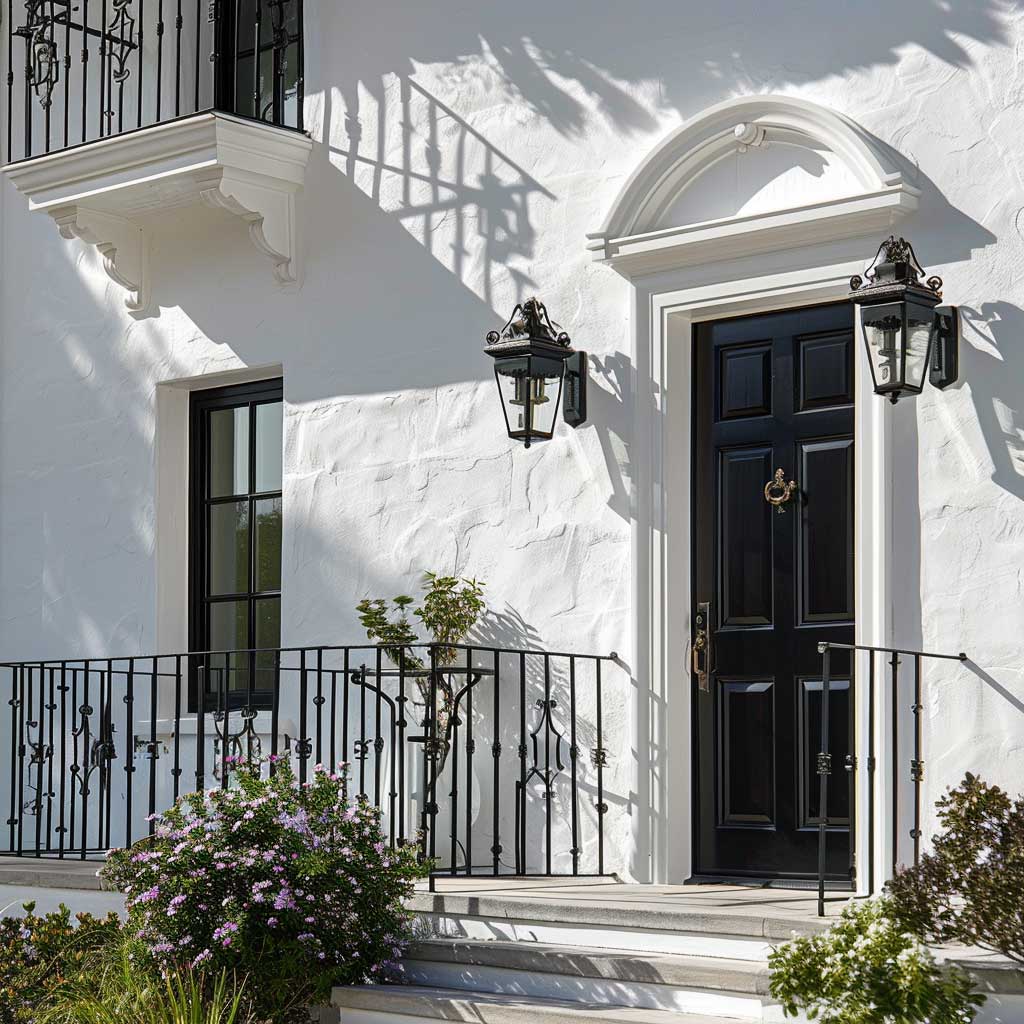
Lighting design is where modern monochrome exteriors separate from just-painted ones. Without the decorative detail of a Victorian facade, evening lighting has nothing to bounce off. Architectural lighting recessed into soffits or mounted at grade level aimed upward at the white walls solves this. The Vasco Lopes project specifically addressed this: black structural elements were lit from below so they didn’t disappear into the night sky, while the white walls became their own luminous surface. Skip the lighting plan and your carefully considered monochrome exterior reads as a dark rectangle after sunset.
The minimalist philosophy here carries a practical cost: imperfections are amplified. A Victorian facade hides minor surface irregularities behind ornament. A flat white wall with black window frames hides nothing. Surface prep — filling gaps, sanding rough patches, priming bare wood — matters more on this style than any other. A common approach is to prime the white body with a tinted primer close to the final white rather than a standard white primer; this gives the topcoat a better base and reduces the chance of uneven finish showing at oblique angles in afternoon light.
Colonial Heritage Black and White Exterior Paint — Geometric Blocking at the Corners


Colonial black and white exterior paint designs work on a different principle than Victorian or monochrome — the contrast lives in the structure itself, at corners and transitions, not primarily in the ornamental details. This Old House documents how white with black shutters remains the quintessential Colonial Revival palette specifically because the symmetrical Colonial facade turns contrast into rhythm: window, shutter, window, shutter, left to right, first floor to second. That rhythm is legible from a moving car. It requires no interpretation. A two-tone Colonial with one wall black and one wall white at a corner takes that rhythm and makes it spatial rather than flat.
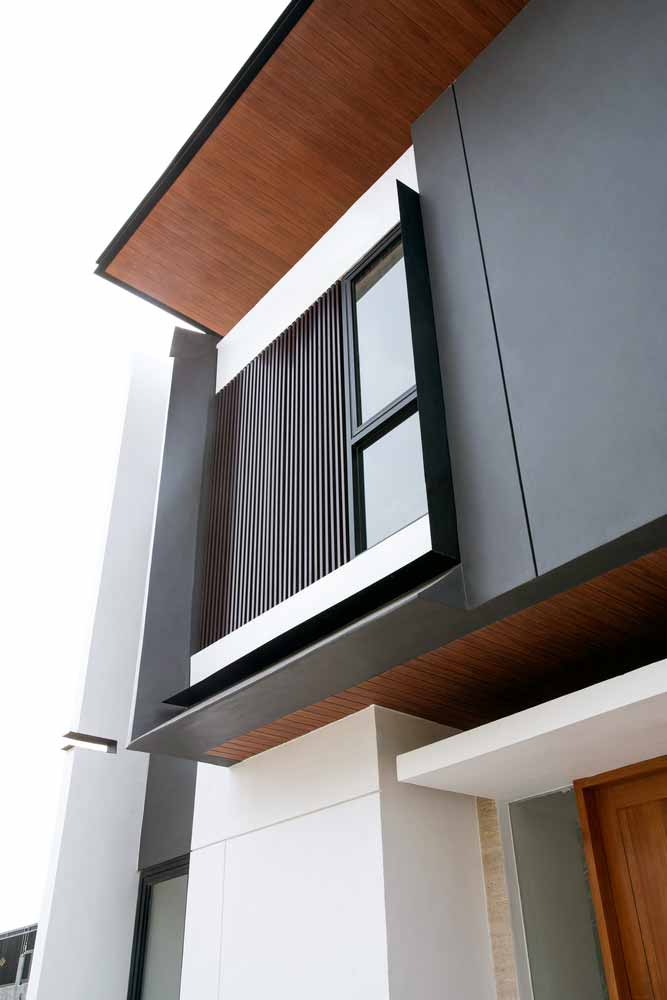
The geometric corner-blocking approach — one elevation painted black, the adjacent elevation white, meeting at the corner without a transition strip — is the most architectural use of black and white on a residential exterior. It operates like a folded piece of paper: one face lit, one face in shadow, the corner as a crease. The effect makes even a modest two-story look like it was designed with intention. For Colonial Revival homes with clapboard siding, stylists recommend keeping the black elevation to a secondary-exposure wall (side or rear) rather than the street-facing primary, partly for UV management on dark paint and partly to preserve the symmetrical reading of the main facade.
Wood siding on a Colonial exterior needs repainting every 3–7 years according to Angi, which is faster than most homeowners expect. Black paint on wood accelerates the upper end of that range on sun-exposed elevations because the surface temperature under direct afternoon sun can climb significantly above ambient air temperature, stressing the paint film and the substrate. The practical recommendation: use a premium-line exterior paint on black elevations. Sherwin-Williams SuperPaint exterior runs around $70 per gallon; Emerald runs around $93.99 per gallon and carries better UV resistance — the price difference is recoverable if it buys you two extra years before repainting a black wall. This Old House’s Colonial Revival color guide covers how different trim configurations respond to black-and-white palettes across multiple architectural sub-types, and is worth reading before deciding where your black stops and your white begins.

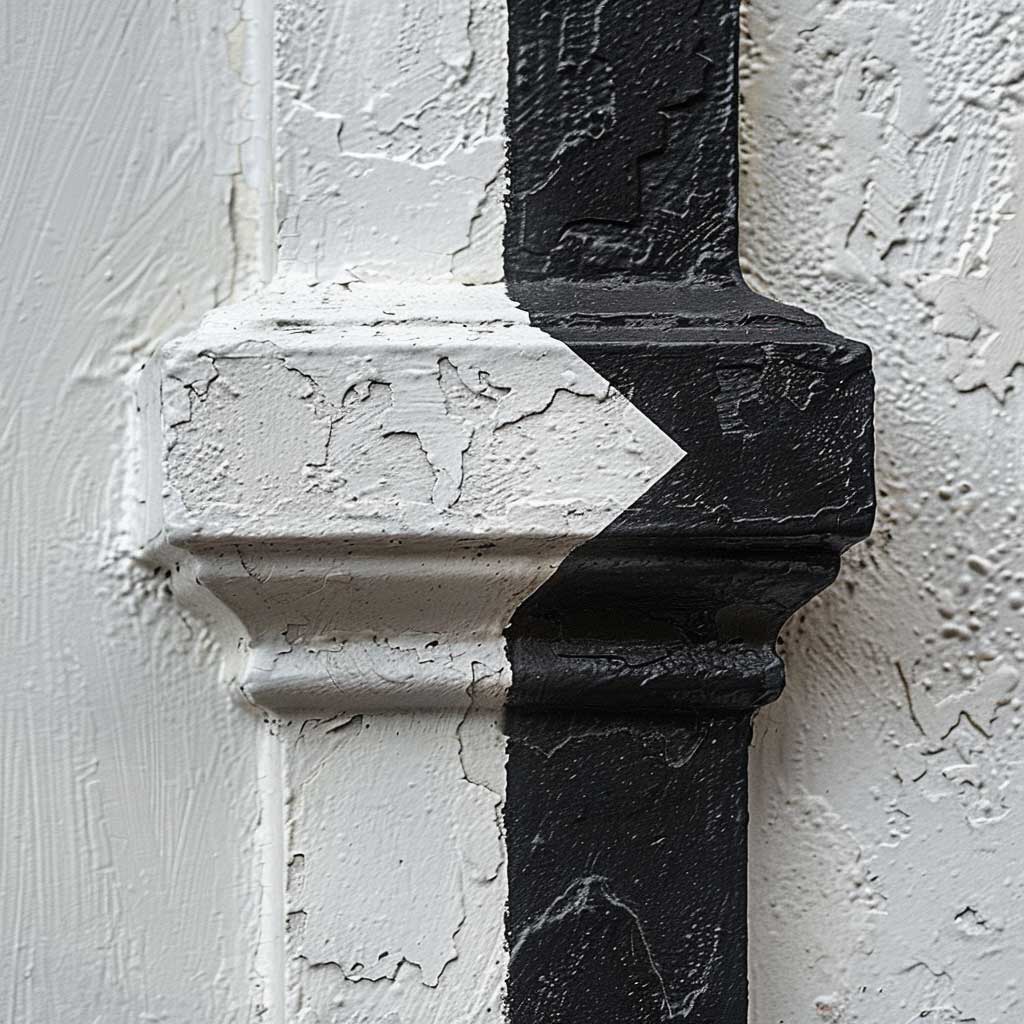


Geometric patterns within the black-and-white Colonial framework — a black half-wall on the garage elevation, a white painted brick chimney against a black board-and-batten section — sharpen the contrast rather than complicating it. The white surfaces reflect the full daylight spectrum and shift from warm cream at dawn to near-blue-white at noon; the black areas give the eye an anchor point and prevent the all-white reading from going clinical. That interplay is worth planning by walking around the house at different times of day before committing to which surfaces go which color. What looks like an elegant pairing at 8 AM can look stark and institutional at 1 PM if the proportions are wrong. For more on how classic exterior wall paint color combinations balance dark and light across different architectural volumes, the detailed breakdowns there are practical rather than abstract.
Corner detailing is where Colonial black-and-white most often fails when executed without care. The most common version of this mistake is painting the corner boards the same color as the siding they adjoin — the result is a blurry, unresolved edge at precisely the most visible joint on the house. A sharp corner reads as designed. Try this: paint corner boards in the contrasting color regardless of which siding color they’re adjacent to. Black corner boards on a white elevation, white corner boards on a black elevation. The house suddenly has an edge, a frame, a boundary. It costs nothing extra and looks like an architect specified it.
| Style | Primary Black Element | Maintenance Cycle | Key Risk |
|---|---|---|---|
| Victorian | Shutters + wrought iron | 7–10 yrs (moderate climate) | Flat sheen on carved surfaces |
| Modern Monochrome | Window frames + front door | 7–10 yrs body; 5–7 yrs black frames | Surface imperfections amplified |
| Colonial Geometric | Corner blocking + shutters | 3–7 yrs (wood siding) | Black on south-facing wood degrades faster |
Bottom Line
Black and white exterior wall paint designs work when the contrast has a job — not when it’s decoration.
Victorian: give black to the shutters and iron, white to everything else. Sherwin-Williams Tricorn Black at $80–$90/gal is the right neutral — no blue, no brown undertone to chase.
Monochrome minimalist: black window frames and front door only, white as deliberate emptiness. Surface prep is non-negotiable. Add exterior lighting or the whole scheme disappears at dusk.
Colonial geometric: rhythm and corner crispness matter more than drama. Paint corner boards in the contrasting color on both elevations. Use premium-line paint on black elevations — the extra $20/gal is recoverable against the repaint cost it delays.
Save this post before you order samples — the sheen and UV notes are the part most homeowners find out too late.