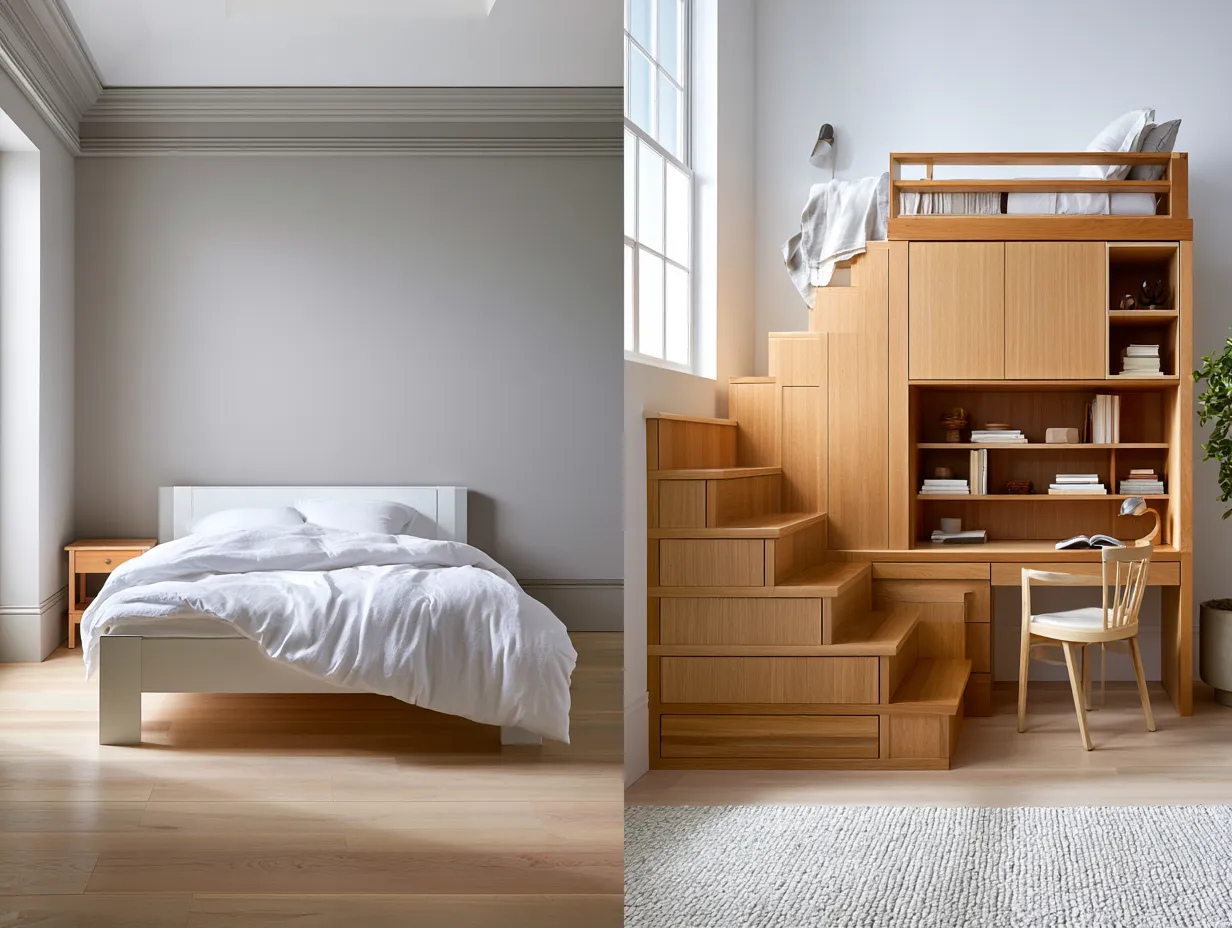
Modern farmhouse window treatments fix the one thing most rooms get wrong at the window — the gap between wanting warmth and ending up with something that looks like it came from a hotel lobby. I’ve replaced curtains three times in my own living room before landing on a combination that actually worked, and the common thread in every failed attempt was ignoring texture. Barn wood shutters at $180–$320 per panel from brands like Rustica Hardware, white linen panels from Pottery Barn’s Emery line at $79–$139 each, layered bamboo blinds from Smith & Noble starting around $95 — these are not interchangeable, and choosing wrong costs you more than the price tag. The farmhouse window isn’t just a light-control decision. It’s the room’s first signal about what everything else will feel like.
You’ll notice something counterintuitive once you start looking at these seriously: the treatments that photograph best are rarely the ones that live best. Sheer linen panels glow in morning light and wilt in afternoon sun. Bamboo blinds that look rich and layered in a styled shoot can feel sparse in a north-facing bedroom. The rustic farmhouse window treatment ideas that actually hold up over time share one quality — they were chosen for how they age, not how they look on day one.
Quick Scan — What This Post Covers
- Barn wood shutters — reclaimed vs. faux, and why the difference shows immediately
- White linen curtains — the weight and header style that makes or breaks the look
- Bamboo blinds layered with fabric — how to get the proportion right
- Roman shades for modern farmhouse living rooms and bedrooms — fabric rules
- Rustic window treatment ideas for bedrooms specifically — light control without blocking texture
- What to avoid in every category (the honest version)
- FAQ covering blinds, shades, and country-style treatments
Reclaimed Wood Shutters Look Better at Year Three Than Day One
Barn wood shutters made from genuinely reclaimed material — salvaged from old structures, not pressure-treated pine with a gray stain applied over it — carry a surface variation you cannot fake. My go-to source is Rustica Hardware, where their Barn Shutter panels run $180–$320 depending on size, and the grain variation between panels is visible but not jarring. You’ll notice the knots read differently across different pieces of wood, which is the point. That variation is the texture that makes a farmhouse living room look like it was assembled by someone with taste rather than assembled by a big-box store.
Functionally, these shutters give you something most curtains can’t: precise slat control that doesn’t require you to move the entire panel. Tilt the slats for morning light, close them completely for afternoon privacy, leave them open at night if you have a view worth keeping. I’ve had clients assume reclaimed shutters would be high-maintenance. Wrong. They need nothing except an occasional dry cloth.


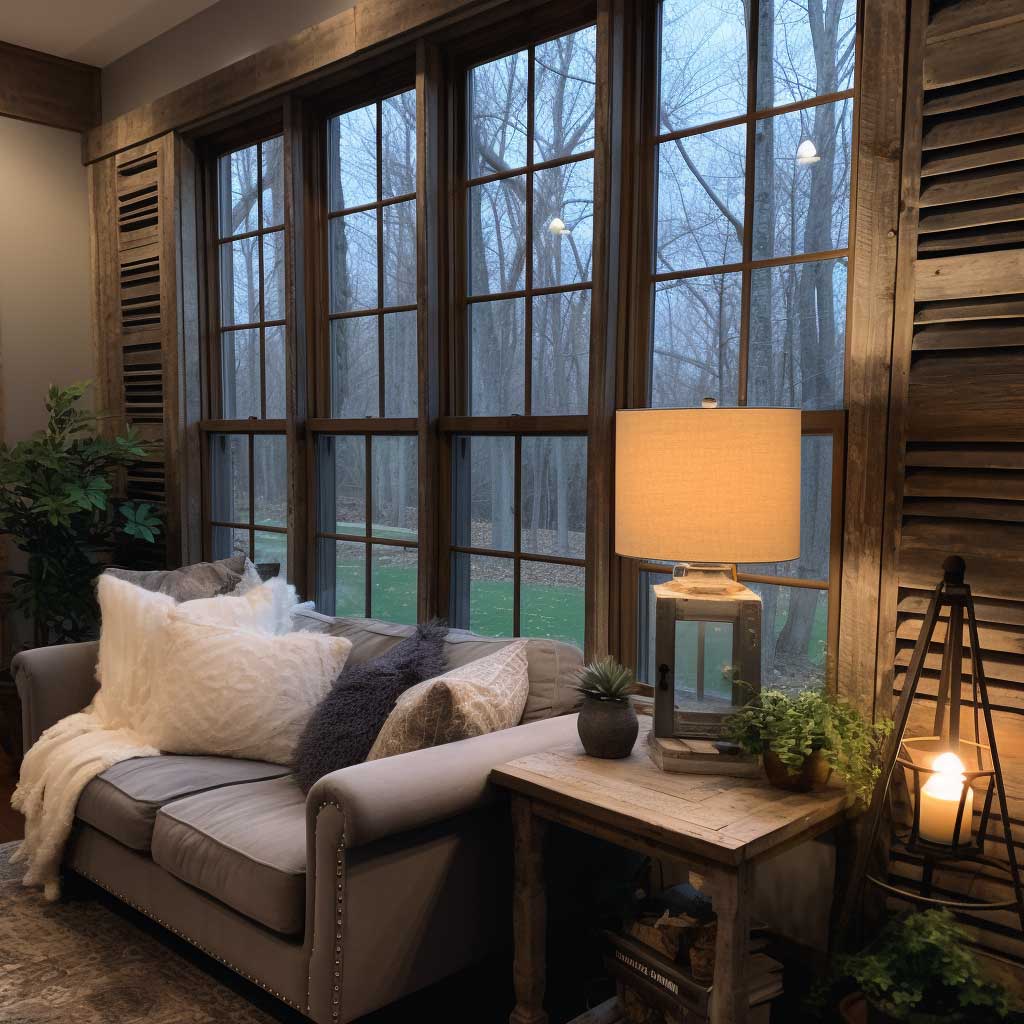


The version you want to skip is the MDF shutter with a faux-distressed finish. I bought a pair for a rental property once at $60 per panel and they looked fine in photos — in person, the grain was a repeat pattern stamped into the surface. Sunlight killed the illusion inside of three months. Spend the money on the real thing or use a different treatment entirely.
Reclaimed shutters work especially well as farmhouse bedroom window treatments, where you want a surface with weight and story without adding visual bulk. Think of them like denim — not precious, not disposable, just good material that gets better with use. Pair them with a simple white roller shade behind the shutter panel if you need true blackout, and you have a layered system that costs less than a custom Roman shade order.
Don’t Do This with Barn Wood Shutters
Don’t paint them white. The entire value of reclaimed wood shutters is the material story — paint erases that in one coat and turns a $280 artisan panel into something that looks like it came from a builder-grade new construction. If you want a white shutter, buy a PVC shutter at $40 and save the reclaimed wood for something that shows it off.
White Linen Panels — Weight and Header Are the Two Variables That Actually Matter
Pottery Barn’s Emery Linen Curtain in white runs $79–$139 per panel depending on length, and it’s the reference point I give people when they ask what a properly weighted farmhouse curtain should feel like. The fabric is heavy enough to hang without pooling awkwardly but light enough to move in a breeze if you leave the window cracked. That weight — around 280 GSM — is the number you want to remember. Anything lighter looks like a bedsheet. Anything heavier starts reading as formal rather than relaxed.
Header style changes everything. Rod pocket headers give you that soft, gathered look at the top, which reads more cottage than modern farmhouse. For a cleaner line, I stole this trick from a designer friend: use a grommet header with an iron or brass rod, and let the panels hang with a half-inch of puddle at the bottom. The grommets create a slight ripple pattern down the panel length. It costs nothing extra but looks like a decision was made rather than a curtain was hung.


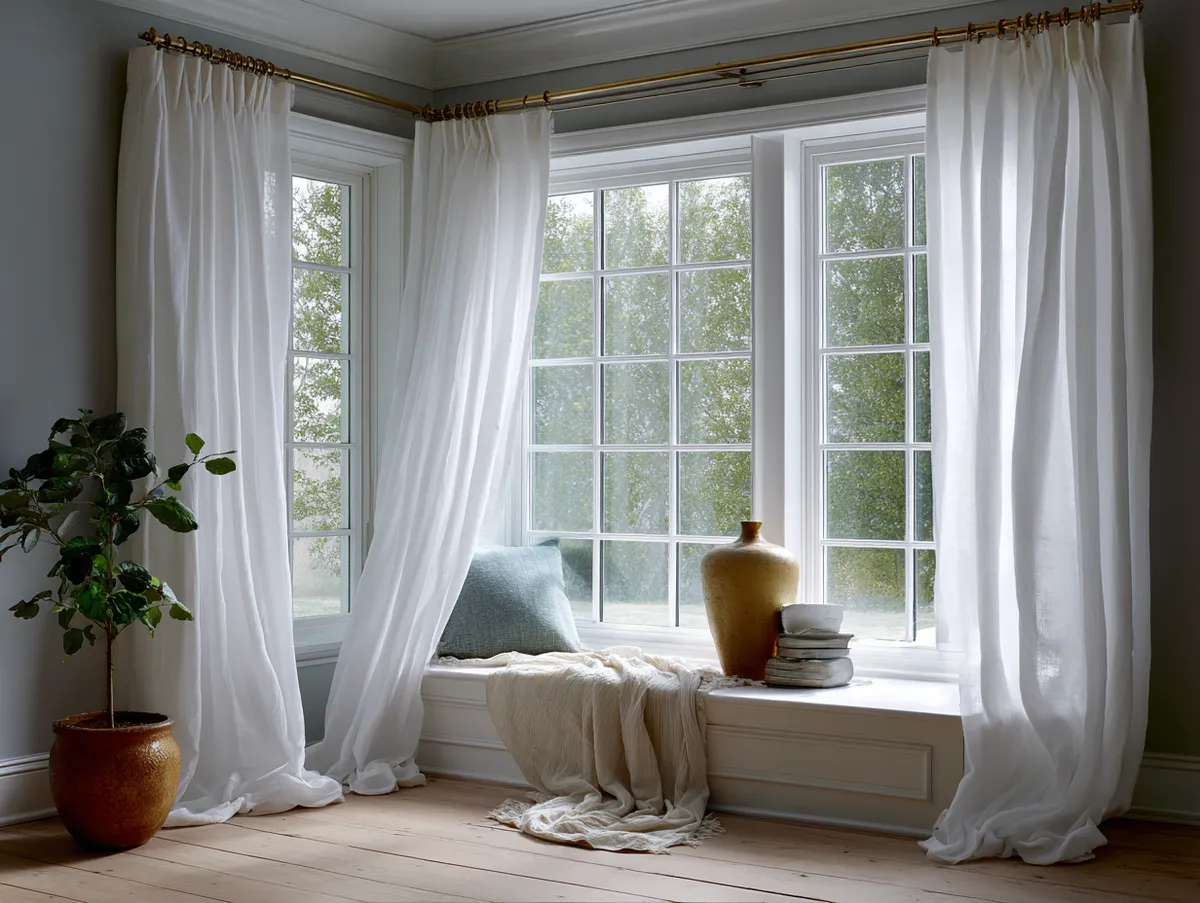


Hang the rod four to six inches above the window frame, not flush against it. This is the single most impactful thing you can do for a farmhouse living room window — it adds visual height without any structural change and makes an 8-foot ceiling read like 9. I’ve done this in three different homes now. It works every single time. White linen curtains used this way also layer naturally with farmhouse bedroom decor that leans into natural textiles and light-colored wood.
What you want to avoid: polyester panels marketed as “linen-look.” You can feel the difference in the store, and you’ll see it within a season. Polyester holds static, wrinkles differently, and loses its shape after two washes. Linen wrinkles too — but those wrinkles read as intentional in a farmhouse context. The polyester version just looks tired.
Bamboo Blinds Layered with Fabric — Getting the Proportion Right
Smith & Noble’s Woven Wood Shades start around $95 for standard sizes and give you the natural material variation that makes layered farmhouse window treatments look expensive rather than assembled. The bamboo or woven grass surface casts a pattern of shadows on the floor and wall throughout the day — think of it like a slow-moving piece of wall art that costs less than a framed print. Layering a fabric panel over this base is where most people miscalculate proportion.
The fabric panel width needs to be 1.5 to 2 times the window width to read as intentional. Anything narrower looks like you ran out of material. I own two of these setups — one in my living room with a natural flax panel over a jute blind, one in a reading nook with a cream linen panel over a bamboo shade — and the window width is 42 inches in both. Each panel is 60 inches wide. That’s the number that creates the soft stack when the panels are open and the full coverage when they’re closed.
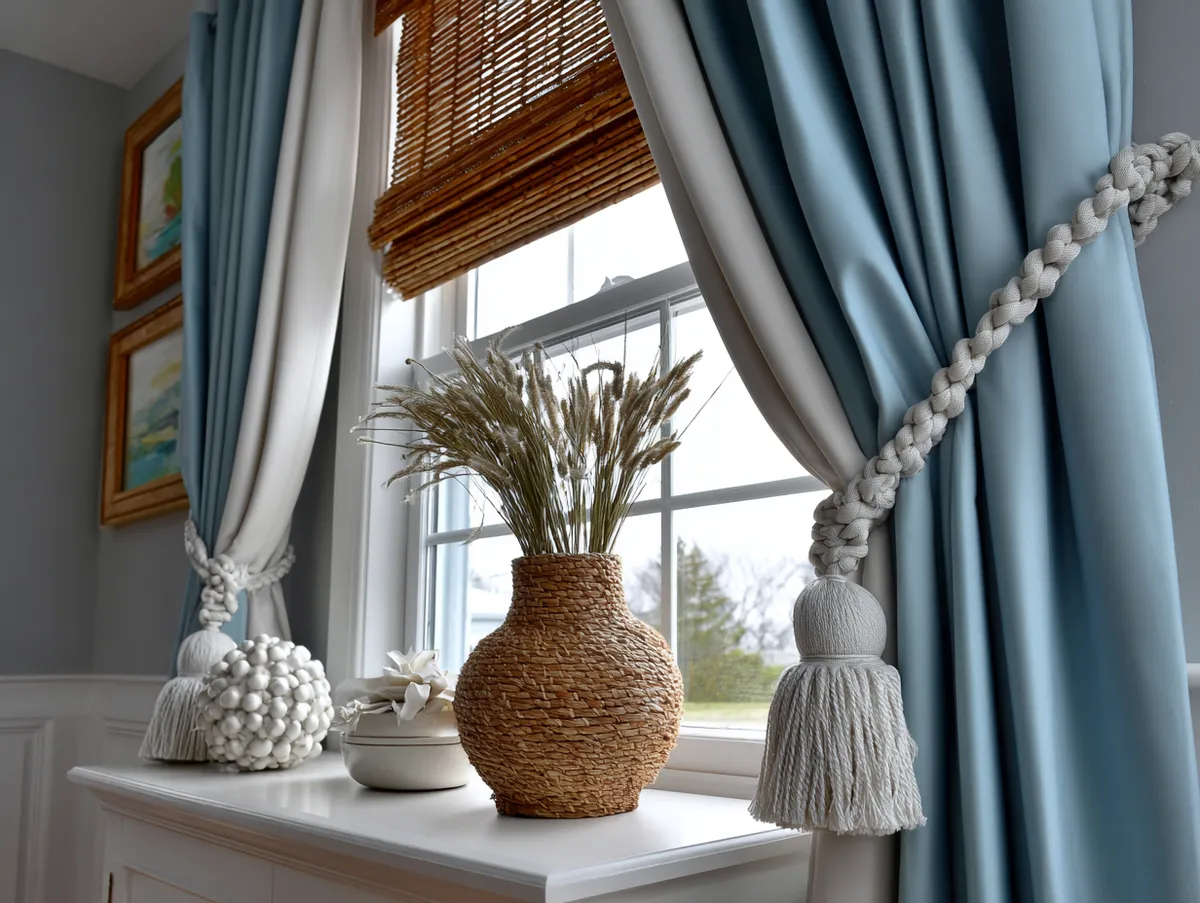


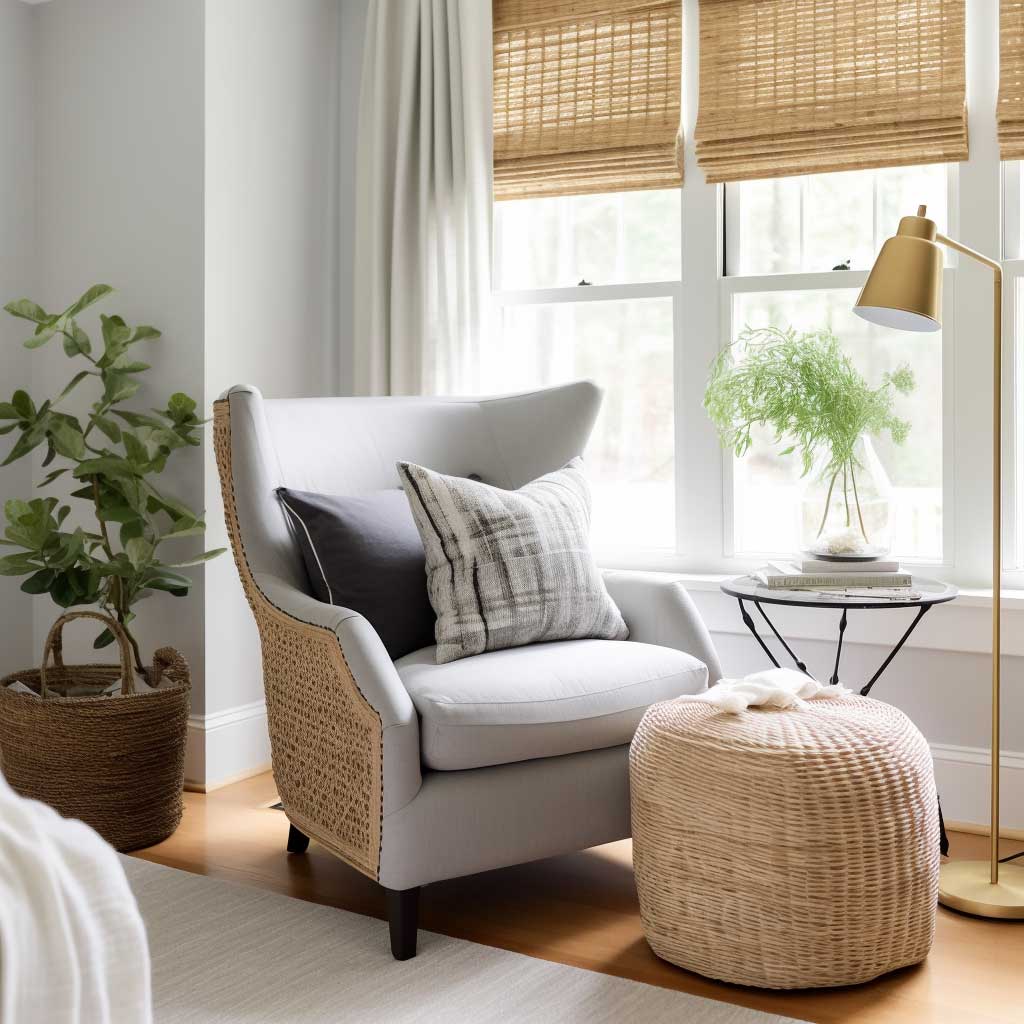

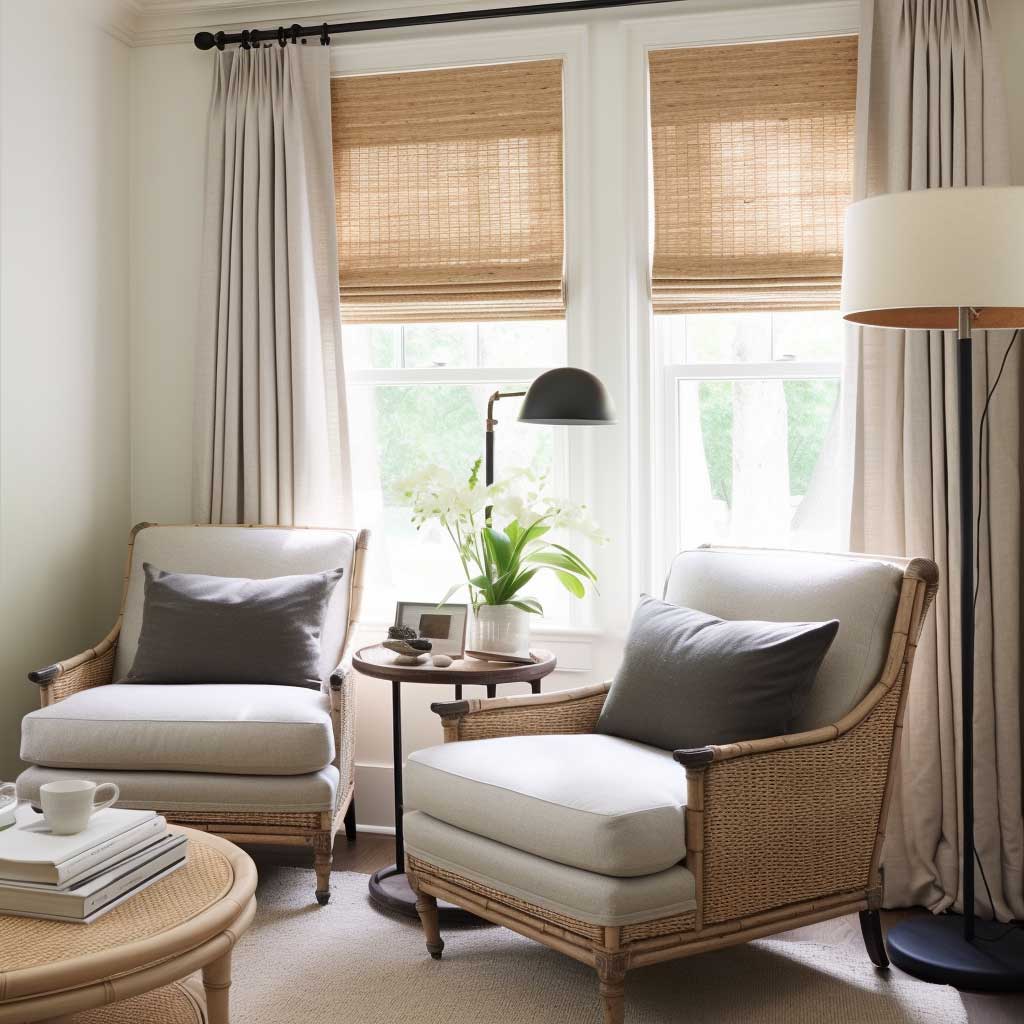

Does color matter here? Yes, but not in the direction most people assume. The bamboo should be warmer — honey, natural, or wheat tones. The fabric panel should be cooler or more neutral — white, cream, or a greyed linen. That contrast between warm texture and cool fabric is what creates depth. Matching the tones to each other flattens the effect and you end up with something that looks like a single-layer treatment that got complicated for no reason.
For farmhouse kitchen window treatments, this layered bamboo approach is actually less practical than it reads. Kitchens need easy cleaning and quick light adjustments. In a kitchen, a single woven wood shade without a fabric overlay is the cleaner call — you get the texture without the maintenance of a fabric panel that absorbs cooking smells. Save the layered look for living rooms and bedrooms.
Roman Shades in a Farmhouse Room — Fabric Choice Overrides Everything Else
Roman shades are the most misused modern farmhouse window treatment. They look controlled and deliberate — which is exactly what makes them farmhouse-wrong when the fabric is synthetic or patterned too heavily. The flat Roman shade from The Shade Store in a natural linen or cotton-linen blend starts around $119 for standard sizes. That’s the version worth considering. A relaxed Roman shade in the same fabric costs slightly more and gives you a soft swoop at the bottom hem that reads as more casual — better fit for a farmhouse bedroom or breakfast nook than a formal living room.
What I’ve bought and returned: Roman shades in a bold buffalo check pattern. The geometry of the check fights with the organic nature of the farmhouse aesthetic. Stripes work. Solid naturals work. Anything with a tight geometric repeat looks like a different design language was imported from a different room. Stick with solid, textured, or very subtle woven patterns.
Roman shades for modern farmhouse living rooms should be mounted inside the window frame for a clean, built-in look when the window trim is substantial — at least 2.5 inches wide on all sides. Narrower trim reads as cheap with an inside mount. In that case, go outside mount and add 2 inches to each side of the window width. You’ll cover the trim gap and the shade will look like it was always there. Roman shades pair naturally with layered rustic farmhouse window treatments — a single shade behind an open linen panel gives you the layered look without the complexity of managing two separate hardware systems.
For more context on pairing these shades with complementary materials across different farmhouse rooms, The Shade Store’s breakdown of farmhouse window treatments by room type is worth the read — their style guide is specific about which shade style works in transitional versus traditional farmhouse settings.
Modern Farmhouse Window Treatment Comparison
| Treatment | Best Room | Starting Price | Light Control | Farmhouse Fit |
|---|---|---|---|---|
| Barn Wood Shutters | Living room, bedroom | $180/panel | Excellent (slat control) | Strong — rustic material story |
| White Linen Curtains | Any room | $79/panel (Pottery Barn) | Light filtering only | Strong — natural texture, soft |
| Bamboo/Woven Shades | Living room, dining | $95 (Smith & Noble) | Good (raise/lower only) | Excellent — organic texture |
| Roman Shades (flat) | Bedroom, nook | $119 (Shade Store) | Good with blackout liner | Good if fabric is natural |
| Layered Bamboo + Curtain | Living room, bedroom | $170–$240 combined | Excellent (two layers) | Excellent — texture depth |
Farmhouse Bedroom Windows — Light Control Without Blocking the Texture
Farmhouse bedroom window treatments sit in a harder category than living room options because they need to do two contradictory things at once: block light sufficiently for sleep while keeping the surface material visible during the day. The solution isn’t a single heavy treatment — it’s a dual-layer setup where each layer has a job. I use a simple white cellular shade on the window frame itself for blackout, then hang a woven grass shade or a linen panel on the outer rod for the visual texture you see when the blackout is raised.
Budget matters in a bedroom because you’re covering less square footage than a living room but sleeping with the decision every night. Hunter Douglas Applause cellular shades in alabaster start around $140 per window and fit any standard farmhouse window size. Pair those with a $95 Smith & Noble woven shade or a single linen panel from IKEA’s AINA line at $29.99 per panel, and you have a layered farmhouse bedroom window for under $200 total. Not $200 per panel — $200 total. That’s the number I give people who think this style requires a decorator budget.
What kills the farmhouse bedroom window look fastest? Blackout curtains in a deep color. I understand the impulse — you want sleep, not style — but a navy or charcoal blackout panel pulls focus away from every other surface in the room. The room starts reading as a color choice rather than a material choice, and that’s the wrong emphasis for a farmhouse aesthetic. Keep the outer layer light. Do the blackout work invisibly, with a cellular shade tucked inside the frame where no one sees it at all.
Country Style and Rustic Window Treatments — Where the Modern Farmhouse Line Sits
Country style window treatments and modern farmhouse window treatments share materials but differ in execution. Country goes ruffled, gathered, and pattern-heavy — think red and white gingham cafe curtains at the half-window, the kind you’d find in a 1985 farmhouse kitchen. Modern farmhouse uses the same linen and wood materials but strips out the fussiness. No ruffles. No tie-back bows with ribbons. No decorative tassels on the rod ends unless you’re going for a very specific look and you know exactly what you’re doing.
Rustic window treatment ideas sit between these two poles. They accept more imperfection than modern farmhouse — a slightly uneven hem, a curtain that’s not perfectly pressed, a blind with visible cordage — but they don’t go as far into the crafty territory as pure country style. If you’re working in a space with exposed beams, shiplap, or reclaimed wood floors, rustic treatments are usually the better match than polished modern farmhouse options. The room is already doing the work. The window just needs to not fight it.
Woven jute or burlap Roman shades — around $60–$90 from sources like Wayfair’s Willa Arlo line — land squarely in rustic territory without tipping into country kitsch. What makes them work is the same thing that makes barn wood shutters work: the material has a surface history that reads as real rather than decorated. Install them on a simple black iron rod with bracket ends, skip the fringe trim, and you have a rustic window treatment that ages into a farmhouse room rather than fighting with it over the years.
Final Word
Modern Farmhouse Window Treatments Work Because the Material Carries the Room — Not the Style
Reclaimed wood shutters, weighted linen panels, woven bamboo shades — these work in farmhouse interiors because the material surface does the decorating. You don’t need the curtain to say “farmhouse.” You need it to stop saying “generic.”
Budget $95–$320 per window depending on treatment type and room priority. Spend more on the living room. Be practical about the bedroom — the Hunter Douglas plus IKEA linen combination at $170 total is not a compromise.
Save this post before you order anything — the material weight, header style, and proportion notes are the things you’ll want to reference at the store.