A mid century modern bathroom mirror does more work than any other surface in the room — it sets the material palette, anchors the vanity wall, and signals whether your retro instincts are sharp or just borrowed from Pinterest. I’ve lived with a sunburst brass piece over a deep blue tile wall for two years, and the number of people who stop mid-sentence to ask about it hasn’t slowed down. The shapes are simple: geometric, clean-edged, occasionally asymmetrical. The frames are honest: walnut, teak, unlacquered brass, matte black metal. Get those two things right and the rest of the bathroom practically designs itself.
Most people get the mirror wrong by going too small. You need a mirror that reads as architecture, not accessory. Budget realistically: a well-made walnut-framed rectangular mirror runs $180–$350 from brands like West Elm or AllModern; a quality sunburst brass piece from Cb2 or Article sits closer to $280–$450. Go below that price ceiling and you’ll find mirrors with frames that warp in bathroom humidity inside 18 months. Cheaper is not always cheaper.
Quick scan — what this post covers
- Sunburst brass mirrors: what makes them work against dark tile walls
- Walnut rectangular frames: the sizing math that most vanity setups get wrong
- Asymmetrical MCM mirrors: which rooms they suit and which they destabilize
- Mid century vanity mirror specs: shapes, finishes, and price ranges worth knowing
- The one mid century modern mirror bathroom mistake that keeps showing up
- FAQ: round vs rectangular, brass vs matte black, frameless MCM options
Sunburst Brass Mirrors Pull Colour Out of Deep-Toned Bathroom Walls
A sunburst mirror with brass accents is one of those pieces that behaves differently depending on what you put behind it — and that’s exactly why it earns a permanent place in mid century modern bathroom mirror design. Against deep navy or forest green tile, the brass rays act like a second light source, pulling warm gold out of a wall that would otherwise read cold. My own version cost $320 from Article and hasn’t tarnished once; unlacquered brass does patina, but that’s the point — it looks more MCM at year three than it did on day one.
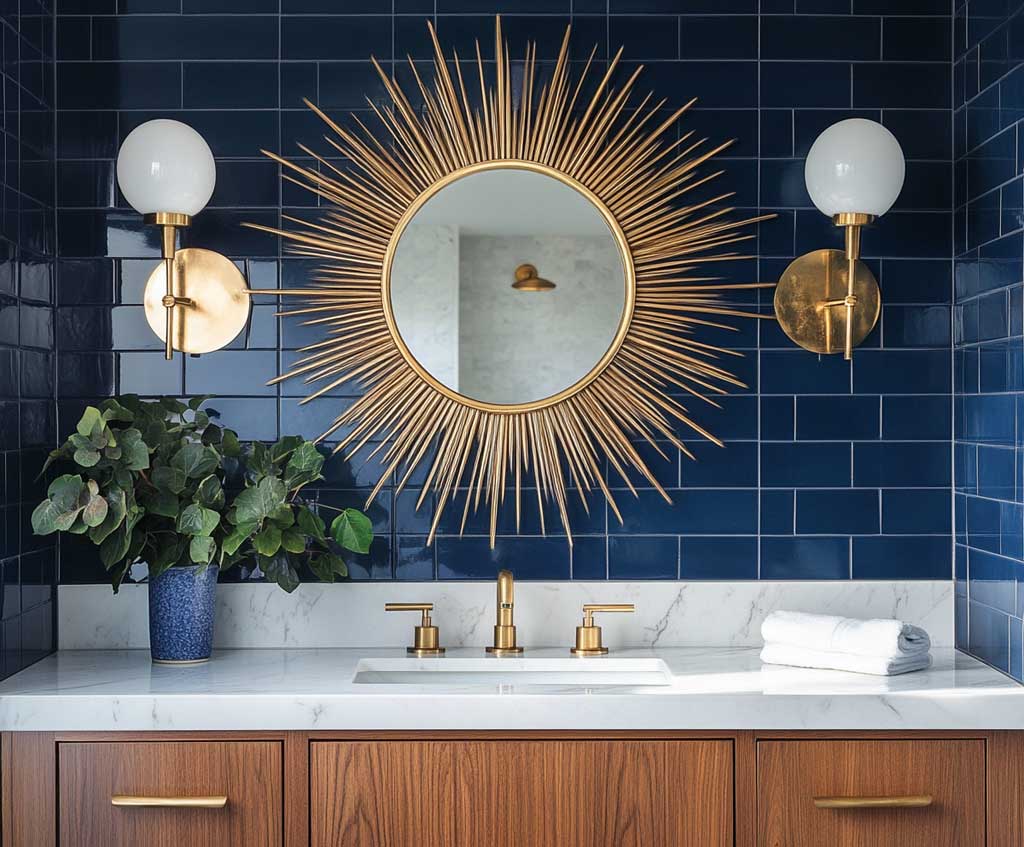
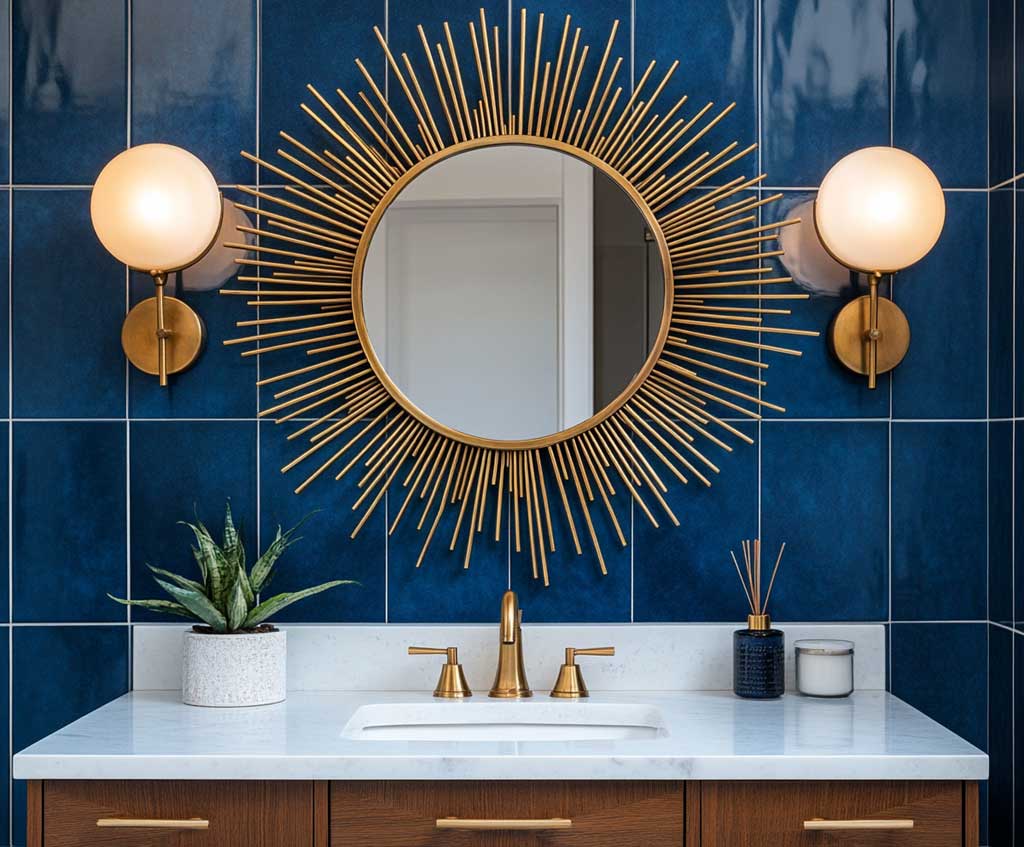


The reflective surface multiplies depth in compact bathrooms — think of it as a skylight that lives on your wall. Pair the mirror with globe sconces at eye level, not recessed ceiling lights, and you get that layered 1950s–60s warmth that photographs beautifully. Brass fixtures on the faucet and towel bar carry the metallic note forward without repeating the starburst shape. One small potted plant below the mirror — something with broad, dark leaves like a rubber tree — breaks the symmetry just enough to stop the room feeling staged.
What doesn’t work: a sunburst mirror on white subway tile. The rays disappear into the grout pattern and the whole thing reads as noise rather than statement. You need contrast — a saturated wall colour, a textured wallpaper, or at minimum a deep matte paint. If your bathroom walls are already light and you love the sunburst shape, go large (minimum 30 inches diameter) so the piece has enough visual weight to register. A small sunburst on a pale wall is the mid century modern bathroom equivalent of whispering in an empty room.
Walnut-Framed Rectangles Scale Better Than Any Other MCM Mirror Shape
A rectangular mirror framed in walnut wood is the workhorse of mid century modern bathroom mirror design — less photographed than the sunburst, more likely to actually work in your space. The math is simple: mirror width should be 70–80% of your vanity width. So a 48-inch double vanity wants a mirror somewhere between 33 and 38 inches wide. I’ve seen people hang a 24-inch mirror over a 60-inch vanity and wonder why the room looks unresolved. Width is the problem every time.
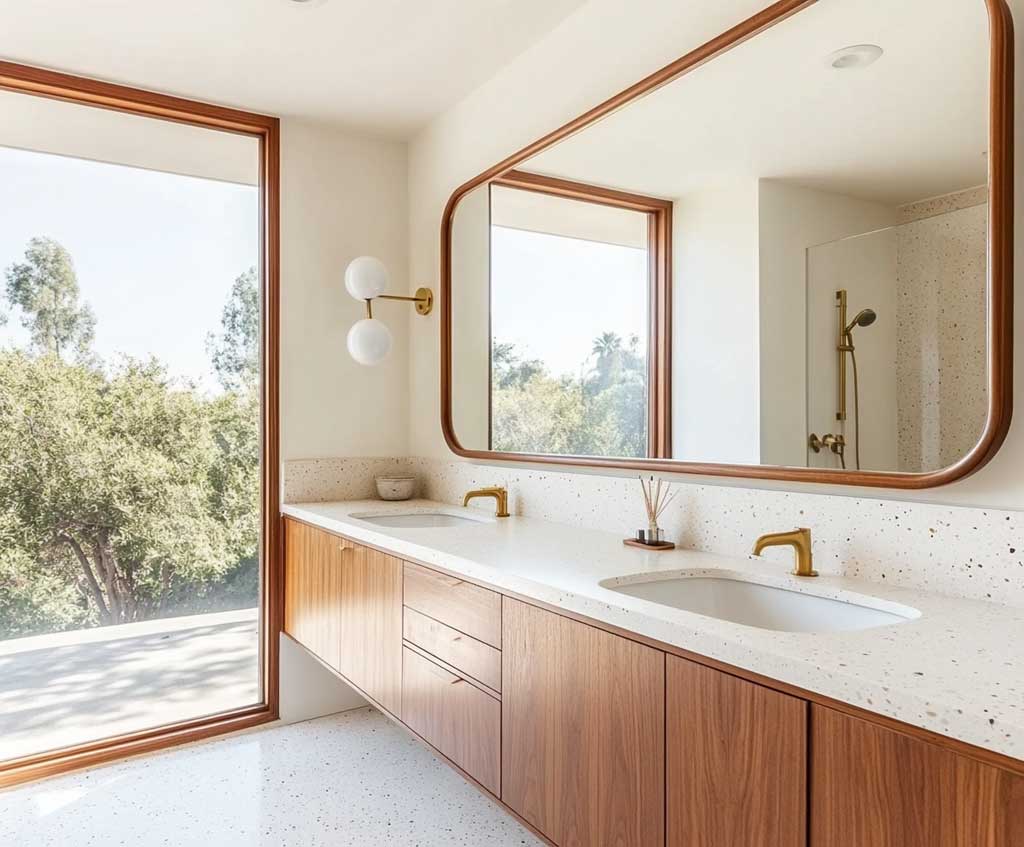
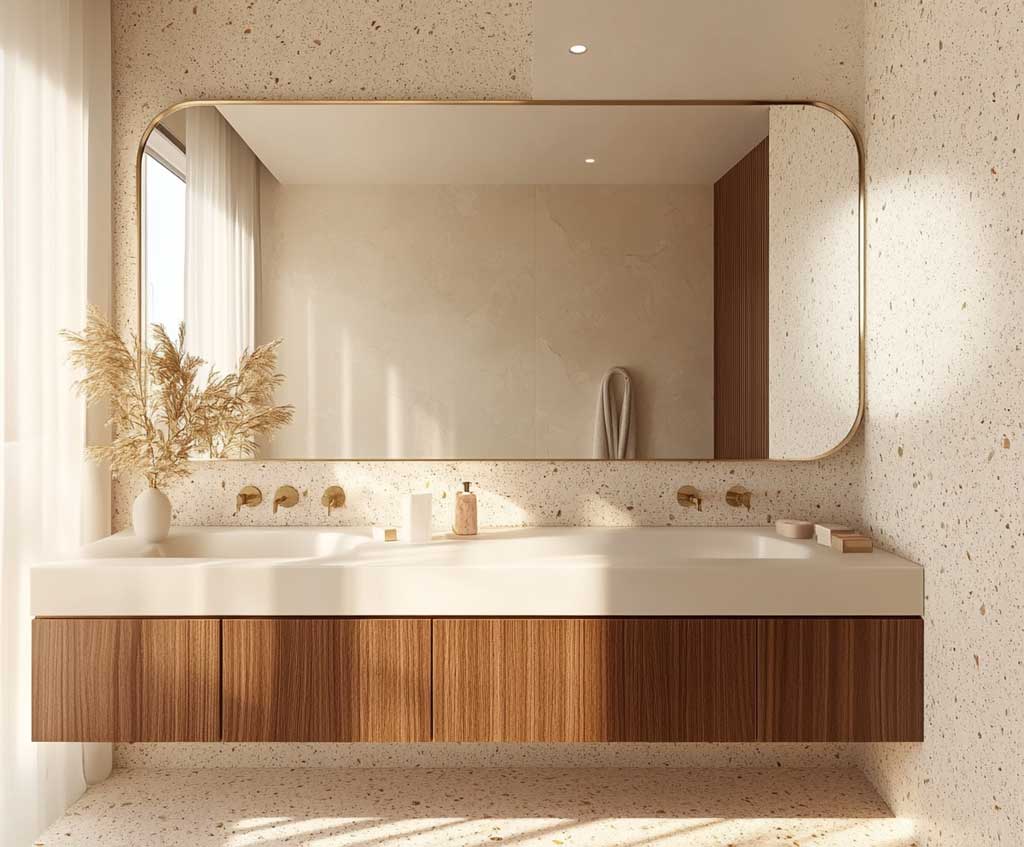
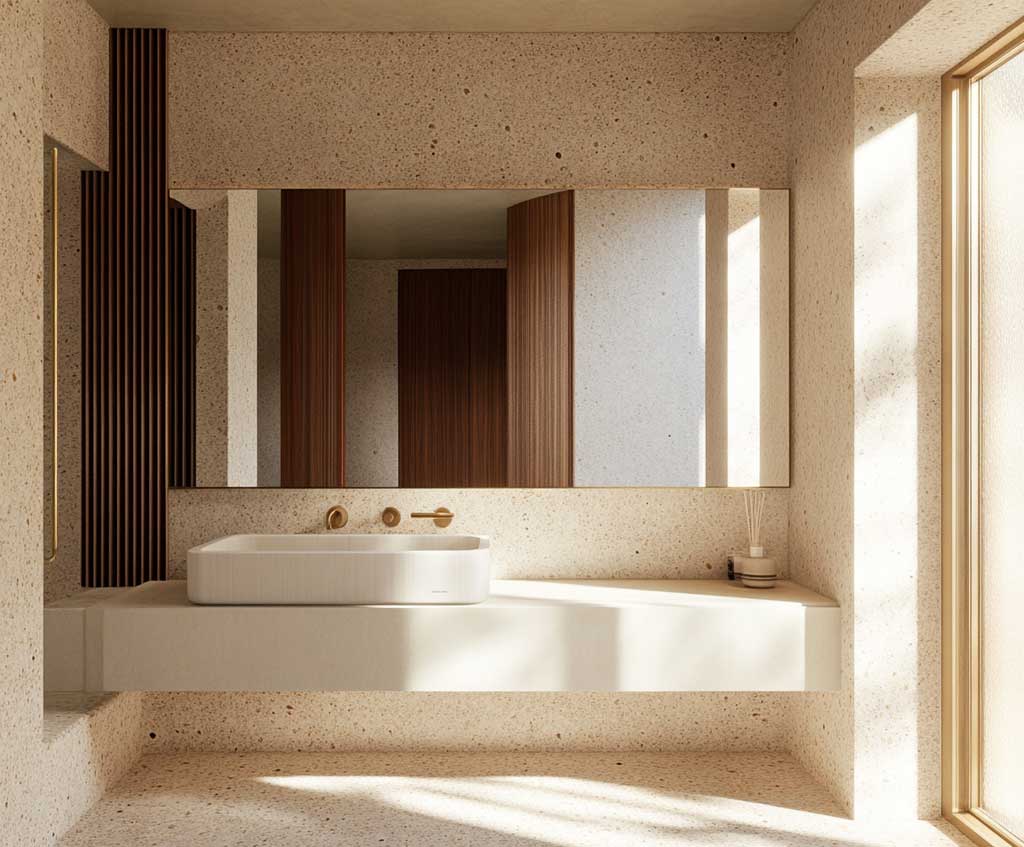
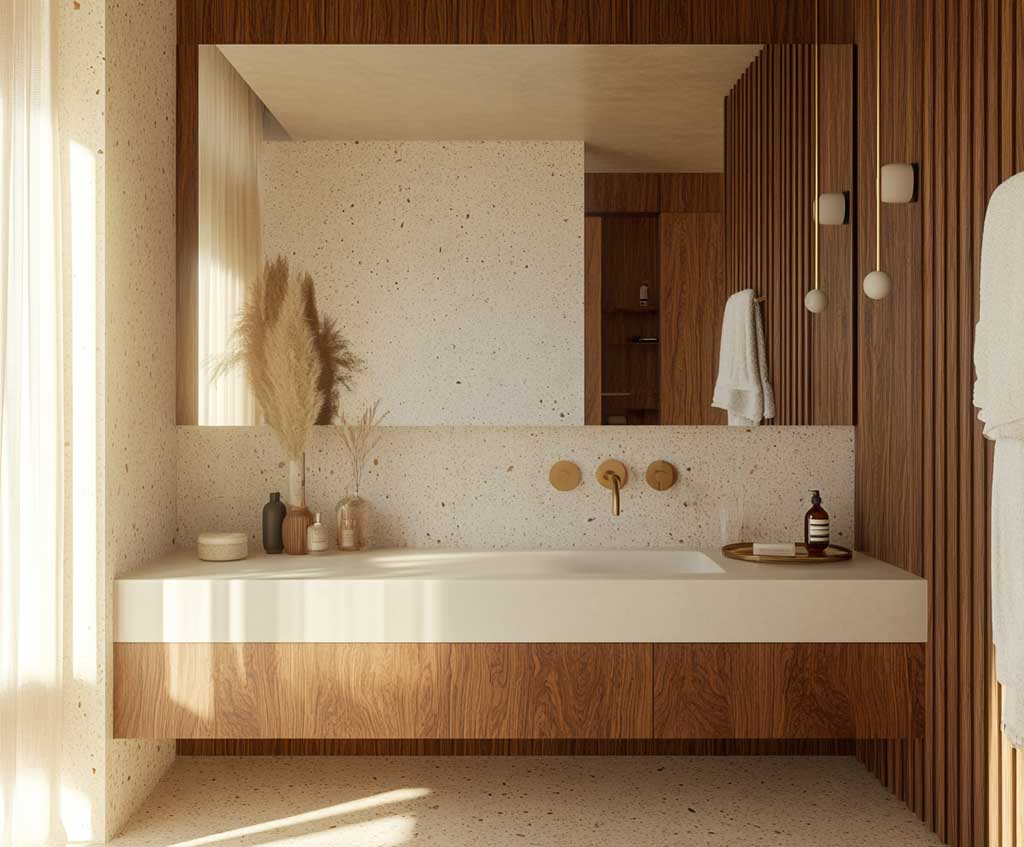
The walnut frame earns its price over lighter wood options because it anchors. Pale oak frames read as Scandinavian; walnut reads as mid century. The difference is about 20 Kelvin of perceived warmth in the room and it matters. A floating white vanity below the mirror creates that sense of the floor breathing — terrazzo or large-format cement tiles underneath compound the effect. Brass faucets, not chrome: chrome in a walnut-and-white bathroom is like wearing white shoes with a navy suit. Technically allowed. Always wrong.
You’ll notice the best MCM vanity mirror setups treat the wall between the mirror bottom and the backsplash as intentional negative space — not a place to cram open shelving. I stole this approach from a hotel bathroom renovation in Kyoto that cost more per night than my first car. Keep that gap clean and the mirror reads as architecture, not furniture. If you need storage, go for a recessed medicine cabinet with a walnut-framed door — it disappears flush into the wall and keeps the surface free. Brands like Robern offer this at around $800; the visual return is worth every cent.
For a broader overview of how mid century modern bathroom furniture interacts with mirror choices, the mid century modern bathroom furniture ideas post on this site shows exactly how vanity, shelving, and mirror selections build a coherent room rather than a collection of individual purchases.
Asymmetrical MCM Mirrors Reward Confident Rooms, Punish Indecisive Ones
An asymmetrical mirror is the move that separates people who understand mid century modern bathroom design from people who’ve collected references of it. The irregular silhouette — one side arcing wider, the other narrower, no two edges parallel — breaks the rigidity of a tiled bathroom wall in a way that geometric shapes can’t. Against muted sage or dusty green tiles, an organic-form mirror becomes the single animated element in an otherwise composed room. That tension is the whole point.
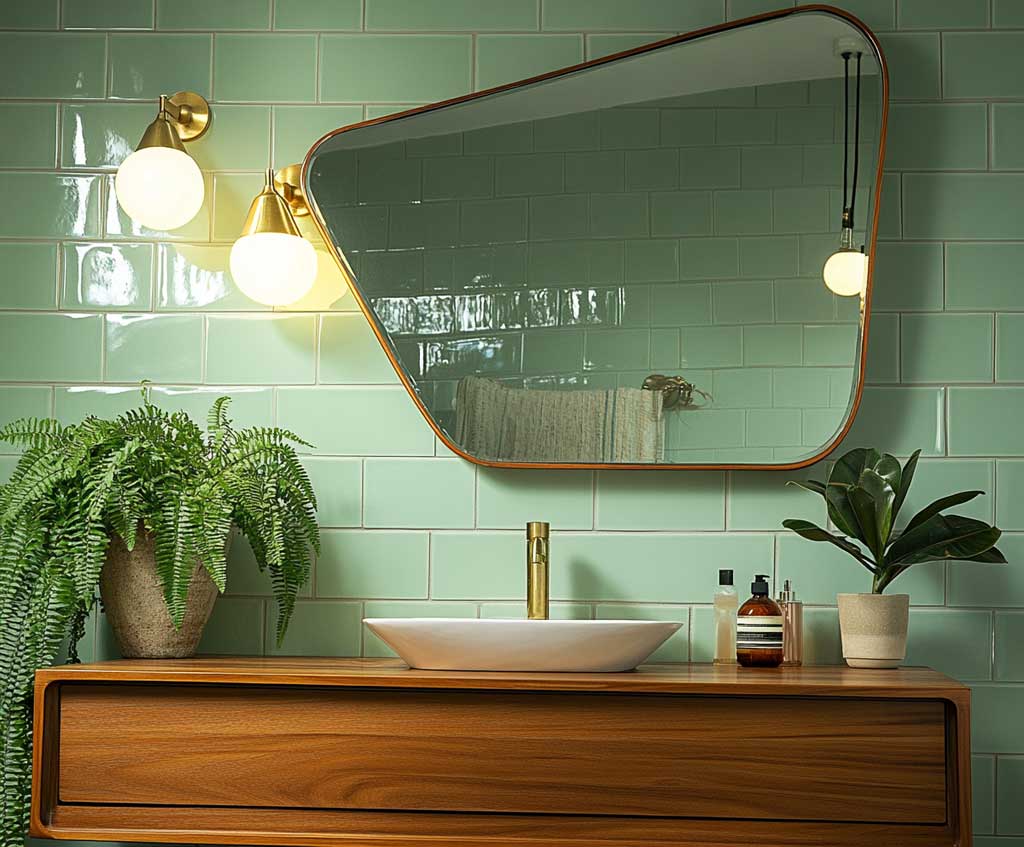
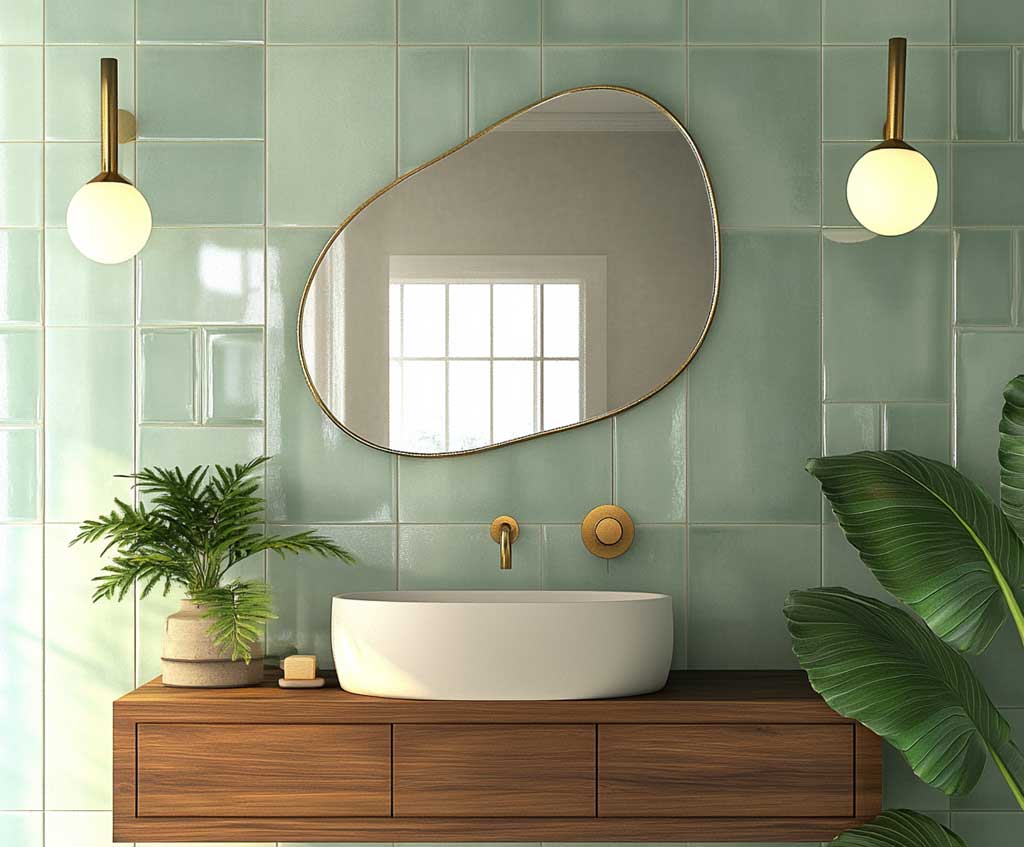
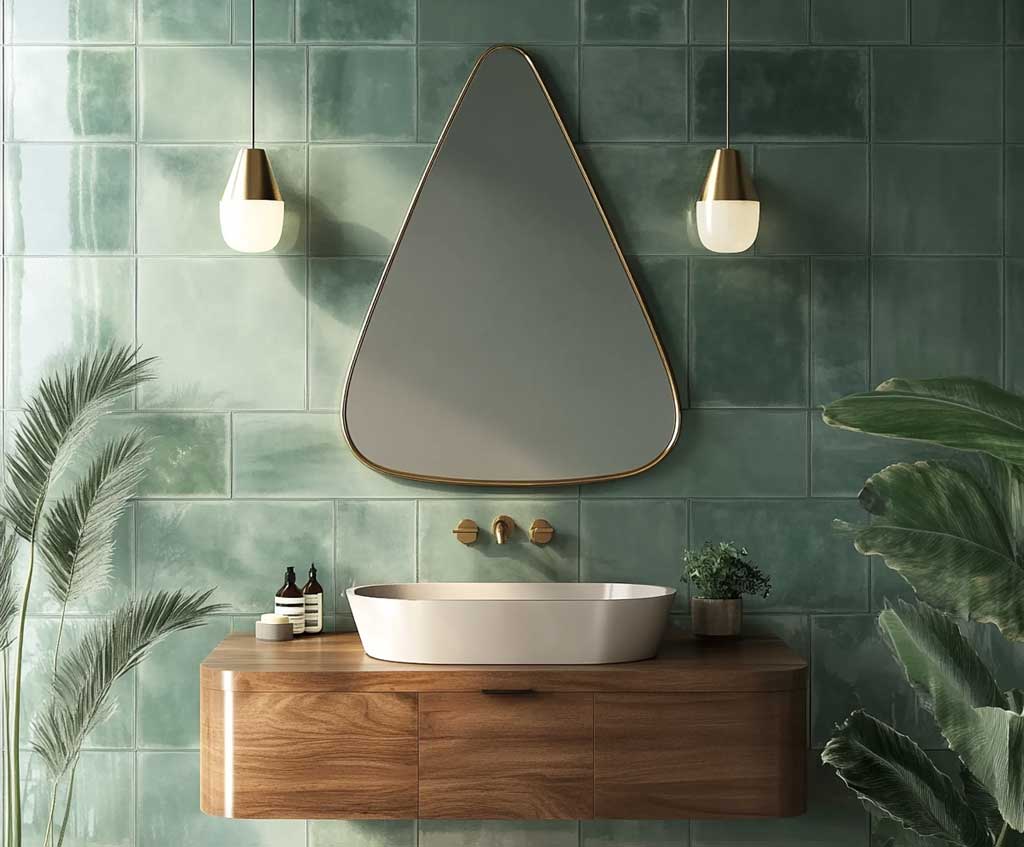
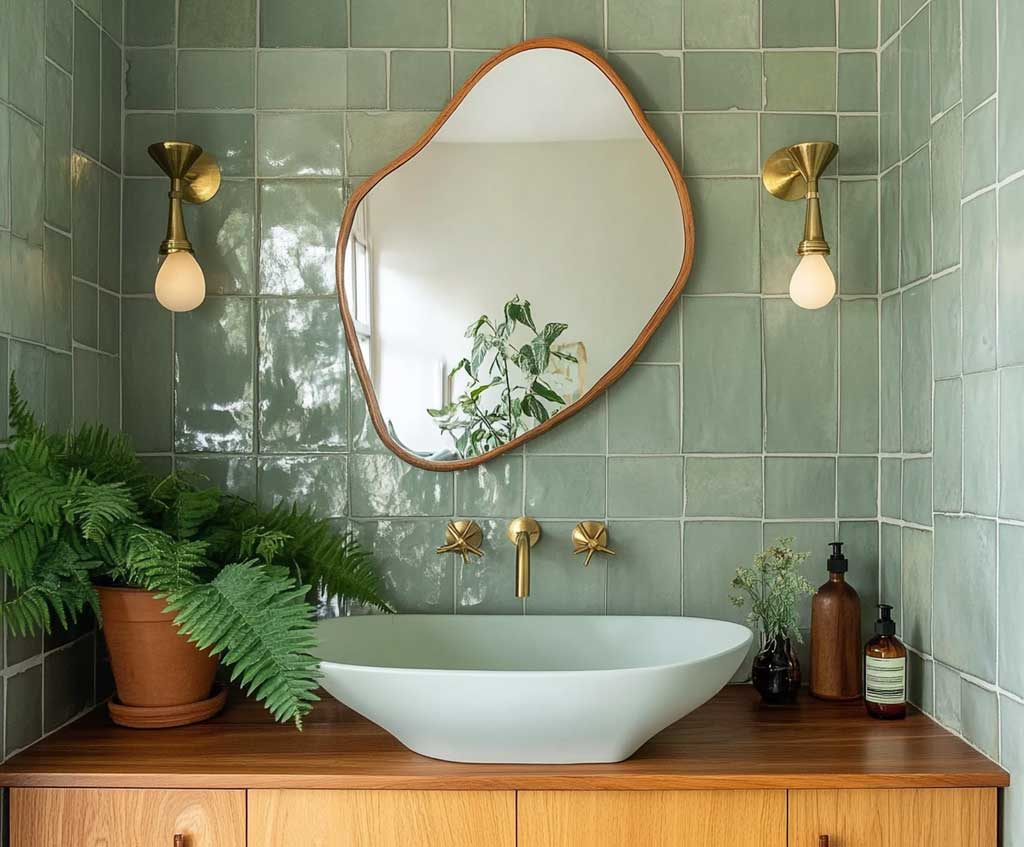
The floating wooden vanity beneath an asymmetrical mirror needs to be simple — no raised panel doors, no hardware that competes. A flat-front walnut or teak cabinet with integrated pulls (or no pulls at all, push-to-open mechanism) keeps the eye moving upward to the mirror shape rather than stalling at the door faces. Brass sconces flanking the mirror rather than a bar light above it give you even facial illumination and reinforce the MCM lighting logic of multiple independent sources over a single strip. A potted fern placed at counter level — not hung, not shelved, just set directly on the vanity surface — reads as intentional rather than decorative.
Don’t do this with asymmetrical MCM mirrors
Hanging an organic-form mirror in a bathroom with geometric tile patterns, a rectangular vanity, and a linear light bar is the design equivalent of wearing a statement necklace with a turtleneck — every element competes and nothing wins. Asymmetrical mirrors need a calm, mostly neutral backdrop to read as intentional. Put one over bold Moroccan tile and you’ll spend the next three years telling guests it’s “a conversation piece” while quietly hating it. Also: never hang an asymmetrical mirror off-centre above a centred vanity. The misalignment reads as accident, not attitude.
Choosing between an asymmetrical and rectangular mirror ultimately comes down to how much visual movement your bathroom can absorb. Rooms with strong tile patterns, bold wall colours, or statement flooring already have a lot happening — the rectangular walnut frame quiets things down. Rooms with plain walls, minimal tile work, or a monochrome palette can handle the organic silhouette. If you’re building a mid century modern bathroom from scratch and want to understand how all these elements combine, mid century bathroom design ideas with real room examples shows how tile, vanity, mirror, and lighting interact in complete spaces rather than in isolation.
Mid Century Vanity Mirror Specifications Nobody Mentions at the Point of Purchase
Buying a mid century modern vanity mirror online means squinting at rendered product photos and hoping the scale reads correctly in real life. It rarely does. The frame depth is the first thing to check: MCM frames sit between 0.75 and 1.5 inches proud of the wall, which means they cast a shadow line that’s actually part of the visual design. A flat-profile frameless mirror doesn’t do this. If frameless is your direction — and there’s a valid MCM argument for it, especially in smaller bathrooms where a frame adds visual weight you can’t afford — look for a bevelled edge rather than a raw cut, which gives the glass its own quiet frame without adding wood or metal.
Humidity resistance matters more in a bathroom mirror than any other room. Solid walnut frames sealed with a waterborne polyurethane finish hold up; MDF cores with walnut veneer start to swell within two years of daily shower steam. Ask before you buy. Brands like MirrorMate build frames specifically for bathroom applications — their Cherokee Mocha Walnut Slim frame at around $120–$180 is one of the few products designed to retrofit over an existing plate mirror, which is useful if your bathroom already has a builder-grade frameless mirror you want to upgrade without a full renovation. For a broader resource on mid century modern mirror types and specifications, MirrorMate’s mid century bathroom style guide covers finish compatibility and frame sizing in practical detail.
Finish pairings to avoid: brass mirror frame with chrome faucets, or matte black frame with polished nickel hardware. Pick a metal family and commit. The MCM era itself was disciplined about this — you see walnut-and-brass or teak-and-chrome, never a mixed metals approach that reads as indecisive rather than eclectic. My go-to formula: walnut frame, unlacquered brass fixtures, and one matte black accent (towel hook, toilet paper holder) to keep the palette from going too warm.
| Mirror Type | Frame Material | Price Range | Best Wall Colour Pairing | Watch Out For |
|---|---|---|---|---|
| Sunburst | Brass or gold metal | $280–$450 | Navy, forest green, charcoal | Too small — min. 30″ diameter |
| Rectangular | Walnut or teak wood | $180–$350 | White, warm grey, terracotta | MDF core in humid bathrooms |
| Asymmetrical | Metal or solid wood | $220–$480 | Sage, dusty green, off-white | Busy tile — needs calm backdrop |
| Round | Brass, walnut, or frameless | $150–$320 | Any — most forgiving shape | Under 24″ feels like a porthole |
| Frameless bevelled | N/A | $120–$250 | White, pale tile, subway tile | Reads contemporary, not MCM |
The bottom line
Your mid century modern bathroom mirror is the one decision that locks in every other material choice in the room — get the shape and frame material right first, then build outward.
Brass rays belong on dark walls. Walnut rectangles belong over floating vanities. Asymmetrical silhouettes belong in rooms that are calm enough to let them move. Pick the wrong shape for the wrong backdrop and no amount of terrazzo flooring or globe sconces will rescue it.
The mirror width rule — 70–80% of vanity width — solves more design problems than any single styling trick I’ve encountered. Apply it before you fall in love with a size on a product listing.
Save this post before you shortlist a single mirror — the comparison table above will save you at least one return shipping label.