Most people think of sitting as neutral — the absence of activity. It isn’t. From the moment you settle into a static chair, a cascade of physiological changes begins in your muscles, spine, and circulatory system. By hour eight, the damage is cumulative and significant. The good news: an active sitting chair doesn’t just manage the problem. It interrupts the process continuously, at the source, without requiring you to change your schedule or your habits.
Here is exactly what happens to your body — and when.
Hour 1 — Your Muscles Begin to Switch Off
Within the first 20 minutes of static sitting, your postural muscles start to disengage. The glutes, responsible for pelvic stability and spinal support, begin what exercise physiologists call “gluteal amnesia” — they stop firing because the chair is doing the load-bearing work instead. The deep stabilizing muscles of the lower back and core — the transverse abdominis and multifidus — reduce their activity significantly at the same time.
Your pelvis also begins to drift. Without active muscle engagement, most people’s pelvis tilts posteriorly, rotating backward and flattening the lumbar curve. This is the beginning of the slouch, and it happens in the first hour, not the eighth. Choosing an active sitting chair from the start of your workday prevents this cascade before it begins.
Hour 2 — Circulation Slows and the Spine Starts to Load
By the second hour, reduced muscle activity means reduced blood flow. Your legs and lower body are doing almost nothing, so blood begins to pool in the lower limbs rather than circulating efficiently. This isn’t just a comfort issue — it directly affects how much oxygen reaches your brain.
Simultaneously, the pressure on your intervertebral discs is increasing. Sitting already loads the lumbar spine at roughly 140% of the pressure of standing. In a static slouch, that pressure concentrates unevenly across the disc — compressing the front while stretching the posterior. This is the exact mechanism behind disc degeneration over time. An active sitting chair distributes this pressure more evenly by keeping the pelvis mobile and the lumbar region continuously in motion.
Hours 3 and 4 — Hip Flexors Tighten, Energy Starts to Drop
The hip flexors — the muscles connecting your spine to your thigh — are designed to shorten when you sit and lengthen when you stand. After two to three hours of continuous sitting, they begin to adaptively shorten. This isn’t temporary tightness. Sustained shortening signals the muscle tissue to remodel at that length, contributing to the chronic hip flexor tightness that underlies much of the lower back pain desk workers experience.
By hour four, the energy drop is noticeable. Shallow breathing — a direct consequence of collapsed posture and a compressed diaphragm — reduces oxygen intake. The body’s metabolic rate slows. Cognitive sharpness begins to dull. This is the physiological origin of the 3pm wall, not sleep deprivation. An active sitting chair keeps postural muscles engaged and prevents the diaphragm compression that drives this energy collapse.
Hours 5 Through 8 — The Damage Compounds
The final stretch of a workday is where cumulative sitting damage becomes most pronounced. The postural collapse that began in hour one is now fully established. The lumbar curve is gone. The shoulders have rolled forward. The head is jutting forward of the spine — for every inch of forward head posture, the effective weight on the cervical spine increases by approximately 10 pounds.
Core muscles that have been switched off for hours have lost the reflex to re-engage. Circulation is sluggish. The nervous system is fatigued from compensating for structural instability. And the person sitting there has usually adapted so gradually to this state that they no longer feel how bad it is — they just feel tired.
Why the Usual Fixes Don’t Actually Fix It
Standing desks
Standing desks address the wrong variable. The problem isn’t sitting — it’s being static. Standing still for eight hours produces its own cascade: varicose veins, knee strain, and lumbar compression from anterior pelvic tilt under load. Alternating between sitting and standing is better, but neither position solves the problem if both are motionless.
Microbreaks
The “stand up every 30 minutes” advice is well-intentioned but structurally flawed. The moment you sit back down in a static chair, the process restarts. Microbreaks don’t undo the damage — they briefly interrupt it before it resumes.
Ergonomic chairs
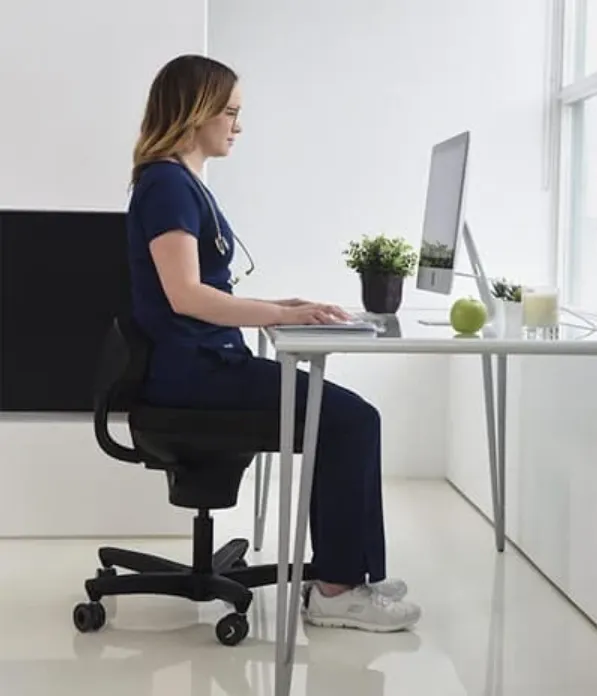
Ergonomic chairs are designed to optimize a static sitting position — better lumbar curve, better hip angle, better armrest placement. But they still ask you to sit still. Optimizing a harmful position is not the same as eliminating the harm. This is the gap that an active sitting chair addresses at its core.
How an Active Sitting Chair Interrupts the Cascade
An active sitting chair is built on a different premise: the problem is stillness, and the solution is continuous movement at the point of contact.
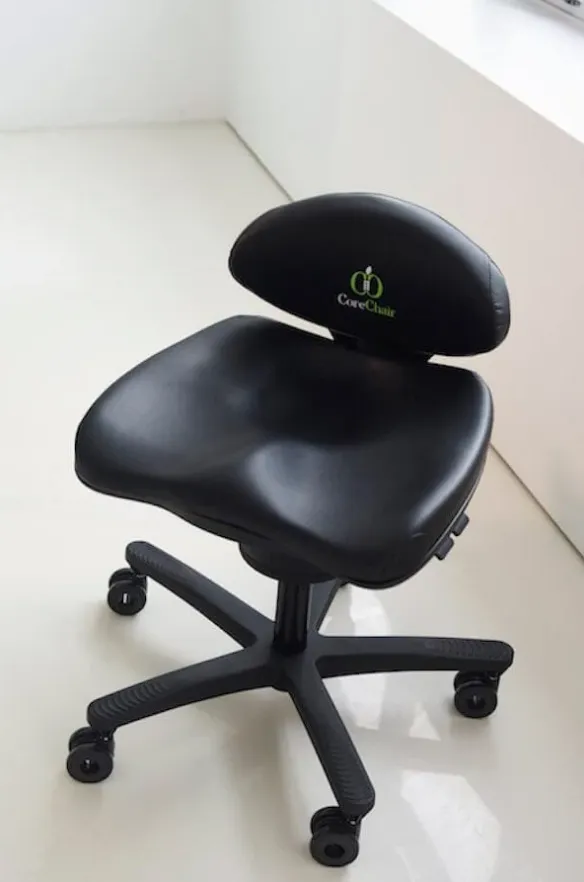
A quality active sitting chair uses a pivot or dynamic base that allows the seat to tilt, rock, and shift in response to the body’s natural weight distribution. The user is never fully static — micro-movements happen constantly, reflexively, without conscious effort. These movements keep postural muscles firing continuously rather than switching off, maintain pelvic mobility and prevent posterior tilt from locking in, encourage circulation by engaging the legs and lower body in subtle stabilizing activity, and support the natural S-curve of the spine by keeping the pelvis in a neutral anterior position.
The key distinction is that this is passive. The user doesn’t have to remember to move, schedule breaks, or change their workflow. The chair creates the condition for movement automatically.
Why CoreChair Takes This Further
As an active sitting chair, CoreChair is designed around one principle that separates it from most active seating options: it removes the backrest entirely.
Most active chairs still include a back panel, which means the body still has the option to lean back, disengage, and let the chair do the postural work. CoreChair eliminates that option. Without a backrest, the deep stabilizing muscles of the spine — the exact muscles that static sitting switches off — are required to work. Not occasionally. Continuously.
There are no armrests either. This is intentional: armrests allow the shoulders and upper body to offload tension onto the chair rather than managing it through proper alignment. Without them, the shoulder girdle, thoracic spine, and core form an integrated support system the way they’re designed to work.
The pivot base handles the lower half of the equation — continuous micro-movement that keeps the hips, pelvis, and lumbar region mobile. The absent backrest handles the upper half — continuous activation of the muscles that posture depends on. Together, they create a sitting experience that is genuinely active from hour one through hour eight.
What That Means Over a Full Workday
The difference an active sitting chair makes isn’t felt most in the first hour — it’s felt in hours five, six, and seven. That’s when the usual cascade of fatigue, aching, and cognitive fog would normally set in. Users of active seating consistently report that the afternoon energy drop diminishes and end-of-day stiffness decreases — not because they worked less, but because their body never fully stopped working.
Sitting for eight hours is not going away. But what happens inside that eight hours can be fundamentally changed — and the most effective tool for that change is an active sitting chair that keeps the body in motion throughout the entire day.
The Bottom Line
The chair you sit in for eight hours a day is either working with your body or against it. A static chair — however ergonomically optimized — works against it by design. An active sitting chair like CoreChair works with it: keeping movement alive throughout the day, building strength instead of undermining it, and preventing the physiological cascade that turns a workday into a slow drain on your health.
The question isn’t whether you can afford to switch. It’s whether you can afford not to.