In a world where most homes rely on ornament and excess to capture attention, there exists a dwelling that speaks with silence. Its voice is not in patterns or color, but in shadows, in textures, and in the gentle choreography of daylight. The experience begins with an encounter of stillness, a room defined not by what it contains but by the play of emptiness, a surface finished in muted grey, a chamber softened by the weight of light that slips through perfectly cut circular openings above.
What unfolds within these walls is not merely architecture but a dialogue between void and illumination. Each step forward feels like walking into a poem written with stone and sky. It is here that the drama of presence and absence takes shape, where matter and immateriality merge into one.
Light on plaster walls
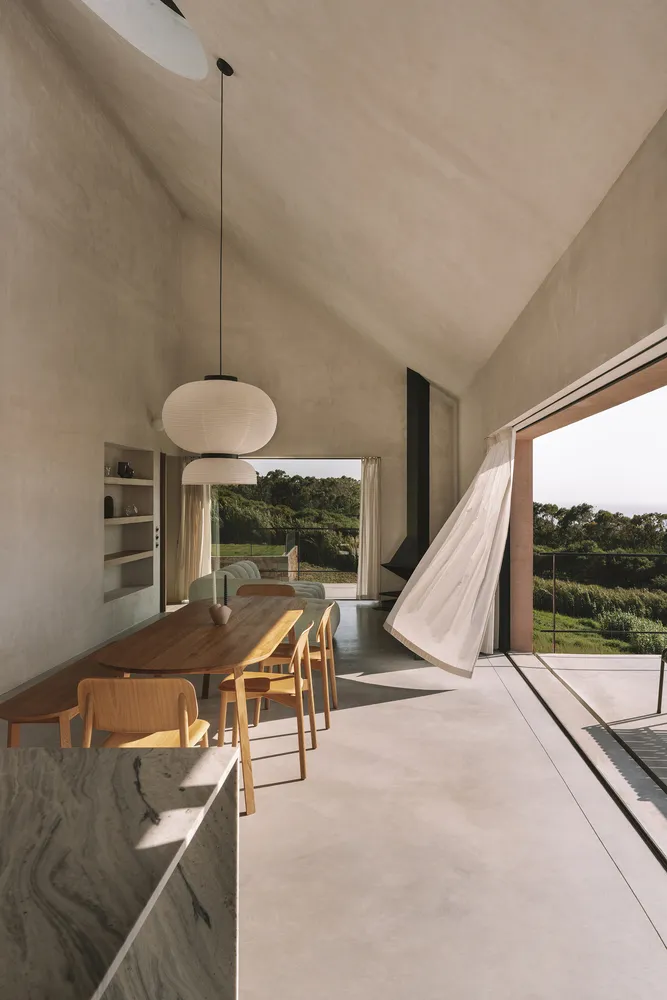
The surface treatment of the house embraces plaster in its most subdued form. No polish distracts the eye, no intricate relief competes for attention. Instead, the walls stand as a canvas for brightness that shifts hour by hour. Morning introduces soft strokes of gold, afternoon sharpens the shadows into geometries, and evening dissolves them into a gentle haze.
The plaster embraces imperfection. Small variations and roughness become part of its character, carrying with them the memory of hand and tool. When the sun finds its way through the oculi, these walls become alive, recording the journey of light across surfaces. It is not simply material; it is a diary, an ever-changing record of the celestial path.
Walking through such a space is like stepping into a gallery where the artist changes daily, yet the artwork always belongs to the same subject—the marriage of brightness and calm grey. The plaster is not neutral, even if it appears so at first glance. It vibrates with the subtleties of time.
Stone shaping the interior
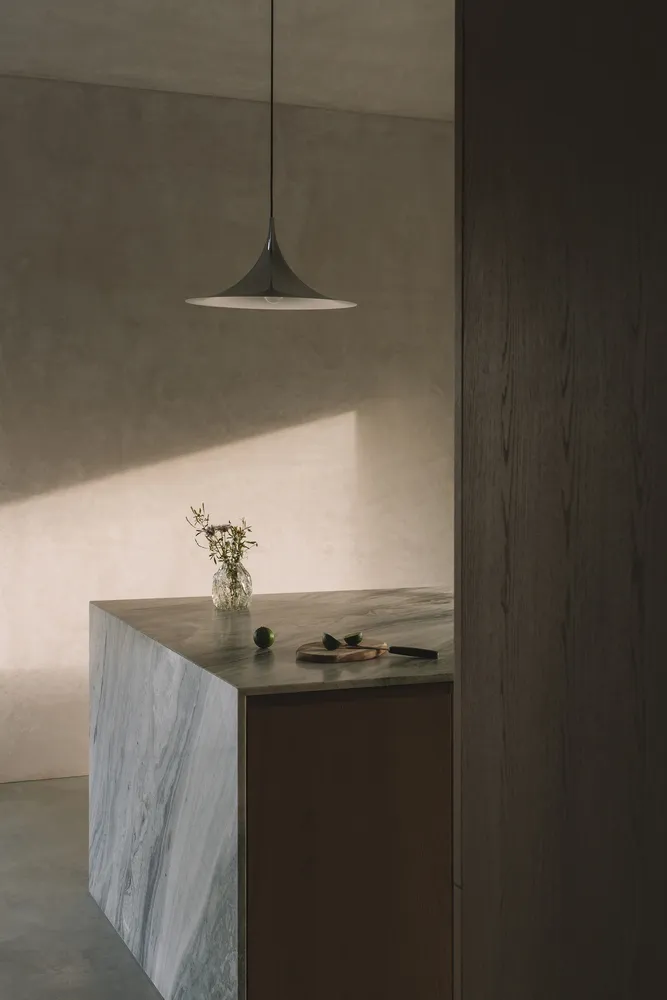
The choice of stone in flooring and details adds weight to the quietness of the space. Marble inserts, carefully chosen, break the monotony with subtle veins that echo the natural world. Each slab carries ancient stories of geological transformation, yet inside this chamber they feel fresh and immediate.
Travertine appears in thresholds and benches, a lighter presence compared to marble, with small cavities that remind one of the earth’s breathing pores. Together, these stones ground the dwelling, creating tactile anchors to balance the ethereal quality of light falling from above.
As daylight brushes across the stone, surfaces glow gently, changing tone from warm beige to cool grey. The observer cannot resist running fingers across the texture, feeling time solidified under their touch. It is as if the house insists on connection, reminding those who enter that the earth is always beneath them, even when the gaze is fixed on the heavens.
Geometry of oculi
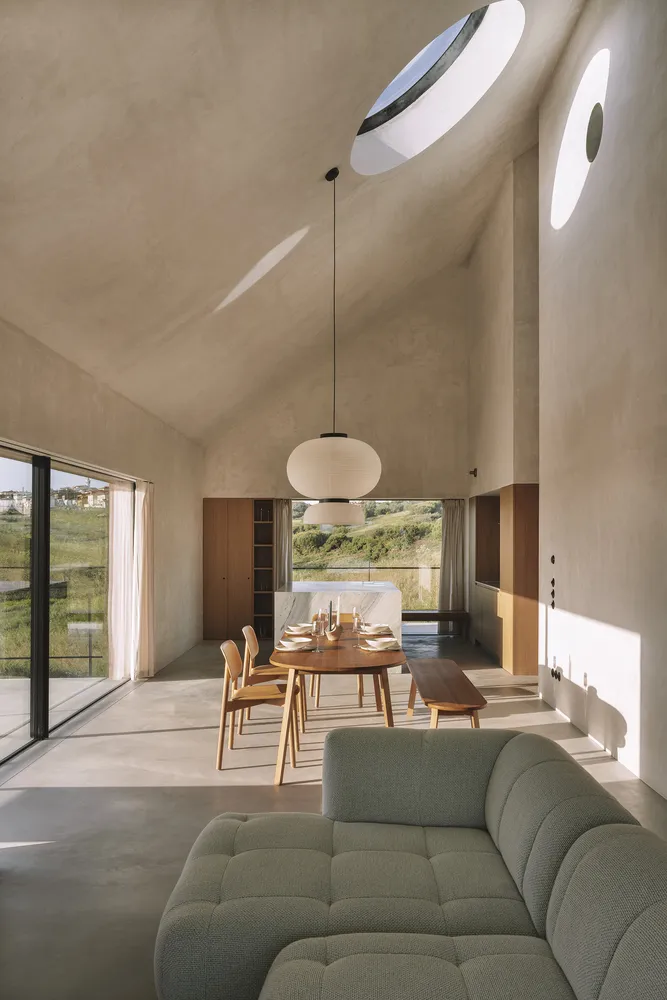
The defining feature of the composition is the circular openings cut into the roof plane. They are more than architectural devices; they are instruments of wonder. Through them, the sky is invited in, not in panoramic excess, but in carefully framed glimpses.
Each oculus acts like a lens, directing attention to a shifting fragment of the atmosphere. Sometimes it is a perfect disc of blue, sometimes a canvas for drifting clouds, and at night it becomes a liquid well of stars. The void receives this borrowed scenery with grace, and the plaster and stone reflect it back in softened radiance.
These circles reshape the perception of the space below. Instead of flat ceilings pressing downward, there are portals stretching upward. Gravity feels less insistent, and the room breathes with the rhythm of the cosmos. Standing beneath one of these openings, a person senses both intimacy and vastness. They are sheltered by stone and plaster, yet also linked directly to infinite sky.
Shadows on grey surfaces
Grey defines the mood of the place. Rather than relying on vibrant pigments or elaborate decoration, the architect embraced monochrome. This decision amplifies the value of shadow, turning each beam of sunlight into a performance.
The grey surfaces seem to drink light and release it slowly. Angles of walls become sharper or softer depending on the sun’s angle, producing a choreography that continues without pause. Even in moments when the day is overcast, there remains a hum of subtle contrast, a meditative quietness.
The effect is not austere but profound. Grey becomes a color of serenity, a background that allows the mind to wander, a stage for light to reveal its countless faces. Without distraction, one begins to notice the smallest transitions—the way a shadow edge blurs, the way brightness deepens into glow as it strikes stone or plaster.
Interior silence
Within this dwelling, silence is not absence. It is a presence that supports clarity. Every material—stone, plaster, marble—cooperates to eliminate noise of excess. The walls are bare, the ceilings plain, the openings deliberate.
This silence amplifies the smallest sounds: the echo of footsteps, the whisper of breeze slipping through windows, the faint resonance of water moving in a nearby pool. It creates an environment where attention heightens, where the body relaxes because the senses are free from overload.
The stillness is never empty. It is full of light, shadow, material grain, and the constant shifting of atmosphere. It is an invitation to dwell not just physically, but mentally, to allow thoughts to slow down and align with the pace of sunlight across stone.
Oculi as spiritual markers
There is a timeless quality to the circular openings. They recall ancient temples, where light falling through apertures was used to mark solstices, to measure the passage of days, to connect human life with celestial rhythms.
Here, too, the oculi carry something beyond practicality. They create an awareness of time’s slow flow. Watching a circle of light glide across the plaster floor, one feels a connection to ages before, to ancestors who also measured their days through sky and shadow.
They also establish a spiritual atmosphere. The void is not just architectural but contemplative. The round windows in the roof transform ordinary moments into rituals: the morning coffee taken under a patch of light, the quiet afternoon rest accompanied by a drifting sunbeam, the evening glance upward at the first star framed above.
Material contrast
The interior gains its power not only from singular elements but from contrast. Grey plaster meets warm travertine, polished marble punctuates rougher textures, and brilliant white light collides with soft shadow. These oppositions keep the space alive.
The red glass door offers the most striking contrast. In a world otherwise restrained to monochrome, it glows like an ember. It does not break the serenity but emphasizes it, reminding visitors that restraint allows a single gesture of boldness to shine even brighter.
Exterior continuation
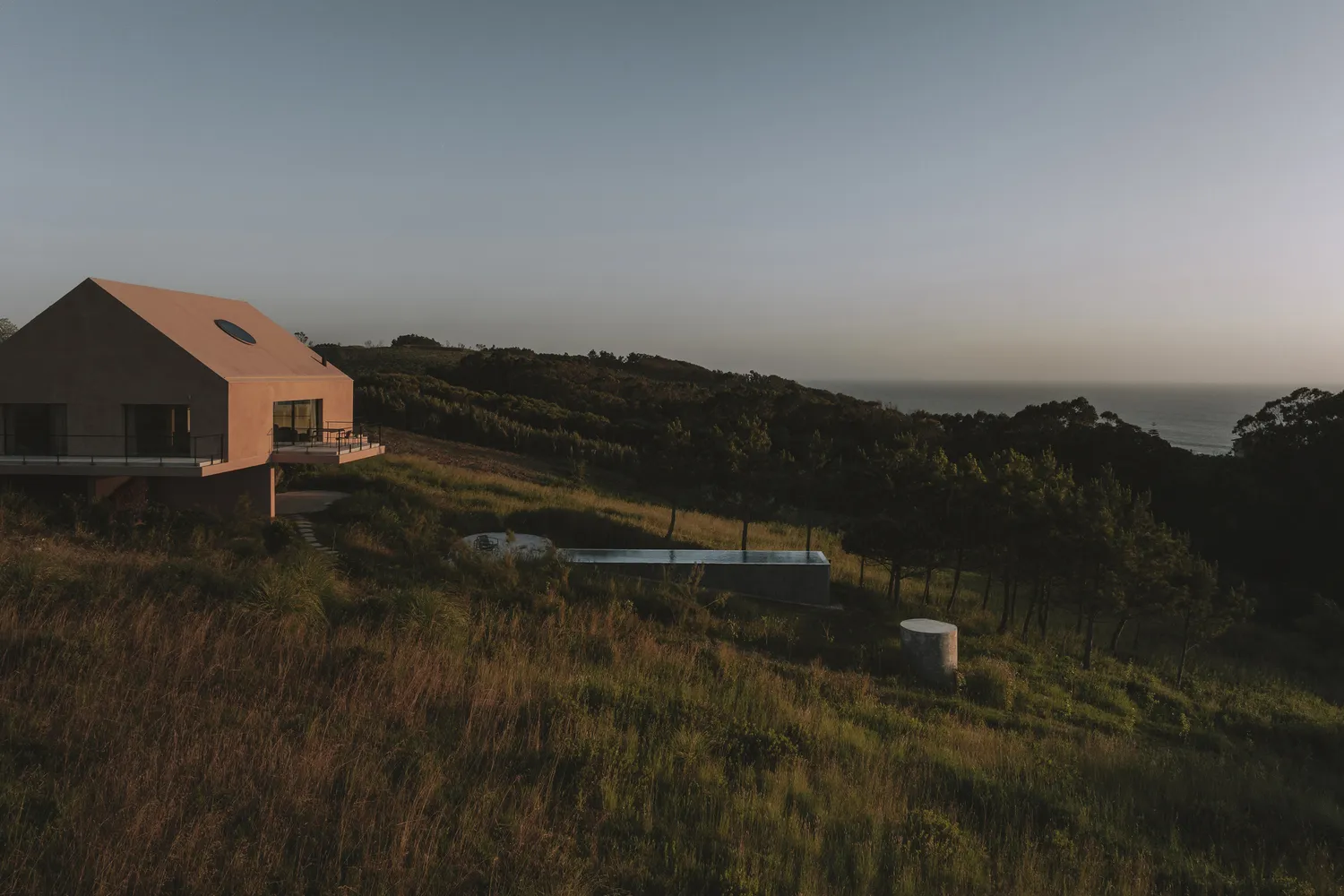
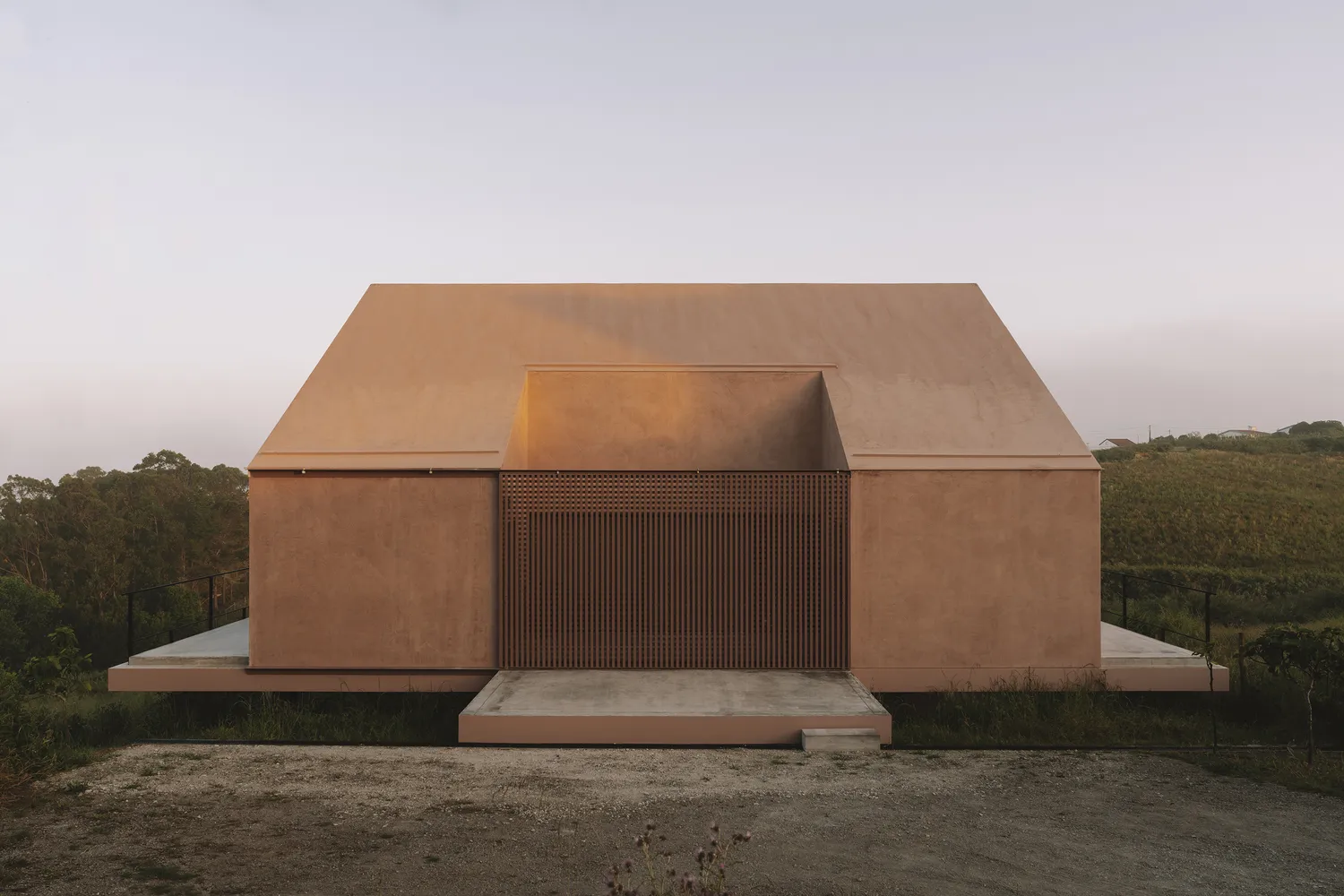
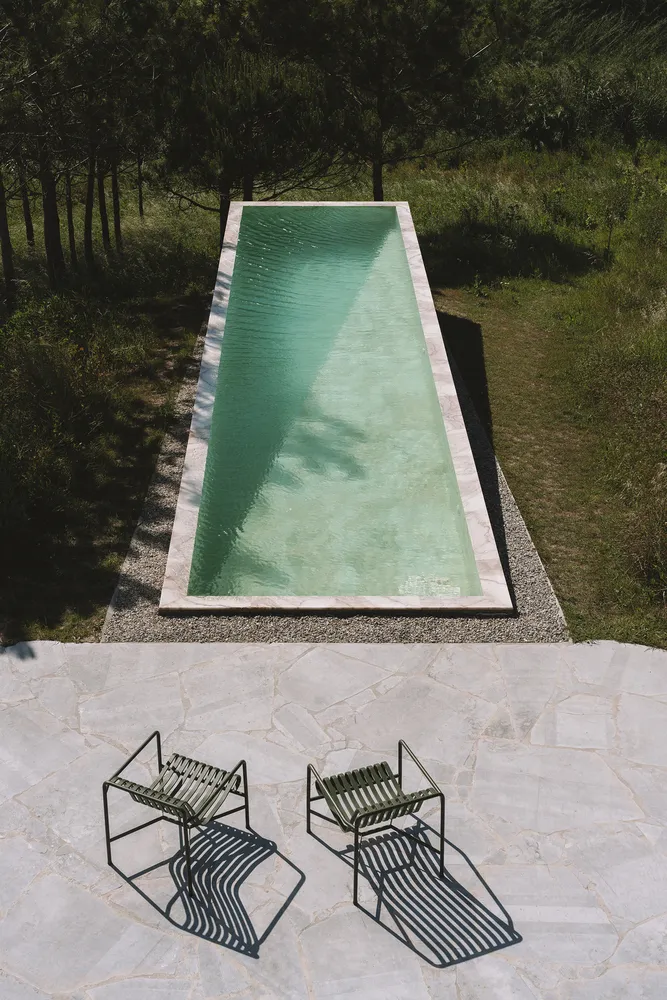
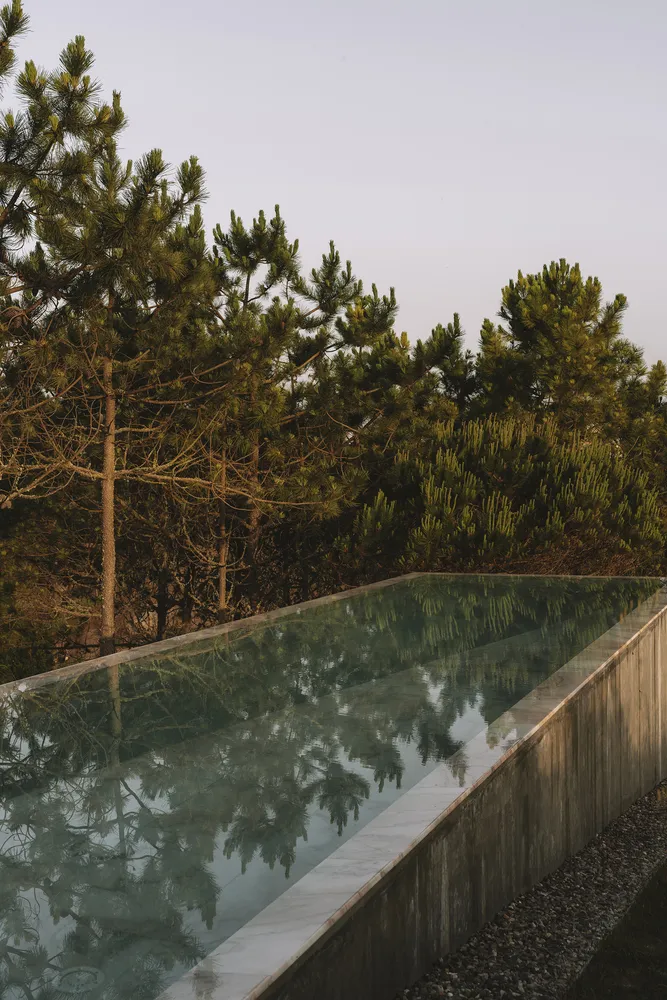
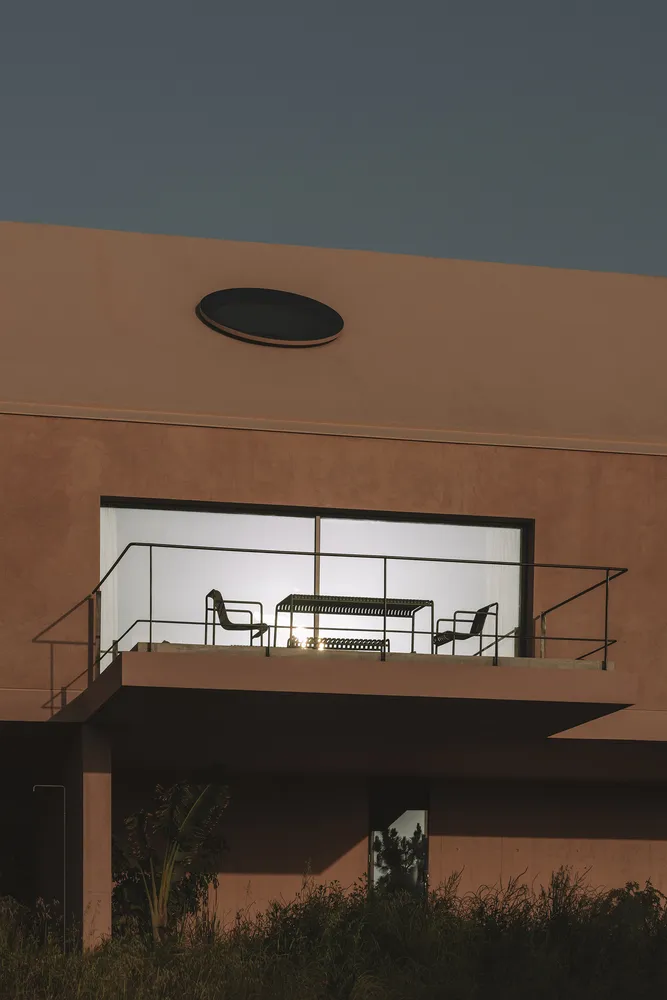
Though much of the narrative belongs to the interior, the material decisions echo outward. Terraces extend the monochrome language into open air, and the pool draws a ribbon of reflective surface toward the sea. From outside, the dwelling reads as a sculptural block resting above a slope, an object that seems carved rather than built.
The same plaster that holds light indoors also converses with daylight outside, changing character with weather and season. The structure never feels static; it belongs to the shifting environment as much as to its own geometry.
The story of this dwelling is told not through ornament but through restraint. Plaster, stone, and marble combine with the geometry of oculi to create a sanctuary where light writes the daily script. Shadows become teachers of time, silence becomes fullness, and grey becomes luminous.
In a world often overwhelmed by excess, such a space demonstrates the profound beauty of less. It shows how simple materials, carefully composed, can turn emptiness into poetry and stillness into inspiration. Here, the void is not absence, but the most eloquent presence of all.
| Architects | https://extrastudio.pt/pt |
| Images | https://clemenspoloczek.com/ José Pedro Marques |