
In a quiet corner of Mexico City, architecture and art converge through forceful geometry and a material as ancient as it is modern—concrete. There is something both elemental and futuristic in the way this home breathes through its structure. It isn’t a passive container of life, but an organism sculpted by volume and rhythm. A sanctuary of sharpness, it draws its soul not from softness or subtle ornament, but from deliberate angularity and movement born in steep gradients. The interior is not merely a sequence of rooms—it is a tectonic landscape, unfolding with tension and depth.
This residence captures your attention through its unapologetic use of concrete, which speaks of permanence, weight, and time. Yet, paradoxically, the space it forms feels anything but heavy. The material here does not smother. Instead, it frames the voids with discipline, orchestrating how light dances, how shadow deepens, and how perception shifts with every step. Rigid angles do not cage the spirit—they liberate it from monotony, forging a poetic confrontation with form.

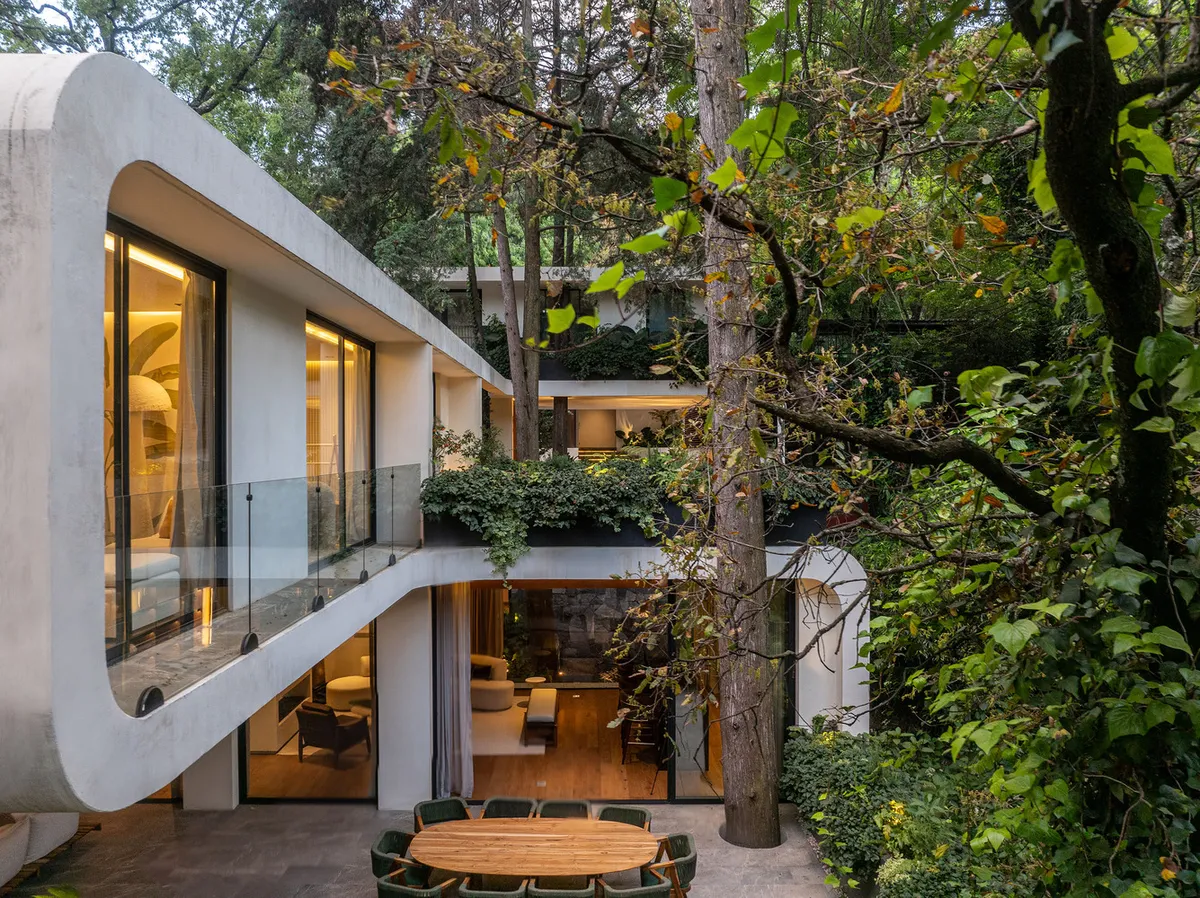


Concrete inclines carve an architectural journey
There’s a pulse to the steep slopes that rise and fall across the house’s concrete interior. The architecture doesn’t ask you to simply walk—it commands you to ascend, descend, pivot. Every transition is shaped by an incline that cuts into space with precision. As you move through the volume, it’s impossible not to feel as though you’re part of a topographic event—an expedition across a terrain made of solid intention.
These inclines are not decorative gestures. They define functionality with grace. A stair may begin as a diagonal slab, not visually distinct from the wall beside it, until it unfurls its purpose in shadow and proportion. Pathways lean into thresholds, bending lines of sight, stretching perspective. It’s as though the home reprograms how bodies move and inhabit space. Walking through the concrete corridors feels like moving through sculpture—where every angle matters, and every gradient is a moment of transformation.
The interior volume bends and twists through calculated planes that reshape expectations. A visitor may not recognize familiar domestic cues: no soft partitions, no suspended ceilings, no plastered ornaments. Instead, one is immersed in a geometry that provokes attention, that demands a kind of spatial literacy to decipher the language of angles and planes. In this way, the experience becomes cinematic—each corner offering a new frame, each intersection a reveal.


Rigid geometry brings harmony through contrast
Despite the starkness of material and the sharpness of lines, the concrete interior never veers into aggression. The rigidity of angles brings an unexpected serenity, a balanced rhythm that pulls its energy from repetition and proportion. The contrast between open voids and solid masses produces tension, but it’s a tension that hums in harmony, not dissonance.
This interior doesn’t retreat into softness to comfort its inhabitants. Instead, it offers the luxury of clarity. Concrete, unpainted and unadorned, becomes a canvas of truth. It shows every form exactly as it is. In the absence of decorative noise, the mind calms. The geometry creates a meditative state—angles become mandalas of the built world. A slanted ceiling directs your eyes toward a slice of sky; a narrow triangular corridor opens into an explosion of space. These moments aren’t accidents—they are designed revelations.
There is something spiritual in how the house eliminates excess. The rigor of the design does not confine—it liberates from distraction. Daylight spills through vertical slits and diagonal cuts, casting sunbeams across concrete floors in abstract compositions that change hourly. Even artificial light responds to the form, highlighting edges and folds with reverence. Here, geometry and light compose a duet, choreographed in shadows and luminous accents.


Concrete becomes a living texture
The walls, ceilings, and even furniture-like components seem carved from the same monolithic substance, but the concrete never feels cold or repetitive. Its surface is alive with subtle variation—grain, lines, air pockets left from formwork. These imperfections speak of process, of pouring and curing and human touch. The result is a tactile depth that softens the austerity of the angles.
In the bedroom, a diagonal ceiling slices across the space, yet the shadows it casts at dusk cradle the room in tranquility. The walls don’t need paintings; the concrete itself becomes the artwork. In the kitchen, counters emerge as horizontal extensions of the floor—function rising naturally from form. The cabinetry is set into cavities, so that utility becomes part of the structural skin.
Every zone of the home uses concrete not as a backdrop but as the protagonist. The material breathes, reflects, and absorbs light differently depending on angle and time. When it rains, the texture deepens to near black; when the sun hits directly, it glows almost silver. These transformations are not engineered illusions—they are elemental responses. Concrete, in its silence, speaks volumes.


Sloped forms reinvent spatial hierarchy
What’s remarkable is how the steep slopes redefine traditional hierarchies within the interior. Instead of rooms boxed into equal proportions or levels stacked predictably, this house becomes a vertical labyrinth. Height, depth, and angularity are used to suggest transitions rather than doors or hallways. Privacy is shaped by movement, not walls.
The living space, for instance, doesn’t sit flat. It leans toward a glazed aperture, inviting the cityscape in at a tilted frame. The floor itself becomes an invitation to pause, to recline, to sit in irregular postures. This reimagining of floor and wall as continuous terrain challenges how we relate to shelter. Nothing here is standard—because nothing aims to be.
The steeply sloped rooflines visible from the interior reinforce this constant tension between groundedness and lift. They funnel light like theatrical spotlights, casting dramatic diagonals onto surfaces. From within, the ceilings feel dynamic, in motion even when still. The house seems to press forward with its angles, suggesting velocity and momentum. It is architecture in motion, even when inhabited in stillness.


The experience offered by this home is not one of excess or ornament, but of deliberate subtraction. Concrete forms serve not just to enclose but to sculpt, to define, to evoke. Every rigid angle is a stroke in a composition of silence and light. Every slope recalibrates one’s relationship to gravity and space. The result is a house that transcends function and becomes a vessel of experience—raw, geometric, poetic.
By choosing concrete as the elemental language, and manipulating it through inclines and precision-cut volumes, the architects have crafted a work that is both shelter and statement. It is not a space you simply walk through—it’s a space that reshapes how you walk, see, dwell. In a world increasingly cluttered by visual noise and superficiality, this design offers an uncompromising return to form, weight, and truth.
You Might Also Like

Related Topics