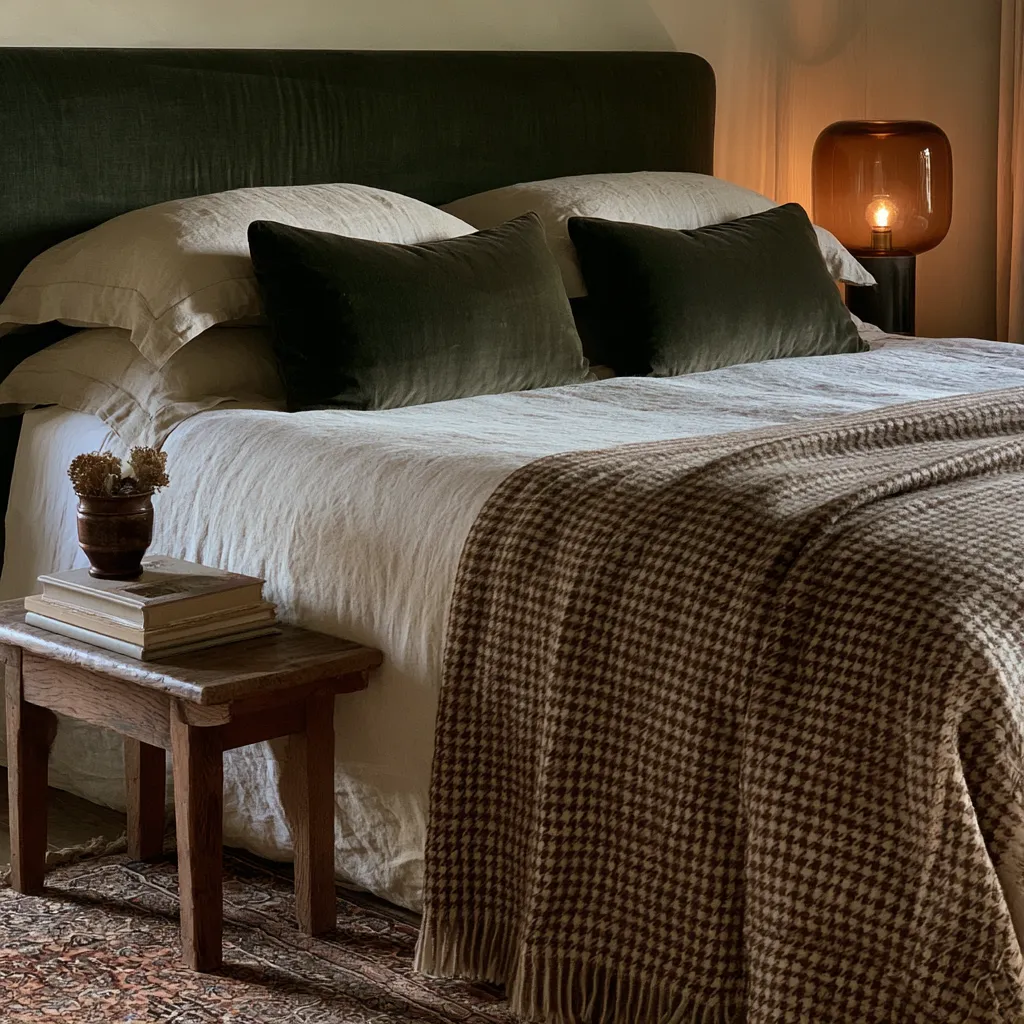
Georgian bedroom design gets misread constantly. People spend thousands on a mahogany four-poster, hang a gilded mirror, and end up with a room that feels more like a period-drama set than somewhere they’d actually sleep. The real backbone of a Georgian bedroom — the thing that makes the whole scheme click — isn’t a single piece of furniture. It’s the logic behind how every element relates to every other one. Symmetry, honest craftsmanship, and architectural scale work as a system. Miss one, and the room falls flat no matter how much you spent.
I’ve reworked two bedrooms using Georgian principles and learned from both what you can cheat and what you absolutely cannot. The era ran from 1714 to 1830 — four King Georges, a lot of Palladian influence, and an almost obsessive commitment to proportion. What’s remarkable is how directly that translates into a room that actually promotes sleep. Order calms the brain. Georgian designers knew this before neuroscience caught up.
Quick Scan
- Target keyword: Georgian bedroom, Georgian bed, Georgian style bedroom
- Section 1 — Symmetry: Covers georgian bed placement, twin sconces, window pairing
- Section 2 — Furnishings: Covers georgian bedroom furniture — mahogany four-posters, Chippendale dressers, gilded mirrors
- Section 3 — Decor & Colour: Covers georgian bedroom ideas — palette, moldings, chandeliers, textiles
- FAQ: Georgian era bedroom, georgian style bedrooms, georgian style interior design
How Symmetry Actually Builds a Georgian Bed Layout
Symmetry in a Georgian bedroom isn’t decoration — it’s structure. Think of it the way a tailor thinks about a jacket: every element on the left has a corresponding element on the right, and the whole thing only looks intentional when the proportions are correct. I bought a pair of brass wall sconces from Vaughan Designs (around $480 each) specifically to flank my bed, and the room transformed before I even touched the bedding. The georgian bed sits centered on the wall, flanked by matching nightstands — not approximately matching, identically matching.
Windows are the most underrated part of this formula. Georgian rooms were designed with evenly spaced sash windows, often in pairs, so natural light arrives from balanced positions. You’ll notice in any authentic georgian style bedroom that no single window dominates — light is distributed, not spotlit. If your room has an asymmetrical window layout, use curtains of identical weight and length on both sides to visually even it out.
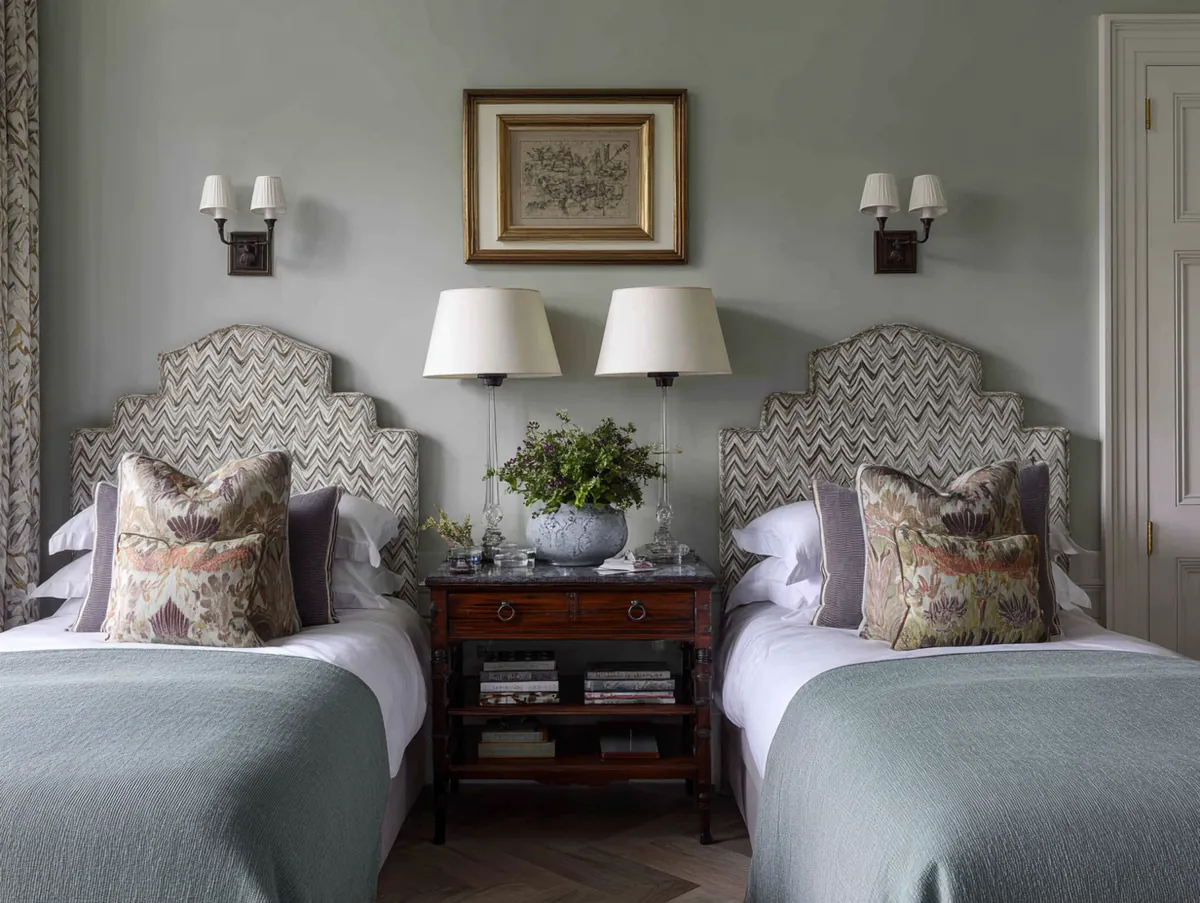
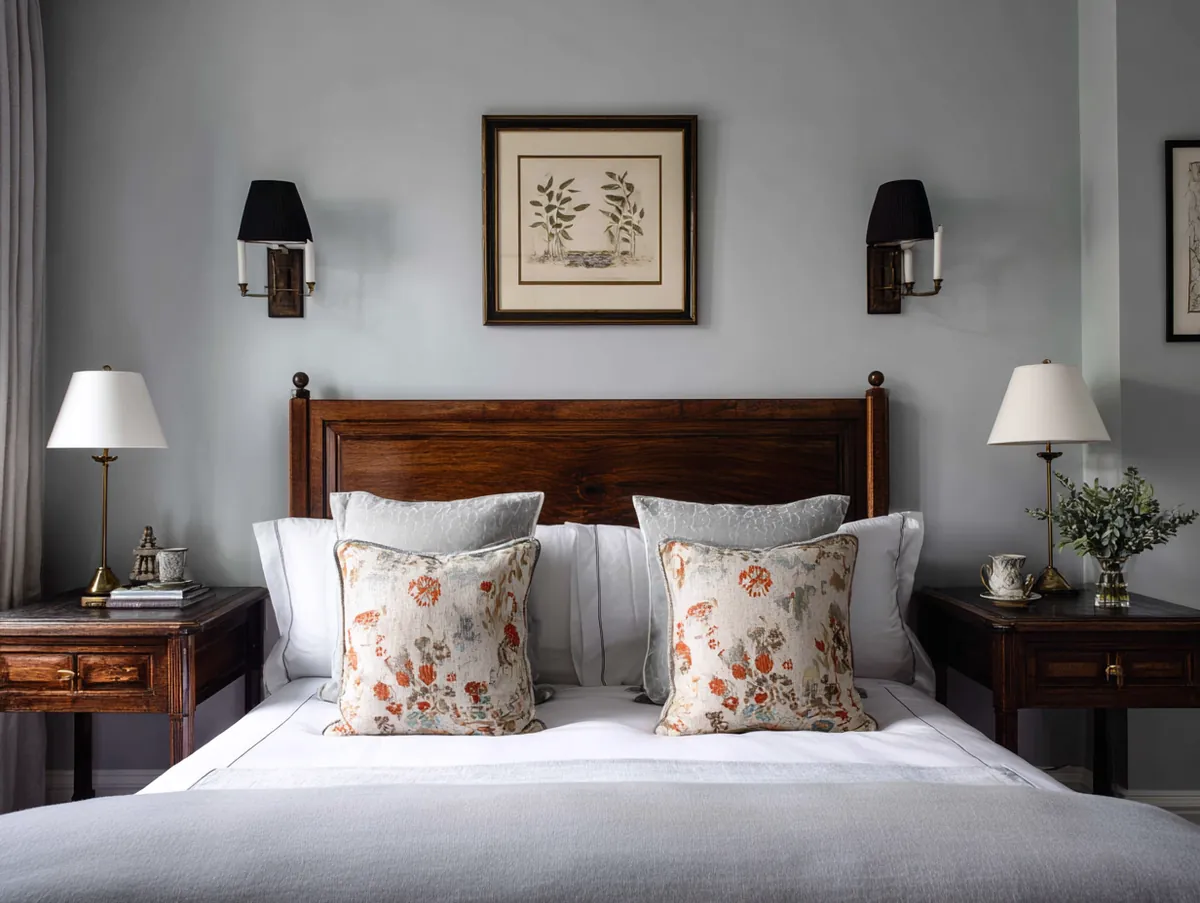
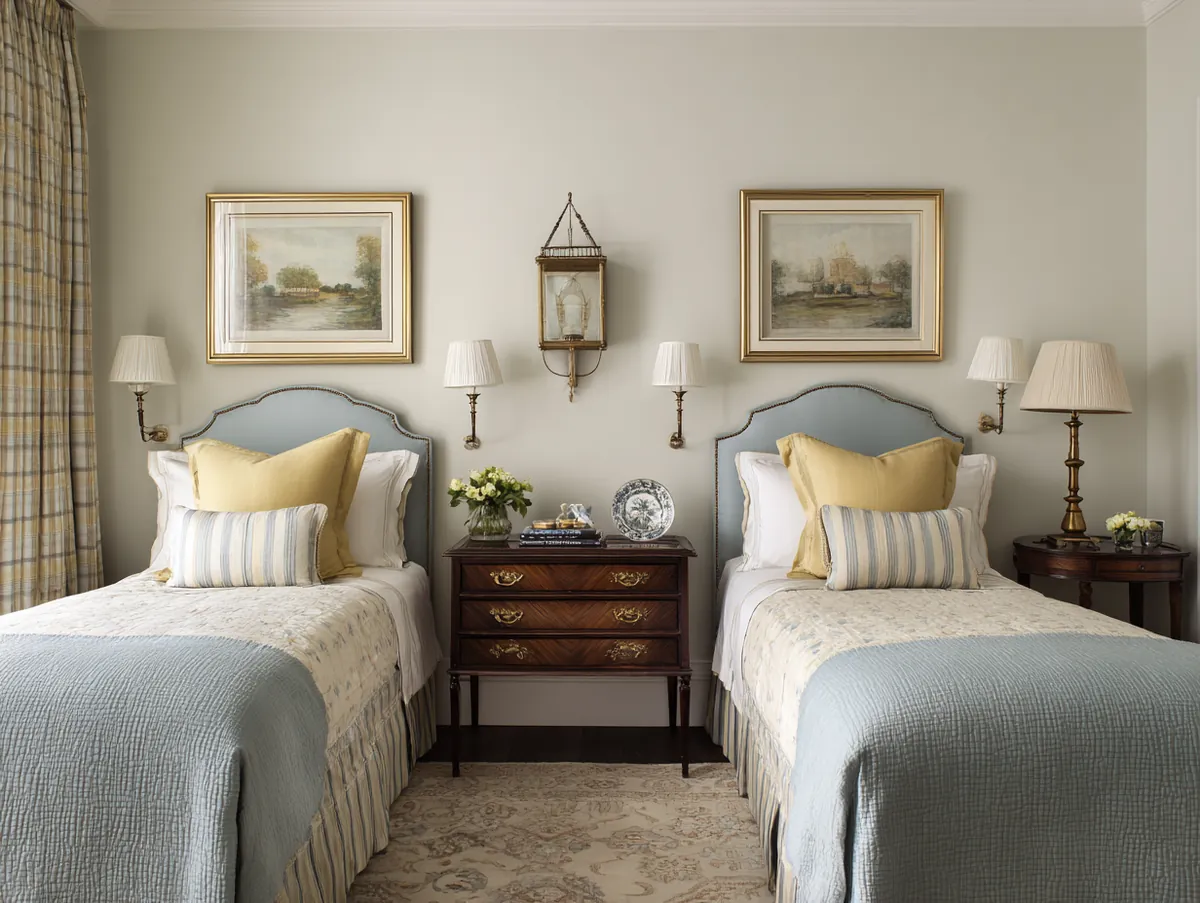
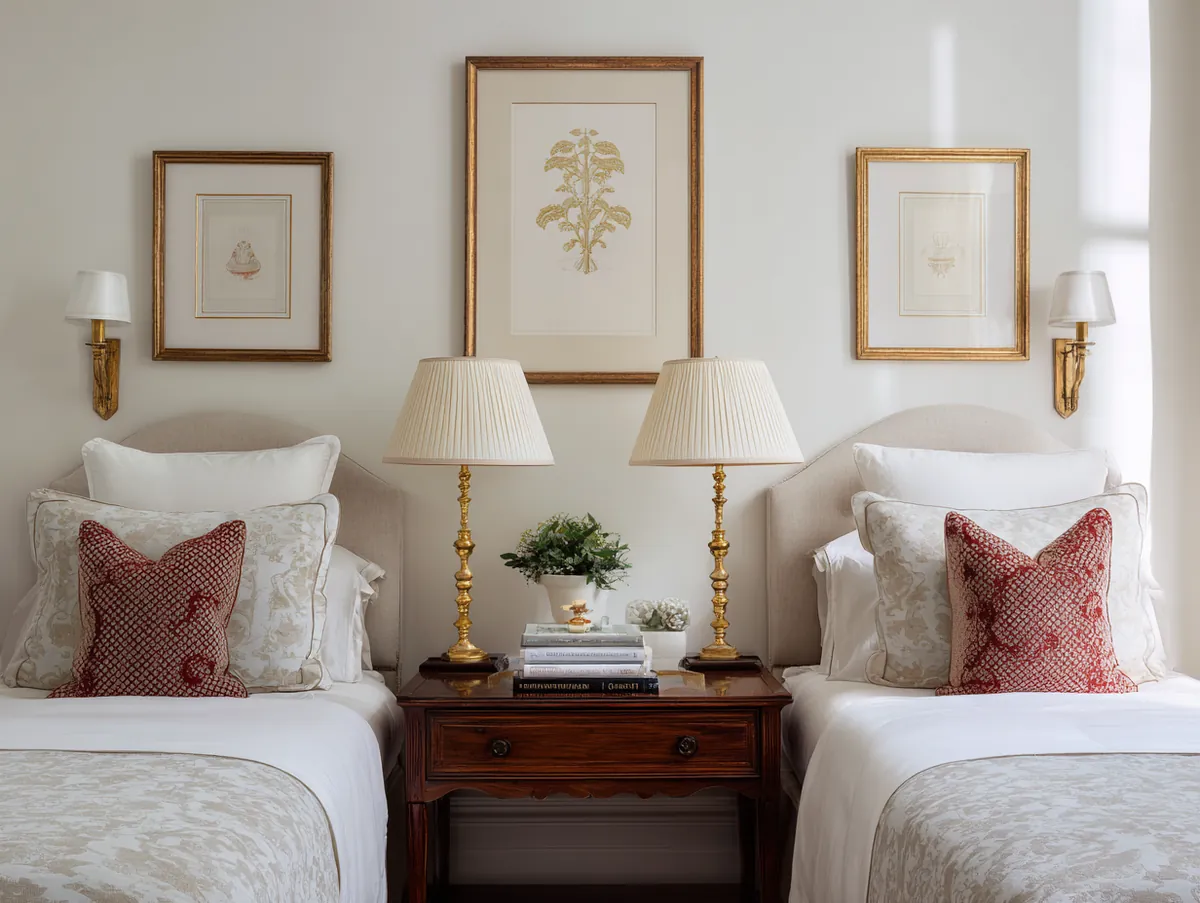
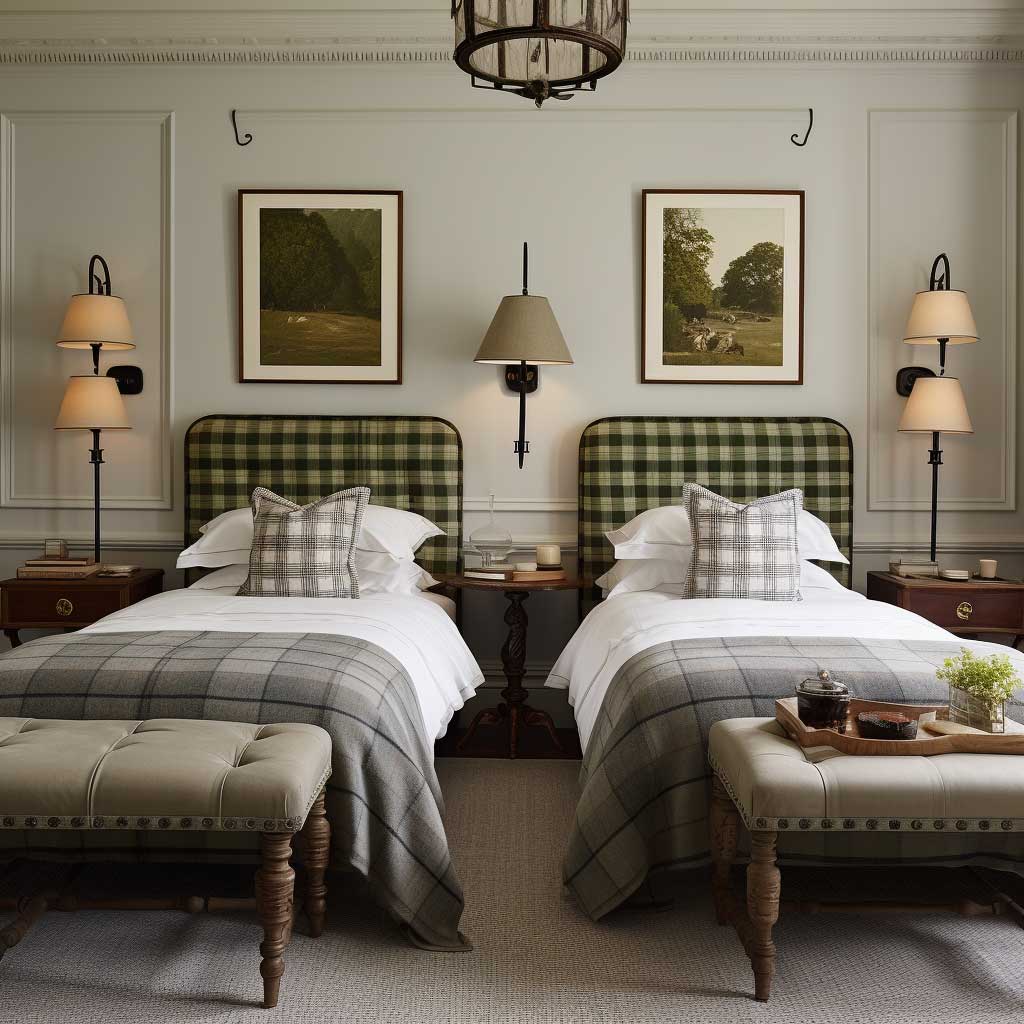


The fireplace, when present, acts as the room’s fulcrum. Place it centered on one wall and let every other element radiate outward from it symmetrically. Chairs in pairs, artwork in pairs, even candlesticks. What trips people up is buying one striking antique piece and trying to make it work solo — it never does in a Georgian context. Two $80 chairs from an estate sale beat one $600 statement armchair every time in this scheme.
Here’s what I’d skip: don’t force symmetry onto a room with genuinely asymmetric architecture unless you’re willing to do the plasterwork to fix it. I tried painting one wall to compensate for an off-center door and it looked worse, not better. Start with a room that already has reasonable bones, or budget for the structural fix first.
Textiles reinforce the logic. Curtains should match exactly — same fabric, same puddle, same ring height. My go-to is a medium-weight linen in off-white: it reads as period-appropriate and doesn’t fight the wood tones that are central to any georgian bedroom furniture scheme. Blue wall panelling can sharpen a Georgian bedroom’s classical drama when the proportions are right — navy behind the bed, white panel trim to carry the symmetry down the walls.
Georgian Bedroom Furniture Earns Its Price When You Know the Names
Chippendale, Hepplewhite, Sheraton — these aren’t just antique-dealer jargon. Each name represents a distinct furniture vocabulary that defined different decades of the Georgian period, and mixing them carelessly is how you get a room that looks expensive but incoherent. Thomas Chippendale’s pieces (roughly 1750s–1770s) feature the most elaborate carving: cabriole legs, ball-and-claw feet, gothic lattice backs on chairs. George Hepplewhite’s work came later and leaner — tapered legs, oval backs, delicate inlays rather than heavy carving. You can combine them, but pick one as your dominant voice.
The georgian bed itself is the starting point. Mahogany four-posters are the classic choice — Niagara Furniture makes a King Size solid mahogany version with hand-carved flame finial posts at around $2,800, which is honest value for what you’re getting. Walnut works equally well and tends to photograph warmer. Don’t buy a four-poster with thin, turned posts — the posts need mass to hold the room visually. Skinny posts on a big bed look like a birthday cake with toothpick candles.
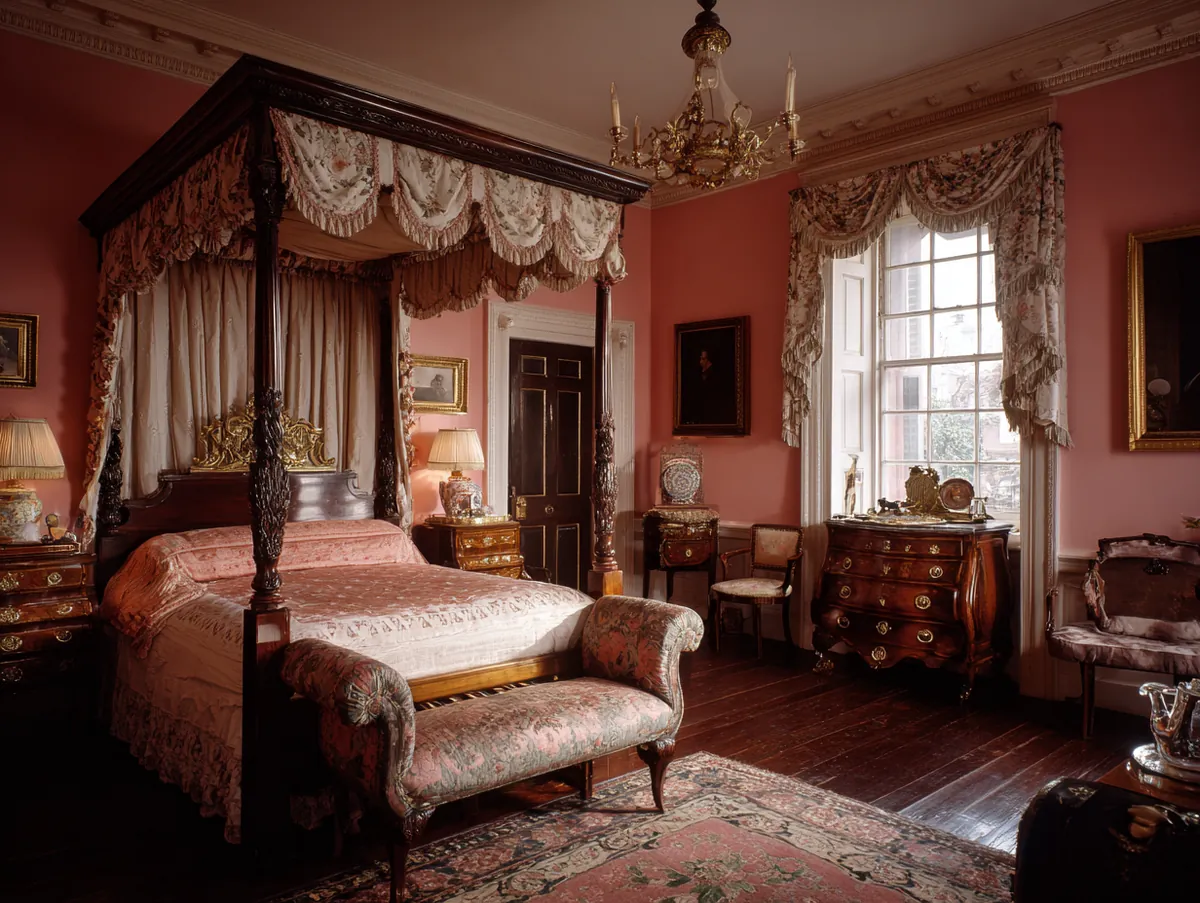
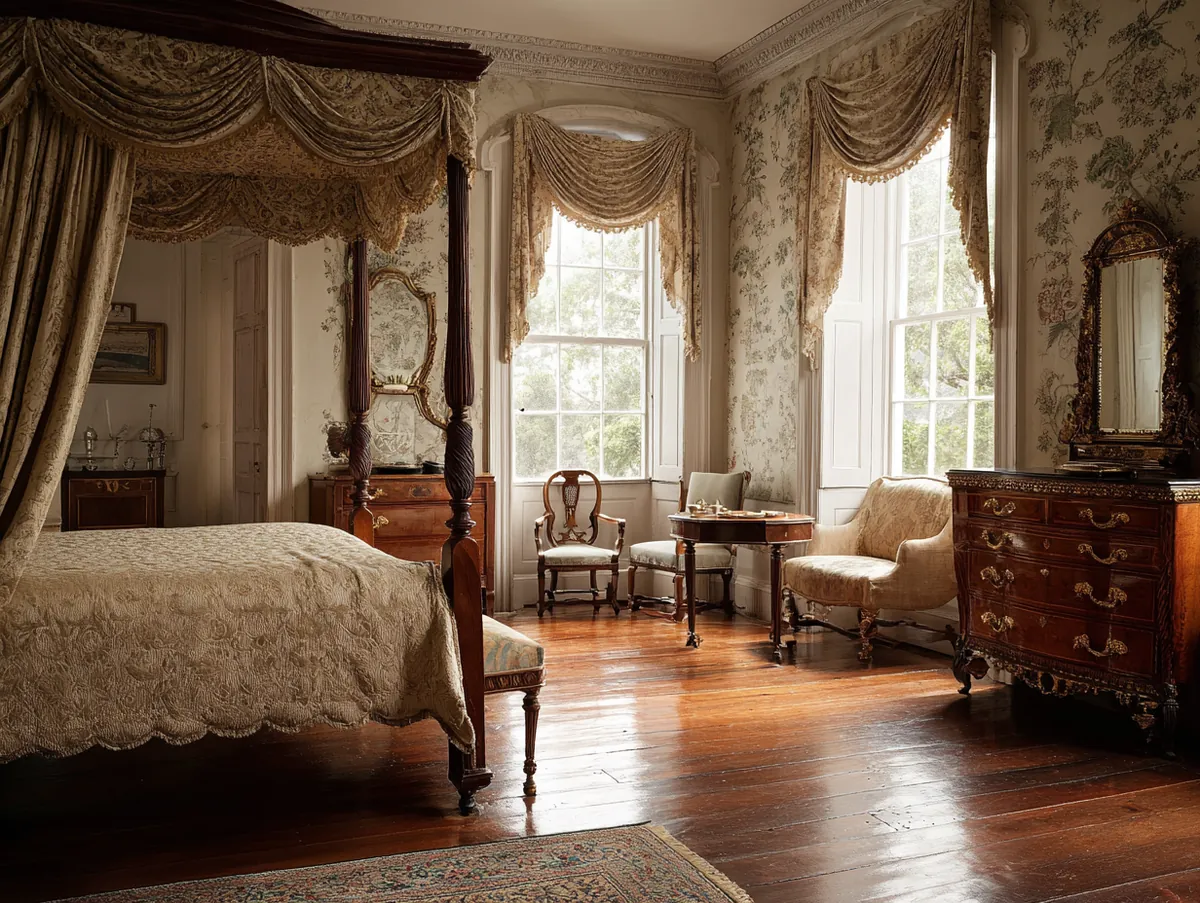
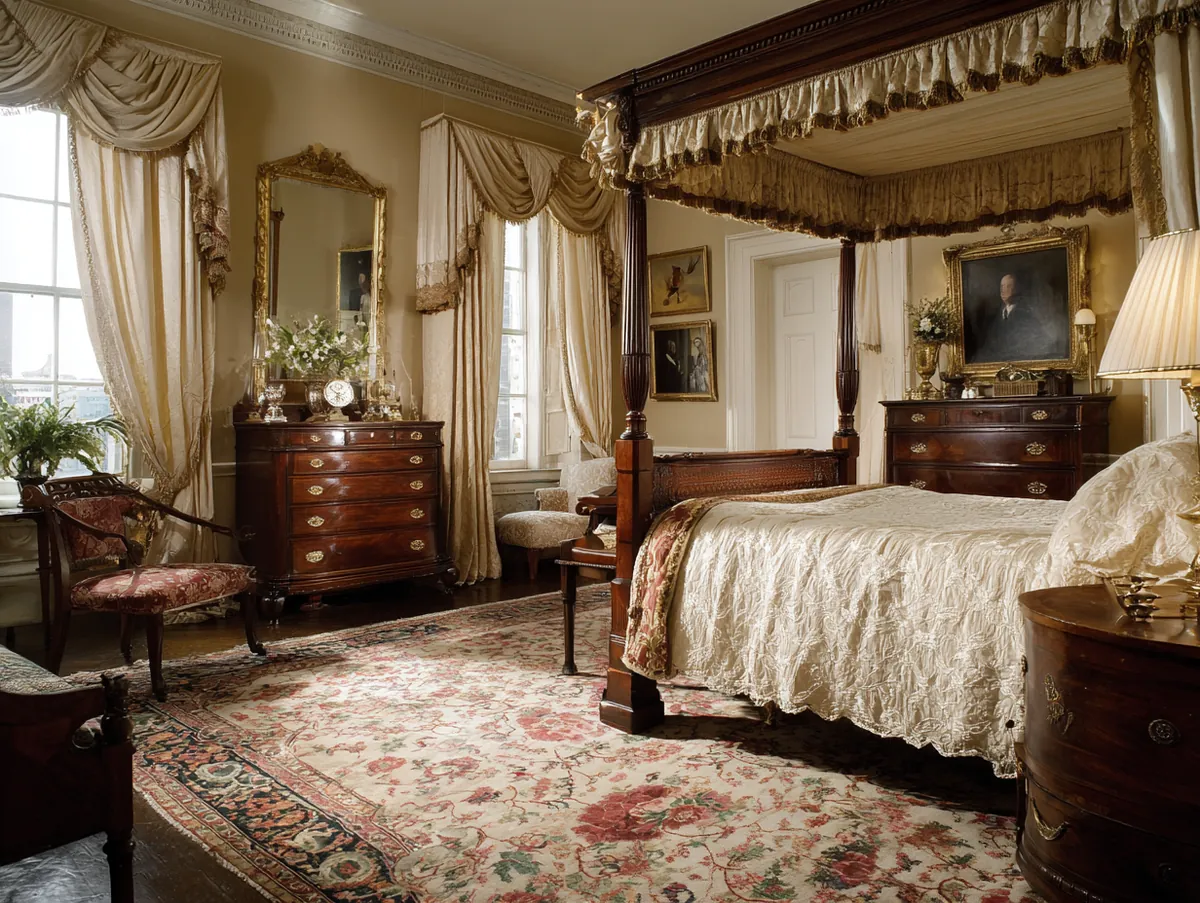
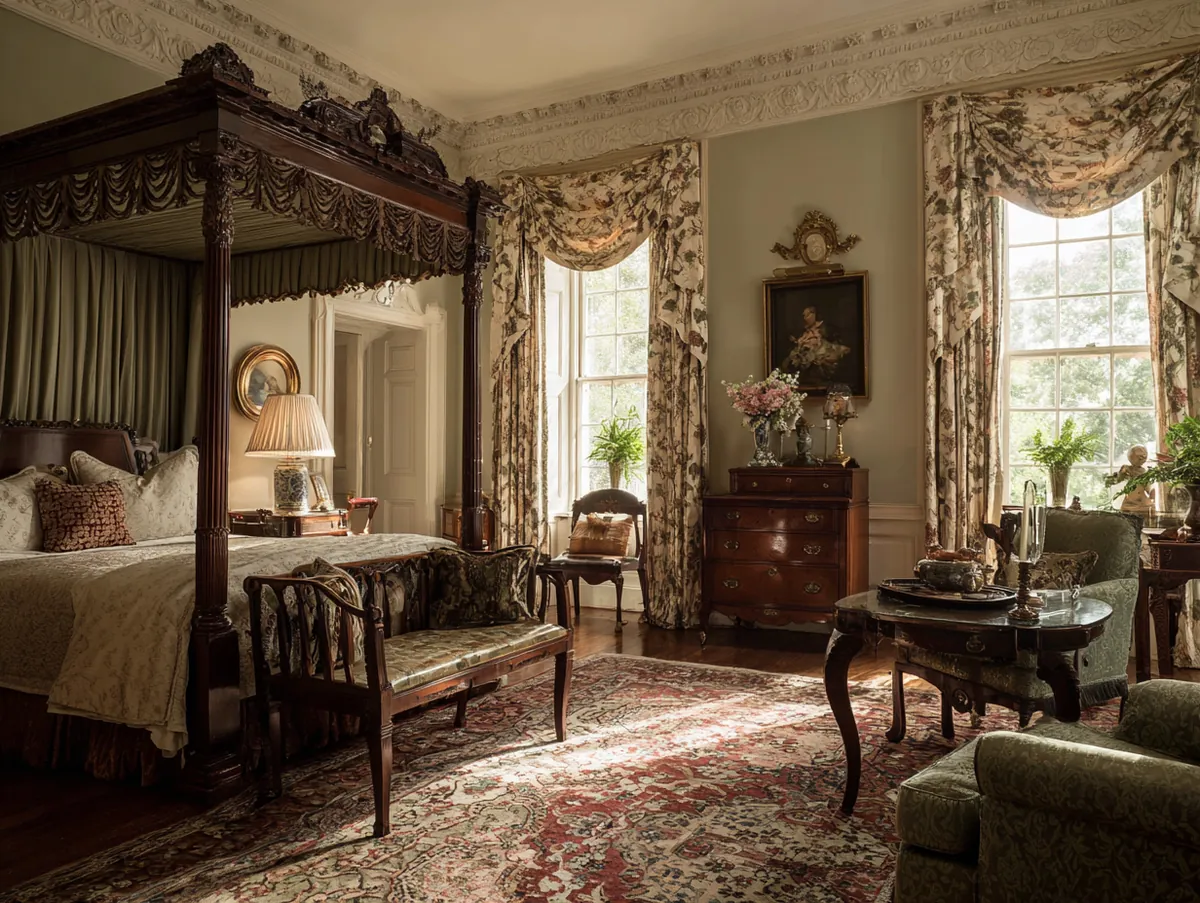



Dressers and wardrobes are where I see people overspend on the wrong things. Ornate drawer pulls are period-correct, but the handles on most reproduction pieces are undersized — they look mean against a large carcass. Swap them out for solid brass bail pulls at least 3 inches wide; a set of eight from House of Antique Hardware runs about $180 and changes the piece entirely. Mirrors framed in gilded wood belong above the dresser, not floating on a random wall. Alignment matters: the mirror center should sit at eye level when standing, not when seated on a low bed.
Seating in a Georgian bedroom isn’t optional — it’s architectural. A chaise longue upholstered in silk or heavyweight linen at the foot of the bed completes the room’s proportional logic. I own two Hepplewhite-style shield-back chairs that I picked up at auction for $340 the pair, and they do more for the room than the rug I spent $900 on. Silk damask fabric in a deep blue or bottle green reads as period-correct and ages beautifully.
Don’t Do This
Mixing Georgian furniture with raw industrial elements — exposed pipes, Edison bulbs, concrete — doesn’t create “contrast.” It destroys the proportional logic that makes Georgian rooms work. I’ve seen this done in dozens of interior shoots and it invariably reads as a design school project, not a considered home. If you love industrial texture, choose a different base style. Georgian doesn’t negotiate with rawness.
Also skip lacquered furniture finished in white or cream. It reads as French Provincial, not Georgian, and the color story becomes confused the moment you add any dark wood accent.
Georgian Bedroom Decor Starts at the Ceiling, Not the Bed
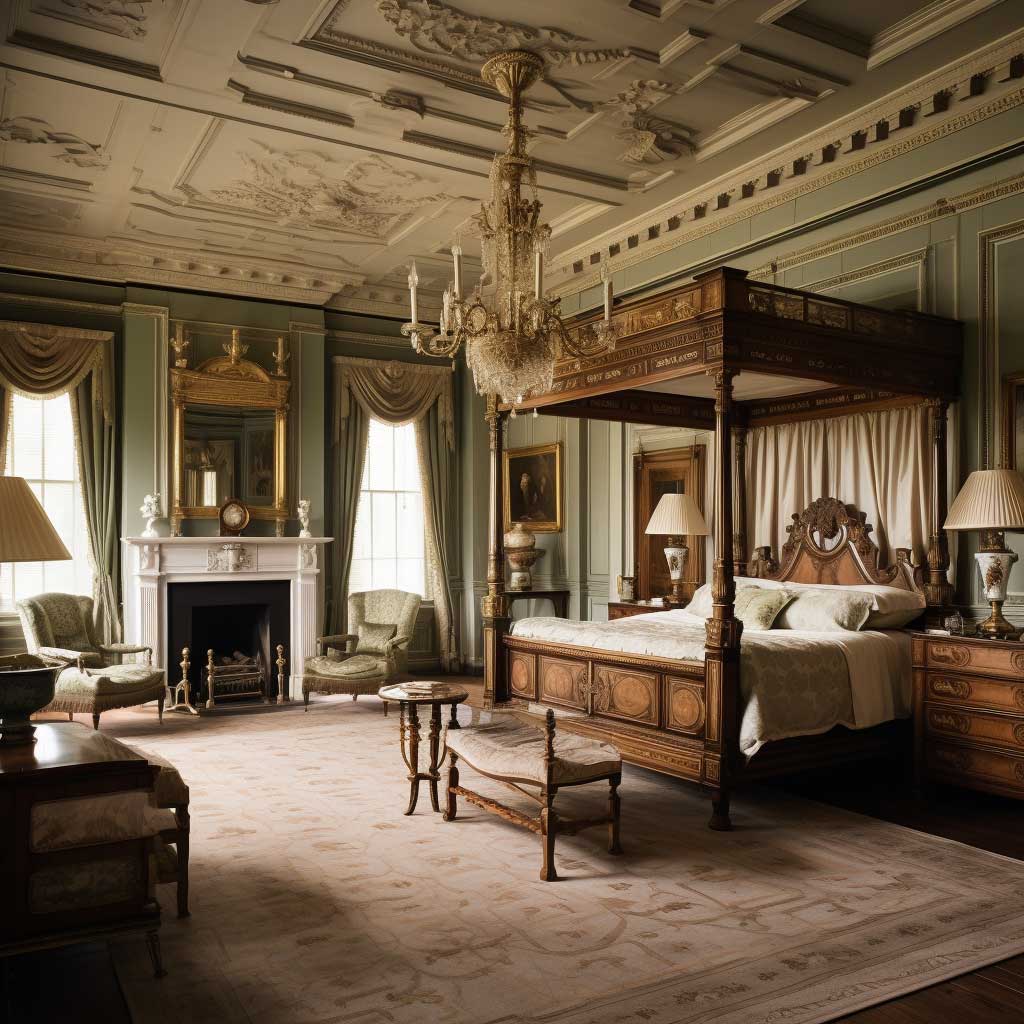
Most people furnish a georgian bedroom from the floor up and wonder why it never looks finished. Start at the ceiling. Georgian rooms are defined by their plasterwork cornices — that decorative junction where wall meets ceiling — and without it, even the best furniture scheme looks like it’s missing its frame. A basic egg-and-dart plaster cornice costs around $12–$18 per linear foot installed, and it adds more visual authority than almost anything else you can buy at that price point. I stole this trick from a Farrow & Ball room guide and haven’t looked back.
Colour is where georgian bedroom ideas get interesting, and also where most people play it too safe. The original Georgian palette wasn’t beige. It included deep Prussian blues, verdigris greens, and rich ochres — all made possible by advances in pigment technology in the 18th century. Farrow & Ball’s “Hague Blue” (No. 30) is my go-to for a georgian style bedroom wall: dark enough to feel period-correct, not so dark it swallows the room. Pair it with their “String” for trim and you get exactly the contrast the originals intended.
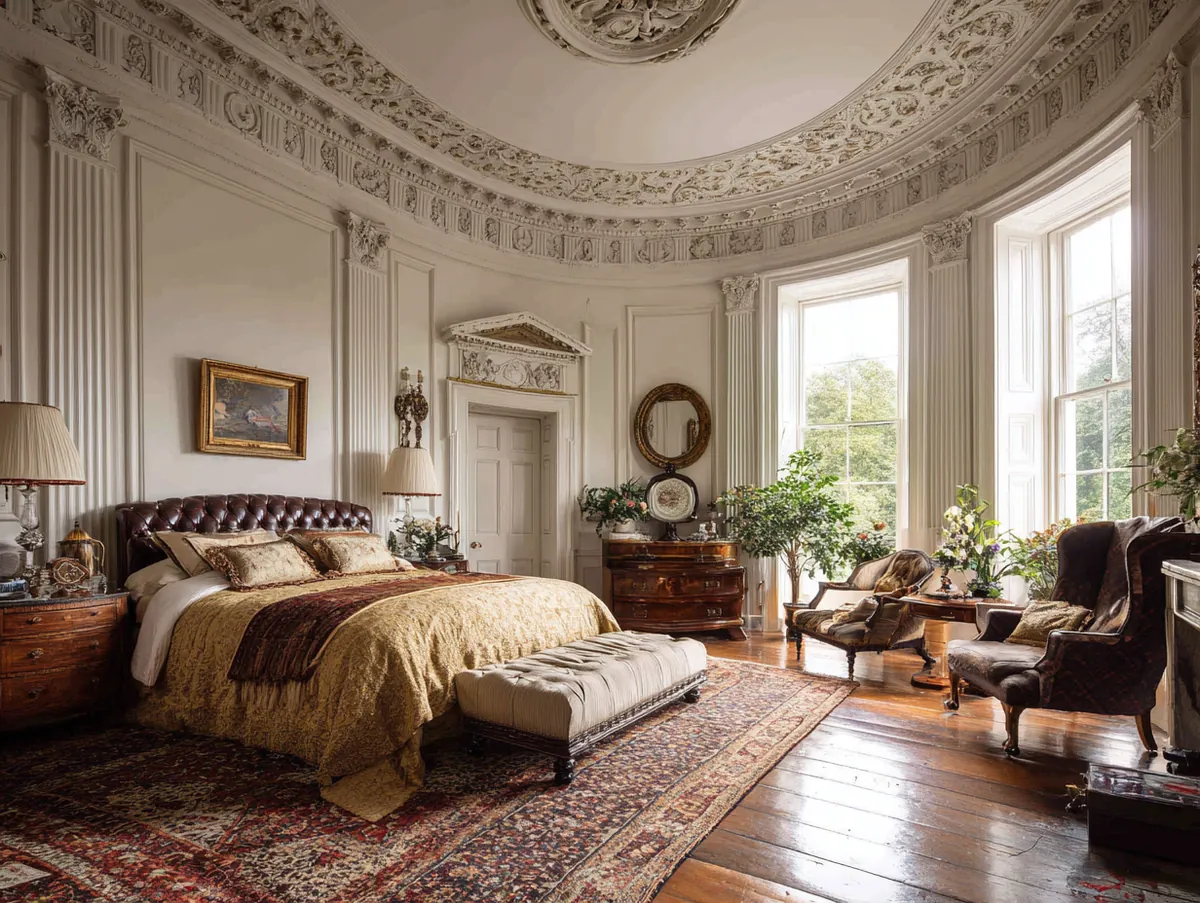
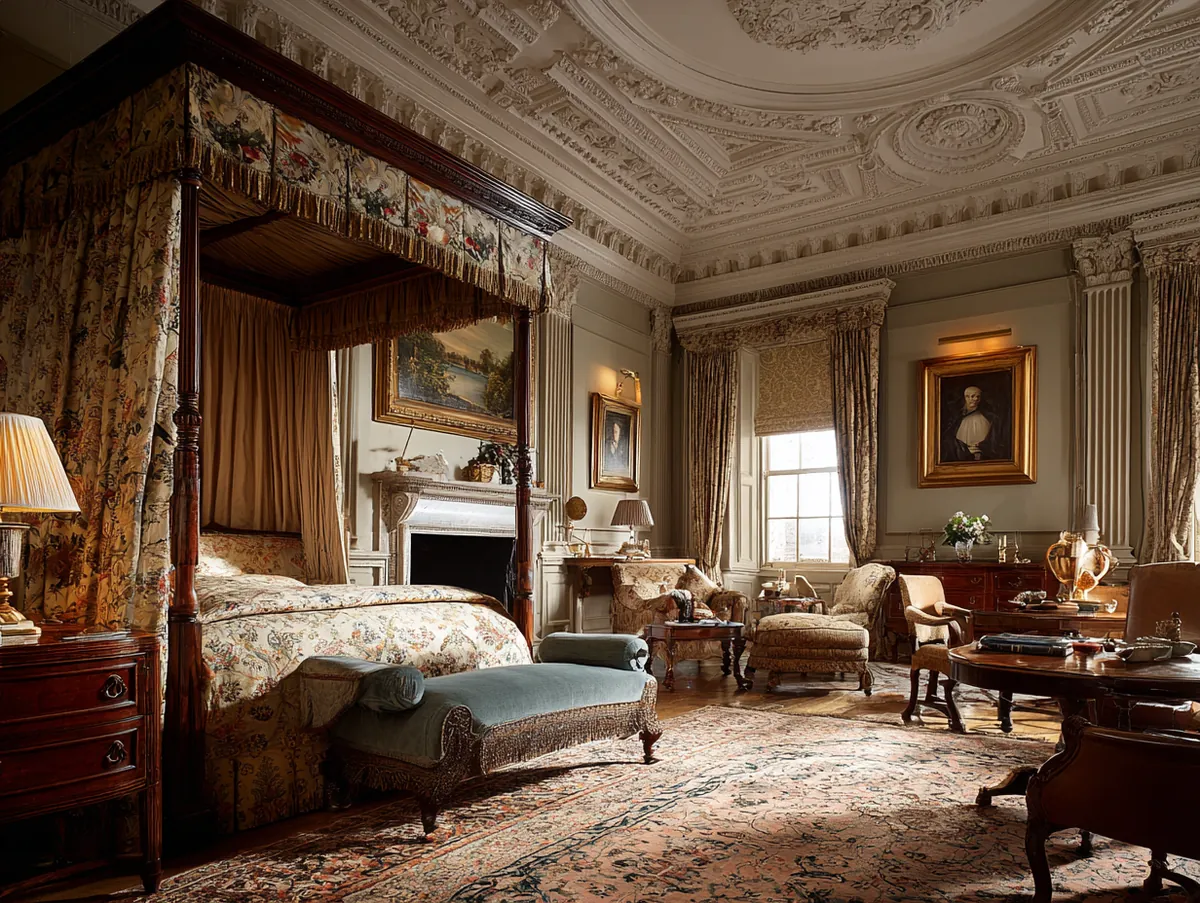
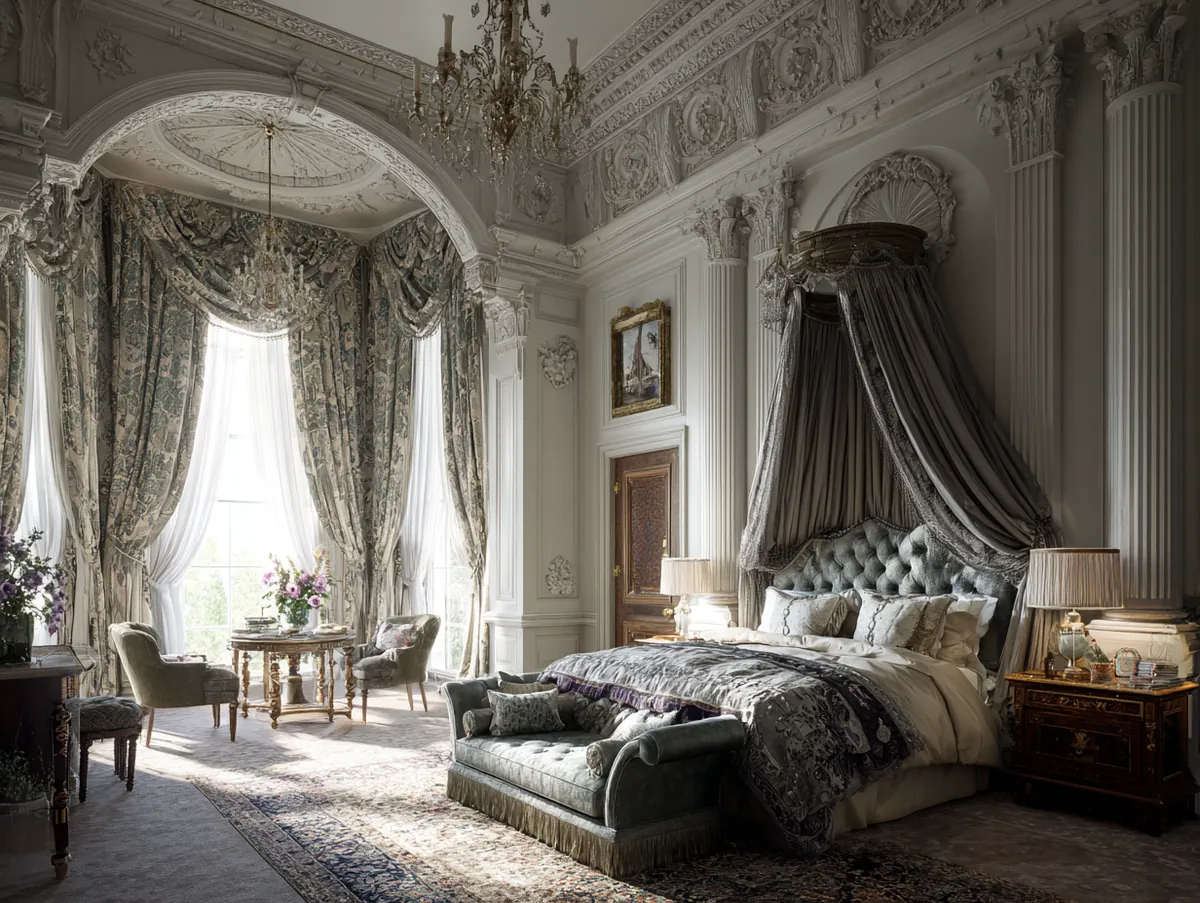
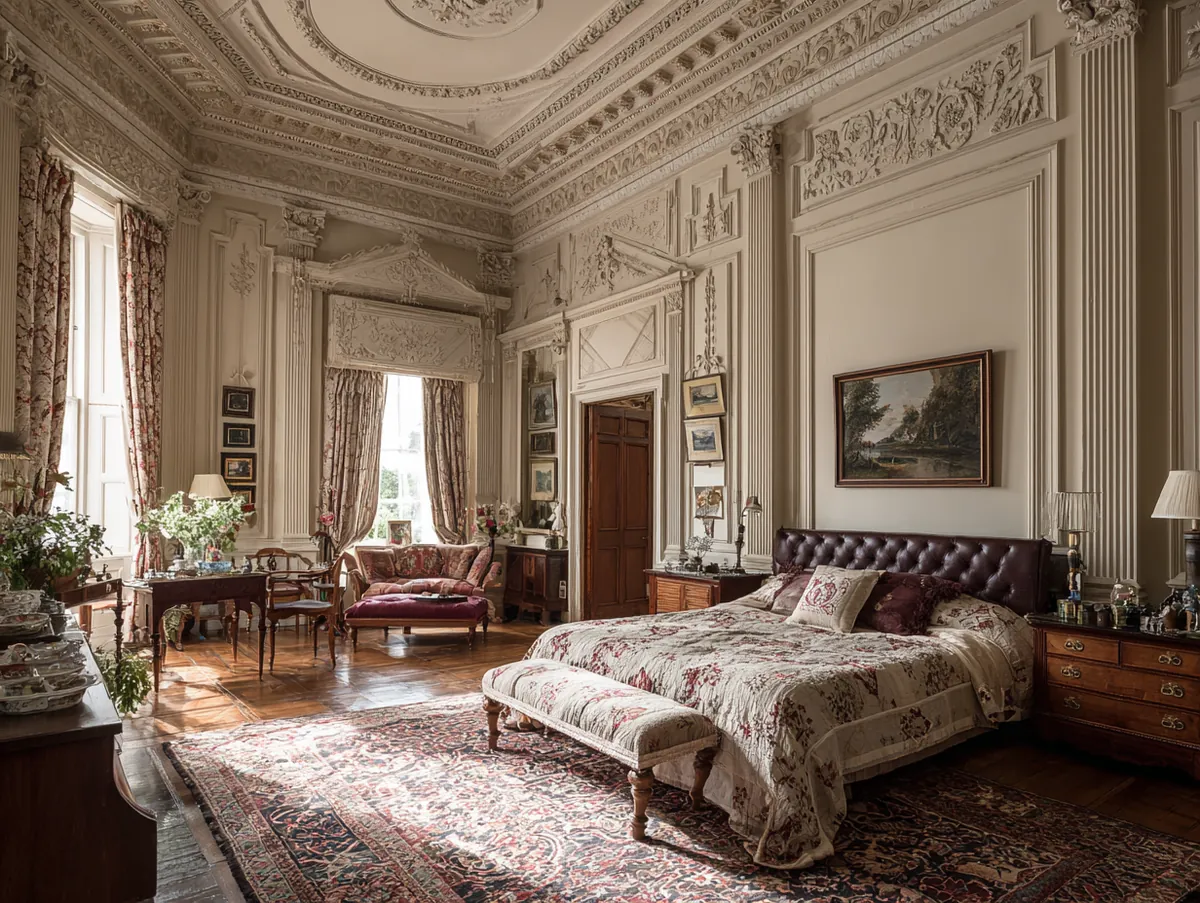


Decorative accents in a georgian interior design scheme should read as collected, not purchased as a set. Ornate gilded mirrors, a crystal chandelier scaled to ceiling height (not room size — ceilings in this style want drama overhead), a Persian or Turkish rug in jewel tones — these layers make the room feel inhabited by someone with taste and history. Georgian rooms absorbed global influence freely: Chinese export porcelain on the mantel, a Venetian mirror above the dresser, Indian muslin at the windows. You’re allowed to do the same. According to Britannica’s overview of Georgian style, the era also saw Josiah Wedgwood advance decorative ceramics to a level of artistry that made them prized display objects in wealthy interiors.
Lighting temperature is the detail most people ignore. Georgian rooms used candlelight — warm, amber, flickering. An LED bulb at 5000K (cool white) destroys every warm wood tone you’ve spent money on. I use 2700K bulbs exclusively, and in the bedroom specifically I layer a central chandelier with bedside candlestick lamps. The chandelier is for getting dressed; the candlesticks are for everything else. Get the lighting right and you can get away with cheaper furniture — nobody inspects the joinery by candlelight. Classical wall panelling ideas work especially well in this scheme, bringing the architectural richness of the era directly into the wall surface.
Georgian Bedroom Style Comparison
| Element | Authentic Georgian | Common Mistake |
|---|---|---|
| Bed frame | Solid mahogany or walnut, heavy posts | Thin-post four-poster, mixed woods |
| Wall colour | Deep Prussian blue, verdigris, rich ochre | Neutral greige or all-white |
| Lighting | 2700K bulbs, chandelier + candlestick lamps | Cool white recessed downlights |
| Ceiling detail | Plaster cornice, egg-and-dart or dentil | Plain flat ceiling |
| Textiles | Silk damask, heavyweight linen, velvet | Cotton prints, linen mix throws |
| Symmetry | Matched pairs: sconces, chairs, tables | One hero piece with no counterpart |
Take This With You
A Georgian Bedroom Isn’t Decorated — It’s Calibrated
Start with the cornice, not the bed. Fix the lighting temperature before you buy a single piece of furniture. And never place a significant object without its mirror image somewhere else in the room.
Farrow & Ball Hague Blue. Vaughan Designs sconces in pairs. A solid mahogany four-poster with posts thick enough to mean something. That’s the short list.
Save this post before you start your next bedroom project — the checklist lives here.
FAQ
What is the difference between a Georgian bed and a Victorian four-poster?
What colours work in a Georgian style bedroom?
How do I get the Georgian interior design look in a modern room without high ceilings?
What georgian bedroom furniture brands make affordable period-correct pieces today?
Can a georgian era bedroom work in a small space?
Complete guide
Bedroom Design Ideas That Actually Change How You Sleep, Feel and Live
Styles, colors, furniture, walls, layouts — 300+ ideas in one place