Solid garden design ideas don’t start with plants. They start with restraint. I’ve pulled apart three different outdoor spaces in the past two years, and every single one of them had the same problem: too much of everything and no clear focal point to anchor the eye. Minimalist garden design ideas change the game not by adding more, but by choosing one strong element — a stone sculpture, a gravel field, a single dramatic grass — and letting it breathe. You’ll notice the shift immediately. The space stops feeling like a chore and starts feeling like somewhere you actually want to sit.
These three concepts cover what actually works for contemporary outdoor spaces: a Zen-informed stone layout, an abstract pathway built for movement, and a clean-lined design anchored by metal sculpture. Each one is reproducible. None requires a landscape architect on retainer.
Quick Scan
- Zen garden with stone sculpture — white gravel, bamboo, abstract forms, $200–$600 for gravel and plants
- Abstract stone pathway — flat pavers, ground cover, sculptural focal point, $3–$5 per sq ft for stone
- Contemporary metal sculpture garden — concrete paths, geometric steel, ornamental grass, $800–$2,500 for metal pieces
- Mid-century garden statues — what works, what looks dated, and the one finish to avoid
- Aesthetic garden photography — lighting angles and plant selection that actually photograph well
Zen Stone Gardens Reward Subtraction, Not Addition
My go-to recommendation for anyone starting a garden from scratch is white gravel and one good abstract sculpture. Pea gravel from Home Depot runs about $4–$6 per 50-pound bag, and you need roughly 80 pounds per 10 square feet at a 2-inch depth. The math is not brutal. What you’re buying isn’t just material — you’re buying silence, because white gravel does something visually that lawn never can: it makes everything placed on it look deliberate. A single smooth stone sculpture from a ceramics studio or a brand like Campania International (their “Zen” series runs $180–$350) lands differently on gravel than it does on grass.
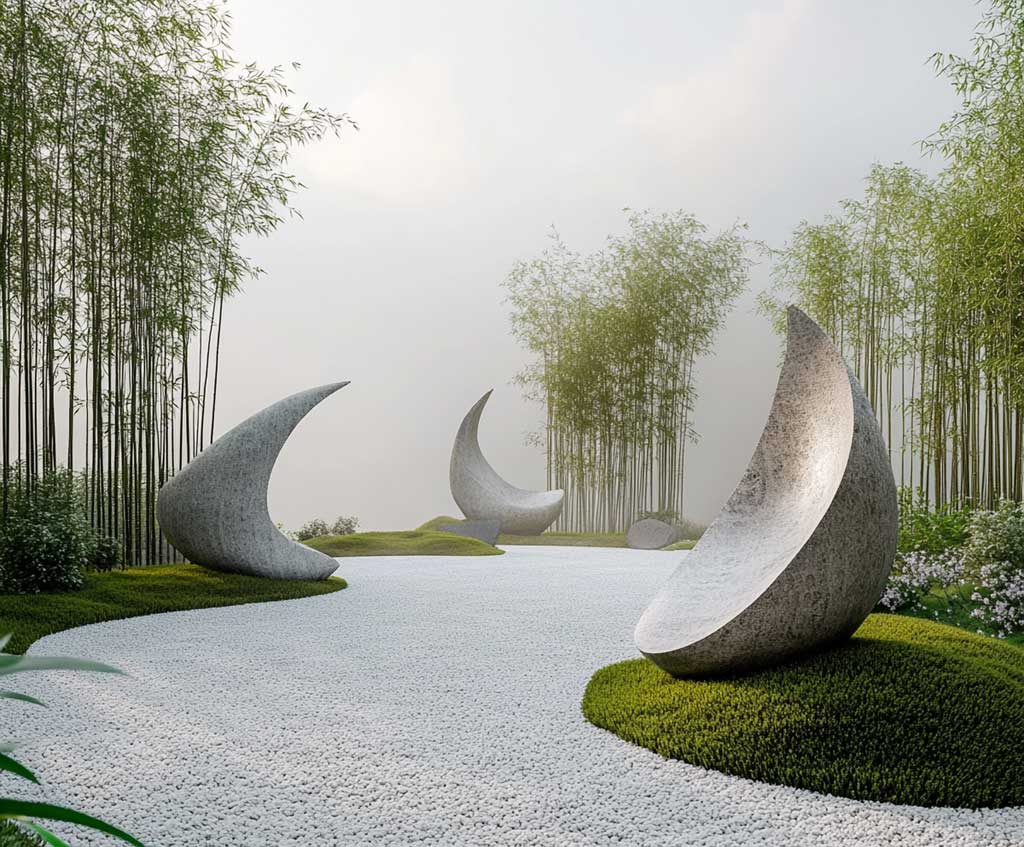
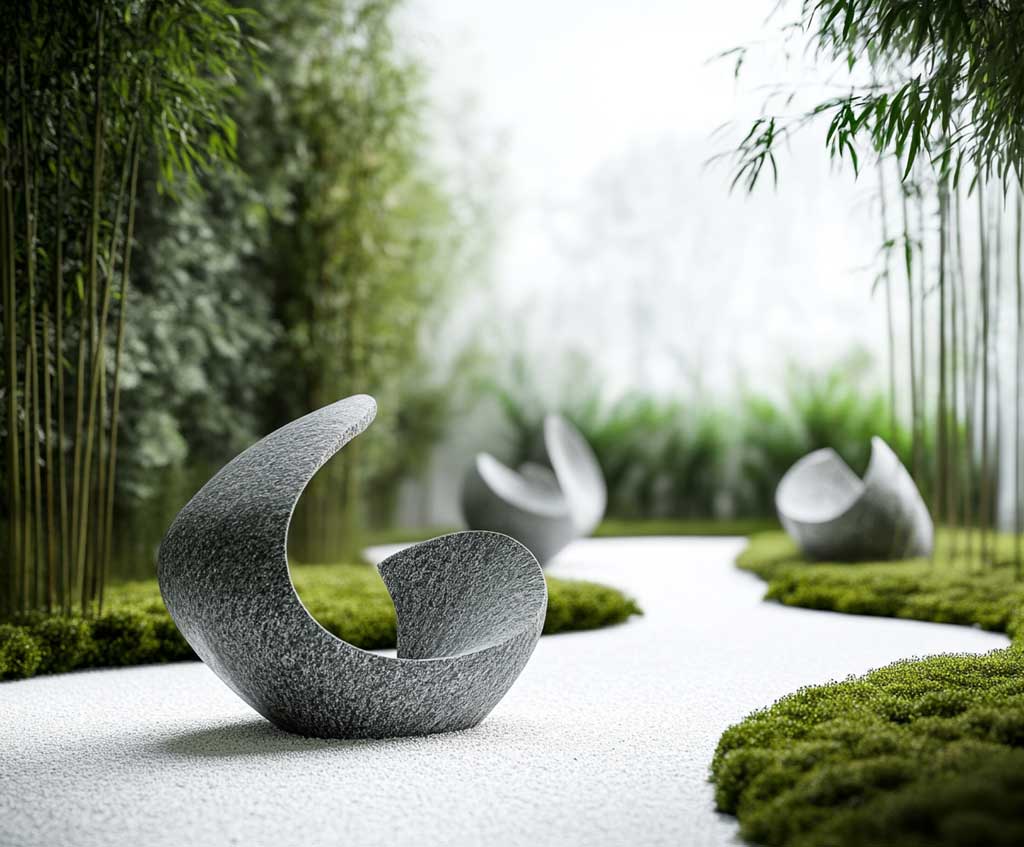
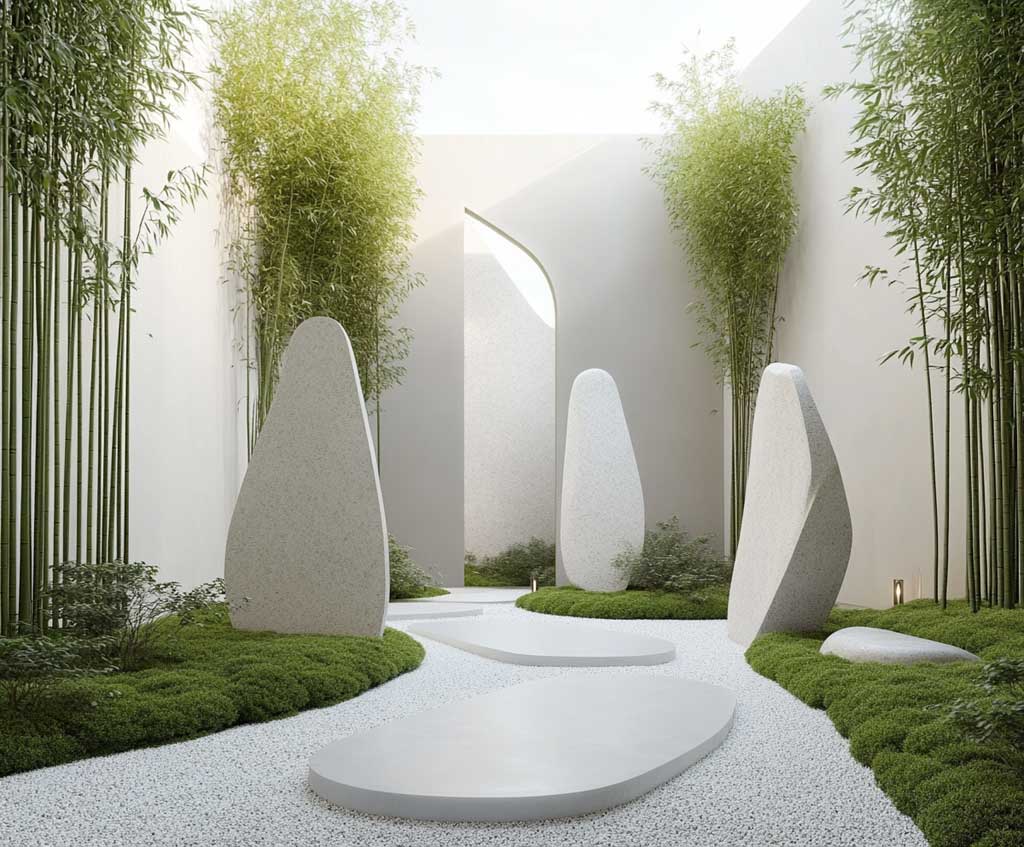
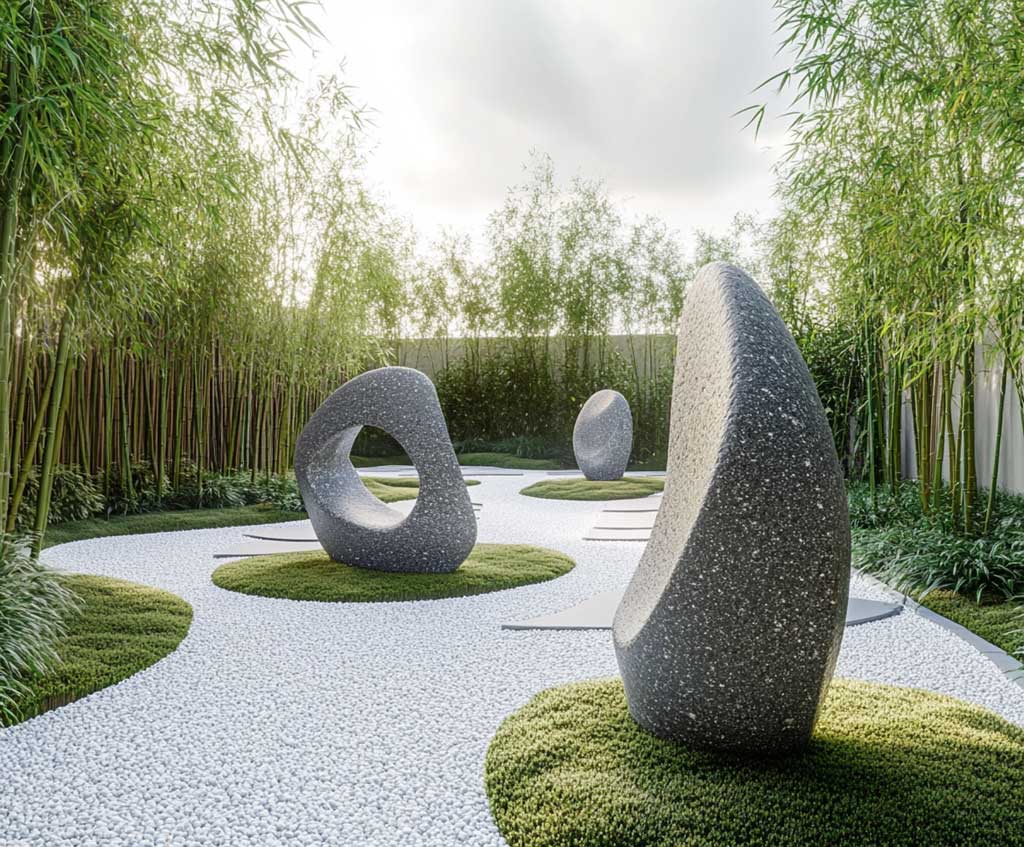
Bamboo is the one plant I’d put in every Zen layout. Fargesia murielae — the clumping variety, not the running kind — stays contained, costs about $25–$40 per plant, and hits 8 feet within three seasons. It casts shadows. Shadows in a Zen garden are doing structural work. The mistake I see constantly is people placing bamboo against a fence in a line, like a privacy hedge. That’s not wrong, but it wastes the plant. Angle it so afternoon light throws the canes across the gravel. Now the whole surface changes at 3pm.
Placement of sculpture along a pathway should follow a rhythm that isn’t perfectly even. If you have three pieces, space them at 6 feet, 9 feet, and 5 feet — not 7-7-7. The irregular spacing is what makes a viewer slow down instead of just walk through. Skip the sculptures with intricate surface carving for a Zen garden. Fussy detail fights the gravel’s calm. You want smooth, abstract forms with one or two curves. Think: something that reads as a shape from 20 feet away. For a related look at how sculptural plants interact with this kind of layout, the principles behind integrating sculptural elements into modern garden design cover the spatial logic in detail.
Stone Pathways Work When the Destination Earns the Walk
Flat flagstone pavers in a wavy layout cost $3–$5 per square foot installed, or about $1.50–$2 per square foot in materials if you lay them yourself. That’s the budget reality. What you’re building isn’t a path — it’s a sequence of decisions for the viewer’s body. Turn left here. Slow down there. Stop at the sculpture. The design only works if there’s actually something worth stopping at. I’ve seen beautiful paver layouts that end at a blank fence. Don’t do that. The focal point at the path’s terminus is non-negotiable.
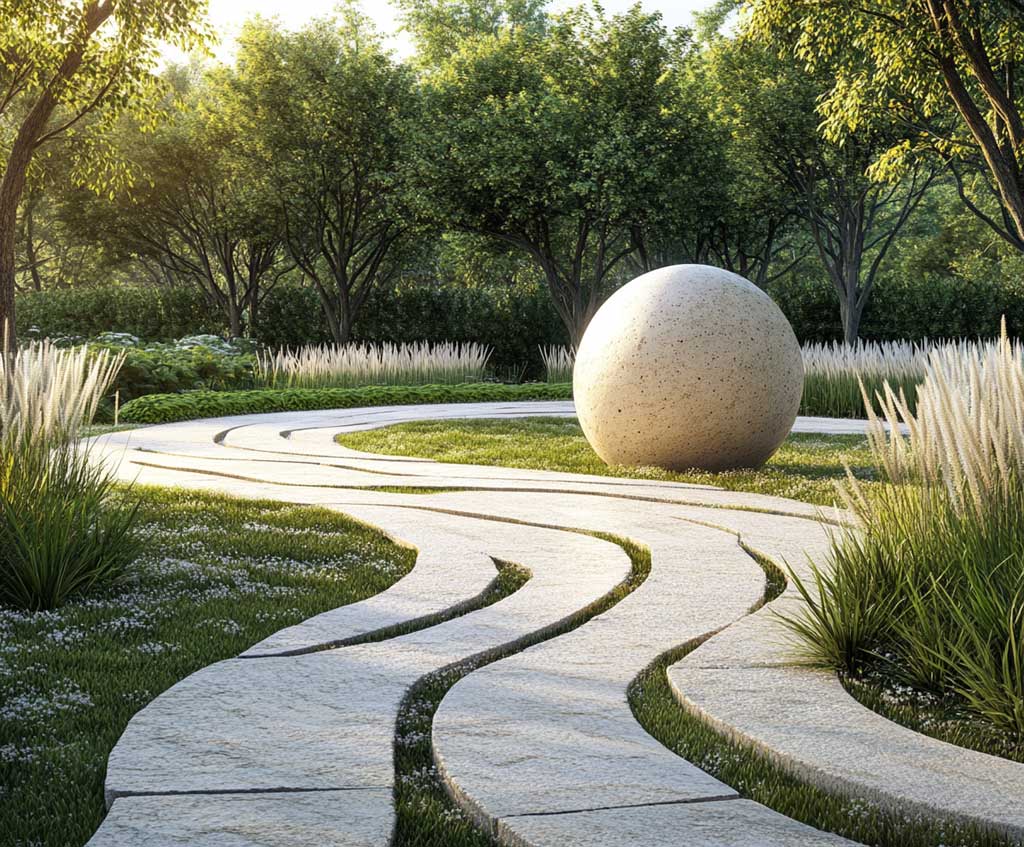
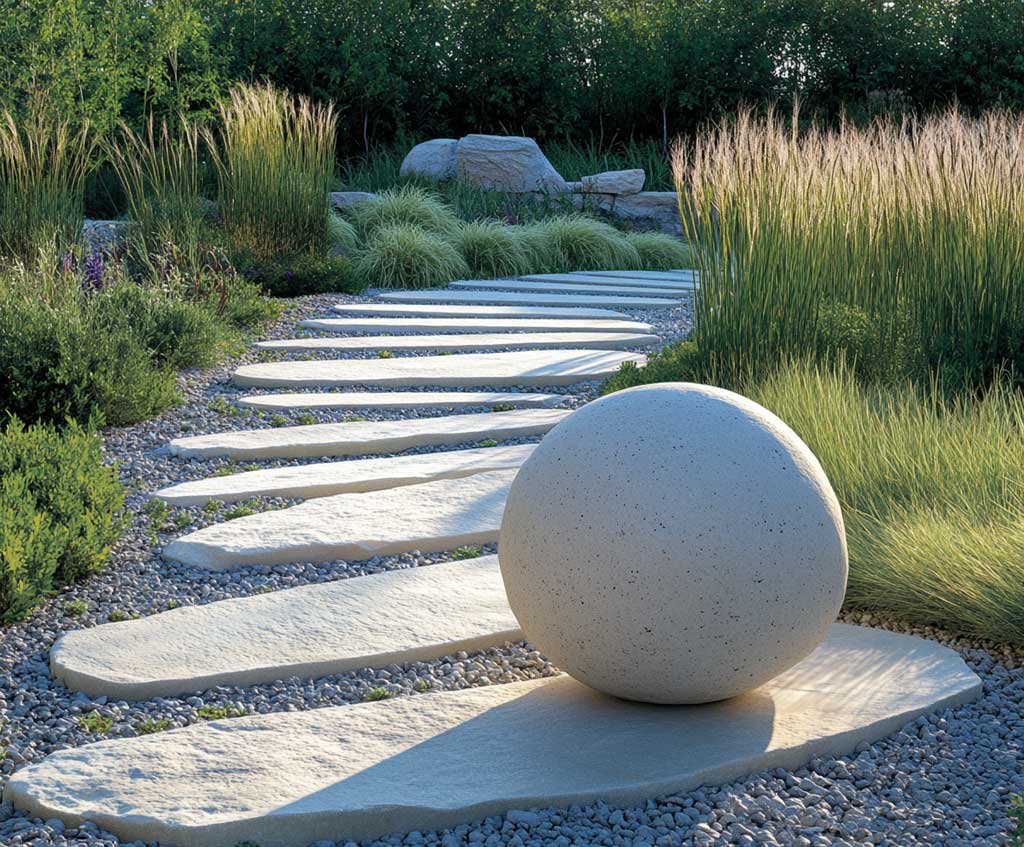
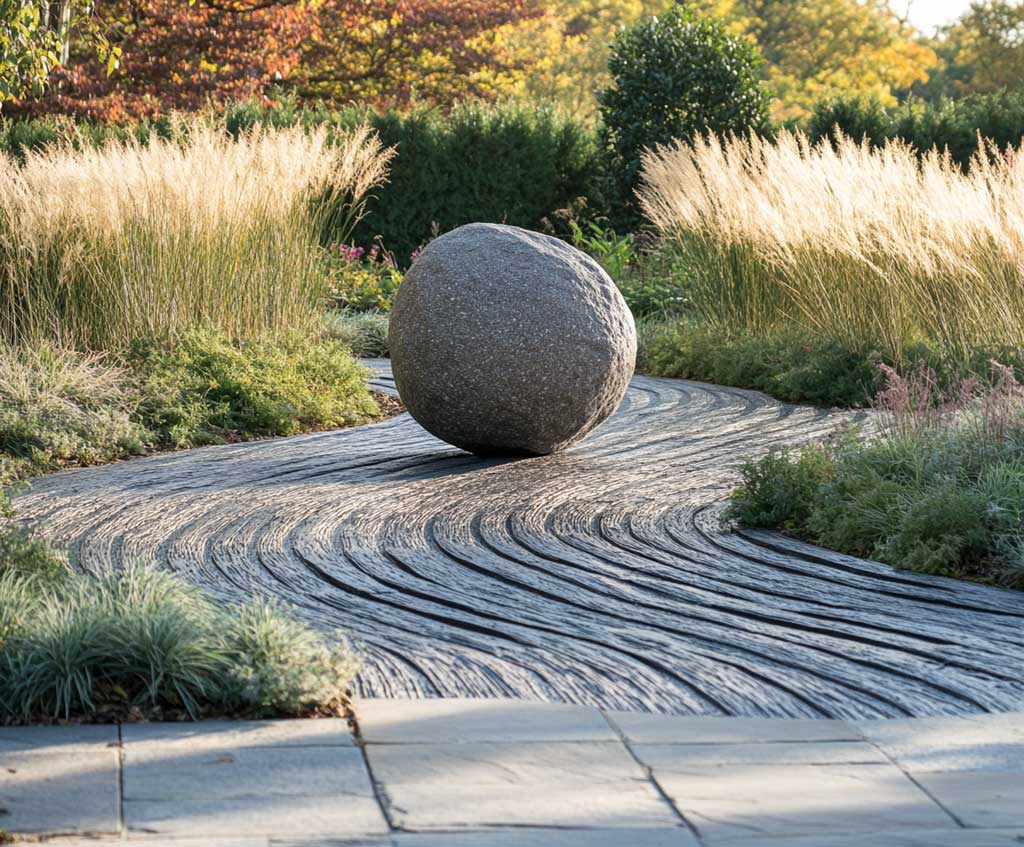
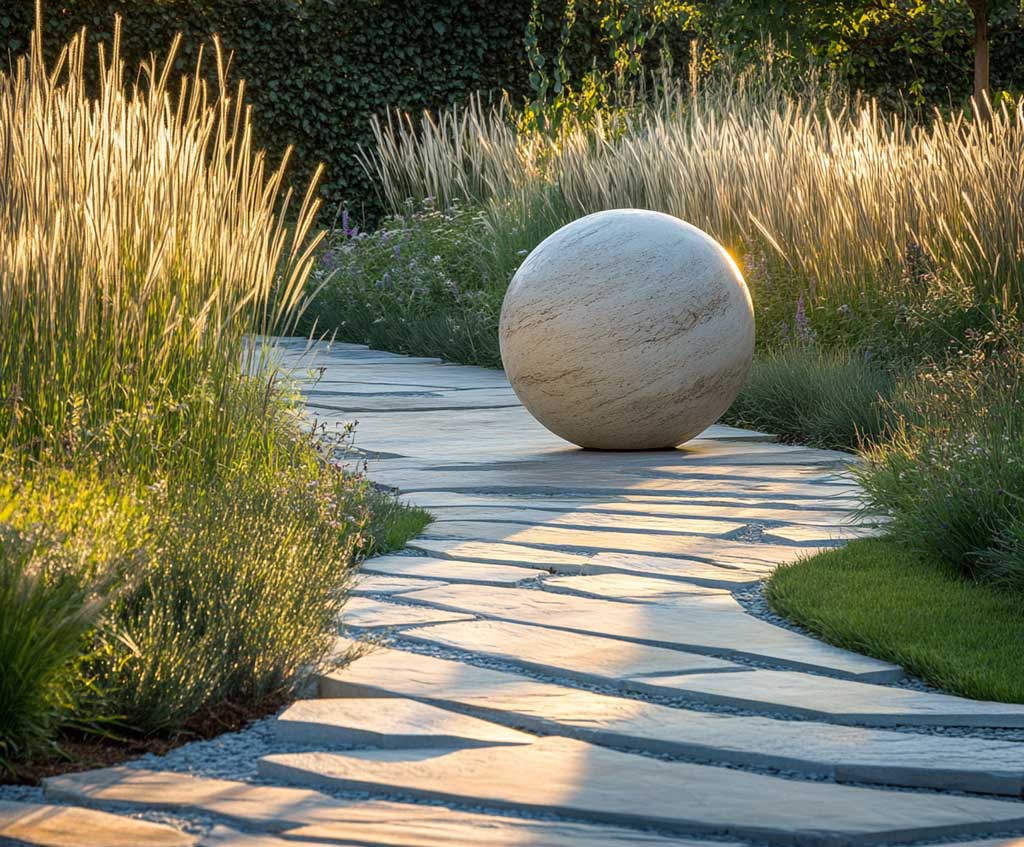
Ground cover is the underrated move here. Creeping thyme runs about $3–$5 per plug and fills in within two seasons. Dymondia margaretae is tighter, grayer, and works better between pavers if you’re in a dry climate. Both survive foot traffic — a fact most people discover too late after they’ve planted fragile baby’s tears in a walking zone and watched it turn to mush. Avoid anything that spreads aggressively between your pavers unless you want to be on your knees with a knife twice a year. I learned that from creeping Jenny. Never again.
Tall ornamental grasses along the path’s edges do something ground cover can’t: they introduce movement. Pennisetum alopecuroides ‘Hameln’ — dwarf fountain grass — tops out at 3 feet, costs $12–$18 per plant, and waves in the slightest breeze. You can buy the whole border for under $150. Place it in irregular clusters, not a continuous row. A continuous row of ornamental grass along a path reads as landscaping. Clusters read as a decision. That distinction is everything for a garden that wants to feel like art placed in nature rather than nature managed by a contractor.
Don’t Do This
Mixing paver sizes on a wavy pathway. Irregular stone sizing makes a fluid layout feel chaotic rather than organic. Pick one dominant size — 24″×24″ or 18″×24″ — and use the occasional smaller piece only to fill gaps. The moment you introduce three different sizes on a curved path, the eye can’t settle. It reads as leftover material, not design.
Skipping the landscape fabric under gravel. You’ll spend the next three summers pulling weeds through your “clean” gravel base. Fabric first, always.
Polished round sculptures look wrong on uneven terrain. Level the base. A $12 paver set flat in the ground works better than any decorative pedestal for this application.
Metal Sculpture and Concrete Paths Age Better Than Any Planted Border
Corten steel is the material I’d use if I were building a contemporary garden from scratch right now. It oxidizes to a warm rust-orange over 18 months and then stops. No maintenance, no painting, no rust progression — the patina seals itself. Cor-Ten garden sculptures from studios like Steel Garden Art or Iron Age Designs start around $400 for a 3-foot abstract piece and run to $2,500 for something architectural at 6 feet. The geometry should be simple: angular planes, a limited number of faces. The more complex the surface, the more it competes with the concrete path beneath it, and you want those two to cooperate, not argue.
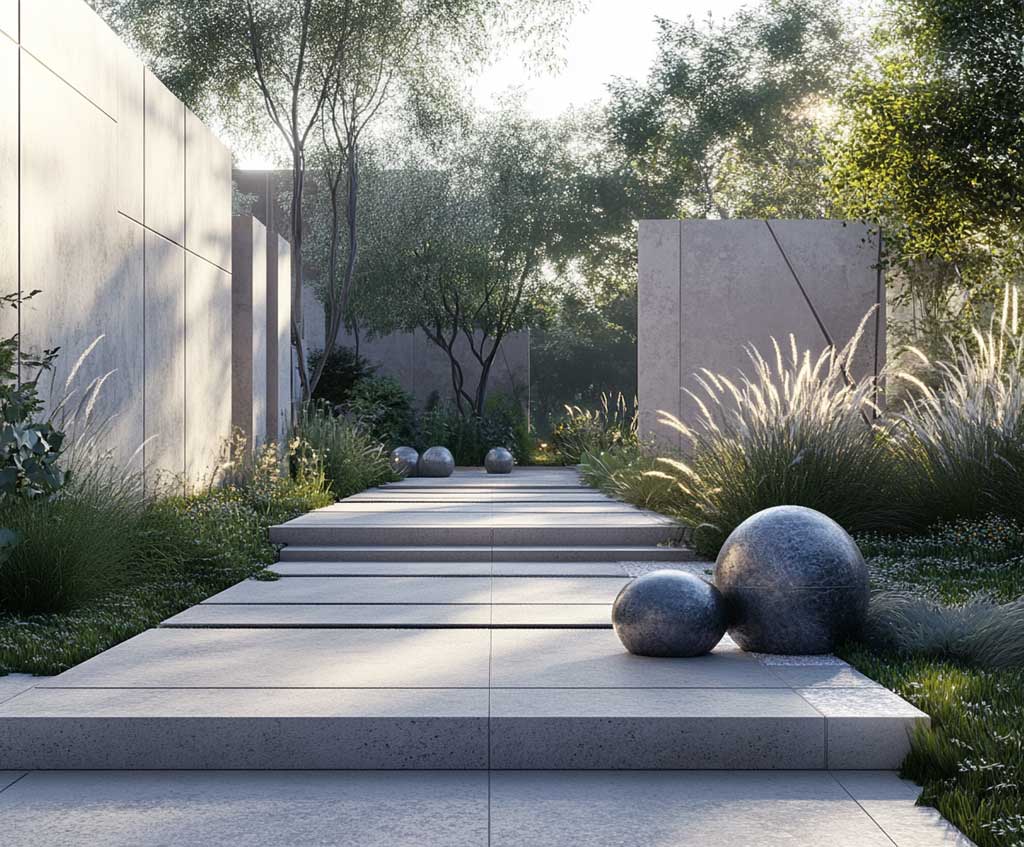
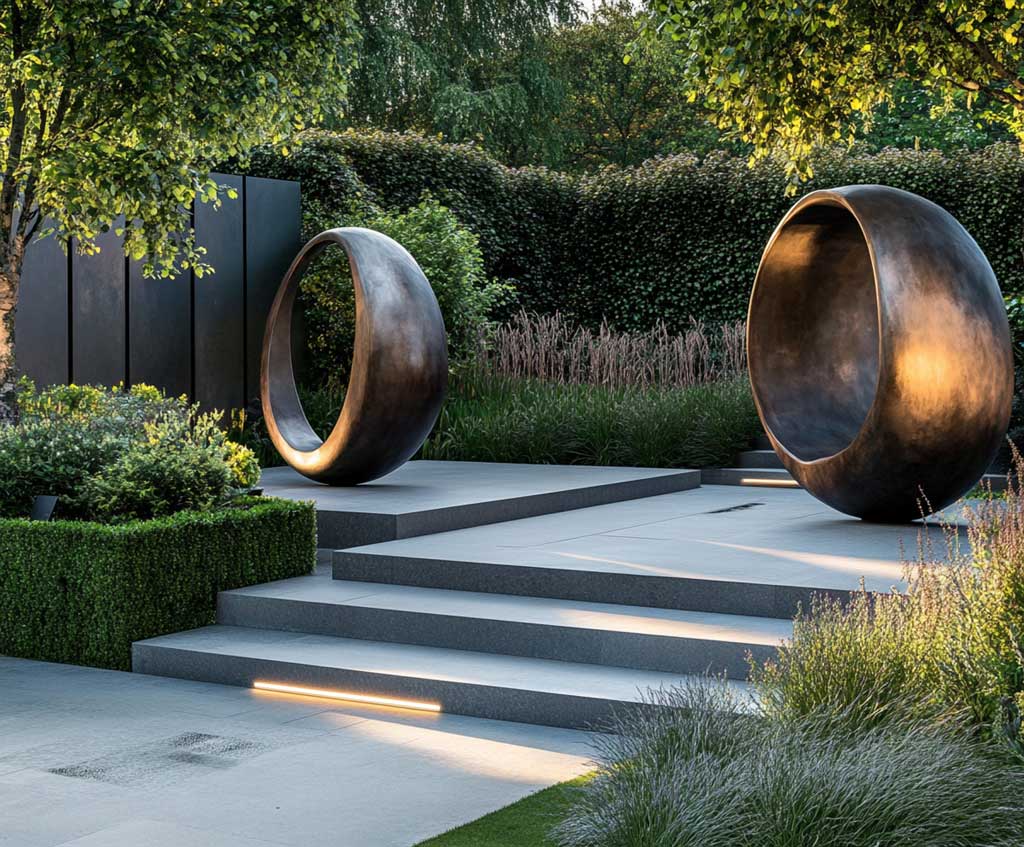
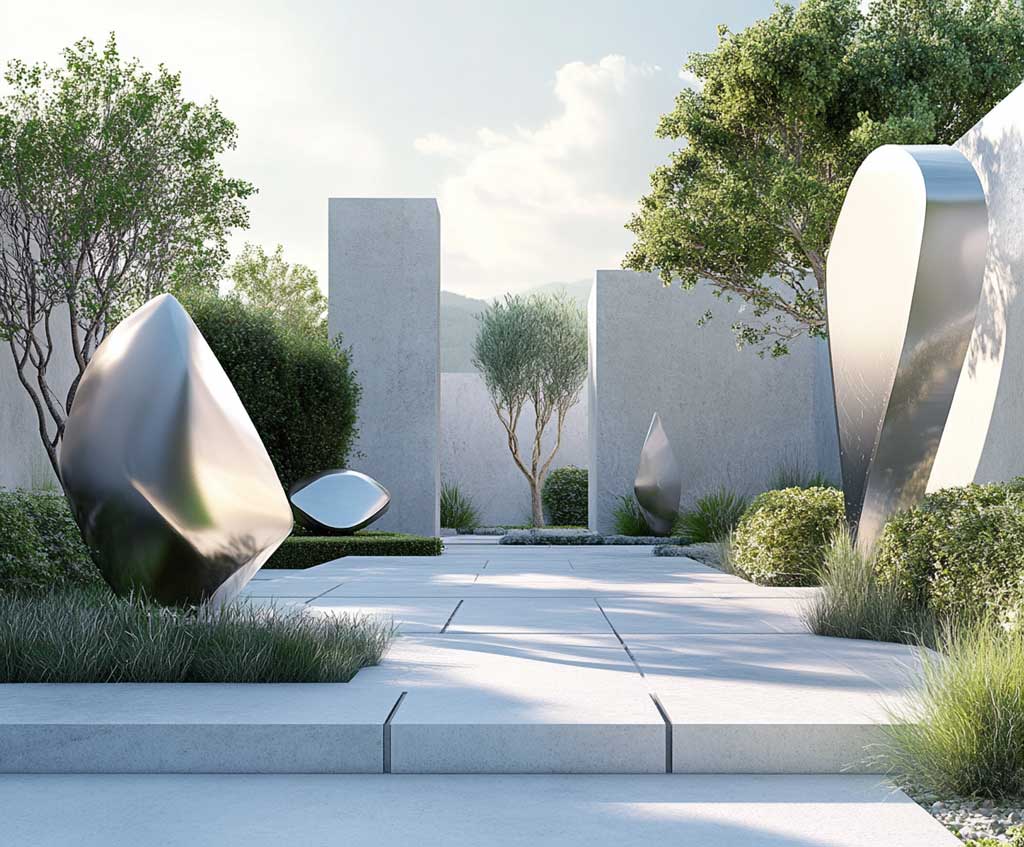
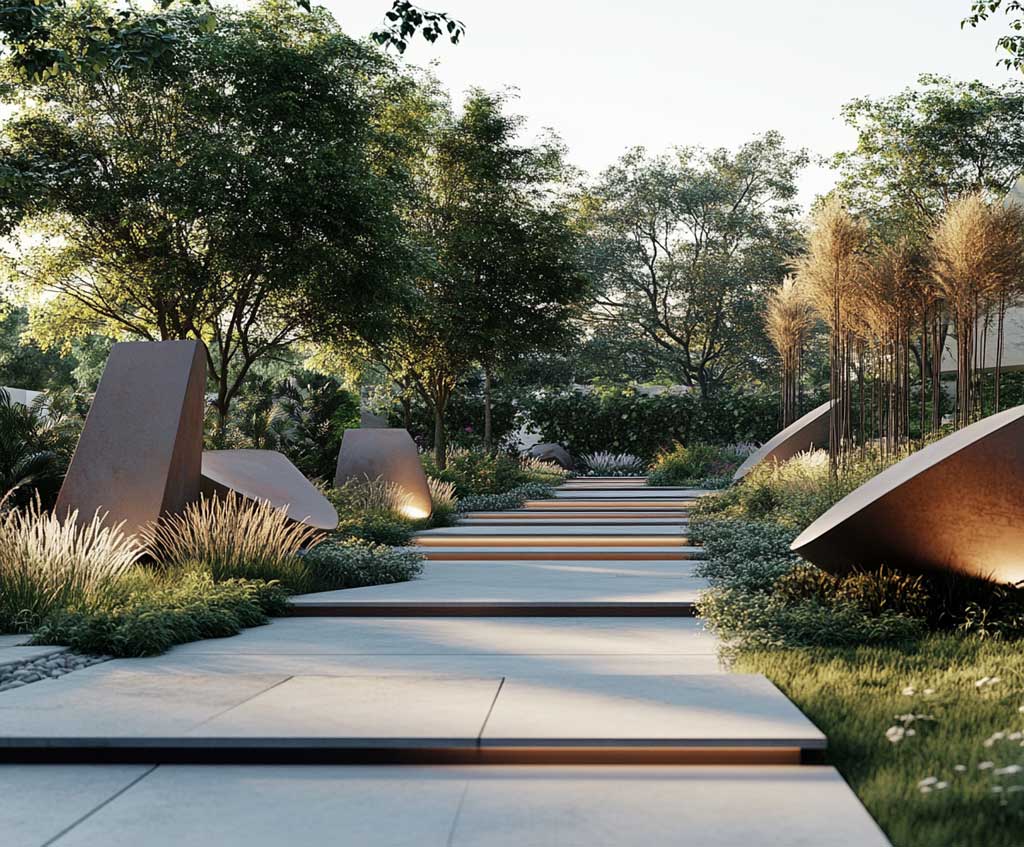
Concrete paths in this style should be broom-finished, not polished. Polished concrete outside becomes a slip hazard in the wet and photographs with too much glare to look good in daylight shots. Broom finish gives it a matte texture that reads as intentional. Poured concrete paths run $8–$15 per square foot installed, or you can use large-format precast slabs at $2–$4 each from a landscape supply yard. I’ve used both. The precast slabs win on budget; poured wins on precision if your layout has curves.
Ornamental grasses in this setting should be muted — not chartreuse, not burgundy. Panicum virgatum ‘Shenandoah’ goes red in fall but stays steel-blue through summer. Stipa tenuissima, at $8–$12 per plant, looks like smoke in a breeze and photographs beautifully in natural light. Both stay under 3 feet. The plants aren’t the story here — the sculpture is. The plants’ job is to soften the hard edges of concrete without pulling focus. Anything brighter than sage green starts competing, and you’ll lose the clean reading that makes this garden design actually work. For how this approach connects to broader contemporary landscape principles, contemporary garden designs for modern homes cover the full range of material and plant pairings.
What doesn’t work in this category: shiny chrome or mirror-polished steel. It looks striking in a showroom photo and terrible in a real garden after two months of weather, fingerprints, and water spots. The reflection-heavy aesthetic is a Pinterest trap. Matte or oxidized finishes hold up and require nothing from you. That’s the actual goal. According to Living Etc’s editors covering modern garden design, the move toward Corten and matte architectural materials is driven precisely by how well they age without maintenance — a priority that polished finishes simply can’t match outdoors.
Material Comparison
| Material | Cost Range | Maintenance | Best For |
|---|---|---|---|
| Corten Steel Sculpture | $400–$2,500 | None after 18 months | Contemporary, industrial |
| White Pea Gravel | $35–$50/ton | Annual top-up | Zen, minimalist |
| Precast Concrete Slabs | $2–$4 each | Re-level every 3–5 years | Pathway, abstract layout |
| Campania Stone Sculpture | $180–$350 | Seal every 2 years | Zen, abstract pathway |
| Polished Chrome Sculpture | $600–$3,000 | Monthly cleaning | Skip it. Looks wrong outdoors. |
Bottom Line
One strong focal point beats a garden full of interesting things.
Every layout here works because it makes a single bet: the sculpture, the path terminus, the line of shadow across gravel. Pick your bet and strip everything else back until it serves that one thing.
Budget doesn’t determine quality in minimalist garden design — edit discipline does. A $180 Campania stone piece on a $140 gravel field outperforms a $2,000 chrome sculpture in a crowded border every time.
Save this post before your next garden planning session.