Entry hallway decor is the one area of your home that every single visitor experiences first — and most homeowners treat it like an afterthought. I’ve walked into hundreds of styled homes and the ones that stop me cold all share one thing: the hallway was designed on purpose, not by default. Get this space right and you shift the entire emotional register of everything that follows.
You don’t need a grand foyer or a $10,000 renovation budget. A $45 console table from IKEA’s HEMNES line, a runner from Ruggable, and two intentional wall pieces will outperform any clutter-filled corridor ten times over. The math is simple: square footage means nothing here. Intention means everything.
What follows covers three distinct approaches — personal and layered, modern and functional, and rustic and warm — so you can find the one that actually fits your home rather than someone else’s Pinterest board. Each section includes what I’ve personally used, what failed, and exactly what to spend your money on first.
- Entry hallway decor built around personal items creates stronger emotional impact than purely styled spaces
- Modern hallways need built-in or flush storage first — decor second; reversing this order always looks cluttered
- Rustic entryways depend on natural materials (reclaimed wood, stone veneer, wrought iron) not faux finishes
- A large frameless mirror in any style hallway adds perceived square footage and bounces light — costs $80–$300 at IKEA or West Elm
- Lighting layering (recessed + accent) is the single upgrade with the highest visual return per dollar spent
- Runner rugs under 2.5 feet wide make narrow hallways feel tighter, not cozier — go wider or go bare
Entry Hallway Decor with Personal Touches Beats Generic Styling Every Time


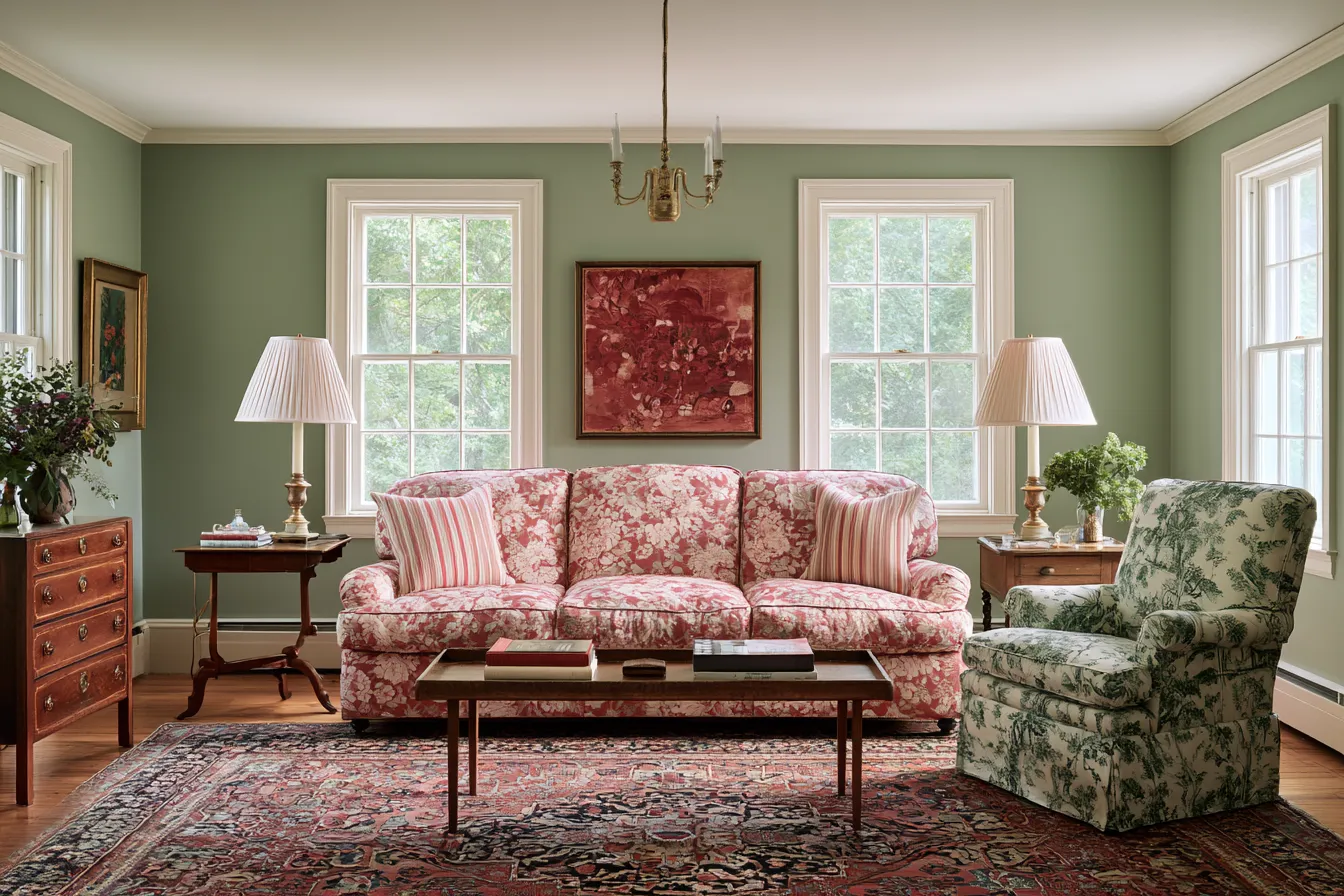
Entry hallway decor that incorporates personal objects — framed photographs, travel finds, inherited ceramics — creates an immediate sense of belonging that no mood-board can replicate. I stole this trick from an interior designer I interviewed: she always starts with three objects the client loves, then builds the hallway color palette around them. The result never looks like it came from a showroom, and that’s precisely the point. Guests don’t comment on the styling; they comment on how the house feels.
A gallery wall works best when you mix frame weights and finishes rather than matching them. My go-to formula: two oversized prints in thin black frames, two mid-size pieces in natural oak, and one small vintage frame in gold. West Elm’s floating frames run $29–$59 each and hold the weight without brackets. What doesn’t work? Matching frame sets from big-box stores — they read as a decoration kit, not a personal history, and guests can clock it immediately.
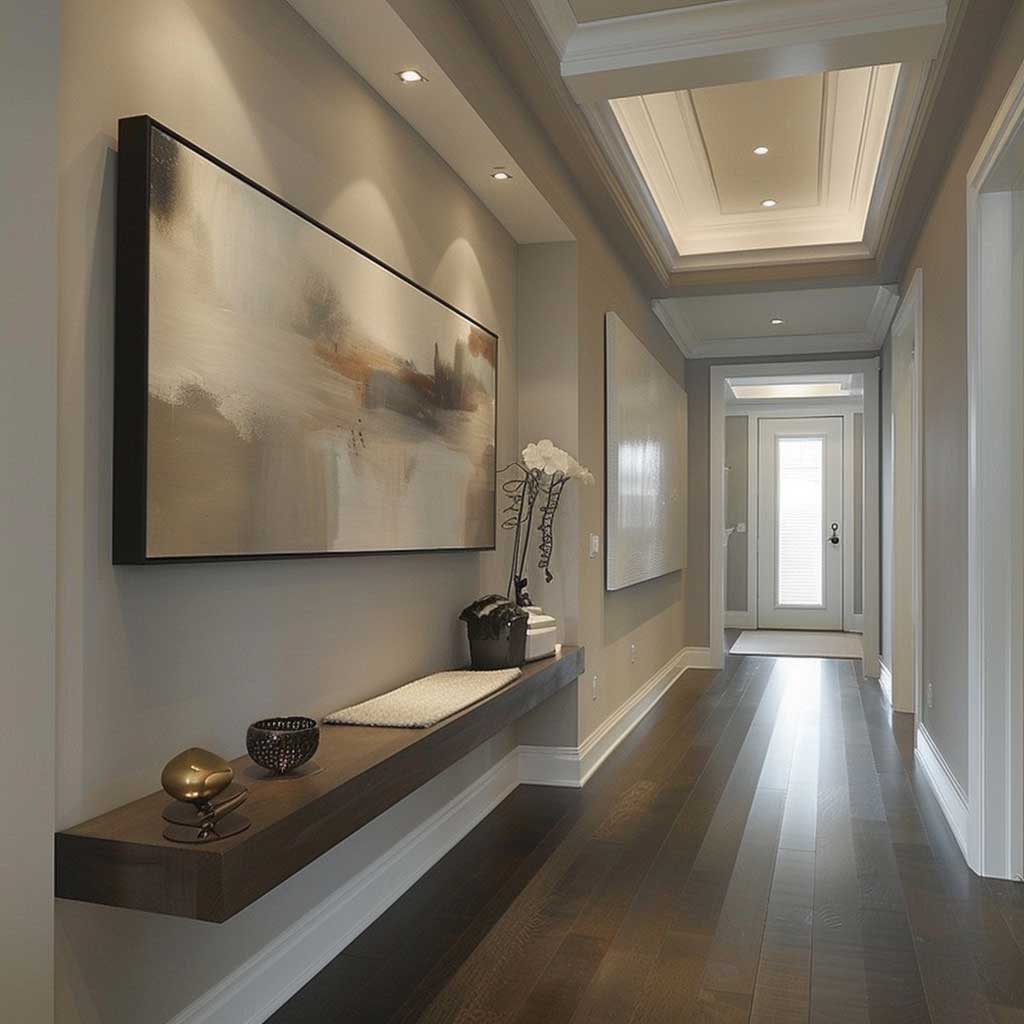
Beneath the gallery, a narrow console at 12–14 inches deep gives you surface space without blocking traffic. IKEA’s LIATORP console at $249 hits every mark — real wood veneer, a lower shelf for baskets, and a scale that doesn’t overwhelm a standard 4-foot-wide corridor. Want the honest test for whether your display feels personal or just filled? Cover everything on the console with a cloth, remove three items, and put the cloth back. If the display looks better with less, you over-filled it.
Lighting seals the whole composition. Soft, diffused light from a wall sconce at eye level does more for a personalized hallway than any overhead fixture ever will. CB2’s Arched Sconce at $129 throws warm light downward across your objects without casting hard shadows. You’ll notice the difference the first evening you come home — the hallway stops feeling like a corridor and starts feeling like a room.
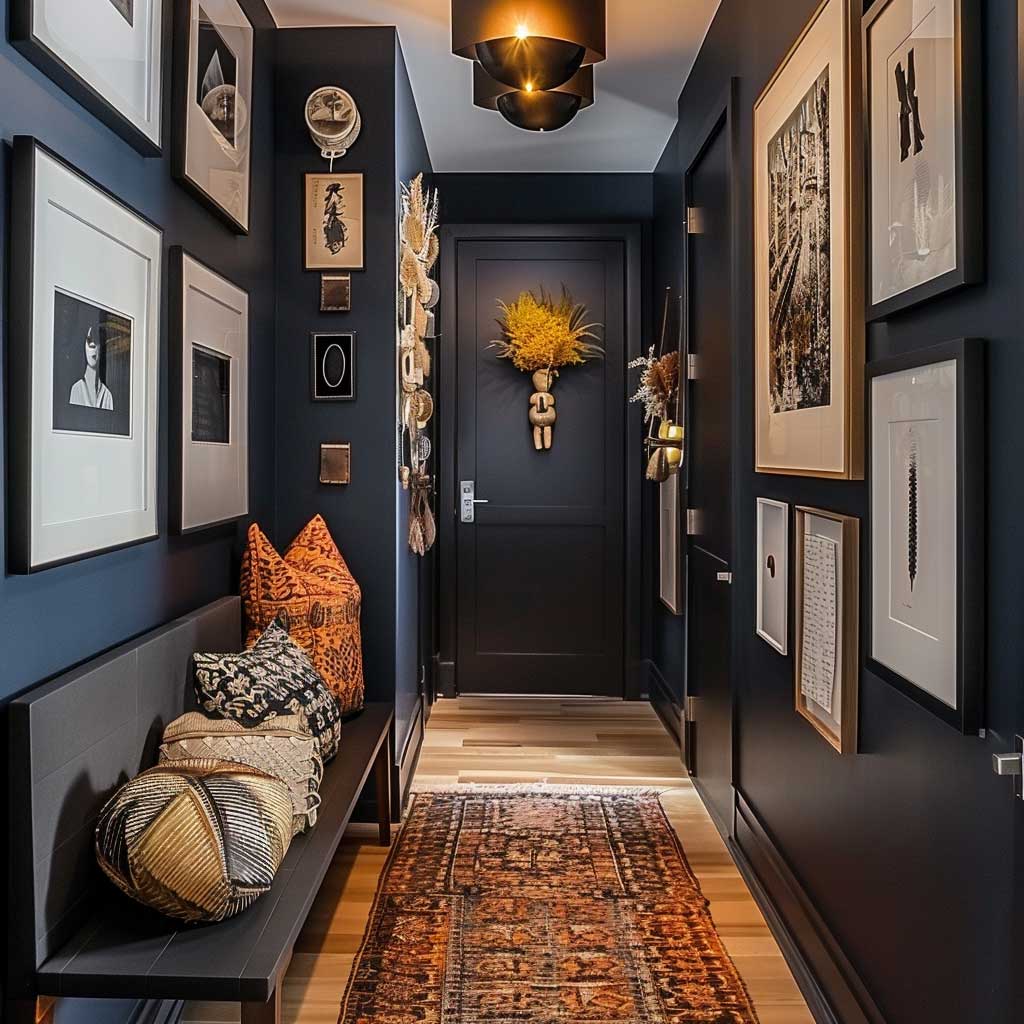


The floor is the last decision most people make and the first surface every guest actually looks at while they remove shoes. A runner rug from Ruggable (machine-washable, $129–$229 in the 2.5×7 size) is my practical pick for families — the pattern hides dirt between washes and adds the warmth that bare hardwood can’t. Avoid runners under 30 inches wide in any hallway wider than 36 inches; narrow rugs floating on wide floors look like they slipped off a larger room by accident.
Personal entry hallway decor tells a story that guests read without realizing they’re reading it. Every object you choose is a sentence. A collection of three different-sized ceramic vases from Anthropologie ($28–$68 each) grouped on one end of the console gives the eye a resting point and signals that someone with taste lives here. The hallway becomes the book jacket for the entire home — and you want that jacket to make people want to read further. For more ideas on what to put on your hallway walls, this home entrance wall design roundup is worth bookmarking.
Functional Entry Hallway Design Where Storage Disappears into the Wall


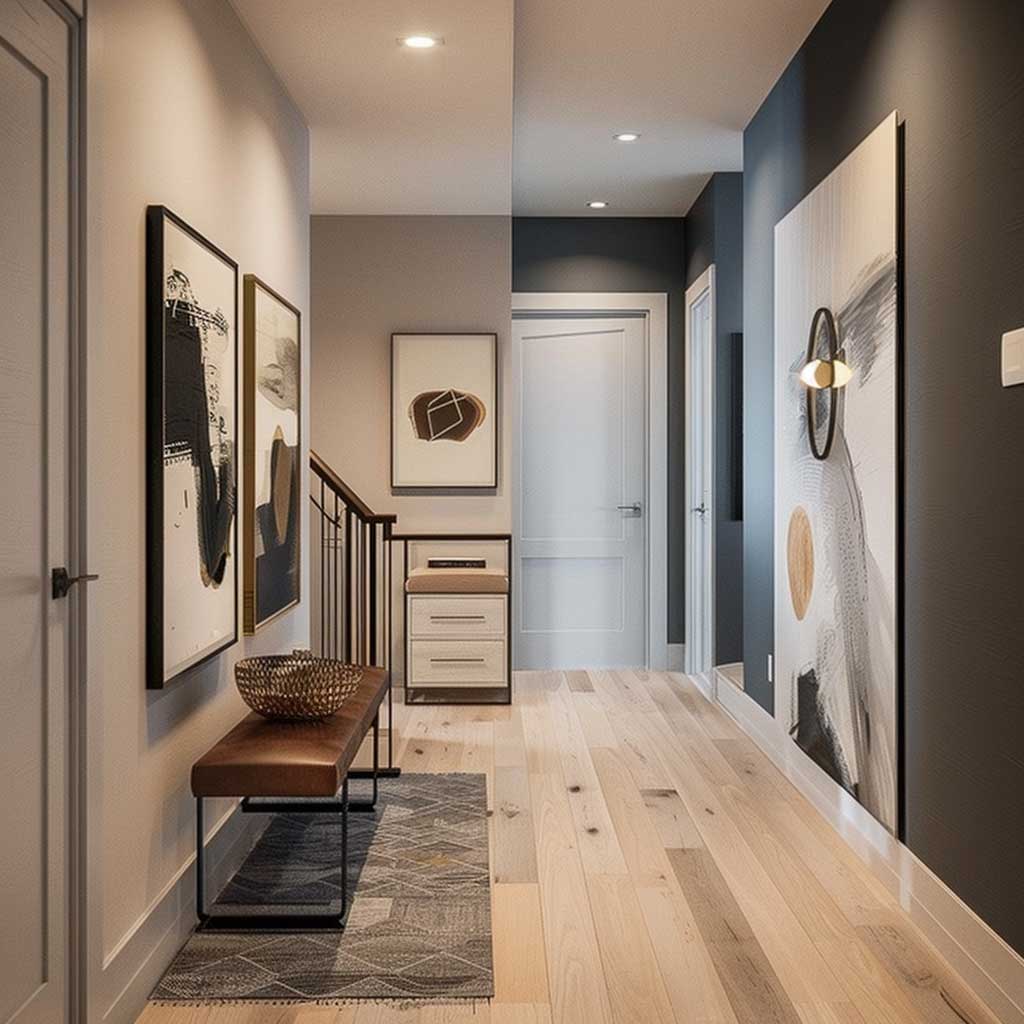

Modern entry hallway design only works when you solve storage before you think about styling — in that order, never reversed. I’ve watched clients spend $800 on decorative objects for a hallway that still had shoes piled against the baseboard, and the objects made the chaos worse, not better. Built-in cabinets with handleless push-to-open doors (IKEA PAX system with custom fronts from Semihandmade, around $600–$1,200 depending on width) hide coats, bags, umbrellas, and seasonal gear completely. The corridor reads as a gallery. Nobody suspects there are 14 pairs of shoes behind those walls.
The large frameless mirror is non-negotiable in this style. A mirror that runs floor to ceiling on one wall isn’t decorating — it’s doubling the perceived square footage of the space without a single structural change. IKEA’s HOVET mirror at $199 in 30×77 inches is the one I recommend most often; the slim aluminum frame reads as frameless from a distance. What you should skip: ornate framed mirrors in a minimalist hallway. The visual conflict between the frame’s detail and the clean architecture is like wearing a tuxedo with sneakers — technically bold, practically distracting.
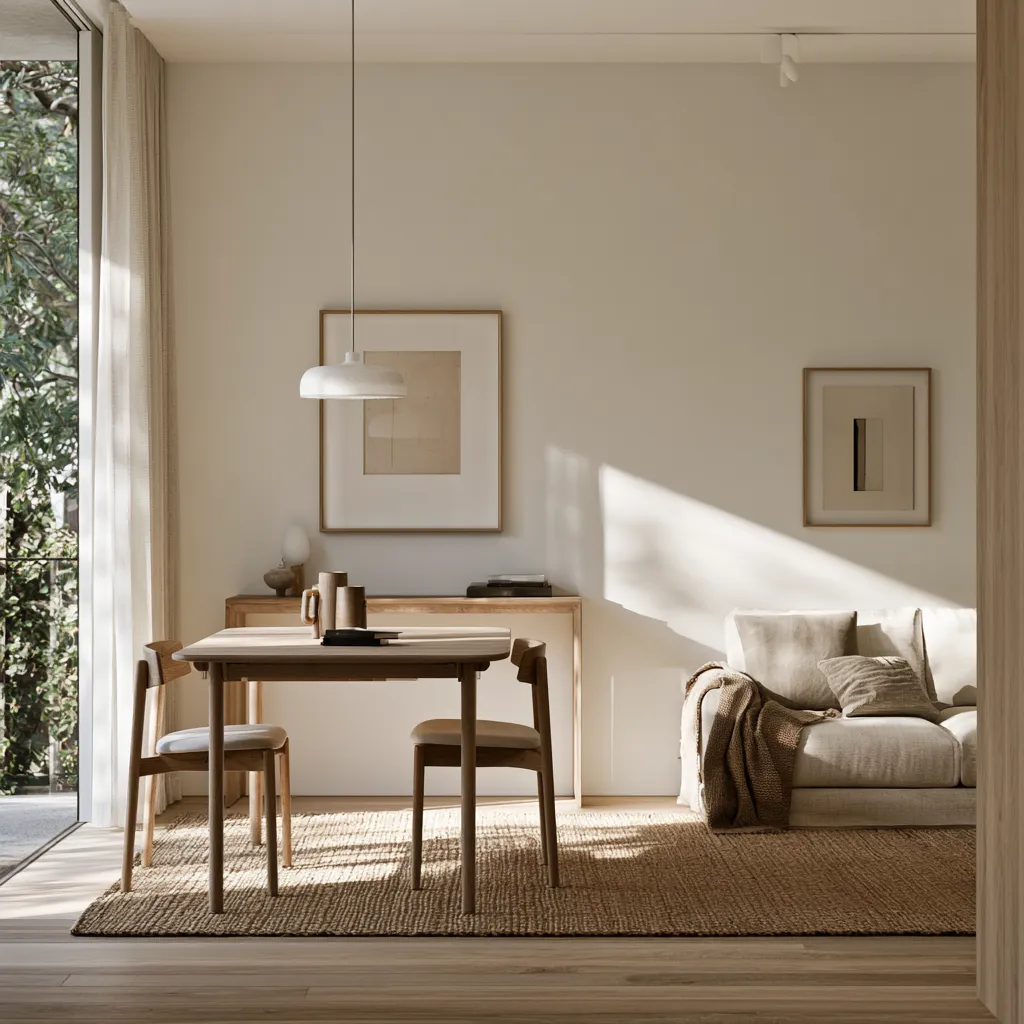
Neutral tones on every surface keep a modern entry hallway from feeling clinical. Warm whites (Benjamin Moore’s White Dove OC-17 is my go-to at $50–$60 per gallon) prevent the cool, sterile feeling that pure white walls create under warm LED lighting. Add one textural interruption — a linen-weave wallpaper panel on the back wall, a single slubby jute rug, a potted fiddle-leaf fig in a matte ceramic pot — and the space earns warmth without surrendering its clean lines. Is a single plant really that powerful? Yes. A 4-foot fiddle-leaf from a local nursery costs $35–$60 and does more for perceived livability than a $300 accent chair.
Lighting in a modern hallway needs two layers: recessed ceiling fixtures for base illumination and one architectural accent fixture for personality. Recessed LED wafers (Halo LT series, $18–$25 each at Home Depot) flush completely into the ceiling and produce zero visual noise. Above the console or mirror, a single wall-mounted fixture with an aged brass or matte black finish gives the eye an anchor. Skip ceiling fans, skip flush-mount dome fixtures, skip anything with visible bulbs — they age the space immediately and fight the architectural calm you spent all that effort building.
- Don’t buy a decorative console before solving shoe and coat storage. Décor layered over clutter always looks worse than no décor at all.
- Don’t use matching accessory sets — the tray-candle-vase trio from HomeGoods reads as a placeholder, not a design decision.
- Don’t hang art below eye level. The center of any wall piece should sit at 57–60 inches from the floor. Lower than that and the hallway starts to feel compressed.
- Don’t choose cool-white LED bulbs (5000K+). Warm white (2700–3000K) is the only color temperature that makes skin and wood tones look good at an entrance.
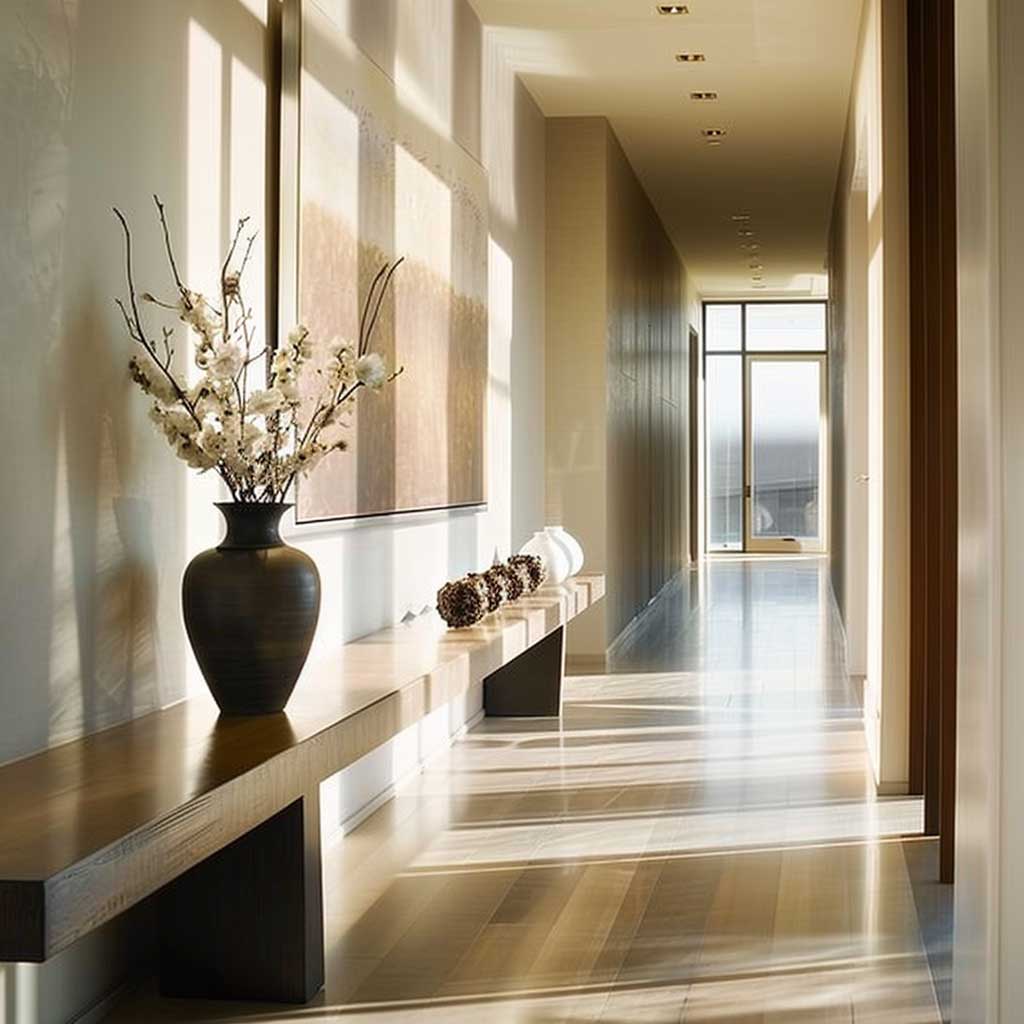
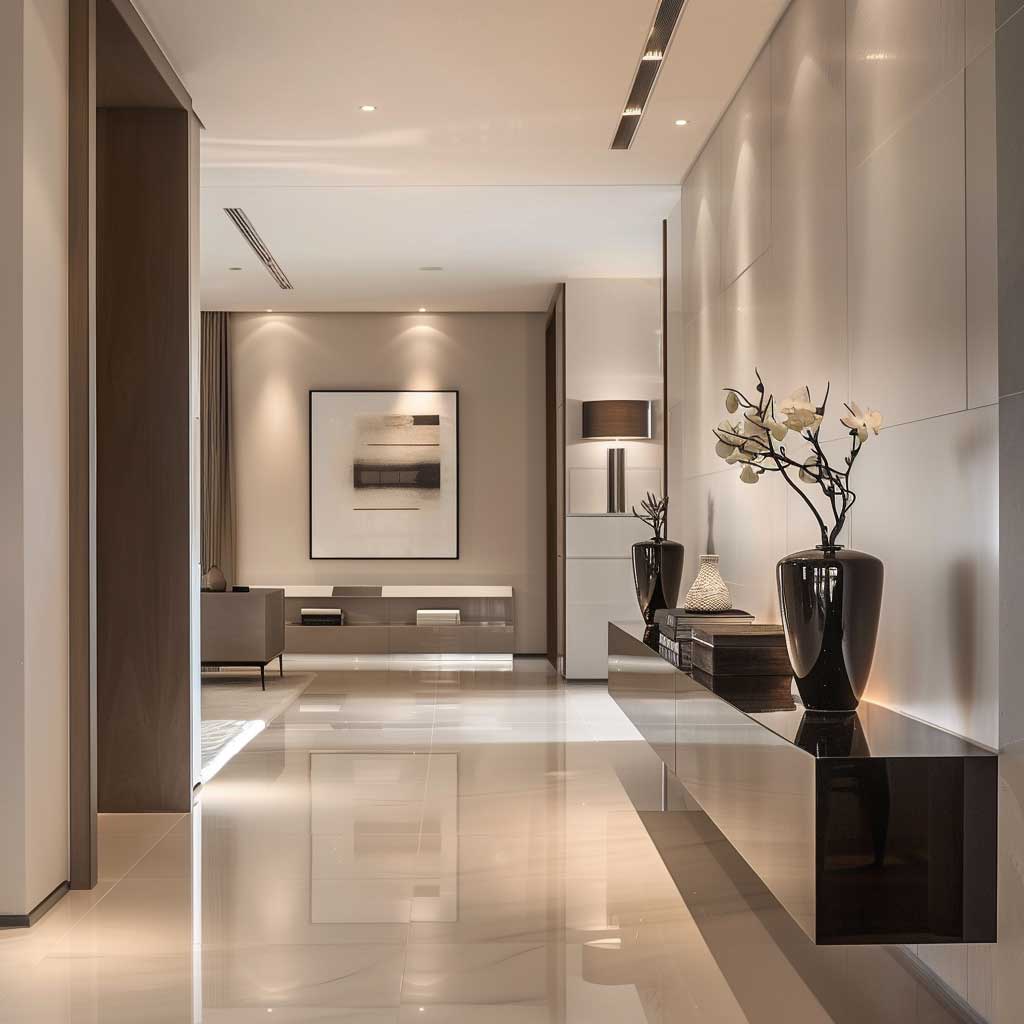

Color pops in a modern hallway should be treated like punctuation — one per sentence. A single emerald linen pillow on a built-in bench, a cobalt blue vase, or a warm terracotta pot can carry the entire personality of the space. Trying to introduce three accent colors at once turns a modern hallway into a confused one. Think of the color choice as a signature rather than a palette: one strong note, sustained all the way through. For hallway furniture that bridges functional and modern, the metal hallway furniture ideas here are a practical starting point for both renters and owners.
Cozy Hallway Ideas Rooted in Natural Materials, Not Farmhouse Clichés


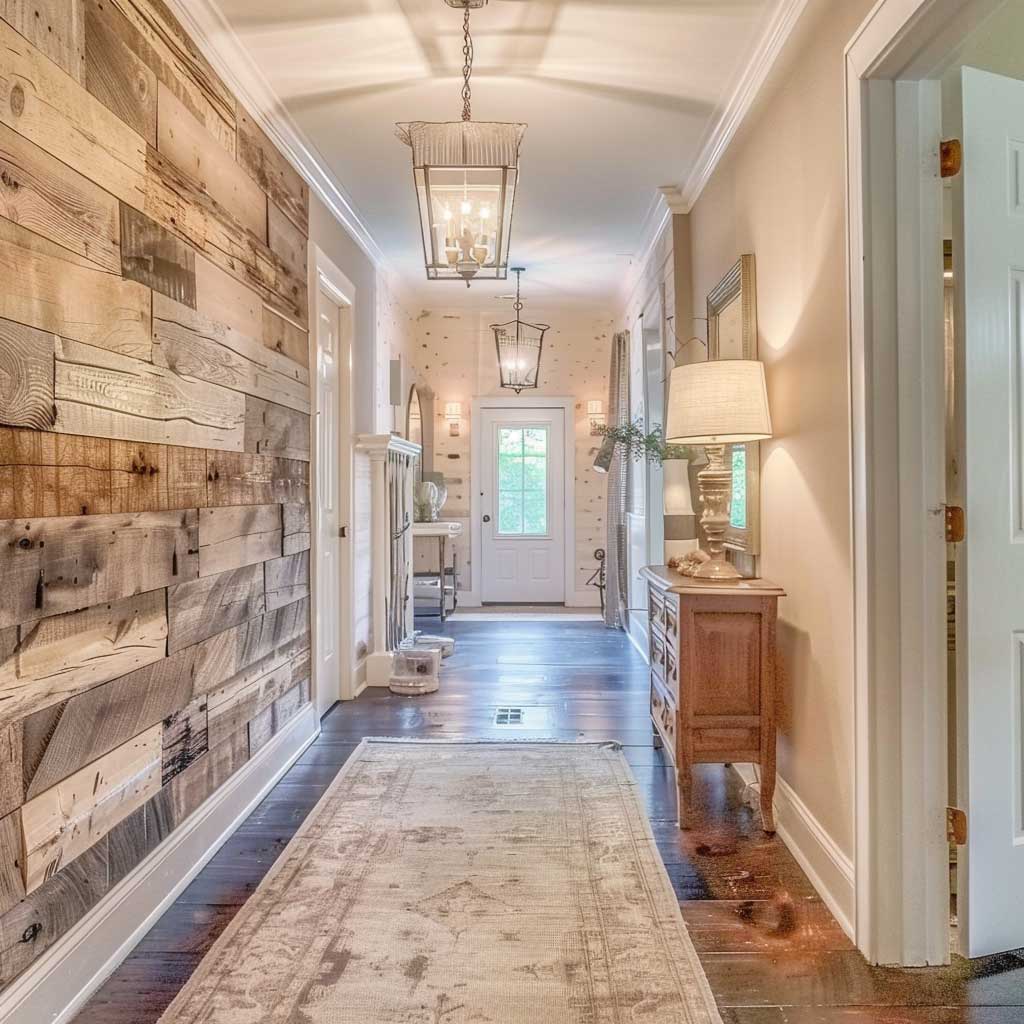

Cozy hallway ideas fail when they lean on the farmhouse checklist — shiplap, a “welcome” sign, and a galvanized metal bucket — rather than on actual natural materials with real texture and age. The difference between a rustic entryway that feels lived-in and one that feels like a Joanna Gaines catalog is simple: real materials versus faux ones. Reclaimed wood flooring from a local salvage yard ($4–$9 per square foot versus $12–$18 for new engineered “distressed” versions) brings actual history to the floor. You can feel it underfoot; guests can see it in the grain.
Stone or brick veneer on a single accent wall is the move that transforms an ordinary hallway into something that feels like it’s been there for 80 years. Airstone DIY panels from Home Depot run $17–$22 per square foot and install with adhesive — no mason required. I own two walls done this way and every person who visits assumes it’s original to the house. Apply it to the back wall behind a bench, not all four walls; full coverage reads as a basement, not an entrance.
The handcrafted wooden bench is the functional anchor of a rustic entry hallway. Does it need to be expensive? No — a solid oak bench from Etsy artisans runs $180–$350 and will outlast anything from a big-box store. Above it, wrought iron hooks (Pottery Barn’s Hammered Hook Rail at $79 for a set of five) handle the coat-and-bag load without bending. What kills the rustic look faster than anything else? Plastic storage — a clear shoe organizer hanging over the door, a wire rack from a dollar store. One plastic piece in a natural-material hallway reads as a rounding error the whole room never recovers from.
Lighting in a warm, cozy hallway should mimic candlelight. A vintage chandelier with amber-tinted Edison bulbs (2200K color temperature) turns even a plain ceiling into a statement. Rejuvenation’s Porcelain Socket Pendant starts at $98 and pairs naturally with aged hardware. Lantern-style wall sconces on either side of a mirror add depth and symmetry — the same logic a fireplace mantle uses, but applied vertically. You’ll notice immediately that the quality of light changes how warm the materials read: the same reclaimed wood floor looks brown under daylight LEDs and honey-amber under warm Edison bulbs.


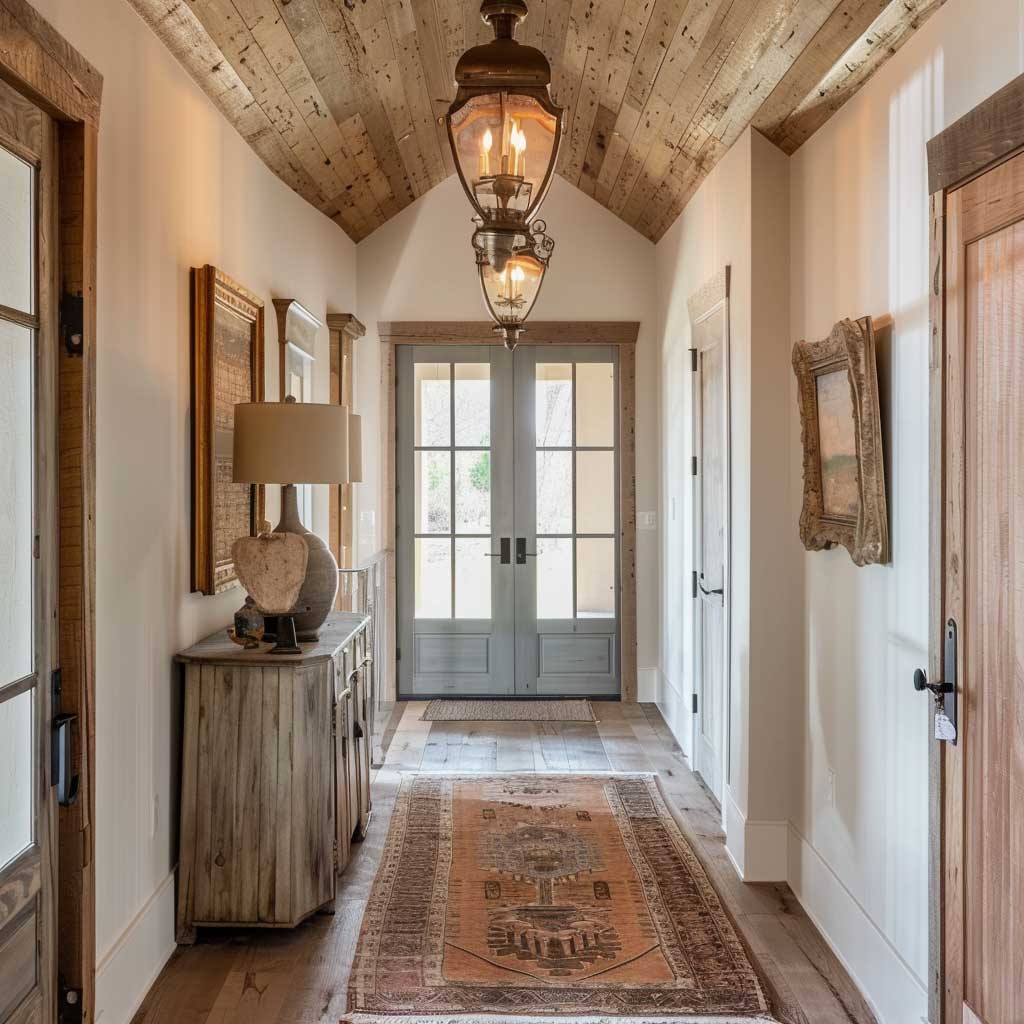
Accessories in a rustic hallway earn their place by being handmade or genuinely old — not “artisanal-looking.” A hand-woven Moroccan runner from Rugs USA ($149–$279, the Beni Ourain style) introduces pattern and pile without competing with the wood and stone. On the walls, antique oil paintings in ornate frames from local estate sales ($20–$80 each) deliver more visual authenticity than any reproduction ever will. My rule: if it looks like it could be in an Anthropologie window display, it’s probably too polished for a rustic hallway. The goal is warmth you believe, not warmth you performed. For exterior context that carries the same material language through to the outside, the small exterior entryway ideas on this site bridge the two spaces without a jarring style shift.
Final Take
Entry Hallway Decor Shapes Every Room That Comes After It
The hallway isn’t a corridor — it’s the opening argument. Get the lighting warm, the storage hidden, and at least one object personal enough to stop someone in their tracks, and the rest of the house inherits that credibility automatically.
Spend money first on storage (built-ins or a console), second on lighting (warm, layered), and third on a single rug or runner wide enough to anchor the floor properly. Everything else is detail.
Whether your hallway runs 6 feet or 30, the principle holds: materials you can touch, light you can feel, and one object nobody else has. Save this post before your next trip to the hardware store.