Farmhouse bathroom wall decor works when the wall itself carries the style first and the accents follow: painted shiplap or planks, one statement mirror, then a few shelves and prints. Does it suit a small, steamy bathroom? Yes, as long as wood stays out of the splash zone and the fan pulls humidity back under 60% after each shower. Shiplap boards typically cost $2.50–$7 per square foot, so most bathroom wall projects land between $100 and $700 in materials. Start with the wall treatment and buy accessories last.
Rustic, country and vintage farmhouse looks share the same toolkit, just weighted differently. Rustic leans on reclaimed wood and black metal, country on handmade ceramics and woven baskets, vintage on framed mirrors and apothecary glass. Placement rules stay the same across all three: center art at 57–60 inches from the floor and keep the middle of the mirror between 57 and 65 inches. Pick one of the three moods before buying anything for the walls.
The sections below follow those three moods plus the wall finishes underneath them, each with typical sizes and prices. A comparison table near the end lines up shiplap, faux PVC boards, open shelves, mirrors and framed art by cost and moisture tolerance. Read the moisture notes before the style notes, because a warped board ruins any look.
Quick Scan
- Shiplap boards run about $2.50–$7 per sq ft; a typical bathroom wall project costs $100–$700 in materials.
- PVC nickel-gap planks cost about $3–$6 per sq ft and handle direct splashes that would warp pine.
- Center the vanity mirror 57–65 inches from the floor, with its lower edge 5–10 inches above the counter.
- Hang art at a 57–60 inch center and size it to about two-thirds of the furniture below.
- Keep bathroom humidity under 60%; framed paper art gets risky above roughly 65% after a shower.
- Mount the first shelf over a toilet 24–28 inches above the tank and keep shelves 6–9 inches deep.
- A cast iron clawfoot tub weighs 200–500 lb empty vs 75–150 lb for acrylic.
Rustic Farmhouse Bathroom Wall Decor Built on Reclaimed Wood and Black Metal


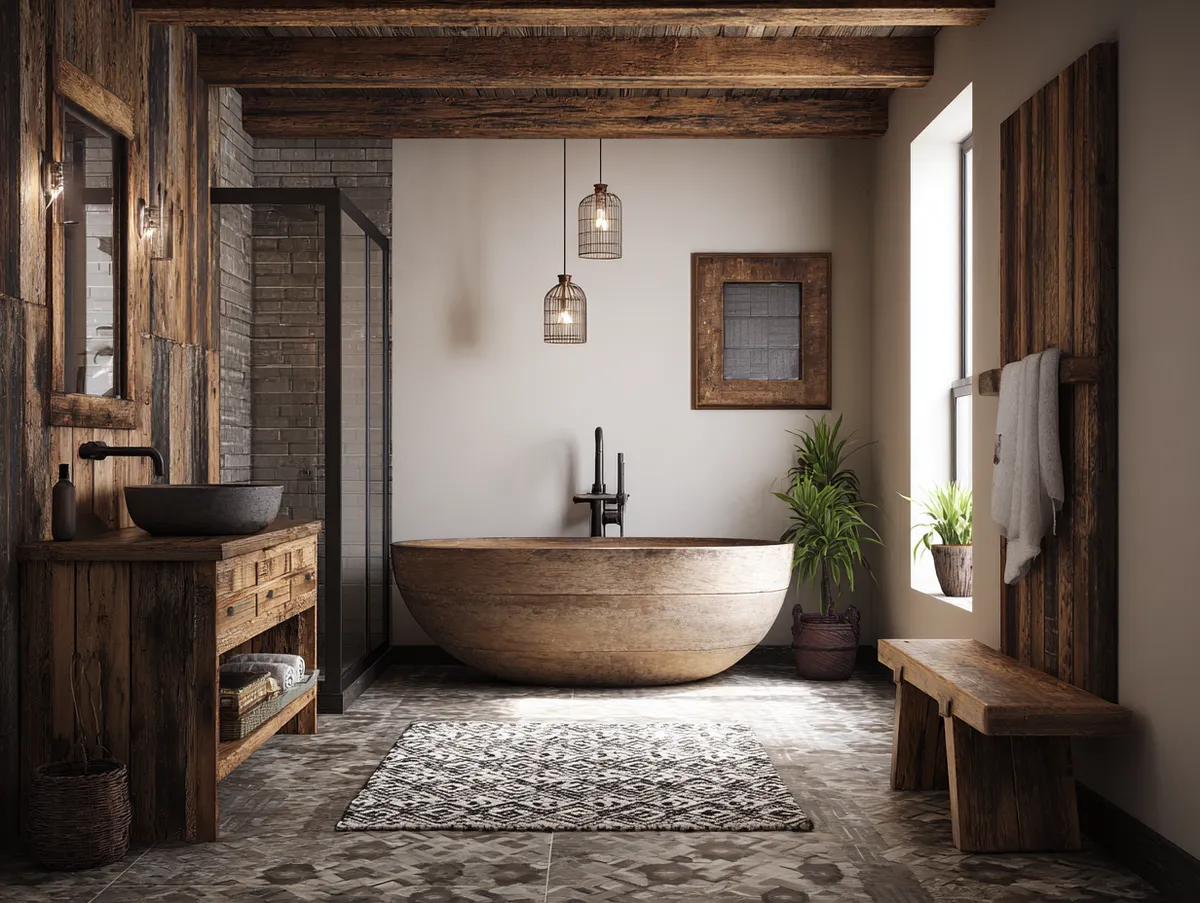
Rustic farmhouse bathroom wall decor starts with two materials that age well together: weathered wood for warmth and matte black metal for structure. A reclaimed wood vanity under a smooth white vessel sink shows the contrast at its clearest, rough grain against glazed porcelain. Behind it, a single plank wall or a wood-framed mirror does more work than ten small accessories. Pick one wood tone for the whole room and repeat it at least twice.
Real timber vs wood-look boards is the first fork. Clear pine and cedar cost roughly $4–$8 per square foot before labor, while primed MDF nickel-gap boards run about $2–$3 and suit powder rooms with no shower. For a damp family bathroom, compare the options in these small bathroom wall paneling ideas in marble, wood and gloss before ordering timber. Seal every cut edge, because raw end grain drinks moisture like a sponge.


Industrial lighting finishes the rustic look, but Edison bulbs need a reality check. Is a row of exposed filament bulbs enough to shave by? Rarely: a 60-watt-style incandescent Edison bulb gives roughly 250–400 lumens, against about 800 for a standard 60-watt bulb. Hang the pendants for mood and add vanity sconces with warm 2700K–3000K LEDs at face height. Never rely on decorative filament bulbs as the only light over the mirror.
Shiplap, Beadboard or PVC Planks Set the Tone for Farmhouse Bathroom Walls
Farmhouse bathroom walls get their character from horizontal or vertical boards, and the material matters more than the profile. Shiplap boards cost about $2.50–$7 per square foot, and Angi’s breakdown of shiplap bathroom costs and precautions puts a typical bathroom project at $100–$700. That is a small slice of a small-bathroom remodel, which commonly runs $1,500–$15,000. Paint wood boards with mold- and mildew-resistant paint and top them with a clear sealer.
Wood vs PVC is the real decision in a bathroom with a shower. PVC planks at roughly $3–$6 per square foot copy the nickel-gap look and shrug off direct spray, while pine and cedar can swell, cup and grow mildew if they stay damp. Think of wood shiplap as a wool sweater and PVC as a raincoat: one looks warmer, the other survives the weather. Keep real wood on dry walls behind the toilet or opposite the tub.
Half-height boards often beat floor-to-ceiling coverage in a compact room. Why? Paneling at roughly one-third or two-thirds of the wall height leaves the upper section free for art, a mirror and paint, so the room never feels boxed in. Ventilation protects whichever option you pick, and a common sizing rule calls for about 1 cfm of fan capacity per square foot in bathrooms up to 100 square feet. Upgrade a weak fan before the first board goes up.
- Powder room without a shower: painted pine or primed MDF shiplap on every wall.
- Family bathroom: wood behind the toilet or above a tiled wainscot, PVC beside the tub.
- Shower surround: PVC planks or tile only, never raw wood.
- Ceiling: one of the safest spots for wood shiplap, since it rarely gets splashed.
Country Farmhouse Bathroom Wall Ideas With Handmade Character


Farmhouse bathroom wall ideas with a country accent swap industrial metal for handmade pieces: a framed landscape, glazed ceramic tile, woven baskets and stoneware. A pastoral painting over the tub works like a window onto a field the room does not actually have. Paper art and steam are poor partners, though. Indoor humidity ideally sits at 30–50% and should stay under 60%, while framed paper prints become risky above roughly 65% after a shower. Choose canvas, metal prints or frames with acrylic glazing for any wall near the tub.
Acrylic vs glass glazing is a small choice with long consequences. Acrylic is lighter, will not shatter if the frame drops onto a tile floor, and copes with condensation better than glass, which can trap moisture against the print. Is an original oil painting ever safe here? Only in a powder room without a shower, where humidity barely moves. Run the exhaust fan during every shower and for 15–30 minutes afterward to protect whatever hangs on the wall.


Open wooden shelves are the hardest-working country element, holding pottery, folded towels and baskets on one strip of wall. Mount the first shelf about 24–28 inches above the toilet tank so the lid still lifts off, and keep shelves 6–9 inches deep, since a standard tank is roughly 8 inches deep. Spans over 30 inches need a center bracket, and 2–3 shelves fill an 8-foot ceiling without crowding it. Skip particle board, which can swell and peel within about six months in a steamy room.
Textiles soften all that wood and ceramic. Gingham or ticking-stripe curtains at a tub window, a linen towel on an iron hook and one trailing plant look collected rather than staged. Hold the palette to two or three colors pulled from the tile or the painting, so the wall reads calm instead of busy. Wash cotton curtains monthly, since fabric holds bathroom moisture longer than sealed wood.
Vintage Mirrors Anchor Modern Farmhouse Bathroom Wall Decor


Modern farmhouse bathroom wall decor leans on one vintage statement, and an antique-style framed mirror is the usual candidate. Distressed wood panels behind it add age, while the glass bounces window light deeper into the room. Placement decides whether it looks right: center it 57–65 inches from the floor, with the lower edge about 5–10 inches above a 32–36 inch vanity. Mark the center height in pencil before drilling a single hole.
Size the mirror to the vanity, not to the wall. A common guideline keeps it at about 80–95% of the vanity width, so a 36-inch vanity pairs with a mirror roughly 29–34 inches wide. A gilded ornate frame vs a plain weathered one is a mood choice: gilt reads French country, weathered oak reads barn. Never hang a mirror wider than the vanity in a small bathroom, because it makes the cabinet below look undersized.


Apothecary jars, pastel paint and floral accents carry the vintage story onto shelves and window ledges. Cotton balls and bath salts in clear glass look like a general store counter and clear clutter off the vanity at the same time. The warm-light and eye-level rules behind these boho farmhouse living room ideas with barn wood and woven texture translate well to a bathroom wall, from 2700K bulbs to art centered near 57 inches. Keep jars in groups of three rather than scattered singles.
A clawfoot tub is the vintage centerpiece that shapes the whole wall behind it. Cast iron versions weigh about 200–500 pounds empty, against 75–150 pounds for acrylic, and a 50-gallon fill adds roughly 417 pounds of water. Does the floor need help? In older homes it often does, so check the joists before ordering cast iron. Lace café curtains and one framed print above the far end of the tub finish the scene without crowding it.
Don’t Do This
- Don’t run real wood shiplap into a shower surround; PVC planks at $3–$6 per sq ft handle the spray instead.
- Don’t light a vanity with Edison bulbs alone; 250–400 lumens is roughly half of a standard 800-lumen bulb.
- Don’t hang paper prints under glass where humidity stays above 65% after showers.
- Don’t mount a toilet shelf so low the tank lid can’t lift; 24–28 inches above the tank keeps it usable.
- Don’t order a 200–500 lb cast iron tub before checking older floor joists.
Farmhouse Bathroom Wall Decor Options Side by Side
Farmhouse bathroom wall decor options differ more in moisture tolerance than in price. A $2.50 pine board and a $6 PVC plank look similar from the doorway, yet only one survives a shower wall. Read the moisture column first and the cost column second.
| Option | Typical cost | Moisture tolerance | Placement rule | Best for | Upkeep |
|---|---|---|---|---|---|
| Wood shiplap (pine, cedar) | $2.50–$7 per sq ft | Low to moderate; needs paint and sealer | Away from shower spray; ceiling is safest | Powder rooms, dry walls | Fan 15–30 min after showers |
| Primed MDF nickel gap | About $2–$3 per sq ft | Low; swells when wet | Rooms without a shower | Budget accent walls | Keep every edge caulked |
| PVC planks | About $3–$6 per sq ft | High; waterproof | Shower surround and tub walls | Family bathrooms | Wipe clean, no sealing |
| Framed art, acrylic glazing | Varies by size | Moderate; risky above ~65% humidity | Center at 57–60 in | Walls opposite the shower | Keep humidity under 60% |
| Floating wood shelves | Varies by length | Moderate with polyurethane seal | 24–28 in above tank, 6–9 in deep | Above the toilet | Center bracket past 30 in span |
| Vintage-style framed mirror | Varies by frame | High for glass, moderate for wood frame | Center at 57–65 in; 5–10 in above counter | Over the vanity | Wipe the frame dry |
Is the cheapest board ever the smartest buy? Only on a dry wall: primed MDF at $2–$3 per square foot works in a powder room but can swell beside a tub. Treat the table like a weather map, matching each material to the wettest spot it will face. Don’t let a low price per square foot pick the material for a wet wall, and spend the difference on PVC wherever spray reaches.
Walls First, Accents Second
Farmhouse bathroom wall decor looks finished when the wall treatment comes first: $100–$700 of sealed shiplap or PVC planks changes the room more than a shelf full of small accessories.
For a rustic look, keep one reclaimed wood tone, black metal hardware and Edison pendants backed by 2700K–3000K vanity sconces.
For a country look, choose canvas or acrylic-glazed art centered at 57–60 inches, plus 6–9 inch deep shelves mounted 24–28 inches above the toilet tank.
For a vintage look, hang a framed mirror centered at 57–65 inches and about 80–95% of the vanity width, and add a clawfoot tub only after the floor is checked for 200–500 pounds of cast iron.
Whatever the mood, keep humidity under 60% with a fan that runs 15–30 minutes after every shower.