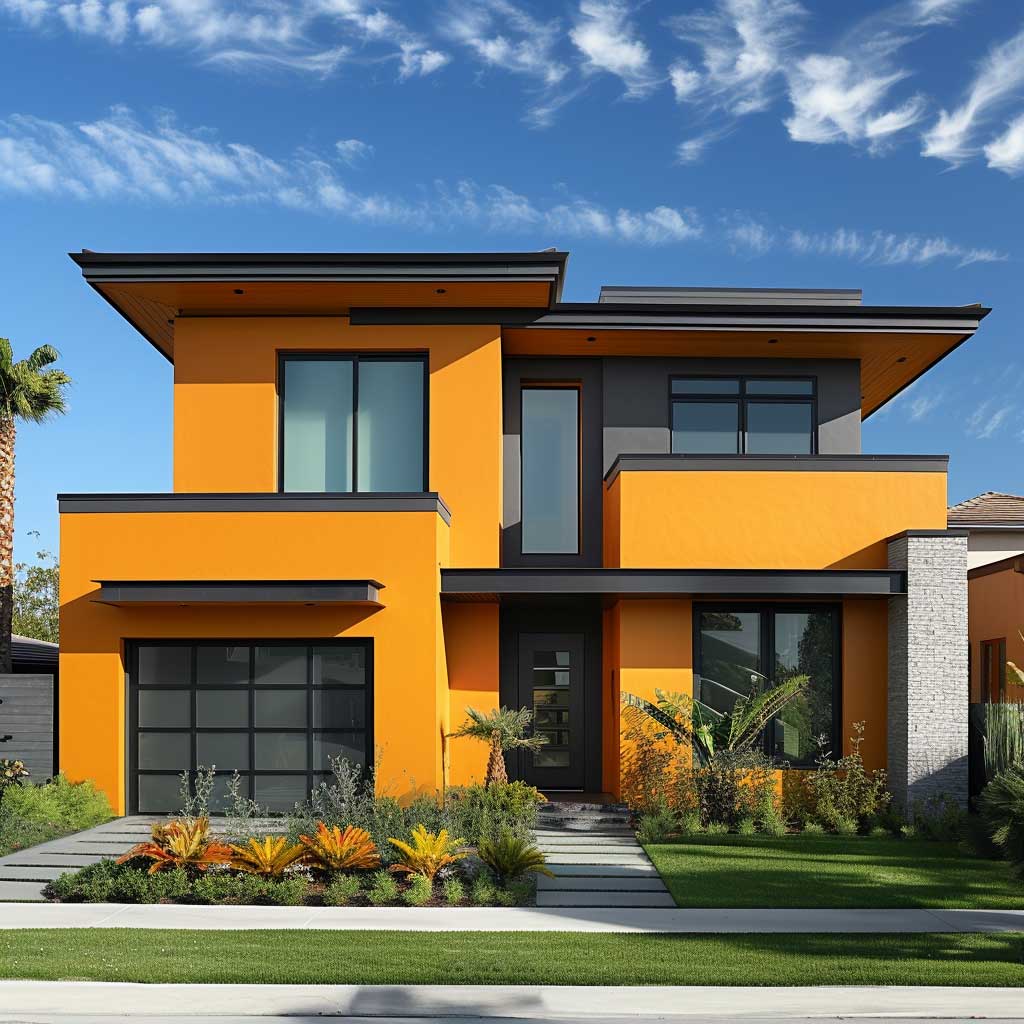
Amber and grey exterior wall paint is one of those combinations that photograph well in every light — warm enough to feel welcoming, cool enough to feel intentional. The pairing works because amber and grey occupy opposite ends of the temperature spectrum, which means each makes the other look sharper. Neither color is doing all the work, and that balance is exactly what gives a facade staying power beyond a single season.
Most exterior paint jobs last between 5 and 10 years before they need serious attention. Choosing a palette that reads well across decades rather than just in the current trend cycle is the only way to get full value from that investment. Amber and grey hold up — you’ll notice that houses painted in this combination from ten years ago don’t look dated the way trendy greige or millennial gray do.
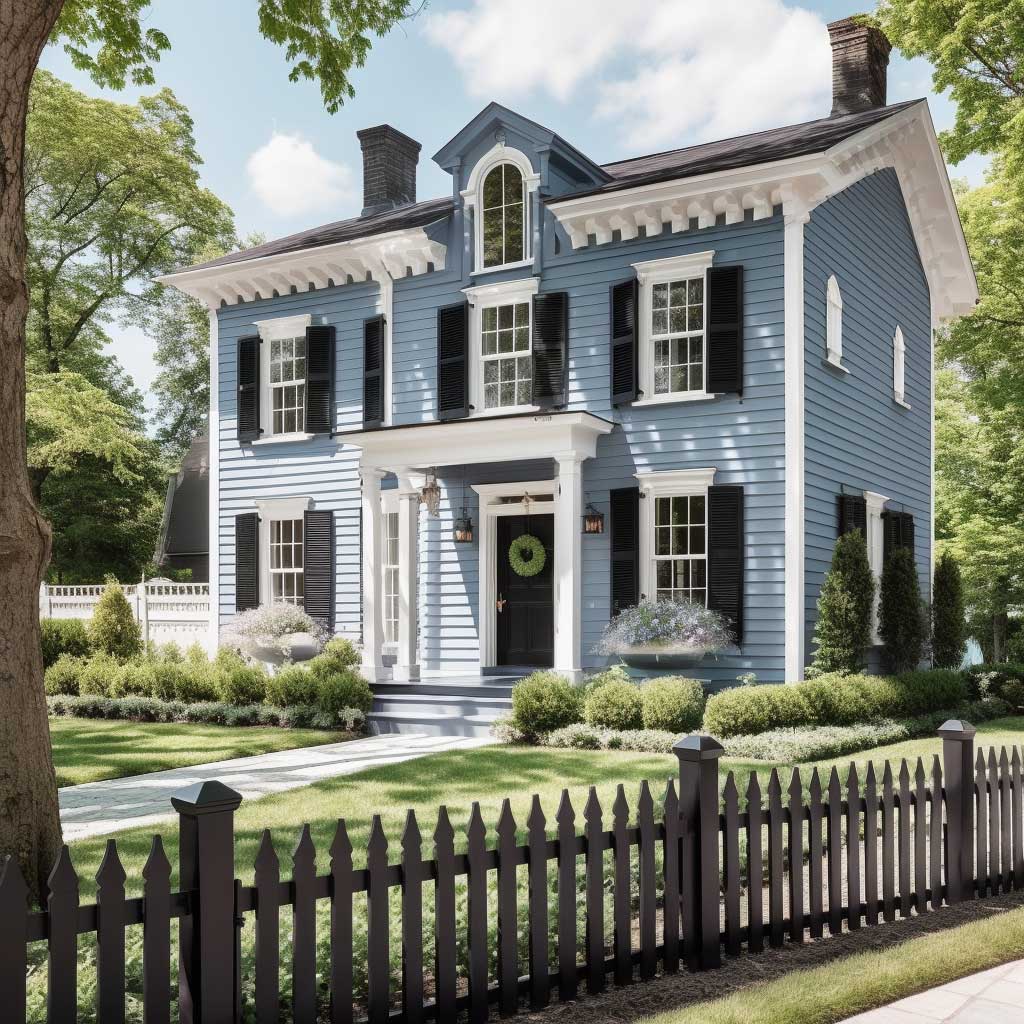
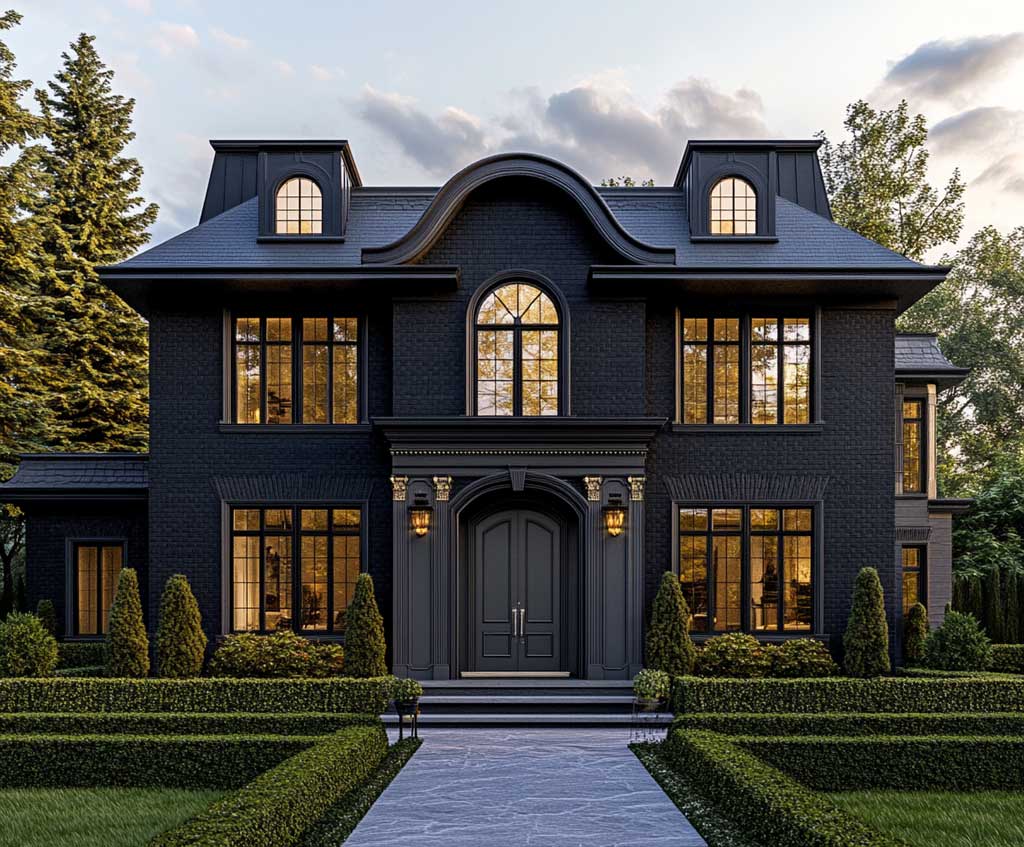
The three approaches below work for different proportions, different climates, and different architectural styles. Amber as the dominant wall color with grey accents reads warm and residential. Grey as the body with amber highlights skews more restrained and classic. A dark blue-grey base with amber punctuation hits the modern urban register that the dark blue grey exterior paint queries are chasing. All three solve different problems, but none of them require you to choose between warmth and sophistication.
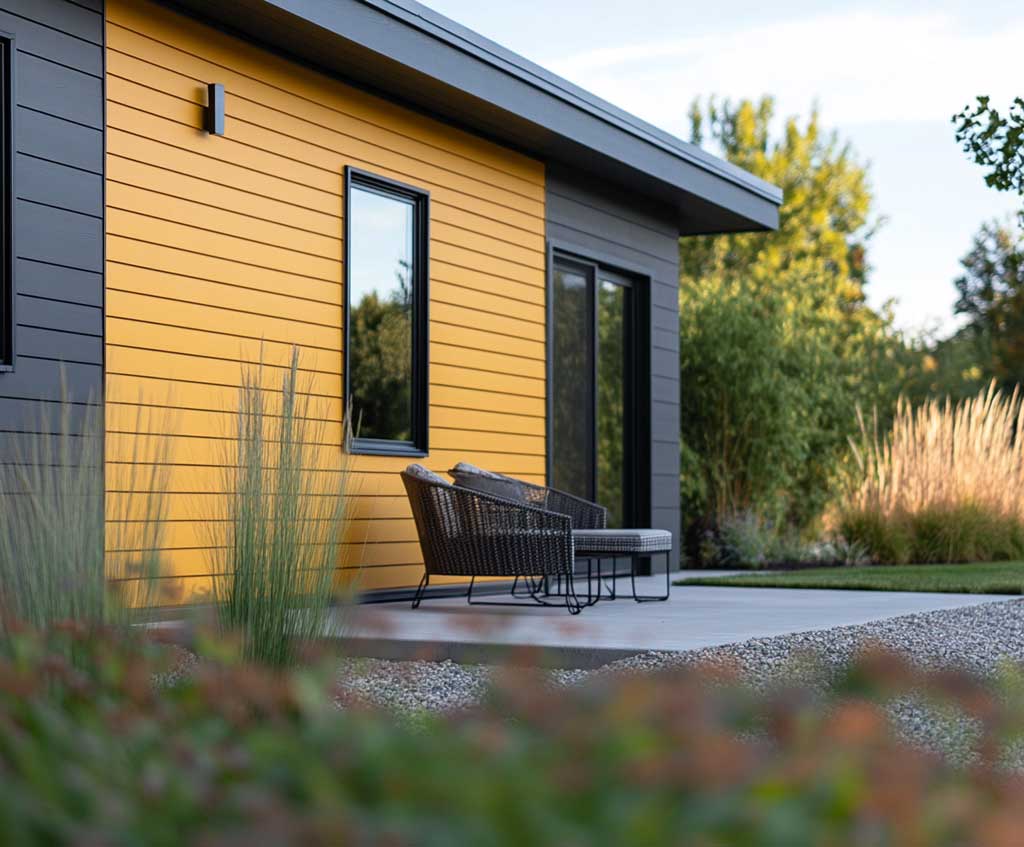
Amber as the dominant wall color with grey accents: warm, residential, works on almost any architectural style.
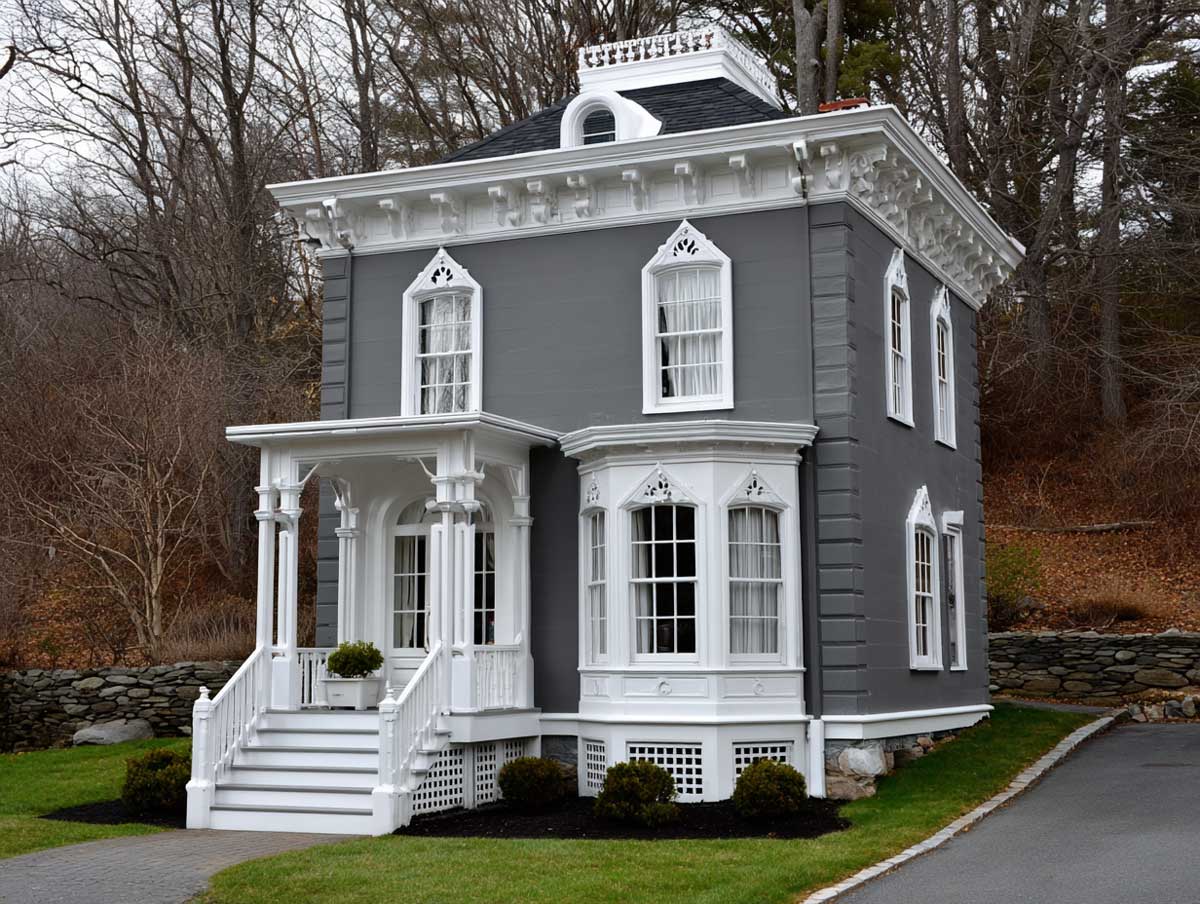
Grey body with amber highlights: more restrained, skews classic-revival, ages exceptionally well.
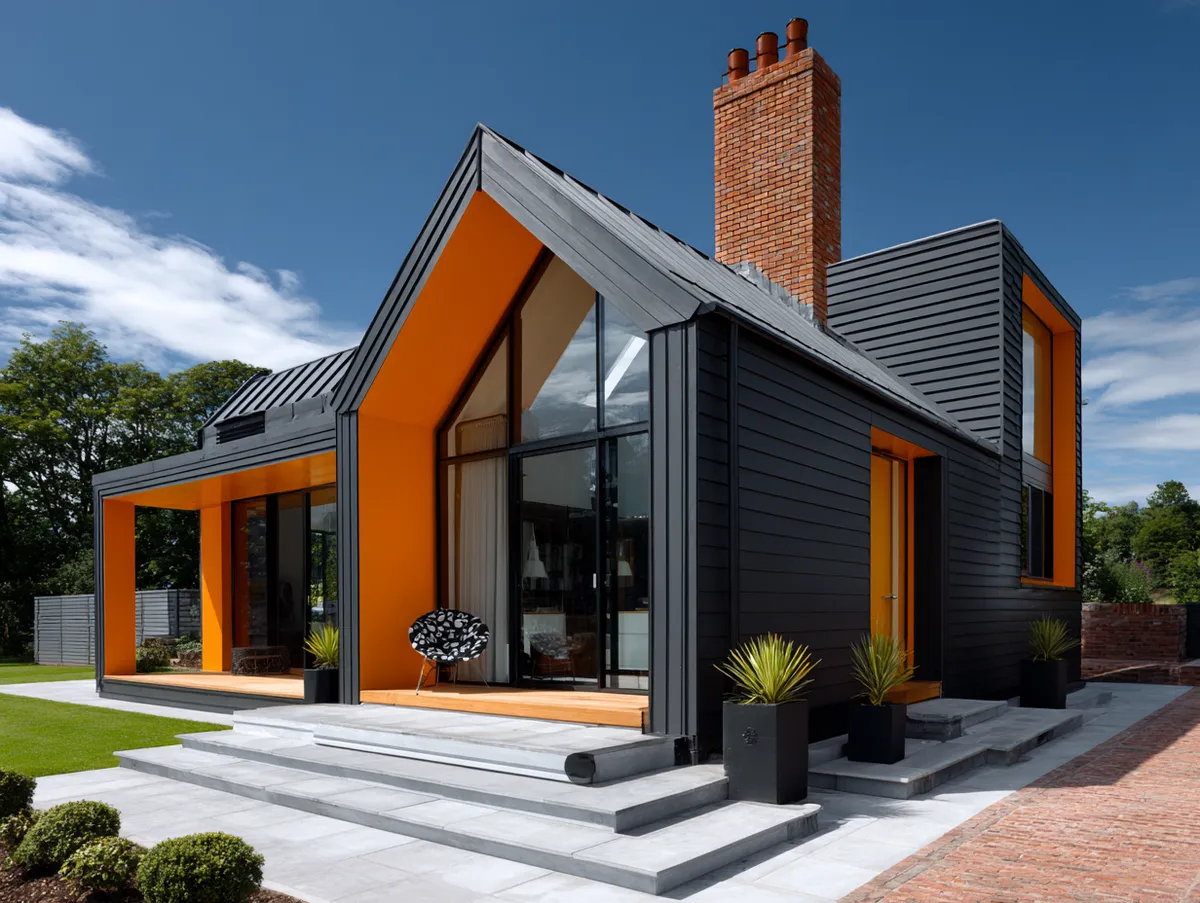
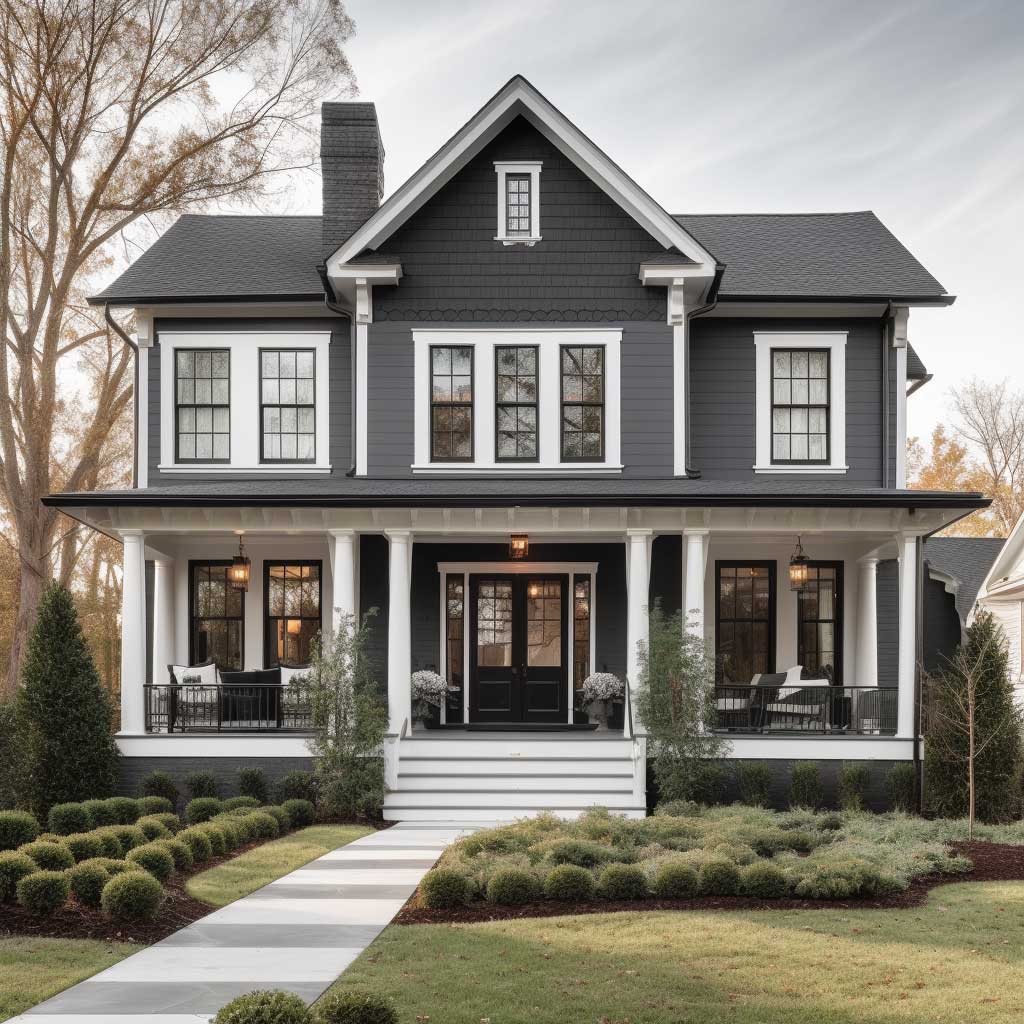
Dark blue-grey exterior with amber punctuation: the sharpest modern reading of the pairing.
Sherwin-Williams Emerald exterior paint runs about $93.99 per gallon — budget for two full coats at 350 sq ft per gallon, not the 400 the label claims.
Most exterior paint lasts 5–10 years. Dark colors fade faster, especially on south-facing walls — budget for repainting closer to the 7-year mark on those elevations.
One gallon of exterior paint covers 250–400 sq ft per coat depending on surface texture. Always buy 10% overage.
Amber Walls With Grey Accents Change Character by the Hour
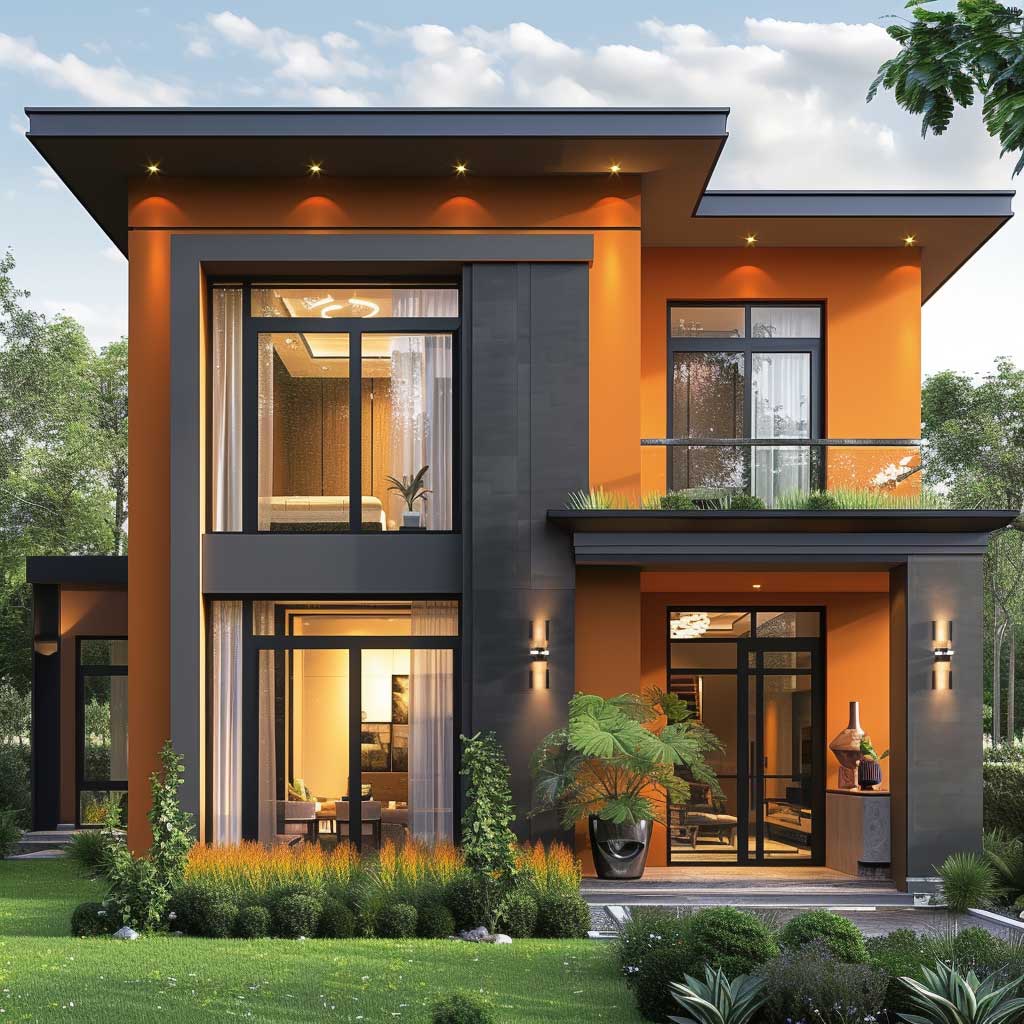
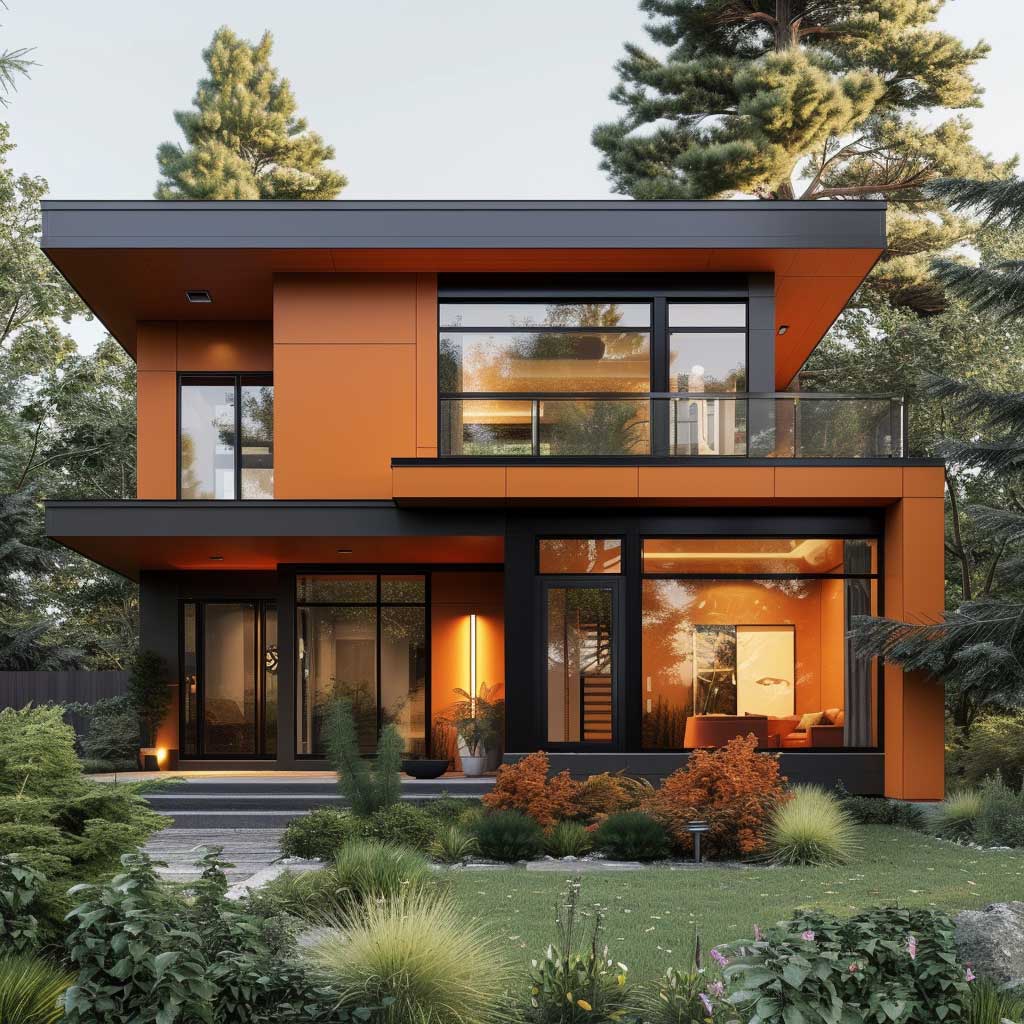
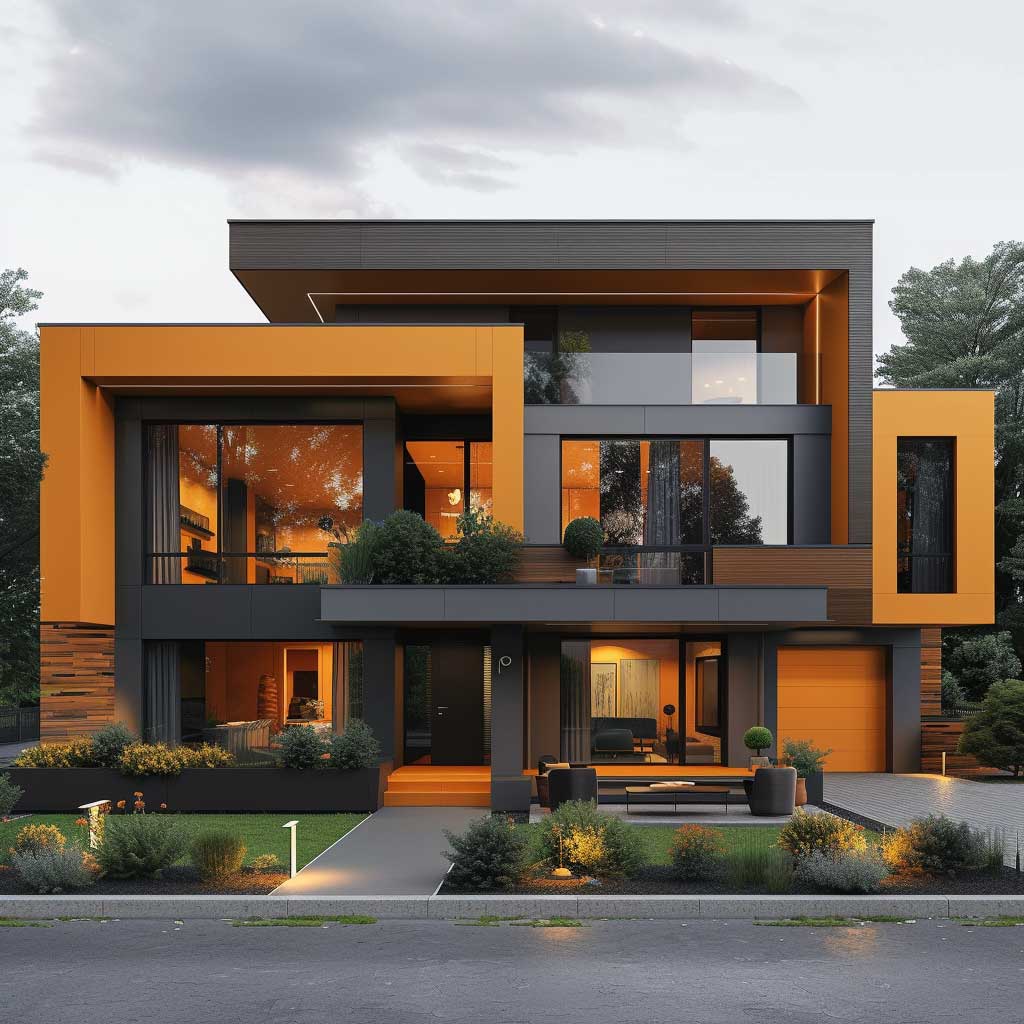
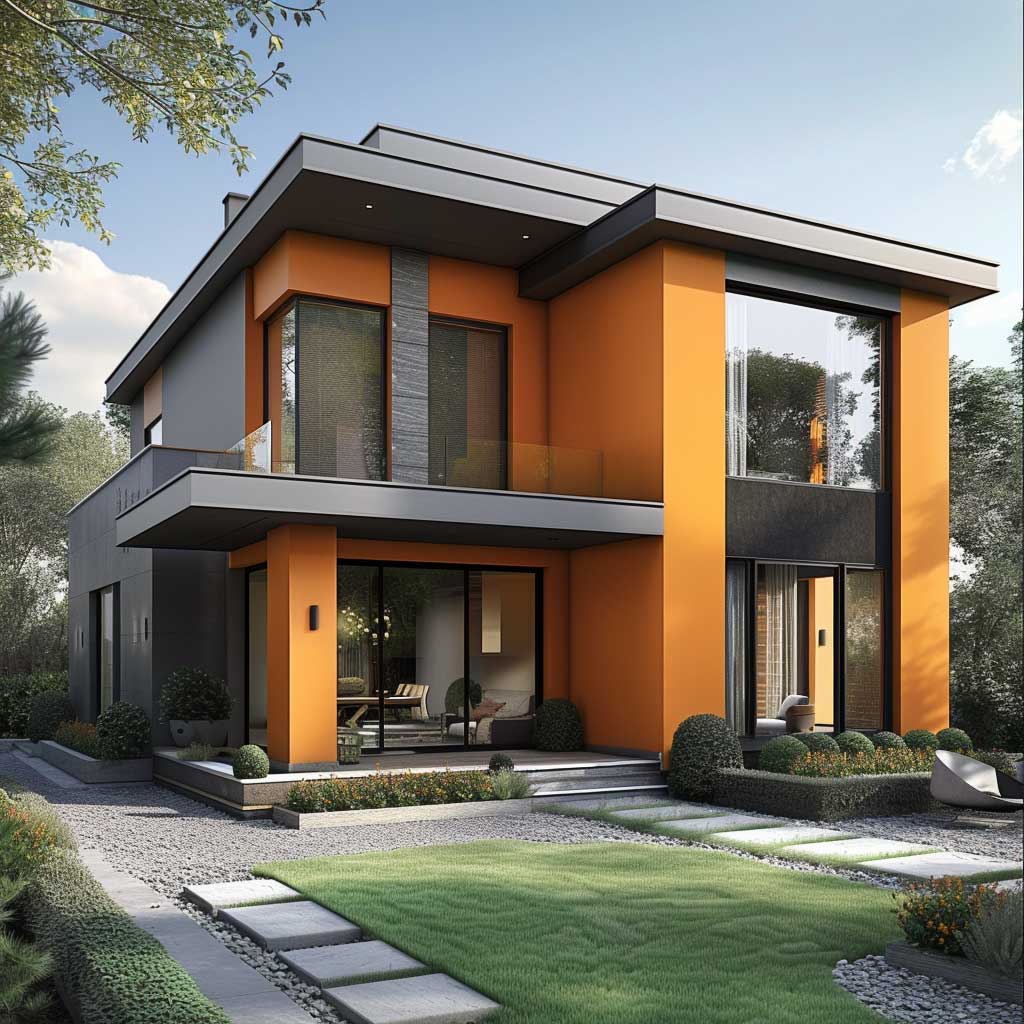
Amber exterior wall paint behaves like a mood board in itself — at 8 AM under diffuse morning light it reads as a rich honey gold, and by late afternoon on a south-facing elevation it deepens to something closer to burnt sienna. That shift is a feature, not a flaw. Grey accents on window frames, doorways, and the roofline act as anchors that keep the palette reading cohesive rather than restless as the light changes. The trick here is to choose a grey with warm undertones — Benjamin Moore Rockport Gray HC-105 is a reliable pick — so the transition between the amber body and the grey trim doesn’t look like two unrelated decisions.
Where do most homeowners go wrong with this setup? Choosing a cool, blue-based grey for the trim. Cool grey next to amber creates a color temperature clash that the eye reads as slightly wrong even if you can’t immediately name why. The grey should feel like the amber’s quieter sibling, not its opposite. Stonington Gray HC-170 or Copley Gray HC-104, both from Benjamin Moore’s Historical Collection, hold warm enough undertones to sit comfortably alongside amber without going muddy. Try both on white foam board in your actual exterior light before committing to a gallon.
Amber body paint earns its keep as a practical exterior choice, not just a visual one. Lighter warm colors reflect more heat than dark greys, which matters on west-facing walls. Sherwin-Williams Emerald exterior — around $93.99 per gallon — holds pigment well against UV degradation, which is the main reason amber tones fade unevenly on cheaper paint. Spend the budget on the body color and you won’t be repainting in year four because the golden tone has turned an uncertain orange.
For houses with architectural detail — corbels, window surrounds, porch columns — amber makes those elements disappear unless you deliberately frame them. Grey semi-gloss on trim pulls attention exactly where it belongs. Use at least a three-sheen difference between body and trim: satin on the amber walls, semi-gloss on every grey accent surface. The sheen contrast creates visual definition that reads as architectural craft even on a relatively plain exterior. Planning a color scheme across the full facade? The house exterior paint colour combinations breakdown covers ratio rules and placement logic for two-color schemes in more detail.
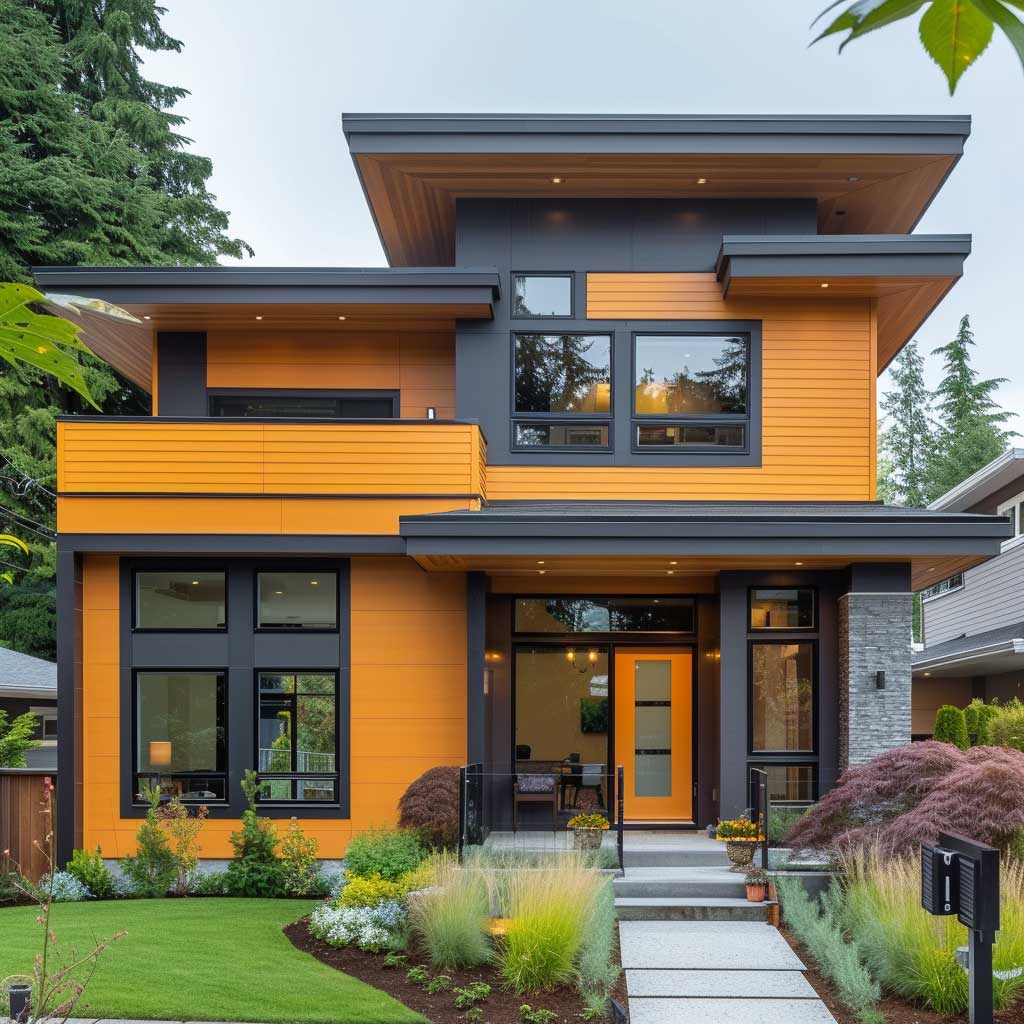
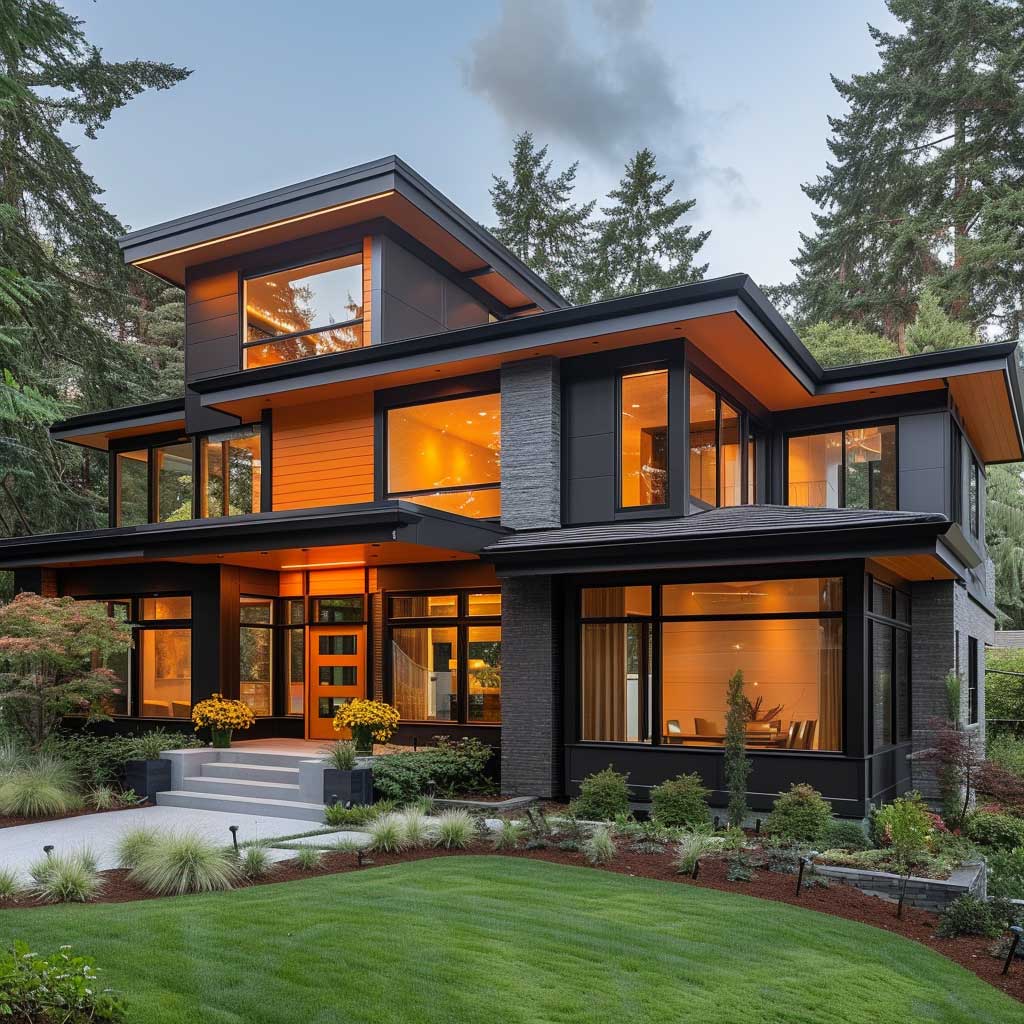
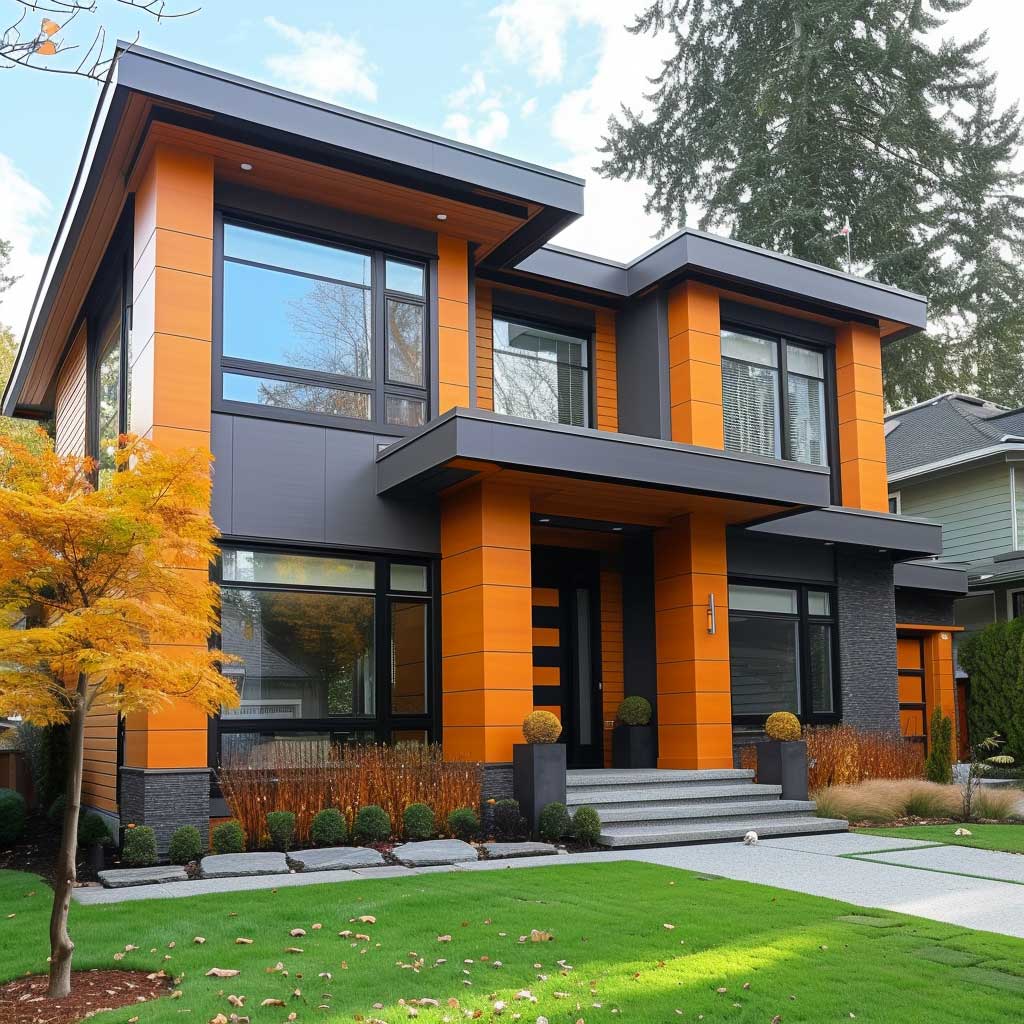
Natural materials amplify this palette without complicating it. Cedar cladding on a gable section reads like a third color that was already there — something between the amber and the grey — so it never feels added-on. Stone foundation courses in blue-grey fieldstone mirror the grey accents and give the warm amber walls a grounded, solid base. The rule of thumb for materials is the same as for trim: stay within the amber’s temperature range or go cooler, never warmer. Terracotta-veined stone next to amber body paint creates a busy, muddy effect that no amount of primer fixes.
Ask a painter which direction this palette needs the most attention and the answer is always the same: north-facing walls. Amber that never gets direct sun can read as flat and slightly murky. The solution is to go one shade warmer on north-facing elevations or use a slightly higher sheen to borrow ambient reflectivity. What you should never do is compromise by picking a pale amber across the whole house to compensate — the palette loses its identity and you end up with something that looks like aged cream paint rather than a deliberate color choice.
Don’t pair amber body paint with a blue-based cool grey trim. The color temperature mismatch reads as a mistake from the curb, even if the individual colors are attractive on their own. Warm grey only.
Don’t skip the sheen difference between body and trim. Matching satin on amber walls and satin on grey trim makes the palette read flat and the architectural lines disappear. Semi-gloss or gloss on all trim, always.
Don’t judge amber samples indoors. Store lighting makes most amber tones look more orange than they are. Tape samples to actual siding in outdoor light and check them at morning, noon, and golden hour before buying full gallons.
Grey Dominance With Amber Highlights Survives Every Architectural Era
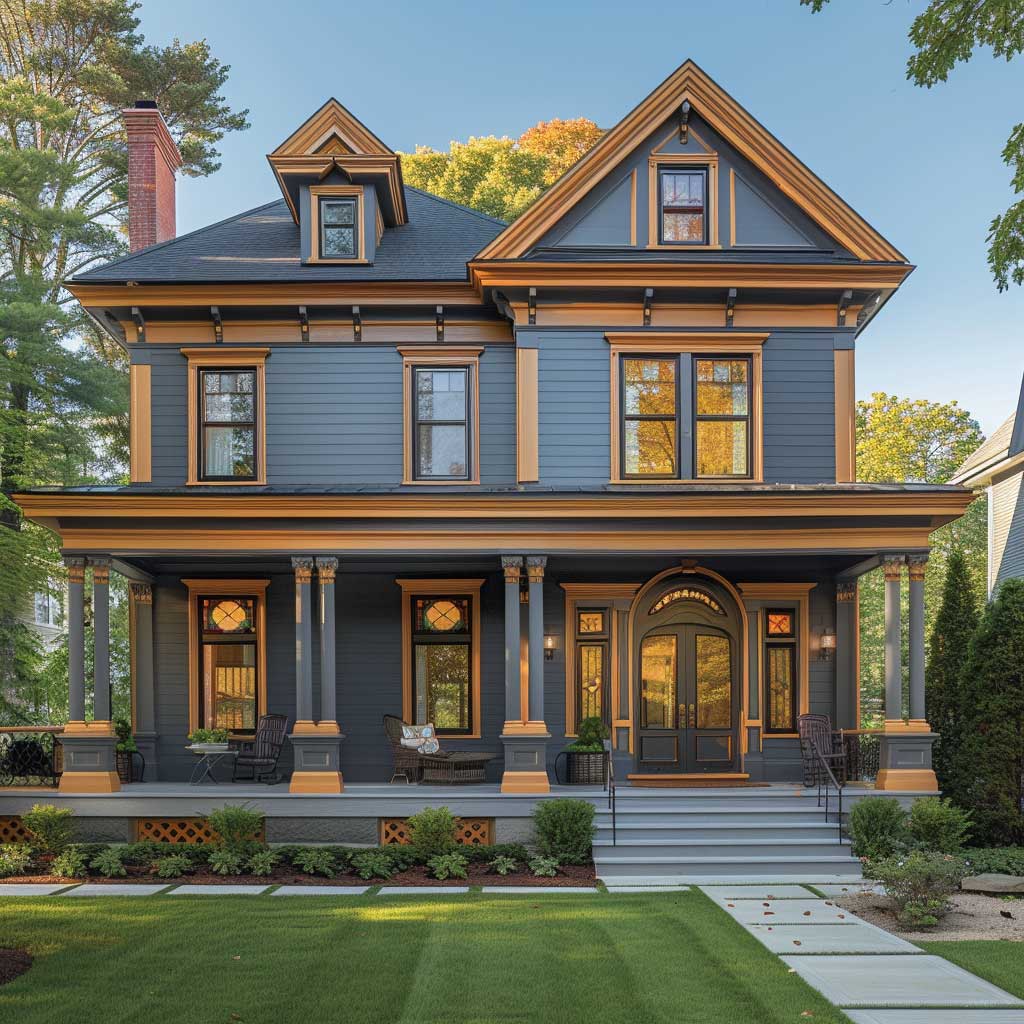
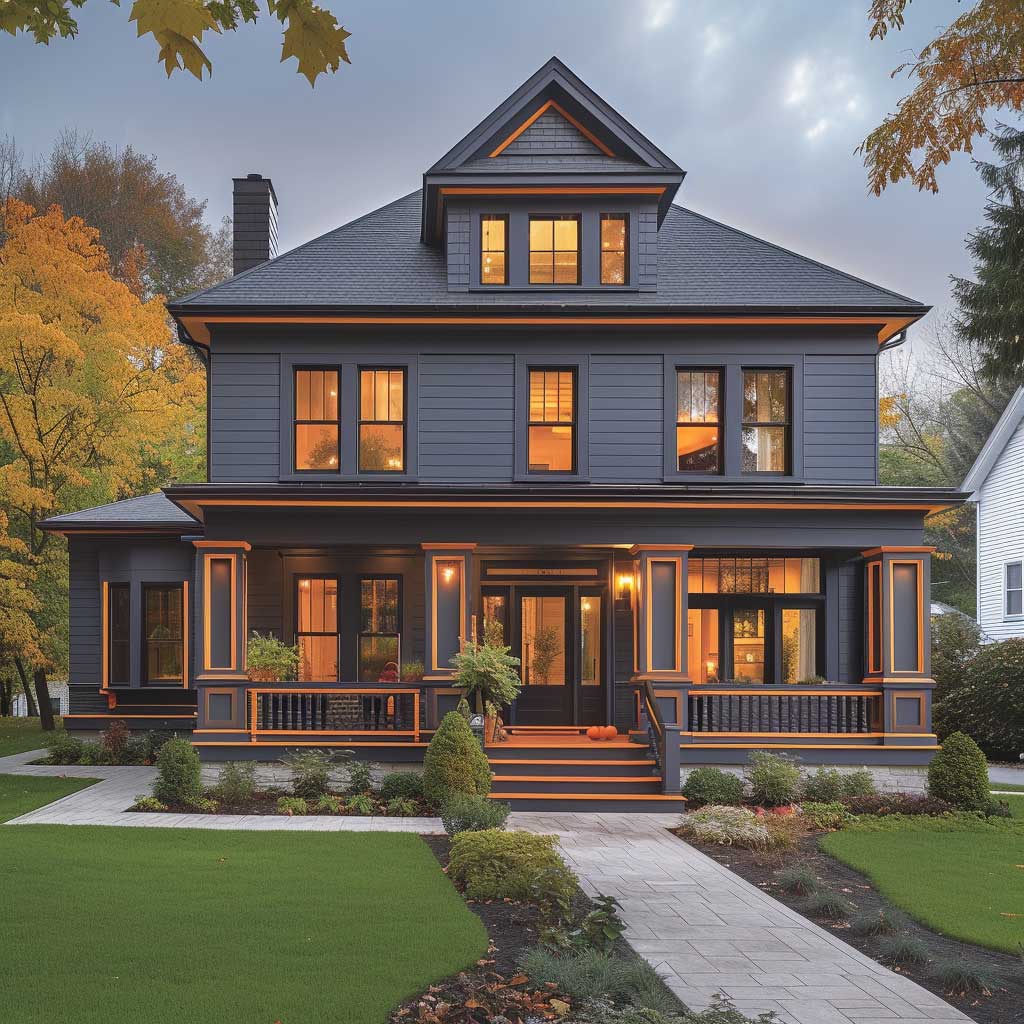
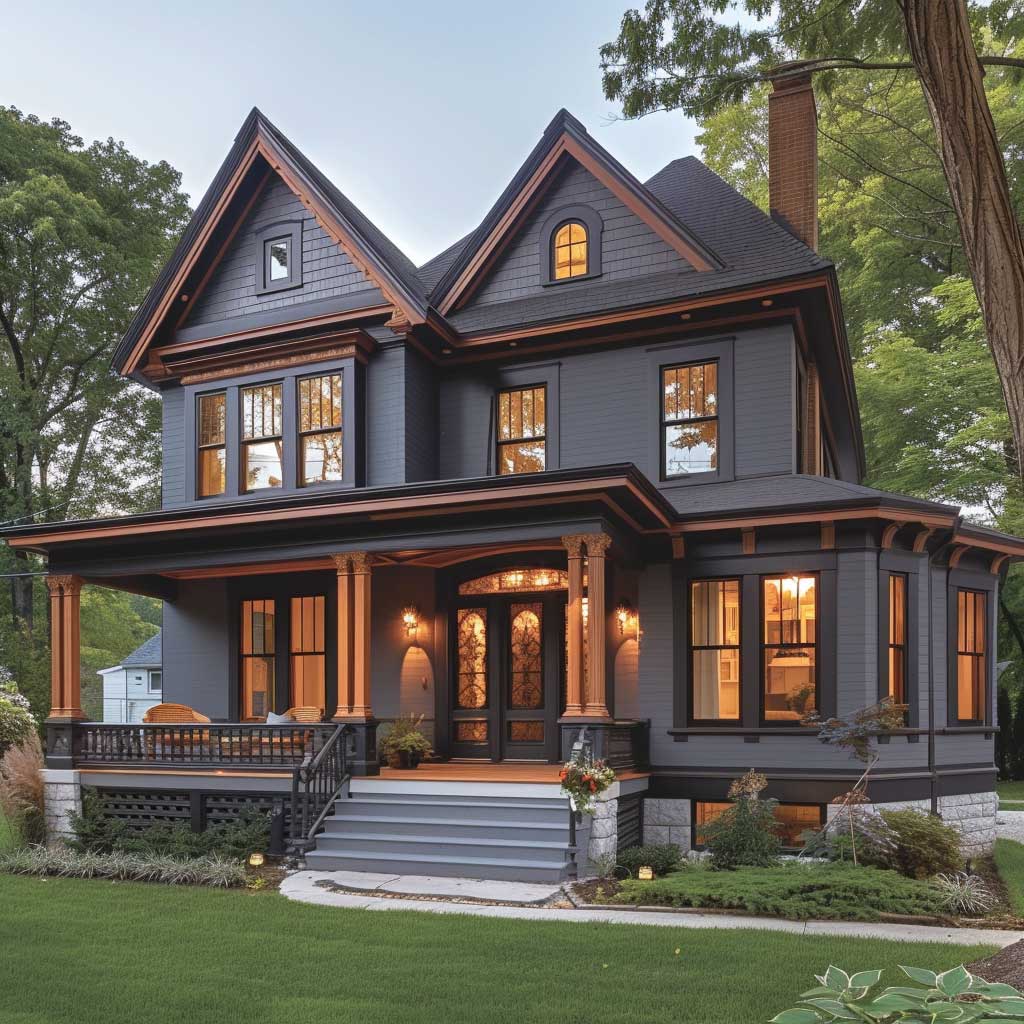
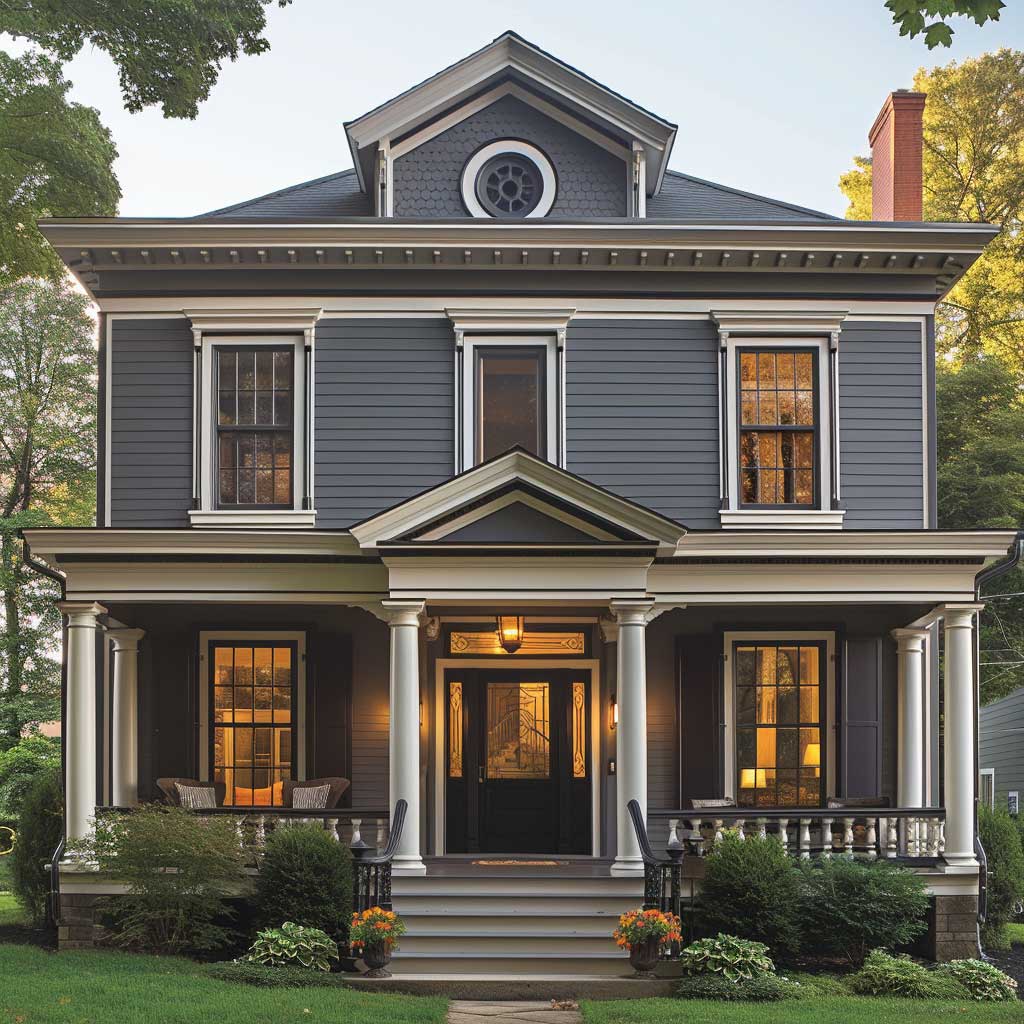
Grey as the dominant body color with amber highlights is the more restrained version of this palette — and the one that holds up best on houses with genuine architectural character. Think of grey as the stage and amber as the lighting: the stage doesn’t fight for attention, but without it the lighting has nothing to land on. Benjamin Moore’s Stonington Gray HC-170, described by the brand as silvery and adaptable across lighting conditions, is one of the most consistent performers in this role — it reads neither too warm nor too cold on a typical daylight spectrum, which means it doesn’t compete with the amber accents you add on top of it.
Amber highlights work best when they’re placed where the eye naturally wants to go: the front door, eaves, window surrounds, and any carved or applied trim detail. What stops this approach from working is over-deploying the amber. Stylists recommend treating it like a spotlight rather than a floodlight — one concentrated application per facade plane, not a scattering of amber details across every surface. A single amber front door on a grey house reads as decisive. Amber shutters, amber door, amber eave trim, and amber flower boxes on the same facade reads as a house that couldn’t decide which color it actually wanted to commit to.
Grey exterior paint adapts to sun exposure in ways that amber doesn’t. On south-facing walls in direct sun, grey can read as bright and almost silvery. In shaded north-facing positions, it deepens toward charcoal without looking gloomy. The direction your house faces matters more for grey than for almost any other exterior color family. Benjamin Moore’s color guidance confirms that grey shifts noticeably between shaded and lit elevations, which is worth factoring into your choice of shade depth. A medium grey like Boothbay Gray HC-165 handles that shift better than an already-dark charcoal, which can turn nearly black in shade. For a broader look at how grey performs alongside other accent colors, house exterior paint colour combinations covers grey pairings with red, cream, and darker accents in tested real-world scenarios.
The finish question matters as much as the color question. Matte grey body paint undersells the palette — it absorbs light rather than interacting with it, and on overcast days the facade can look flat and a little defeated. A satin sheen on the grey body gives it the subtle luminosity that makes the amber highlights pop in comparison. The amber accents, placed on trim and doors, should go at least semi-gloss — amber in a matte finish loses the warmth and glow that makes it worth choosing in the first place. Spend more time getting the sheens right than agonizing over whether the grey is four shades or five shades lighter than your roof.

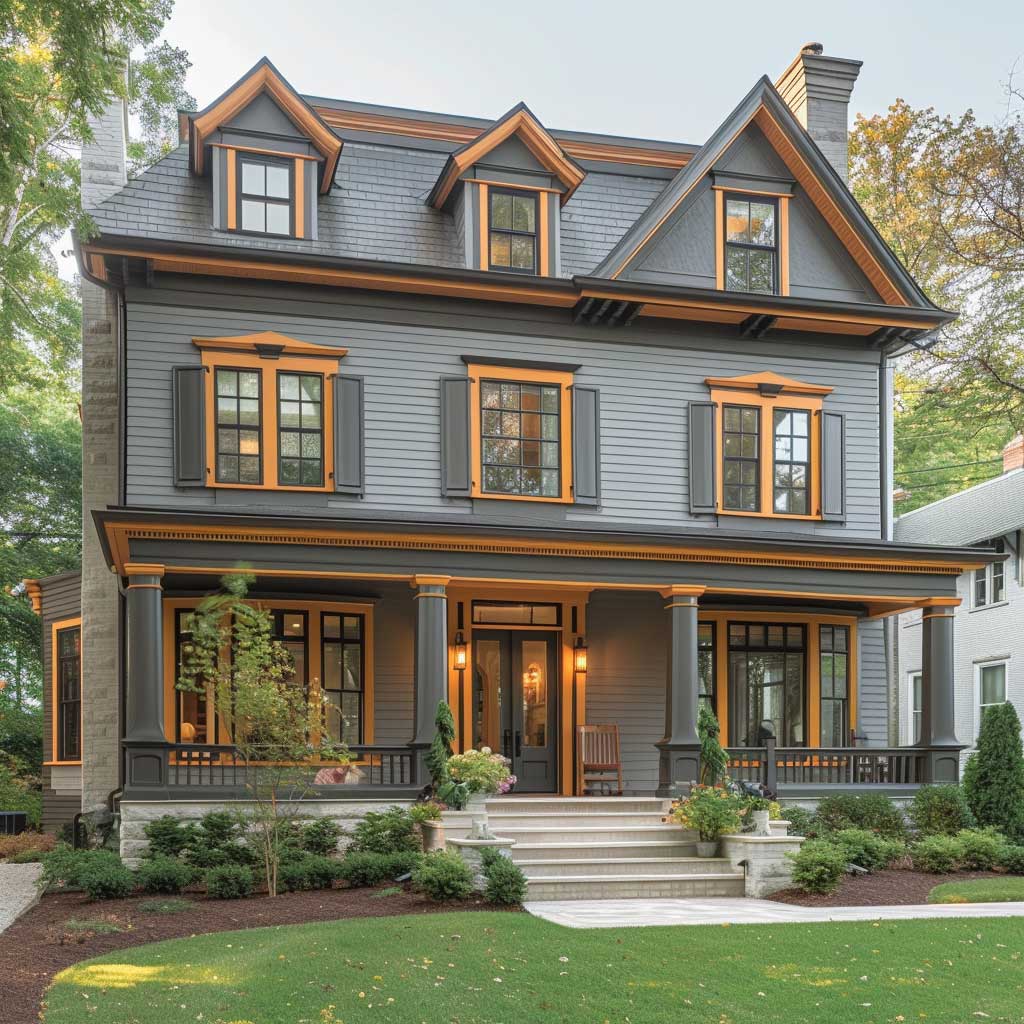
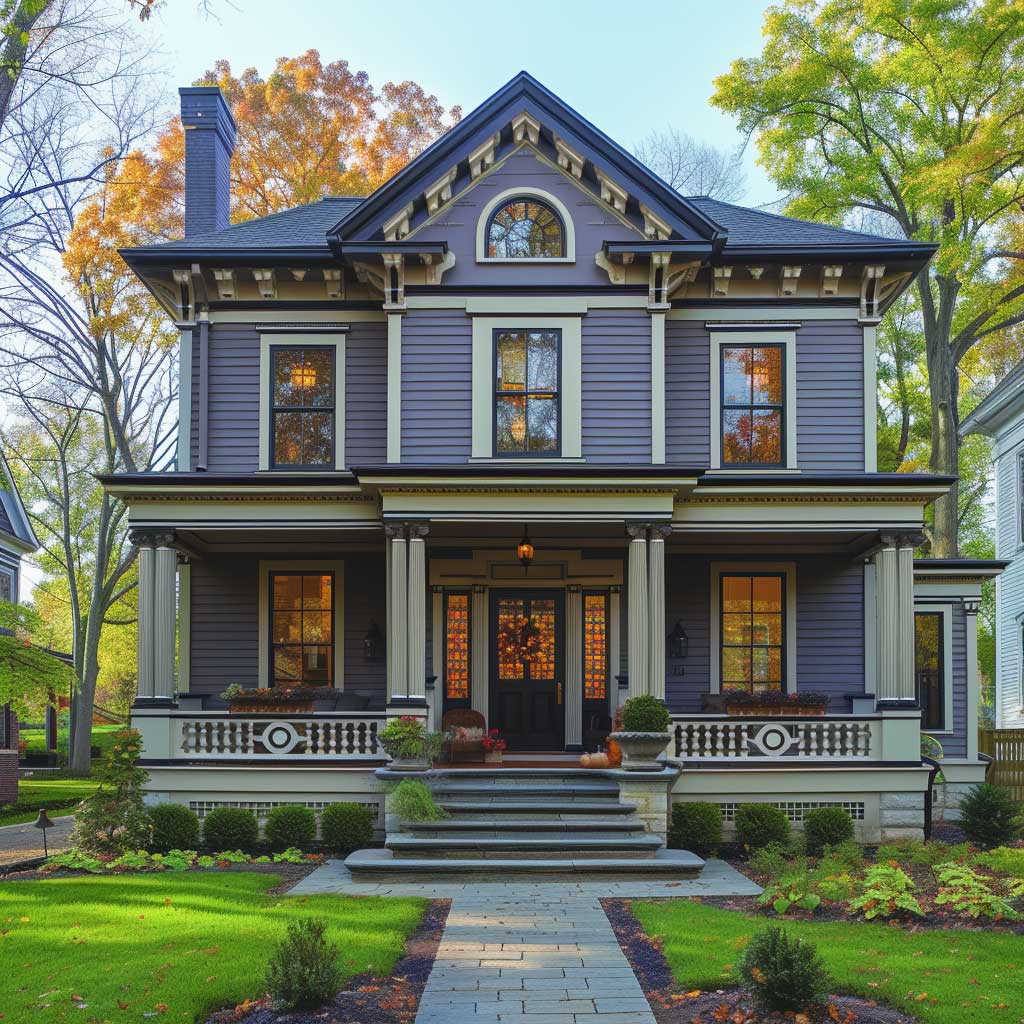
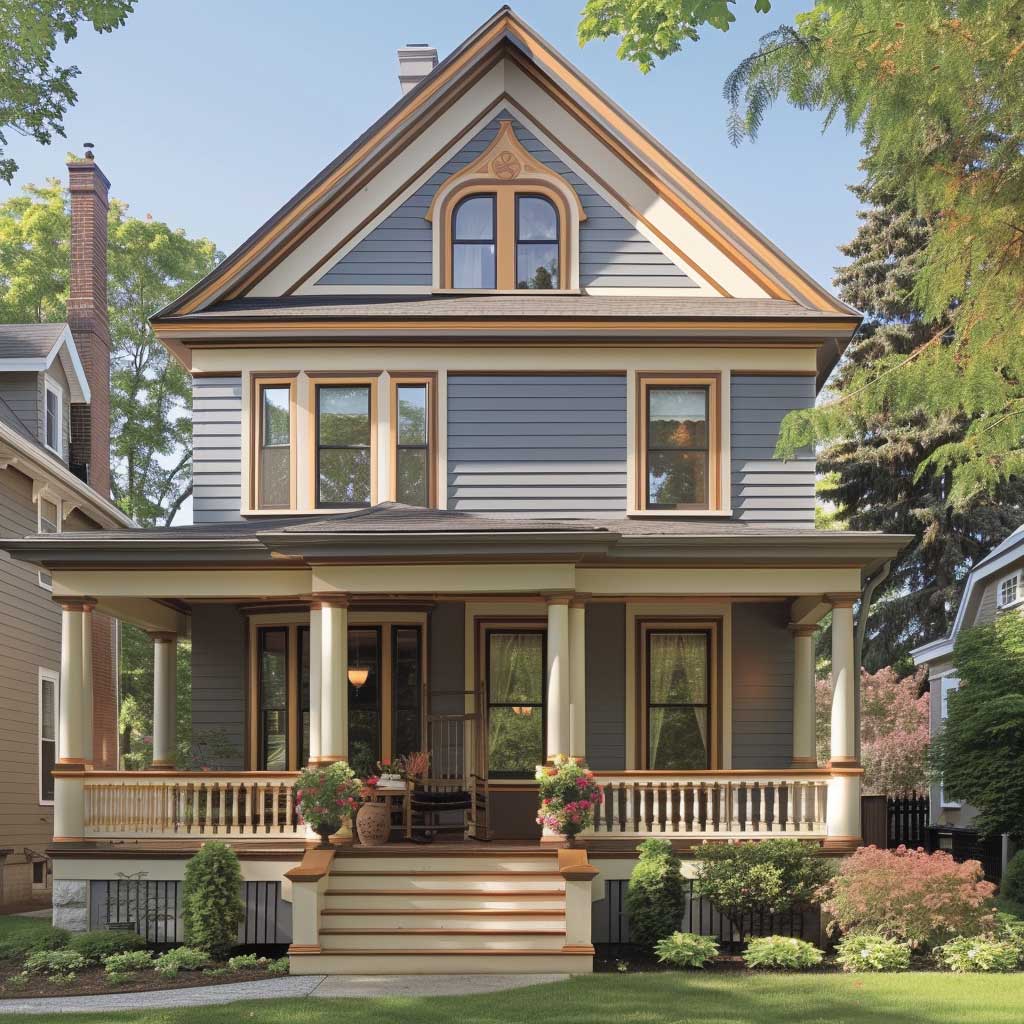
Landscaping does a lot of work for a grey-dominant exterior that many homeowners don’t account for. Evergreen shrubs immediately in front of a grey facade create a green-grey neutral zone that makes amber accents read warmer by contrast. Burgundy or bronze foliage — ornamental grasses, Japanese maples — push in the other direction and compete with the amber. The simplest landscaping rule for a grey house with amber highlights: stick to green or silver foliage in front of the main facade and let the amber do the warmth work by itself. Amber potted plants on a grey porch step are a $30 experiment that tells you instantly whether your chosen shades are correctly calibrated.
Wood siding exteriors in this palette need repainting every 7–10 years due to expansion and contraction from temperature shifts — which means grey body color on a wood-clad house should be chosen for long-term livability, not just current appeal. High-quality exterior paints applied professionally can stretch that interval toward 10–15 years. The extra per-gallon spend on a premium exterior line is the one area where cutting the budget consistently produces a worse outcome than paying it. On a grey body that covers 70% of your facade, a $20-per-gallon savings across ten gallons is not worth an early repaint cycle that costs $4,000–$8,000 in labor.
Dark Blue-Grey Exterior Paint Reads Modern — Until Amber Pulls It Back Toward Human
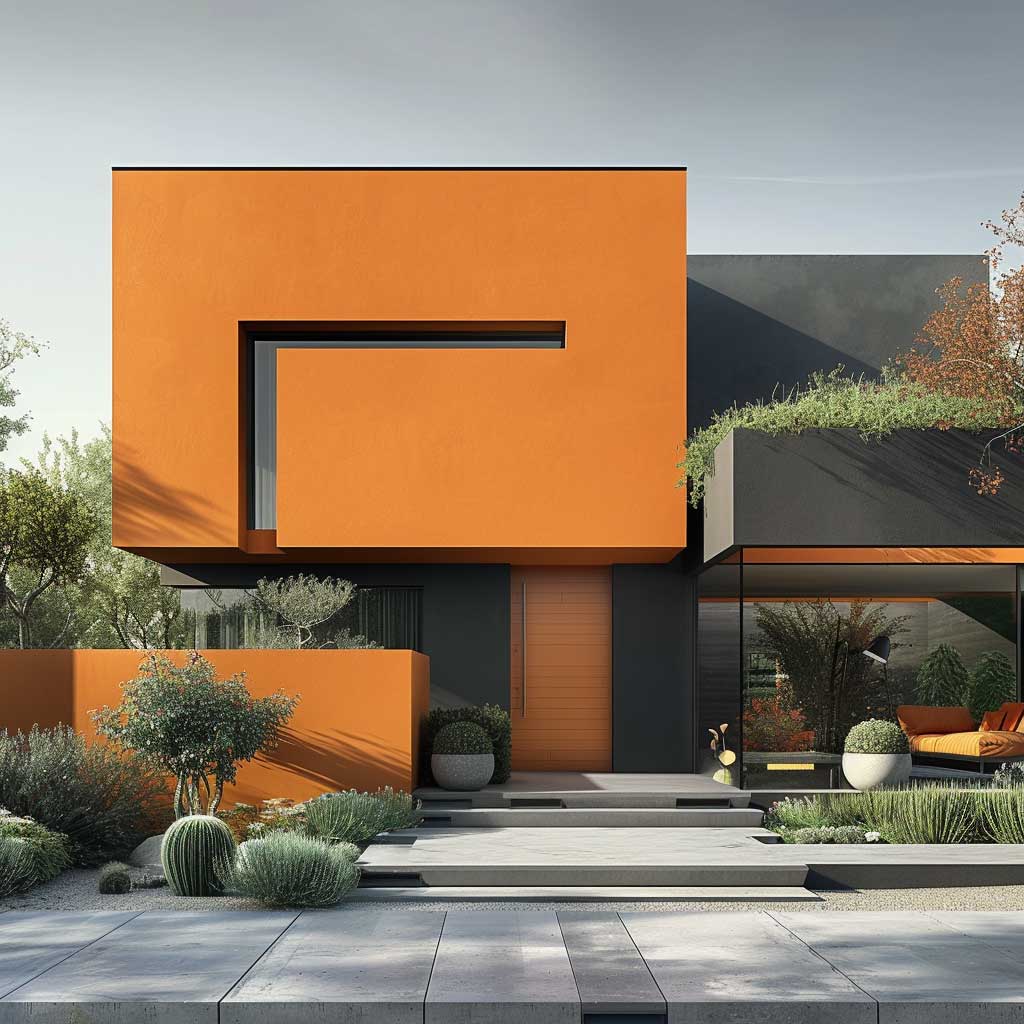
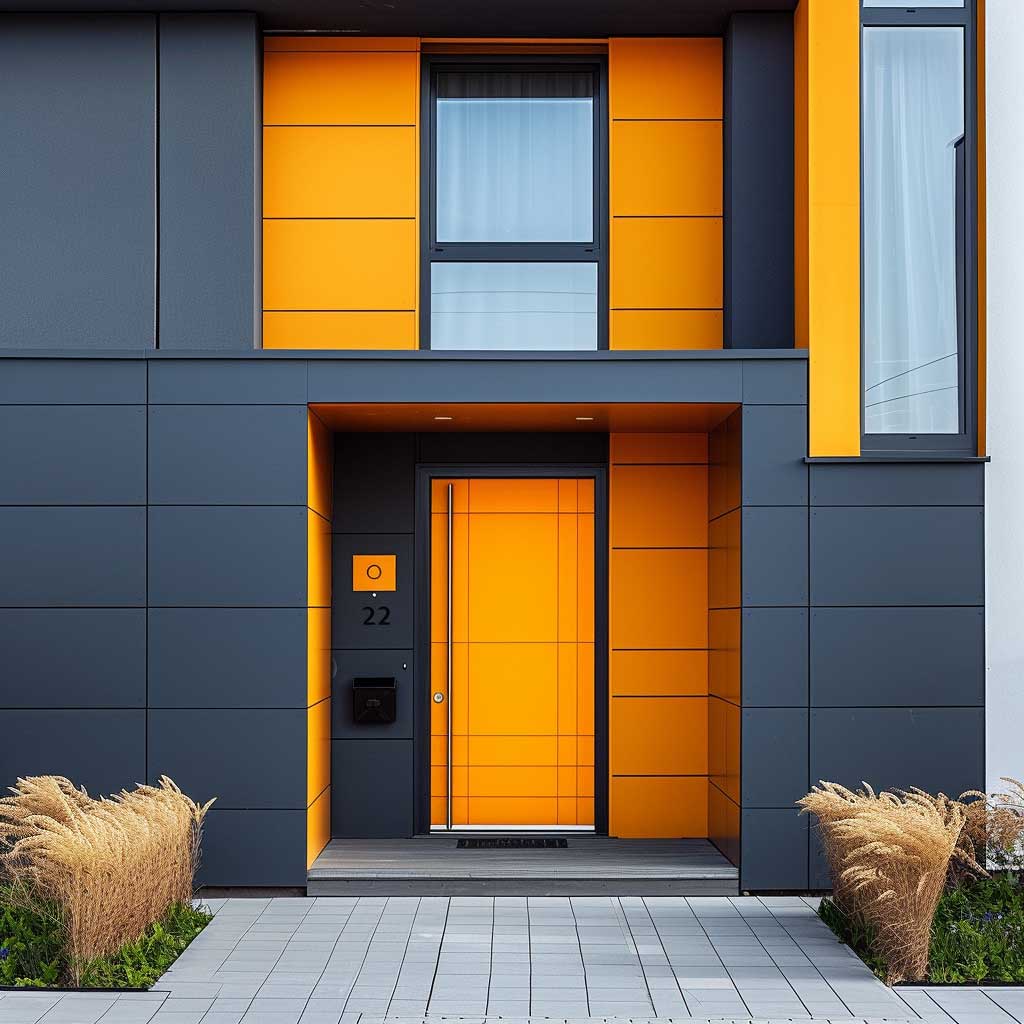
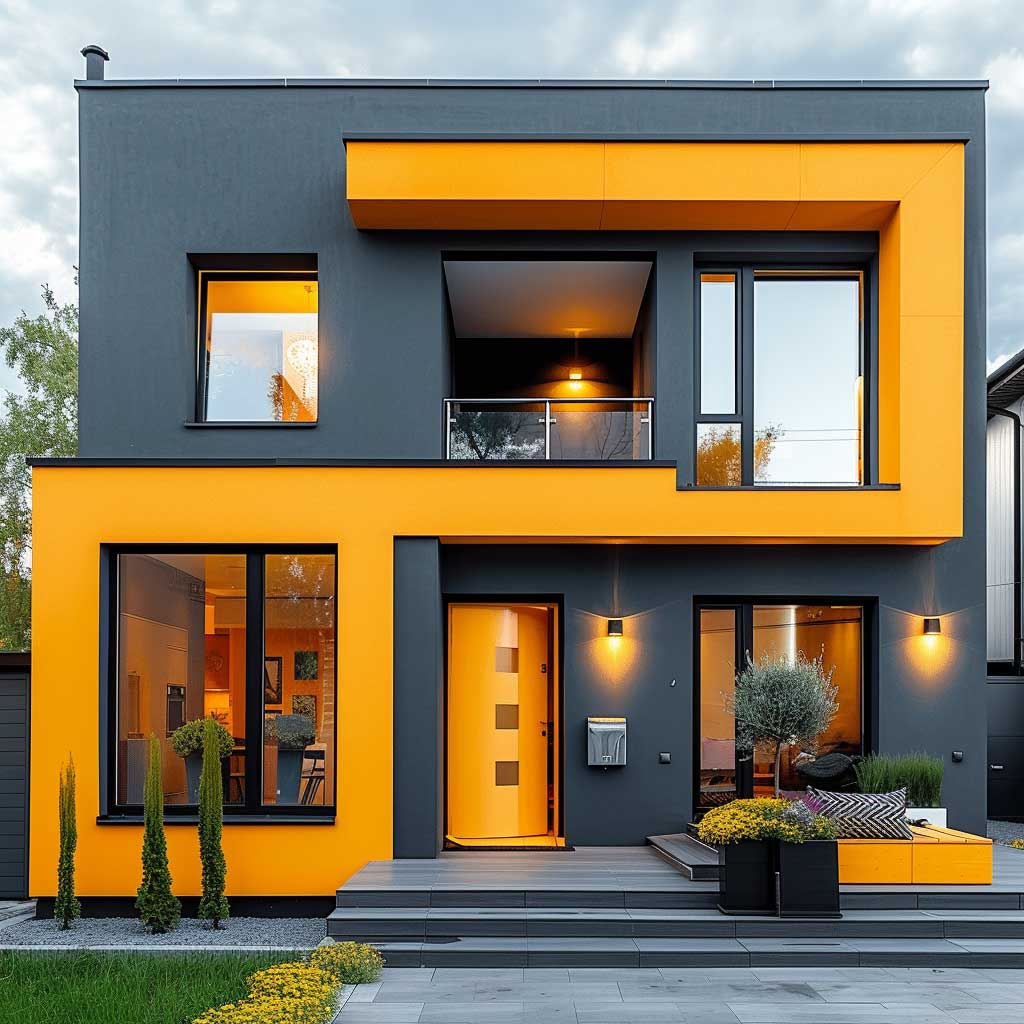
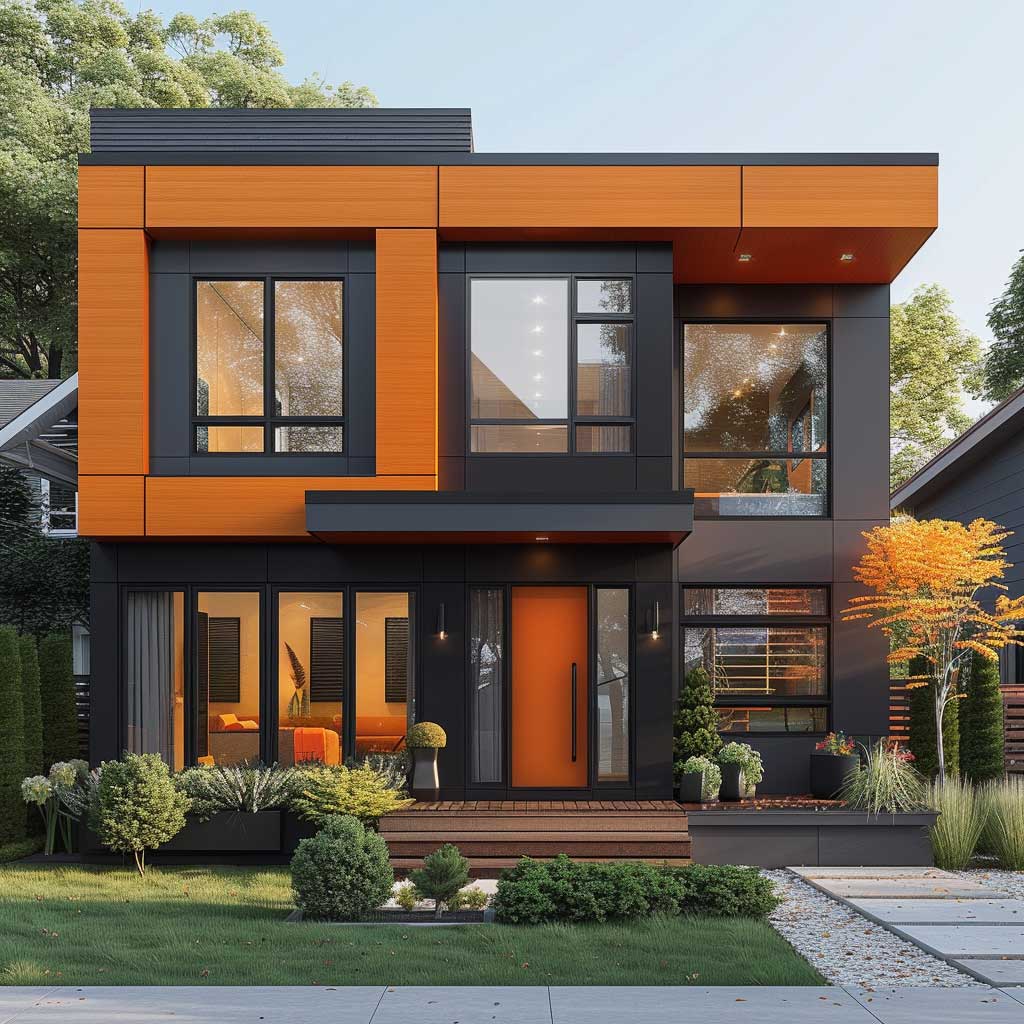
Dark blue-grey exterior paint occupies a specific register — more sophisticated than plain grey, more restrained than full navy, and just moody enough to make a house look like a deliberate design decision rather than a builder default. Benjamin Moore Hale Navy HC-154 is the color that comes up most consistently in this conversation among exterior painters, described by the brand’s Historical Collection as a deep, complex blue-grey with enough neutral undertones to avoid reading as blue from the street. The amber infusion in this palette functions differently than it does with mid-grey — here it’s genuinely corrective, warming what would otherwise be a facade cold enough to feel uninviting.
Dark exterior colors absorb significantly more heat than lighter shades — a documented limitation of deep blues and dark greys on south and west-facing walls. That means dark blue-grey exteriors in hot climates fade faster and may require repainting closer to the 5–7 year mark rather than the 7–10 year standard. The tradeoff is worth it on north-facing or shaded elevations, where the same dark color that bakes in direct sun instead creates exactly the dramatic depth that makes this palette compelling. You’ll notice houses painted in dark blue-grey on wooded lots age far better than the same color on an exposed suburban block.
The amber punctuation strategy for this palette is different from the highlight approach used with medium grey. The goal isn’t to warm the facade overall — it’s to insert one point of human-scaled warmth that keeps the exterior from reading as cold. A single amber front door achieves this in a way that amber window trim does not. Amber spread across multiple elements on a dark blue-grey house creates a confused message. One amber element — door, or sconce light fixtures, or a single accent panel on a contemporary design — operates like a period at the end of a sentence. It completes the palette. Multiple amber elements make the dark grey look like it’s apologizing for itself. For reference on how dark exteriors pair with accent colors across different architectural types, see these dark exterior house color ideas on the site for tested accent placement logic.
Evening lighting changes the math entirely for this palette. Dark blue-grey exterior paint under outdoor lighting at dusk absorbs the warm spectrum of incandescent or warm-LED fixtures and reflects it back as a subtle warmth that mimics the amber accent during daylight. This is the one exterior color combination where exterior lighting design matters as much as paint selection. Warm-spectrum LED sconces (2700–3000K) placed at either side of the front entry will do more to make a dark blue-grey house feel welcoming than any amount of amber trim. Cold daylight-spectrum fixtures will fight the amber and make the dark grey look like concrete.
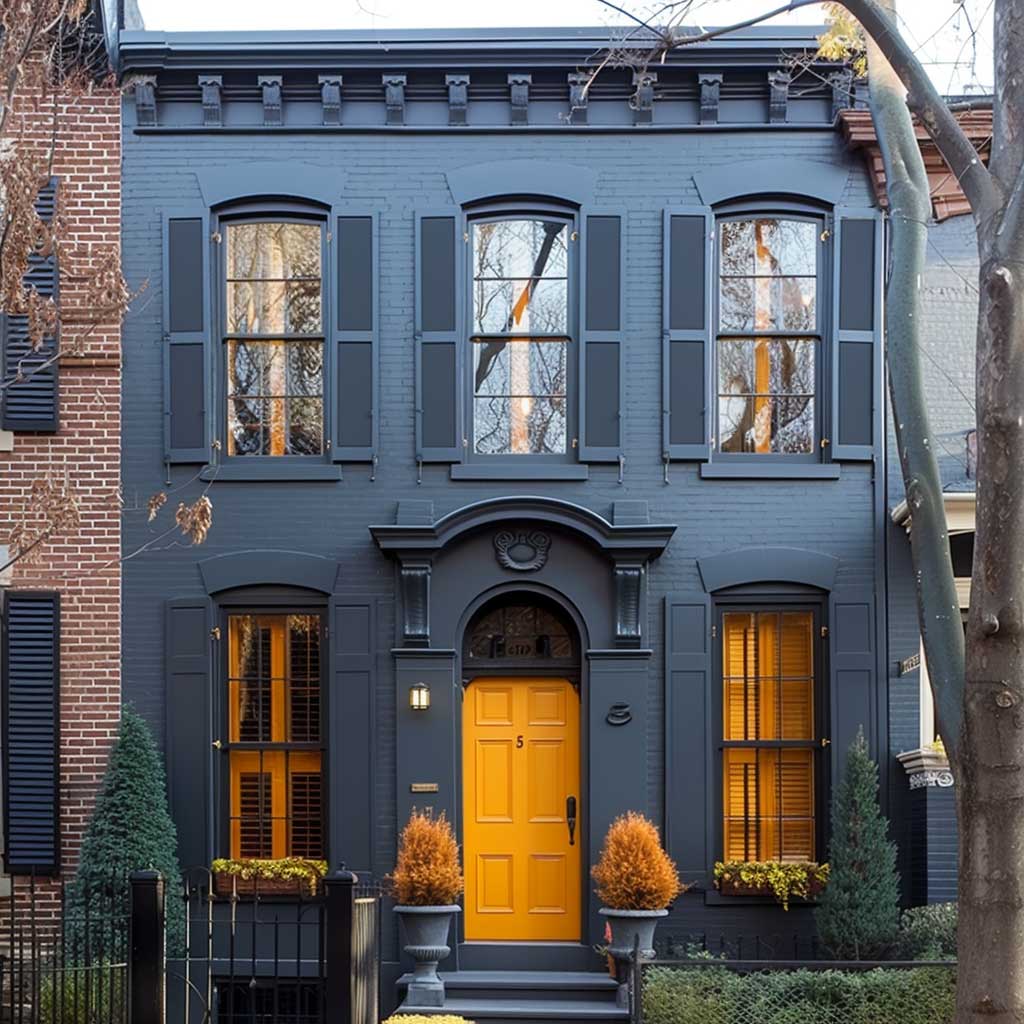
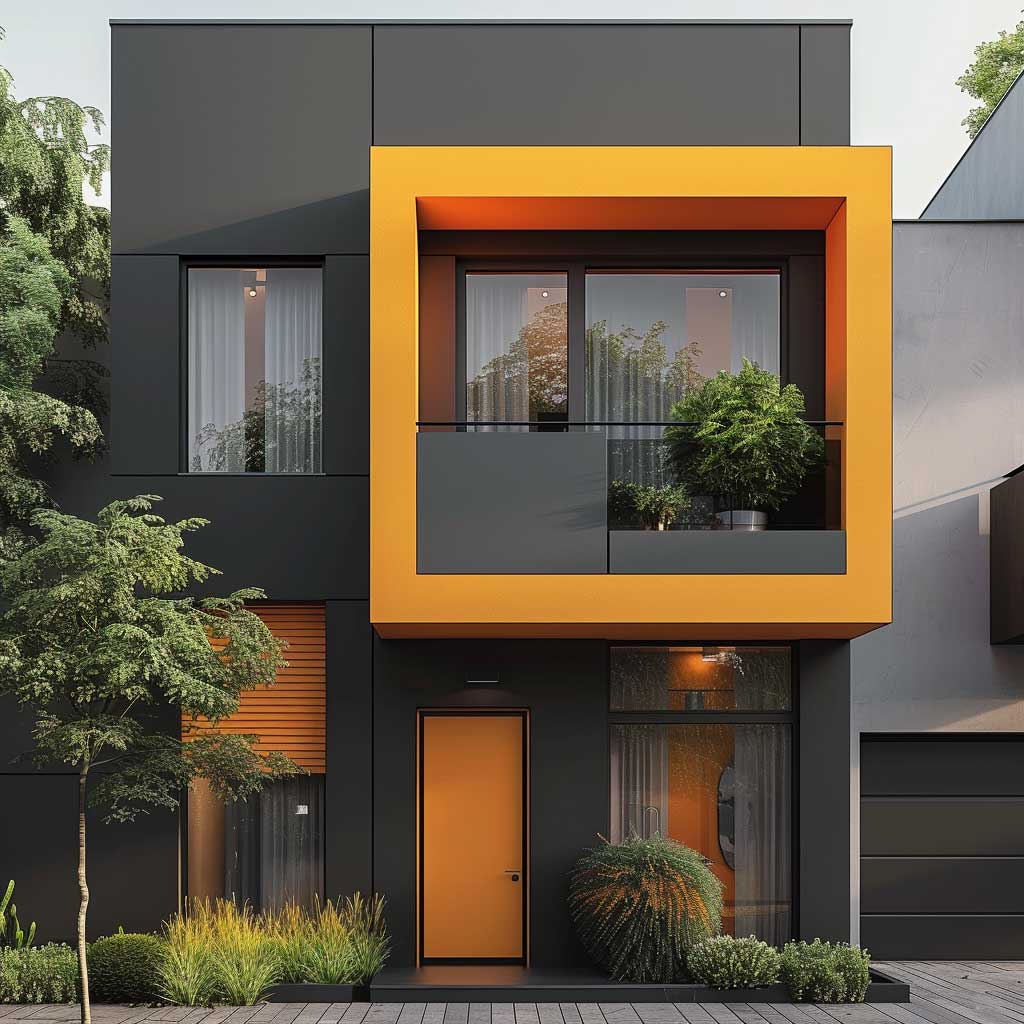
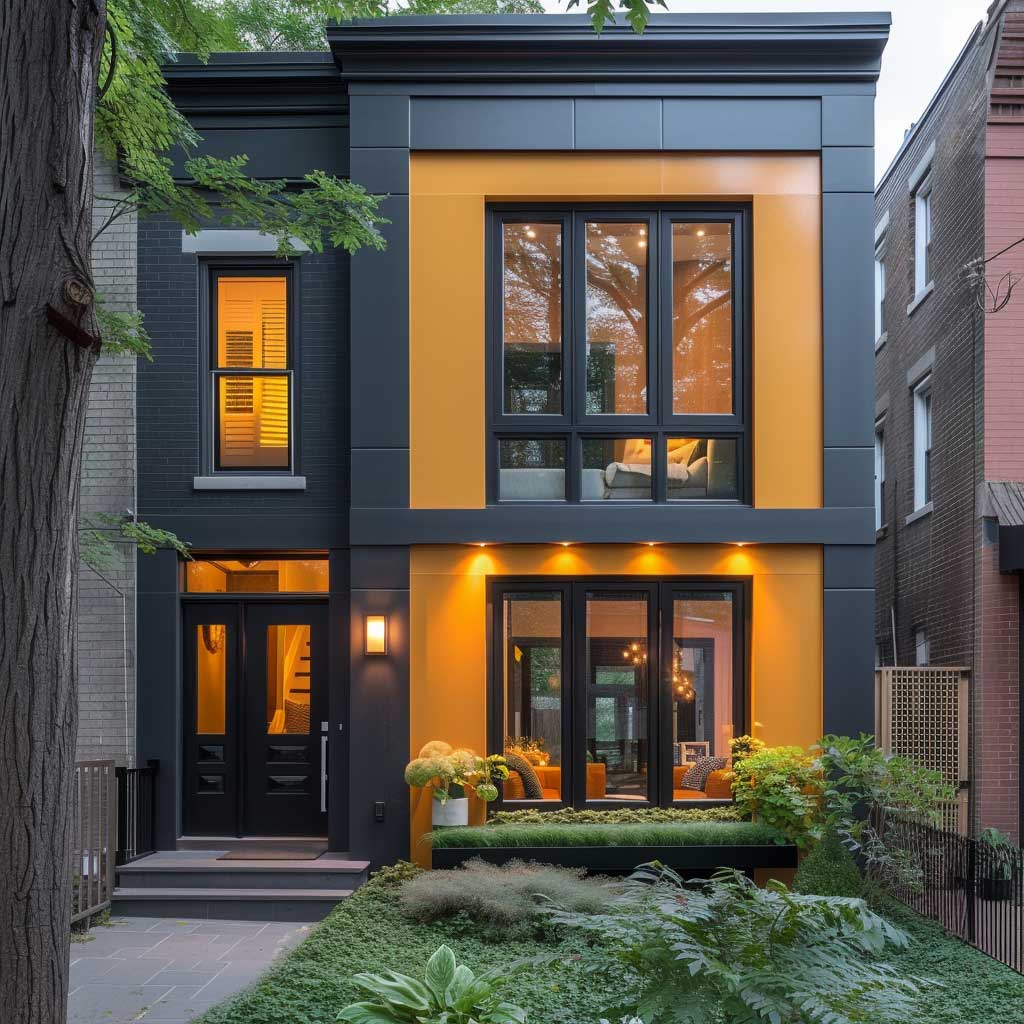
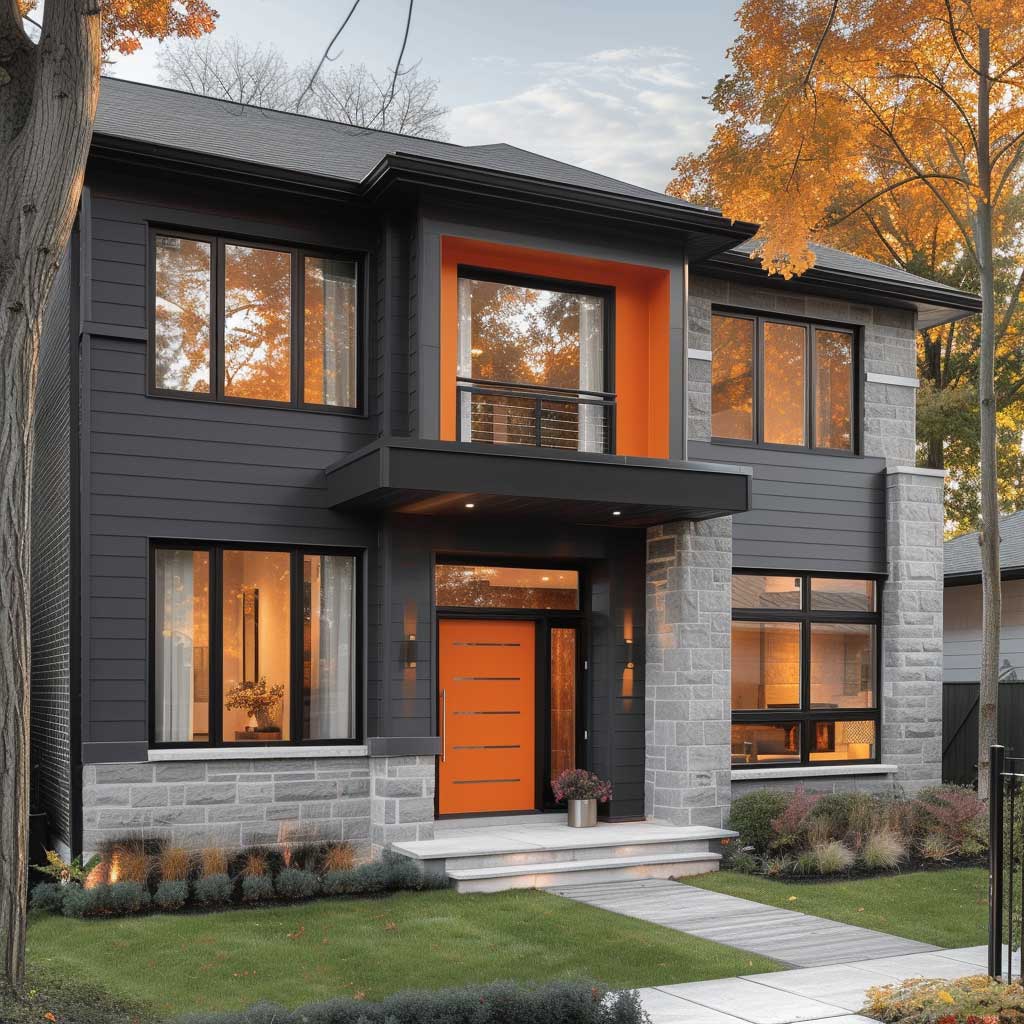
Landscaping against dark blue-grey follows a different logic than it does against amber or medium grey. Silver and white foliage — lamb’s ear, dusty miller, white-flowering shrubs — hold their own against dark exteriors and provide a contrast that reads as deliberate. Green foliage often disappears against dark blue-grey in dim light. Amber-toned ornamental grasses like Karl Foerster in autumn plumage mirror the amber accent without literally repeating it, which is the most elegant way to use exterior plantings as color support. The worst pairing for this palette is burgundy or deep red foliage, which creates a visual muddle with the dark blue-grey and makes the amber accent look muddier than it is. For gray exterior paint options from a major brand with a filterable dark-shade collection, Benjamin Moore’s gray exterior paint collection lets you compare dark neutrals and their blue undertones directly.
One material combination that makes dark blue-grey exterior paint work on even plain-box modern houses: raw or lightly stained cedar as a vertical accent panel. Cedar’s natural honey tone is amber without being painted amber — it introduces the warmth without requiring any additional color decision. A single cedar-clad section, perhaps the garage facade or the entry volume, against dark blue-grey siding gives the palette the material depth that three coats of amber trim can’t replicate. This works because cedar’s undertone shifts between amber and silver as it weathers, which means the material actually improves the color story over time rather than fighting it.
| Palette Variant | Best For | Maintenance Interval | Key Risk |
|---|---|---|---|
| Amber body + warm grey accents | Residential, traditional, Craftsman | 7–10 years (premium paint) | Cool grey trim creates temperature clash |
| Grey body + amber highlights | Classic revival, colonial, Victorian | 7–10 years (wood siding) | Over-deploying amber kills restraint |
| Dark blue-grey + amber punctuation | Modern, urban, contemporary | 5–7 years (south-facing walls) | Too many amber elements reads apologetic |
The Takeaway
Amber and grey exterior wall paint works because each color makes the other harder to ignore.
Choose warm-undertone grey when amber is the body color — cool grey creates a temperature mismatch the eye reads as wrong from the street. Dark blue-grey exterior paint earns its mood through restraint: one amber element, not several.
Budget for premium exterior paint. One gallon of Sherwin-Williams Emerald runs about $93.99 and covers 350 sq ft per coat on typical siding — two coats plus 10% overage is the only quantity math that makes sense.
Save this post before your next trip to the paint store.