Industrial bedroom design works when every exposed surface earns its place — and the eight rooms below prove that concrete, brick, and black metal can feel just as inviting as a boutique hotel suite. My own first attempt at this look failed hard: I threw a steel bed frame into a beige room and ended up with something that looked like a furniture showroom after a fire. You’ll notice the real difference is always in the layering. Pull this off right and you get an industrial bedroom that genuinely stops people in the doorway.
The style draws from converted warehouses and urban lofts, but it’s not frozen in 2010. In 2025 and into 2026, designers are softening the raw bones with warm wood, aged leather, and plush textiles — keeping the structural honesty without the cold-factory feel. I’ve pulled eight specific design directions from these rooms that you can actually replicate, with real material costs, brand names, and one hard truth about what not to do in each.
Quick Scan — What You’ll Find Here
→ Exposed brick paired with black metal bed frames — the contrast ratio that works
→ Weathered wood in industrial rooms — where to use it and where to stop
→ Loft ceilings with open beams — pendant choices under $200 that don’t look cheap
→ Concrete walls done right vs. the heavy-handed version to avoid
→ Modern industrial bedroom furniture — specific frames, shelves, and lighting brands
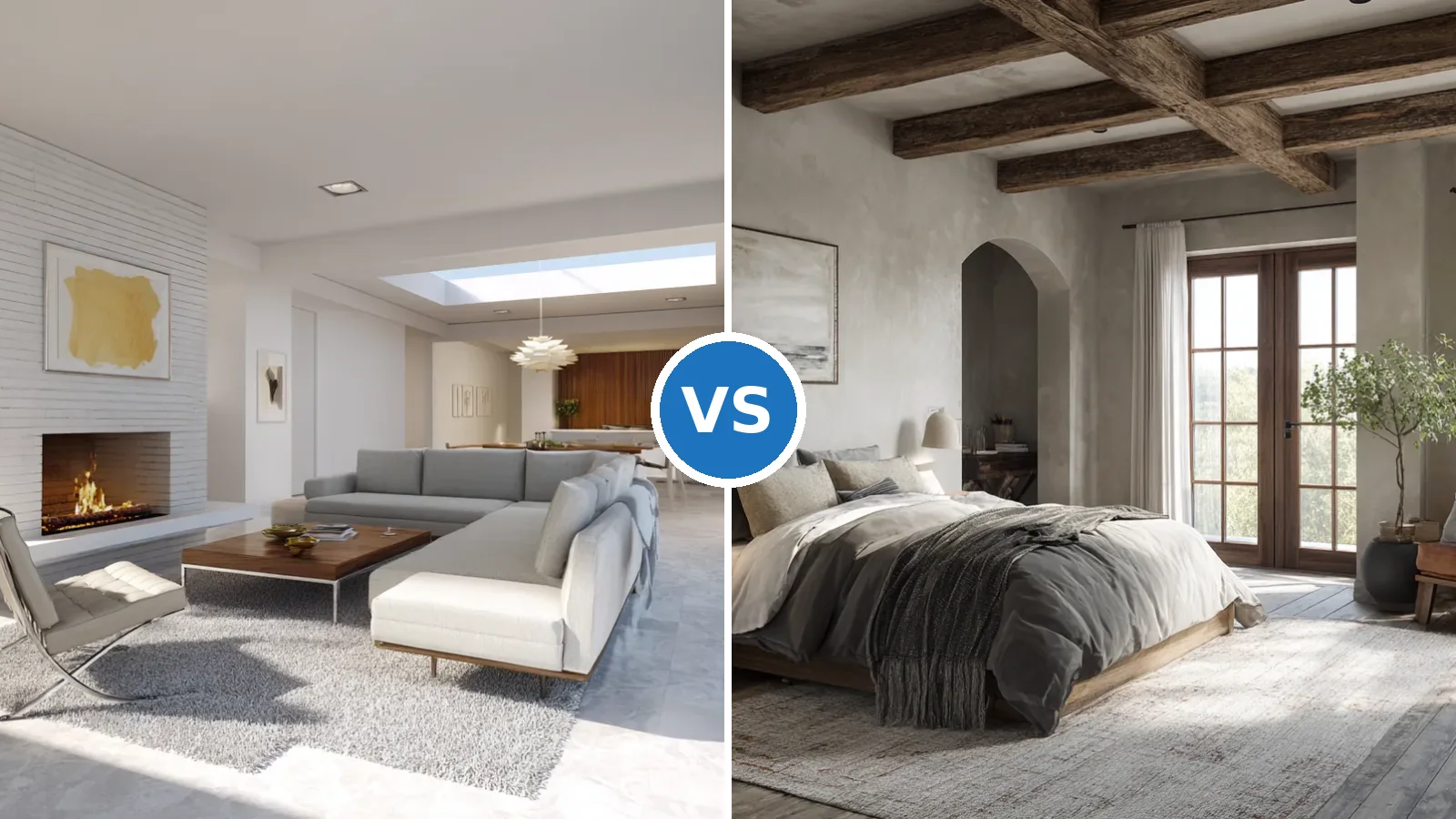
→ Rustic industrial and minimalist industrial — how they differ and when to pick each
→ One “Don’t Do This” warning per section. Read those first.
Exposed Brick Walls Earn Their Keep Next to a Black Metal Frame
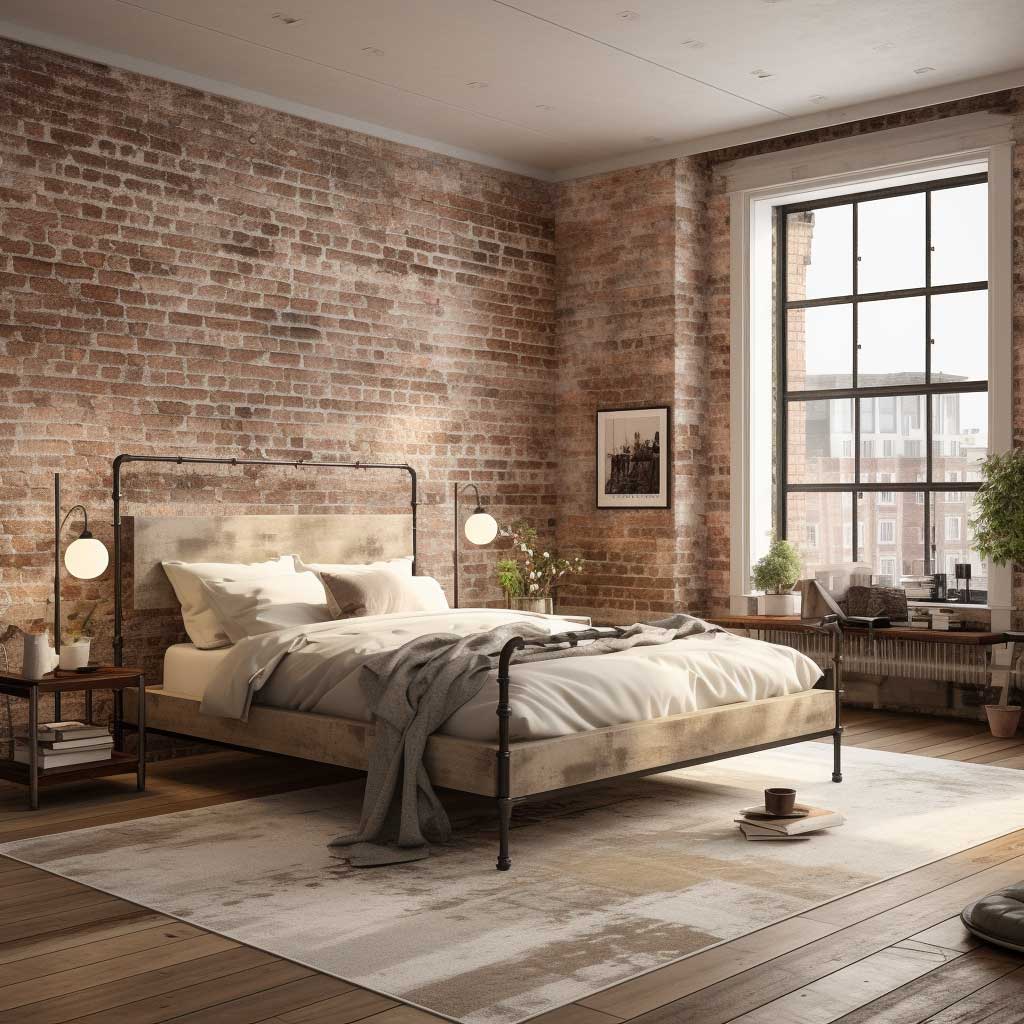
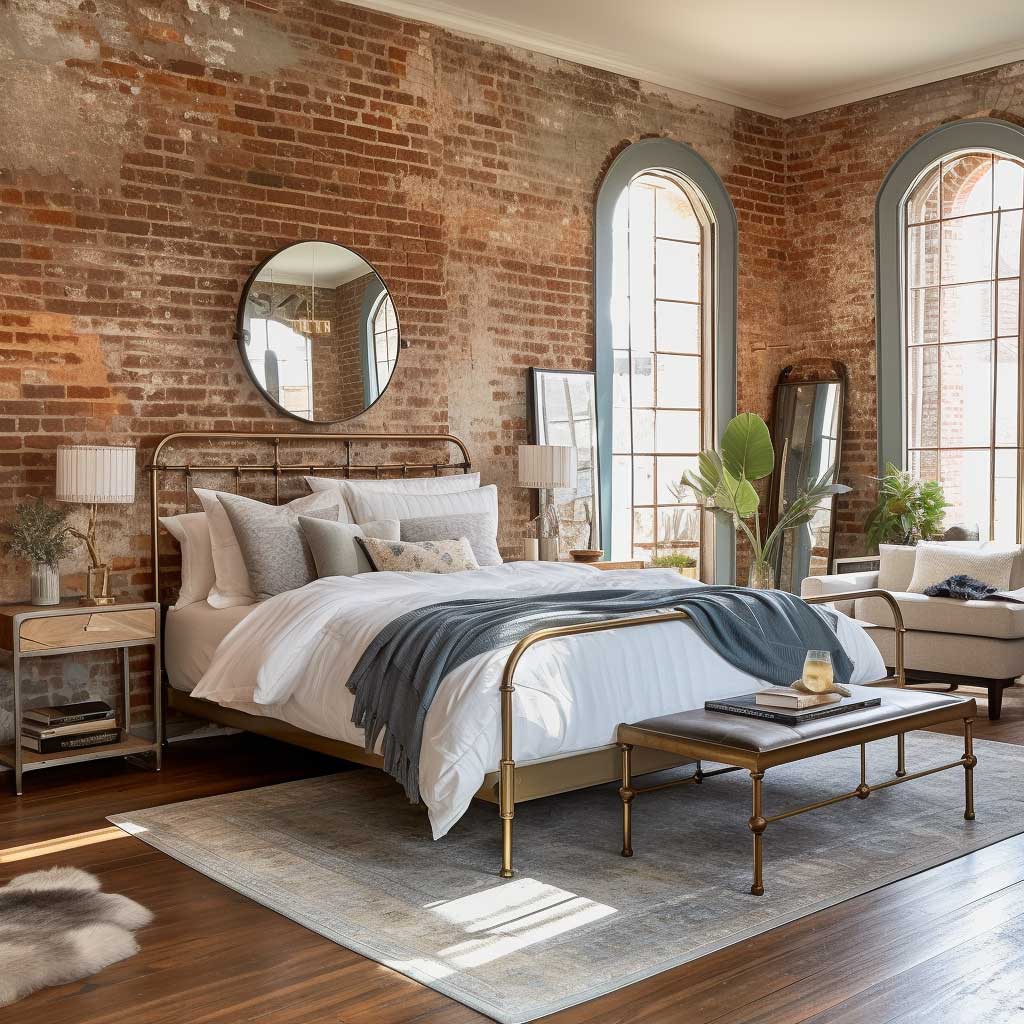
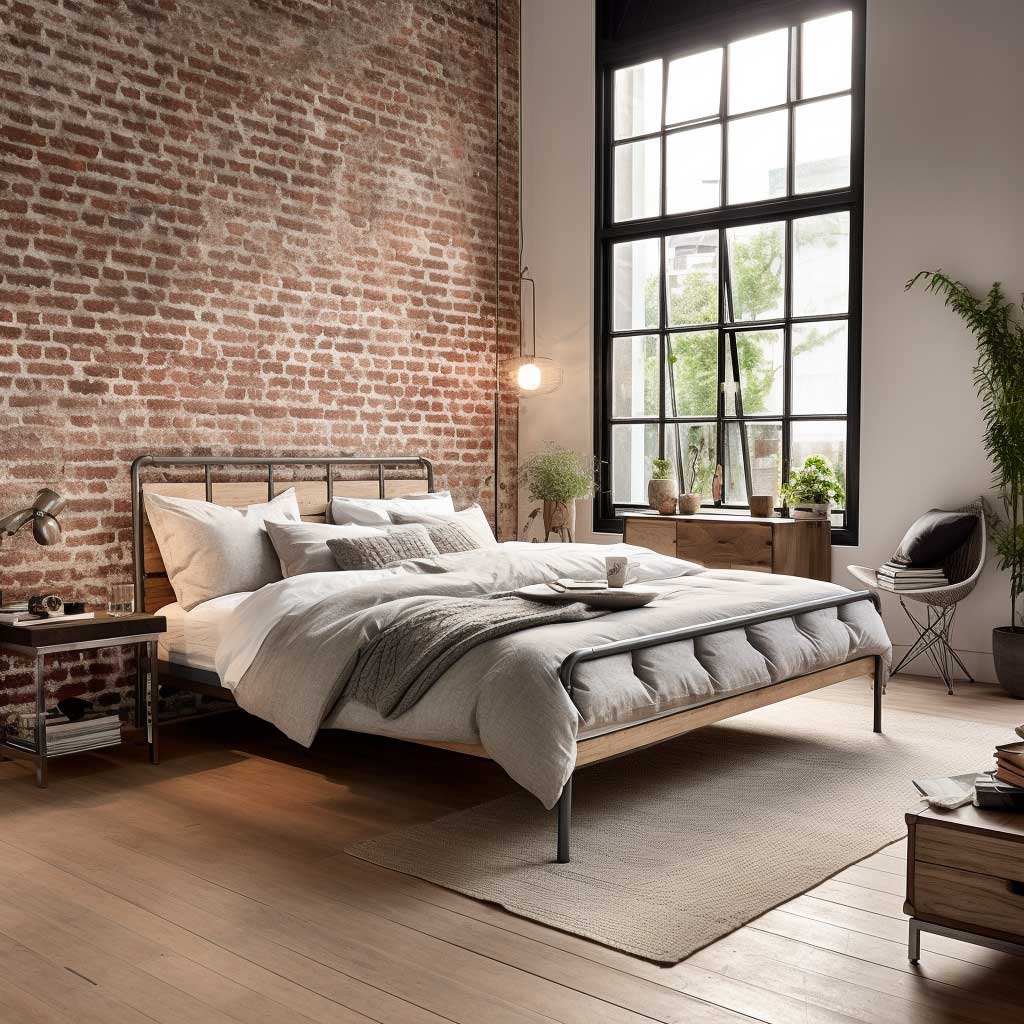
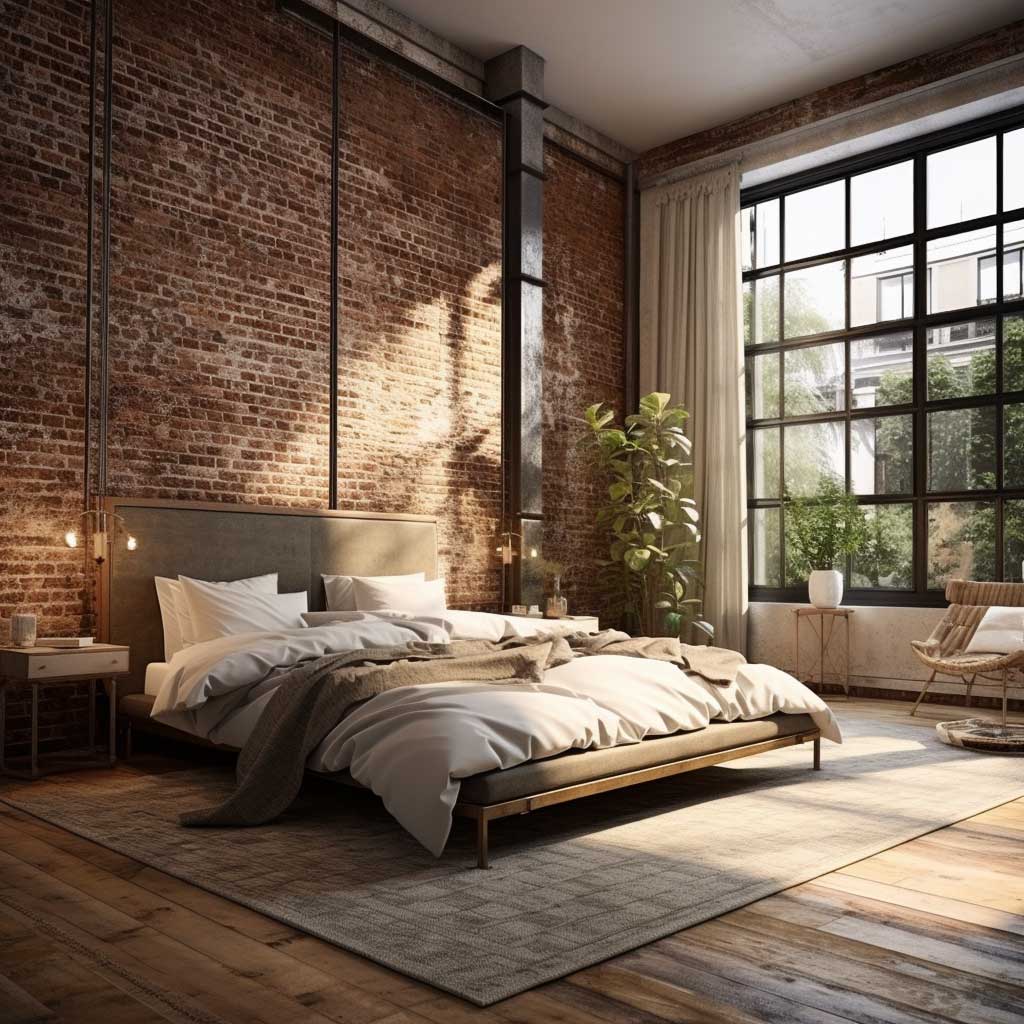
Exposed brick is the most-copied element in industrial bedroom design, and also the most misused. The wall works because its texture does all the decorating — you don’t need artwork, you don’t need floating shelves covered in plants. I picked up a queen-size black powder-coated steel bed frame from ZINUS for $279 and put it against a single full-length brick wall. Nothing else on that wall. It photographed like a $15,000 room.
The key pairing is rough surface against clean line. Brick is chaotic and warm-toned. Steel frames are precise and cool-toned. That friction is the whole point. What’s the mistake almost everyone makes here? They soften the brick with warm white paint to “brighten” it — and instantly kill the contrast that makes the design work. Leave the brick raw or give it a limewash; never full-cover paint.
Bedding matters more than people admit in this combination. You need weight and texture against the hard surfaces: a chunky knit throw, linen duvet in stone grey or charcoal, real pillows — not the flat hotel-stack look. I grabbed a black metal bed frame setup with matching nightstands for a client and the whole room shifted from “edgy” to “considered” the moment we swapped synthetic bedding for Belgian linen. Budget around $180–$250 for linen that holds its shape.
Don’t Do This
Don’t pair exposed brick with warm beige or cream walls on adjacent surfaces. The clay tones fight each other and the room ends up looking like a pizza restaurant, not a designed space. Go cool grey, deep charcoal, or stark white on the surrounding walls instead.
Weathered Wood Pulls Heat Into a Room Full of Metal and Concrete
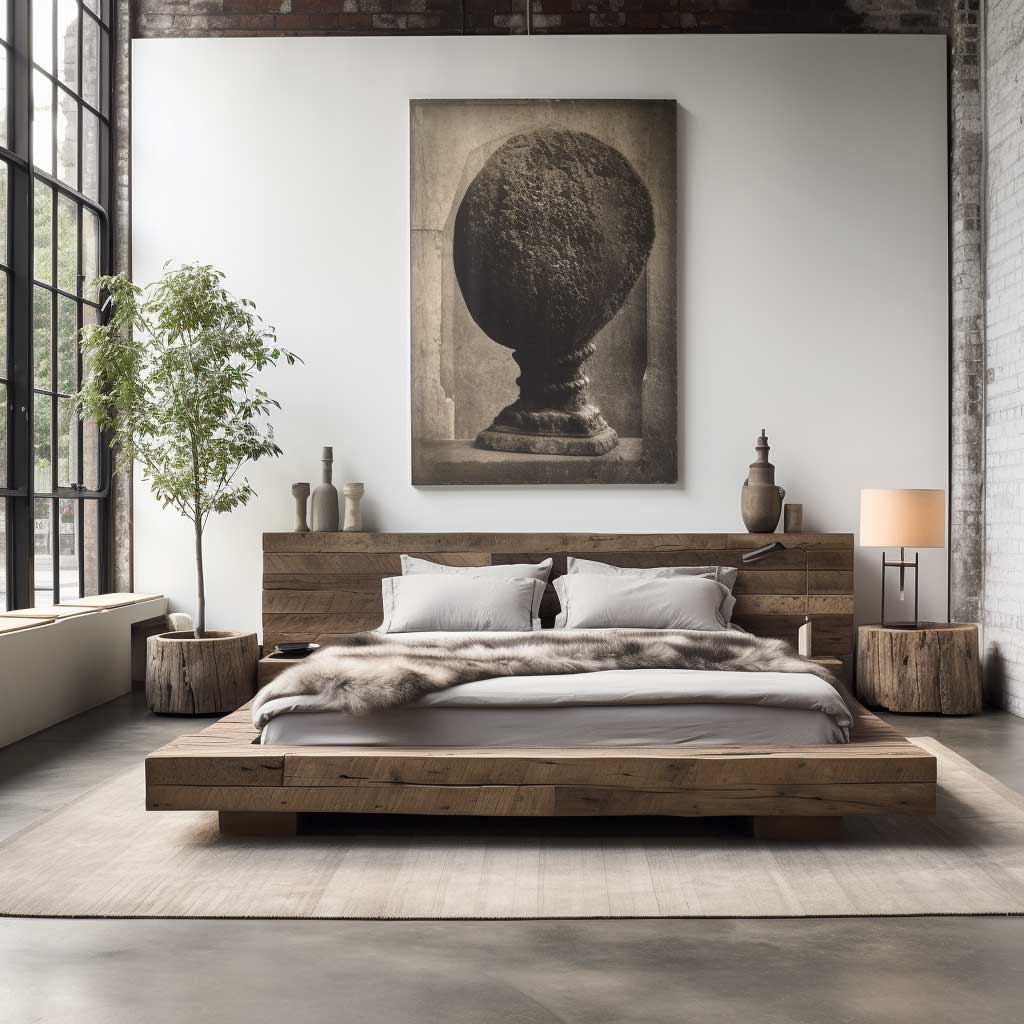


Think of weathered wood in an industrial bedroom the way a bartender thinks about a single cube of ice in a whiskey — not much, but it changes everything. One reclaimed wood floating shelf, one wood-slab headboard, or a pair of solid pine nightstands is enough. I’ve seen rooms where someone went overboard and installed wood plank ceilings, wood floors, a wood headboard, and two wood side tables simultaneously. The result was a ski chalet, not an industrial space. Less is how you keep the steel and concrete in charge.
The grain and aging matter more than the species. Elm, oak, and pine all work — but you want visible growth rings, mineral staining, or a rough-sawn surface. Perfectly smooth, lightly stained wood reads as IKEA and undercuts the whole look. CB2 sells a reclaimed wood nightstand (the Rowan series) that runs around $349 and has the right level of texture without looking like it fell off a barn. That’s my benchmark for “enough aged, not too rustic.”
Where does wood placement actually matter? At eye level and at bed height, not on the floor. A wood ceiling alone does nothing for an industrial sleep space unless you can see it from the pillow — which in most rooms you can’t. Prioritize the headboard wall and the surfaces you touch: nightstands, shelving within arm’s reach. You’ll also want to read about how Scandinavian industrial rooms use wood — they’re disciplined about it in a way that pure industrial design sometimes isn’t.
Loft Ceiling Beams Change What Pendant Lights Can Do
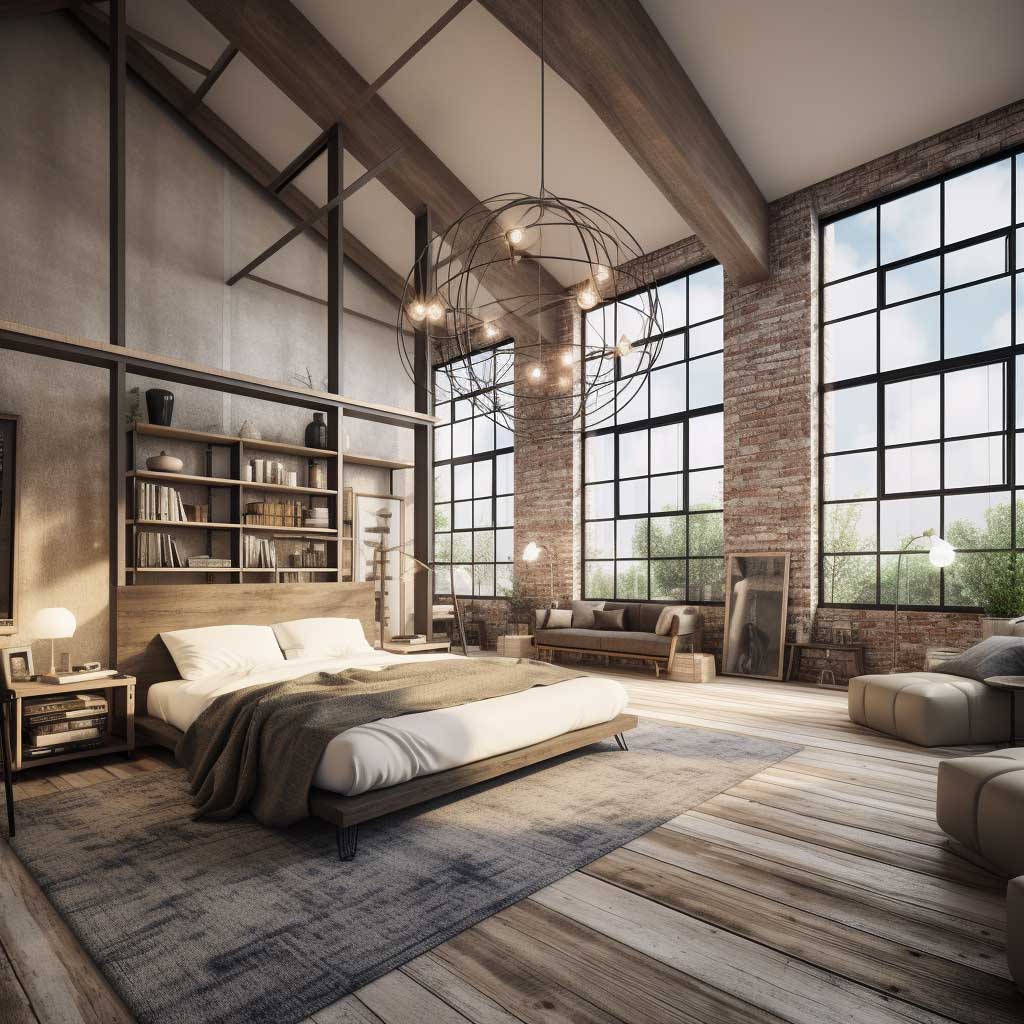


Loft bedrooms with open ceiling beams have one advantage no other room type gets: vertical drama. The beams themselves are architecture, which means the lighting just needs to complement — not perform. Most people hang pendant lights too high in these rooms, treating them like chandeliers in a ballroom. You want the bottom of the shade to land 7 feet from the floor maximum, sometimes lower if you’re hanging them as bedside pendants instead of ceiling centrepiece.
For a beam-ceiling industrial bedroom, I’ve had the best results with cage-style Edison pendants hung on black cloth cord — Kichler makes a solid two-pack in the $90–$130 range. Avoid globes with milk glass shades; they fight the raw ceiling rather than reading as part of the same material language. The beams are structural and visible. Your light fixtures should feel like they belong to the same family: metal, visible hardware, no frosted diffusers.
Standard 8-foot ceilings can fake the loft effect if you paint them the same dark colour as the wall — charcoal, deep slate, or even near-black. You lose the height but gain the enclosed, moody atmosphere that loft bedrooms naturally produce. That’s the workaround I’ve used in three actual apartments where ripping out the ceiling was not an option. It works. See how loft bedroom layouts handle the spatial logic when ceilings are the main feature.
According to Chairish’s industrial design overview, layering warm up-lighting with targeted accent pendants prevents the sterile, flat effect that kills most DIY industrial rooms. That’s consistent with what I’ve observed — a single overhead pendant is never enough. Add a floor lamp in the corner with a warm 2700K bulb and the room reads completely differently.
Modern Industrial Bedroom Furniture — Frames That Do the Work Without the Fuss
Modern industrial bedroom furniture sits at the intersection of minimal and mechanical. You want pieces with visible joinery, metal legs, pipe frames, or welded construction — not furniture that just happens to be dark grey. The difference matters. Restoration Hardware’s Reclaimed Russian Oak bed frame ($1,800 queen) is genuine industrial aesthetic because the construction method is visible. A veneer-over-MDF “industrial-look” frame from a big-box store at $400 usually has the colour without the material honesty, and you notice it immediately in person.
My go-to for clients who want the look without the Restoration Hardware price: Article’s Seno bed frame in matte black ($699 queen) has pipe-style legs and a frame construction you can actually see. Pair it with open-back metal nightstands — Article again, or CB2’s Mies steel side table ($149 each) — and the whole room coheres without looking like a showroom. What kills modern industrial bedroom design faster than anything? Matching everything too precisely. You need slight variation in the metal finish: maybe the bed is matte black, the lamp is brushed steel, the shelf brackets are raw iron. That mismatching is what makes it look designed rather than ordered as a set.
Storage in an industrial bedroom should be visible or hidden completely. Open steel shelving on the wall (IKEA Boaxel with steel crossbars, around $180 per unit) fits the aesthetic and avoids the disconnected floating-TV-console problem. Avoid decorative furniture with ornamental handles, curved legs, or any surface carving — those details belong to other styles and will quietly sabotage your industrial room every time.
Industrial Bedroom Material Comparison
| Material | Best Use | Approx. Cost | Watch Out For |
|---|---|---|---|
| Exposed Brick | Feature wall behind bed | $8–$15/sq ft (faux panel) | Over-painting kills the texture |
| Weathered Wood | Headboard, nightstands, shelving | $200–$500 per piece | Too much reads as farmhouse, not industrial |
| Black Steel Frame | Bed frame, shelving brackets | $280–$700 (bed, queen) | Faux-industrial veneer looks fake close-up |
| Exposed Concrete | One wall or floor | $3–$7/sq ft (concrete paint) | All-concrete feels cold without warm layers |
| Edison/Cage Pendants | Ceiling and bedside | $60–$180 per pendant | Globe milk-glass shades clash with raw materials |
Minimalist Industrial Bedroom — Concrete Walls Need Exactly One Warm Layer
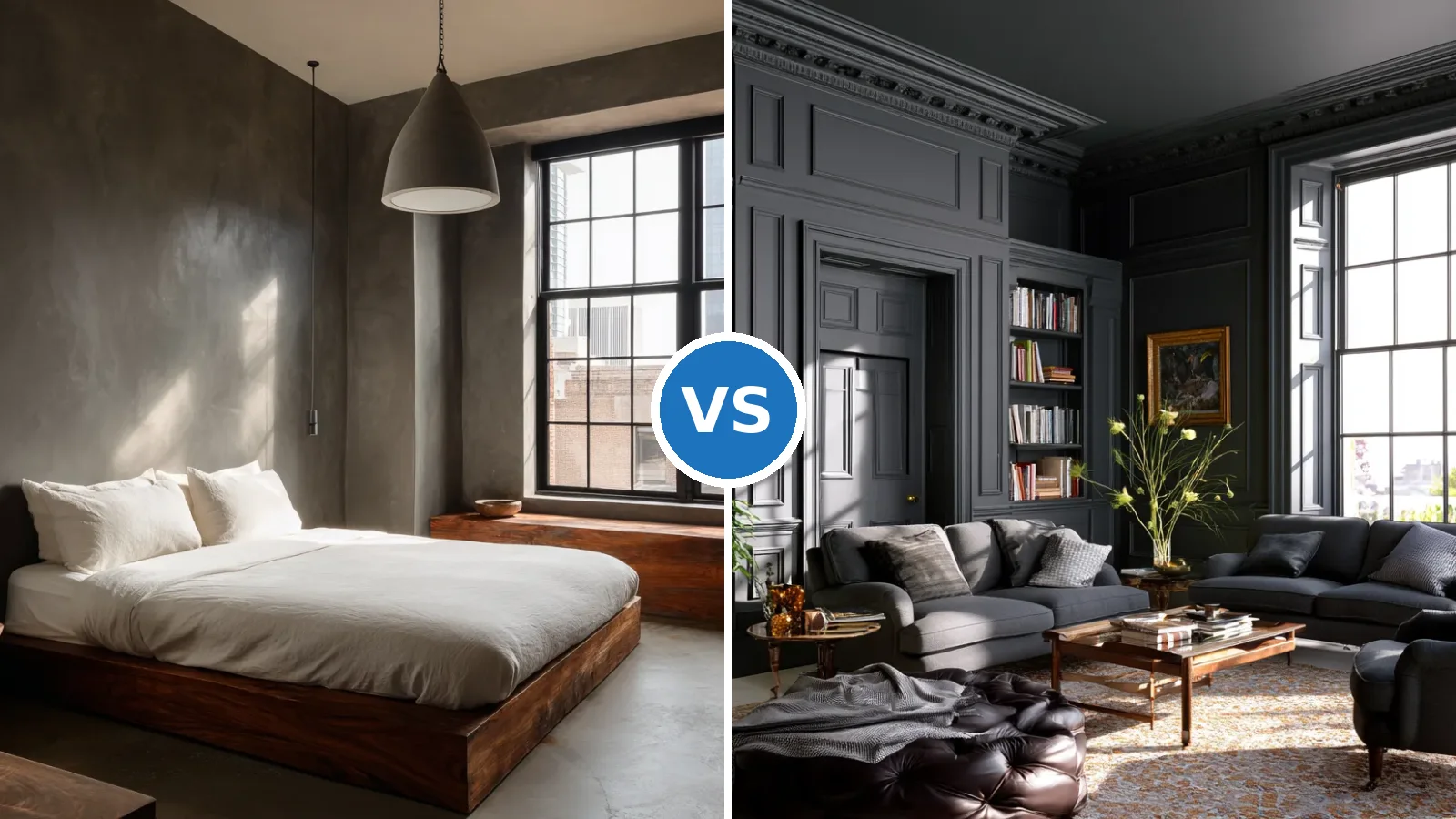
Concrete is the hardest industrial bedroom element to pull off at home. It photographs beautifully in every editorial — cool, sculptural, completely self-assured. Then you live in it and realise that a full concrete wall in a bedroom feels about as welcoming as a parking garage at midnight. The solution isn’t to abandon concrete; it’s to counter it with a single, high-quality warm layer placed directly in the line of sight from the bed.
My favourite move: a generously sized wool or jute rug in warm ochre or rust, laid on a concrete or dark wood floor. It doesn’t need to be expensive — I’ve used a Rugs USA jute flatweave (around $180 for 8×10) in two concrete-walled rooms and both immediately crossed from “loft” to “liveable.” The rough natural fibre against the concrete is the same logic as the brick-and-steel pairing: two opposing textures that make each other more interesting. Do not use a grey rug against a grey concrete wall. The room will have no contrast and it will read as unfinished.
Minimalist industrial bedroom design also requires discipline about what goes on the concrete surface. Nothing, or one very deliberate thing. A single large-format artwork — black-and-white photography, abstract ink, architectural print — anchors the wall without competing with it. What doesn’t work: gallery walls of mixed frames, floating shelves loaded with small objects, wall-mounted TVs in cheap brackets. Any one of those details breaks the minimalism and makes the concrete feel like a backdrop rather than a design decision.
Rustic Industrial Bedroom — When the Rough Edges Are the Whole Point
Rustic industrial bedroom design leans harder into age, wear, and imperfection than the cleaner modern version. You’re looking at actual reclaimed material — barn wood, antique iron, genuine leather aged to creasing — rather than materials that simulate those qualities. The difference costs money. A real reclaimed oak platform bed from a custom maker runs $1,200–$2,500; a distressed-look oak-veneer bed from Wayfair runs $400. Both can work, but they produce completely different rooms and the gap shows in photographs.
I’ve bought real and fake in this category, and my honest take: the fake versions work fine if you commit to having real reclaimed elements elsewhere — an actual antique lamp, a genuine leather throw, a piece of salvaged iron used as a shelf bracket. The mix reads as curated rather than budget-constrained. Full commitment to faux rustic, on the other hand, consistently reads as a stage set. Pick your one or two genuine pieces and let those carry the authenticity.
What genuinely doesn’t work in rustic industrial bedrooms is anything soft and decorative that reads as “country cottage” — floral prints, whitewashed shiplap, painted wicker, distressed white furniture. Those elements pull the room into farmhouse territory and the industrial quality evaporates. Stay in the leather, iron, raw timber, and dark linen zone. You can learn more about how this material combination works at different scales in rooms built around exposed brick as the primary material.
The Bottom Line
Industrial Bedroom Design Fails When the Room Has No Warmth and Succeeds When It Has Exactly One Surprise
Every room in this post works because the raw material — brick, steel, concrete, exposed wood — is met by something soft and unexpected: a wool rug, Belgian linen, a leather headboard, a single warm-toned pendant lamp.
The industrial look is not about stripping a room down to its bones. It’s about letting the bones show while still making the room a place you actually want to sleep in. Get the contrast right and you’re done.
Save this post before you start shopping — the material table and section on pendant placement will save you at least one expensive mistake.