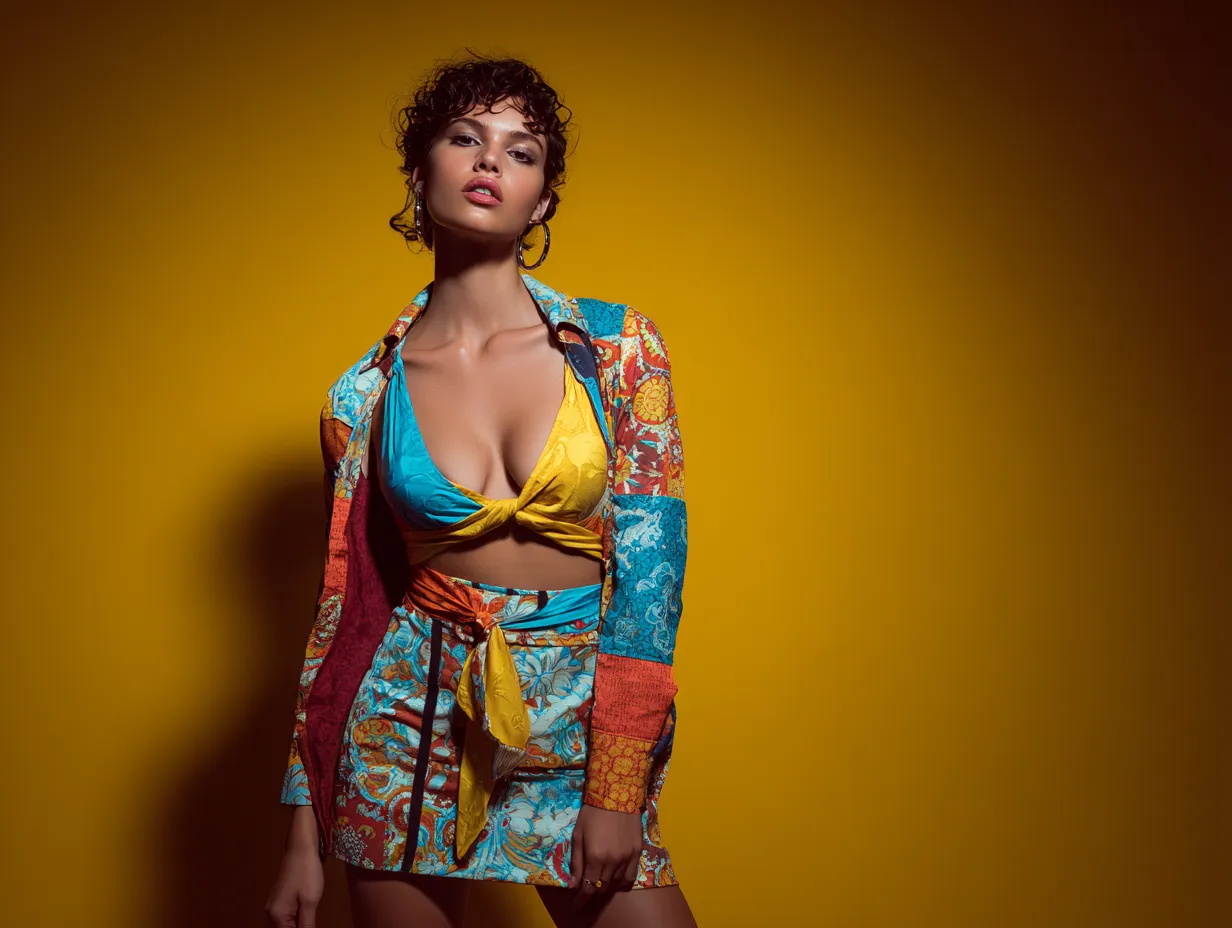
Men coat design for daily comfort in urban streetwear has moved past looking sharp for its own sake — the coat is now the first thing a city outfit is built around. I’ve spent three winters road-testing everything from $180 Carhartt WIP canvas trench coats to $620 Fear of God Essentials wool overcoats, and the difference between a coat that works and one that photographs well but fails by noon is narrower than most brands admit. You’ll notice the real coats the moment you put them on: the shoulder sits clean, the lining doesn’t drag against your hoodie, and the length hits exactly where it should.
Coat design for men has split into two distinct schools — the structured overcoat crowd and the technical shell crowd — and which one you need depends entirely on how you actually move through your day. My go-to for three-season daily wear is a mid-length wool-blend in charcoal, but I keep a Patagonia Torrentshell for rain-heavy weeks. Neither replaces the other. Knowing which school you belong to before you spend $300 is the only advice that matters.
Target look: Urban daily coat design — structured meets functional
Key silhouettes covered: Long overcoat, mid-length wool, technical casual coat
Coat types in this post: Wool overcoat, black coat design, casual coat, modern street coat
Price range discussed: $120–$650
Brands referenced: Carhartt WIP, Fear of God Essentials, Patagonia, Stone Island, A.P.C., mnml
What you won’t find here: Generic “layer for warmth” advice and coats that only work in photos
City Mornings Separate the Coat from the Costume
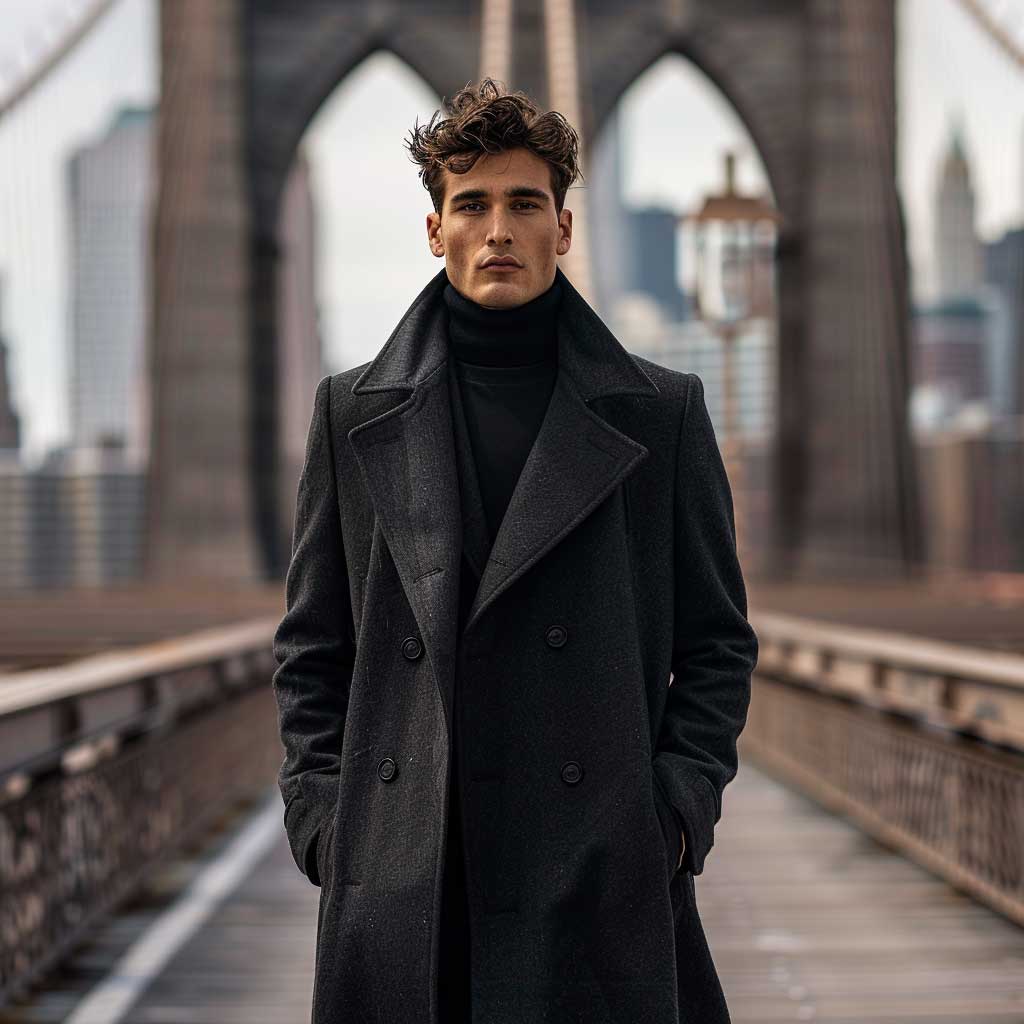


A coat that only works when you’re standing still isn’t a coat — it’s a prop. The coats that hold up through a city day share one structural trait: the armhole is cut high enough to let you move without the back riding up. I learned this the hard way after buying a $280 coat from a brand whose name I’ll omit that looked incredible on the mannequin and strangled my arms by 10 AM. Fit at the shoulders is non-negotiable. Everything else can be adjusted at a tailor for around $40.
You’ll find that coat design for men increasingly factors in internal structure — interfacing in the chest, a half-lining in wool versions, and a back vent that actually opens far enough to sit down in. A.P.C.’s Wool Surchemise at around $590 does all three correctly. Cheaper options from mnml hit around $160 and get the vent right but skip the interfacing, so they drape soft rather than structured. Neither is wrong. One is a working coat, one is a layering coat — decide which you need before the purchase.
Don’t buy a coat based on how it looks unbuttoned on an Instagram grid. Collar bulk, button placement, and the way the lapel rolls are all invisible in that shot but visible in every mirror you walk past. Button your coats in the fitting room. Walk around for five minutes. Sit down. The coat that passes all three is the right coat.



My own rotation runs three coats across three functions: a Stone Island Nylon Metal coat (~$580) for rain and wind, a charcoal A-line wool overcoat for meetings and colder commutes, and a lighter unstructured trench for the shoulder seasons. If you’re building from zero, the wool overcoat covers the most ground per dollar spent. Get it in charcoal or camel — navy photographs beautifully and fades into every other navy in the room in real life. Minimalist coat design for men is a strong entry point if you’re not sure which silhouette works for your frame — clean lines show proportion errors less forgivingly, which means they also show proportion wins more clearly.
What Modern Coat Design Actually Gets Wrong About the Urban Man


Most coat design for men is still built around a fictional urban man who walks slowly, never carries anything heavy, and doesn’t sweat. Real city coats need interior pockets — not decorative ones, actually sized for a phone and transit card. I’ve bought three otherwise excellent coats in the last two years and had to use a tailor to add an interior pocket to two of them ($25 per pocket at most local tailors). Stone Island gets this right. Fear of God Essentials gets it wrong at almost every price point they offer.
The latest design direction from brands like Carhartt WIP and mnml has been honest about the trade-off: utility at the cost of silhouette refinement. Their jackets run $120–$220, hit the pockets-and-durability brief, but add about an inch of bulk through the chest that reads as casual even under a dress shirt. That’s a feature for some wardrobes and a problem for others. Know which camp you’re in before you commit.
Don’t buy a black overcoat two sizes up because you’ve seen it styled that way on Pinterest. Oversized coat design works when the rest of the outfit is intentionally slim — slim trousers, close-fit hoodie, low-profile sneaker. Buy the oversized coat with baggy cargos and a puffer underneath and you’ve built a coat that reads as “forgot to check the mirror,” not “editorial.” I made this exact mistake in 2022 with a $340 coat I sold eight months later for $120. Size is a styling decision, not a sizing accident.
What’s the difference between a coat that makes you look put-together and one that makes you look like you grabbed the first thing on the rack? Proportional awareness. A knee-length coat on a shorter frame reads as “borrowed from a taller person.” The same coat on a 6’1″ frame lands as editorial. I stole this trick from a stylist I worked with — always try the coat with the shoes you’ll actually wear it with. The hem-to-shoe relationship is everything, and it’s invisible in changing rooms where everyone’s barefoot.


Fabric weight is the other thing brands don’t talk about honestly. A 400g/m² wool blend is a winter coat. A 280g/m² blend is a transitional coat. Both are sold as “wool overcoats” at most price points from $200 upward. You’ll feel the difference the first time the wind picks up, not in the store. Ask for the fabric spec or check the product description carefully — if it’s not listed, that’s usually a tell. Designers who prioritize raw material authenticity over branding list this information because they’re proud of it.
Black Coat Design Reads Different Depending on What’s Under It
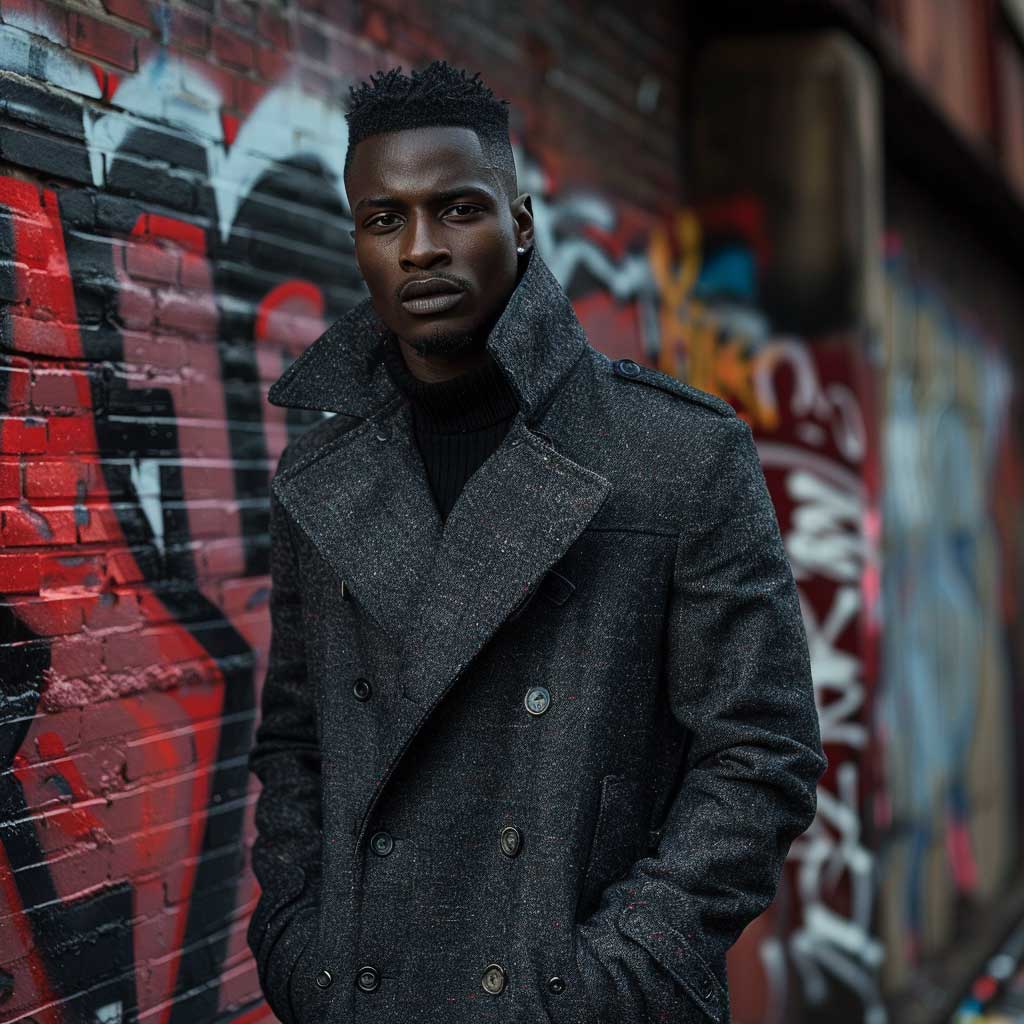


Black coat design for men is the most searched, the most pinned, and the most often gotten wrong. The coat itself isn’t the problem — it’s the assumption that black on black on black reads as intentional. It only does when the textures are doing different things. I own two black overcoats: one matte wool, one with a slight sheen in the weave. Same color family, completely different visual weight. Pair the matte one over a flat black knit and you disappear into yourself. Pair it over a ribbed turtleneck or a quilted shirt layer and suddenly there’s depth.
All-black coat design works like a monochrome formula that requires contrast through texture, not color. A black coat over a black scarf over a black turtleneck needs at least two of those three pieces to have surface variation — or the whole look reads flat under any lighting that isn’t a photographer’s strobe. I stole this framework from the styling notes on the all-black outfit builds we’ve covered before — the principle holds exactly the same for coat-centered looks.
According to PAUSE Magazine’s men’s fashion trend breakdown for 2026, long overcoats and structured wool jackets layered over casual bases like hoodies or knitwear remain central to urban dressing — and black is still the colorway doing the heaviest lifting in that category. The black coat isn’t a trend. It’s the baseline from which every other coat decision is measured.


One thing that genuinely doesn’t work — and I’ve tried it — is a slim black coat over a wide-leg trouser without breaking up the vertical line somewhere. The eye just runs straight down from collar to hem. A contrast piece in the mid-zone (a cream roll-neck, a white tee, even a different-texture scarf) breaks the vertical and gives the coat silhouette a reason to exist. Skip that break and the coat becomes background noise instead of the point.
Coat Design Comparison
| Coat Type | Price Range | Best Silhouette | Daily Comfort | Works With |
|---|---|---|---|---|
| Wool overcoat | $280–$650 | Structured, knee-length | High (cold weather) | Slim trousers, boots, sneakers |
| Technical casual coat | $120–$380 | Relaxed, mid-length | Very high (any weather) | Cargo, jogger, straight denim |
| Black coat design | $160–$590 | Any length | High (texture-dependent) | Needs texture contrast underneath |
| Casual street coat | $80–$220 | Boxy, hip-length | High (movement-first) | Hoodies, wide trousers, chunky sneakers |
The Takeaway
Men Coat Design Isn’t About the Coat. It’s About the Gap Between the Coat and Everything Under It.
The coat is the last layer you put on and the first thing anyone sees. Get the silhouette right for your frame, get the fabric weight honest for your climate, and let the texture underneath do the visual work. A $200 coat worn correctly reads better than a $600 coat worn as an afterthought.
Skip black-on-black-on-flat-black. Skip the oversized coat with oversized everything. Those aren’t style choices — they’re defaults dressed up as decisions.
Save this post before you head to the store — or at minimum, read the fabric spec before you hand over your card.
Related Topics