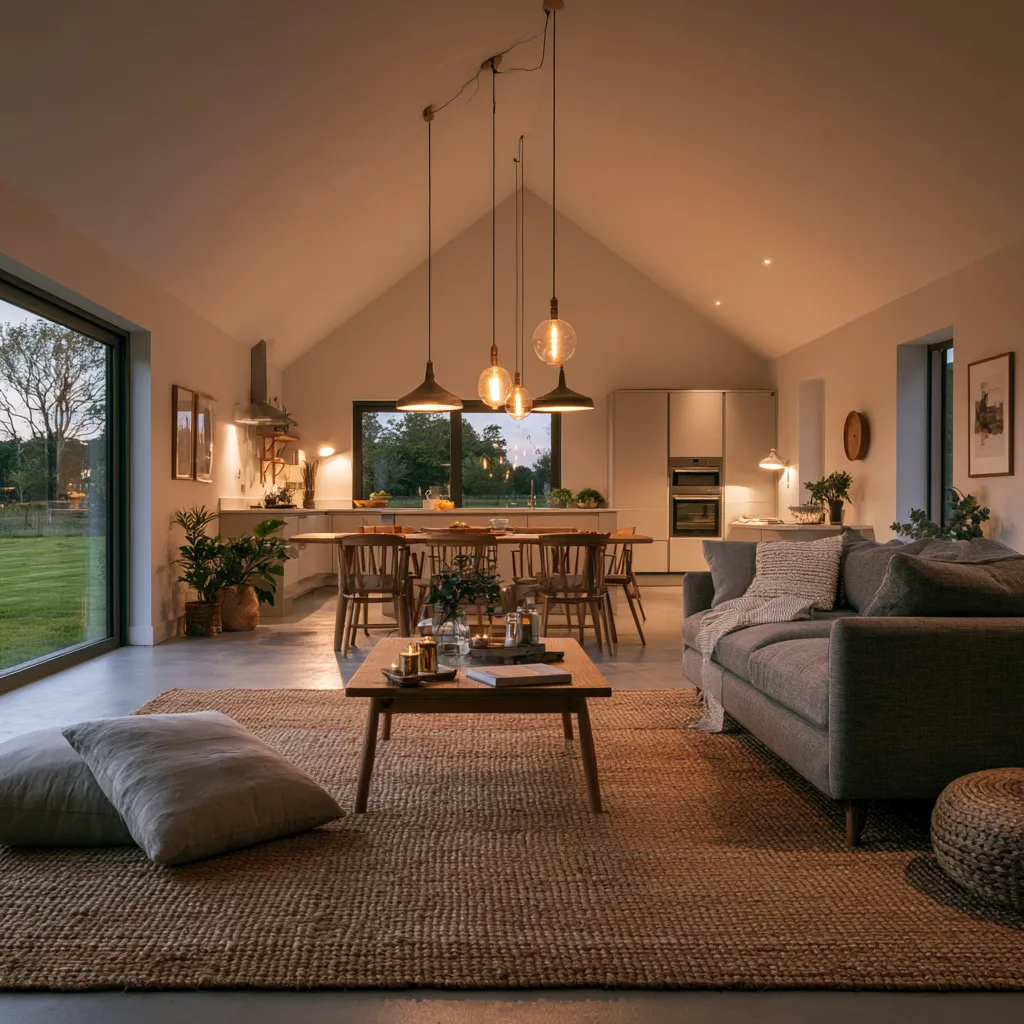
An orange backsplash tile is the fastest way to shift a flat kitchen into a room people actually want to stand in. I’ve renovated two kitchens from scratch and tested four different orange tile treatments — and the difference between a dead-feeling space and one that draws people toward the stove is almost always the wall between the cabinets and the countertop. Not the cabinets. Not the countertops. The backsplash. Orange kitchen tiles work because the color sits at the intersection of warm and energetic without screaming at you the way red does. You’ll notice this the moment the grout dries.
The myth is that orange is too bold for a kitchen. Wrong — too much beige subway tile is bold in the most boring direction possible. My go-to move when a client says orange is risky is to pull up three rooms where it failed: every single one used the wrong shade or the wrong pattern scale. Nail those two variables and orange kitchen backsplash ideas go from risky to inevitable.
Quick Scan
- Target look: glossy hex tiles — pair with black countertops and open shelving
- Pattern energy: chevron orange and white — best with white cabinetry and stainless
- Subtle play: muted orange herringbone — works with marble counters and brass fixtures
- Shade rule: brighter orange = smaller application; muted terracotta = can go wall-to-wall
- Grout tip: white or beige grout keeps orange backsplash tiles from feeling heavy
- Material cost range: ceramic from $3/sq ft, glass mosaic from $12/sq ft, handmade tile $20+
Glossy Orange Hexagon Tiles Make Geometry Do the Heavy Lifting
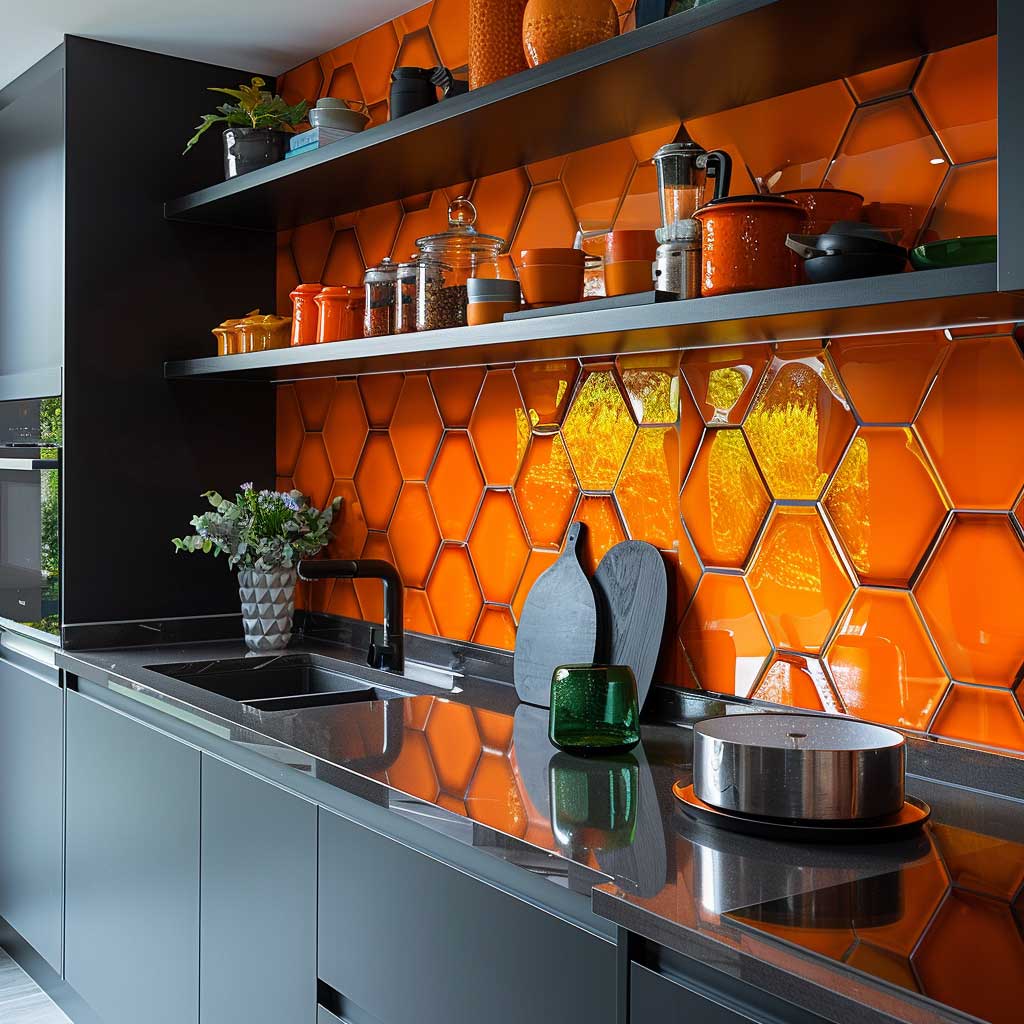
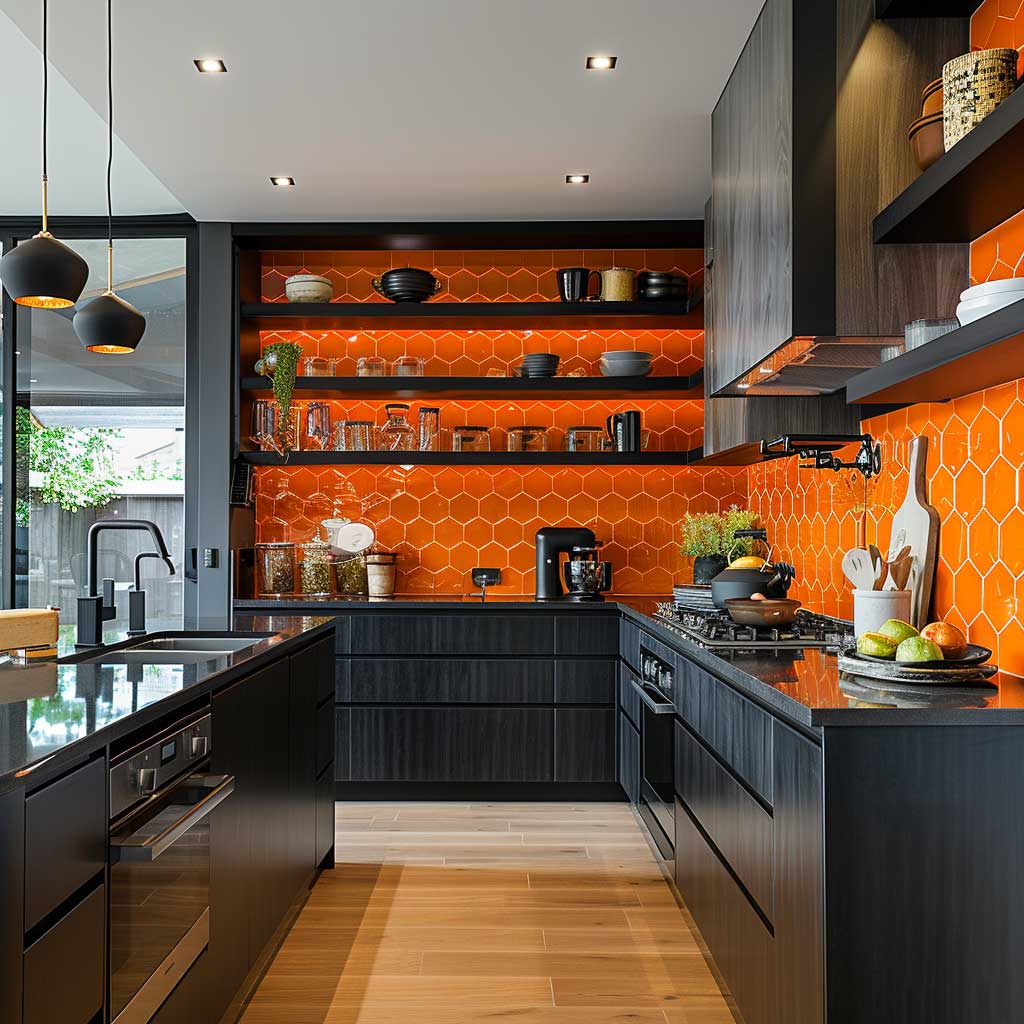
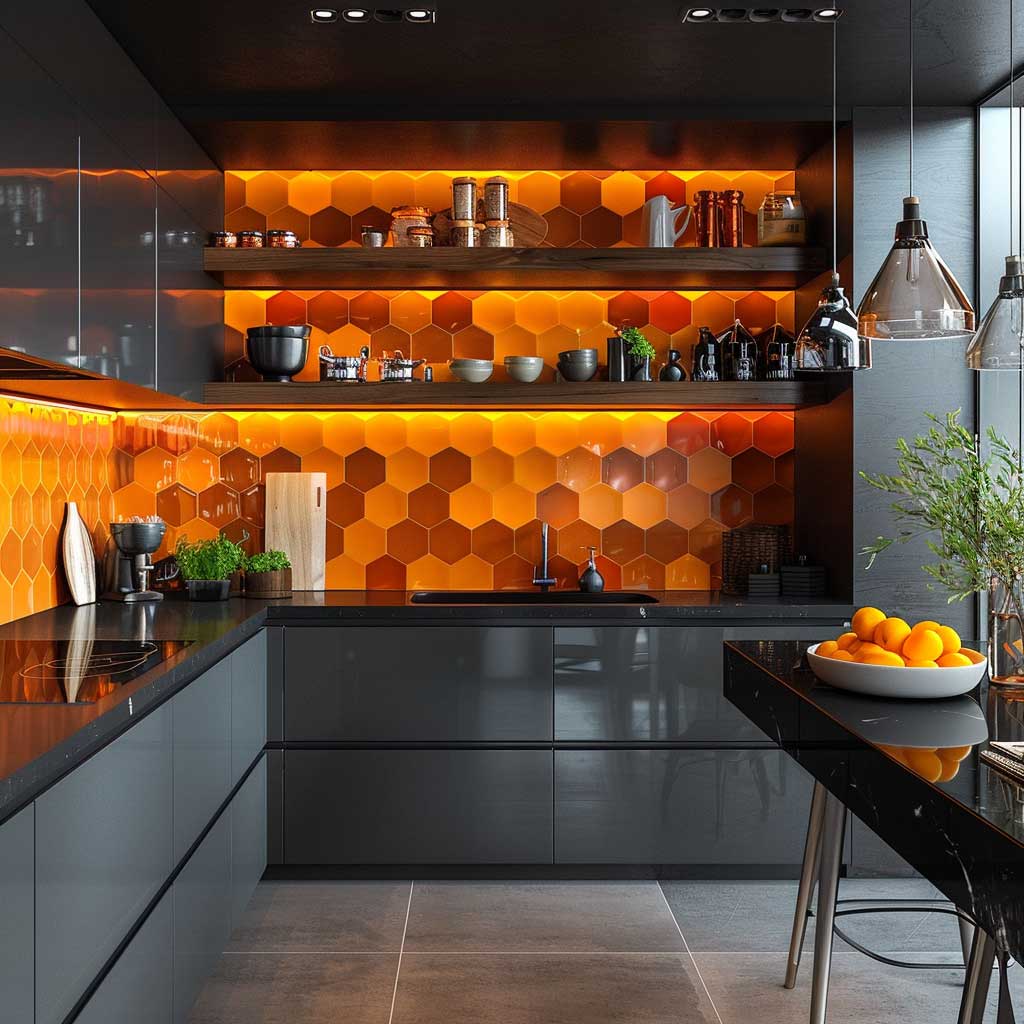
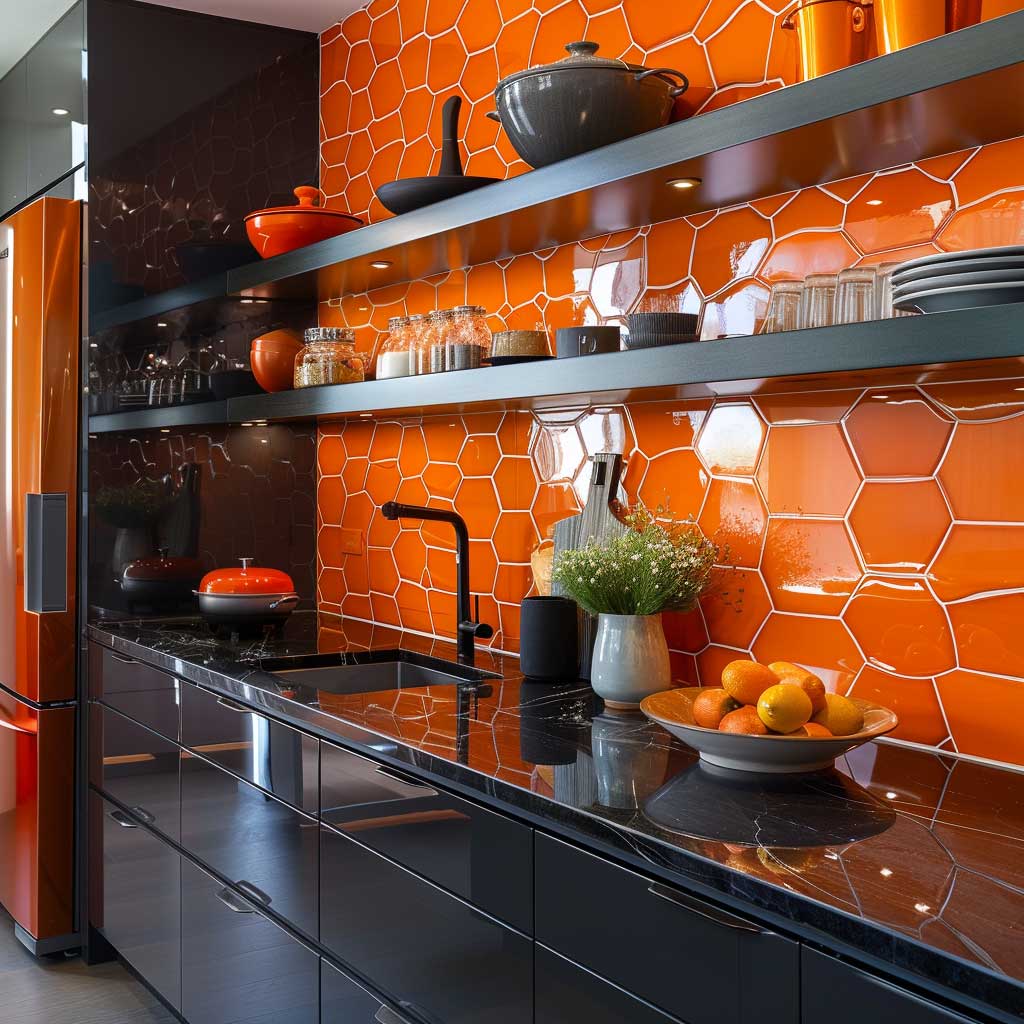
Hex tiles are like a mosaic floor tile that climbed the wall and decided to stay. The shape interrupts the predictable grid of subway tile without requiring you to commit to anything precious or difficult — you can buy 2-inch glossy orange hex sheets from Merola Tile at Home Depot for around $4.89 per square foot, and a standard backsplash behind a 36-inch range costs you under $60 in tile. I’ve done this install myself over a weekend. The glossy finish bounces light around the room at angles that matte tile simply cannot replicate.
The mistake I see constantly is pairing bright orange hex tiles with warm-toned wood cabinetry. Both compete for the same visual register and the result looks like a pumpkin exploded. Black countertops are the actual move: the contrast is architectural rather than accidental. Open shelving in natural walnut or white oak next to this backsplash adds breathing room without softening the punch. You’ll want a matte or satin finish on the cabinetry — high-gloss on both the tile and the cabinets is too much shine fighting itself.
Keep fixtures minimal. Chrome or brushed nickel pulls disappear appropriately; brass pulls add warmth but tip the palette toward retro if you’re not careful. Clean lines on the range hood and faucet let the orange kitchen tiles do their job without competition. The glossy surface is practical too — a damp microfiber cloth picks up splatter in seconds, which matters at the range where grease lands constantly.
Don’t Do This
Avoid mixing glossy orange hex tiles with busy stone countertops that have heavy veining — the pattern collision looks unresolved, not curated. I tested a bold Calacatta slab against these tiles in one renovation and regretted it within a week. Stick with solid or near-solid countertop surfaces: matte black, white quartz, poured concrete, or butcher block. Any countertop that tries to tell its own story competes with the hex tile and neither wins.
Orange and White Chevron Backsplash Runs Energy Through the Room
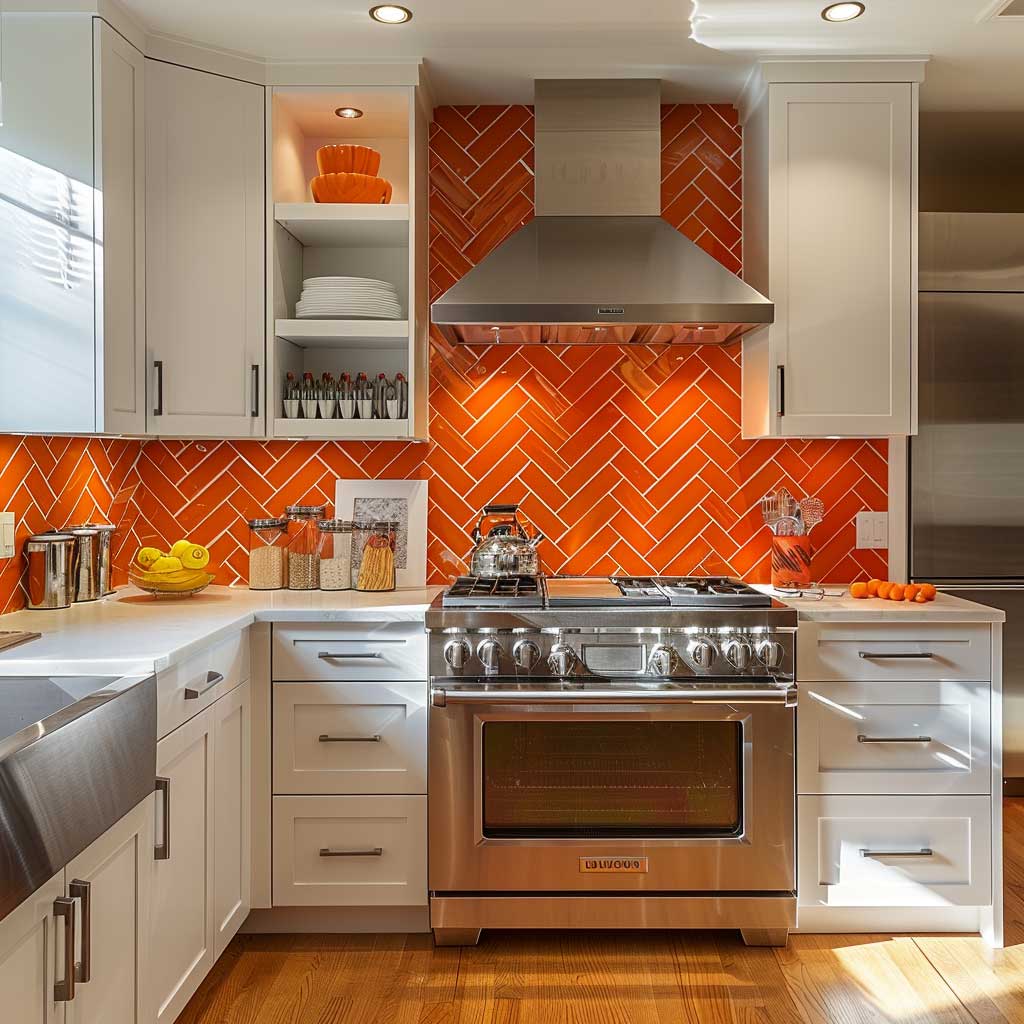
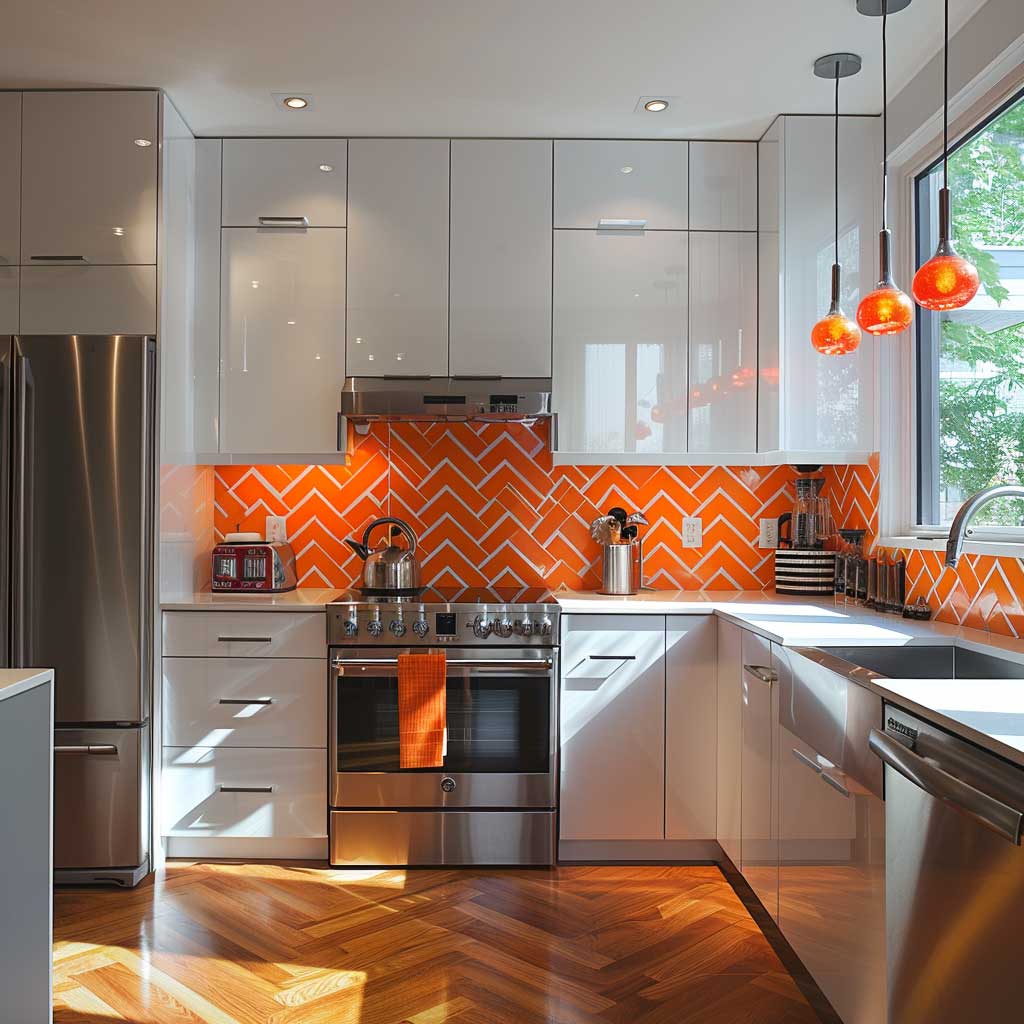
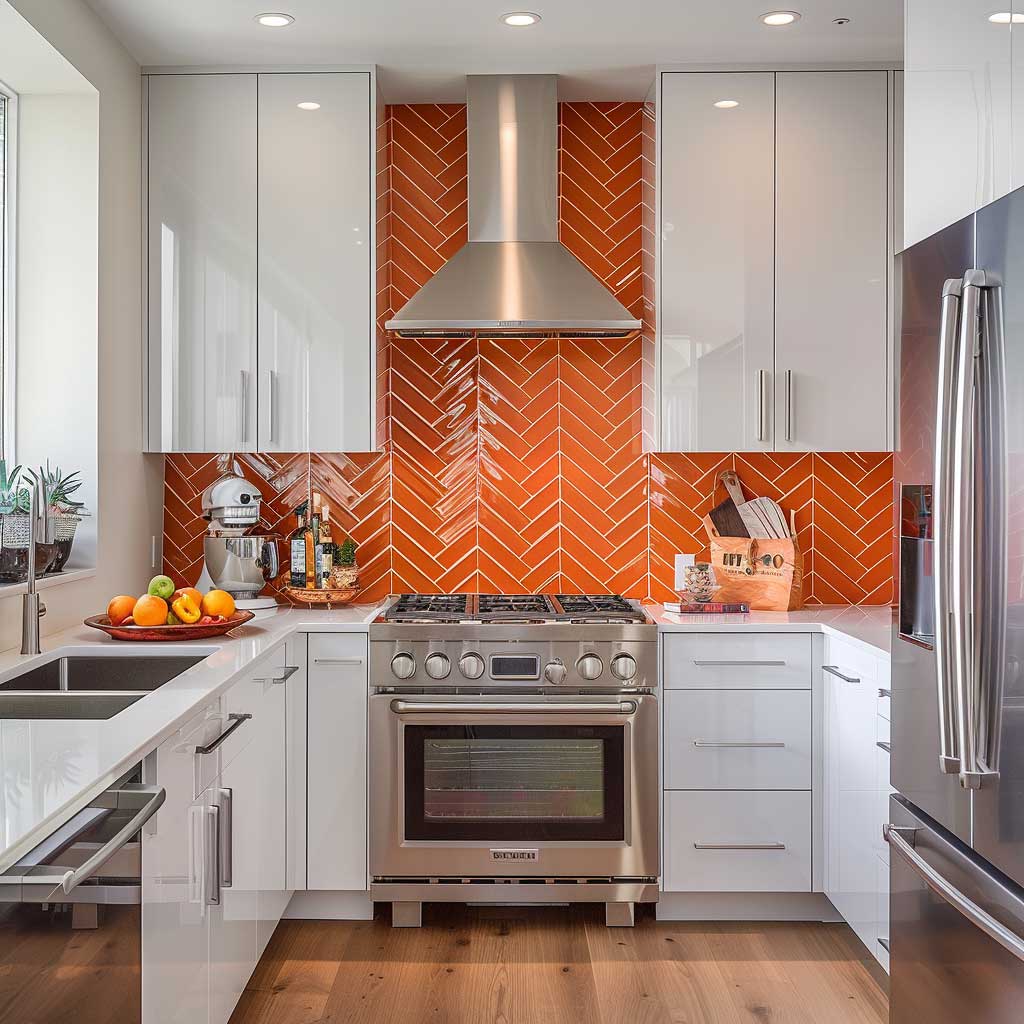
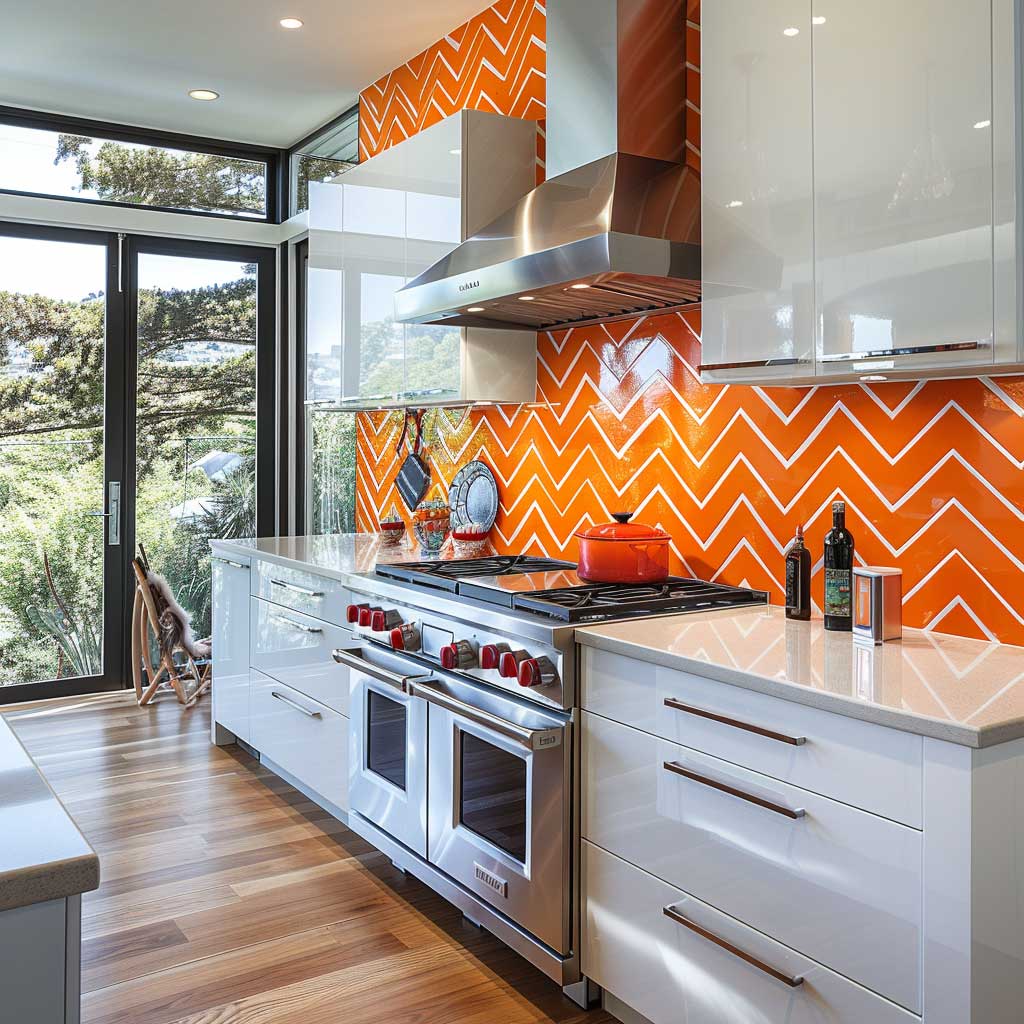
Chevron is a pattern with directionality — your eye follows those zigzags across the wall, which visually widens a narrow kitchen the way horizontal stripes widen a room. I stole this trick from a galley kitchen renovation in Portland where the designer used it specifically to make a 7-foot-wide space feel like it had a few extra feet. The alternating orange and white tiles clock in around $8–$14 per square foot depending on whether you go ceramic or porcelain — MSI’s Calypso line runs about $9.50 and ships from most tile distributors within a week.
White cabinetry is the non-negotiable partner here. Cream, off-white, or aged-white cabinets muddy the orange-white contrast and make the chevron pattern look dusty. You need true white — think Benjamin Moore Chantilly Lace or Sherwin-Williams Extra White on the cabinet fronts. Stainless appliances read neutral in this context, which is exactly what you want: the backsplash is the statement, everything else plays support. Does the orange feel too intense once it’s installed? Add a white pendant light directly above — it pulls white out of the pattern and rebalances the space instantly.
The maintenance reality of chevron: the angled grout lines catch more debris than straight horizontal joints. Budget for an epoxy grout rather than sanded cement grout — MAPEI Ultracolor Plus FA in a warm white runs about $18 per bag and resists staining significantly better. I own two kitchens with patterned backsplashes and the one with epoxy grout still looks installed-yesterday after four years.
Want to echo the orange without over-decorating? A single ceramic vase or ceramic bowl in the same orange family sitting on the counter nearby is enough. Resist the urge to add orange towels, orange cutting boards, and orange placemats — that’s how a design decision becomes a theme park. Small kitchens especially benefit from strategic pattern placement on the backsplash rather than loading every surface with color.
Muted Orange Herringbone Tiles Age Beautifully While Everything Else Dates
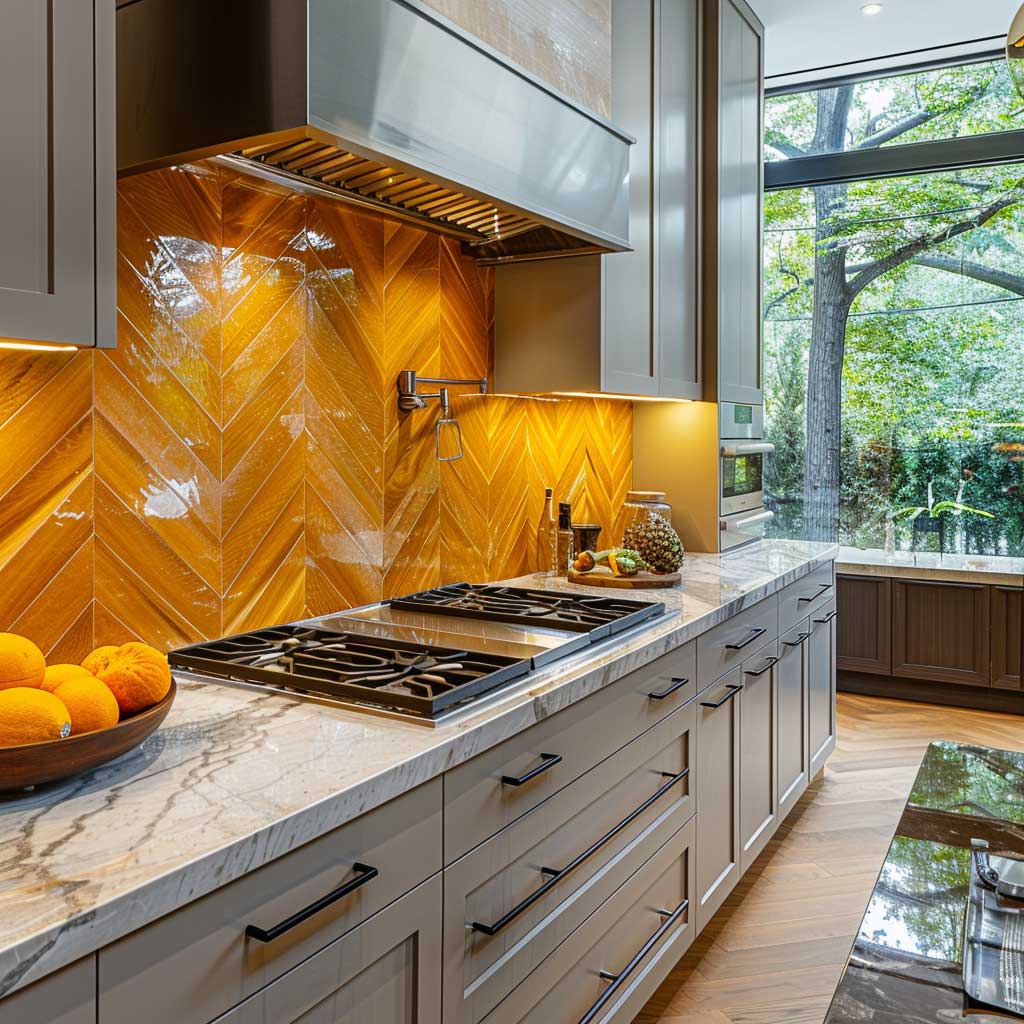
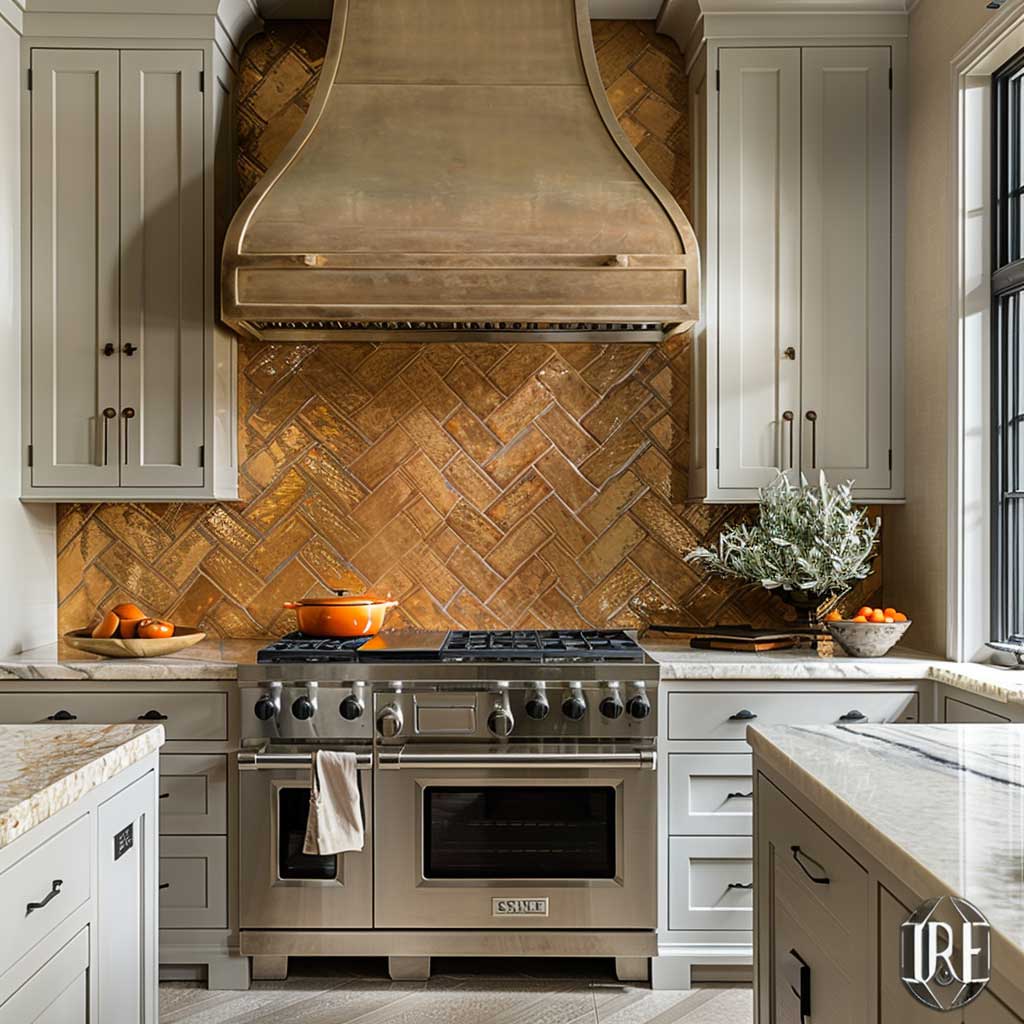
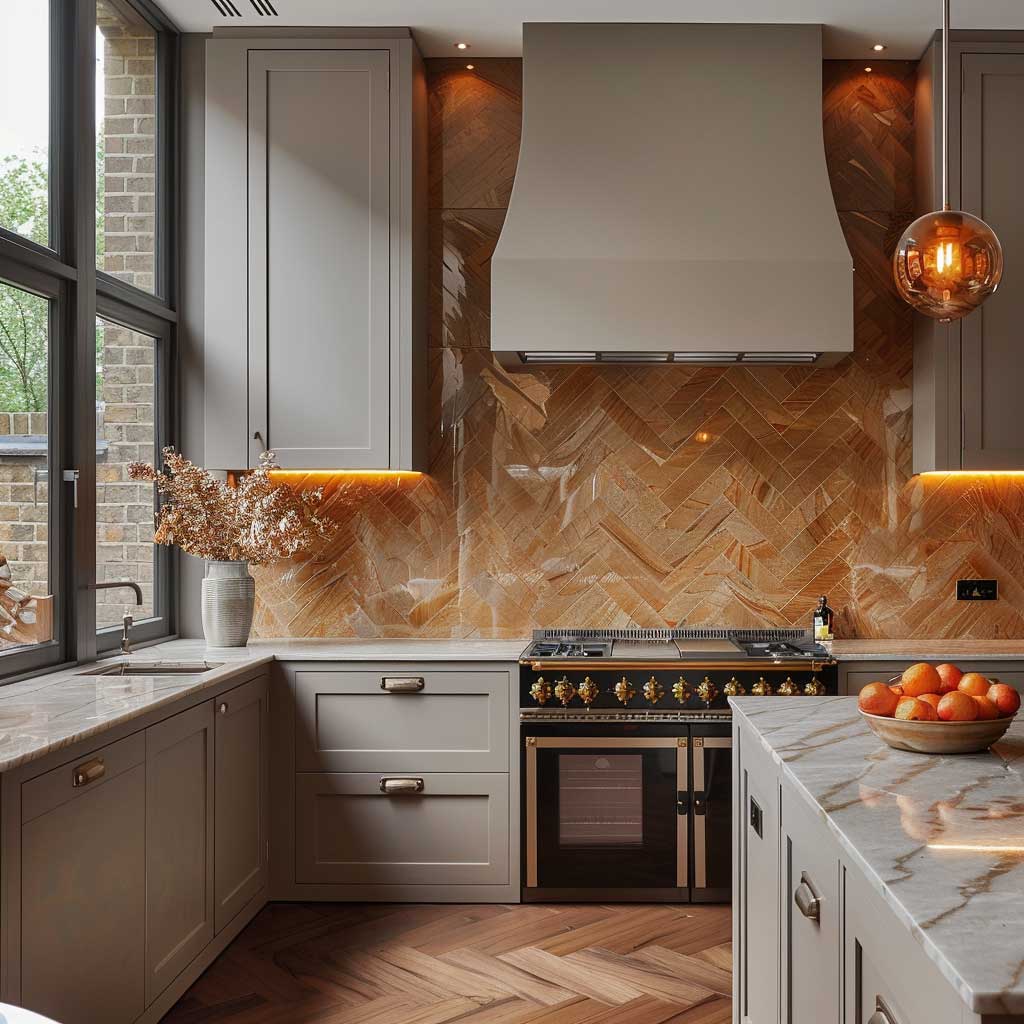
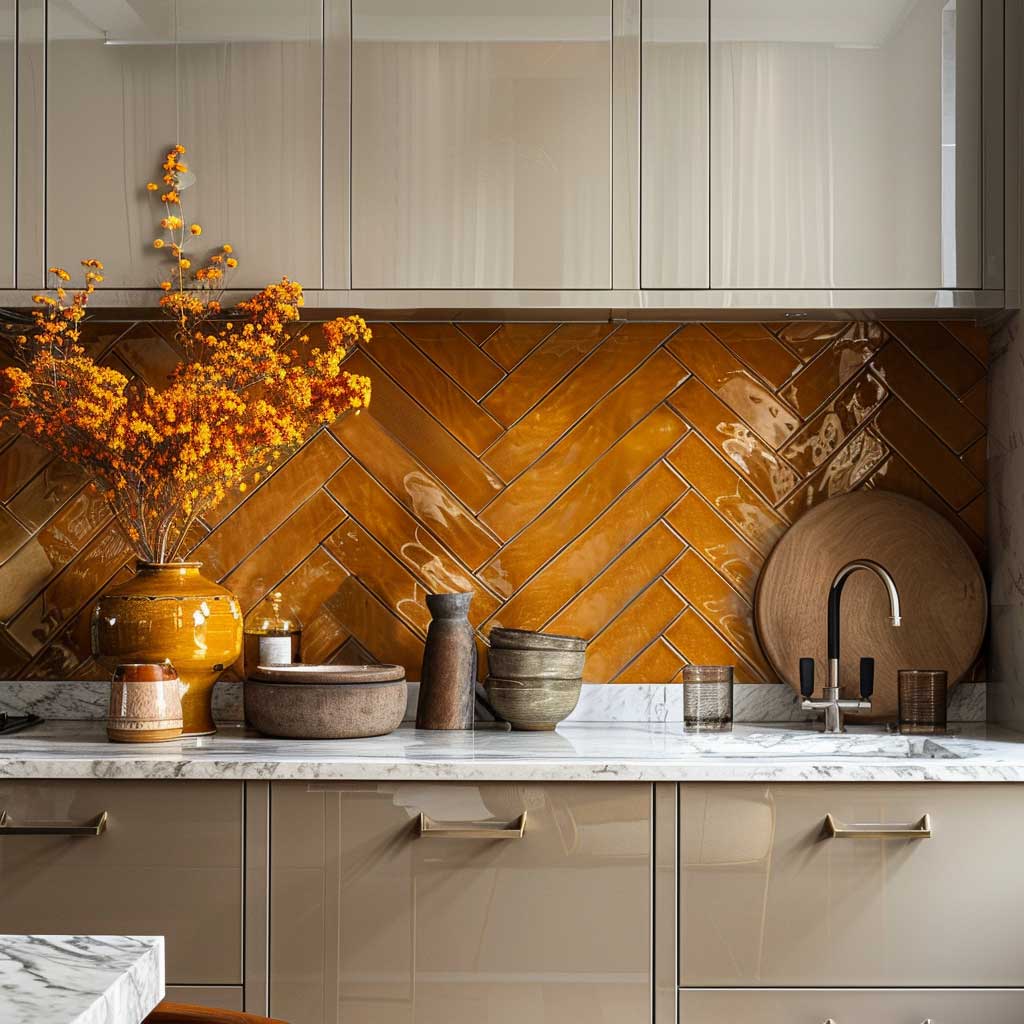
Muted orange — think terracotta, burnt sienna, dusty persimmon — behaves like a neutral that happens to be warm. Heath Ceramics makes a Persimmon Dimensional Diamond tile that costs around $42 per square foot and has a quality that reads as genuinely artisanal rather than manufactured. It’s expensive, but a backsplash behind a standard range is only 8–12 square feet, so the total tile cost stays under $500. That’s not unreasonable for something that lasts 30 years and gets better-looking as the kitchen around it evolves.
The herringbone lay pattern creates motion in a way that straight-stacked tile never does. It’s the visual equivalent of a braided rug versus a flat one — same material, completely different energy. My go-to cabinet pairing for this treatment is linen or warm greige — Benjamin Moore Pale Oak on shaker doors with muted orange herringbone behind the range is a combination I’ve specified three times now without a single client ever regretting it. Marble countertops in Carrara or Statuario pull out the white mineral tones and let the orange warm the entire room.
Brass and copper fixtures are the correct hardware choice here — not because they’re trendy but because the undertones in terracotta orange literally contain yellow and red, which is what brass and copper are made of. Unlacquered brass from Rejuvenation costs more ($85–$200 per fixture) but develops a patina that matches the aged quality of handmade tile over time. Chrome looks cold next to muted orange and I’d avoid it completely with this palette. Hardware finish consistency across your kitchen makes even a bold backsplash look intentional.
One practical note on herringbone installation: the angled cuts at the edges add 10–15% to your tile waste factor and significantly to your labor cost if you hire out. Account for this in your budget. DIY herringbone is doable but requires a wet saw and patience — the pattern punishes misaligned cuts more than straight-lay does.
For the research side of this, the Tile Council of North America publishes installation standards that cover grout joint sizing by tile format — herringbone with 2×4 tiles typically calls for a 1/16-inch joint, which affects grout quantity calculations. Color psychology research on orange tile confirms that muted shades like apricot and terracotta are ideal for larger applications and relaxing spaces, which is exactly why the herringbone treatment reads as sophisticated rather than loud.
Orange Backsplash Tile Comparison
| Style | Tile Cost | Best Cabinet Color | Fixture Finish | Install Difficulty |
|---|---|---|---|---|
| Glossy Orange Hex | $4–$8/sq ft | Black or white | Chrome or nickel | Easy (mesh-backed) |
| Orange+White Chevron | $8–$14/sq ft | True white only | Stainless or nickel | Moderate |
| Muted Orange Herringbone | $12–$42/sq ft | Greige or linen | Brass or copper | Hard (angled cuts) |
Bottom Line
Orange Backsplash Tile Pays Off When You Match Shade to Scale
Bright glossy orange needs a small footprint and high-contrast surroundings. Muted terracotta can fill a full wall. The pattern — hex, chevron, herringbone — shifts energy from architectural to playful to artisanal.
Grout choice matters as much as tile choice. Epoxy grout in warm white keeps orange kitchen tiles looking clean for years without staining.
Save this post before your next tile store visit — these three treatments cover the full range from bold to subtle.