Vintage pendant lighting for kitchen island setups works when two things line up: a shade style that suits the room and a hang height of roughly 30–36 inches above the counter. Get both right and a mid-century globe, an enamel barn shade or a black cage fixture reads as intentional rather than themed. Get the height wrong and even a $300 original looks like a stage prop.
Which retro style fits which kitchen? Globes suit warm wood and pastel cabinetry, enamel shades suit traditional and farmhouse rooms, and cages suit brick, concrete and steel. New fixtures start around $30–$70 for a basic cage and climb to $199–$499 for a classic barn pendant, so the style choice also sets the budget. Pick the style from your countertop material first, then the color.
Bulbs finish the job. Filament-style LEDs in the 2100K–2700K range give the amber glow people link with old diners, while drawing a fraction of the power of the 60-watt bulbs those diners burned. Treat the bulb like the frame on a painting, because the wrong one cheapens everything around it.
Quick Scan
- Hang the bottom of each pendant 30–36 inches above the countertop, measured from the counter, not the floor.
- Space multiple fixtures 24–30 inches apart, center to center, and keep the outer ones 6–12 inches from the island ends.
- Plan one pendant per 2 feet of island length: a 6-foot island takes 3 fixtures.
- Globes give a soft, diffused glow; enamel shades push light down; cages put the bulb on full display.
- Filament LEDs at 2100K–2700K look vintage and use at least 75% less energy than incandescent bulbs.
- New enamel barn pendants run about $199–$499, while salvaged 10–12 inch originals sell for roughly $115–$170.
- Most islands look right with shades 12–18 inches in diameter.
Mid-Century Globe Pendants Bring Soft Color to the Island
Mid century modern kitchen island lighting leans on the glass globe because it softens a room built on straight lines. Opal and tinted globes spread light in every direction, so a row of them glows instead of glaring. Typical retail prices for new mid-century style globes sit around $145–$215 for an 8-inch shade and $259–$388 for an 11.6-inch one. Shades under 10 inches look best in groups of 3 or more, while a single globe needs 12–18 inches to hold its own.


What color should the glass be? Opal white is the safe pick for task light, while amber, smoke or pastel tints feel more retro but cut usable brightness. Tinted glass works like sunglasses: the mood improves and the detail drops. Over a prep zone, keep at least one opal globe in the row or add under-cabinet light to compensate.
Avoid hanging globes in three different sizes over a short island, since a 7-foot counter cannot carry that much visual noise. A matched set of 3 identical globes spaced 24–30 inches apart looks calmer than 5 mixed globes at random heights. Original 1950s opal globes from antique dealers often sell for about $300–$370 each, roughly double a new reproduction. Spend on originals only when the fixture is meant to be the main event in the room.
Enamel Barn Shades for Traditional Kitchen Island Lighting
Traditional kitchen island lighting with a retro twist usually means porcelain enamel, the glossy white, red, cobalt or factory-green steel shades borrowed from barns, garages and diners. A widely sold reproduction of the classic barn pendant comes in 10- to 26-inch widths and costs roughly $199–$499 depending on size. The reflective white interior throws light straight down onto the counter, which makes these shades better task lights than most glass globes. For the classic look, choose white enamel inside and color outside.
Is a salvaged original worth it over a reproduction? Original 10–12 inch green enamel shades from the 1930s trade for about $115–$170 each, so a set of 3 can cost less than one large new fixture. The tradeoff is condition, since chips, surface rust and tired wiring are common and many pieces need rewiring before use. Budget an electrician visit into every salvage purchase.


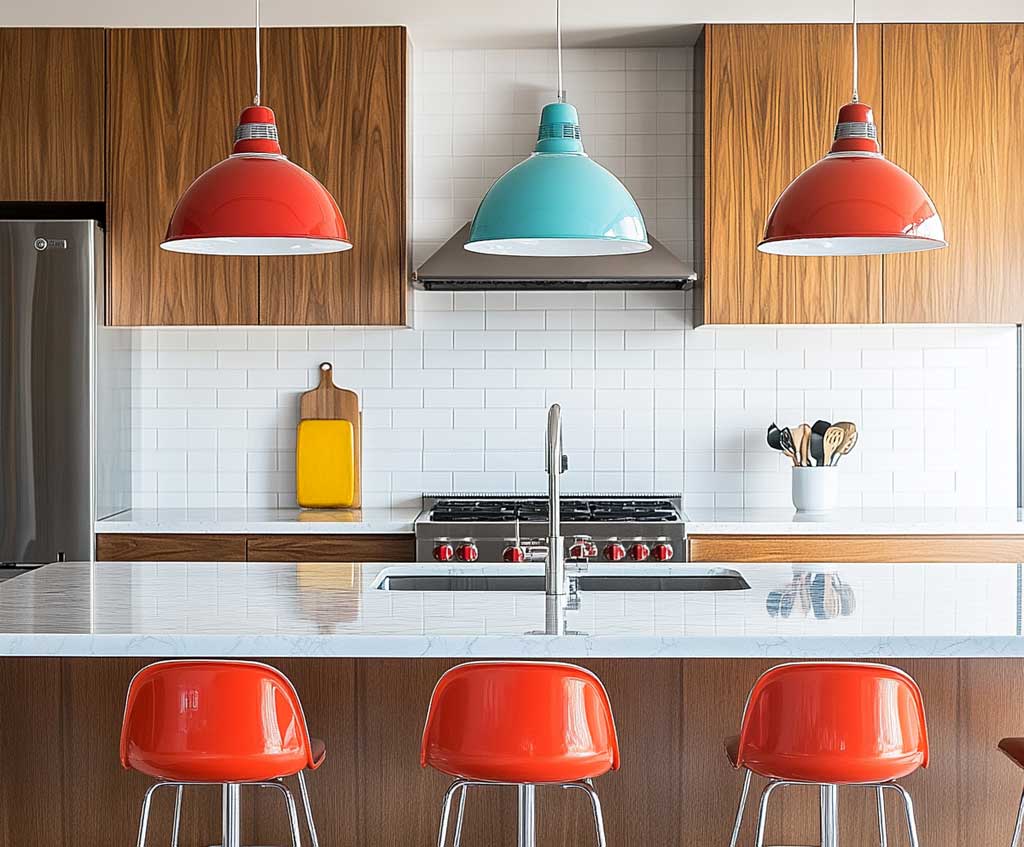

Bold enamel behaves like a red coat in a gray crowd, so one strong color is enough. Pair red or cobalt shades with neutral walls and plain cabinetry, and skip a patterned backsplash that fights for attention. If your kitchen leans classic rather than diner, compare enamel with these timeless brass, glass and black metal kitchen island pendants before you commit. A white or cream shade bridges both moods at about the same price.
Most enamel reproductions take a single bulb, with 10- and 14-inch shades typically rated for 60 watts and 22–26 inch shades for 100 watts. Smaller shades suit islands under 6 feet in pairs or trios, while one large shade can anchor an island up to about 48 inches long on its own. Any filament LED in the 4–8 watt range sits far below those limits, so heat is not a concern.
Industrial Cage Pendants Give Vintage Kitchen Island Lighting Some Grit
Vintage pendant lights for kitchen island spaces with brick, concrete or raw steel usually arrive as black metal cages wrapped around an exposed bulb. They are the cheapest way into retro kitchen lighting, with single cage pendants commonly priced around $45–$70 and 3-light cage sets starting near $30 at mass retailers. Most use a standard E26 socket rated for up to 60 watts, so any filament LED fits. Put the money you save into better bulbs, because the bulb is the whole show here.


Why does the bulb matter more here than inside a globe? A cage hides nothing, so a cheap bulb with a bulky base or cold white light ruins the effect instantly. A vintage ST19 filament LED at 8 watts and 2200K gives about 650 lumens for roughly $11 per bulb, enough task light at a 30–36 inch hang height. A classic 60-watt incandescent delivers about 900 lumens, so you trade a little brightness for a much warmer tone.
A bare cage is like an open-plan office, where everything is on display, including dust. Skip cages directly beside the cooktop, where grease settles on every wire, or plan to wipe them regularly. A linear 5-light cage fixture around 32 inches long covers a medium island from one junction box, which is simpler than wiring 3 separate pendants. Choose the linear version when your ceiling has only one electrical box.
Sizing Rules for Vintage Pendant Lighting for Kitchen Island Layouts
Vintage pendant lighting for kitchen island layouts follows the same geometry as any modern fixture, and retro shades punish mistakes harder because they pull the eye. The bottom of each pendant should sit 30–36 inches above the countertop so people seated across from each other can still make eye contact. With ceilings above 8 feet, a common rule adds about 3 inches of drop per extra foot of height. Measure from the counter surface, never from the floor.
- Count: one pendant per 2 feet of island length, so a 6-foot island takes 3 fixtures.
- Spacing: 24–30 inches between fixtures, center to center.
- Ends: keep the outer pendants 6–12 inches in from each end of the island.
- Coverage: the full row should span about two-thirds of the island length.
- Size: 12–18 inch shades suit most islands, and a single pendant works only up to about 48 inches of counter.
Does an odd number always win? Three pendants usually look more balanced than two or four, and islands of 84 inches or longer typically start at 3 fixtures. Four pendants on a 6-foot island cap each shade at roughly 9 inches if the gaps match the shade width, which is why two larger shades often beat four small ones. Think of the row like fence posts, where even spacing matters more than the exact count.
Don’t Do This
Don’t drop retro pendants to 24 inches above the counter for extra drama. At that height a 12-inch enamel shade blocks faces across the island and shines straight into seated eyes, while 30 inches is the practical minimum. Don’t push the end fixtures to the very edge either: anything closer than 6 inches to the island end looks like it is about to fall off.
Warm Bulbs Make Retro Kitchen Lights Look Authentic
Retro kitchen lights only look period-correct when the bulb glows in the 2100K–2700K range, the amber band that imitates old carbon filaments. Bulbs at 3000K and above look crisp and modern, which helps task zones but flattens the vintage effect. Is there a middle ground? Warm-dimming filament LEDs shift from about 3200K at full power to 1800K when dimmed, so one bulb handles both cooking and dinner. Put every island pendant on a dimmer to unlock that range.
The efficiency gap between old and new bulbs is large. Residential LEDs use at least 75% less energy and last up to 25 times longer than incandescent bulbs, according to the U.S. Department of Energy LED lighting overview. A typical incandescent lasts about 1,000 hours, against 15,000–25,000 hours for a typical LED. Swapping three 60-watt incandescents for 8-watt filament LEDs cuts the island load from 180 watts to 24.
- 2100K–2200K: deepest amber, best for evenings and dining.
- 2700K: warm but clearer, the safer pick over a prep zone.
- About 650 lumens from an 8-watt ST19 filament LED vs about 900 from a 60-watt incandescent.
- 80 CRI as the floor, 90+ CRI preferred where food gets cut.
Color rendering deserves as much attention as color temperature. Filament LEDs range from about 80 CRI to 90+ CRI, and the higher figure keeps tomatoes, herbs and wood grain looking natural instead of muddy. A low-CRI bulb over a prep island acts like a cheap phone camera at dusk, turning everything slightly brown. Avoid anything below 80 CRI over a surface where you handle food.
Comparing Vintage Pendant Lighting for Kitchen Island Styles Side by Side
Retro kitchen island lighting styles differ more in light quality and upkeep than in price alone. The table compares the three main families using typical retail prices and manufacturer bulb ratings. Start with the row that matches your countertop material, then check the price column.
| Style | Typical shade size | New price per fixture | Bulb rating | Light character | Best countertop match |
|---|---|---|---|---|---|
| Mid-century globe | 8–12 in | About $145–$390 (originals $300–$370) | Often integrated LED, 9–17 W | Soft, diffused, all-around glow | Wood, laminate, pastel cabinetry |
| Enamel barn shade | 10–26 in | About $199–$499 (salvaged $115–$170) | 60 W max on 10–14 in, 100 W on 22–26 in | Directed downlight, strongest task light | Marble, butcher block, painted cabinets |
| Industrial cage | 5–12 in, linear sets about 32 in | About $30–$70 | E26 socket, 60 W max | Exposed bulb, crisp shadows | Concrete, brick, stainless steel |
Can you mix two styles over one island? Rarely well, because two shade families over a single counter compete like two radios playing different stations. Avoid that, and repeat one style over the island and a related style over a dining table at least a few feet away. For kitchens that welcome a deliberate clash, these eclectic kitchen island pendant ideas with stained glass, geometric metal and woven shades show how far the rule can bend. Keep one bulb color temperature across every fixture so the mix still reads as one plan.
The Short Verdict
A retro pendant succeeds or fails on placement before style. A modest $45 cage hung 30–36 inches above the counter and 24–30 inches from its neighbors beats a $400 original hung at the wrong height.
Match the shade to the surface. Globes from about $145 suit wood and pastel kitchens, enamel shades from $199 suit traditional rooms, and $30–$70 cages suit brick and concrete.
Fit filament LEDs at 2100K–2700K with at least 80 CRI, ideally 90. They use at least 75% less energy than the incandescents that inspired them and keep the amber glow that makes retro lighting worth the effort.
Count before you buy. One pendant per 2 feet of island, an odd number where possible and outer fixtures 6–12 inches from the ends keep even a bold red enamel row looking deliberate.