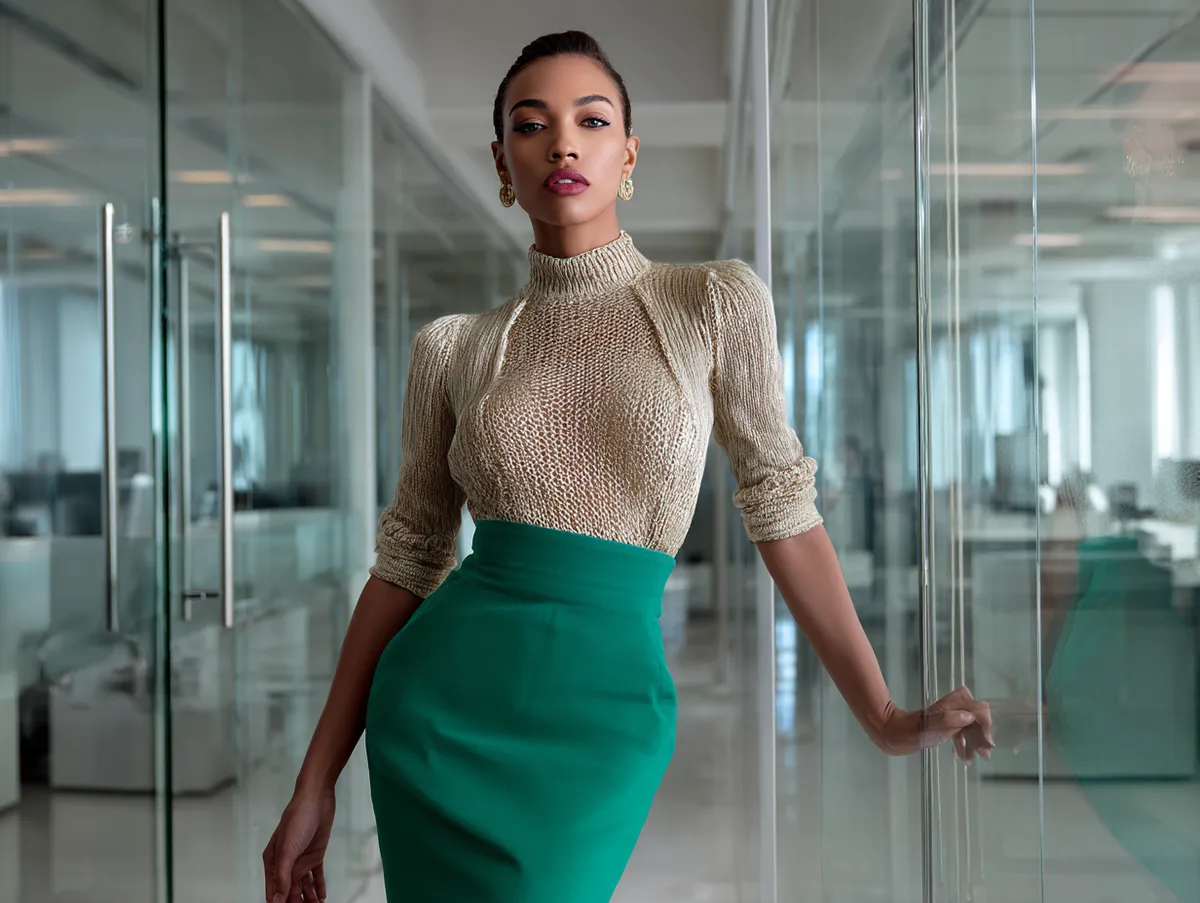
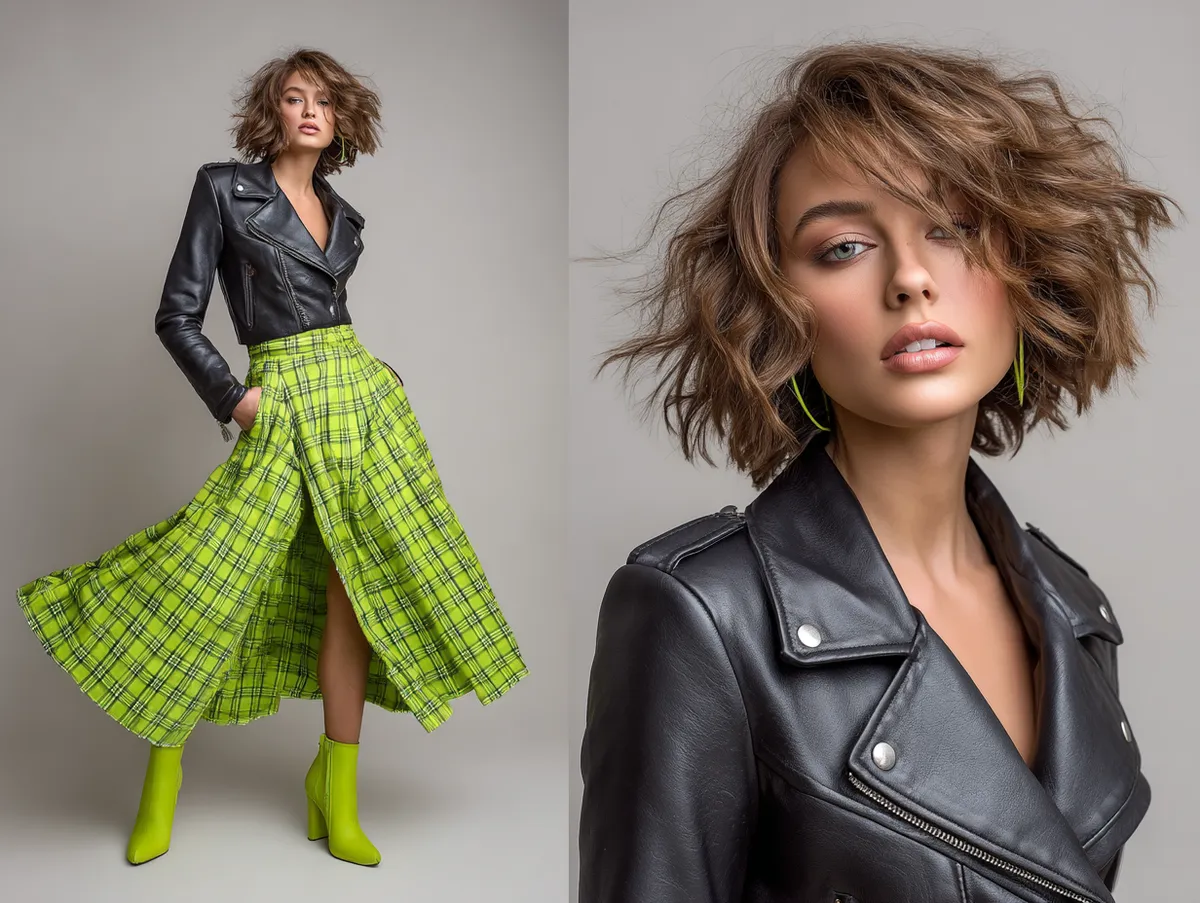
Green outfits work in every season once the shade matches the weather: sage for spring, lime for summer, forest green from October through early winter. The color itself is not the hard part. What decides whether a green look reads polished or chaotic is proportion, and the simplest working formula splits an outfit into 60% base, 30% secondary color and 10% accent. Treat green as one of those three slots instead of all three, and it stops fighting the rest of your wardrobe.
Does green suit everyone? Almost, provided the depth is right. Soft sage and forest tones sit comfortably on most complexions, while acid lime needs a white or cream partner to calm it down. The three formulas below cover a full year with only 6 core pieces: a sage knit, a cream midi skirt, a forest turtleneck, dark jeans, a lime blazer and white trousers.
Quick scan
- Keep any look to 3 colors split roughly 60 / 30 / 10, with green in one slot.
- Spring: sage knit under 300 g reads light, while a 300–600 g knit already belongs to autumn.
- Fall: forest green plus 12–16 oz midweight denim beats light summer jeans under 12 oz.
- Summer: lime works as the 30% blazer, never as the 60% base.
- Cream and ivory flatter sage more gently than stark white does.
- An all-green look needs at least 2 shade steps (light vs deep) to avoid a flat block.
How to Wear Green Without Overthinking the Palette
Learning how to wear green starts with deciding which job the color does in your outfit. Stylists borrow the 60-30-10 split from interior design: 60% is the dominant color, 30% the secondary, 10% the accent. Picture a room where the walls, the sofa and the cushions all compete for attention, and you already know what equal thirds of color look like. Give green one role and let neutrals carry the rest.
What to wear with green, then? Cream, ivory, camel, denim blue, white and black all handle the 60% base well, which leaves green to show up as a 30% knit or blazer or a 10% bag or shoe. A useful breakdown of the three-colour rule with 60/30/10 outfit examples even uses green as the 10% accent against black and tan. Start with green as the accent if you are nervous about the color, then promote it to 30% once it feels natural.
- Green as 10%: a sage scarf or emerald flats on a black-and-tan base.
- Green as 30%: a forest turtleneck over dark jeans and a camel coat.
- Green as 60%: tonal sage, olive and forest pieces finished with a cream accent.
A frequent mistake is splitting colors evenly, because 33/33/33 reads busier than a clear winner. Some stylists loosen the rule to 80/20 for calmer looks, and that works just as well for green. Avoid pairing green with two other saturated brights at once, since a fourth color almost always tips the balance.
Sage Knit and Cream Midi Skirt for Soft Spring Green
Light green and cream is the most forgiving colour combination for spring, and a sage sweater over a cream midi skirt shows why. Sage carries enough grey to look grown-up, while cream softens the contrast more than optic white would. Think of it like morning light through a linen curtain: the edges stay soft and nothing shouts. This pairing is also the gentlest entry point for green outfit ideas for women who rarely wear color.


Weight matters more than fiber name here. As a rough guide, knits under 300 g count as lightweight and 300–600 g as midweight, so a spring sage sweater should sit in the lighter band. Merino fibers run about 17.5–18.5 microns versus 20–40 for traditional sheep’s wool, which is why fine merino feels smooth next to a satin or cotton skirt. Skip chunky cable knits for this look, because the bulk swallows the skirt’s movement.
Why a midi and not a maxi? A midi ends between knee and ankle, so it shows a little shoe and keeps the outfit light, while a maxi turns the cream into a heavier block. The trade-offs are laid out well in this comparison of midi vs maxi skirt outfits for everyday wear. For this palette, a pleated or satin midi in ivory gives the best balance against sage.
Keep accessories in the 10% slot: a beige crossbody, white flats or woven sandals, a single pearl or gold piece. Adding a second color here, such as a bright pink bag, breaks the calm the outfit depends on. On cool mornings, a trench in stone or a light-wash denim jacket adds a layer without introducing a fourth shade.
Green Fall Outfits Built on Forest Green and Dark Denim
Green fall outfits get their depth from forest green, the shade Spanish speakers call verde bosque, and dark-wash denim is its most reliable partner. The deep green and inky blue sit at similar darkness, so the contrast is quiet rather than loud. It works like a pine stand against a dusk sky: rich, close in value, never jarring. A fitted turtleneck keeps the look clean, while a slightly oversized one reads more relaxed.


Denim weight decides how seasonal the look feels. The common industry split is under 12 oz for lightweight, 12–16 oz for midweight and over 16 oz for heavyweight, and midweight denim wears noticeably warmer in fall. Paired with a 300–600 g knit, a 12–16 oz jean handles cold mornings far better than thin summer stretch denim. Leave the light, faded washes for spring, since they pull the outfit away from forest green’s richness.
Is a turtleneck too formal for weekends? Not when the shoes stay casual: brown or black ankle boots or loafers keep it relaxed, and a camel or charcoal tote handles the 10% accent. When temperatures fall further, a long wool coat over the same base pushes the outfit into December without changing a single core piece. Avoid red accessories with forest green, because the pairing reads as holiday costume rather than everyday wear.
Lime Blazer and White Trousers Make Green Outfits Loud
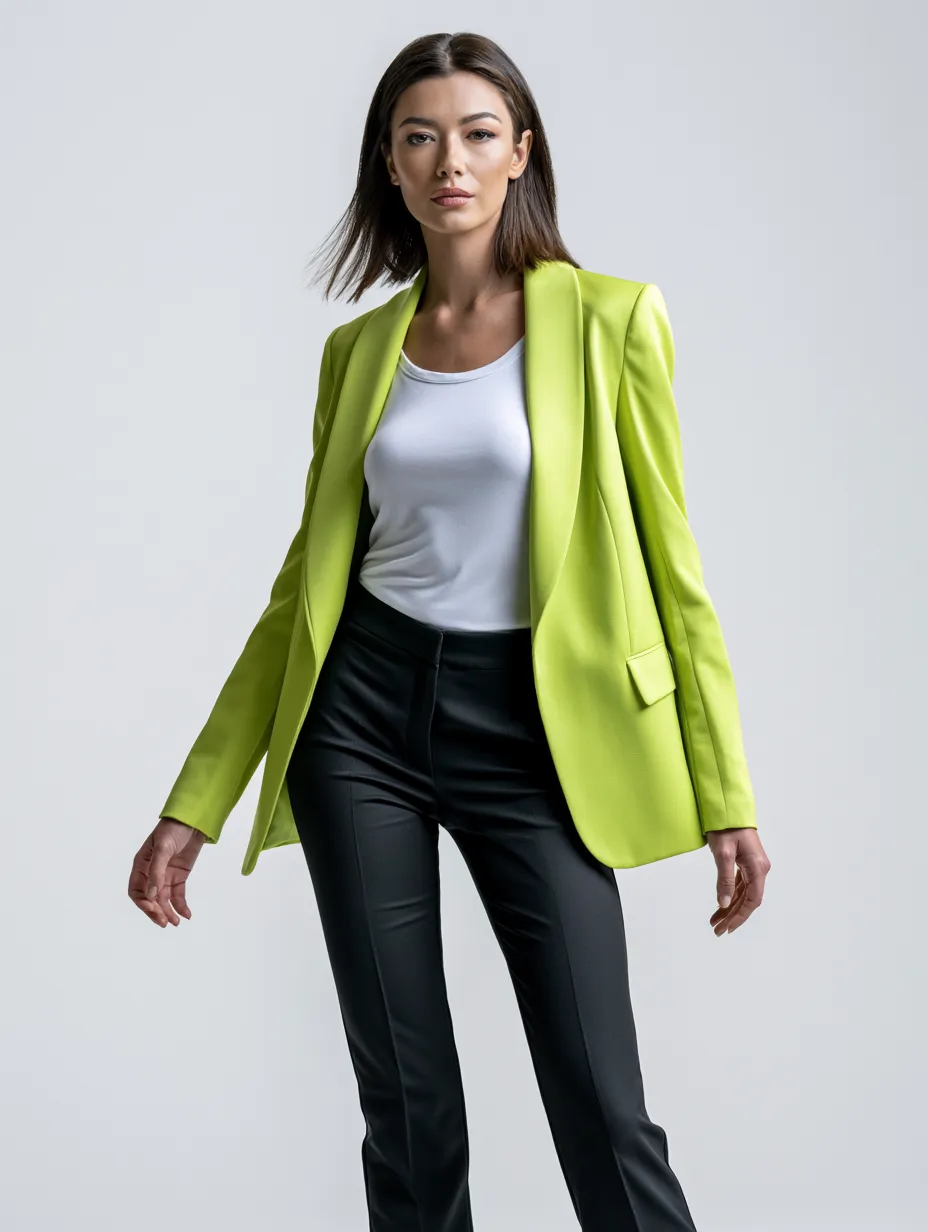
A lime blazer is how to style green when the goal is attention, and white trousers are what keep it wearable. Lime, the shade searched in many languages as verde lima or лайм пиджак, behaves like a highlighter on a white page: impossible to miss, but crisp because the page is clean. Put lime in the 30% slot and white in the 60% slot, and the outfit looks deliberate instead of neon.


Fit decides whether the blazer reads sharp or sloppy. For a relaxed, oversized cut, the usual advice is 2–3 sizes up from your tailored size, with the shoulder seam about 1–2 inches past the natural shoulder. Underneath, a fitted white tank or crop top gives the volume a waistline; the logic behind that contrast is explained in this piece on oversized blazer and crop top layering. Never pair an oversized blazer with an equally loose top, because the torso collapses into a tent.
Mid-market linen or cotton-linen blazers typically land around $120–180, which makes lime a low-risk experiment compared with a designer piece. Choose high-waisted white trousers in a wide or straight leg, and keep shoes to white heels or tan sandals. For evening, swap the tank for a silky cami and add gold hoops, but resist adding a second bright color, since lime already owns the room.
An All Green Outfit Needs Contrast in Depth
An all green outfit works when the shades differ in depth, not when everything matches. Pair a sage shirt with olive trousers and a forest coat, and the eye reads layers; dress in three pieces of the same mid-green and it reads as a uniform. It is the difference between a forest, with dozens of greens, and a painted fence. Aim for at least 2 clear steps between your lightest and darkest piece.
Don’t do this
- Splitting green, white and a third bright evenly at 33/33/33 instead of a clear 60/30/10 hierarchy.
- Wearing light summer denim under 12 oz with a heavy forest knit in late fall.
- Making lime the 60% base color; keep it at 30% or less.
- Matching three greens of identical depth in one monochrome look.
Who looks good in green this way? Most people, if the darkest shade sits closest to the face only when it suits their coloring. Fair, cool-toned skin often prefers sage or emerald near the face, while warmer complexions handle olive well. Add a 10% neutral, such as cream sneakers or a camel belt, so the tonal look has a resting point.
| Formula | Best season | Green’s role | Fabric weight to look for | Shoes | Best for |
|---|---|---|---|---|---|
| Sage knit + cream midi | Spring | 30% secondary | Knit under 300 g | Flats, woven sandals | Brunch, weekend errands |
| Forest turtleneck + dark denim | Fall to early winter | 30% secondary | Knit 300–600 g, denim 12–16 oz | Ankle boots, loafers | Office, travel |
| Lime blazer + white trousers | Summer | 30% statement | Linen or cotton-linen blazer | White heels, tan sandals | Events, creative work |
| Tonal all green | Any | 60% base | Mix 2+ textures | Cream or camel | Fashion-forward days |
Pick One Green and Let It Lead
Six pieces and one proportion rule are enough to wear green 12 months a year: sage in spring, lime in summer, forest green from fall into winter.
Start with green as a 10% accent if the color feels new, then move it to the 30% slot once it looks natural on you. The 60% base should almost always be a neutral.
Match fabric weight to the season: knits under 300 g and light denim for warm months, 300–600 g knits and 12–16 oz jeans when it turns cold.
For bold lime, size the blazer 2–3 sizes up only if the top underneath is fitted. For tonal looks, keep at least 2 steps of depth between your lightest and darkest green.