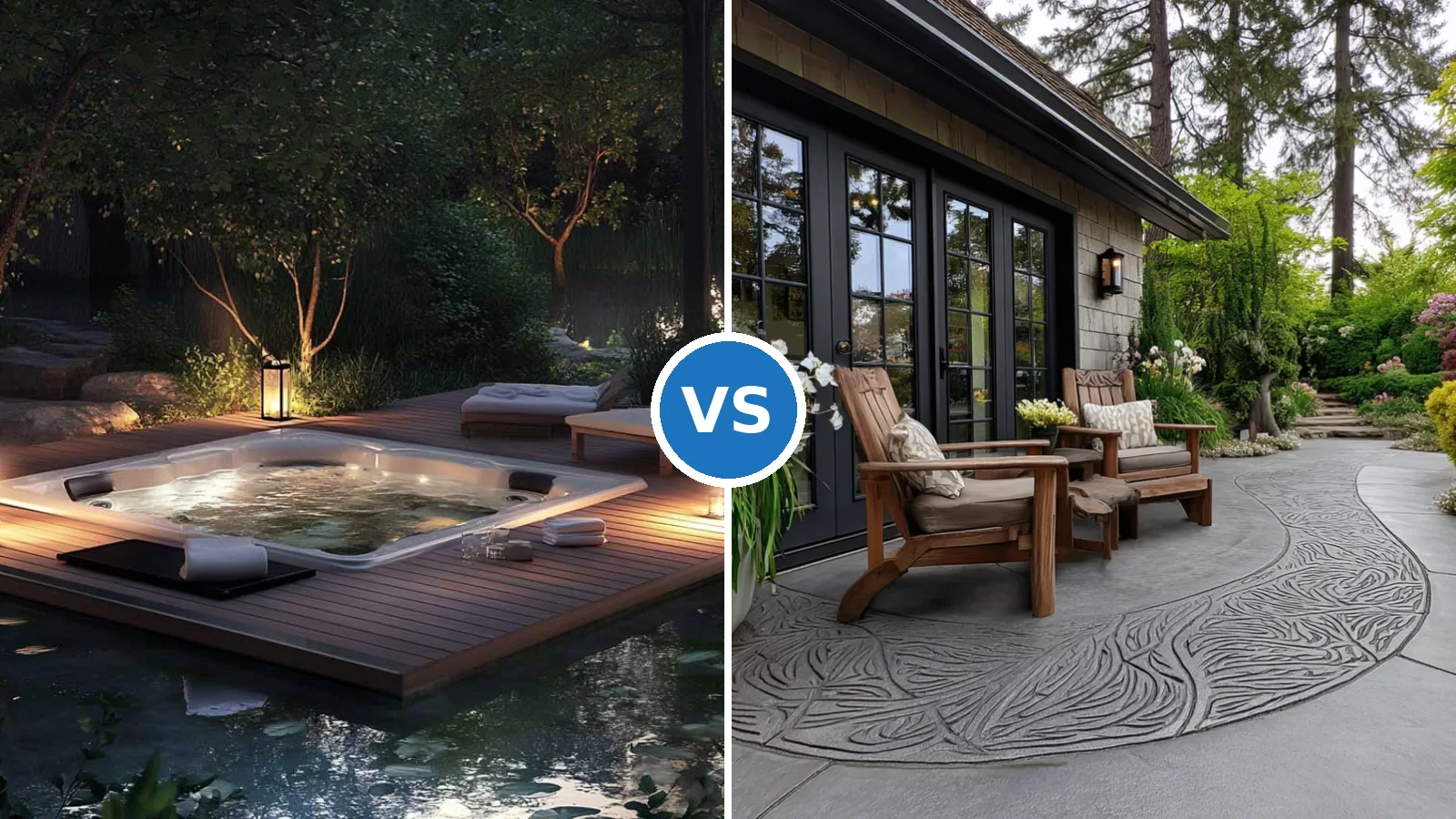
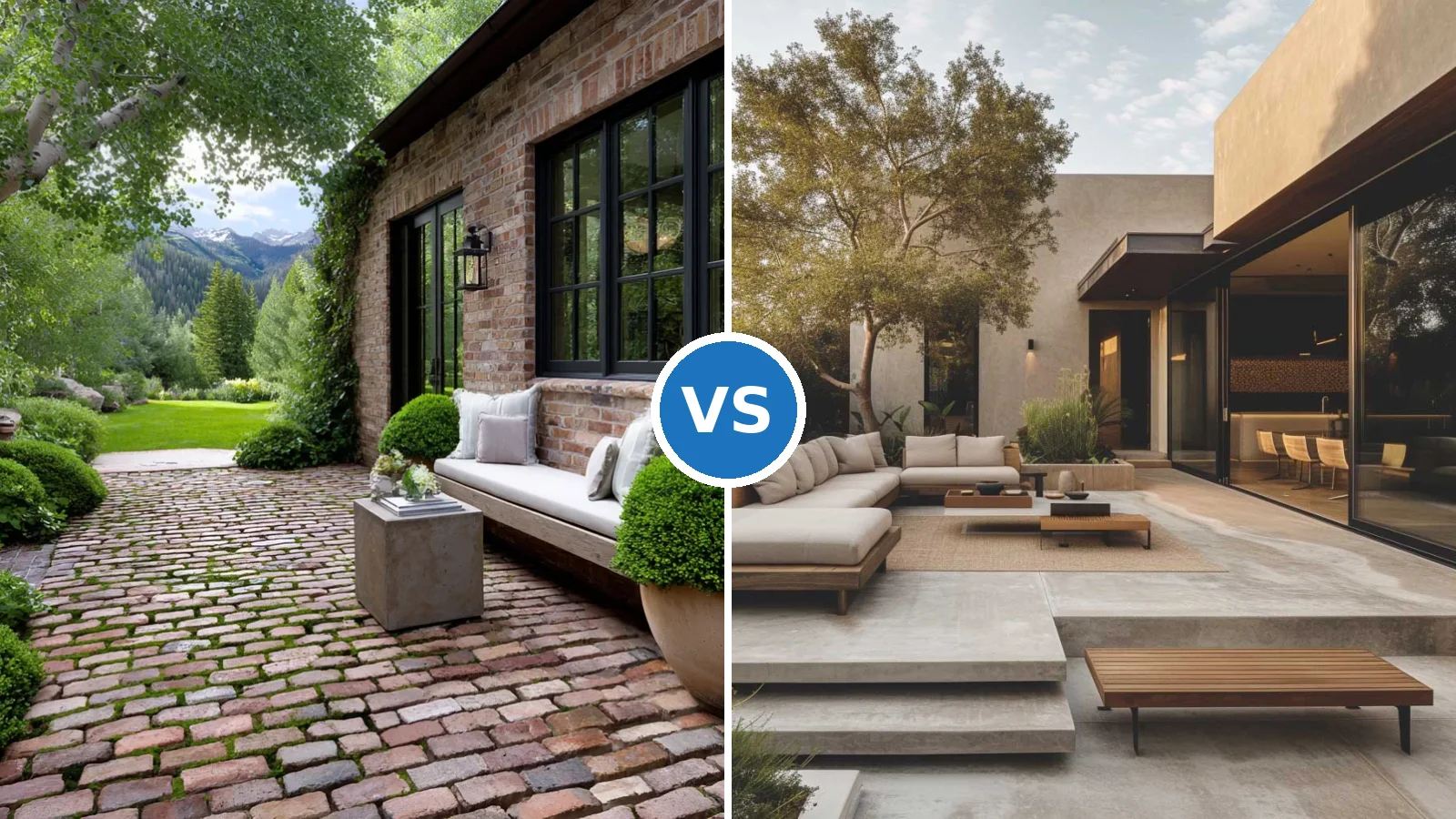
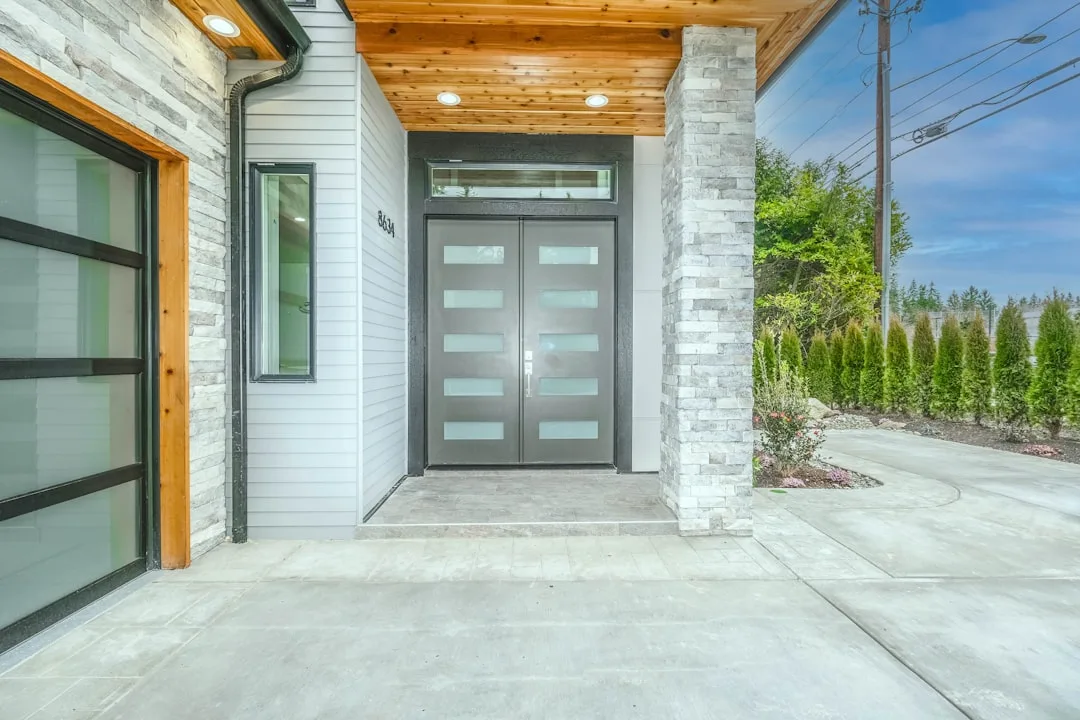
Concrete slab patio ideas get dismissed as the plain option — the boring fallback before you commit to pavers or flagstone. I’ve watched that assumption cost homeowners twice as much money for half the longevity. A well-designed concrete slab patio in the backyard handles foot traffic, outdoor furniture, and a decade of weather without cracking — provided you know what finishes, furniture, and plants to pair it with. Plain concrete patio done right looks nothing like the grey rectangle you’re picturing.
A basic poured slab runs $4–$8 per square foot. Stamped or colored concrete hits $10–$18. That budget gap means you have real money left for the furniture and landscaping that actually make or break the final look. Use it wisely and you’ll have a backyard patio that reads modern and considered, not default.
What You’ll Find in This Post
- Modern minimalist concrete slab patio design — what actually works
- Rustic styling on concrete without looking like a farmhouse cliché
- Landscaping around a concrete slab patio to soften hard edges
- Small concrete patio ideas for tight backyards
- Budget breakdown and material comparisons
- FAQ: finish options, sealing, furniture weight limits
Minimalist Concrete Slab Patios and the Furniture Choices That Ruin Them
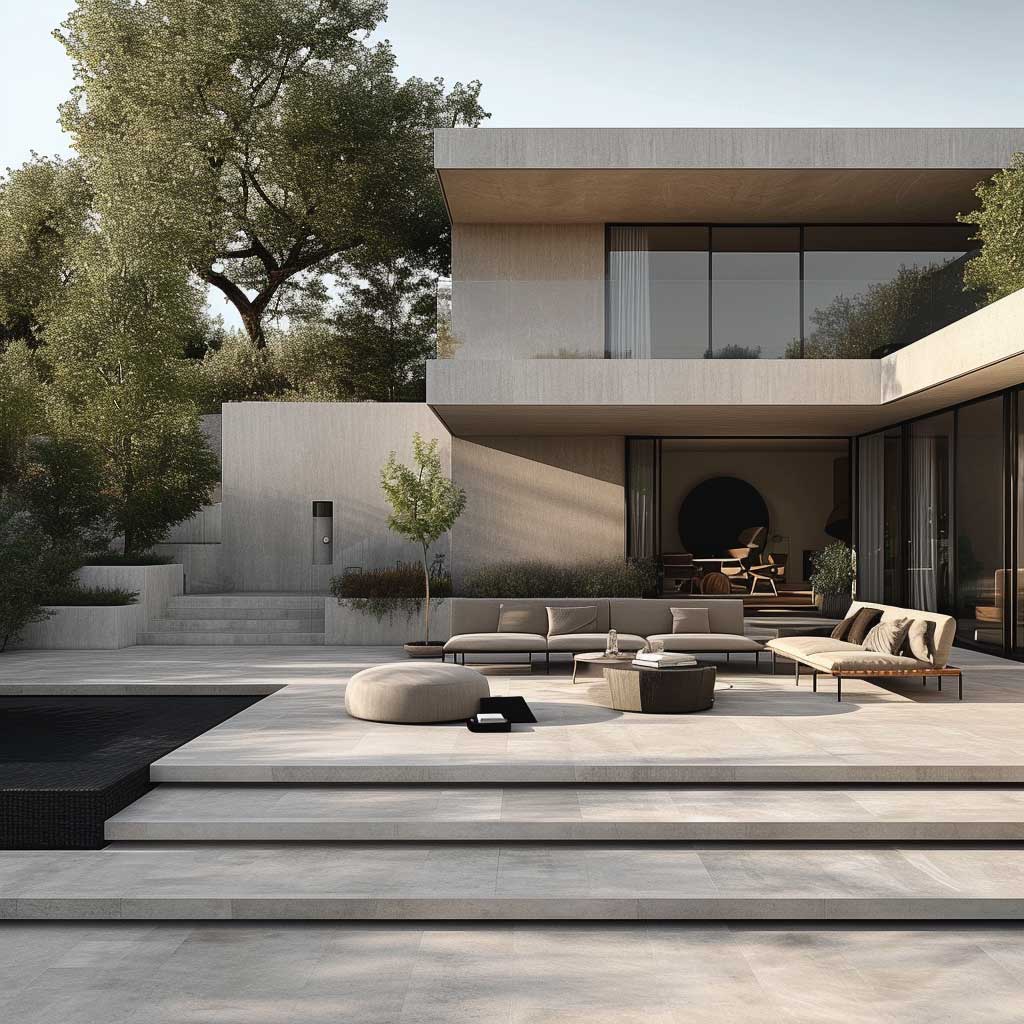
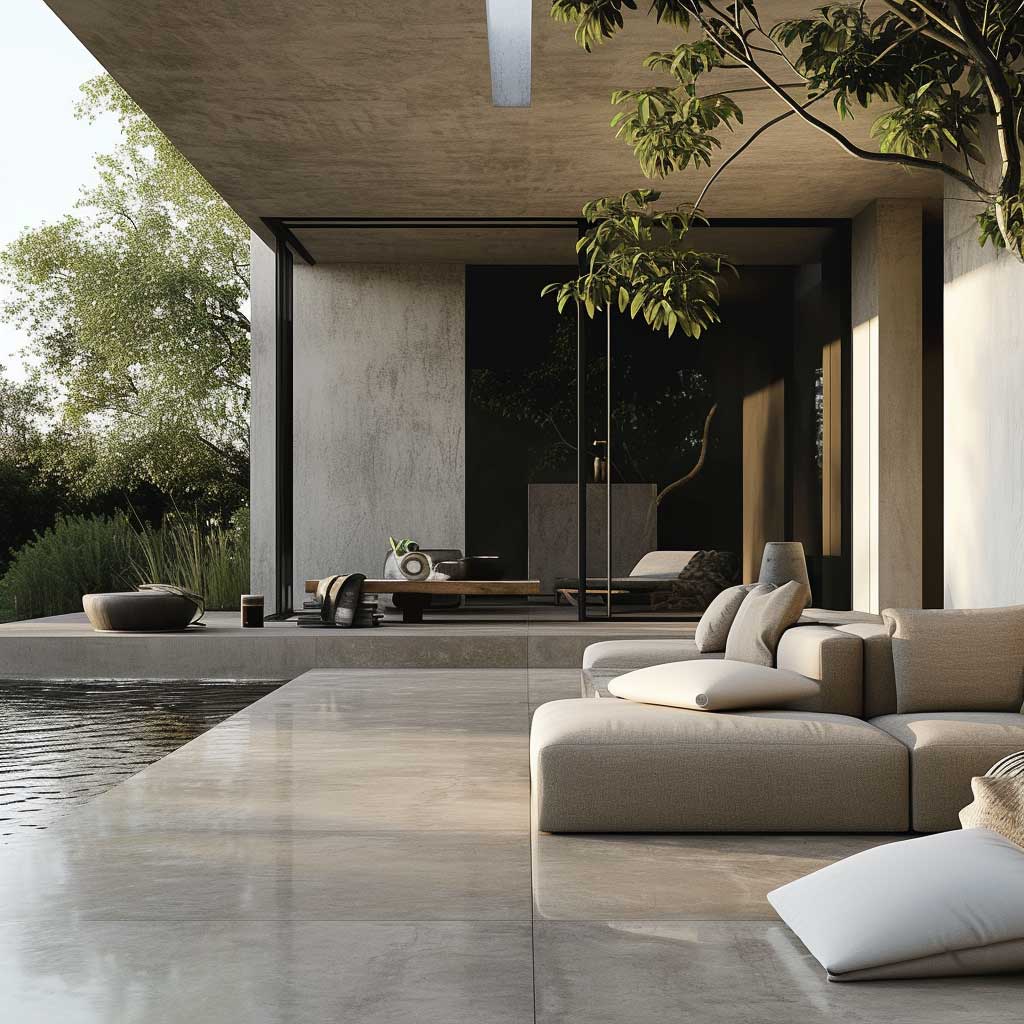
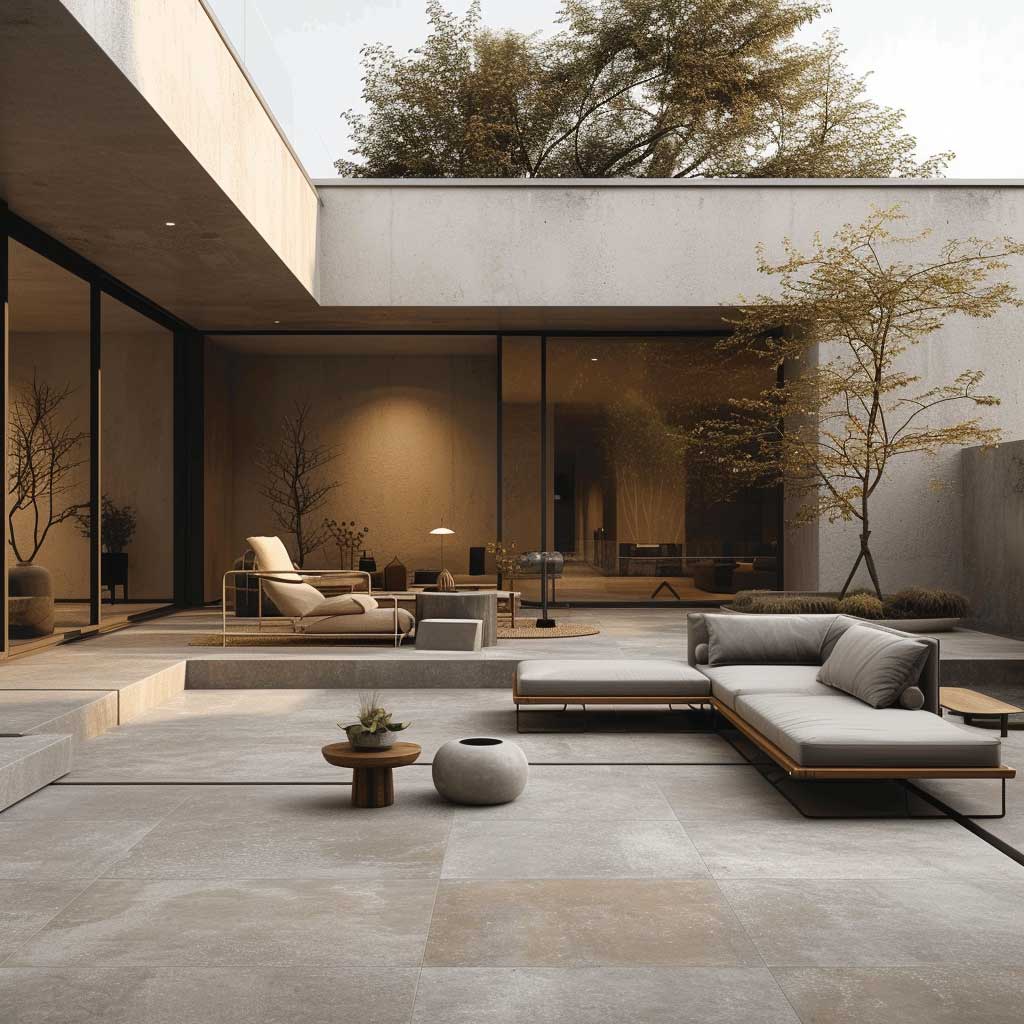
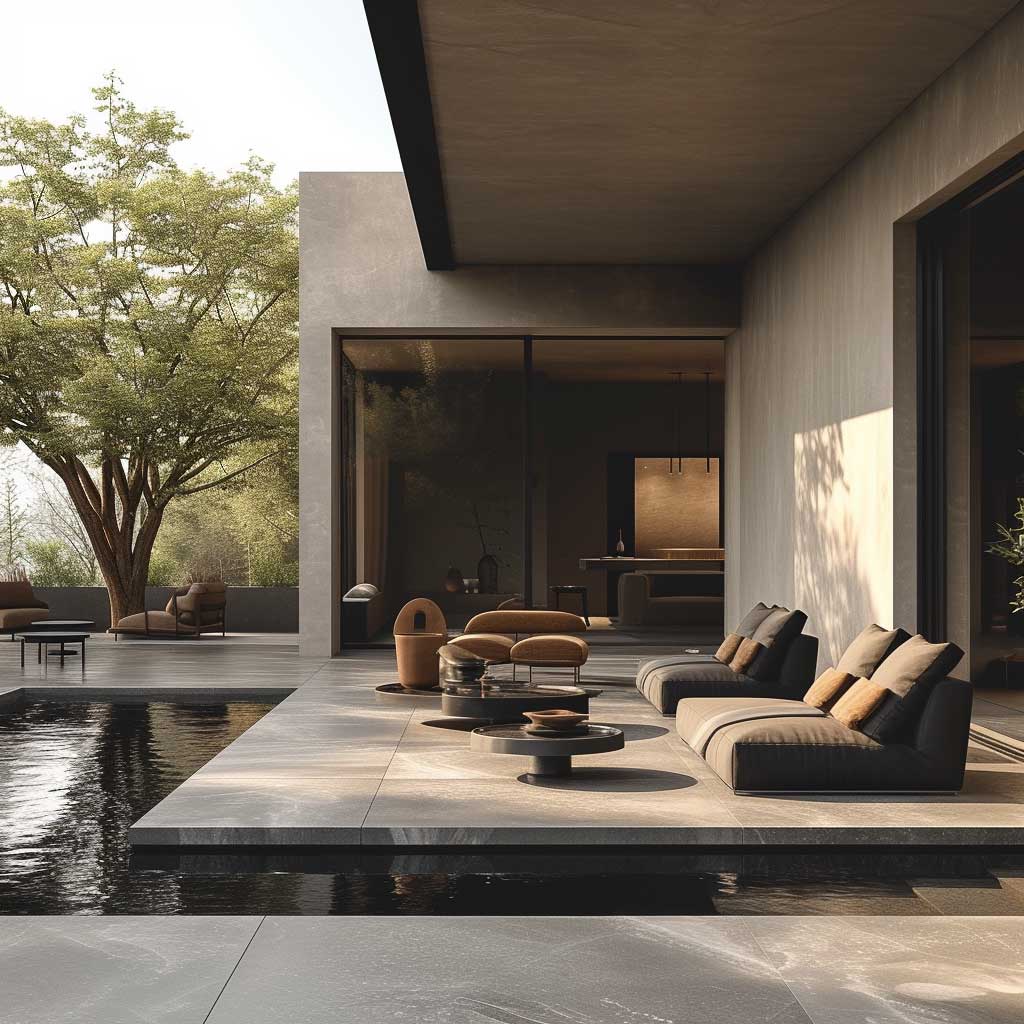
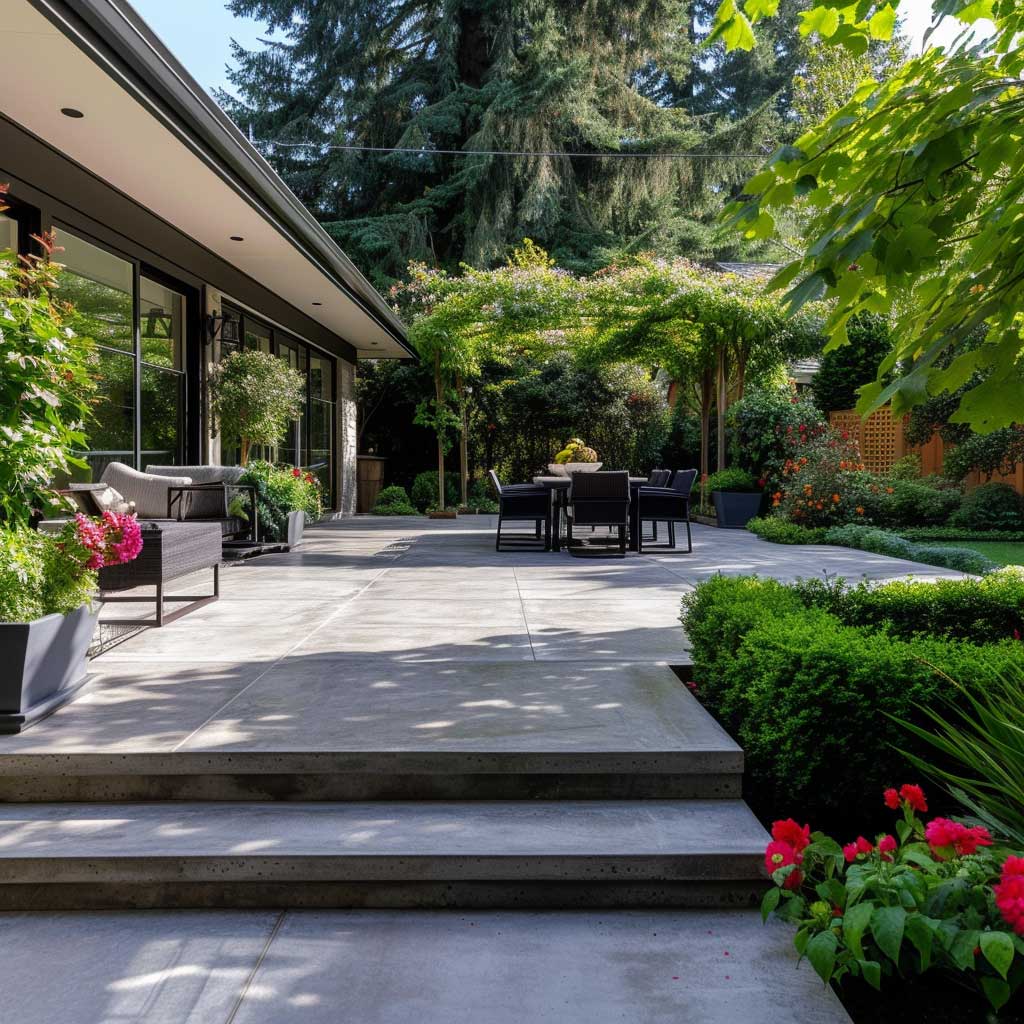
Minimalist concrete slab patios fail — not in their construction, but in the furniture aisle. You pour a smooth, light-toned slab, leave it open, and then someone buys a resin wicker set in honey brown. The whole effect collapses. My go-to rule: keep furniture in the same tonal family as the concrete. Charcoal, matte black, warm white. Anything with fake wood grain undermines the concrete’s honesty as a material.
A polished or broom-finished concrete surface in a light grey or warm ivory reads as architectural. The finish matters more than the colour here. Broom-finished concrete gives subtle linear texture — cheap to produce and it hides scuffs. Polished surfaces are dressier but show oil stains from grills. Pick based on how you actually use the space, not how it looks in a Pinterest photo. I own two outdoor spaces; only one of them gets the polished finish, and it’s the one that’s covered.
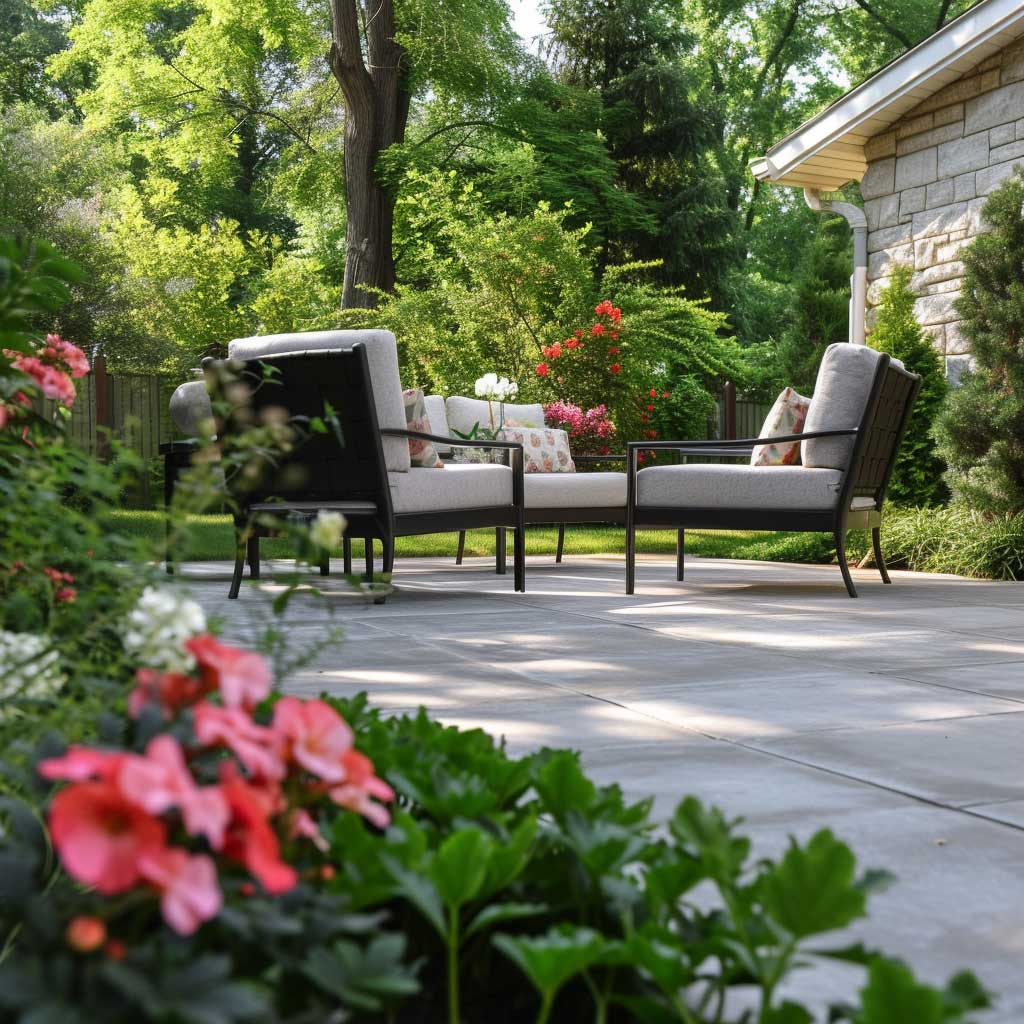
Furniture for a minimalist concrete slab patio: KETTLER’s Advantage Pro line (~$800–$1,100 per set) holds its finish through three seasons without a cover. VONDOM’s Faz collection leans more architectural if your budget is flexible. Keep pieces sparse. Two chairs and a low table beat a full sectional for a patio under 200 sq ft — the slab needs room to breathe. You’ll notice that the open expanse of concrete is doing compositional work, not just filling space.
Lighting is where minimalist concrete patios earn their keep after dark. Recessed LED strip lights along the slab edge — around $15–$25 per linear foot installed — create a floating effect that makes the patio feel designed rather than functional. Skip the solar-powered stake lights. They look fine in a garden; they look cheap against polished concrete.
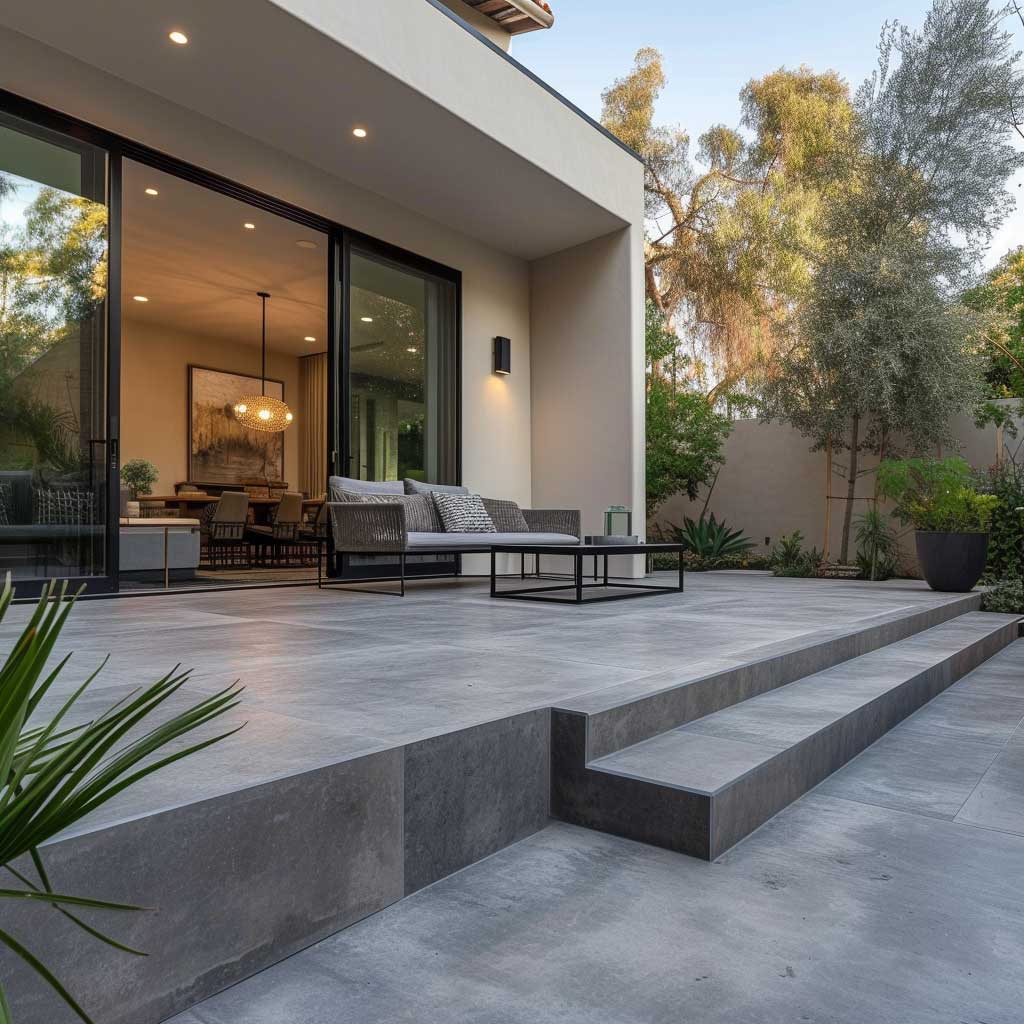
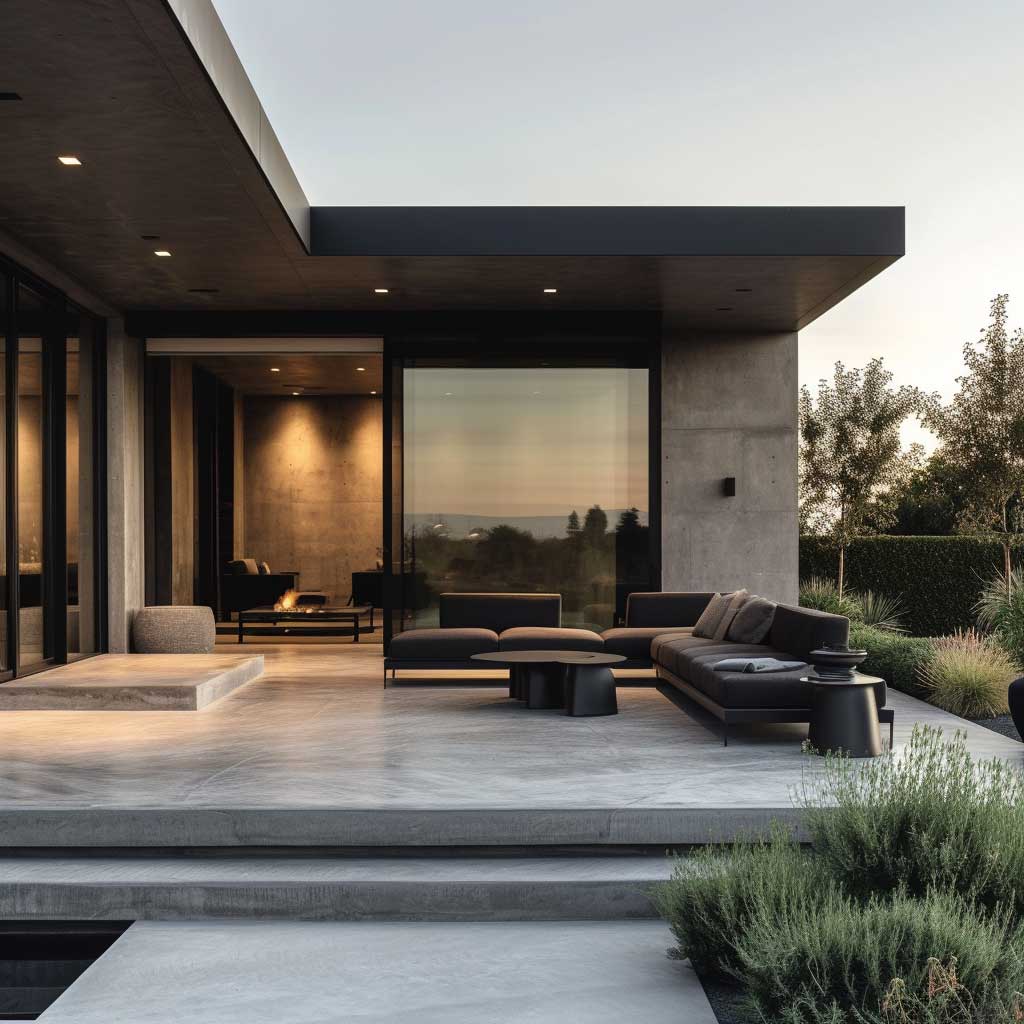
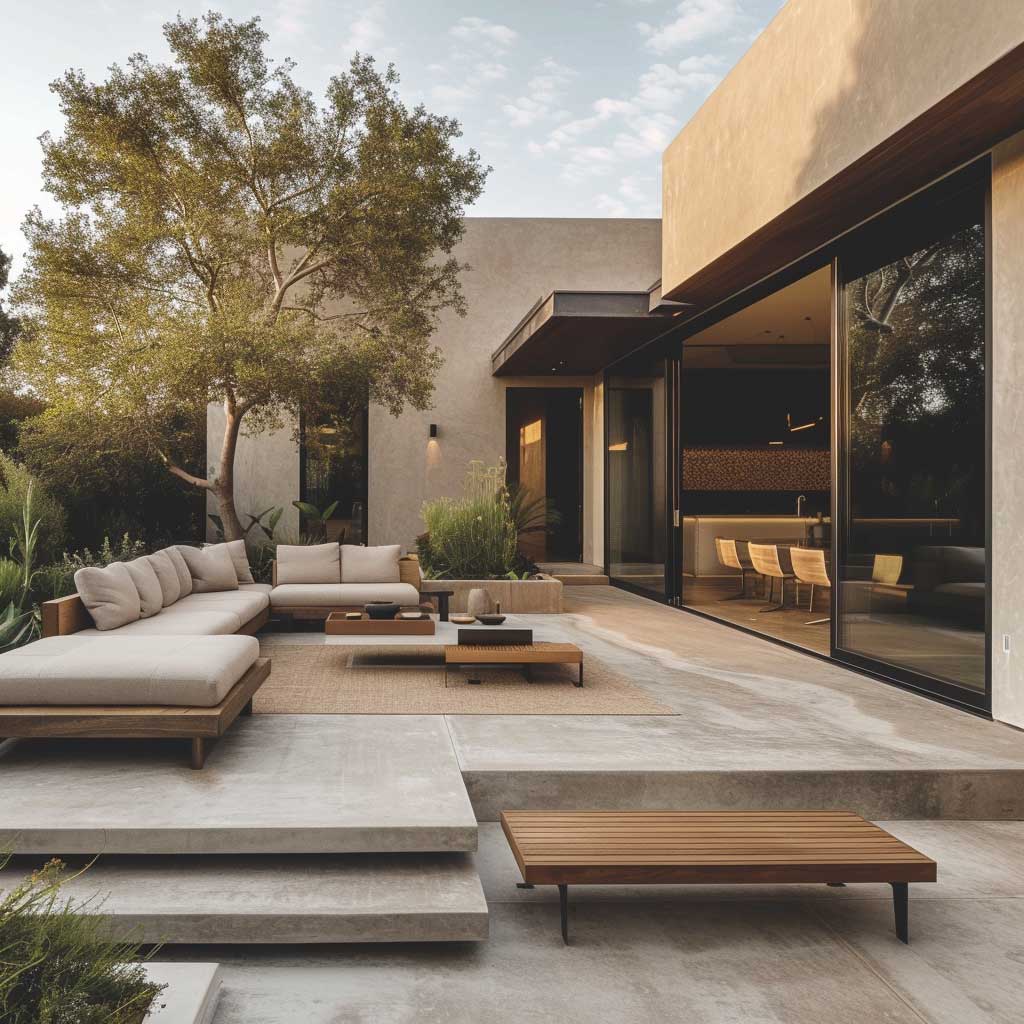
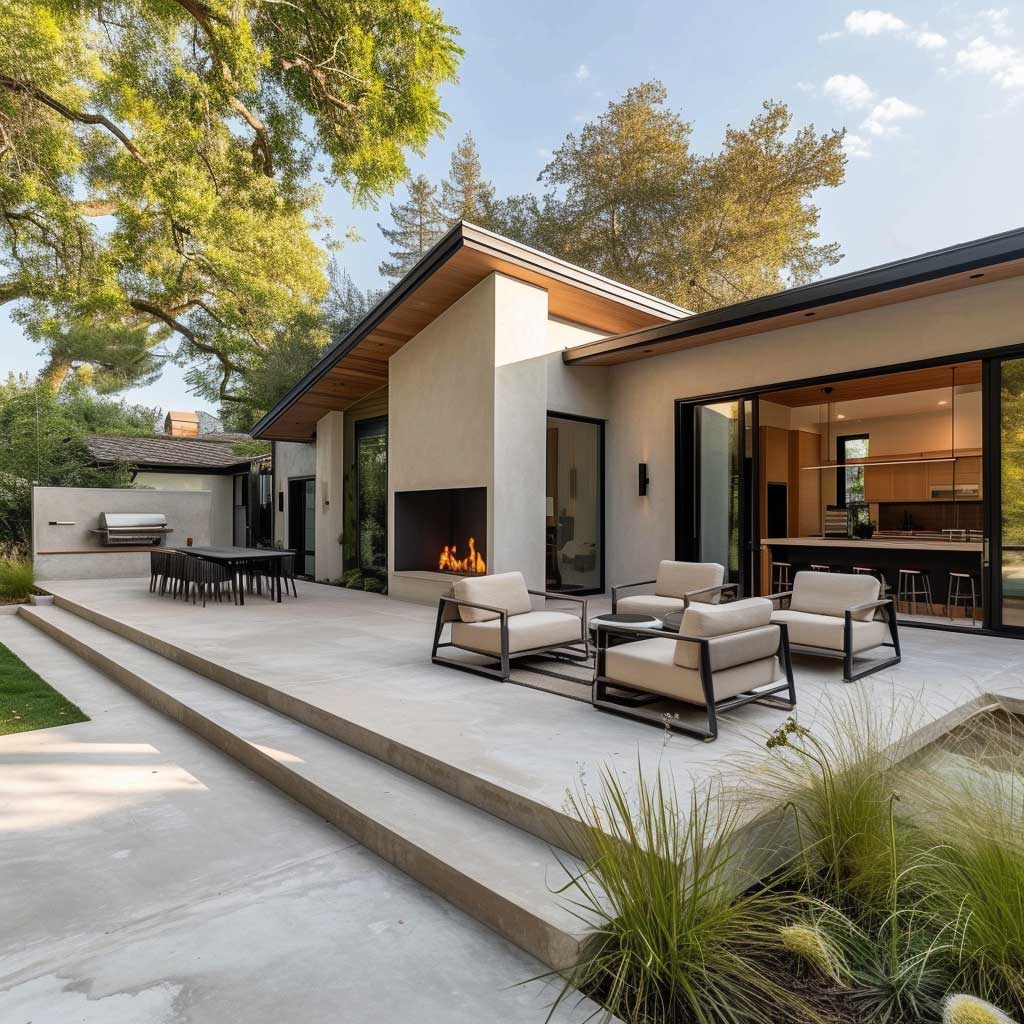
Planters on a minimalist concrete patio should be tall cylinders or rectangular troughs — never terracotta urns or anything with decorative lips. Serralunga’s Luppo planter (~$220) in white or anthracite works. Plant it with a single ornamental grass species, not a mixed arrangement. Mixed arrangements look casual; minimalism needs discipline in the plant selection as much as the furniture. One variety, clean pot, end of story.
The anti-advice here: don’t plant a border of lavender along the concrete edge. Everyone does it. It reads as a default choice, goes woody and ragged by year three, and softens the line you’ve worked to create. If you want that concrete-meets-nature effect, try Carex ‘Evergold’ in a tight row — cleaner, less expected, and it stays tidy year-round.
Rustic Styling on Concrete Without the Farmhouse Cliché
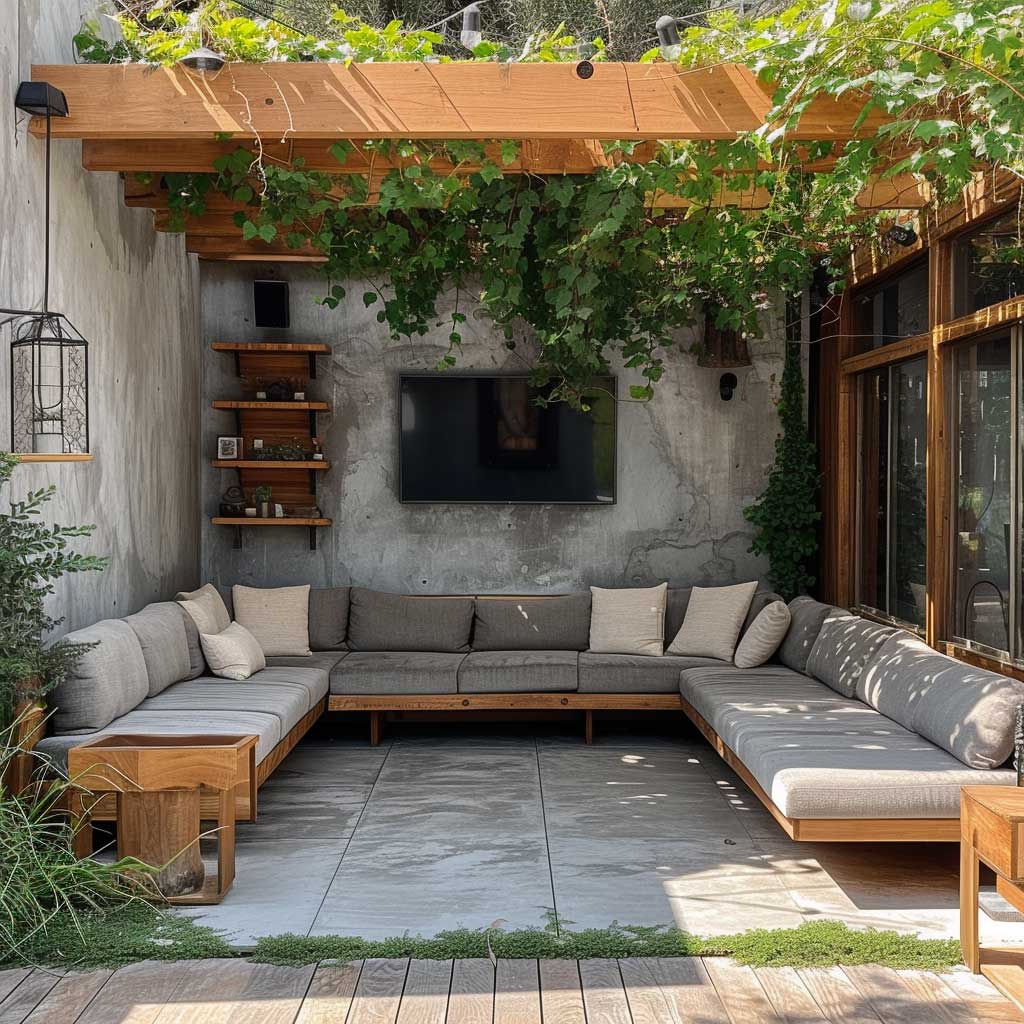
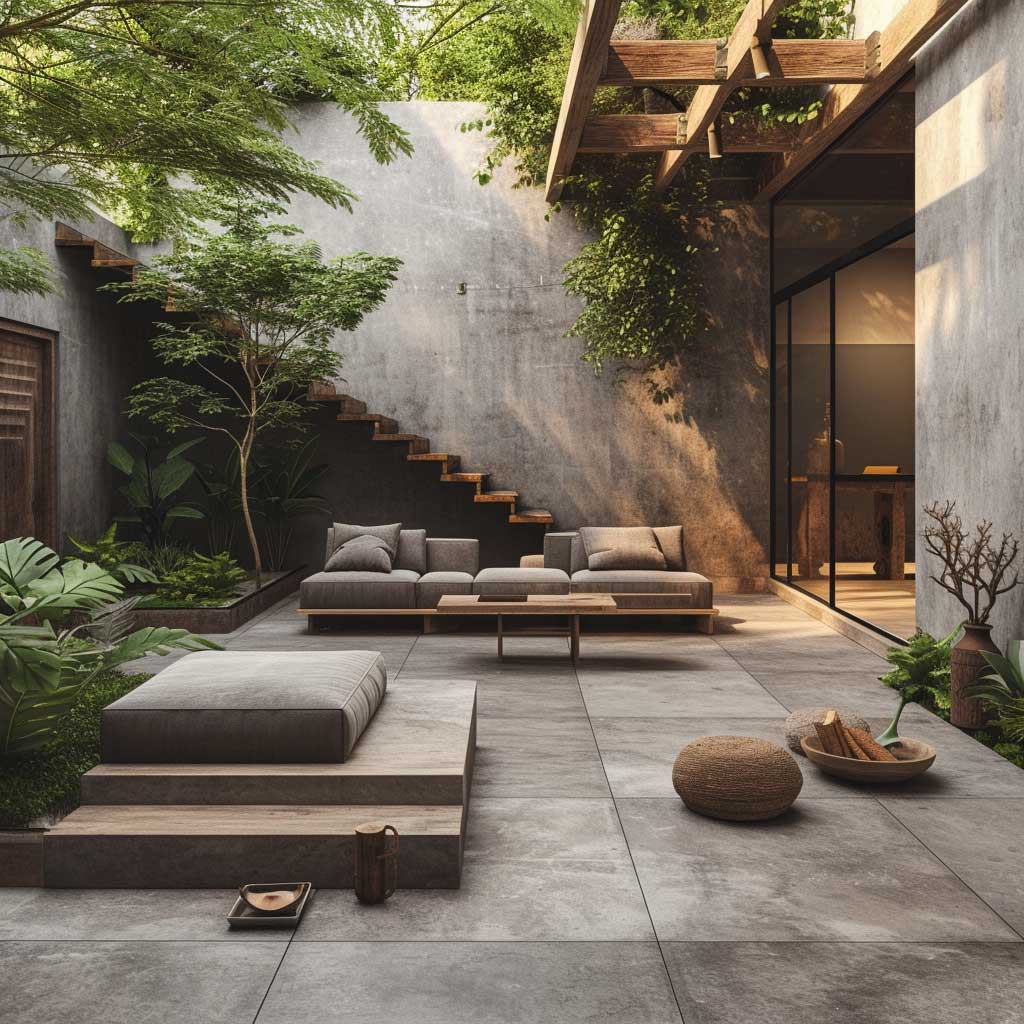
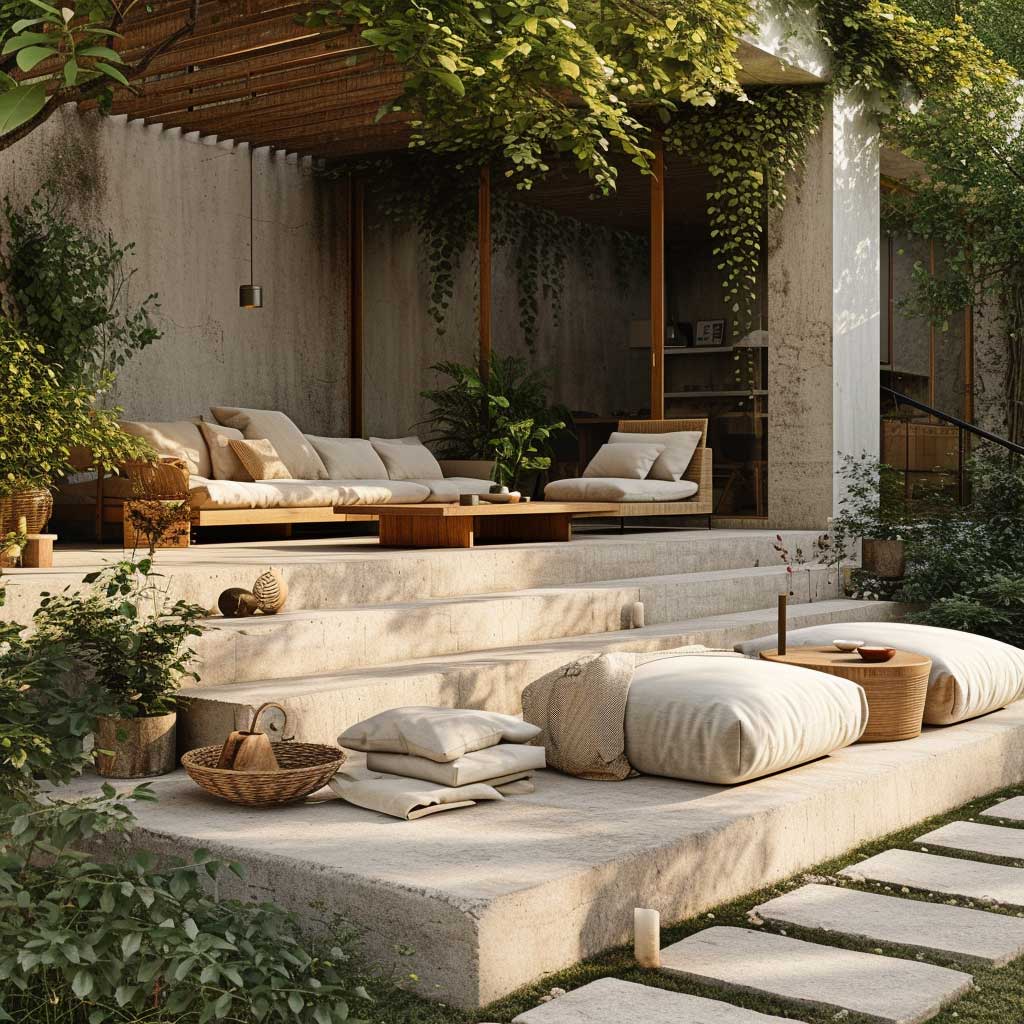

Rustic and concrete sounds like a contradiction — one material is raw and industrial, the other is aged and organic. That tension is exactly what makes it work when you do it right. I stole this trick from a garden designer in Austin: leave the concrete slightly rough-brushed rather than smooth, use a darker aggregate for a sand-and-stone tone, and the slab stops reading as man-made. It reads as ground. The furniture you put on it does the rest of the aesthetic work.
Teak and wrought iron are the workhorses of rustic patio furniture. Teak weathers to a silver-grey that pairs beautifully with concrete — no staining or oiling needed if you want that aged look. Barlow Tyrie makes good teak at the $600–$2,000 range per piece; their Monaco table has held up in my friend’s Texas backyard for nine years without warping. Wrought iron adds weight and permanence. It does not blow over in wind. That matters more than you’d expect.
Soft furnishings lift the whole composition. Cushions in terracotta, ochre, or deep forest green — not beige, never beige — signal warmth without competing with the concrete. Sunbrella fabric is the only brand worth buying for outdoor cushions: $35–$70 per yard, fade-resistant, mildew-resistant, and it cleans with soap and water. Avoid cushions with too much pattern; the patio surface already has texture from the concrete finish.
What doesn’t work: mixing too many eras. A wrought iron table, wicker chairs, mason jar lights, AND reclaimed barn-wood side tables all at once turns the patio into a prop room for a country music video. Pick one material as the lead — say, weathered teak — and let everything else support it. Simplicity is the actual principle behind rustic style, even if the aesthetic looks layered from the outside.
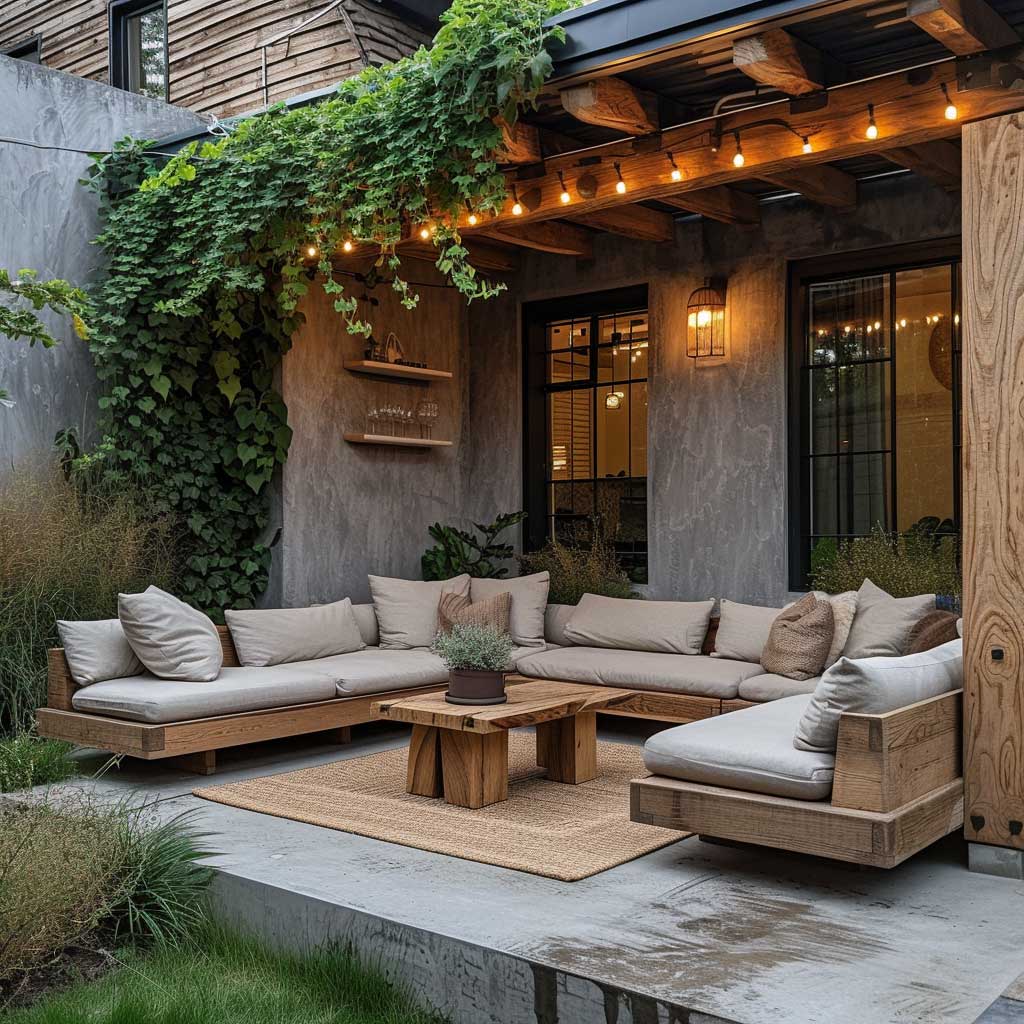
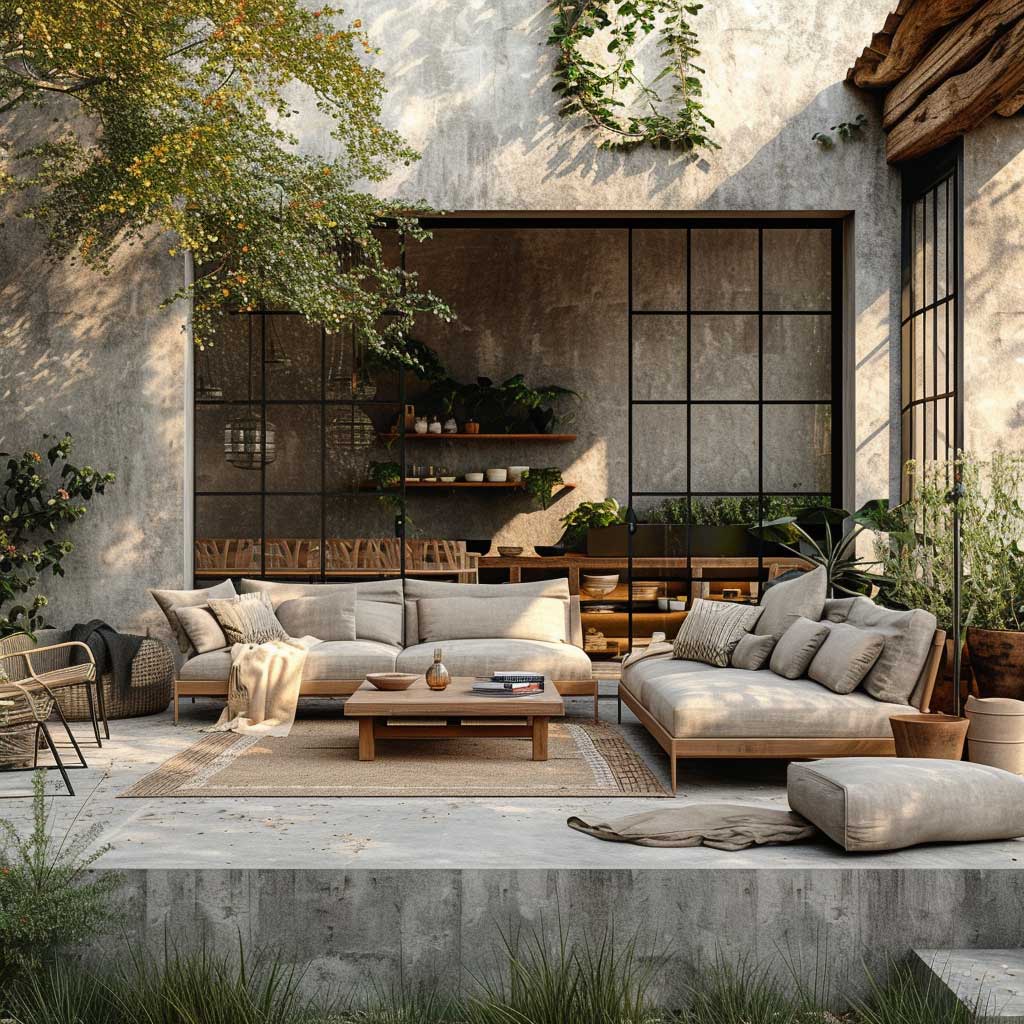
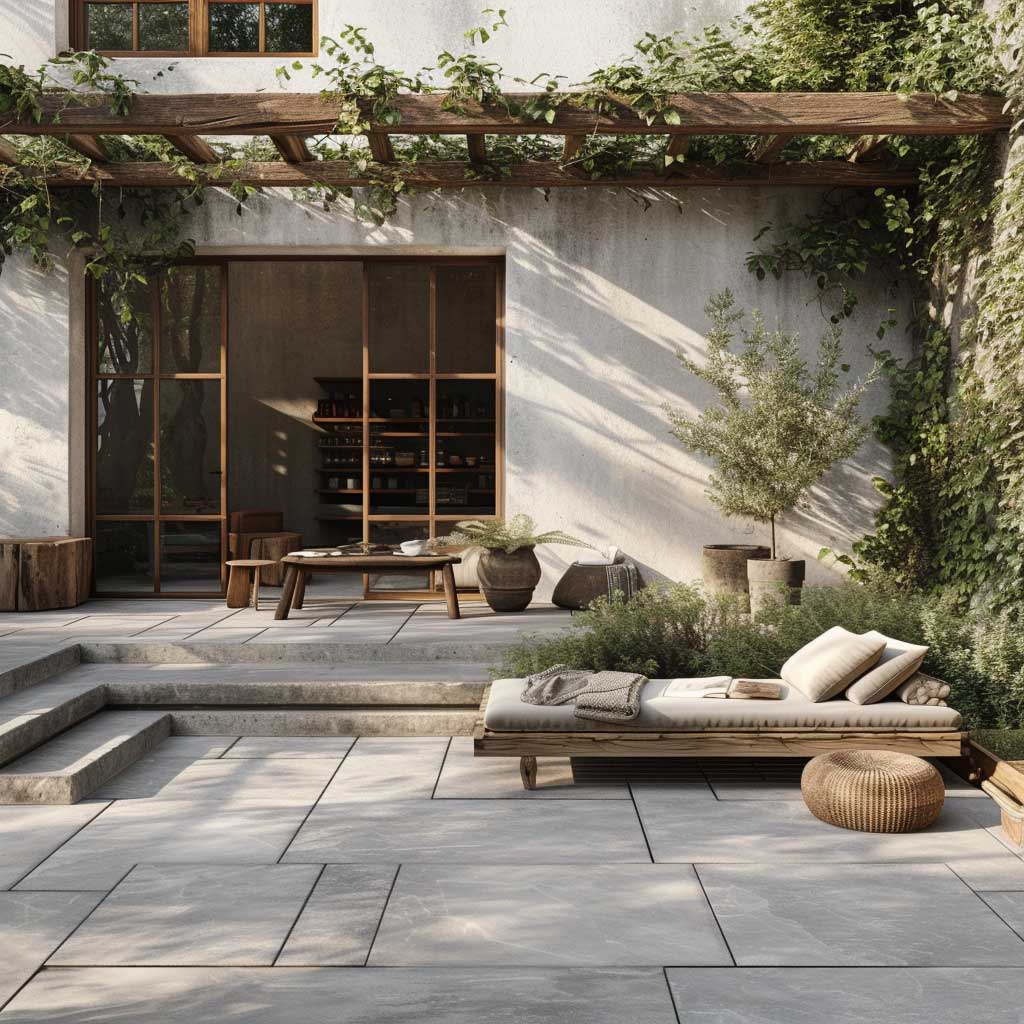
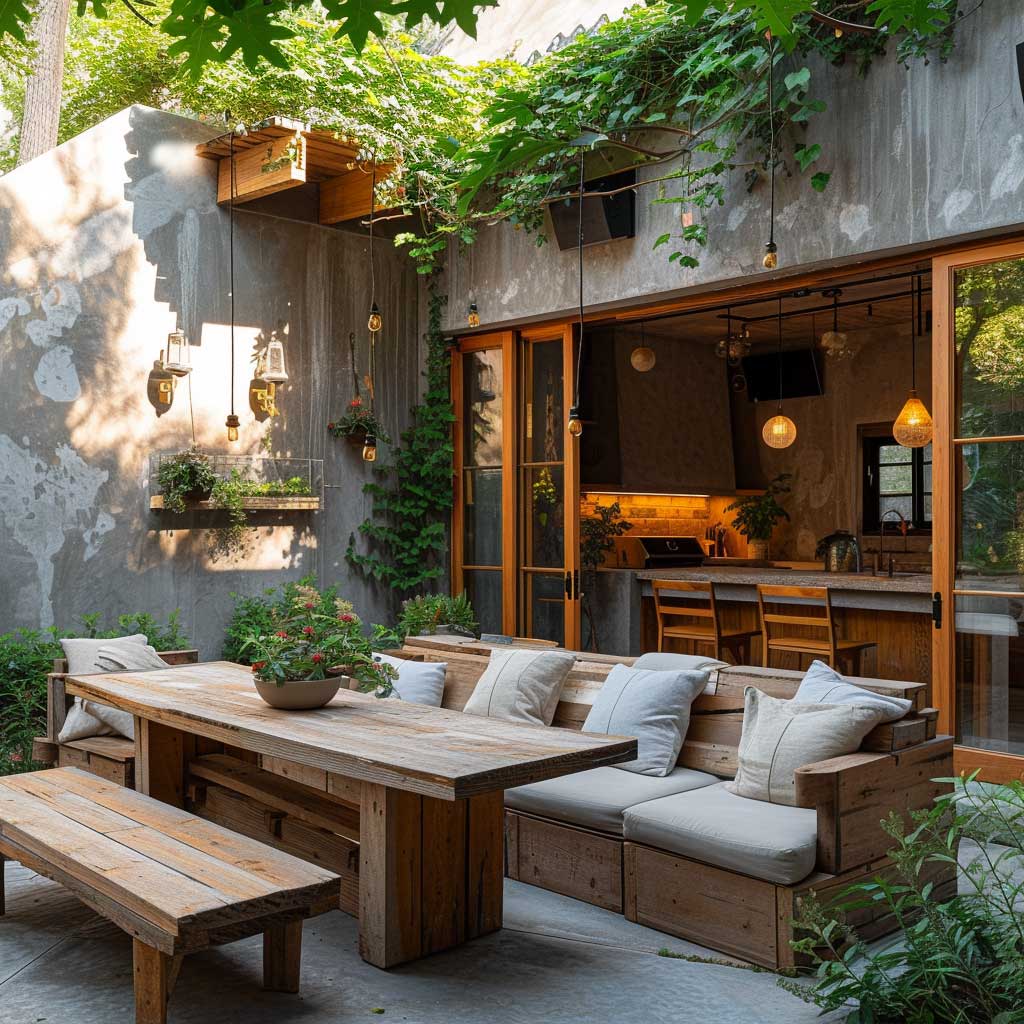
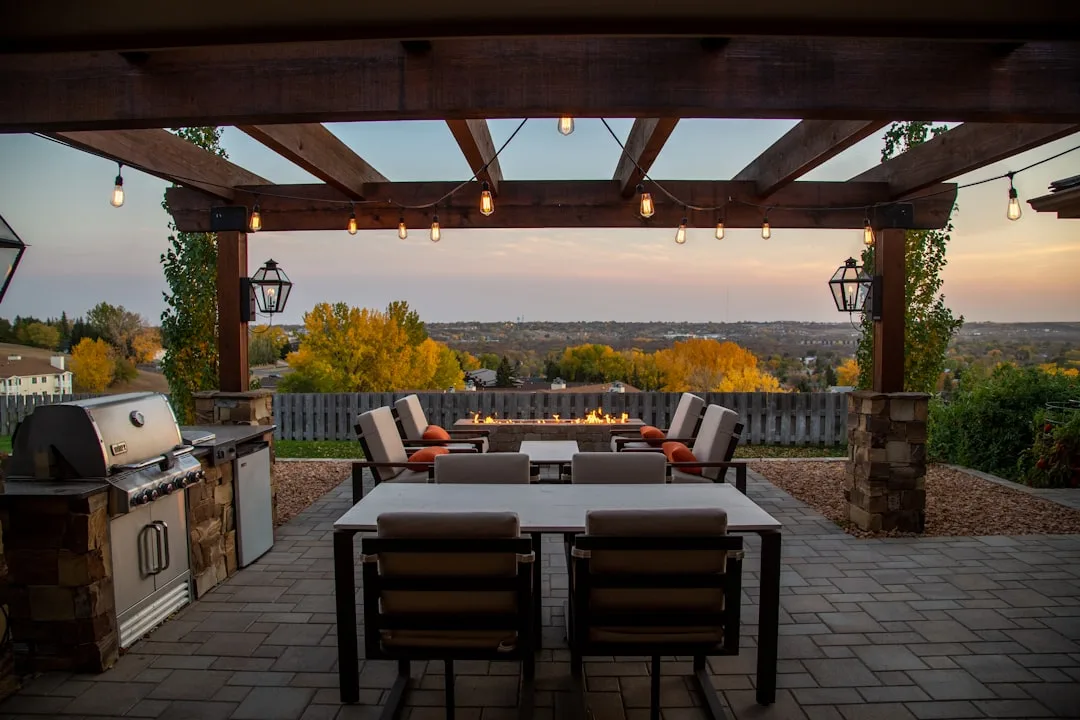
Lighting a rustic concrete patio: Edison bulb string lights on a wire between two posts is the classic move, and it still works because it works. Hang them at 8–9 feet, not lower — lower looks like a bar patio. Around $40–$80 for a quality strand from Brightech or Feit Electric. Add two or three wrought iron lanterns at ground level for the secondary layer. Candles in mason jars are fine as occasional accents; as a primary light source they’re a fire hazard and a cliché.
For internal links on rustic-meets-landscape themes: you’ll find complementary patio styling ideas at artfasad.com’s garden patio privacy post — especially useful if you want to screen the concrete slab from neighbors without installing a full fence.
Don’t Do This
Don’t pour concrete directly onto unprepared ground and expect it to last. Skipping a 4-inch compacted gravel base is the single most common cause of slab cracking — and it shows up 12–18 months in, not immediately. By then your patio furniture is on it and the repair is $800 minimum. The gravel layer adds maybe $150–$300 to a standard 12×16 slab pour. Pay it.
Don’t seal a new slab before it’s fully cured. Concrete needs 28 days to reach full strength. Sealing at day 3 — which contractors who are rushing will push — traps moisture and causes surface flaking within a season. Ask for a curing compound application first, then seal at the 28-day mark with a penetrating silane-siloxane sealer like Ghostshield Lithi-Tek 4500.
Don’t choose an acid-stained color from a small chip sample. Acid stain on concrete varies dramatically by slab batch, aggregate composition, and moisture level. Always ask for a 12×12 test patch on your actual slab before committing to a colour for the full surface.
Landscaping a Concrete Slab Patio So the Hard Edge Disappears
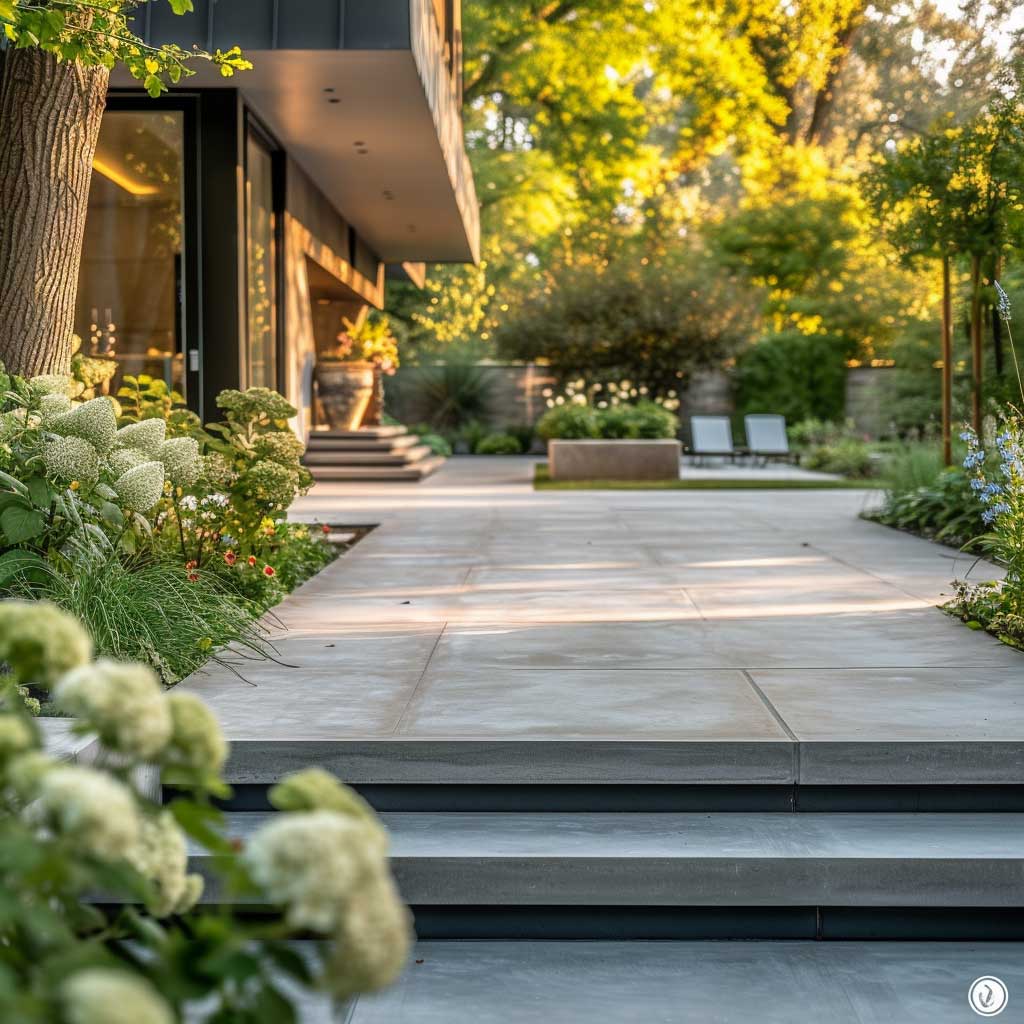
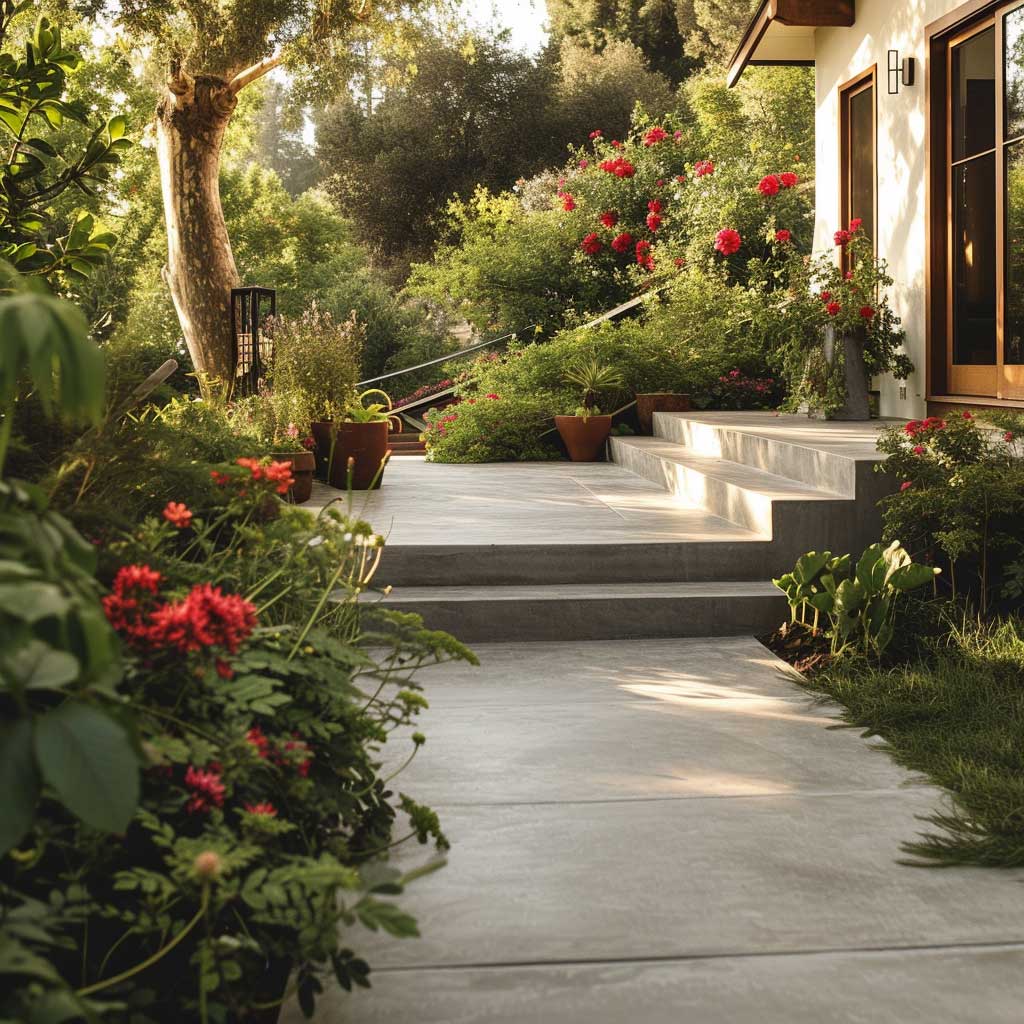
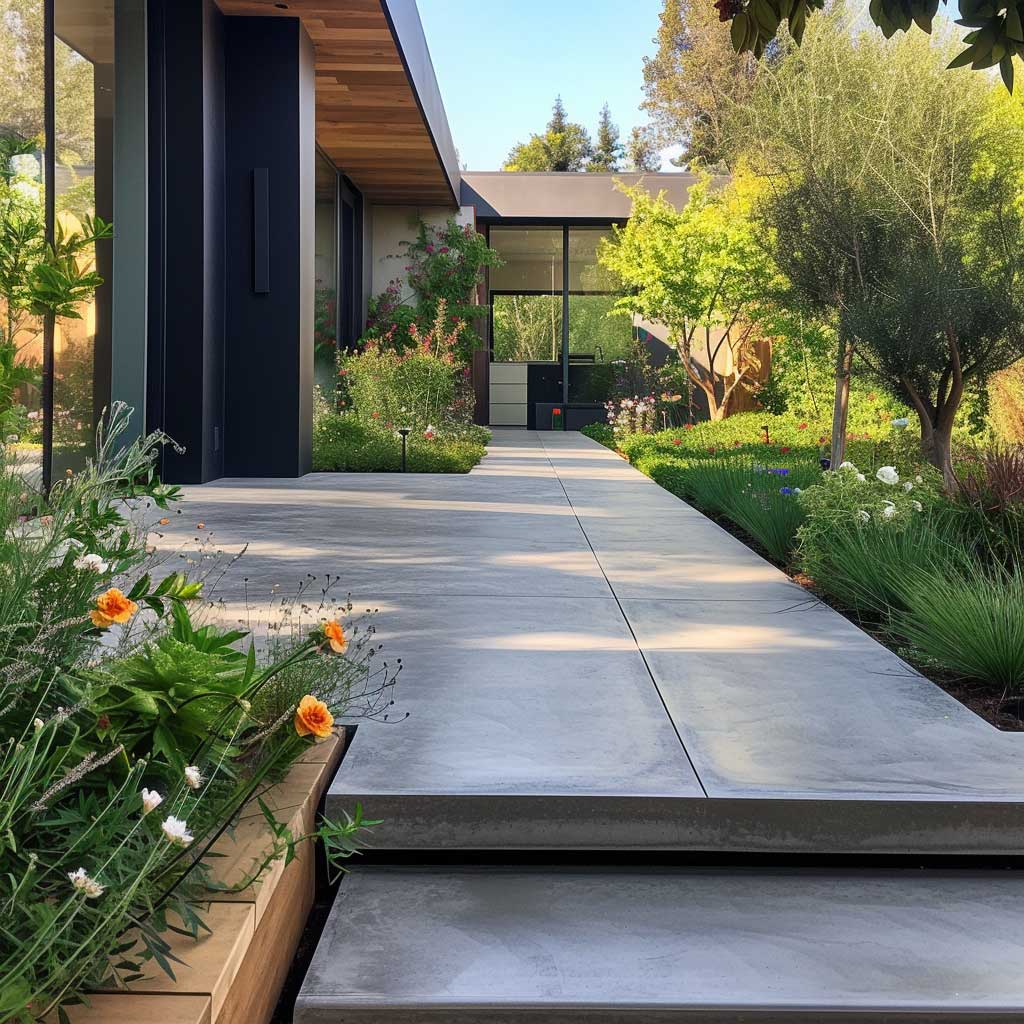
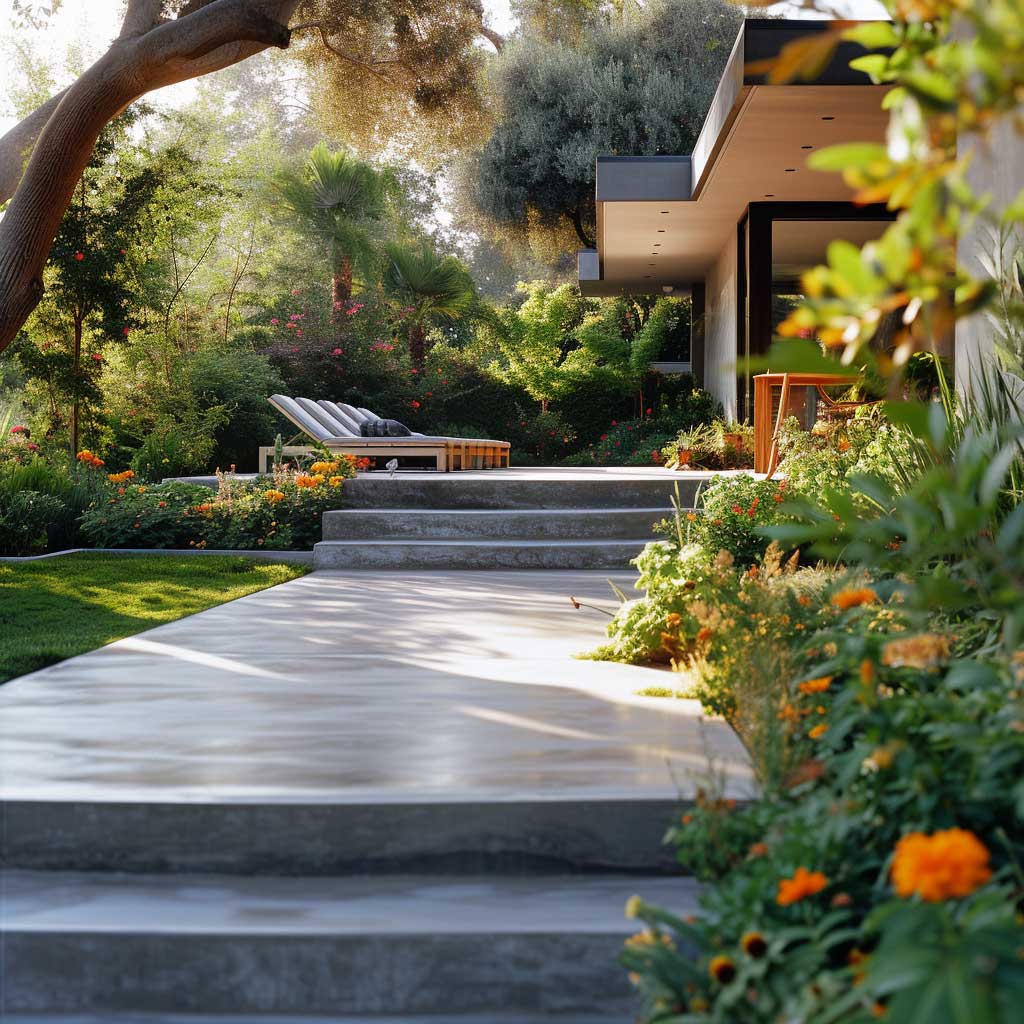
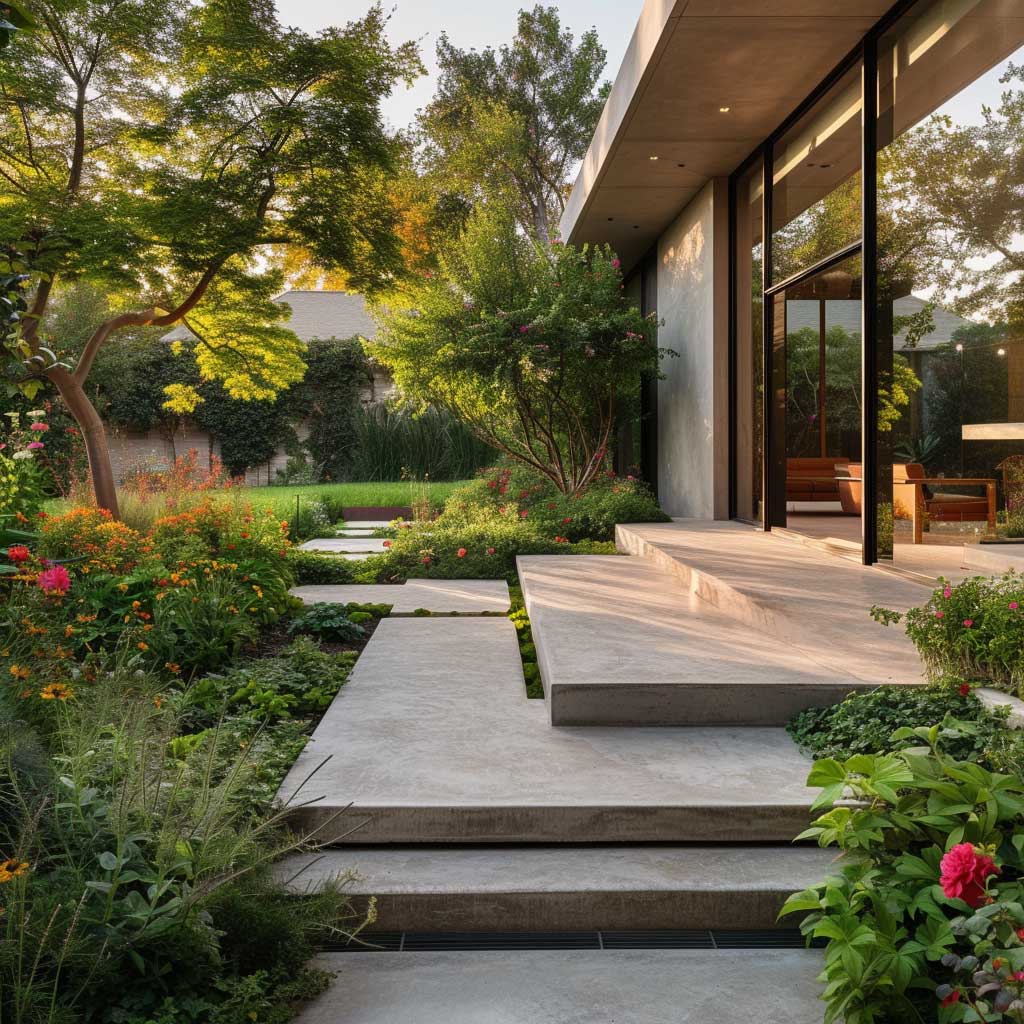
The concrete edge is the problem. A slab that terminates abruptly into lawn reads as unfinished — like a floor tile laid into a field. The landscaping’s job is to dissolve that boundary. Think of it as picture framing: the plants aren’t decoration around the patio, they’re the transition zone between constructed and natural. Get that zone right and the concrete stops looking like concrete and starts looking like a deliberate design decision.
Creeping thyme between concrete expansion joints is a detail worth stealing from Mediterranean garden design. It costs almost nothing — flat of thyme runs $15–$25 — and by year two it’s self-seeding into every crack. It releases fragrance when you walk on it. It crowds out weeds without herbicide. I’ve used it twice; it outlasted two sets of furniture on the same patio. The only catch: it needs full sun. In shade, try Mazus reptans instead.
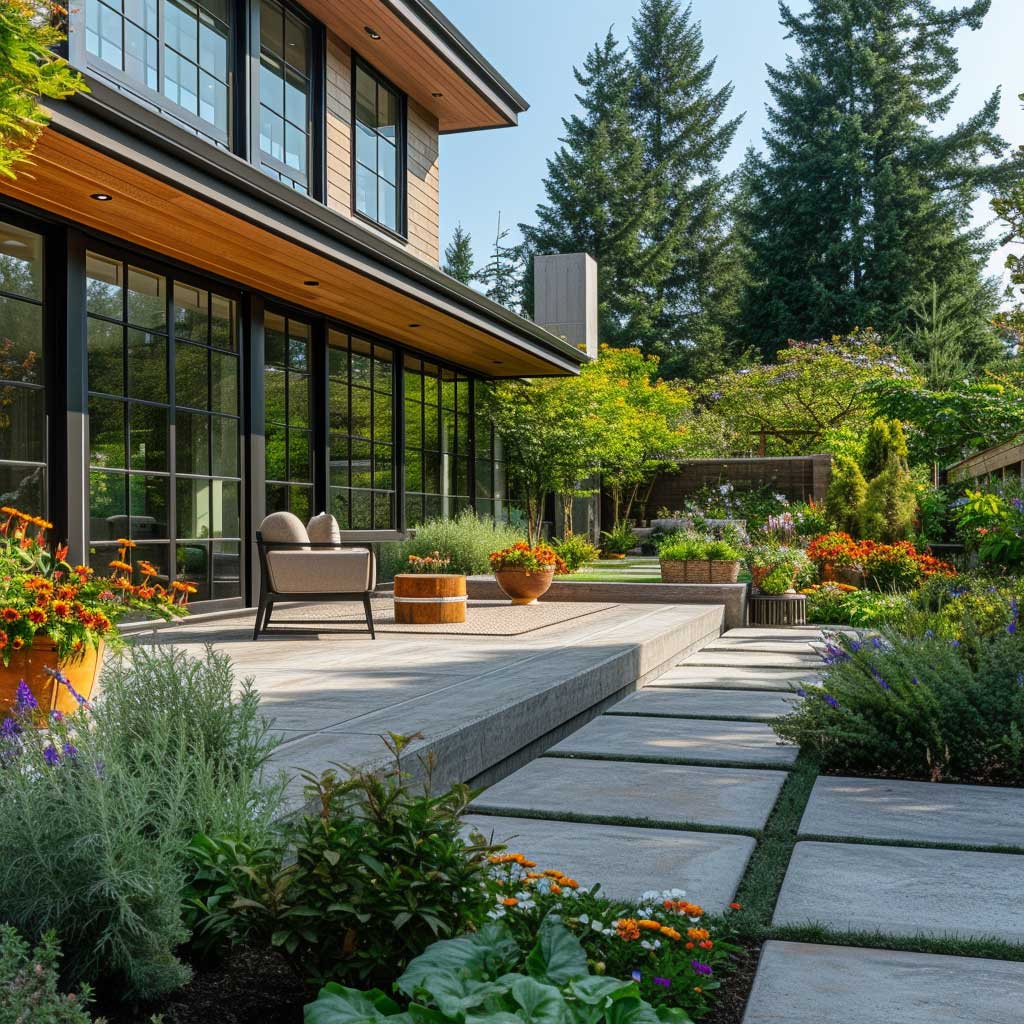
For the border beyond the slab edge, layer by height rather than by season. Back layer: ornamental grasses (Miscanthus sinensis ‘Morning Light’ at 4–5 feet works for a windscreen effect). Middle layer: a flowering perennial in one colour — Russian sage, echinacea, or agapanthus depending on your climate. Front layer: a low-growing ground cover that spills slightly onto the concrete edge. The layering is exactly like arranging bookshelves — the tallest things go in the back and the eye travels forward.
For a deeper look at how to pair plants with hardscaping in a minimal, low-maintenance way, this backyard landscaping post covers species selection and spacing for different climate zones — worth reading before you commit to a planting plan.
Water features near a concrete slab patio are underrated for small backyards. A compact solar-powered fountain — the Sunnydaze 20-inch Cascading Bowl runs about $80 and doesn’t need an electrician — adds sound that masks traffic or neighbor noise. Position it at the far corner of the slab rather than the centre; centre placement eats the usable space and crowds the furniture arrangement. Corner placement anchors the patio visually without taking up the area you actually sit in.
Lighting through the landscaping does different work than lighting on the slab itself. Landscape spotlights angled up at ornamental grasses create movement — the blades catch the light differently in every breeze. Kichler’s 15W LED landscape spot (~$35 each) with a warm 2700K bulb is the right tool. Cool white spotlights make plants look bleached. Use warm white exclusively in the garden zone, and let the cooler patio lighting contrast it. You’ll notice the patio reads as a separate, intentional room as a result.
The mistake I keep seeing: covering the entire border around a concrete slab with river rock mulch. It’s low-maintenance, yes. It also looks like a gas station median. If maintenance is the real concern, use a weed barrier under a 2-inch layer of fine bark mulch — it biodegrades, looks considered, and actually suppresses weeds. Replace it every two years for about $30 per 100 sq ft. Better outcome, lower visual cost.
Small Concrete Patio Slab Proportions and the 10×10 Problem
Small modern concrete patio ideas run into a proportions problem almost nobody mentions: a 10×10 slab feels like a landing pad, not a destination. You step out the back door and you’re already at the edge. The fix isn’t always pouring more concrete — sometimes it’s furniture scale and sightlines. A small concrete patio that’s properly furnished at the right scale reads larger than a bigger one that’s overfilled.
Scale rule for small concrete patio ideas on a budget: use one fewer furniture piece than you think you need. I have a 12×12 slab off my kitchen. Two chairs, one side table, one small planter. That’s it. The open concrete is doing 40% of the aesthetic work. Every time I’ve been tempted to add a bistro table or an extra chair, the space collapses from garden patio to junk patio. Restraint is the skill.
For small cement patio ideas where budget is the primary constraint, a plain poured slab at $4–$7 per square foot beats pavers at every level — cost, durability, and ease of cleaning. A 12×12 slab runs $576–$1,008 installed for a basic rectangular pour. You can stain it later with a water-based concrete stain (H&C Concrete Stain runs $35–$45 per gallon, covers 200–300 sq ft per coat) and it transforms completely without a jackhammer or a contractor. That’s the upgrade path for budget-first projects. Check out these concrete patio design styles for finish and colour options across different backyard sizes.
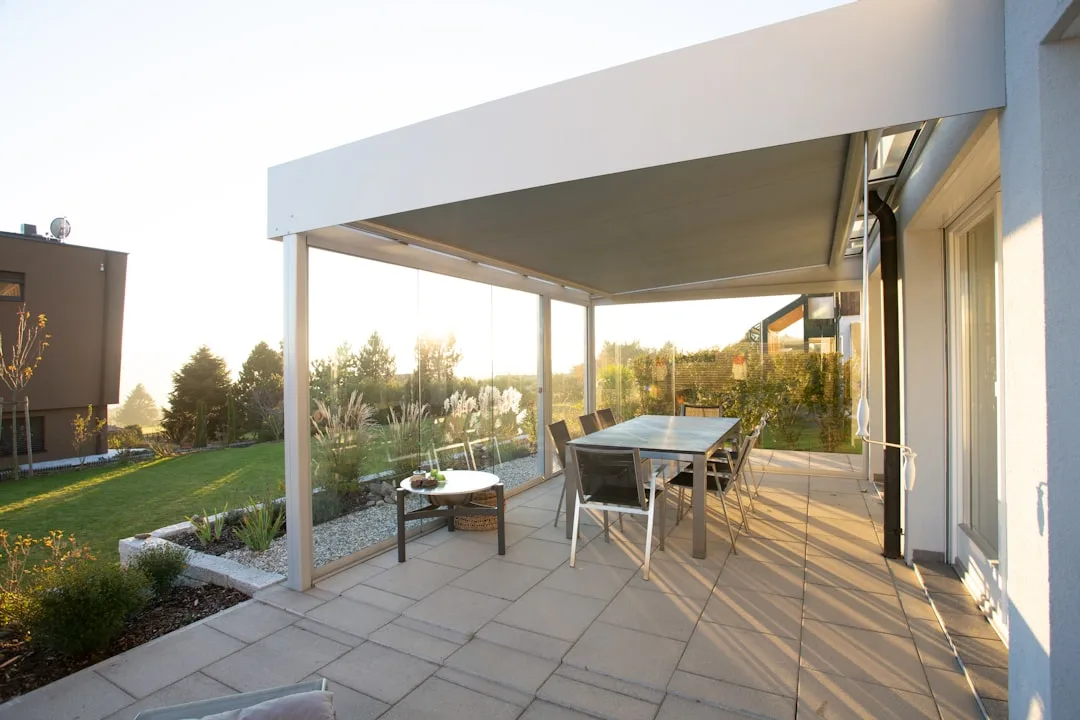
Vertical elements rescue small concrete patios from feeling like paved afterthoughts. A pergola over a 10×12 slab — pressure-treated lumber kit from Home Depot starts at $700 — instantly creates a room. The moment there’s a ceiling reference above a patio, however open, the brain registers it as an interior space. That psychological shift is more powerful than any furniture arrangement. Add one climbing plant at the base — Clematis ‘Jackmanii’ is fast and forgiving — and within two seasons the structure looks like it was always there.
Concrete Patio Surface Comparison
| Surface Type | Cost per sq ft | Maintenance | Best For |
|---|---|---|---|
| Plain broom-finish slab | $4–$7 | Seal every 3–5 years | Budget builds, any style |
| Acid-stained slab | $7–$12 | Reseal annually | Rustic or earthy palettes |
| Stamped concrete | $10–$18 | Reseal every 2–3 years | Stone or brick mimicry |
| Polished / ground finish | $9–$20 | Reseal every 1–2 years | Minimalist, covered patios |
| Exposed aggregate | $8–$16 | Seal every 2–3 years | Slip resistance, texture interest |
For a broader look at how concrete patios compare to other outdoor flooring options, This Old House’s concrete patio ideas overview covers regional cost variations and climate considerations that affect finish selection — useful if you’re in a freeze-thaw zone where the wrong sealer can destroy a slab in two winters.
Before You Pour
A Concrete Slab Patio Is Only as Good as Its First 28 Days
The design decisions — finish, furniture, plants — happen after the pour. But the pour is where patios succeed or fail. Get the gravel base, the rebar grid, and the curing time right and you’ll have a slab that outlasts every material that costs more.
Plain concrete with the right landscaping and disciplined furniture choices beats a stamped patio with overcrowded styling every time. The material is not the limitation. The room you give it to work is.
Save this post — come back when you’re at the furniture and plant stage and you’ll see why the sequencing matters.
Related Topics
FAQ
What is the cheapest concrete slab patio option for a backyard?
How do I make a plain concrete slab patio look modern?
What plants work best around a concrete slab patio?
How often does a concrete patio slab need to be sealed?
Can I build a small patio on a concrete slab without a pergola?
What is the difference between a concrete slab and a stamped concrete patio?
Complete guide
Patio and Yard Ideas That Turn Any Backyard Into a Living Room Outside
Flooring, furniture, shade, pools, kitchens, fire pits, courtyards — all in one place