Burnt orange and navy blue sit directly opposite each other on the colour wheel, which means pairing them creates the maximum visual contrast colour theory allows — the same principle behind why sports teams love orange-and-blue kits. Translated into autumn clothing, that contrast becomes something quieter and far more useful: a warm-season palette that photographs well, layers naturally, and holds its own against October light.
Navy acts as the anchor in this pairing. Its cool depth absorbs the energy of burnt orange, preventing the combination from reading as too loud. That dynamic is why stylists recommend building these outfits with navy as the dominant piece — coat, blazer, or tailored trouser — and letting orange arrive as the warmer accent.
The three looks below cover the full range: a relaxed weekend outfit, a dressed-up evening option, and a sharp workwear approach. Each one treats the colour ratio differently, so you can see exactly how much orange is enough and when it tips over into costume territory.
– Navy and burnt orange are complementary colours — they enhance each other’s vibrancy rather than competing
– Use navy as the dominant piece (at least 60% of the outfit) with burnt orange as the accent for the most polished result
– Plaid pants in navy translate the combination to a casual register without losing sophistication
– A navy trench coat over an orange dress is the strongest way to wear the pairing to an evening event
– A burnt orange scarf over a navy blazer is the lowest-risk entry point — and the easiest to test at the office
Navy Plaid Trousers Pull a Burnt Orange Sweater Into Outfit Territory
A burnt orange sweater and navy blue plaid trousers is one of the cleaner expressions of this colour pairing because the plaid introduces navy as a pattern rather than a solid, which softens the contrast just enough. H&M’s cable-knit burnt orange sweater in a 50% wool, 50% polyamide blend retails for $109 and hits exactly the right depth of tone — not too red, not too rust — to read as genuinely autumnal. Avoid oversized knits here. A chunky silhouette over tailored plaid pants creates a proportion problem that no belt will fix.








What makes navy blue plaid work specifically — rather than plain navy trousers — is the tonal variation in the pattern. The plaid introduces lighter navy threads alongside darker ones, which gives the eye more to read and prevents the lower half of the outfit from turning into a heavy block of colour. Structured, straight-cut or wide-leg fits work best: they balance the weight of a knit without looking shapeless. What doesn’t work is skinny navy trousers, which turn the silhouette into an inverted triangle. Can you wear dark jeans instead of plaid trousers? Yes, but the look drops from considered to default.
Black loafers are the correct shoe here, not brown. Brown would introduce a third warm tone alongside the orange and muddy the overall read. Loafers land the look in smart-casual territory; ankle boots push it slightly dressier. A small structured crossbody in black or dark tan handles the bag. The trick is keeping everything below the waist dark enough that the burnt orange sweater stays as the single colour statement. For more autumn outfit combinations built around warm tones and earthy palettes, see cozy autumn outfit ideas with burgundy and mustard accents.


A Navy Trench Coat Gives a Burnt Orange Dress Somewhere to Land
Navy and burnt orange in outfits reach their most formal expression when a navy trench coat layers over a burnt orange dress — the coat providing the cool structure, the dress underneath supplying the warmth. Zara’s short flowy navy trench in the ZW Collection, currently reduced to $47.60 from $119, is made from 89% lyocell and drapes rather than stiffens, which means it works over a flowing dress without creating a boxy silhouette. The lyocell construction is worth noting: it won’t trap moisture the way a fully synthetic coat would, which matters for the in-between temperatures of early autumn.


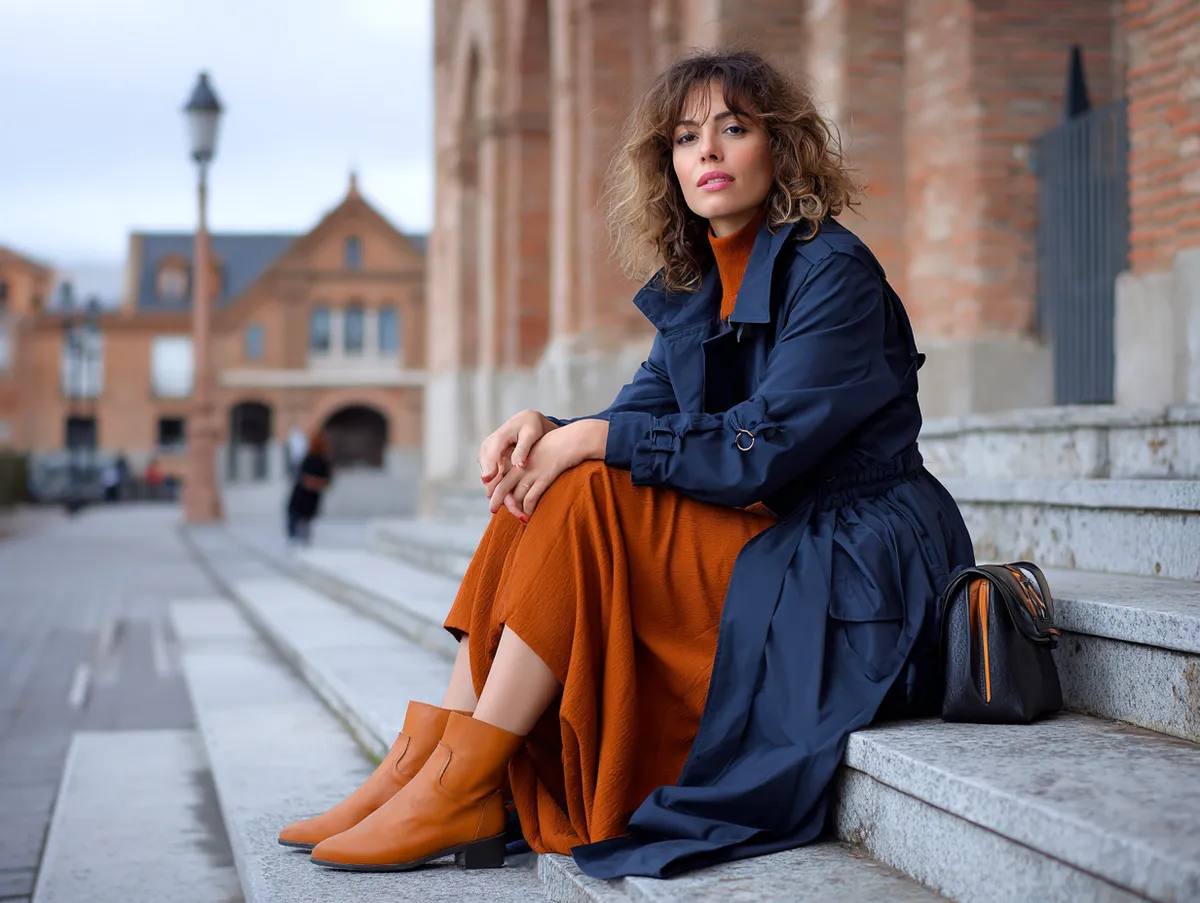


The dress length matters more than most people realise. A knee-length or midi dress lets the coat hem sit above it — that small gap of orange fabric at the bottom is what makes the pairing visible and intentional rather than just a navy coat over something underneath. If the dress and coat hit the same length, the contrast disappears. Avoid orange dresses in silk or satin for daytime; they read as too formal and the sheen competes with the structured coat above it. A matte jersey or crepe finish keeps the colour as the focus.
Heeled ankle boots in dark tan or cognac bridge the two tones without introducing black, which would cool the outfit down more than necessary. A wide-brimmed hat in camel or oatmeal adds overhead structure and takes the combination from dressed up to genuinely finished. Do navy blue and orange go together for evening? Yes — but only if the orange is muted enough. Bright traffic-cone orange against navy reads as costume; the red-brown warmth of true burnt orange reads as season.


Wearing a navy coat over a bright orange dress with matching orange shoes and bag. The moment you add orange accessories to an already orange dress, the colour is everywhere and the navy reads as an afterthought. The rule is simple: if the dress is orange, the shoes and bag should not be. Stick to cognac, tan, or black below the hem to let the coat-and-dress contrast do all the work.
What a Burnt Orange Scarf Does to a Navy Blue Blazer Outfit
Burnt orange and navy blue outfits in a work context live and die by proportion, and the scarf-and-blazer combination handles that better than almost any other approach. A navy blazer carries enough visual weight to anchor the look, while a burnt orange scarf introduces the colour through roughly 10–15% of the visible outfit — close to the 60-30-10 colour rule that stylists recommend for well-balanced dressing. This works because the scarf is removable; you can calibrate how much orange the situation calls for before you walk through the door.






Dark-wash straight-leg jeans ground this outfit without introducing a third tone. They read as neutral in this context — close enough to navy to support the blazer, far enough from it not to clash. Try this: hold your jeans up next to your navy blazer before wearing them together. If the wash is so light it looks washed-out or so dark it matches exactly, the combination won’t work. A medium indigo that sits one or two shades lighter than the blazer is the target. Tan ankle boots at the hem add the one warm note below the waist that ties back to the scarf overhead — a small detail that makes the outfit feel resolved rather than assembled.
Does orange go with navy blue at the office? It does when orange arrives through an accessory rather than a main piece. A cashmere or wool-blend scarf in burnt orange adds warmth and visual interest without signalling anything other than considered dressing. What doesn’t work is a bright orange blazer over navy trousers — the warm-cool reversal at that scale creates too much conflict and the look slides from intentional to accidental. Keep orange as the supporting tone and let navy carry the outfit. For more autumn-season layering approaches that use the same principle of warm accents over cooler base pieces, see fall flannel shirts with high-waisted trousers.


| Look | Navy Piece | Orange Piece | Key Risk |
|---|---|---|---|
| Weekend casual | Navy plaid trousers | Burnt orange knit sweater (~$109) | Oversized knit creates poor proportions |
| Evening / event | Navy trench coat (~$47–$119) | Burnt orange midi dress | Dress and coat same length hides contrast |
| Work / smart casual | Navy blazer | Burnt orange scarf | Bright orange (not burnt) reads as costume |
Colour theory explains why navy and burnt orange sit so naturally together — they are complementary colours, sitting directly opposite each other on the colour wheel. For a deeper look at how this relationship works across outfits and decor, Palette Hunt’s colour theory resource on blue combinations covers the full range of navy pairings and the proportional rules that make each one work.
The verdict
Burnt orange and navy blue work because they are designed to work — not because the season says so
Use navy as the dominant piece in at least 60% of the outfit. Burnt orange earns its place as the accent, not the base.
The trench coat and dress approach is the most striking. The sweater and plaid trouser version is the most repeatable.
Skip bright orange — the red-brown warmth of true burnt orange is what makes this pairing sophisticated rather than sporty. Save this post to come back to before your next autumn wardrobe edit.
FAQ
Do navy blue and burnt orange go together in an outfit
What is the difference between orange and burnt orange for clothing combinations
Does orange and navy blue work for a work outfit
What shoes work with navy and burnt orange outfits
Can soft autumn seasonal types wear navy blue
What colours go well with burnt orange besides navy blue
Complete guide
Fashionable Blue Outfits for Every Mood, Body and Occasion
Cobalt, navy, electric, sky, ice blue — every shade and combo in one place