Mediterranean minimalist interior design is the room that stops you in the doorway — the one where you immediately feel your shoulders drop. My go-to shorthand for it: a Greek island house that got edited by a Scandinavian. You keep the whitewashed plaster, the terracotta underfoot, the light that comes in sideways at 4 PM. You lose the clutter, the ornate ironwork, the seven patterned cushions nobody asked for. What’s left is genuinely harder to pull off than either style alone.
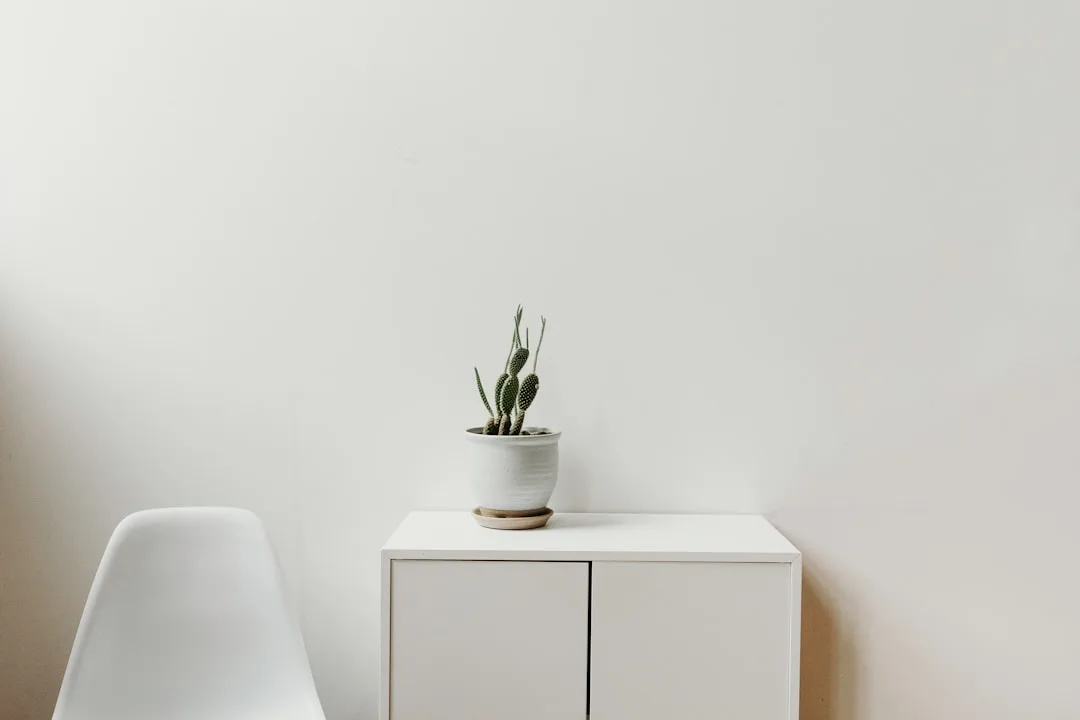
You’ll notice the difference the moment you walk into a room that got it right versus one that just has some white walls and a clay pot. The minimal Mediterranean approach is disciplined about surface count — every piece earns its place. Ikea’s KALLAX unit pushed against a whitewashed wall with a handmade ceramic bowl on top is not Mediterranean minimalism. A slab of travertine counter, one branch of dried olive in a narrow terracotta vase, and nothing else on that surface: that is. The philosophy is closer to editing than decorating.
The spaces in this post span living rooms, kitchens, and bedrooms — three rooms where the minimal Mediterranean approach performs very differently. I’ve broken each section down by what actually holds the look together, including the specific materials and price points I’ve tested or stolen from interiors I’ve sat inside for more than an hour, which is the only real quality test.
- Mediterranean minimalist living rooms: the palette is two colors, not five — whites and pale blues, nothing muddier
- Minimal Mediterranean kitchens run on stone and smooth cabinet faces; terracotta tile works only if it’s unglazed
- The bedroom case for this style is the strongest: fewer surfaces mean slower mornings and genuinely better sleep environments
- Rustic wood, wrought iron, and natural fiber are the material trio that keeps spaces from reading as cold Scandinavian rather than warm Mediterranean
- The single biggest mistake: mixing all the Mediterranean textures and colors at once, which buries the minimalist logic entirely
Serene Mediterranean Minimalist Living Rooms
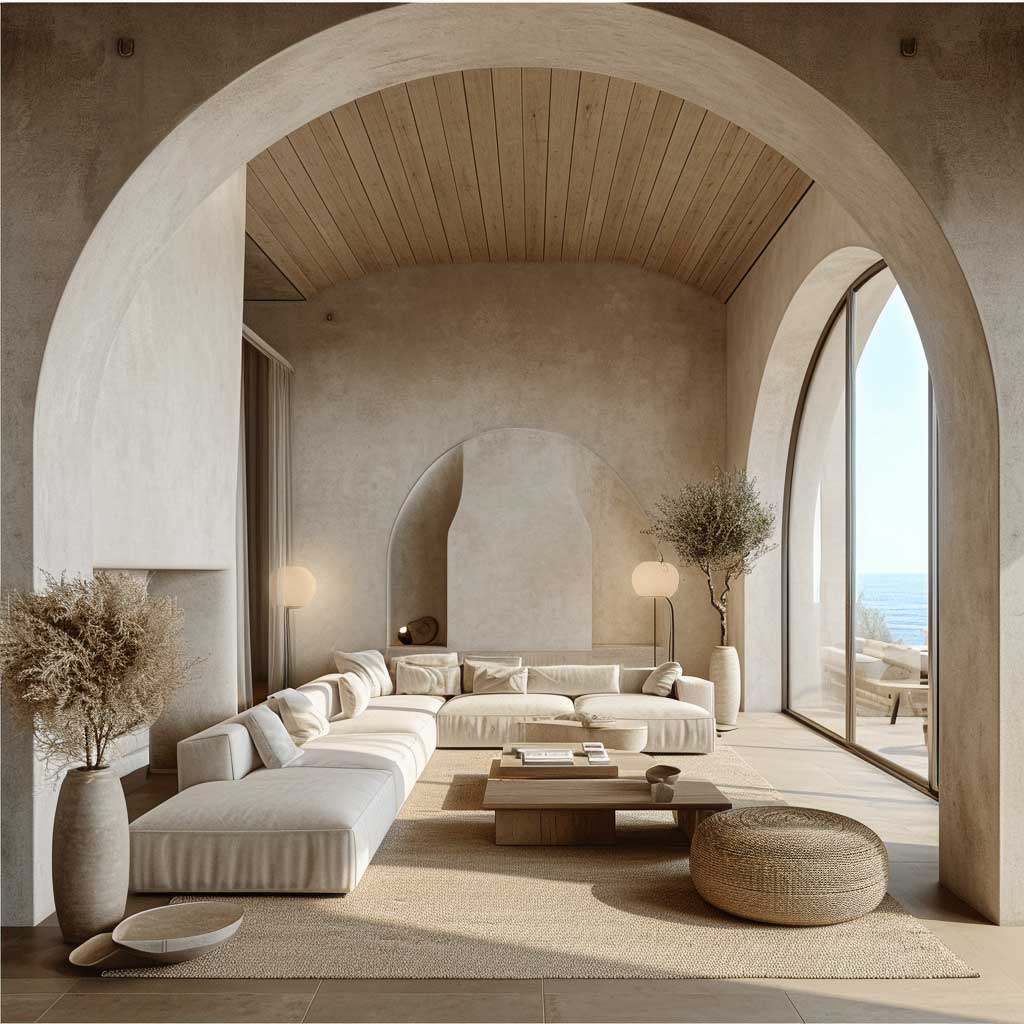
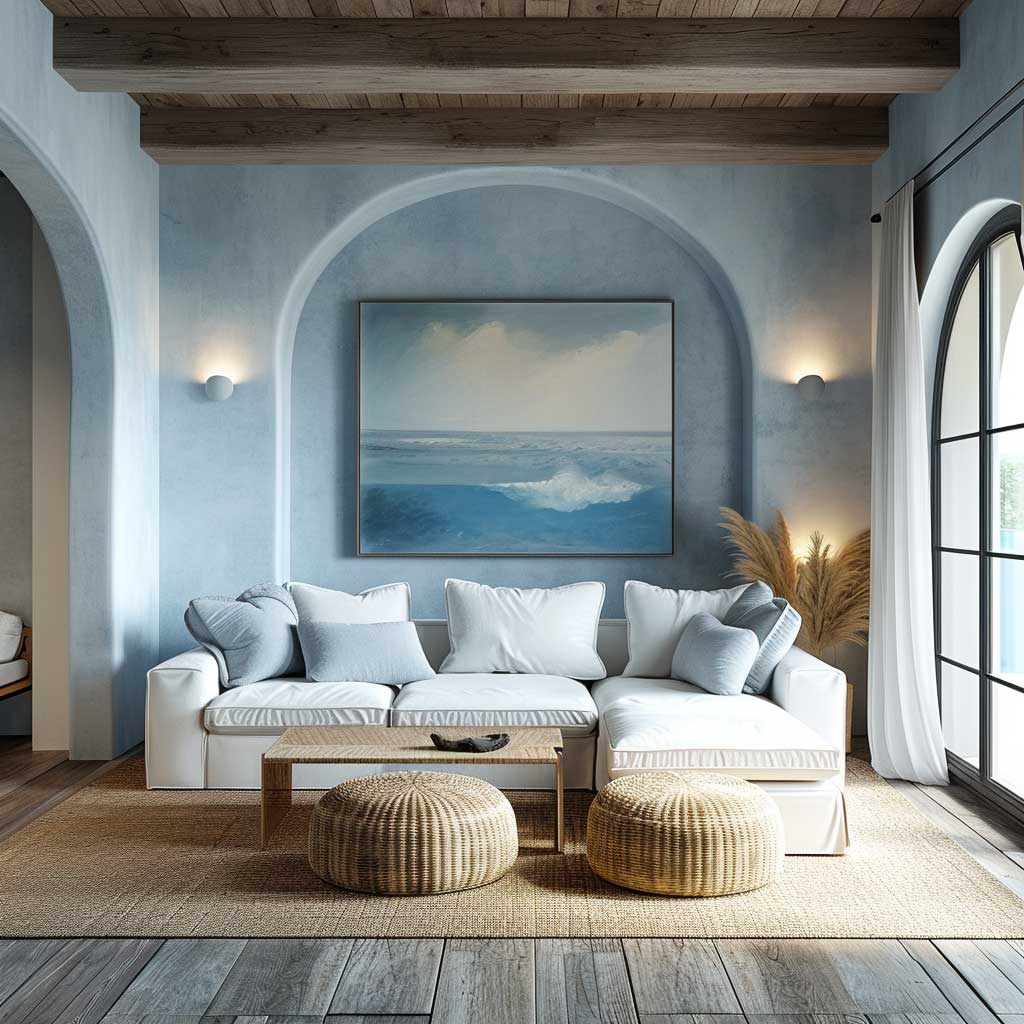
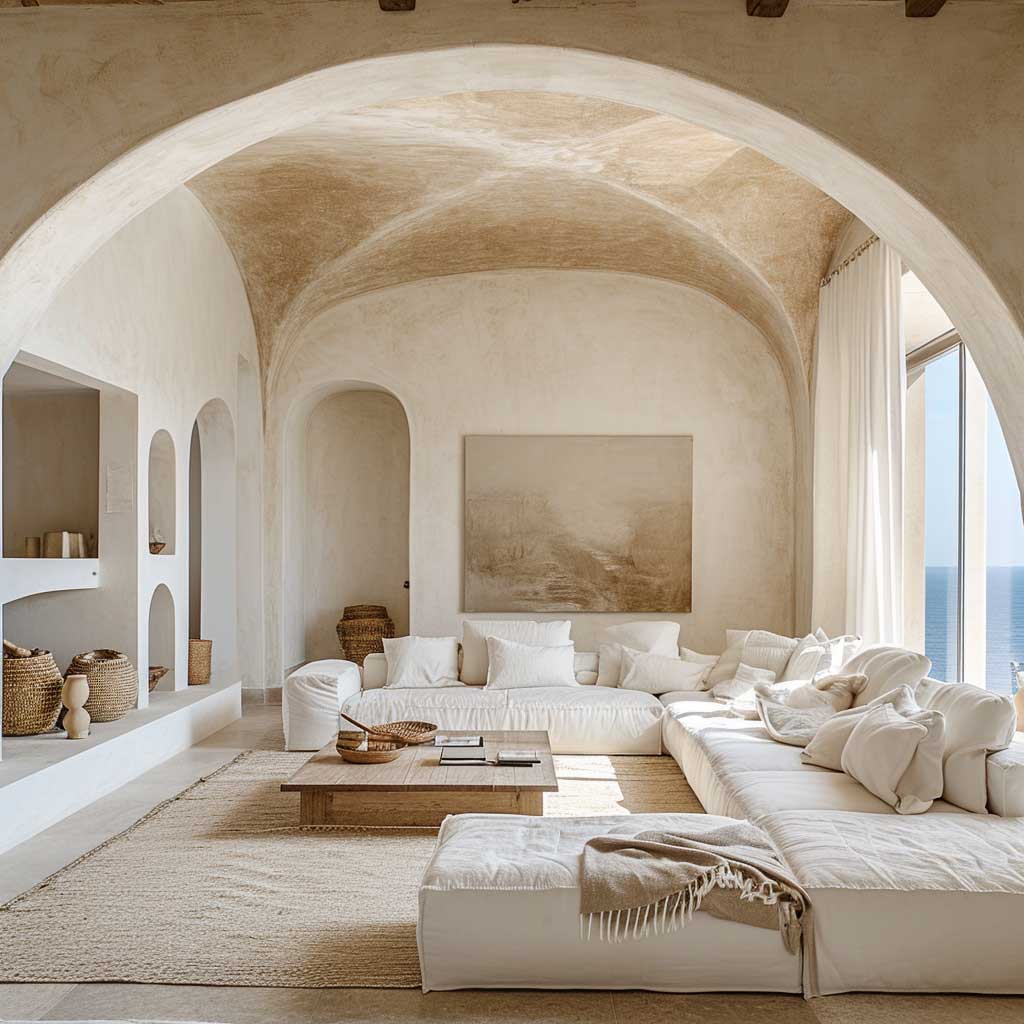
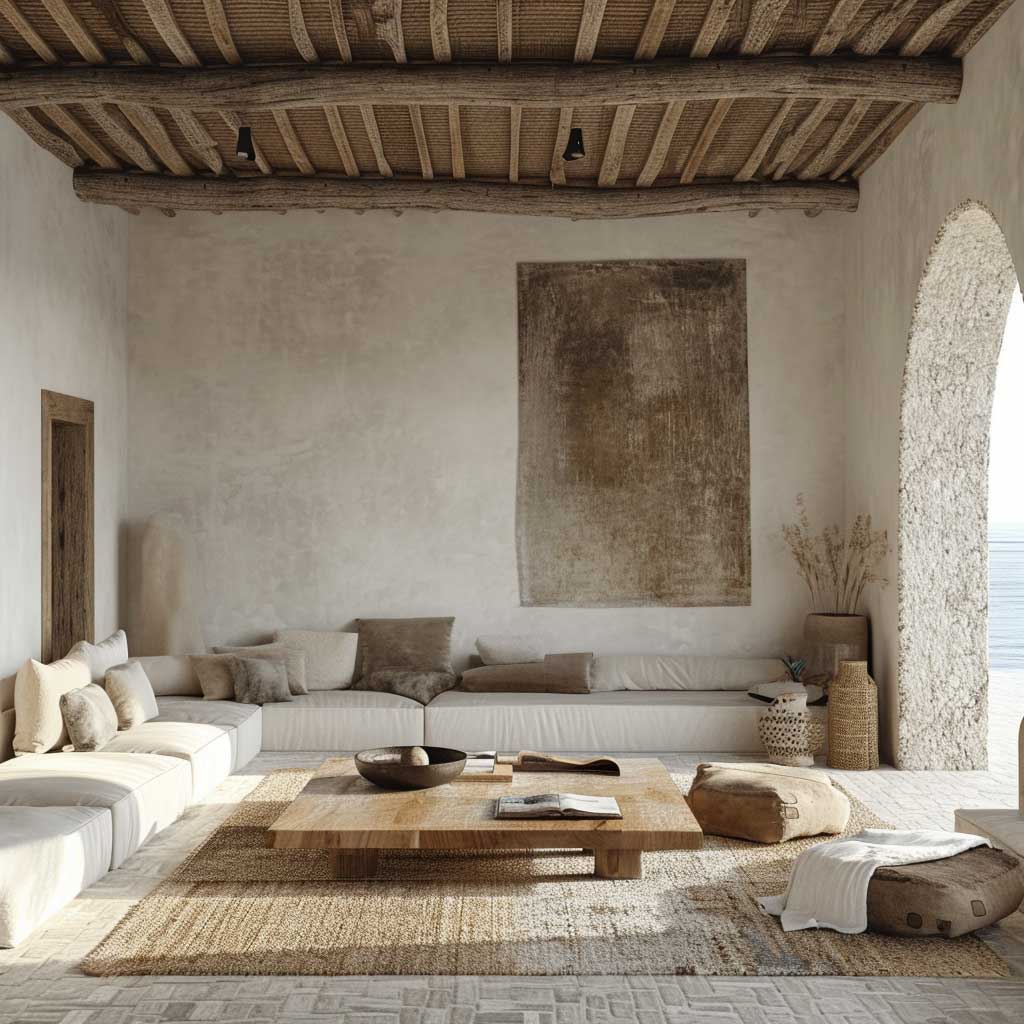
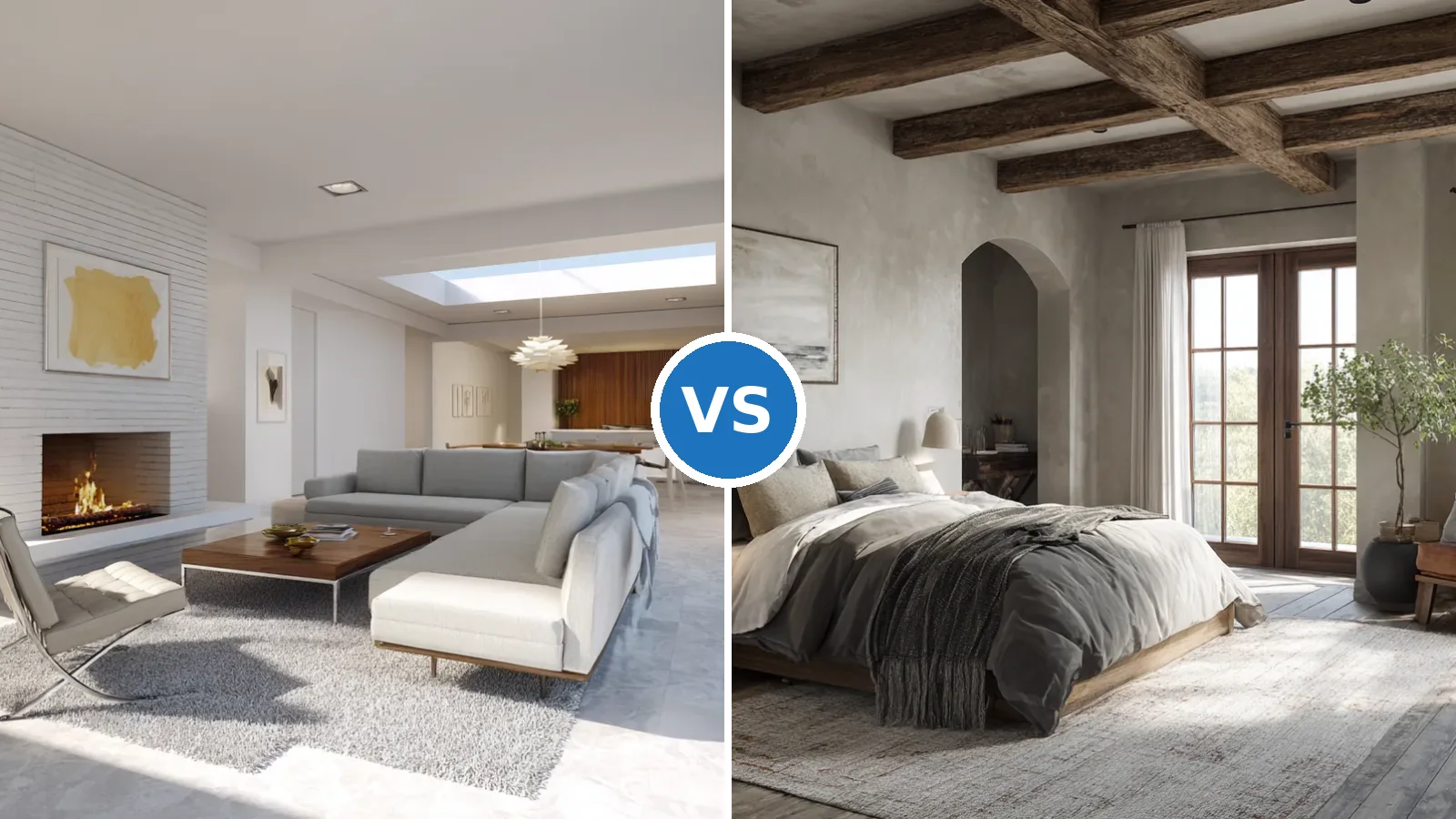
Mediterranean minimalist living rooms succeed on a two-color rule that most people abandon too early: white or near-white walls plus a single muted coastal tone — usually a soft blue-grey or pale sage — and nothing else in terms of wall color. I’ve seen rooms pull this off with Benjamin Moore Sea Salt (under $70 per gallon in eggshell) on one accent wall against flat white plaster. The room reads coastal without announcing it. What keeps it from tipping into a beach rental is material quality: the sofa fabric, the rug texture, the weight of the ceramic pieces you choose.
Furniture in this style is chosen for what it contributes and refused when it merely adds. A slipcovered linen sofa in warm white — West Elm’s Nomad at roughly $1,400 or IKEA’s SÖDERHAMN at $699 — provides the seating anchor. The coffee table should be low-profile wood with visible grain, not lacquered or painted. Ask yourself whether each piece would exist in a house built on a Greek island cliff in 1960. That filter eliminates about 80% of what most furniture stores sell. Wrought iron floor lamps pass. Glass-topped side tables typically don’t.
Decor in a Mediterranean minimalist living room is about restraint at the object level, not at the texture level. You can have four different surfaces — rough linen, smooth plaster, unglazed ceramic, weathered oak — without the room feeling busy. What crowds it is multiple decorative objects competing at the same visual height. My practice: one ceramic vessel (handmade, not printed), one woven textile element, and natural light as the third “decoration.” Large windows or glass doors that flood the room with sun at midday do more visual work than any styling choice. For a deeper look at how the coastal palette translates room-to-room, this breakdown of Mediterranean style living rooms covers the rugged-elegance and sunlit approaches in detail.
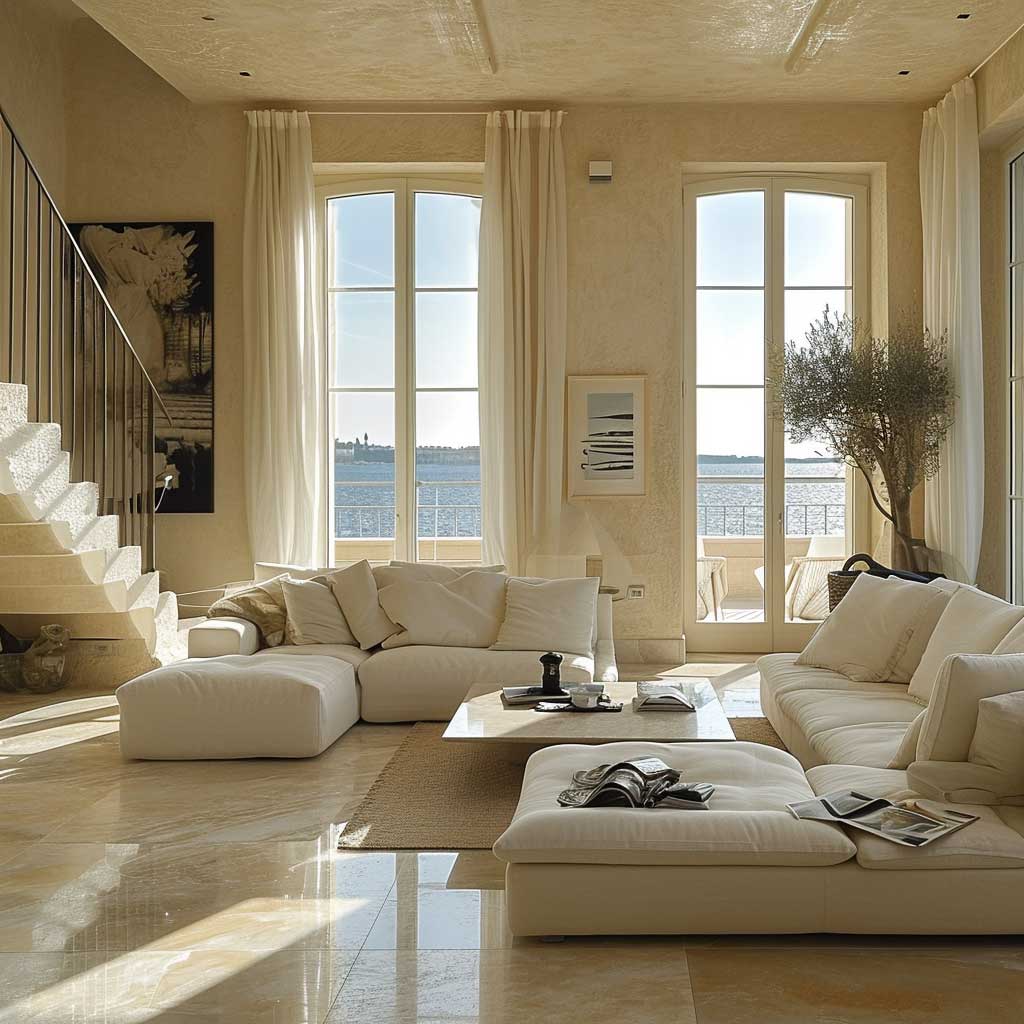
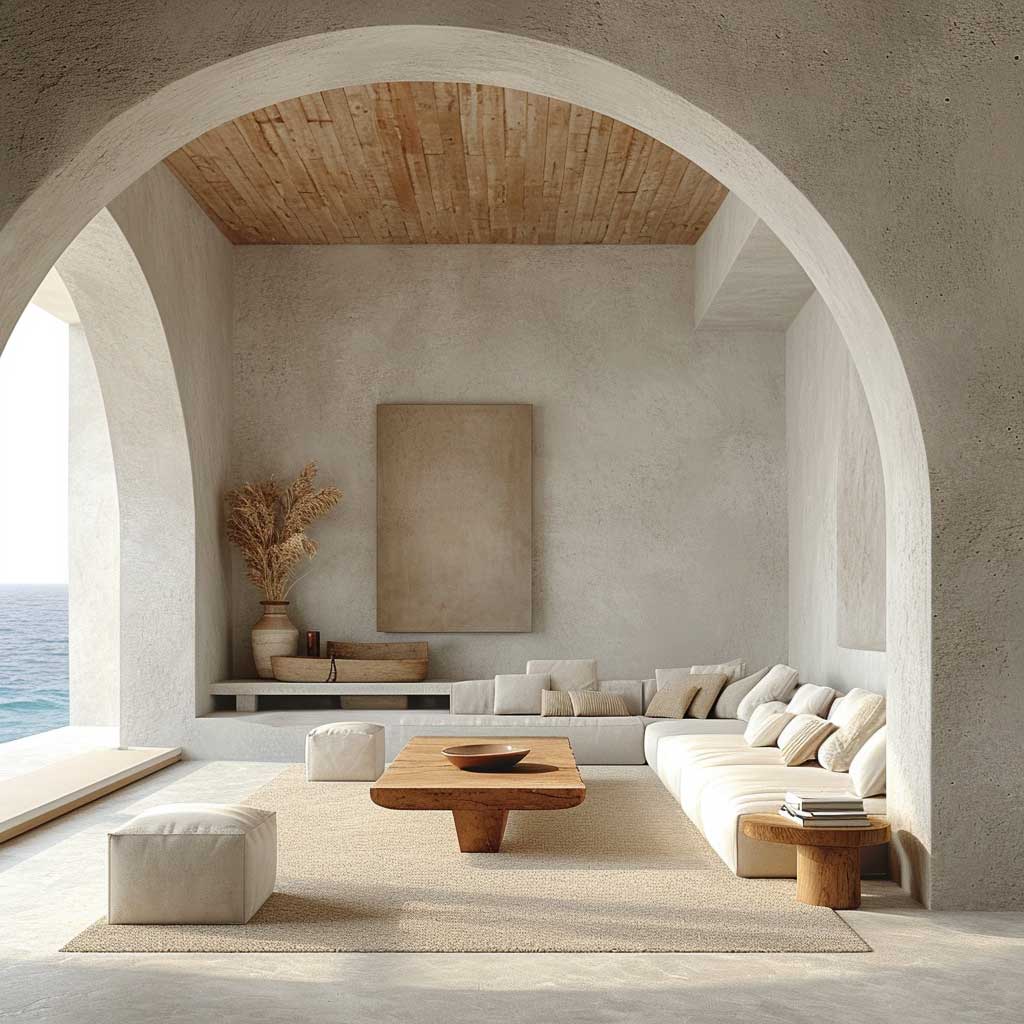
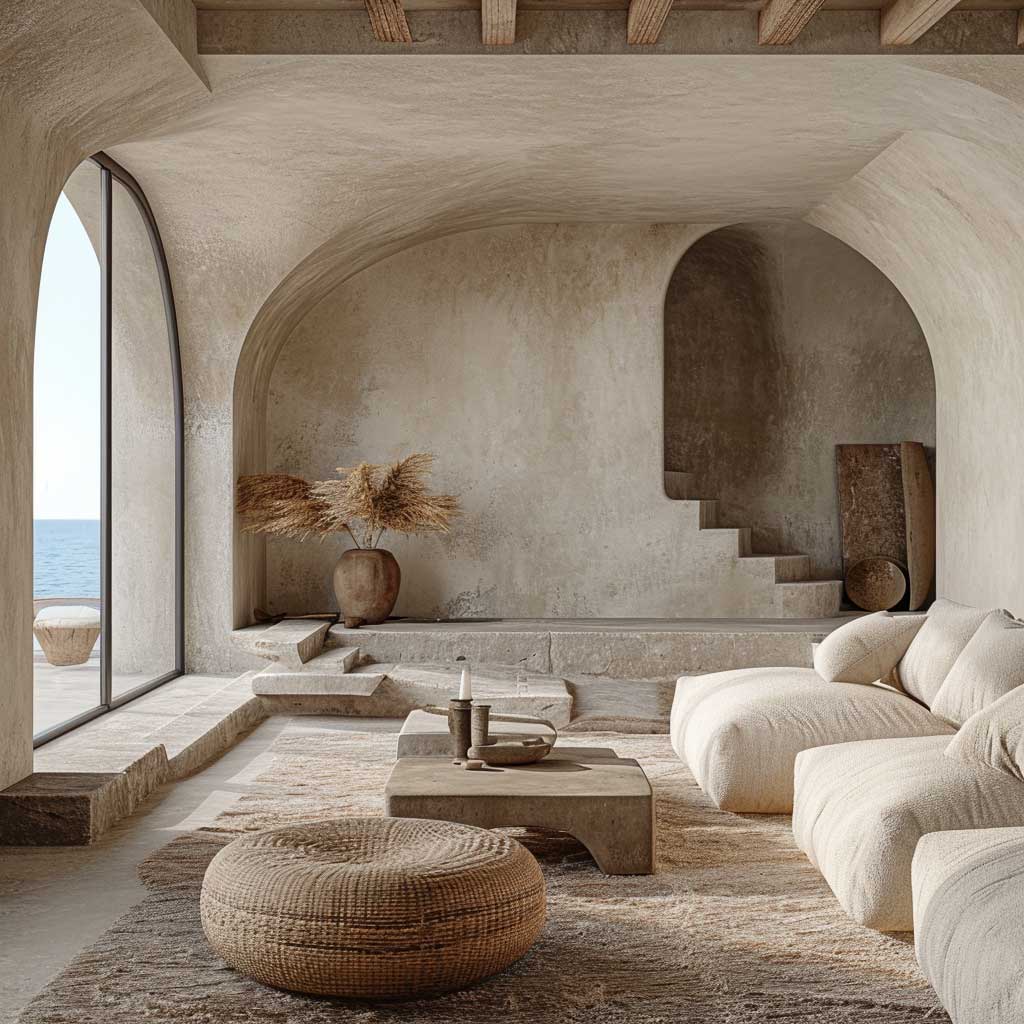
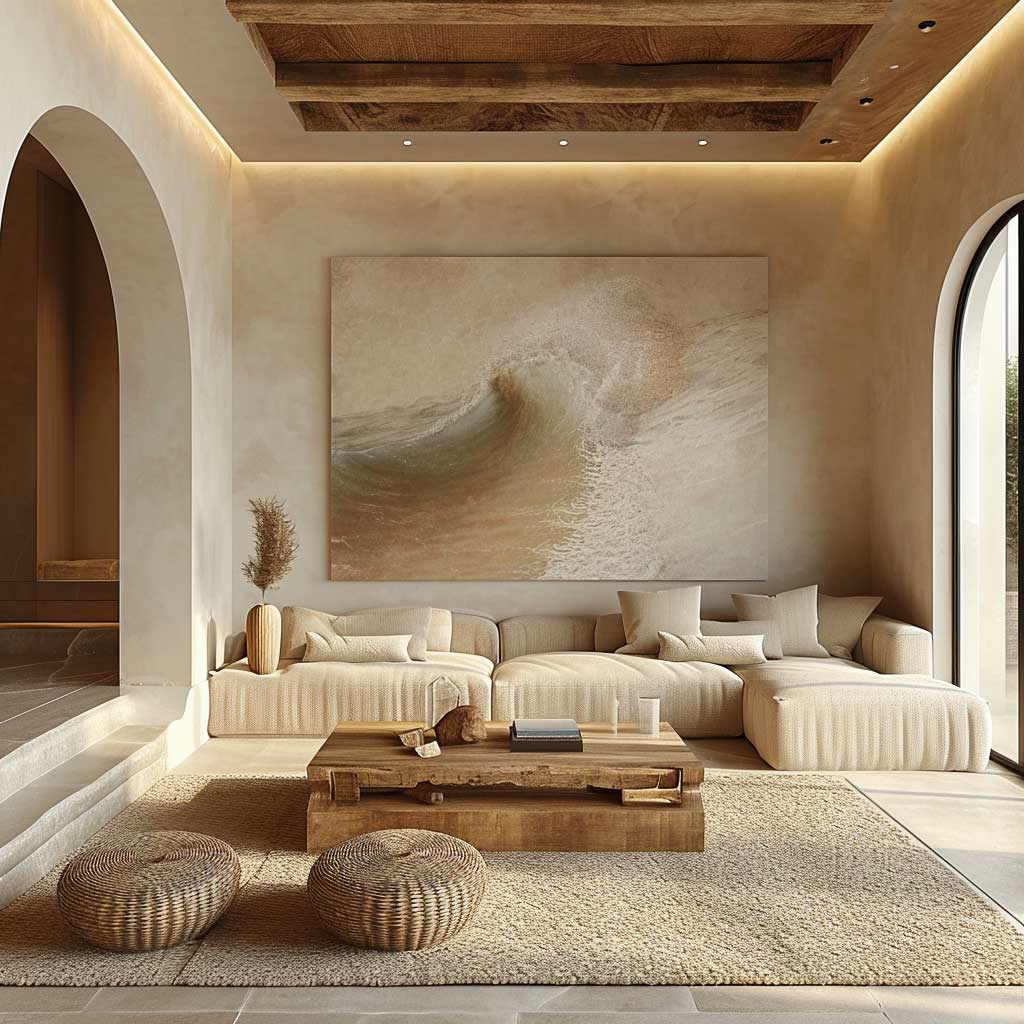
Does natural fiber belong in a minimal Mediterranean living room? Yes — exclusively. Jute rugs in the $80–$200 range from Pottery Barn or Amazon’s Stone & Beam line anchor seating areas without visual noise. What doesn’t work: synthetic shag rugs, patterned area rugs with multiple colors, or anything with a pile so thick it reads as cozy rather than clean. The rug is the floor’s texture, not its decoration. Think of it like sand under a terrace chair: present and functional, not the point of the room.
The room becomes a statement when you commit to the edit: keep what reads Mediterranean and discard what just fills space. A sofa, a low table, one floor plant (olive tree in a plain terracotta pot, $45–$80 at most garden centers), and afternoon light. That’s the whole formula. Rooms that start adding bookshelves, side tables, and gallery walls are building a different style — and that’s fine, but it’s no longer this one.
Sleek Mediterranean Minimalist Kitchens
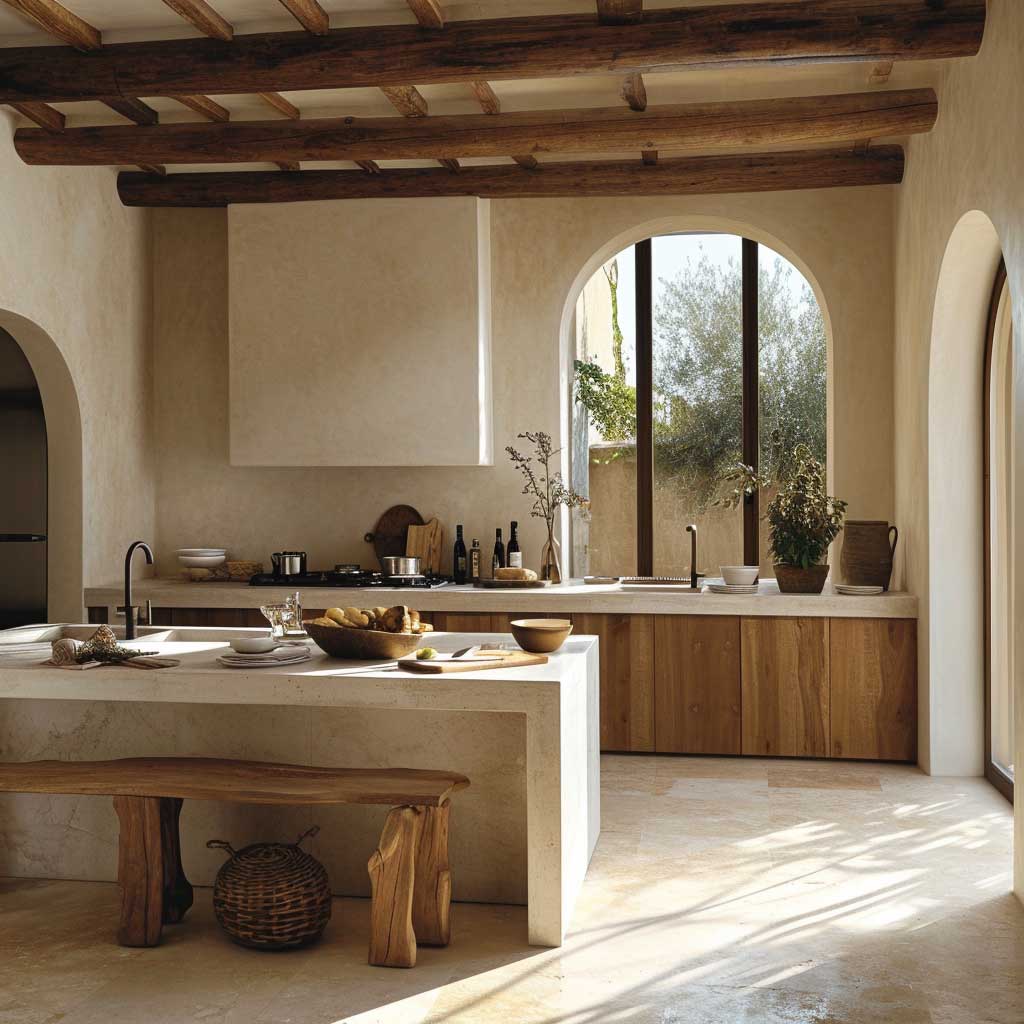
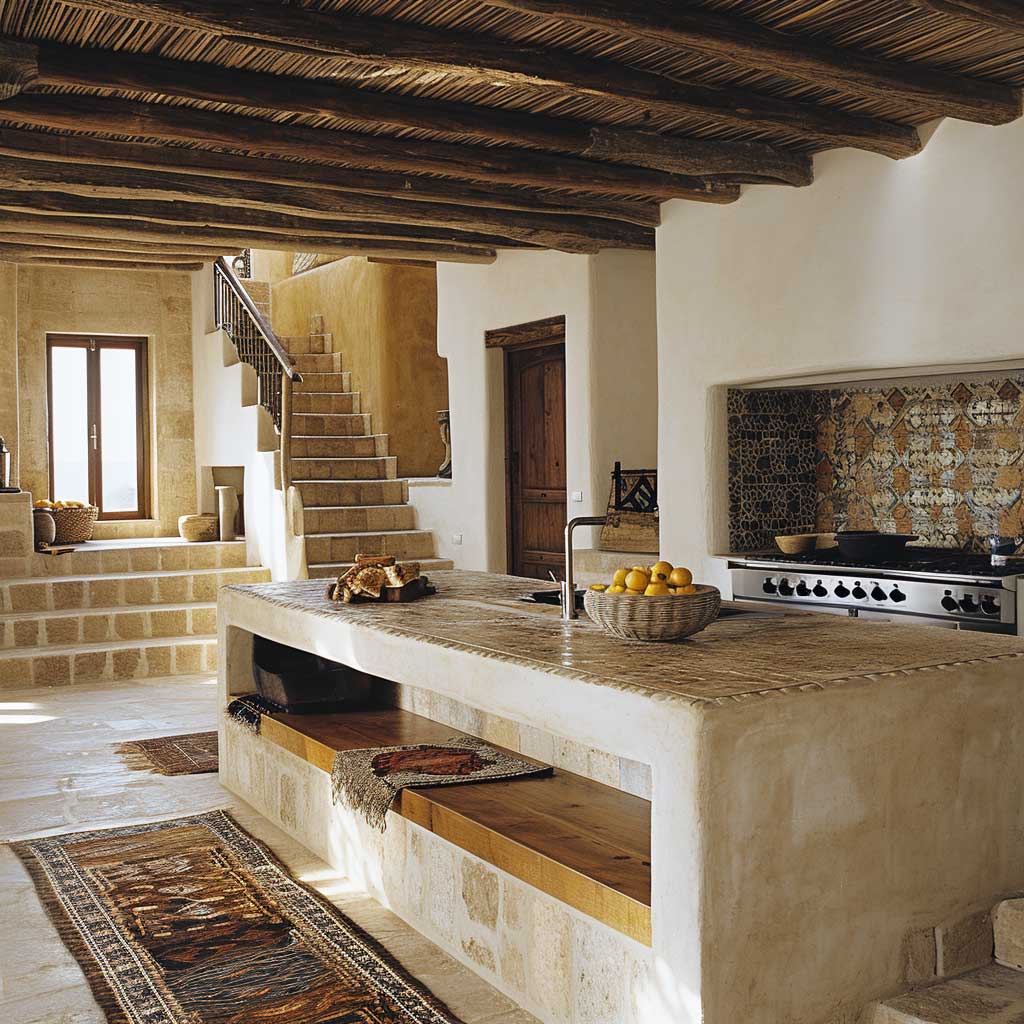

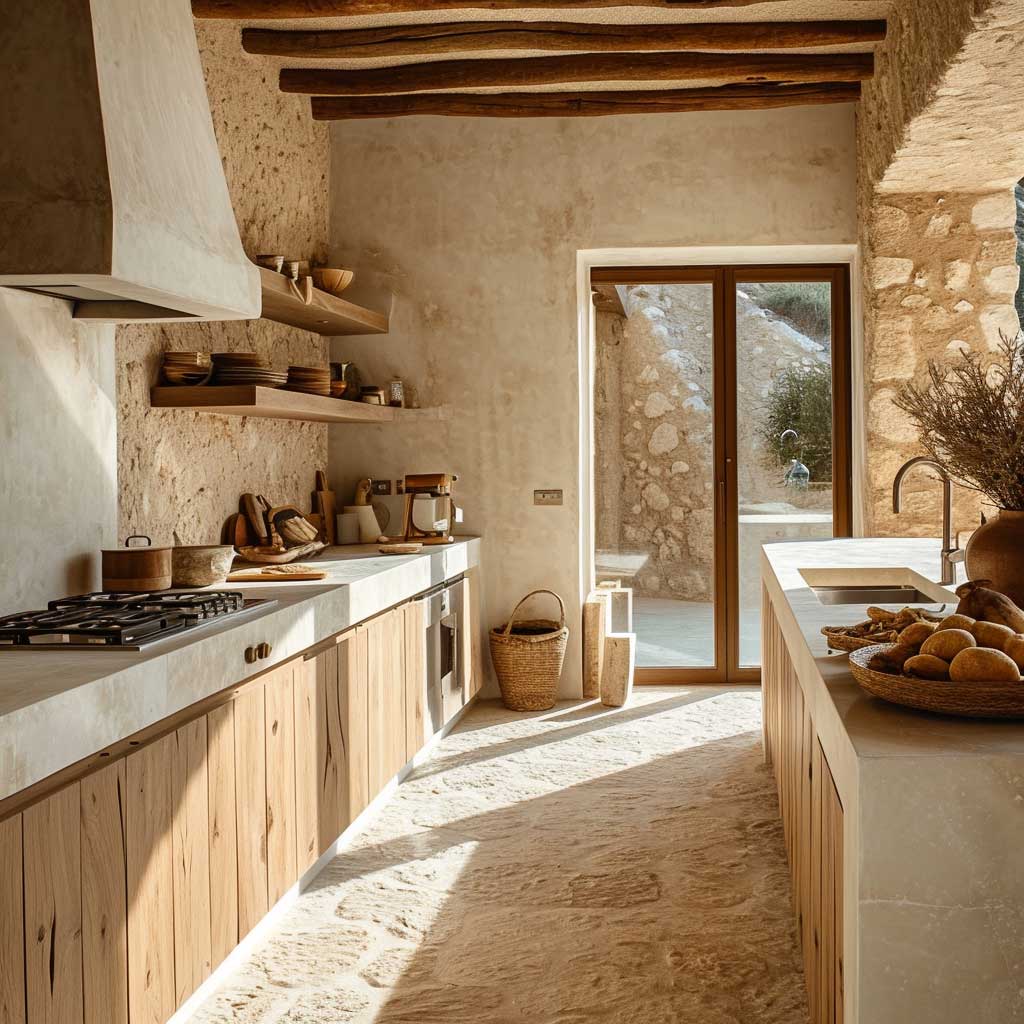
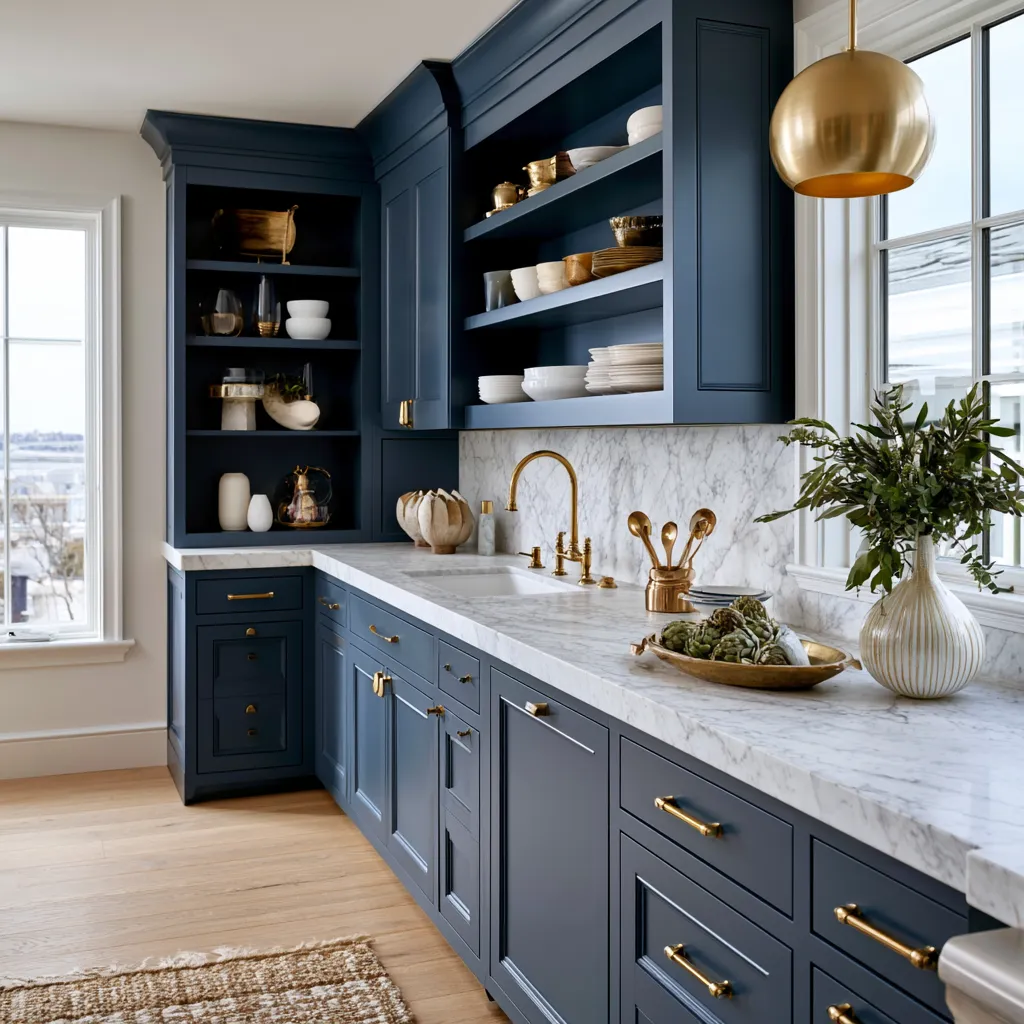
Minimal Mediterranean kitchens work because they make a single strong material decision and then let everything else recede. I’ve bought into this logic twice — once with a limestone countertop that cost $2,400 installed, once with unglazed Saltillo tile flooring at $4 per square foot from a local tile warehouse. Both times, the material did the heavy lifting that ten decorative accessories couldn’t. The cabinet faces go smooth, handleless, and painted in a warm white or putty tone. Benjamin Moore Chantilly Lace OC-17 or Sherwin-Williams Alabaster SW 7008 at $65–$70 per gallon work here. They disappear against the walls and let the countertop and floor tell the story.
Appliances need to integrate or stay out of sight. Visible chrome-handled refrigerators and freestanding microwaves on the counter are the visual equivalent of someone talking loudly in a quiet room. Panel-front dishwashers and built-in ovens from brands like Bosch (the 300 Series starts around $900) make the kitchen read as a composed room rather than an appliance showroom. The countertop stays clear. Genuinely clear: no knife block, no paper towel holder, no appliances plugged in at all times. A small wooden cutting board leaning against the backsplash is the only permitted exception.
Glazed terracotta tile on the floor. I know it looks like the right move — it’s orange, it’s Mediterranean, it’s tile. But glazed terracotta reads as orange bathroom from a 1970s renovation. The sheen is the problem. Unglazed tile has surface variation and a matte finish that reads like actual Mediterranean earth. The glazed version reads like a kitchen at a fast-casual restaurant chain. Buy unglazed Saltillo ($3–$6 per square foot), seal it with a penetrating sealer, and live with a little variation underfoot. That variation is the point.
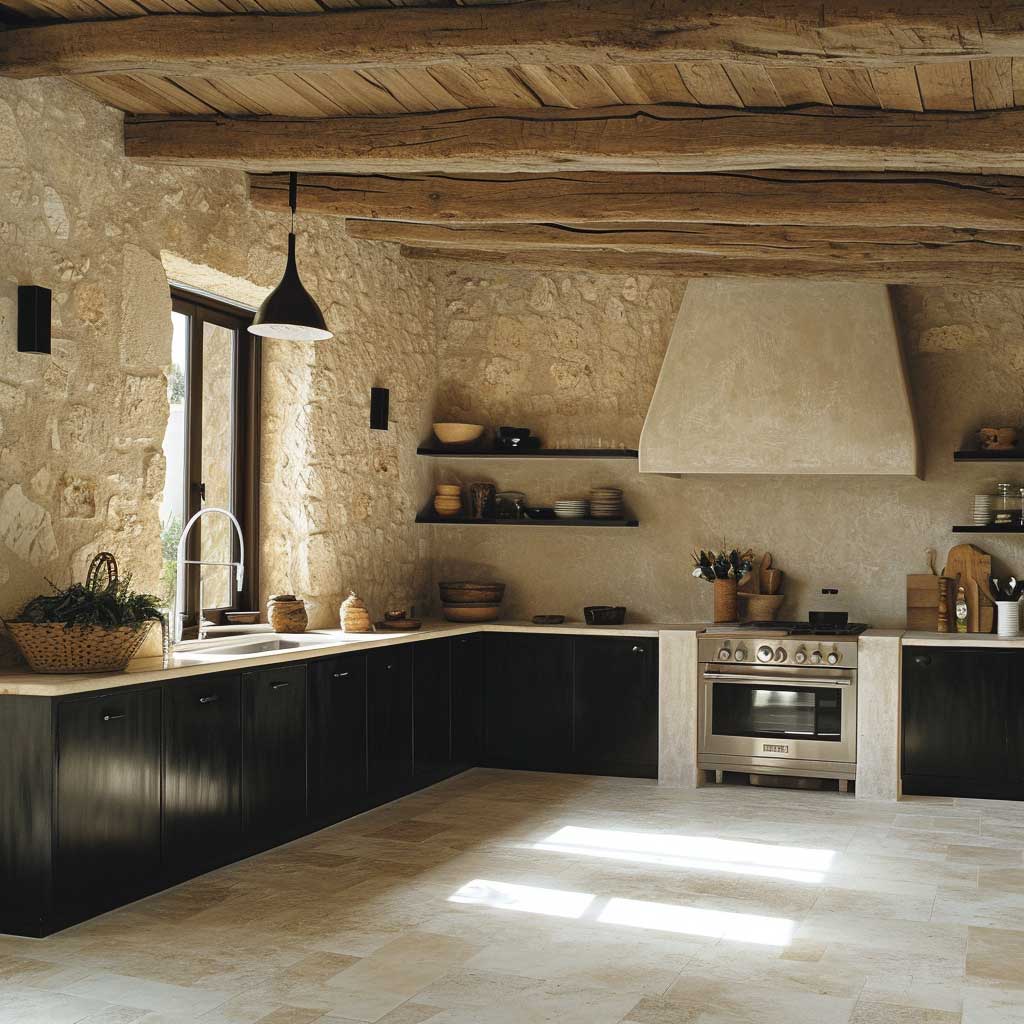
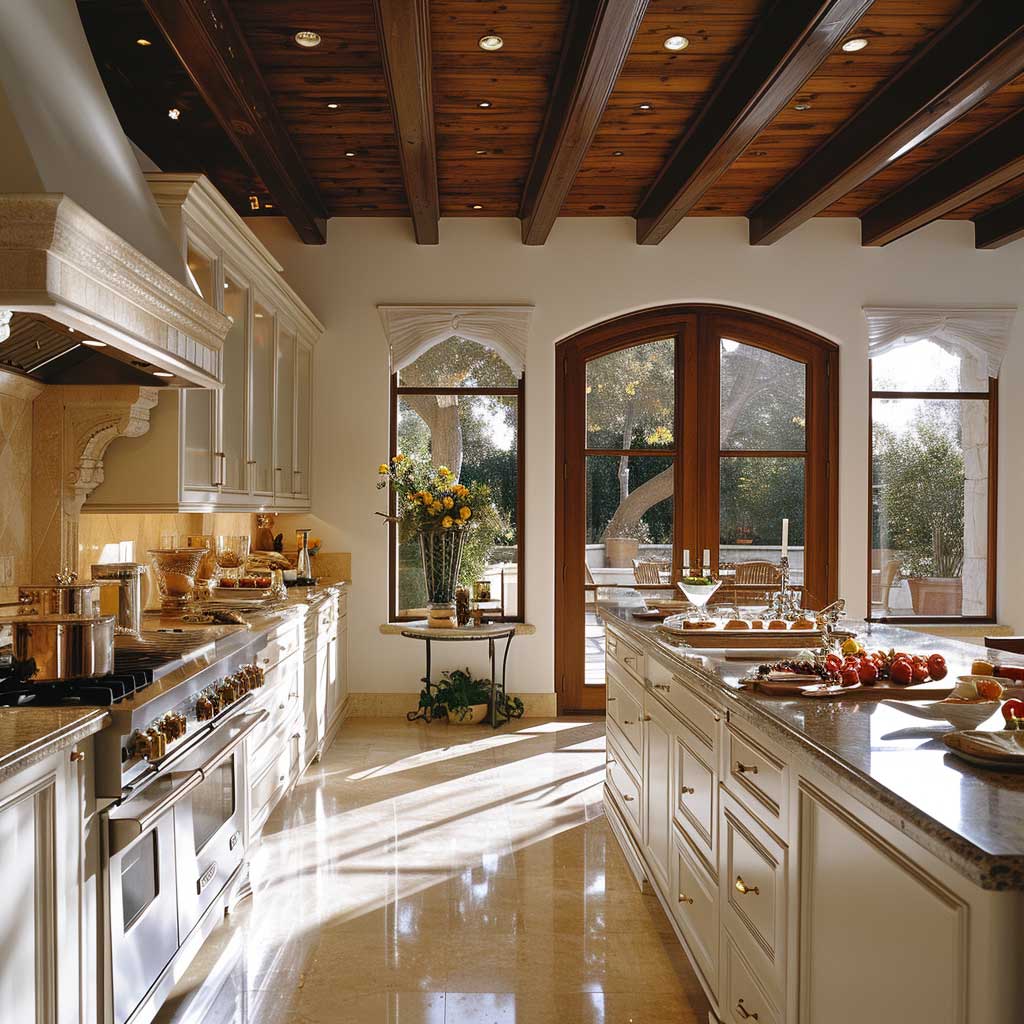

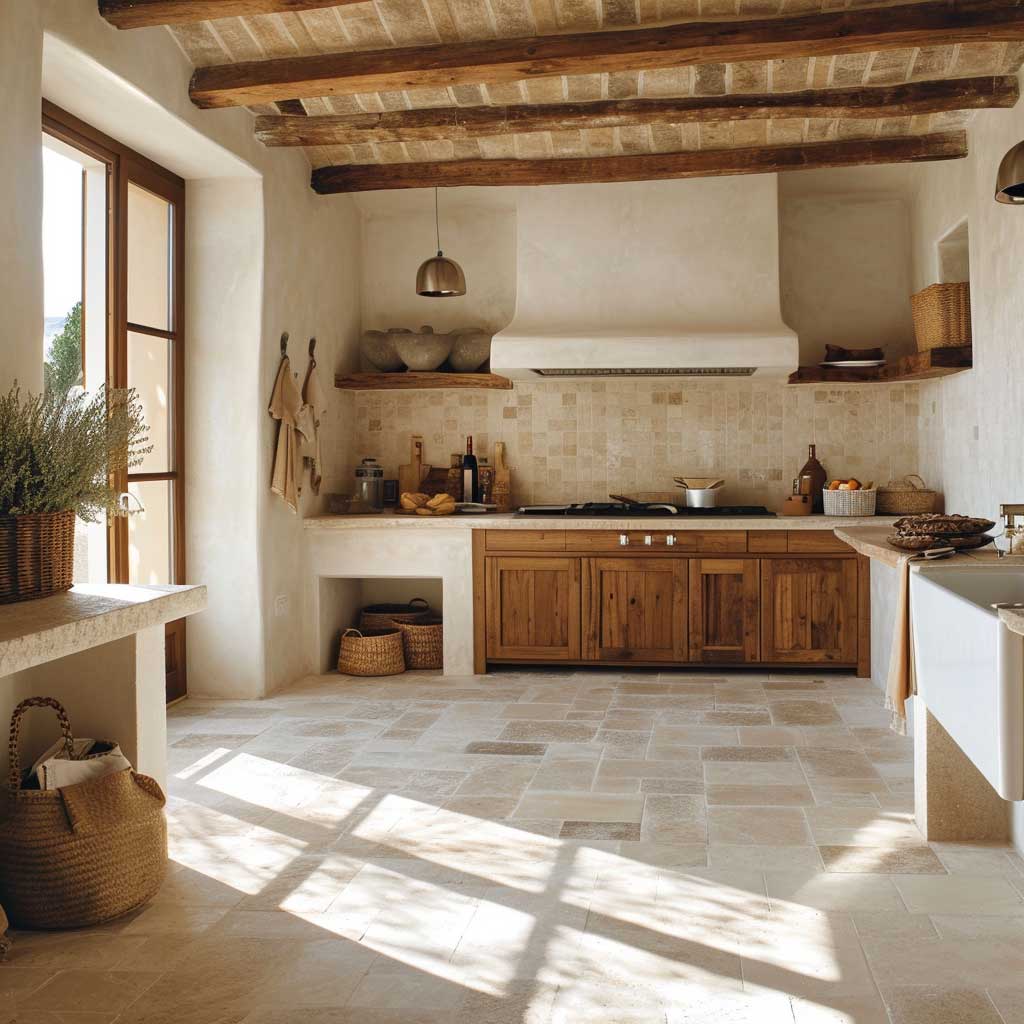
Lighting in this kitchen type is task-first, atmosphere-second. Natural light maximized through a large window over the sink — ideally facing south or east — does more than any pendant fixture can. For artificial light, wrought iron pendants over an island at $80–$180 per fixture from Pottery Barn or similar add the material story without visual clutter. Skip under-cabinet strips in a warm yellow tone; they make the countertop glow in a way that reads as showroom rather than home. Warm 2700K bulbs in the ceiling fixtures and nothing else after 6 PM gets the Mediterranean evening atmosphere right.
You’ll notice that every Mediterranean minimalist kitchen worth photographing has one thing in common: you can see the counter from the doorway and nothing is on it. That cleared counter is doing the same optical work as a whitewashed wall — it makes the space feel three times larger than it measures. One bowl of lemons or a small potted herb (rosemary, thyme) on the windowsill is Mediterranean authenticity. Everything else is clutter pretending to be character. For more on how to commit to a color scheme that holds this kitchen together across seasons, the Mediterranean color palette breakdown at ArtFasad covers terracotta and olive pairings in precise brand and price detail.
Tranquil Mediterranean Minimalist Bedrooms
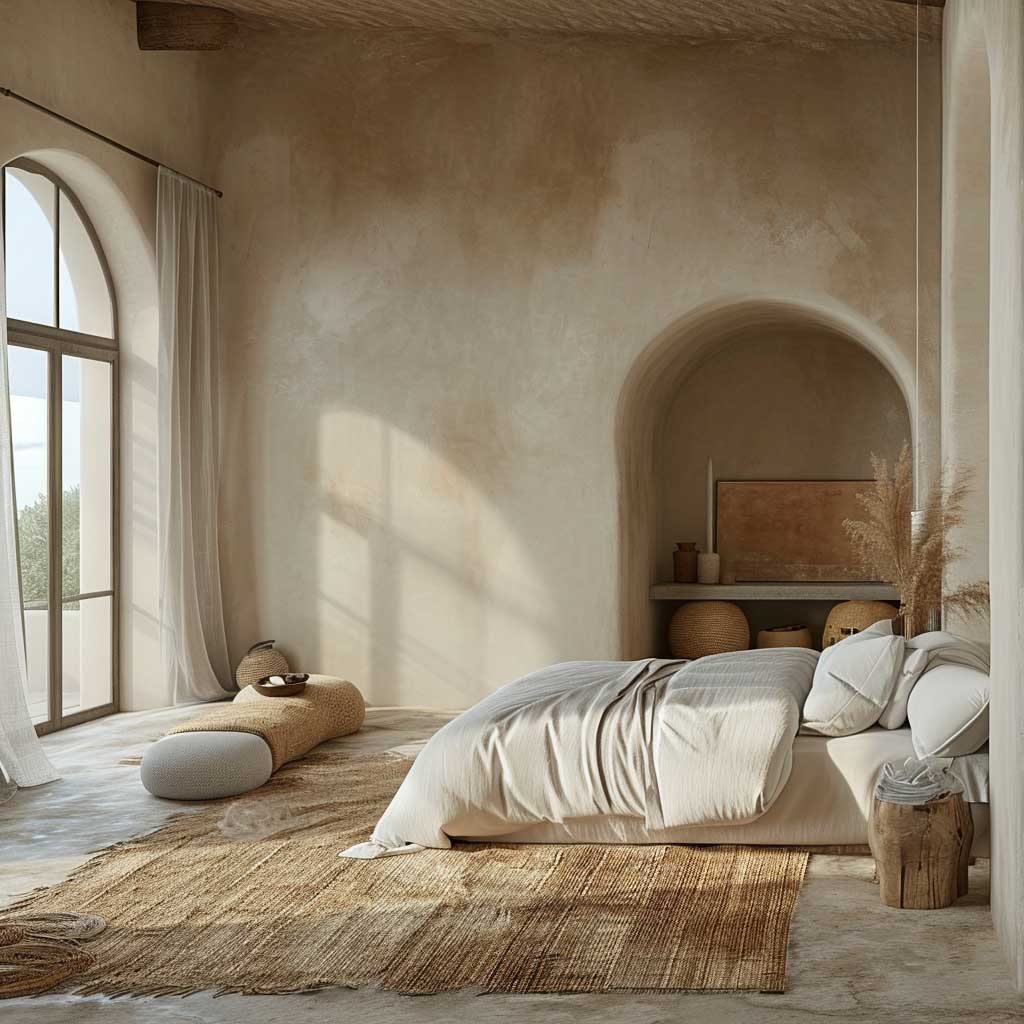
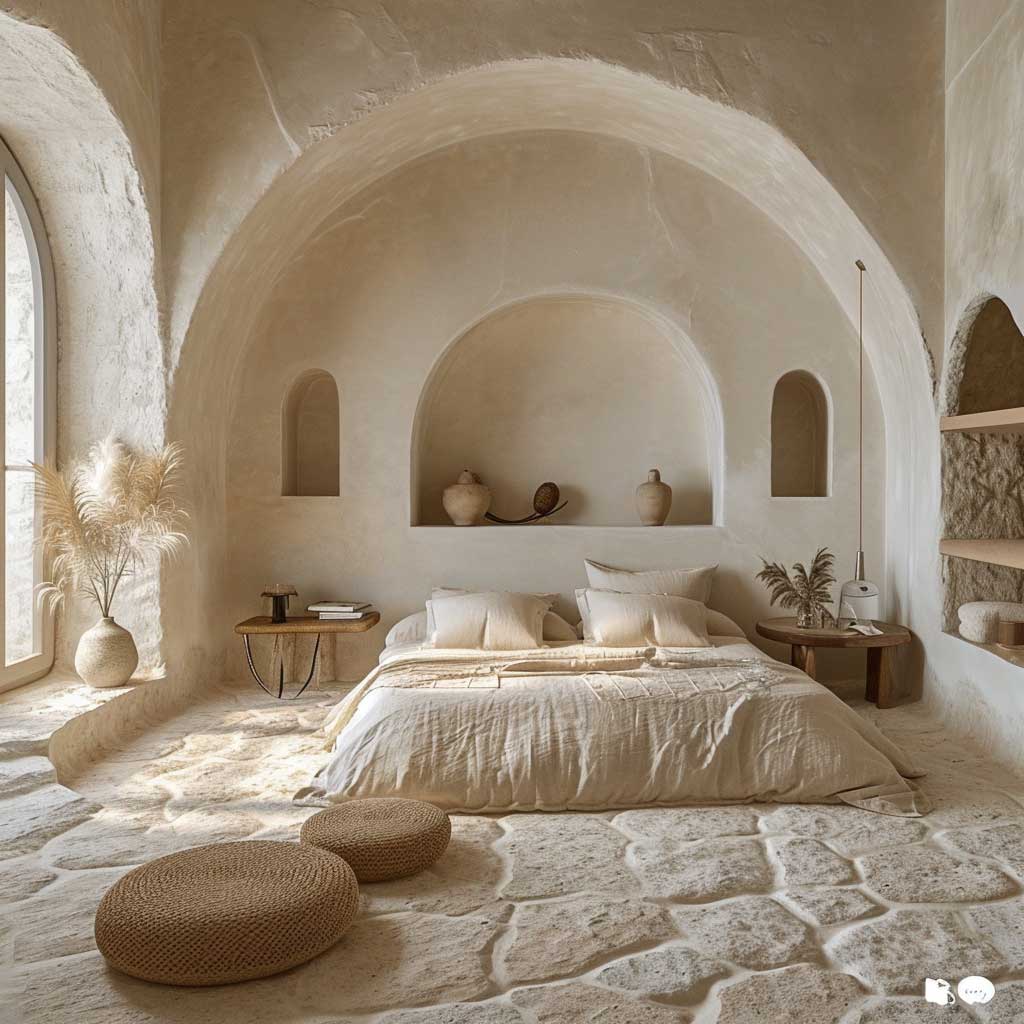
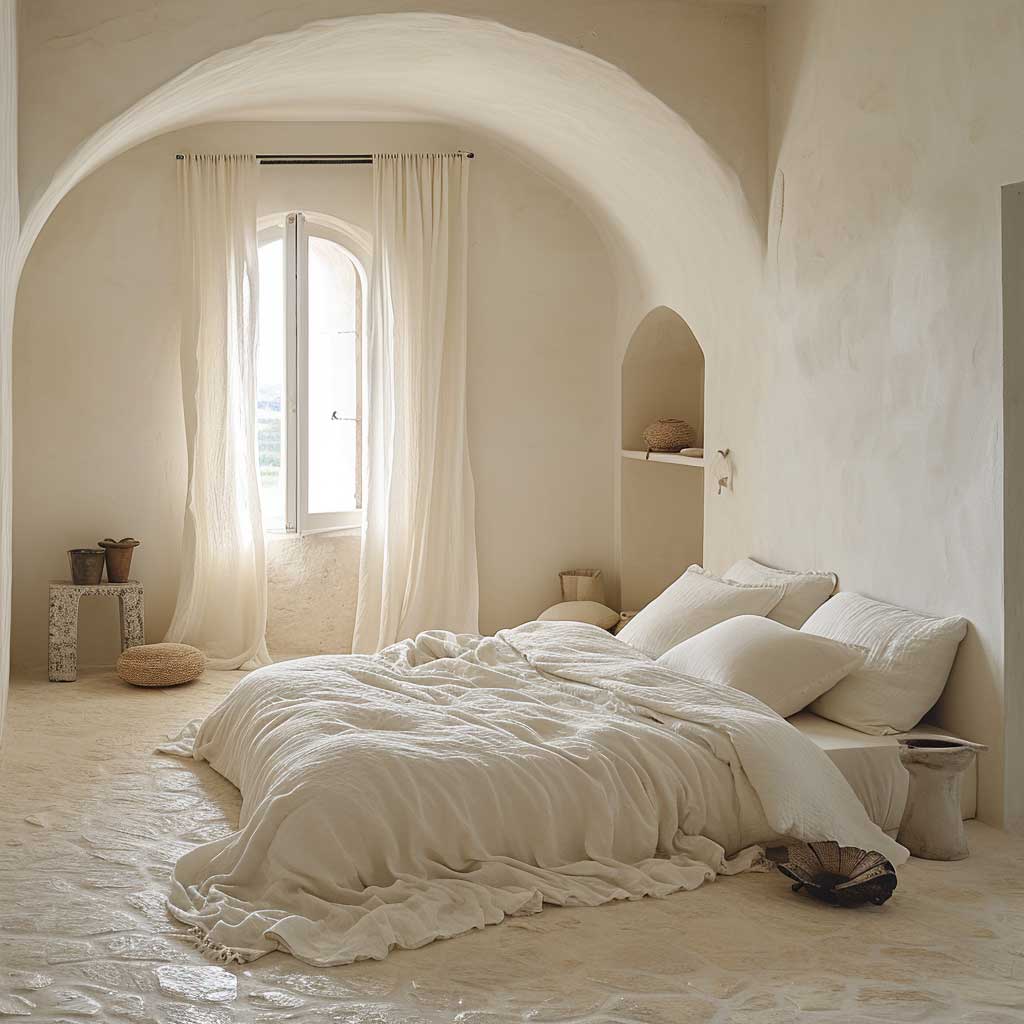
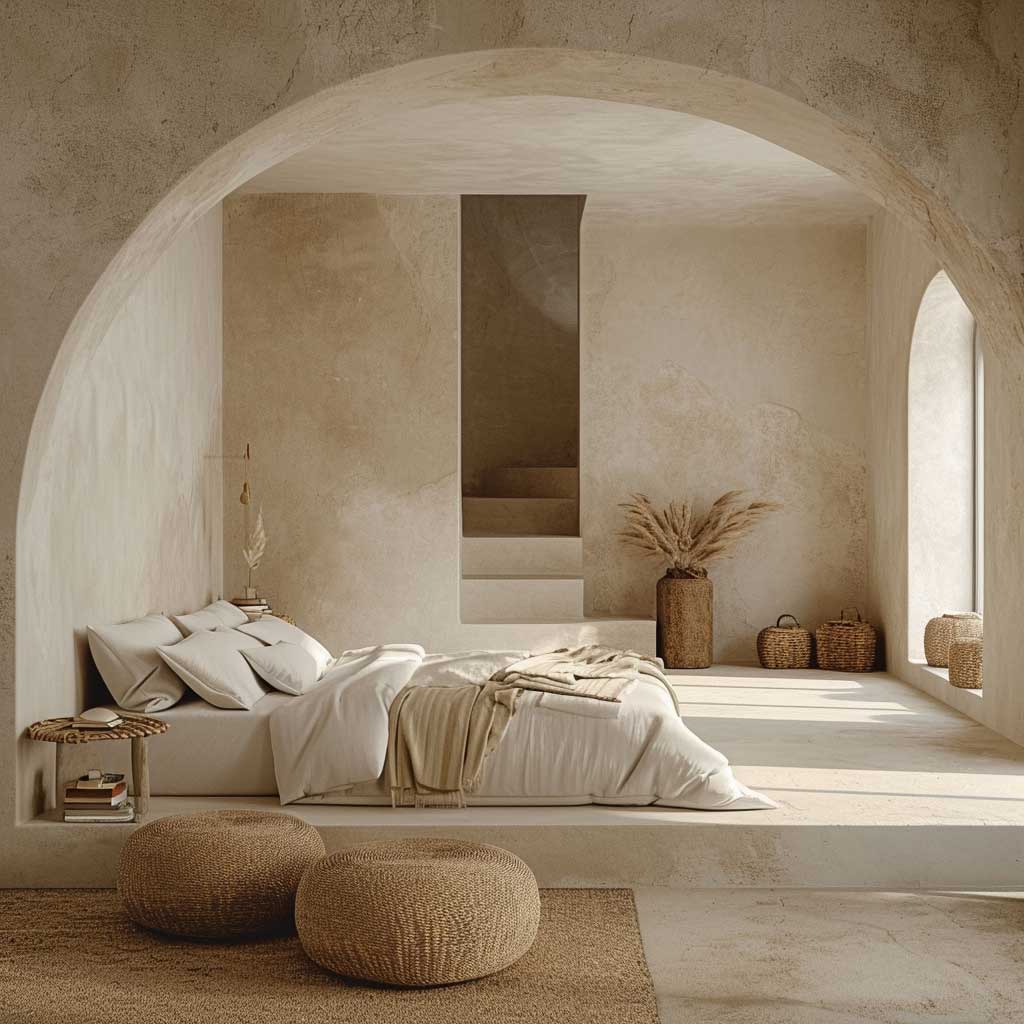
Mediterranean minimalist interior design makes its strongest argument in the bedroom, and here is why: the bedroom is the room where visual noise costs you the most. A cluttered bedroom is not just an aesthetic problem; it is a sleep quality problem. I switched my own bedroom to this approach four years ago — low oak platform bed (IKEA MALM frame at $249 in oak veneer), Cultiver linen duvet cover in flax ($220), bare plaster-white walls, one bedside table instead of two. The difference in how quickly I fall asleep was noticeable within a week. That is not a design observation; it is a lived one.
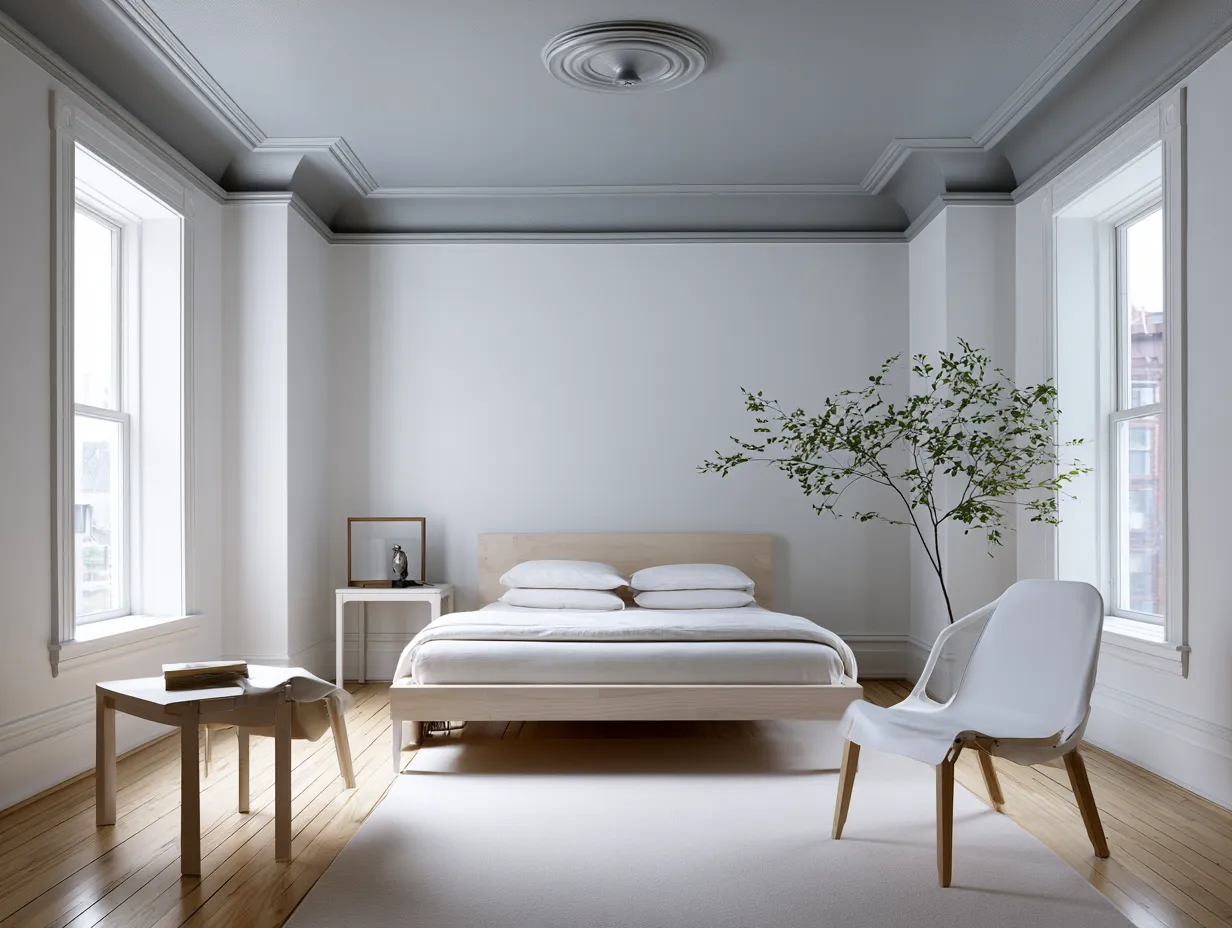
The color palette for a minimal Mediterranean bedroom pulls from the softest end of the natural spectrum: chalk white, very pale blue-grey, warm sand. Farrow & Ball All White No. 2 on the walls plus a linen headboard in flax or oat reads exactly right. What kills this palette is contrast — a dark feature wall, a bold pattern on the duvet, or too many pillow colors competing. You want the room to feel like the inside of a shell: uniform in tone, varied in texture. A slightly rough plaster finish on the walls (even a DIY texture paint over flat latex) delivers that quality at around $40–$60 in materials.
Furniture in such a bedroom is, by rule, simple and from natural materials. A solid wood bedframe, a single bedside table in stone or wood (Crate & Barrel’s Marin side table in acacia runs $199), and a low bench at the foot of the bed in natural linen or leather. No dresser on the primary wall — built-in closet storage keeps the floor plan clear. Is a mirror acceptable? Yes: one frameless or wood-framed mirror, leaned against the wall rather than hung, adds the reflected light that makes small Mediterranean bedrooms read as larger than they measure. The Salvatori material philosophy — stone and wood together, nothing synthetic — is the design logic this bedroom follows; their write-up on the combination of Mediterranean and minimalist principles is the clearest explanation of why natural materials are non-negotiable in this approach.
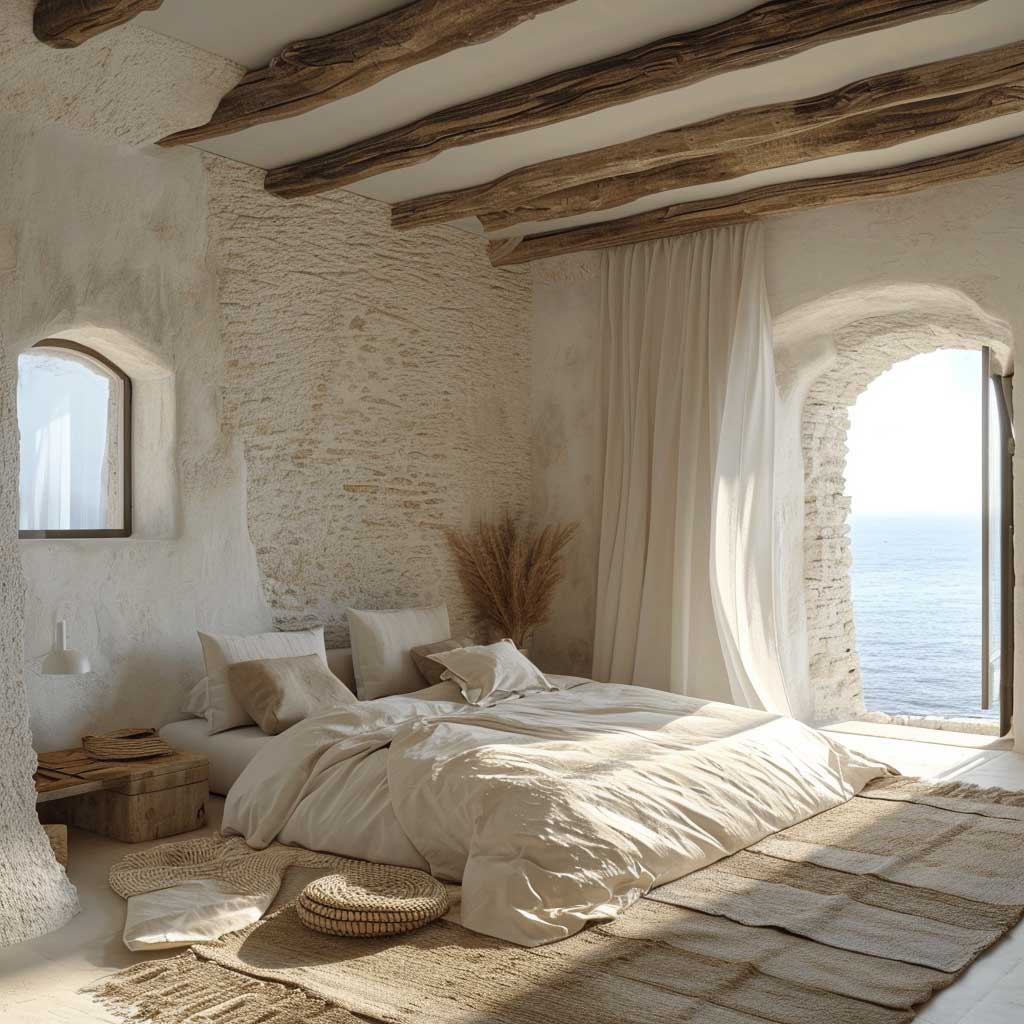
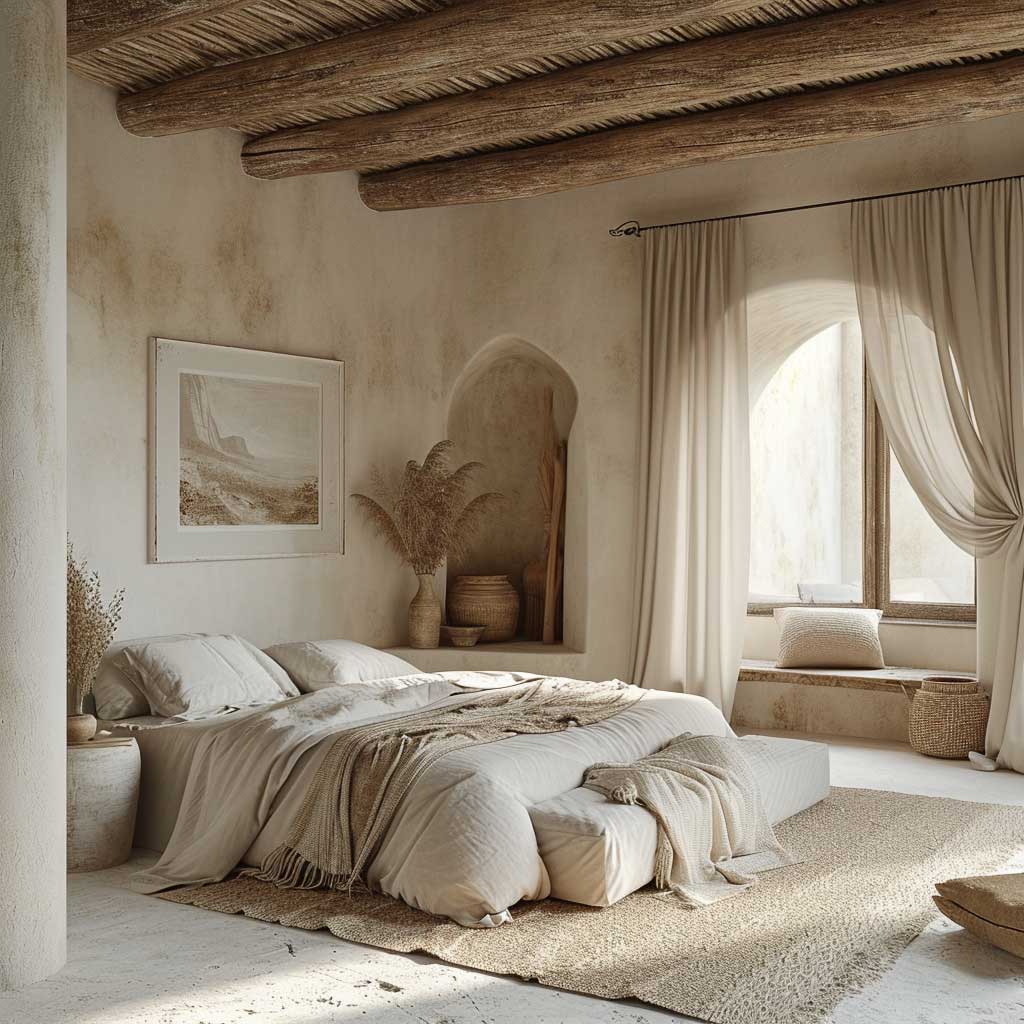
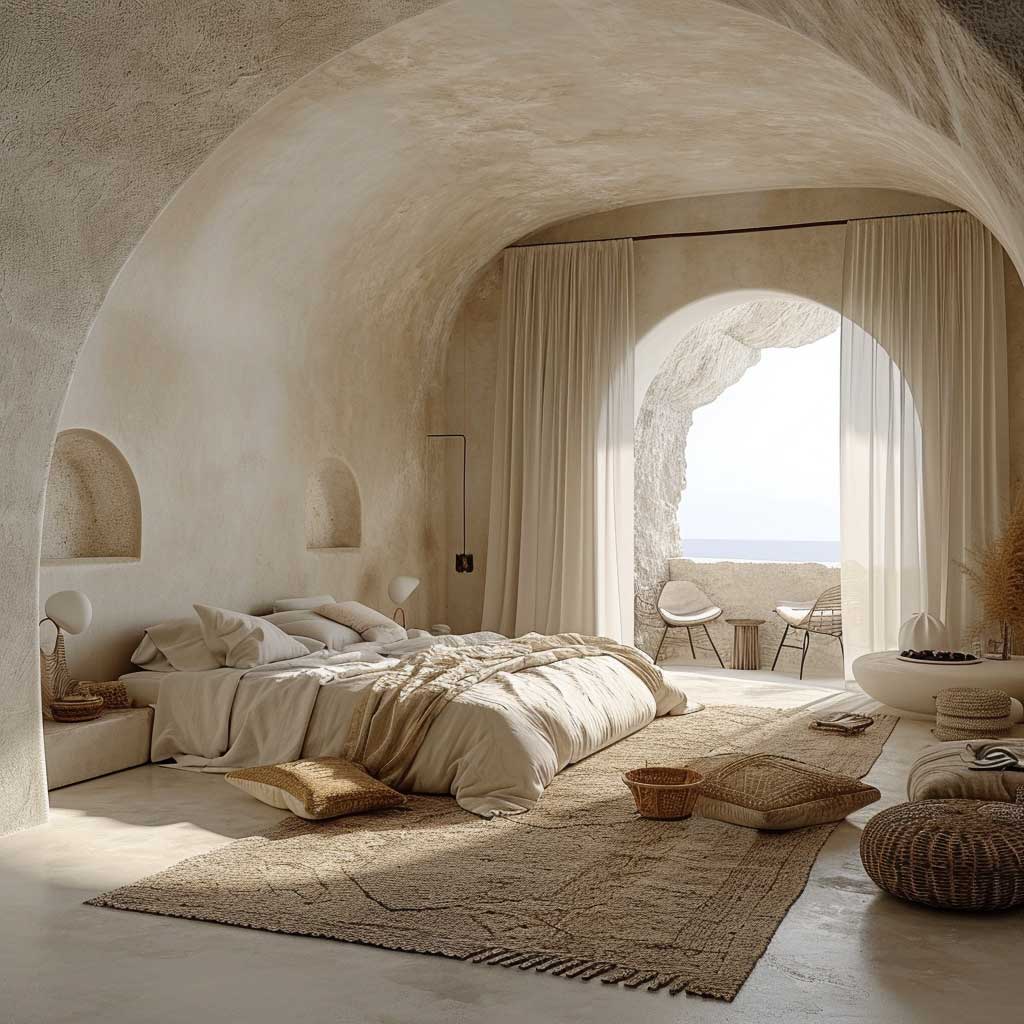
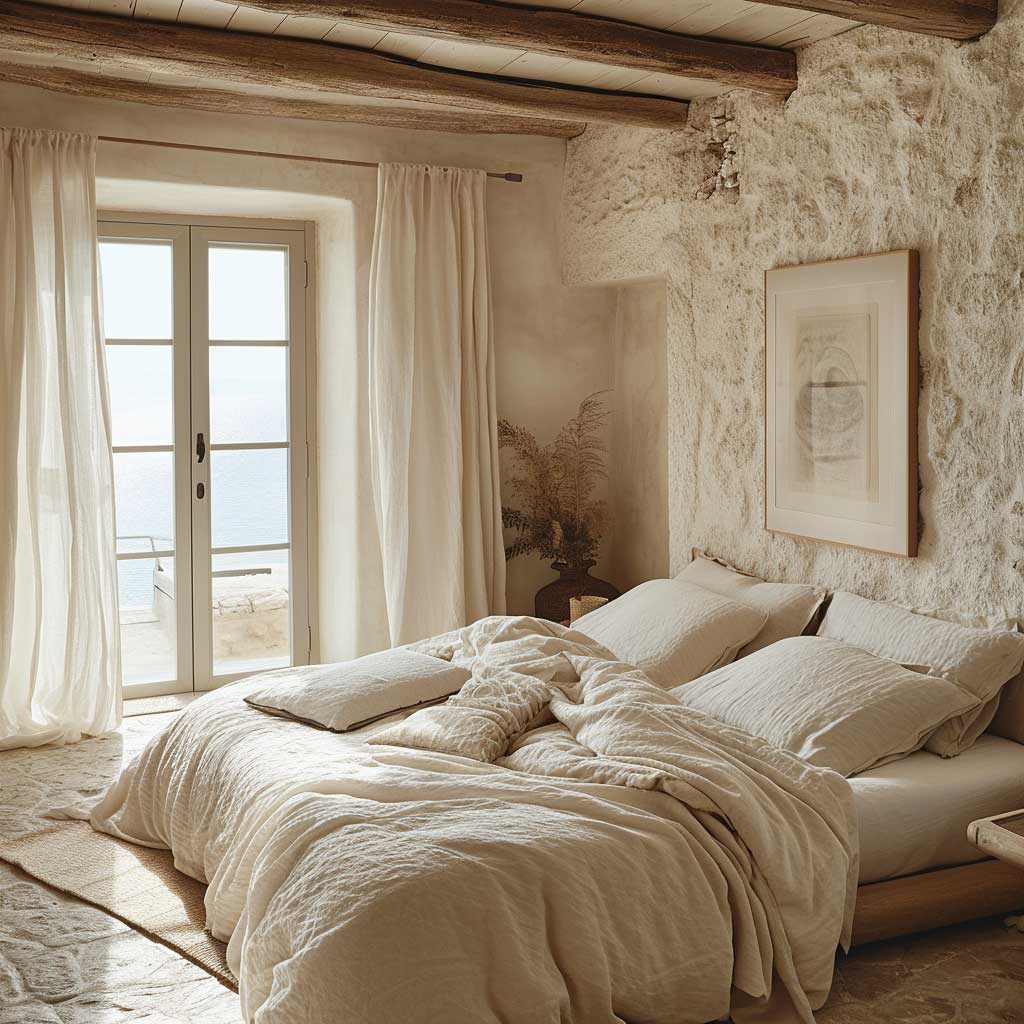
Decor in a Mediterranean minimalist bedroom is permitted exactly two expressions: one small ceramic object on the bedside table (handmade, unglazed, not printed), and one piece of art on the wall — ideally a simple abstract or a landscape with muted tones. Nothing framed in ornate gold. Nothing hung in a gallery arrangement. The art earns its place by adding one layer of warmth without introducing a new color or pattern into the room’s already settled logic. I own two pieces like this; both came from local ceramicists for under $80 each. Provenance matters less than restraint.
Sheer curtains in natural white linen — IKEA’s LILL at $9 per pair or similar weight from H&M Home — transform morning light into something worth waking up for. This is the Mediterranean bedroom’s specific gift: the way southern or eastern light filters through undyed fabric and lands warm on plaster walls. You cannot replicate this with blackout curtains and a lamp. The light is the design. Build the room around capturing it, and the rest of the choices — bed height, pillow count, floor material — become cleaner decisions almost automatically.
Final Word
Mediterranean Minimalism Has One Rule: Each Room Gets One Story
Living rooms get a two-color palette and a single material mix of linen, wood, and ceramic — the rest is light doing the work.
Kitchens get one strong material decision (stone counter, unglazed tile floor) and a permanently cleared counter. Everything else follows from those two calls.
Bedrooms get the simplest brief of all: subtract until the morning light through a sheer curtain becomes the most interesting thing in the room.
Save this post before you start editing.