Minimalist loft interior design is not about living with less — it’s about living with exactly what earns its place. I’ve visited dozens of loft apartments and the ones that feel genuinely spacious share one thing: every surface, every piece of furniture, every material was chosen with friction. The empty wall isn’t neglect; it’s a decision. The concrete floor isn’t unfinished; it’s the finish. That’s what separates a minimalist loft from a room that just happens to have nothing in it.
You’ll notice the difference the moment you walk in. A Muuto Outline sofa in warm gray anchors the room without asking for attention. A single Artek pendant at 200 cm drop does more for the atmosphere than a whole ceiling of recessed lights ever could. My go-to reference point is always the same: if you could remove it and not miss it, remove it first.
The three rooms covered here — living room, bedroom, and kitchen — each solve a different problem that open-plan loft spaces create. Raw square footage is not automatically a gift. Without deliberate structure, a 70 sqm loft just looks like a warehouse with a bed in it. Minimalist loft interior design is the architecture you add after the walls are up.
- Minimalist loft living rooms work because furniture placement replaces walls as room dividers — one sofa, one rug, one low table is the full formula.
- The minimalist loft bedroom needs a platform bed under 30 cm height and zero nightstand clutter — a wall-mounted Gubi bedside lamp at $195 does the job of an entire side table.
- A minimalist loft kitchen survives on handleless cabinetry, an induction cooktop (Bosch Series 6, around $900), and one statement pendant — everything else is unnecessary.
- Color palette across all three rooms: white, warm gray, and one natural material (oak, concrete, or linen) — never two accent colors at once.
- The biggest mistake in minimalist loft design is buying “minimal-looking” furniture in too many different wood tones. Pick one and repeat it.
What a Minimalist Loft Living Room Actually Costs to Get Right
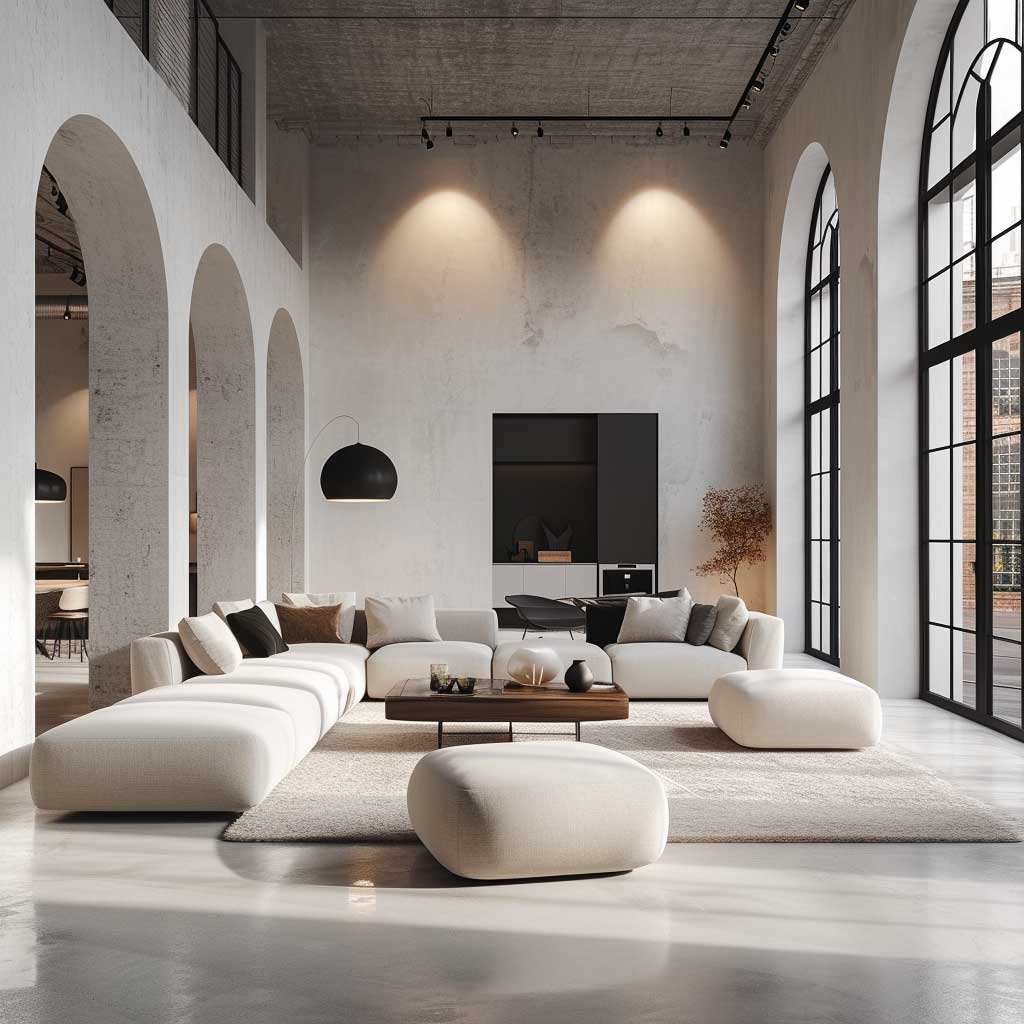


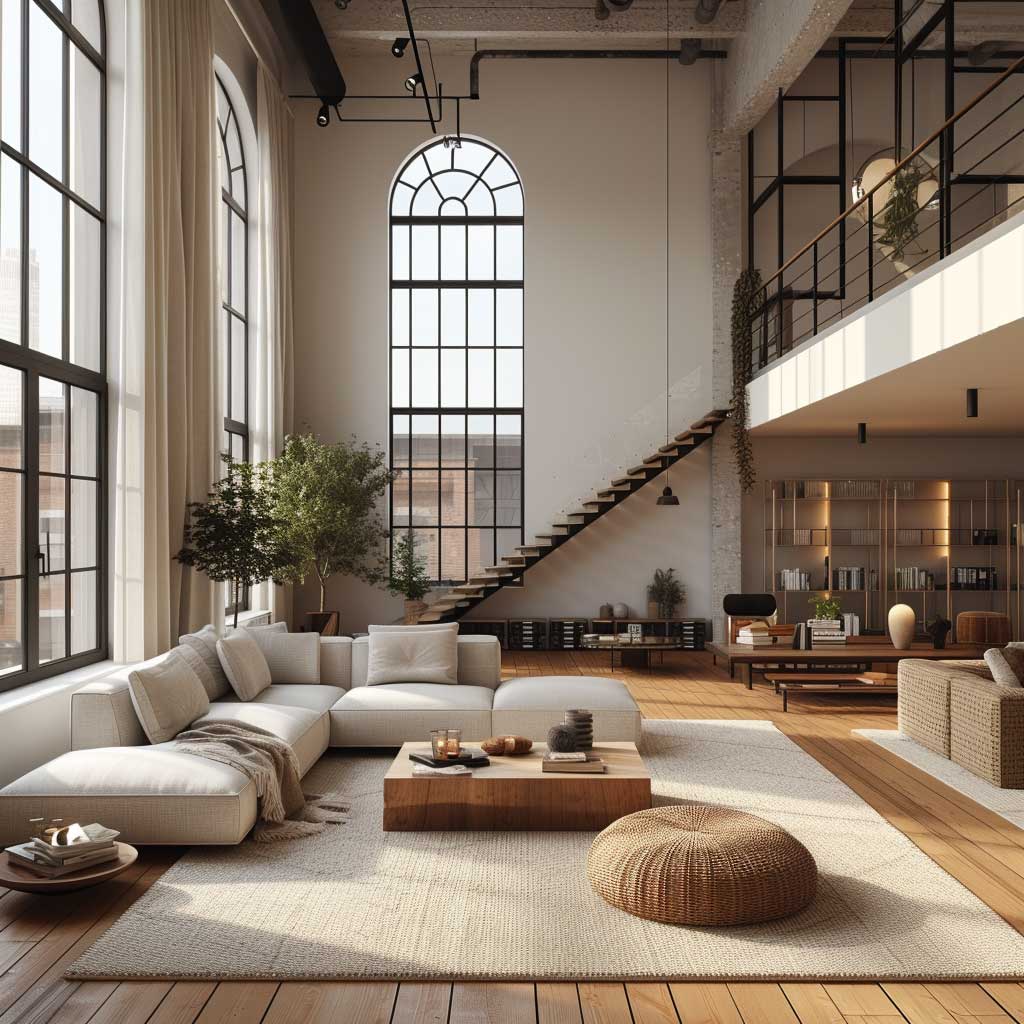
Minimalist loft interior design in the living room lives or dies by the sofa choice. I’ve made the mistake of buying a sectional for an open-plan space — it ate the room alive. The correct move is a two-seat or three-seat sofa with legs, never a floor-hugging chesterfield, because legs create visual breathing room underneath. HAY’s Mags Soft in light gray runs about $2,800 and works in almost any minimalist loft I’ve seen. Pair it with a smoked oak coffee table (Menu Passage, $490) and you’re done with seating — full stop.
Does a minimalist loft living room need a rug? Yes — and this is where most people get it wrong. A rug defines the zone where the sofa sits. Without it, the furniture looks like it got dropped from a moving truck. The rug should be large enough that the front legs of all seating rest on it — typically 240 x 170 cm minimum in a loft. Natural jute or undyed wool keeps the palette honest. Beni Ourain rugs from Morocco average $400–$700 for that size and photograph brilliantly against polished concrete, which is the other detail I keep coming back to: in a minimalist loft living room, the floor is a design element, not a substrate.
Artwork follows the same logic as furniture — one large piece outperforms three medium pieces every time. I stole this trick from a Berlin loft I visited in 2022: a single 120 x 90 cm black-and-white photograph by a local photographer, unframed, mounted flush to the wall. It cost $350 and made the room feel curated without feeling decorated. The trap is filling vertical space to avoid the discomfort of emptiness. That discomfort is the point — it’s what makes the room feel like a loft and not a showroom.


Lighting in a minimalist loft living room should never come from overhead downlights alone — they flatten the room and kill the texture of every natural material you’ve invested in. My setup: one floor lamp (Flos Arco, $1,500, yes it’s worth it) and two wall sconces with warm 2700K bulbs. No RGB, no dimmers with 14 presets. The goal is a room that looks the same at 7 pm as it does in a lifestyle magazine. Consistent warm-white light at multiple heights achieves that; recessed ceiling grids do not. For external inspiration on loft lighting principles, Dezeen’s loft design archive documents how architects approach the problem across real projects.
The minimalist loft living room is also where people over-buy plants. One large fiddle-leaf fig or a rubber plant in a concrete planter earns its place as a living material contrast to the hard surfaces around it. Four small succulents on a shelf do not. Scale matters as much in plant selection as it does in furniture — a single specimen that hits 150 cm tall reads as a design decision; a collection of tiny pots reads as indecision. If you’re looking for more room-by-room ideas for loft living spaces, this roundup of loft living room designs covers five distinct approaches worth comparing.
Minimalist Loft Bedroom Sleep Quality Is Directly Proportional to What You Remove


The minimalist loft bedroom starts with the bed platform height. I own two platform beds — one at 18 cm, one at 27 cm — and the lower one wins every time in a loft setting. A low bed makes the ceiling read taller, which is already the loft’s structural gift to you. The IKEA Neiden frame at $79 with a Tuddal slat base gets you to 22 cm total for under $150. If you want to spend more, the Ethnicraft Shadow bed in solid oak runs $1,800 and is the piece you’ll still want in fifteen years. The bedding goes white or warm linen — that’s it. My go-to is Tekla’s percale duvet cover at $295, which photographs as well as it sleeps.
What the minimalist loft bedroom cannot have is the standard double nightstand setup with matching table lamps. It turns a loft bedroom into a mid-range hotel room — which is the opposite of the feeling you’re creating. Replace both nightstands with a single wall-mounted shelf at mattress height plus one Gubi BL5 wall lamp ($195) on the reading side. The other side stays empty. That asymmetry reads as intentional design rather than incompletion, which is the entire psychological game of minimalist interiors.
Color here should be even more restrained than the living room. Soft white walls with one wall in warm plaster (Benjamin Moore HC-172 Revere Pewter works if you want a warm gray) give the bedroom enough depth without pattern or texture overload. The common mistake I see is adding a statement wallpaper wall “because the room needs personality.” It doesn’t need personality — it needs quiet. The bedroom’s only job is to help you sleep. Every decorative decision should serve that goal first. A 2023 sleep study from Monash University found that rooms with lower visual complexity produced measurably shorter sleep onset times, which is the science version of “stop putting stuff on your walls.”
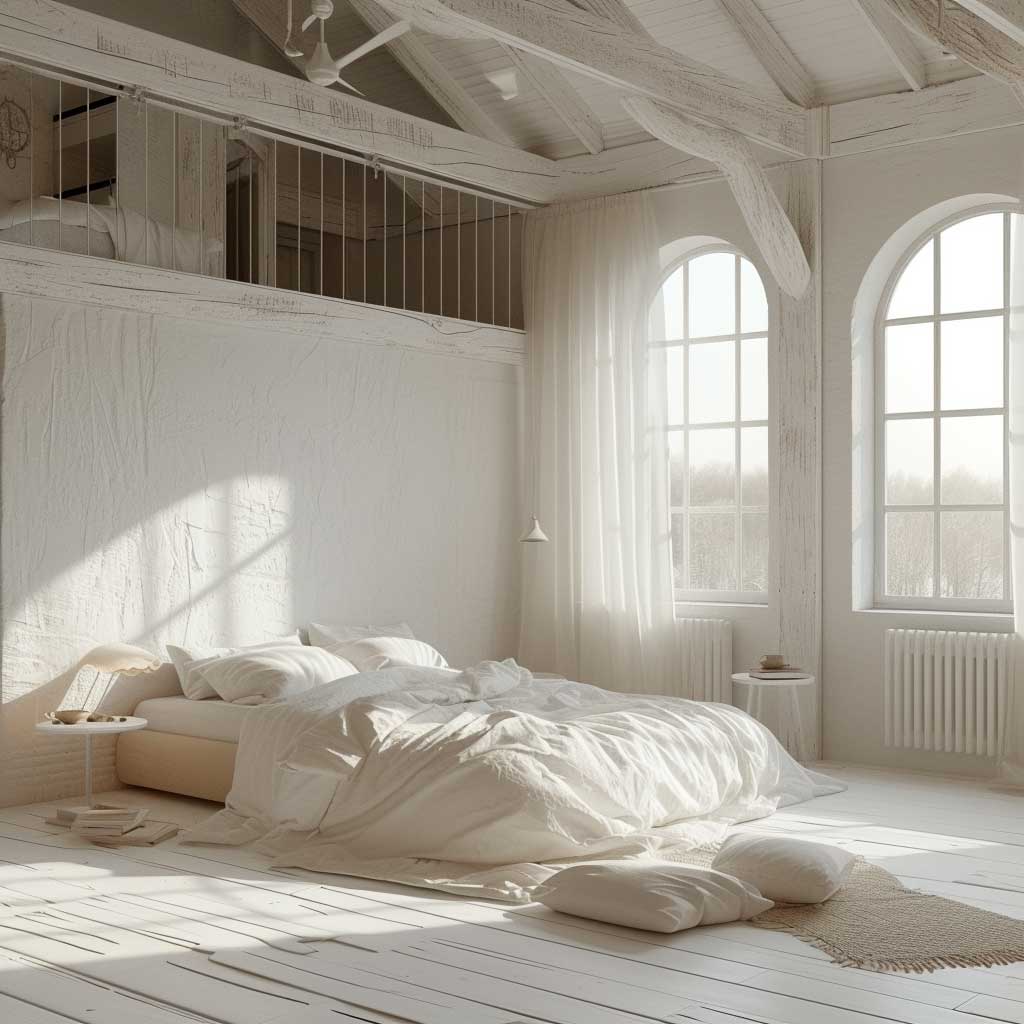


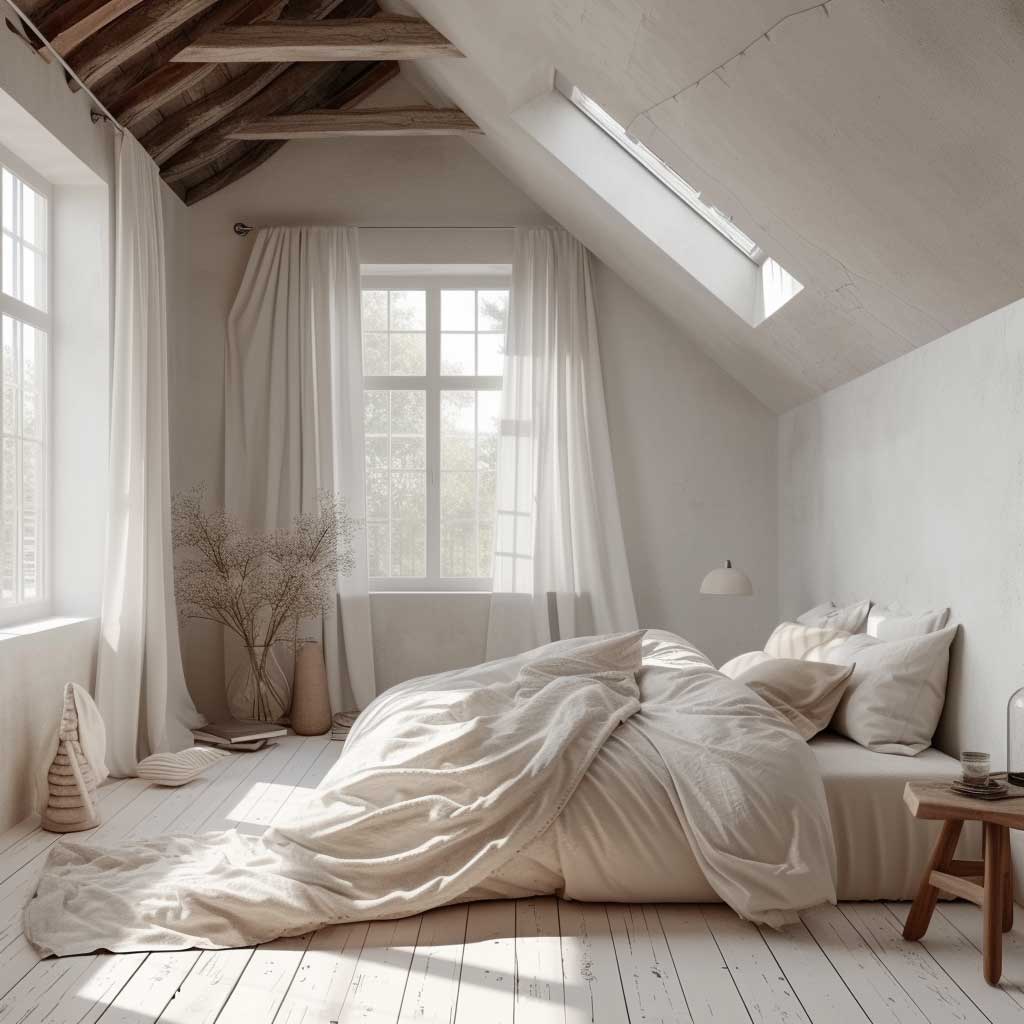
Storage in a minimalist loft bedroom is the hidden structural challenge — because lofts rarely come with built-in wardrobes and a freestanding armoire breaks the visual plane immediately. The correct move is a floor-to-ceiling built-in with slab fronts (no handles, push-to-open hardware) in the same color as the wall. PAX from IKEA with custom fronts from Superfront runs about $600–$900 for a full wall and disappears completely. Under-bed storage using shallow pull-out drawers adds another 60+ liters without showing. You’ll notice after living in a properly configured minimalist loft bedroom for three months that your morning decision time drops noticeably — fewer objects in view means fewer micro-decisions before 9 am.
Window treatment in a minimalist loft bedroom: roller blinds in blackout linen, mounted to the ceiling line — not the window frame. Ceiling-mount makes the window look taller and keeps the wall surface uninterrupted when the blinds are up. Luxaflex Duette blinds at $180–$300 per window are my go-to, but Ikea Praktlilja blackout roller at $25 does the same functional job if budget is the constraint. For more ideas on how loft bedrooms handle space and storage across different design styles, this breakdown of loft bedroom approaches is worth reading alongside this one.
Minimalist Loft Kitchen — The Appliances You See Are the Decoration
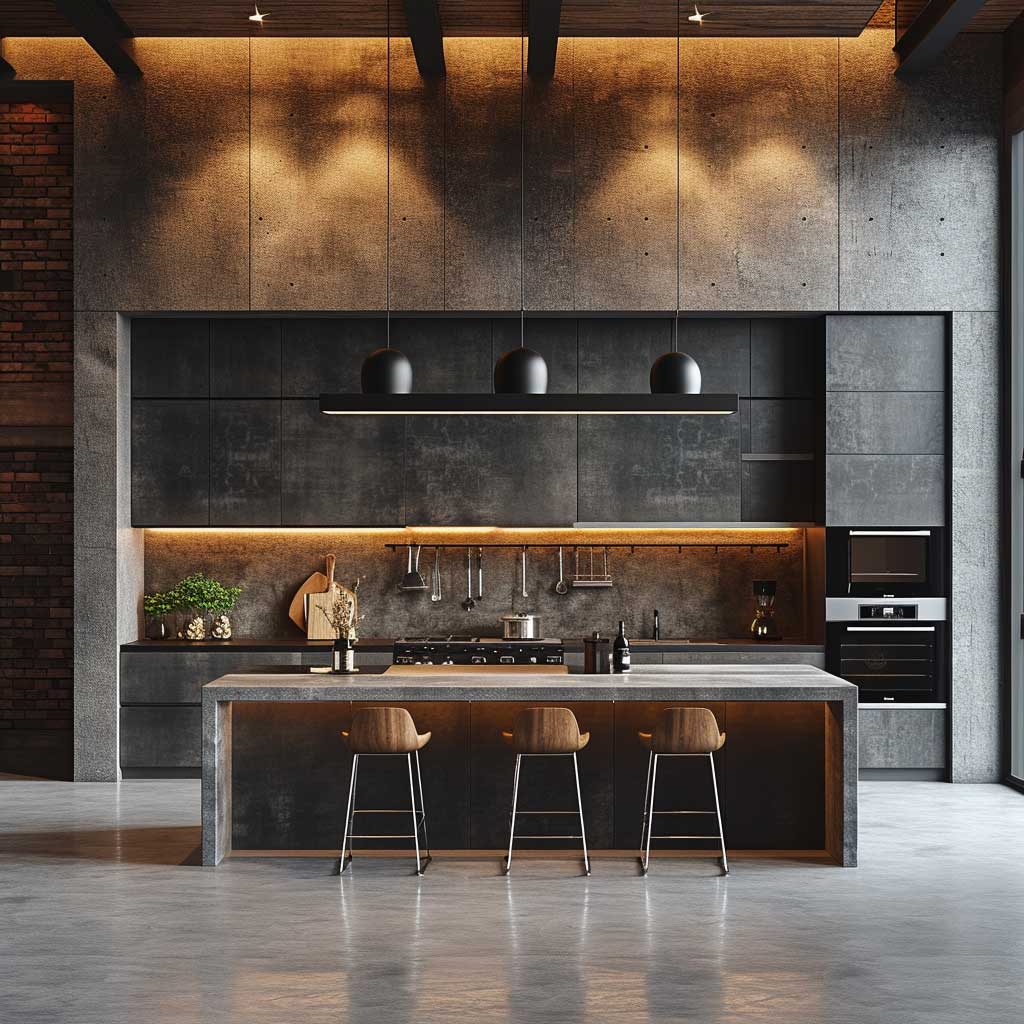


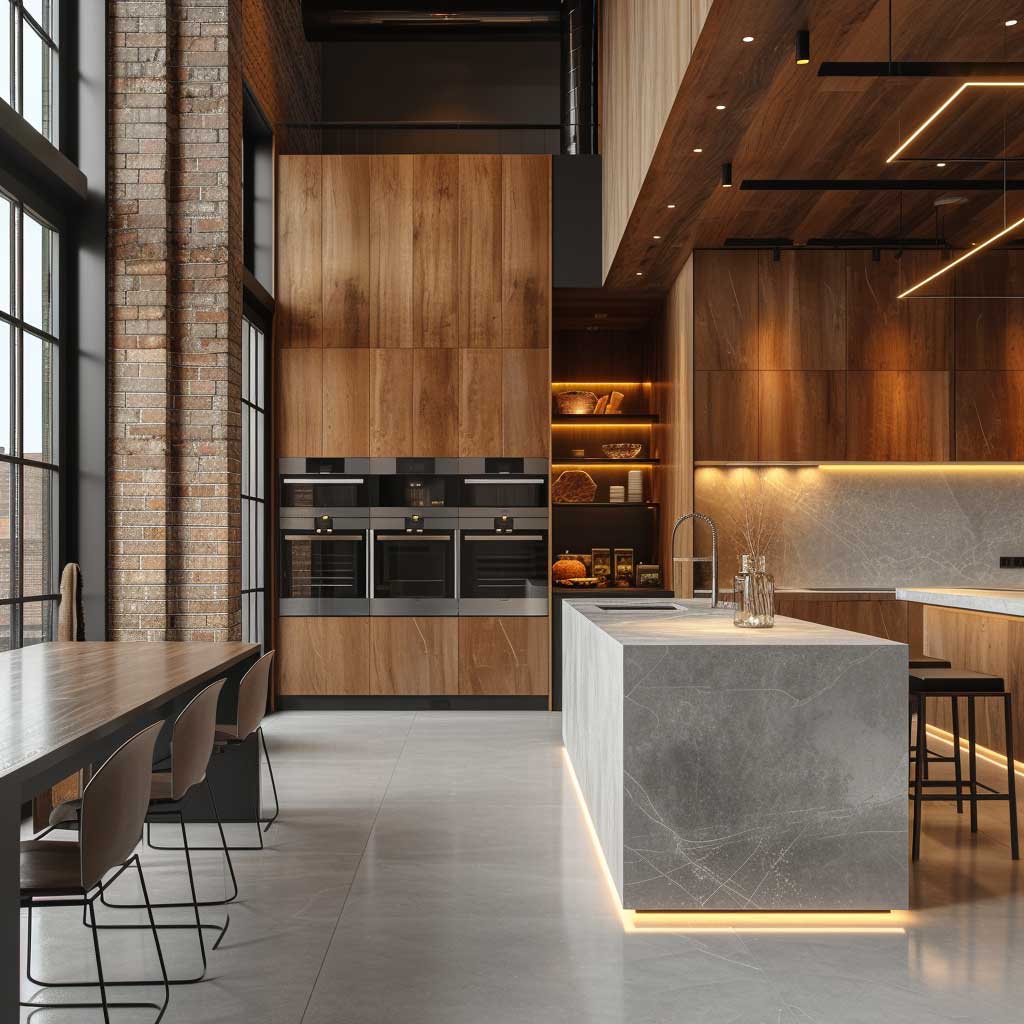
A minimalist loft kitchen works on one rule: if it lives on the counter, it has to be worth looking at. That means your appliances are the decor. I have a Smeg kettle in matte black ($130) and a Nespresso Vertuo Next in aluminum ($150) on my counter — full stop. Everything else is inside a cabinet. The Bosch Series 6 induction cooktop (PVS651FB5E, around $900) sits flush with the counter and has no visible knobs — the controls are touch-operated and disappear when not in use. That flush integration is what separates a minimalist loft kitchen from a regular kitchen that happens to have white cabinets.
Handleless cabinetry is non-negotiable in a minimalist loft interior design kitchen. Push-to-open or J-pull profiles eliminate the visual noise of hardware — a detail that sounds minor until you see the before-and-after. Ikea Voxtorp matte white doors ($1,200–$1,800 fitted) are the affordable path. Bulthaup B1 is the benchmark product — around $15,000–$20,000 for a full kitchen — but you’re buying the same principle: no hardware, no visual interruption, surfaces that read as a single continuous plane. The countertop material matters just as much. Honed Calacatta marble at $200/sqm is the magazine version; poured concrete at $80–$120/sqm is the loft-authentic version and handles scratches better than marble in a working kitchen.
- Open shelving above the cooktop. It looks editorial for three days and then becomes where you store things that don’t fit anywhere else. I’ve watched it happen in six different loft kitchens.
- Mixed cabinet finishes. Upper cabinets in white plus lower cabinets in wood plus an island in a third material is not contrast — it’s confusion. Pick one finish and repeat it.
- Exposed spice racks on the counter. A row of mismatched spice jars is the single fastest way to make a minimalist kitchen look cluttered. Decant into identical magnetic tins (Zeller, about $30 for a set of 12) and mount inside a cabinet door.
- Pendant lights with visible cord and plug. Hardwired pendants only. A visible cord from a ceiling hook telegraphs “temporary” in a space that should feel permanent and intentional.
Storage planning in a minimalist loft kitchen is where the real work happens. Pull-out drawer inserts (Blum Tandembox at $80–$150 per unit) eliminate the black hole of deep lower cabinets. A pull-out pantry column — 30 cm wide, full height — holds more than a standard corner carousel and you can actually see everything in it. The goal is zero counter-to-cabinet migration: every small appliance has a dedicated home with a dedicated power point inside the cabinet, so it never has to come out unless it’s being used. My bread maker lives in a lower cabinet wired with an interior socket — I haven’t moved it to the counter in two years.
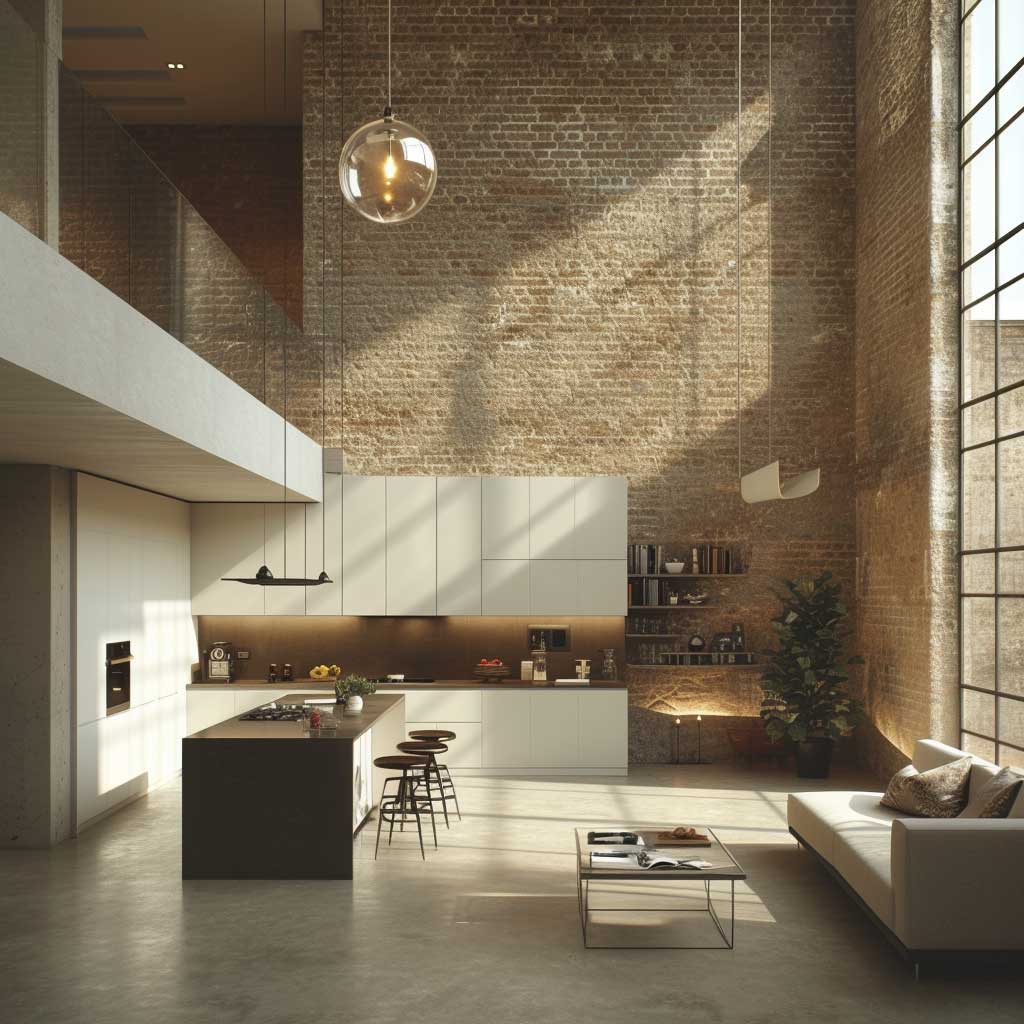


Lighting in a minimalist loft kitchen follows a two-layer rule: task and accent. Under-cabinet LED strips (Philips Hue Lightstrip at $80 per meter) for task lighting — warm white, 2700K, not daylight — and one or two pendant lights over the island for atmosphere. The pendants need to be on a separate circuit from the task lights so you can cook with full brightness and eat with ambient warmth. Tom Dixon’s Beat pendant in brass ($345) works at most ceiling heights above 280 cm. For lower ceilings, the Muuto E27 pendant ($195) hangs tighter and reads as intentional rather than compressed. The trap most people fall into is buying a pendant set of three — three pendants over an island looks like a design decision made by committee; one pendant, off-center, looks like a choice. For more on small-space kitchen approaches specific to loft environments, this urban loft kitchen breakdown covers the arrangement logic in detail.
What most minimalist loft kitchens get wrong is the backsplash. White subway tile — the default move — is not minimalist; it’s just common. A truly minimal backsplash is the same material as the countertop, extended up the wall 60 cm, no grout lines, no joints. Poured concrete or large-format porcelain at 120 x 60 cm with thin-set and polished grout achieves this. It costs roughly the same as a quality tile installation but reads as one continuous plane — which is exactly the visual grammar that makes minimalist loft interior design work across every room in the apartment.
The Takeaway
Minimalist Loft Interior Design Pays Off in the Rooms You Use Most
Spend on the sofa, the bed, and the cooktop — these are the three objects you interact with for hours every day. The rest of the budget goes into built-in storage and proper lighting circuits, not decorative objects.
A minimalist loft done right requires four decisions, not forty: one sofa, one bed, one countertop material, one cabinet finish. Everything else follows from those anchors.
The rooms that photograph best in minimalist lofts are the ones with the highest ratio of empty space to objects — not the ones with the most carefully curated objects. Save this post.