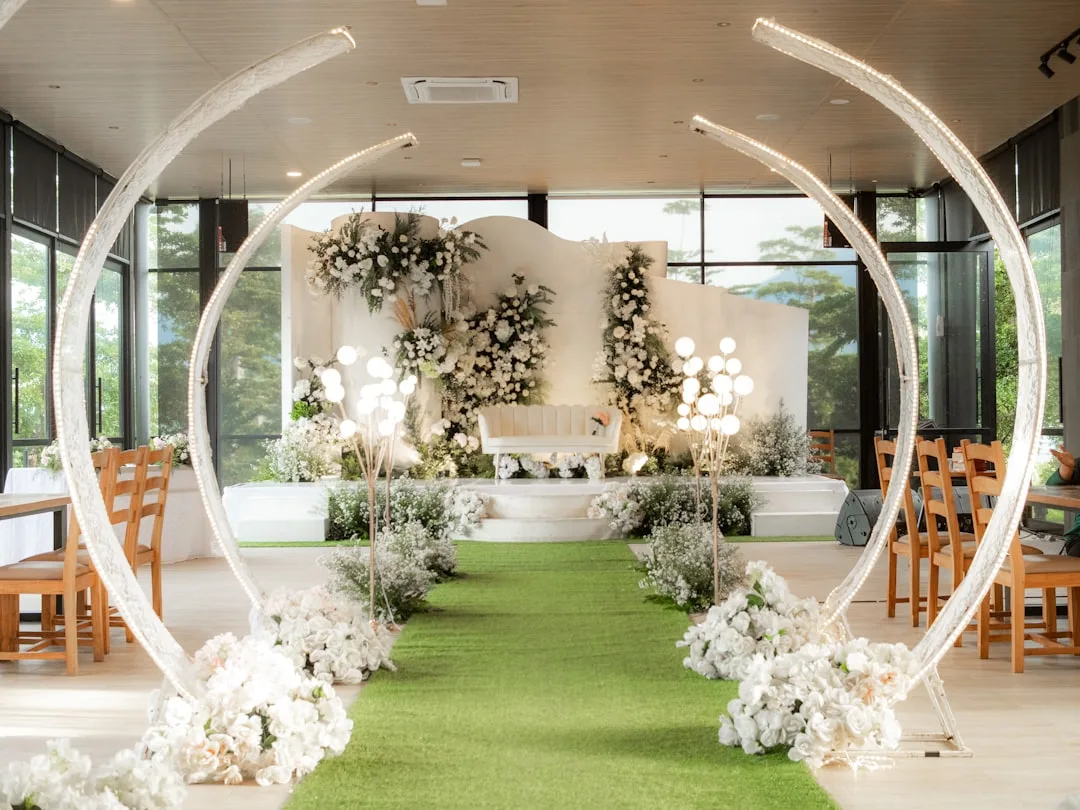
A black and white wedding theme does one thing color palettes can’t: it makes every photograph feel like it was shot on film in 1962, even if it was taken on a Sony A7 last Saturday. I’ve attended dozens of weddings over the years, and the ones I still pull up on my phone are never the pastel-sage spreads or the dusty blue centerpieces. They’re the black tuxedo, white gown, monochrome dance floor shots that look like stills from a Hitchcock film. That contrast doesn’t just look good — it engineers the photograph before the shutter even clicks.
You’ll notice the difference the moment you see a side-by-side: a color reception shot feels document-worthy, a monochrome version feels cinematic. The reason is physics, not nostalgia. When you strip color from an image, the viewer’s eye goes directly to light, shadow, and human expression. Your guests’ faces, the lace texture on the gown, the way chandeliers throw shadows across a white tablecloth — all of that reads at twice the intensity without competing hues in the frame. Photographers who specialize in documentary work will tell you: the black and white wedding theme isn’t a style choice, it’s a photography strategy.
Every element of this theme — attire, cake, invitations, reception decor — compounds that photographic advantage. Build it right and even your phone snapshots look like editorial spreads. Build it wrong (more on that below) and the whole palette flattens into gray mush. Here’s what actually works.
- A black and white wedding theme creates high contrast that makes monochrome photography dramatically more powerful than color shots in the same venue.
- Bride’s attire: white gown with lace or embroidery detail — texture reads 3x stronger in monochrome than satin or crepe. Groom: slim-cut black tuxedo, not charcoal.
- Reception decor anchors: black and white checkered dance floor, crystal glassware, white peonies or gardenia in black vessels.
- Wedding cake: fondant-based tiers with black brushstroke or geometric detail outperform buttercream for monochrome photography.
- Invitations: letterpress or engraved printing on cotton paper — not laser-printed, which photographs flat.
- Photography brief: ask your photographer to shoot RAW and convert selectively; never batch-desaturate the whole gallery.
What the Bride and Groom Actually Wear in a Black and White Wedding Theme


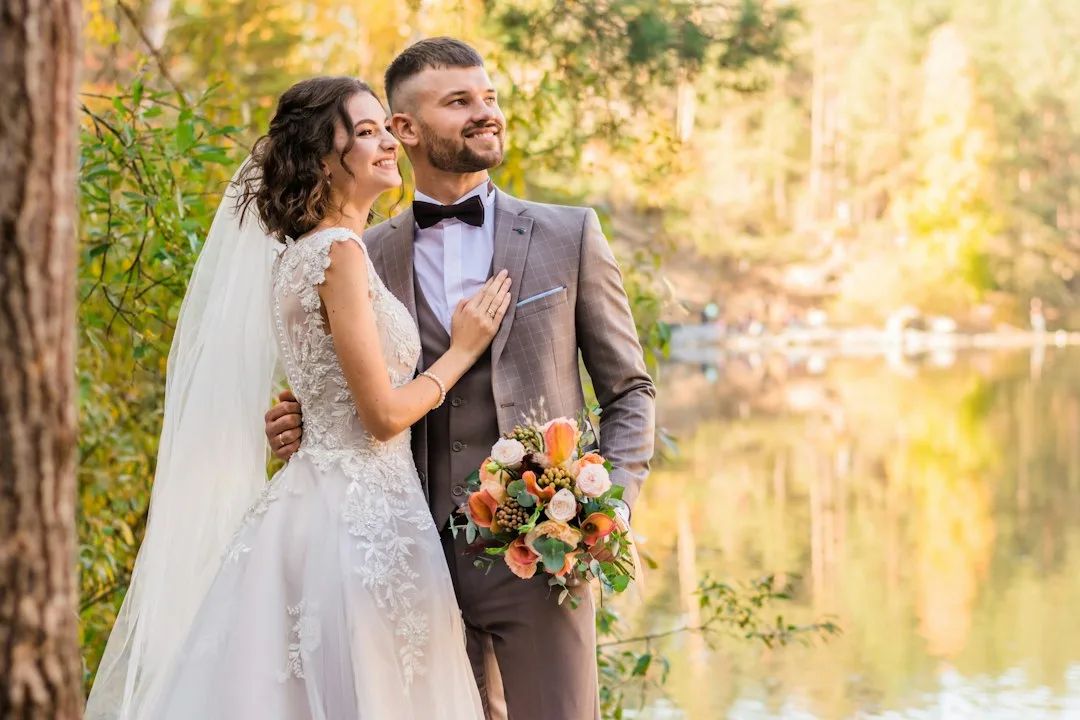
Vera Wang’s lace column gowns and Monique Lhuillier’s embroidered A-lines — both around $4,000–$8,000 at trunk shows — are my personal benchmark for black and white wedding theme attire because the texture density is exactly what monochrome photography needs. A plain satin gown photographs as one flat shape in black and white; a lace overlay breaks into hundreds of micro-shadows that give the image depth. Want a budget version? BHLDN’s “Willowby” line runs $800–$1,200 and uses chantilly lace that photographs identically to designer options. The one mistake I see constantly is brides choosing ivory silk crepe because it feels luxurious in person — in monochrome, ivory and white become indistinguishable, and crepe photographs as a smooth, featureless blob.
For the groom, the choice is binary and that’s where people get it wrong. Charcoal suits photograph as dark gray, not black — they lose definition against white decor and blend into shadows rather than contrast with them. You need true black: a slim-cut tuxedo from Suit Supply ($599 for the Napoli tux) or Ralph Lauren’s Black Label line. I stole this trick from a wedding photographer friend: have the groom wear his jacket in direct window light and check the photo on your phone before the wedding day. If it reads as gray, it’s the wrong suit. Black should hold its depth even in full midday light.
Accessories are where the theme gains or loses its edge. White pocket square, black leather oxford shoes (Allen Edmonds Park Avenue, $395), and no colored tie — a deep charcoal or burgundy tie will photograph as a mid-tone that muddies the monochrome palette. Bridesmaids in pure white or true black, not silver, champagne, or “off-white blush.” Those in-between tones are the photographic equivalent of tuning a guitar to almost the right key: technically close, audibly wrong. Does the venue matter? Yes, and dramatically — more on that in the decor section below.
Reception Decor That Earns Its Keep in Monochrome


Black and white wedding theme reception decor lives or dies on one decision: the dance floor. A black and white checkered vinyl floor — rental cost runs $800–$1,500 for 20×20 feet through vendors like FloorFX or Party Reflections — acts as the photographic anchor for the entire room. Every wide shot has a built-in geometric pattern that gives structure to what would otherwise be a sea of round tables. I’ve seen couples skip this to save money and then spend twice as much on floral centerpieces trying to compensate for the visual flatness. The dance floor does more per dollar than any other single decor element in this theme.
Table settings: black linen napkins, white charger plates (not silver or gold — metallic plates photograph as mid-gray and lose all contrast), Riedel Vinum series crystal glasses ($30–$45 per stem). The florals that work best in this theme are white peonies, gardenias, and white ranunculus — all high-petal-count flowers that create texture masses in photographs. Avoid white roses alone. A single white rose head is too simple; it photographs as a white blob with no interior shadow. Mix three varieties minimum, with matte black vessels from CB2 or West Elm, around $20–$35 each. What doesn’t work: baby’s breath as filler. It photographs as visual noise — like static on an old television — and reads as cheap even in color, worse in black and white.
Lighting is the hidden element most couples underestimate. Chandeliers casting downward warm light create the shadows that make monochrome photography dramatic — like a drawing that shows form through cross-hatching. Uplighting in blue or purple, popular in many venue packages, is a disaster for this theme. Those hues photograph as mid-gray in black and white and flatten all the contrast you worked to build. Stick to warm tungsten-balanced lighting only, or ask your venue about neutral white pin spots aimed at each table center. I’ve attended black and white weddings where the venue’s default LED uplighting package turned a potentially editorial reception into a flat corporate event.
Silver or gold metallic accents — charger plates, mercury glass votives, sequined table runners — photograph as mid-tones in monochrome and destroy the high-contrast foundation of a black and white wedding theme. I’ve seen Pinterest boards for this theme that are 80% metallics. In real photographs, those tables look gray and muddy, not glamorous. The same applies to “blush” as a third accent color. Blush photographs as a pale gray that’s neither black nor white, creating a visual third zone that confuses the eye. If you want warmth, use texture instead of color: linen napkins, textured white wallcovering, matte black candle pillars, cut-crystal glassware. Texture reads as depth. Color reads as distraction.
If you’re planning a related aesthetic, wedding party decorations with elegant minimalism apply directly here — the same principle of restraint that makes minimalist decor work is what makes a black and white theme pop in photographs.
Black and White Wedding Cake Details That Actually Photograph

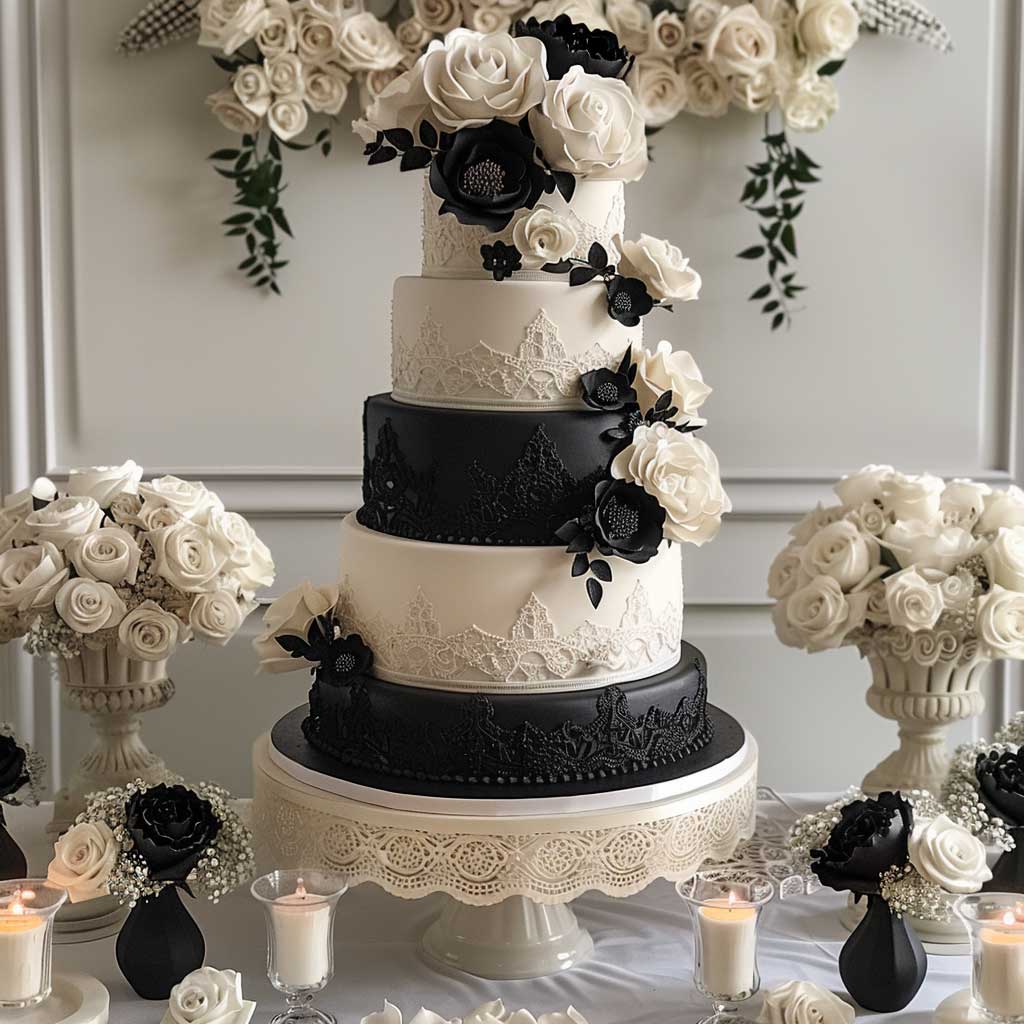
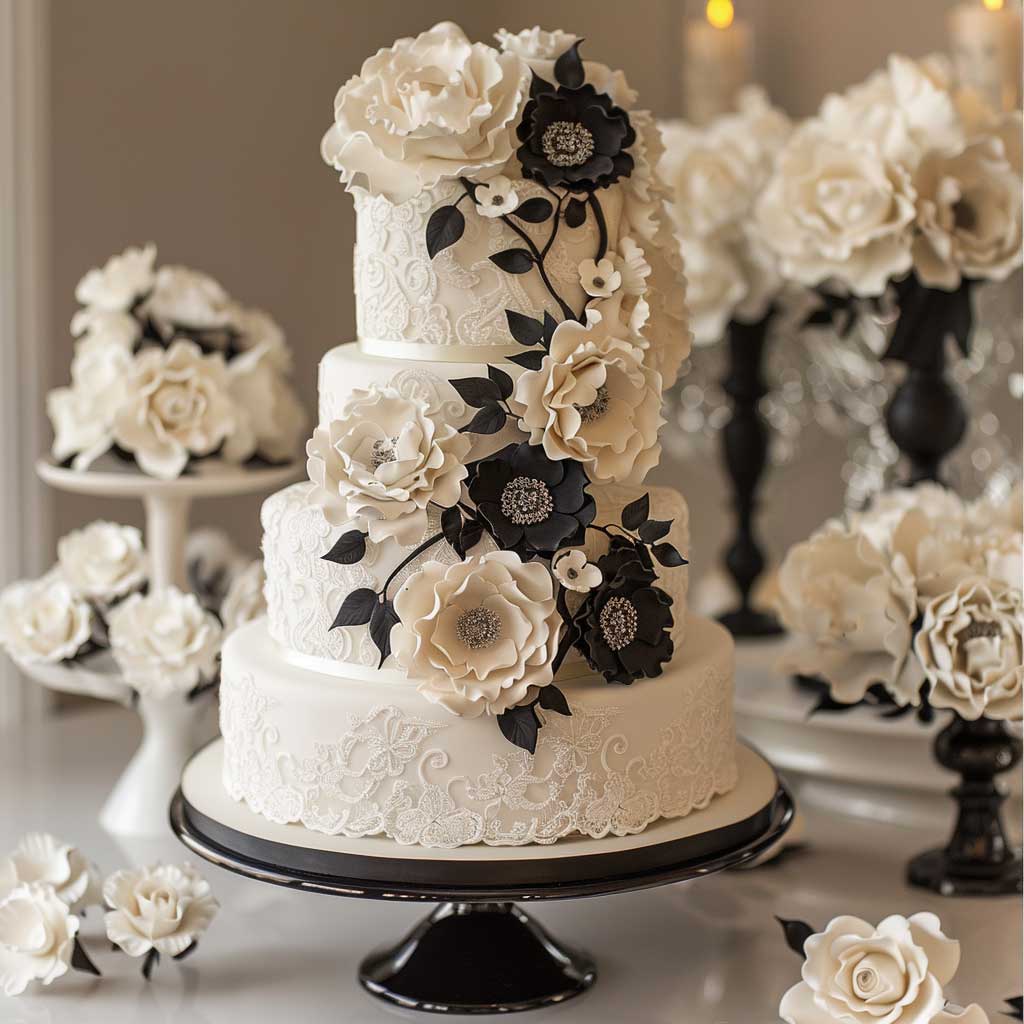

The wedding cake in a black and white wedding theme is one of the few places couples routinely make the wrong call for the right reason. Buttercream is delicious. It’s also photographically dead. A smooth buttercream finish, especially in white, photographs as an unmarked white cylinder with no surface interest — all that piping detail your baker promised? It’s invisible at three feet in a reception photograph. Fondant is what you want: it holds edge detail, accepts black food paint cleanly, and photographs with genuine depth. Expect to pay $12–$18 per slice for fondant work from a skilled pastry shop versus $7–$11 for buttercream.
The design approaches that work: black geometric banding (think Art Deco chevron or graphic stripe) on a white tier, black brushstroke painting from someone like a Sylvia Weinstock-trained baker, or pressed sugar flowers in white with black stamens at the center. Three tiers minimum — a two-tier cake photographs as short and squat and doesn’t fill the frame the way a tall three or four-tier does. The cake table itself matters: a black marble cake stand (available from Etsy sellers for $80–$150) gives the base photograph ten times more visual interest than a white ruffled fabric stand. Pair with three to five white gardenia stems in a bud vase, not a full arrangement — you don’t want the flowers competing with the cake for focus.
Does the flavor need to match the aesthetic? Of course not — and anyone who tells you it does is selling something. I’ve tasted a black-and-white-themed cake with a Meyer lemon curd filling and it remains one of the best wedding cakes I’ve had. The flavor lives on your tongue; the design lives in photographs for sixty years. Prioritize both on their own terms. One unexpected detail worth knowing: black fondant contains significantly more pigment than white, which means it stains lips and teeth in a way that shows clearly in monochrome close-up shots. Have your photographer avoid extreme cake-cutting close-ups, or warn the couple to pat lips before the formal portraits resume.
Invitation Suites That Set the Black and White Wedding Theme Tone Before Guests Arrive
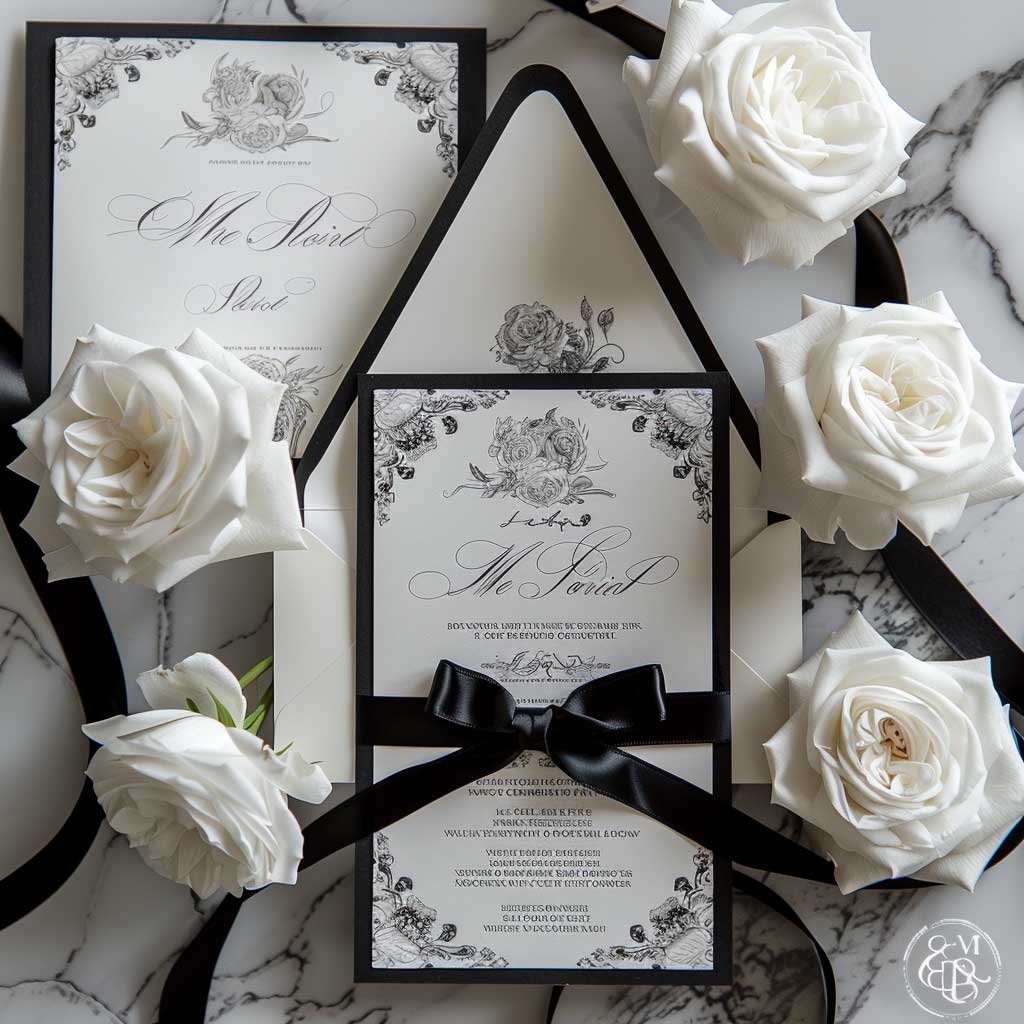


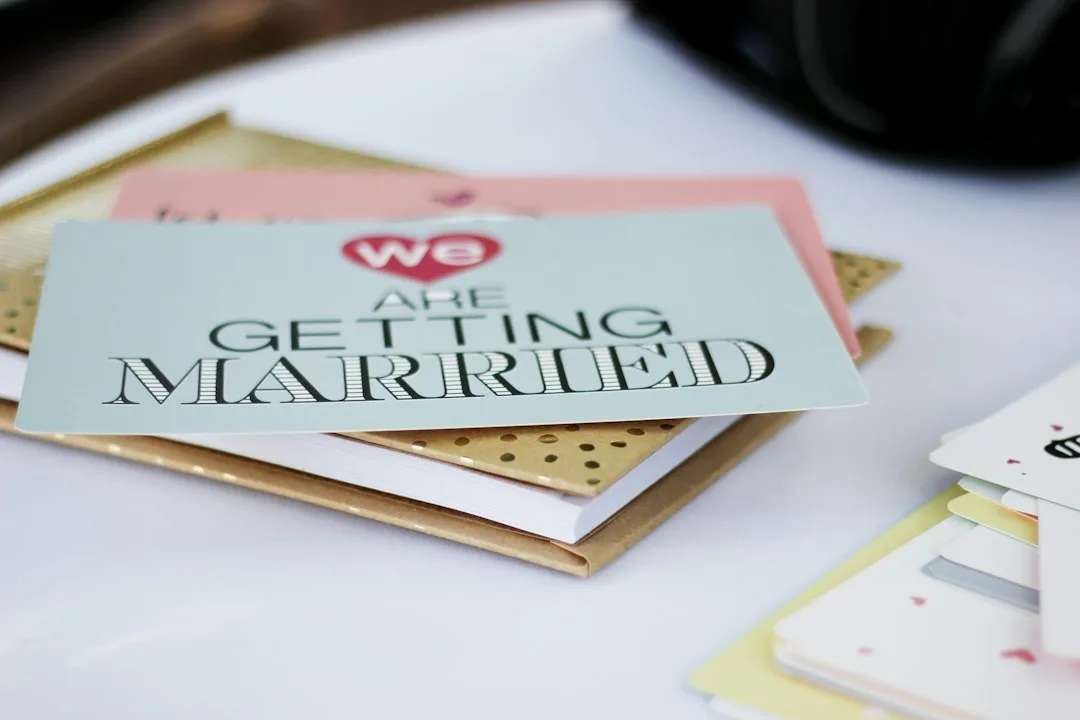
Minted, Artifact Uprising, and Papier all offer black and white wedding invitation suites, and in my experience the results are predictably flat. They’re all digitally printed on bright white stock, which means the black ink sits on the surface rather than pressing into the paper — guests hold the invitation and there’s zero tactile feedback that this event is going to be worth dressing for. My go-to recommendation: letterpress or engraving on Crane & Co. cotton stock, which runs $4–$9 per card but feels and photographs entirely differently. The impression depth — that slight physical indentation the ink leaves — creates micro-shadows that no digital printing can replicate.
Typography and illustration choices matter more than people realize. A condensed serif font (like Hoefler Text or Cormorant Garamond) reads as formal without being stiff; paired with a hand-drawn botanical illustration in black ink, it signals “editorial” rather than “template.” Avoid script-only designs — calligraphy-only invitation suites read as wedding-generic in this theme. You need at least one graphic element that communicates the black and white wedding theme directly: a border, a geometric motif, a custom monogram in a bold sans-serif. That graphic element becomes the visual connector between the invitation your guests received and the decor they walk into at the reception.
The envelope liner is where I’ve seen the smartest couples spend an extra $50–$100 on their full run. A black-striped or black-marble-printed envelope liner means the moment your guest opens the envelope, they already know what visual language the day will speak. White wax seal with the couple’s initials on the outer envelope — not black wax, which photographs beautifully but smudges in transit. Does that seem like an overthought detail? My rule: the invitation is the one physical object from your wedding that guests keep and look at before the day. It’s doing more image-building work per square inch than anything else in the budget. For contrast on how a color-led wedding theme handles the same invitation decisions, this burgundy wedding theme breakdown is worth reading alongside.
Expert photographers note that black and white wedding photography removes color distractions so the viewer’s focus goes directly to light, shadow, and human expression — which is exactly why invitations with physical texture and ink depth photograph so differently from flat-printed cards. The Bell Tower on 34th’s photography resource is the clearest explanation I’ve found of why black and white wedding photography creates images that feel timeless rather than dated.
The Bottom Line
A black and white wedding theme doesn’t just look elegant — it actively makes every photograph more powerful.
Contrast is the mechanism: true black against pure white, texture instead of color, tactile materials over smooth surfaces. That’s the through-line from the gown to the cake to the invitation.
Skip metallics, avoid colored uplighting, and never let your baker talk you into buttercream for a fondant-worthy design. The details that save money often cost you the photographs.
Save this post before you meet with your photographer or florist — it’ll change the questions you ask.
Related Topics
FAQ
What is a black and white wedding theme?
What flowers work best for a black and white wedding theme?
What should the groom wear to a black and white wedding?
What kind of cake works for a black and white wedding theme?
How should I brief my photographer for a black and white wedding?
Does a black and white wedding theme work for outdoor ceremonies?
Complete guide
Wedding Ideas That Turn Every Detail Into Something Worth Remembering
Ceremony, décor, themes, guest outfits, hairstyles, cakes, stationery — all in one place