An L-shaped house with pool works as architecture precisely because the geometry does the privacy work for you. The two wings wrap around the water like cupped hands — no fence required, no neighbors staring at your morning swim. I’ve spent hours studying these projects and the ones that photograph well at every hour share one non-negotiable: the pool lives in the interior corner, not pushed to the property edge like an afterthought.
You’ll notice something immediately in the photos below. The water isn’t a separate amenity tacked onto the house — it reads as another room. That’s the whole point of this configuration. Architects at firms like Studio Gabriel Garbin Arquitetura have built entire reputations on exactly this relationship between the L-form and a courtyard pool, and the results are consistently more private and more dramatic than any rectangular house-plus-pool combo at a similar budget.
In these photos you’ll see:
- How an L-shaped house with pool looks at three different times of day — sunset, morning, and dusk
- Why the pool placement in the interior corner creates natural privacy without added structures
- Minimalist deck and landscaping details that hold up under changing light
- The specific outdoor furniture and plant choices that keep the monochrome palette from going flat
The Sunset Hour Reveals What Your Pool Placement Got Wrong
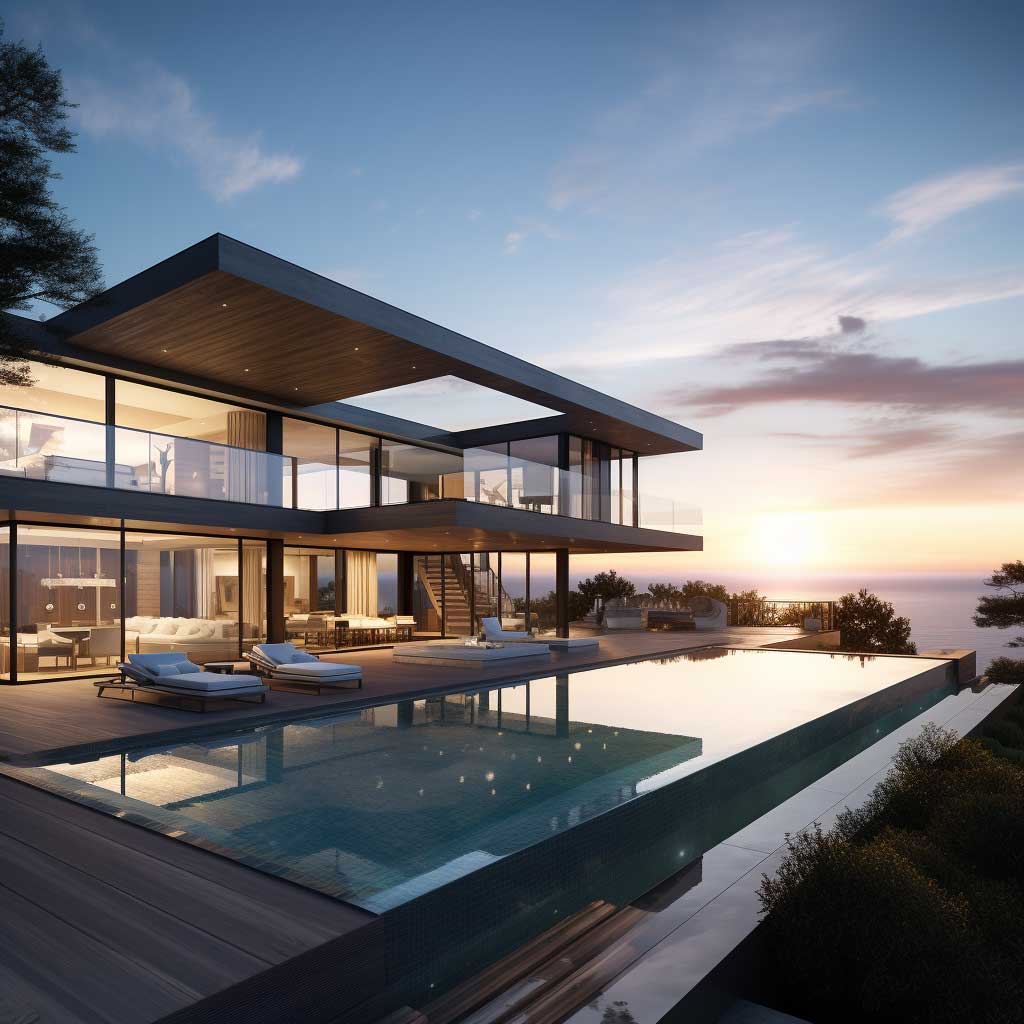
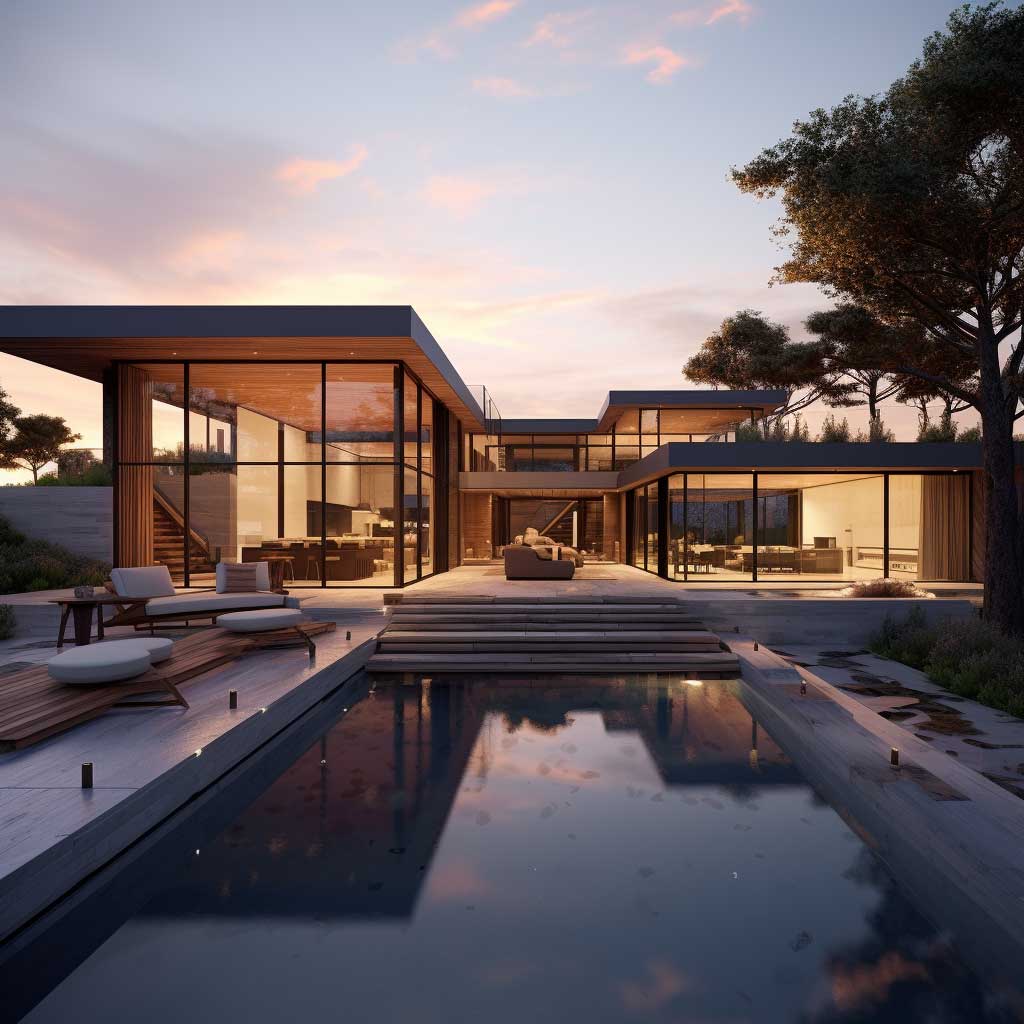

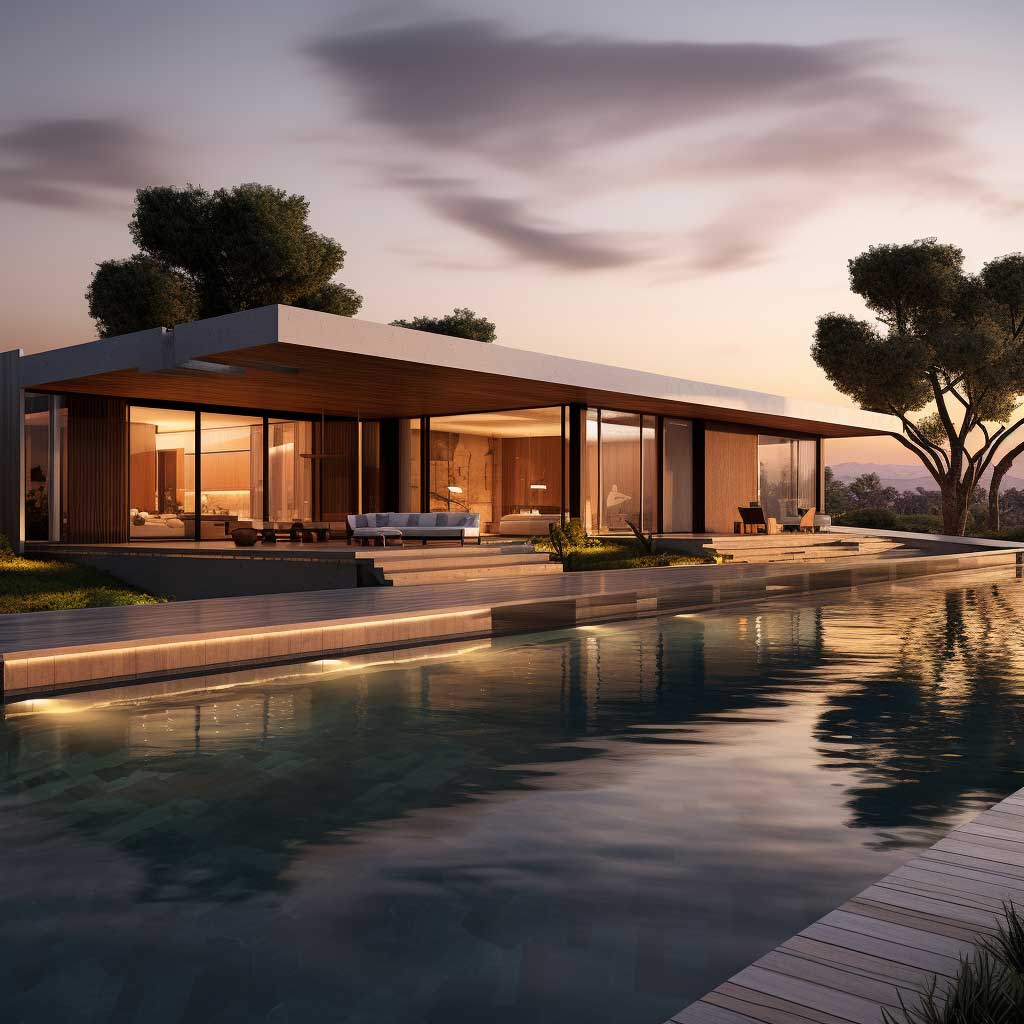
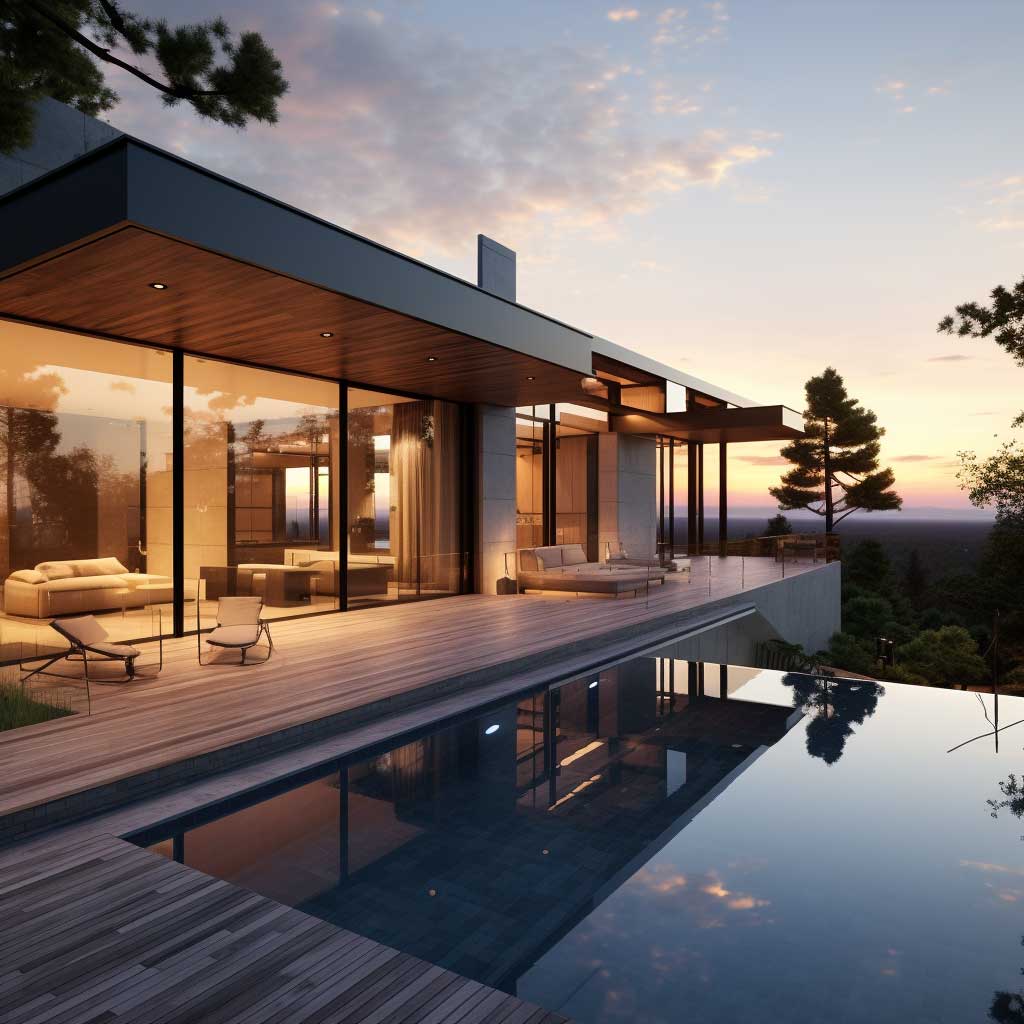
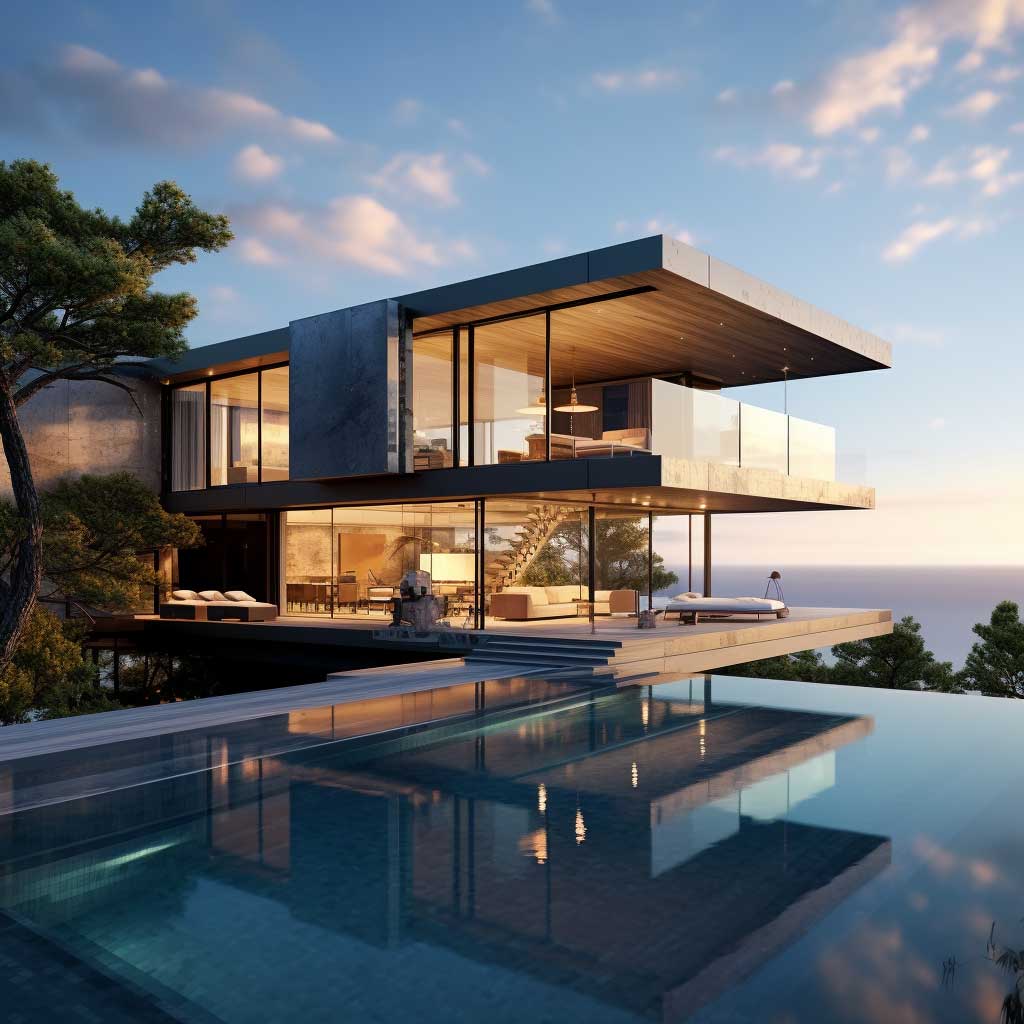
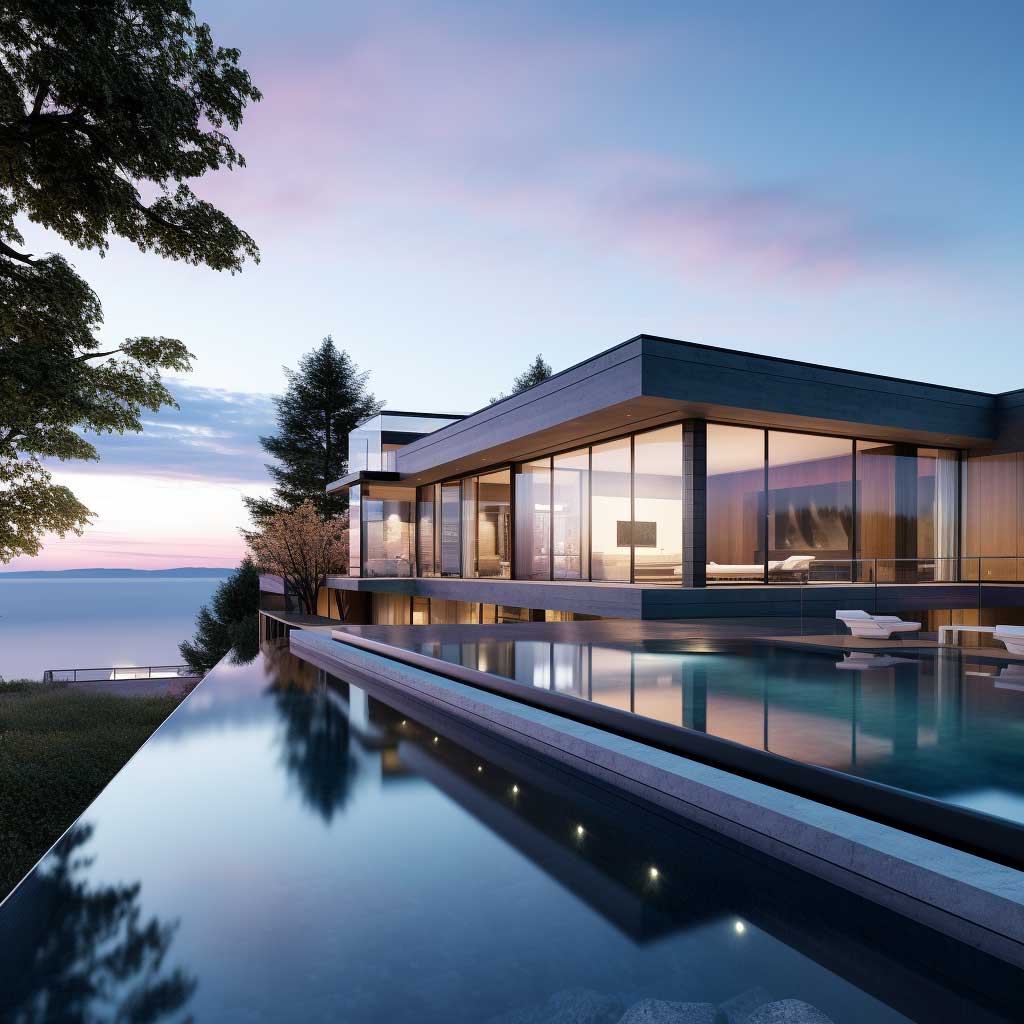

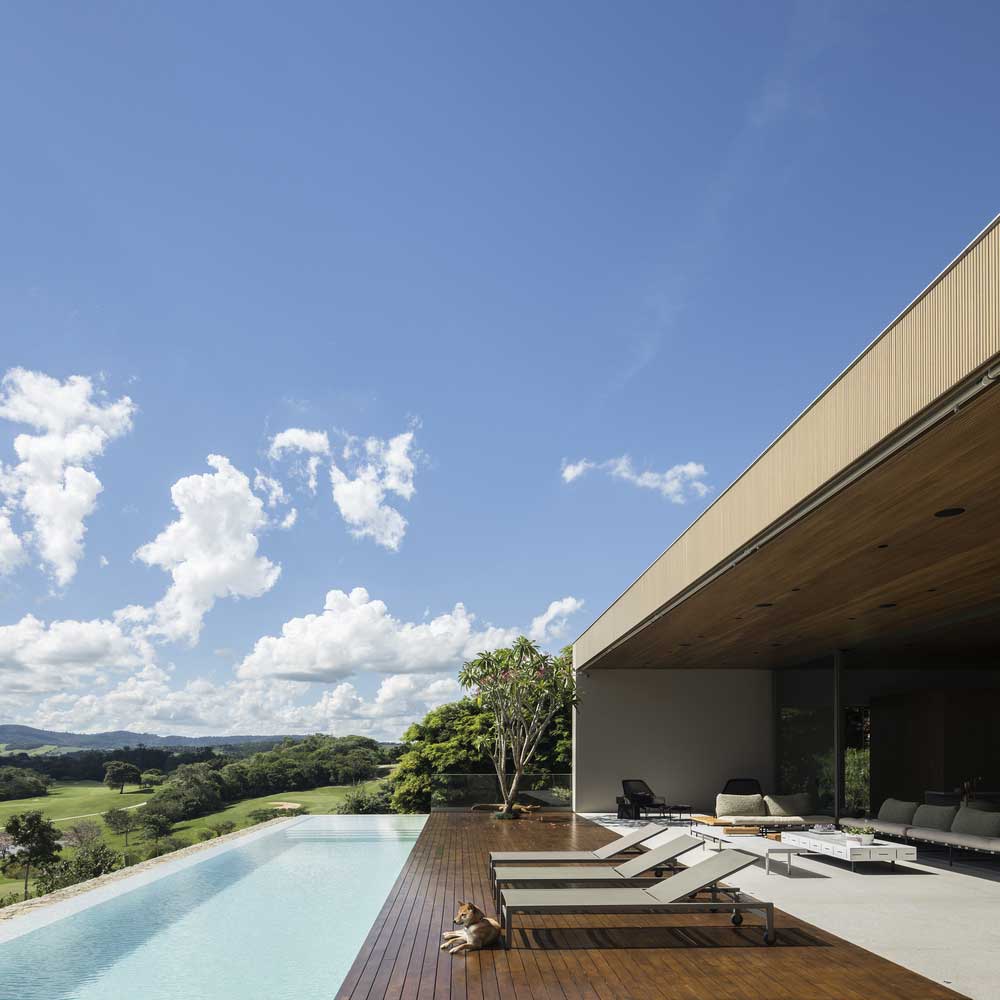
The first set of images captures the house and pool at the hour most residential architects use to validate a design — late afternoon, when shadows do the sculpting that daylight conceals. What you’re looking at is a light-colored, minimal-detail facade with floor-to-ceiling glass panels running along both wings of the L. The pool sits right in the crook, oriented lengthwise along the longer wing. That decision alone is responsible for 80% of what makes this photograph work.
The wooden deck flanking the pool runs the full width of the shorter wing. My go-to advice here: keep outdoor furniture to three pieces maximum in this zone — a pair of teak loungers (Gloster’s Curve collection runs about $1,800 each) and a low side table. The moment you fill this deck with umbrella stands and side chairs, the pool shrinks visually. I’ve seen renovators make this mistake repeatedly on otherwise strong L-shaped builds.
The plant border at the pool’s far edge deserves a closer look. Low boxwood hedging and ornamental grasses hold the geometry without fighting it. Tall columnar plants — Italian cypress, Leyland cypress — are the wrong call here. They compete with the house’s vertical glass planes and chop the sightline from inside the living room. Keep anything green below 60cm at the pool perimeter.
What’s the lighting strategy in these shots? Zero feature lighting on the house itself. The facade reads clean because there are no uplights creating hot spots or wall-wash fittings that announce themselves after dark. The pool has recessed underwater LEDs — about $120 per fixture installed — set to a warm 2700K temperature. Cold white pool lighting aged badly by 2018. Don’t spec it.
Don’t Do This
Placing the pool along the outer perimeter of the property rather than in the L-shaped corner eliminates the entire privacy advantage of this floor plan. I’ve seen $400,000 builds lose their selling point because the pool was positioned for construction convenience rather than spatial logic. The corner is the point. If your pool isn’t tucked into the interior angle of the L, you’ve paid a premium for a layout that behaves like a rectangle.
Morning Light Exposes the Courtyard Geometry From Above
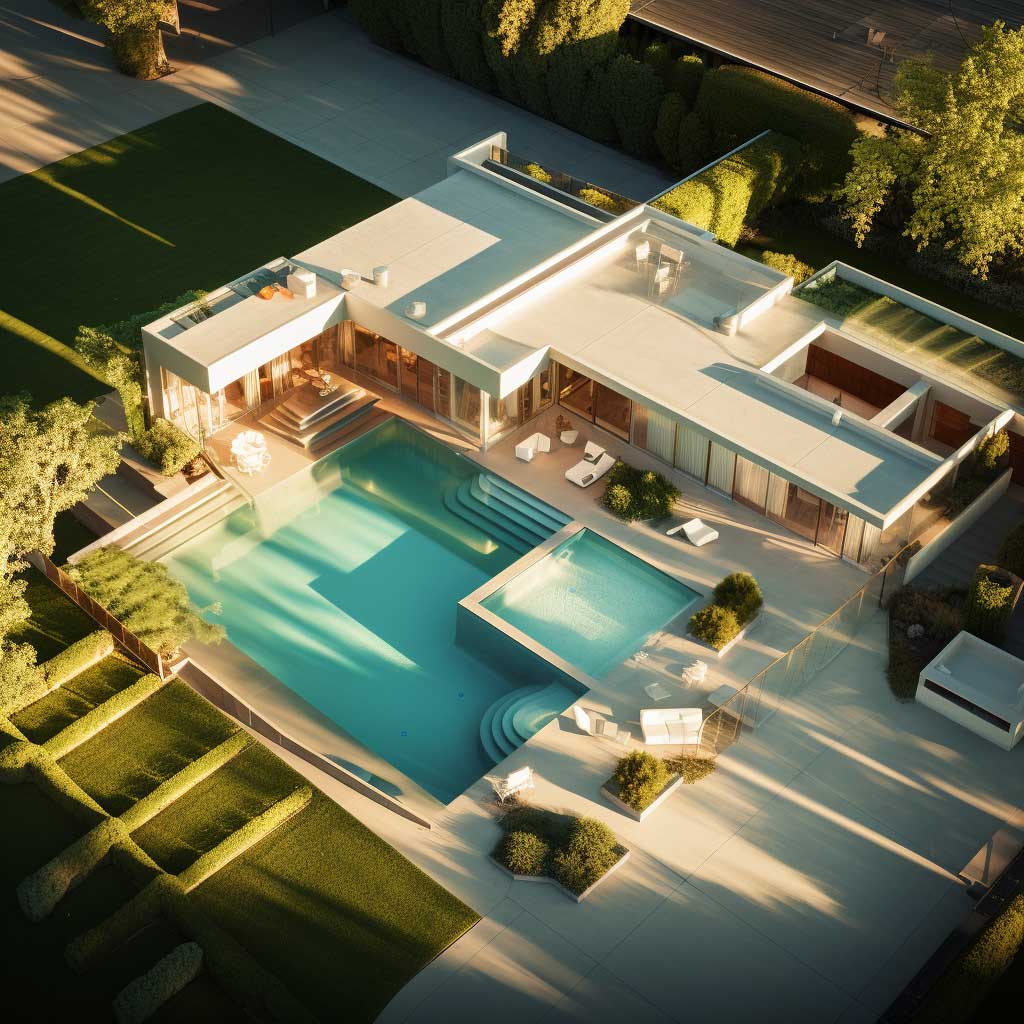


The aerial perspective is where an L-shaped house with pool becomes genuinely legible as a concept. From above, the plan reads like a letter dropped onto a green field — the two wings, the pool in the corner, the garden running along the outer edges. You can’t get this reading from street level. Drone photography changed how this type of house gets marketed, and these morning shots demonstrate exactly why: the reflection on still water doubles the house, turning a 230sqm footprint into something that photographs at twice the size.
Notice the driveway approach in the lower corner of the aerial. It enters from the public facade — the short wing’s gable end — and wraps around to the entrance without revealing the pool at all. That separation between arrival sequence and pool courtyard is intentional planning, not luck. You get the private interior as a reveal, not a first impression. I stole this trick from a Juliana Stefanelli project and applied it to a renovation brief two years ago. It works.
The lawn surrounding the pool wing is cut to a single plane. No raised planters. No trellis structures. No pergola interrupting the roofline. This restraint is harder to achieve than it looks — landscape contractors will always pitch you on “visual interest” additions that fragment the read from above. Hold the line. A single-story L-shaped house with a flat perimeter lawn photographs more dramatically from the air than any garden-heavy alternative.
The pool surface acts as a natural mirror here. Still at 7am, it reflects the white facade and the early sky with near-photographic accuracy. Salt-chlorine systems (Zodiac TRi-Pro runs around $1,200 installed) keep the water clearer than tablet-based chlorine treatment, which tends to leave a faint green tint that kills reflections. Clarity is everything in this shot. You’d never know it from the photo, but water chemistry is doing heavy compositional work.
Dusk Light Proves the Interior Corner Is a Room Without a Roof
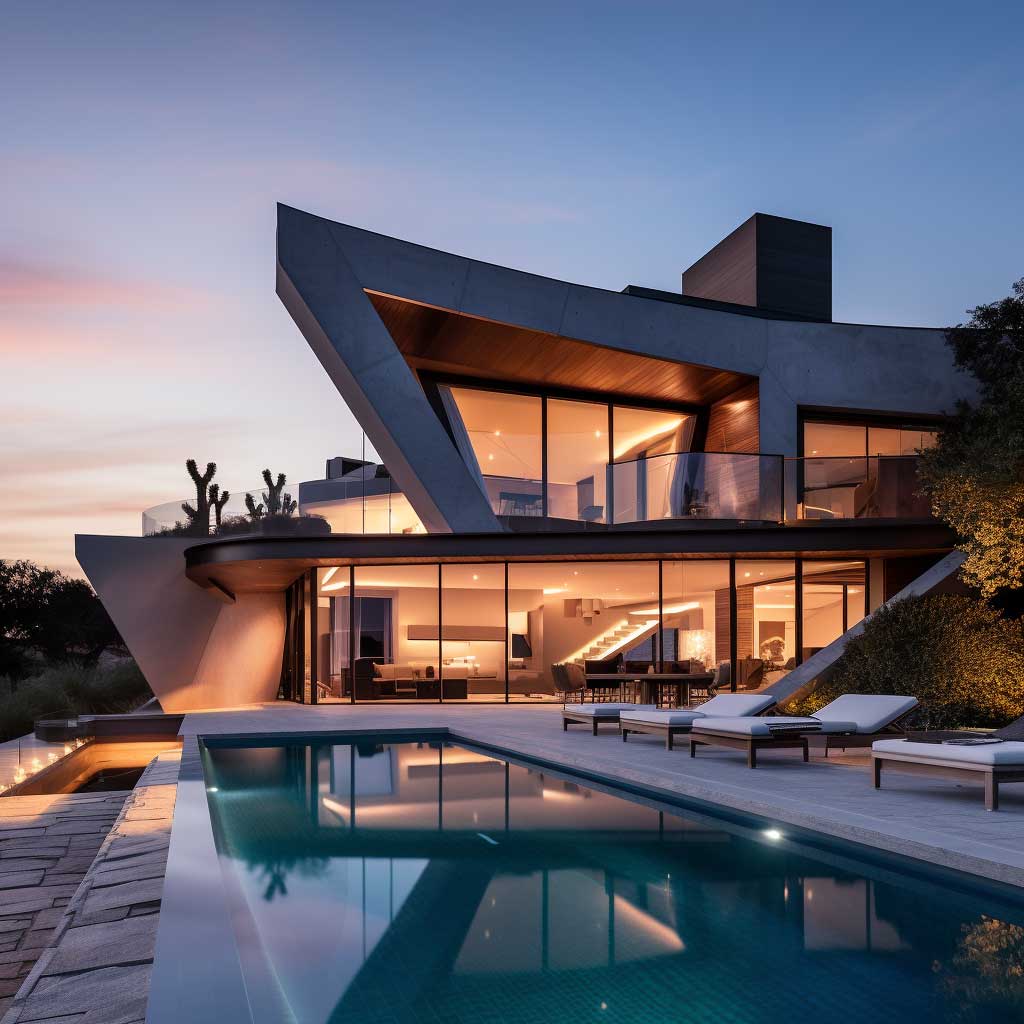
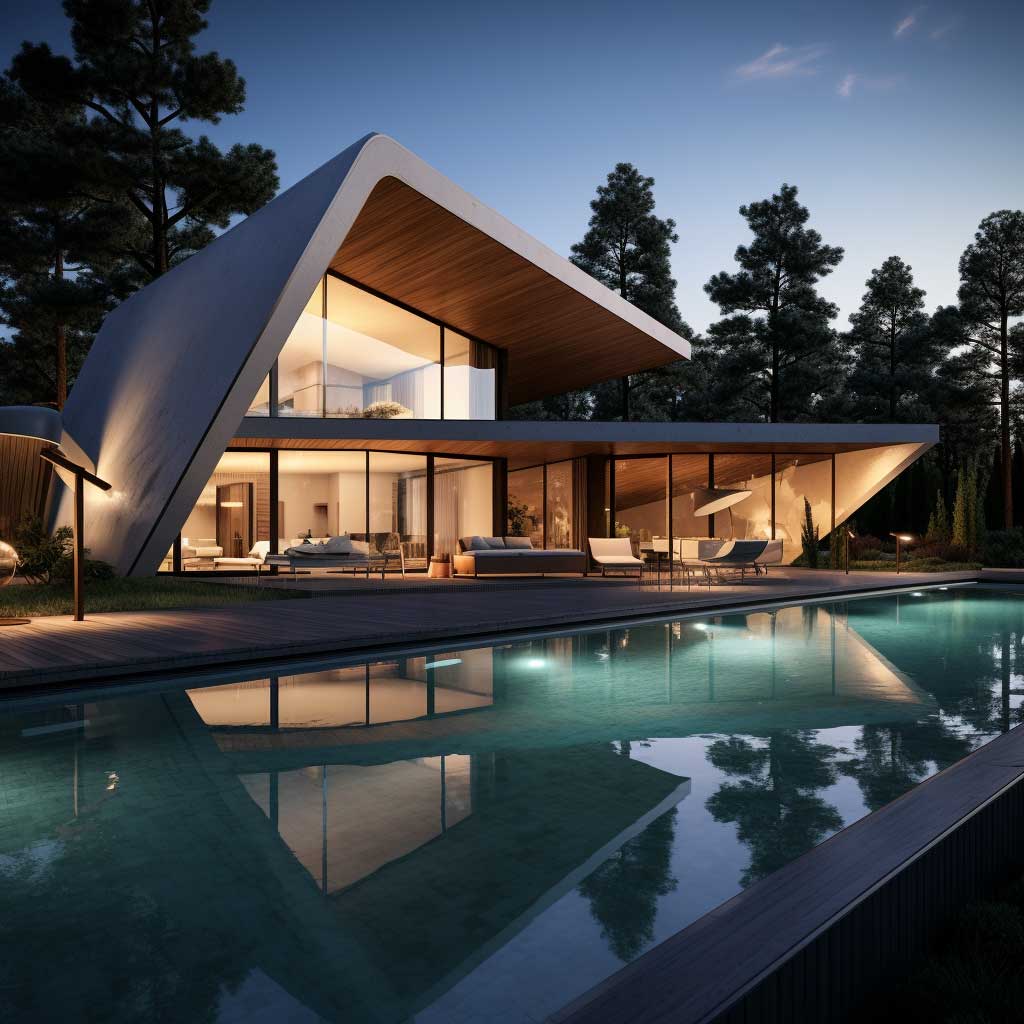
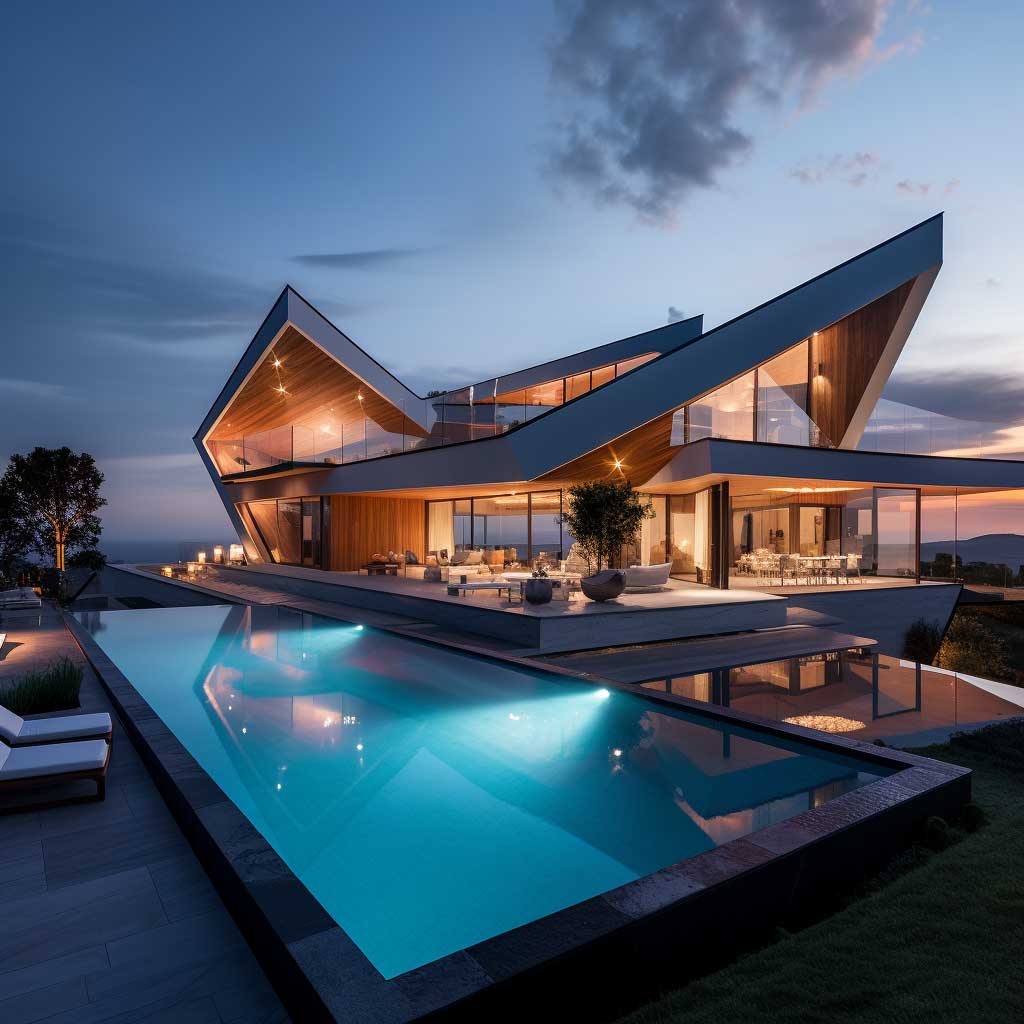
Twilight is when the L-shaped pool house earns its square footage. The two wings glow from inside, the pool holds the last blue of the sky, and the covered deck becomes genuinely usable — protected on two sides by the building mass, sheltered from wind without any overhead structure required. This is the design working exactly as the form intended. Think of the interior corner as an outdoor room that the house shapes rather than contains.
The indoor lighting in these dusk shots is low and warm — no ceiling can fixtures blasting downward at 3000 lumens. Floor lamps visible through the glass are running probably 400 lux. The glass walls create a lantern effect: the house illuminates the pool deck from the inside without a single exterior fixture pointing outward. You’ll notice zero light spill beyond the pool perimeter. That’s Lutron Caséta dimming, or a comparable system in the $800-1,200 range, handling the whole interior on a dusk-trigger schedule.
The landscape takes on a completely different character at this hour. Shrubs that registered as green mass in daylight become sculptural silhouettes. Trees at the property perimeter disappear into the dark and stop competing with the building. This transformation is the strongest argument for keeping the planting simple — complex mixed-species borders look chaotic in nighttime photography and read as visual noise from the deck. My observation from a dozen renovated projects: restraint in the garden always photographs better than abundance.
What are the plans actually showing here? The outdoor deck-to-lawn transition is flush — no step down, no level change between the timber deck and the grass. This detail costs almost nothing at build stage and makes the outdoor space feel twice as large. Add a 150mm step later and you’ll spend $3,000 removing it. Modern L-shaped house design consistently returns to this flush-grade outdoor condition because it photographs as a single unified plane rather than a series of platforms.
The angle of this third photograph reveals something the frontal shots missed: the shorter wing of the L has a deeper overhang than the longer one. That asymmetry is deliberate. The deeper soffit on the pool-side wing creates shade on the deck from 11am to 3pm — the hours when Australian and Brazilian clients especially need it. You don’t always need a pergola. Houzz’s L-shaped pool house gallery documents dozens of examples where a generous soffit handles the solar shading job entirely.
The Takeaway
The L-shape earns its cost only when the pool owns the corner.
Every photograph in this article shares one structural fact: the pool sits in the interior angle and the house wraps it on two sides. Move the pool to the perimeter and you’ve paid for a floor plan that delivers none of the privacy advantages this layout is known for.
The lighting, the flush deck-to-lawn transition, the simple plant border — these details cost less than you expect and photograph better than anything more complicated.
Save this post before you talk to your architect about pool placement.
Related Topics
FAQ
What size pool fits best in the corner of an L-shaped house?
Which direction should the L-shaped house face to get sun on the pool all day?
Do I need a fence around an L-shaped pool house courtyard?
What is an L-shaped pool house compared to a standard pool house?
What outdoor furniture works on an L-shaped pool house deck?
Complete guide
Patio and Yard Ideas That Turn Any Backyard Into a Living Room Outside
Flooring, furniture, shade, pools, kitchens, fire pits, courtyards — all in one place