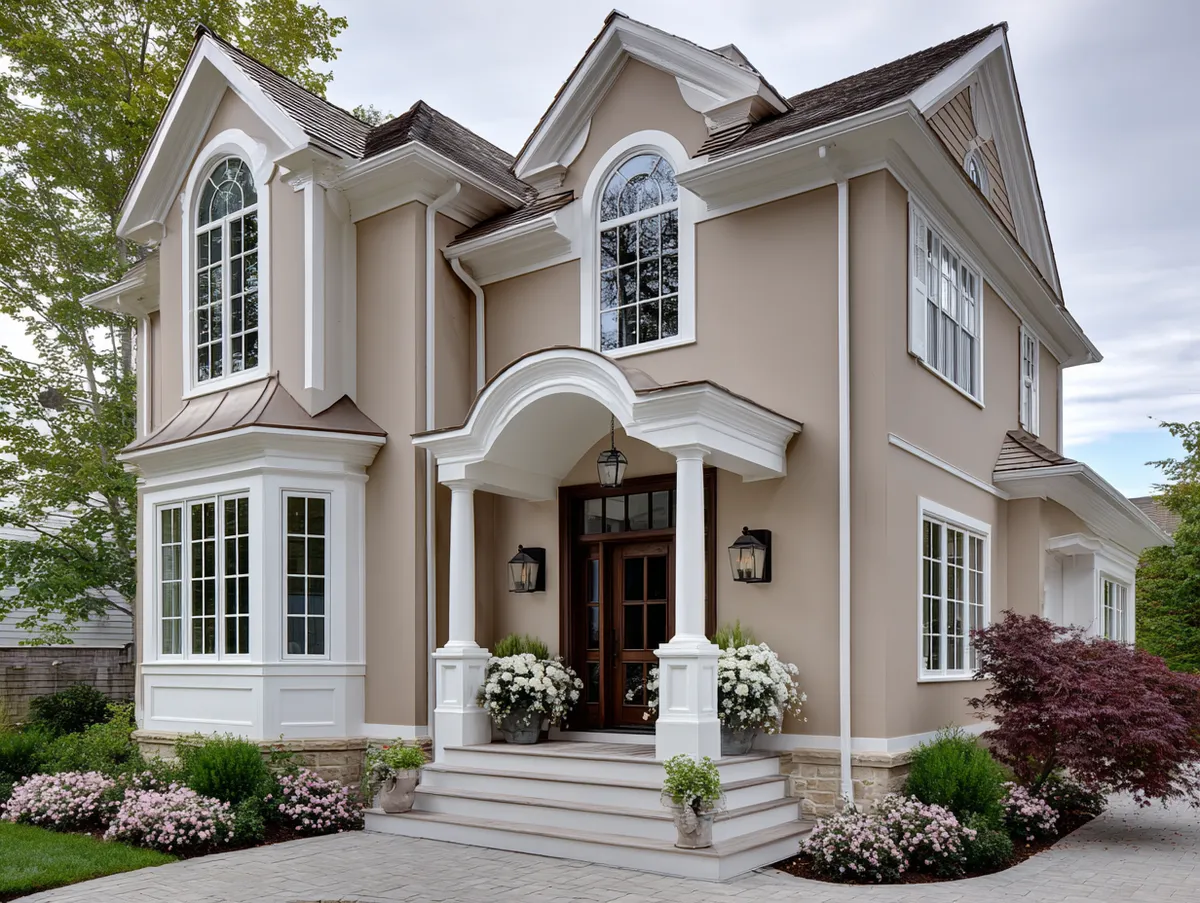
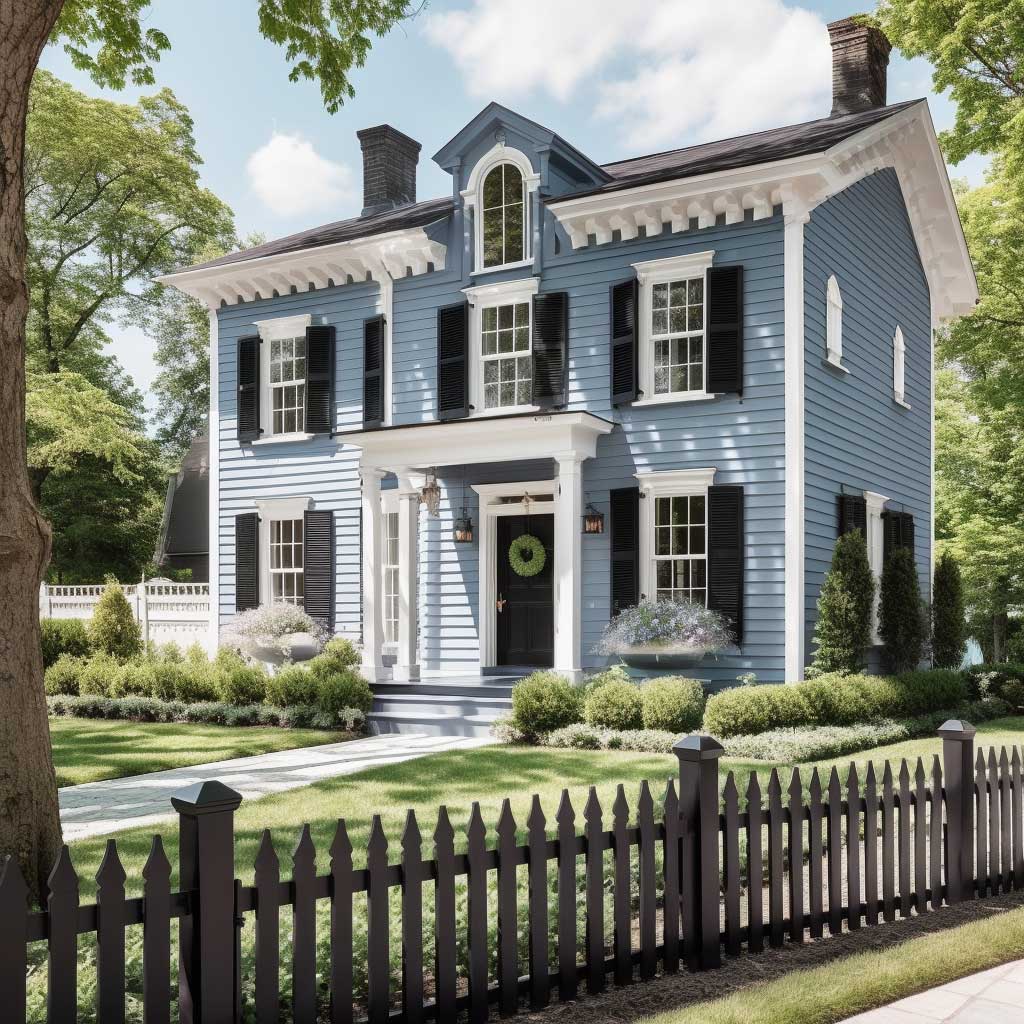
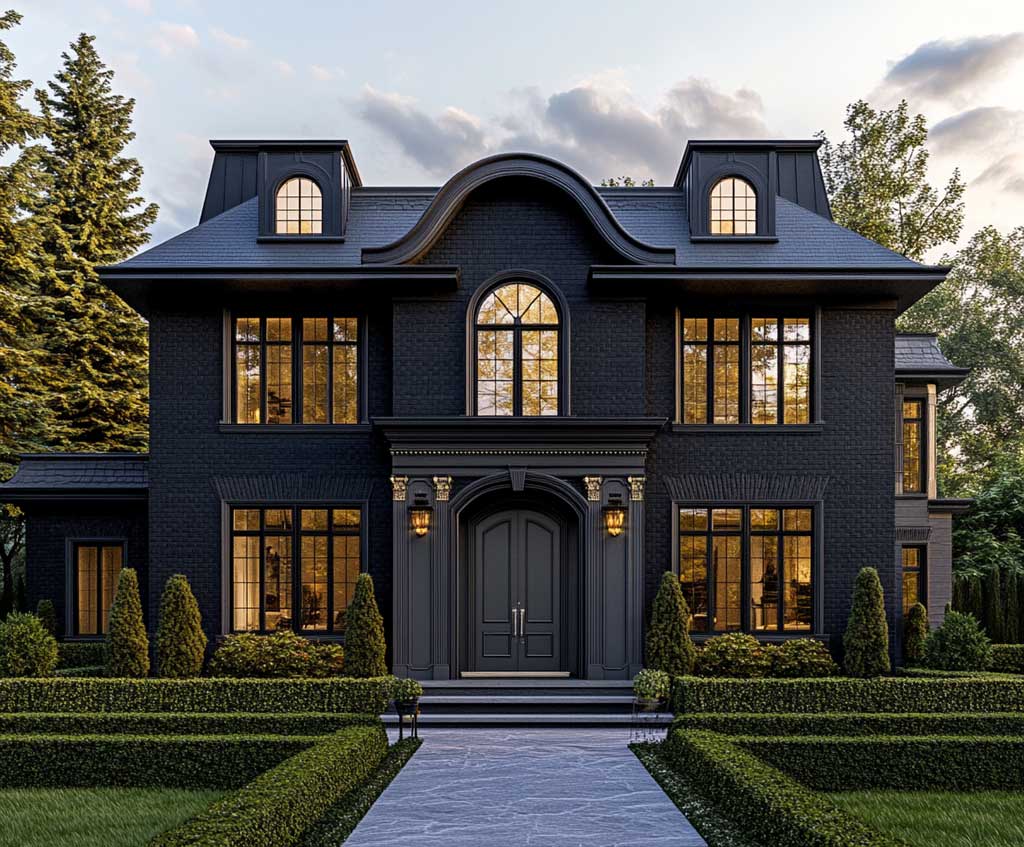
Warm beige and taupe outside paint colors are the rare combination that reads differently at 8 a.m. and at dusk — and looks right both times. The palette sits at the intersection of stone, sand, and shadow, which is exactly why it holds up on Georgian columns, Craftsman porches, and Colonial Revival facades without needing adjustment. Benjamin Moore’s Regal Select Exterior, a mid-premium line priced at $55–$70 per gallon, is the product color pros default to when a client commits to this palette — the alkyd-fortified formula delivers a soft-touch finish that keeps earthy tones from looking chalky after a few winters.
The key mechanic is undertone matching. Warm beige carries yellow or pink undertones depending on the formula; taupe carries gray-brown or violet. Pair the wrong two and the facade reads muddy — one color pulls warm while the other pulls cool, and the eye registers the tension without being able to name it. Pair the right two and the house looks like it arrived fully formed, as if the colors were always there. The 70/30 rule applies here: 70% body color (beige), 30% accent (taupe on trim, shutters, window casings).
A quality exterior paint job on wood siding typically lasts 7–10 years in moderate climates, dropping to 5–7 years on south- and west-facing walls that take direct UV. That makes color choice a long-horizon decision — the beige you choose today is the beige your neighbors see for a decade. Worth getting the undertones right before the first drop hits the wood.
- Beige body + taupe trim is the most forgiving exterior formula for classic American home styles — Georgian, Craftsman, Colonial Revival.
- Benjamin Moore Revere Pewter HC-172 is the decade’s best-selling exterior taupe-beige greige; Sherwin-Williams Accessible Beige SW 7036 is the warm beige counterpart.
- Match undertones: yellow-undertone beige needs warm red-brown taupe; pink-undertone beige needs cooler gray-brown taupe.
- Standard exterior paint covers 350–400 sq ft per gallon; plan two coats plus 10% overage.
- South- and west-facing walls fade faster — repaint on a 5–7 year cycle for those elevations.
Georgian Symmetry Sharpens When Beige Holds the Body


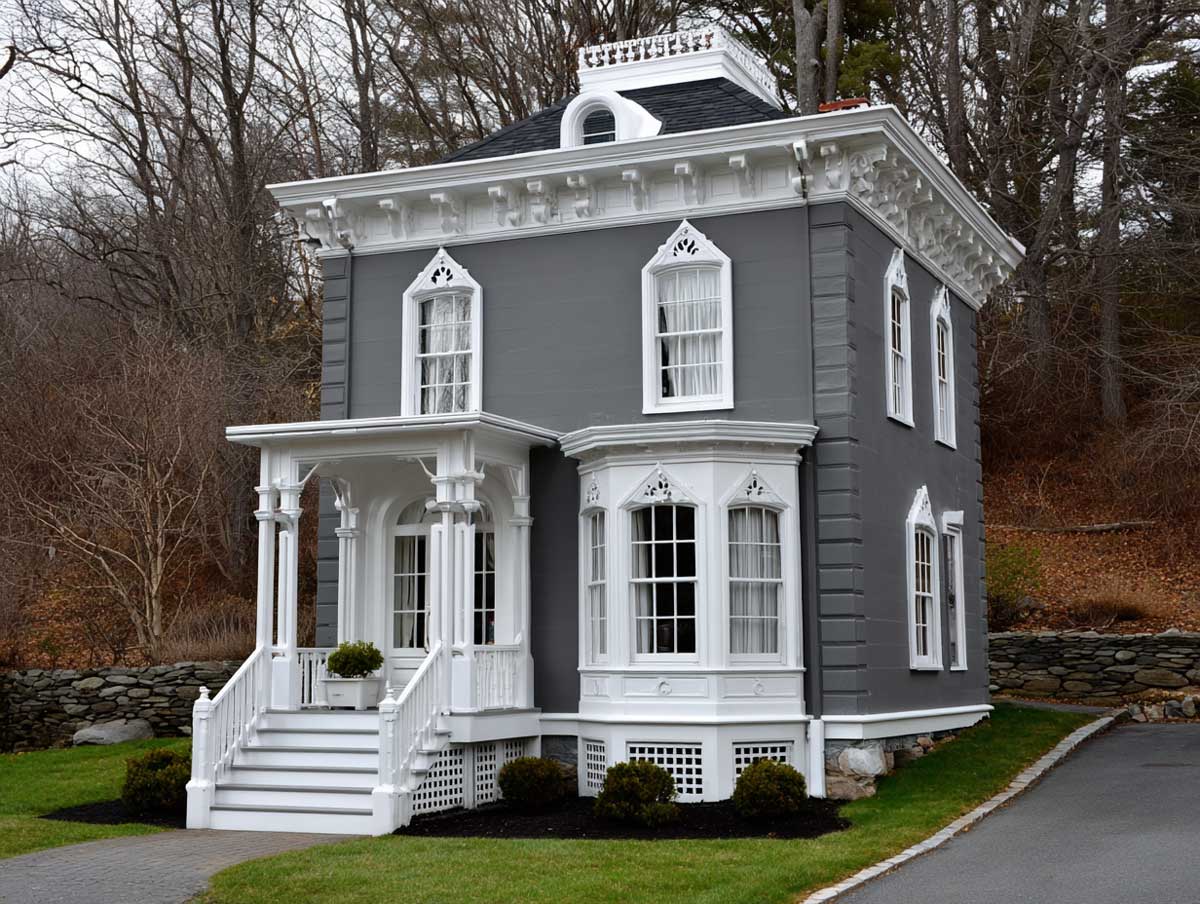
Georgian architecture relies on proportion — equal window spacing, a centered door, symmetrical wings — and warm beige and taupe outside paint colors are the fastest way to make that geometry visible from the street. The beige body recedes slightly, acting like the off-white mat around a painting: it contains and frames. Taupe on cornices, window casings, and the front door pulls those architectural lines forward so they register without competing with the siding. Think of it as a pencil sketch made visible — the structure was always there; the color just traces the lines.
Sherwin-Williams Accessible Beige (SW 7036) has a Light Reflectance Value of 58, which puts it in the practical sweet spot for full-body exterior use — dark enough to read as a real color, light enough to reflect roughly 58% of visible light and avoid the heat-load problems that punish dark facades in hot climates. On a north-facing elevation or under heavy tree canopy, that LRV can make the body look gray; the fix is a slightly warmer trim rather than a different body color. What doesn’t work on a Georgian: a perfectly matched beige-on-taupe scheme where body and trim are too close in value — the symmetry is still there, but it disappears into a wall of sameness.
Painters who work on historic Georgian restorations consistently recommend against applying high-gloss paint to the main body. The sheen amplifies the reflectance and makes the beige read orange in afternoon light. Flat or low-luster on the body, semi-gloss on trim — that differential in sheen does as much work as the color differential. Why does this matter? Because the symmetry Georgian architecture promises is a visual promise; anything that muddies the facade breaks it.
Standard exterior paint covers 350–400 sq ft per gallon on smooth primed surfaces; on rough or porous siding, plan for 300 sq ft. A two-story Georgian with 2,000 sq ft of paintable exterior typically needs 12–15 gallons for two full coats — about $660–$1,050 in Regal Select Exterior before labor. Budget the taupe separately: trim and casings on a Georgian typically add another 3–5 gallons. Is your taupe warm enough to hold against the beige body, or does it slide gray in afternoon shadow? Test both colors on the north and south elevation simultaneously — never on a single patch in the middle of the house.


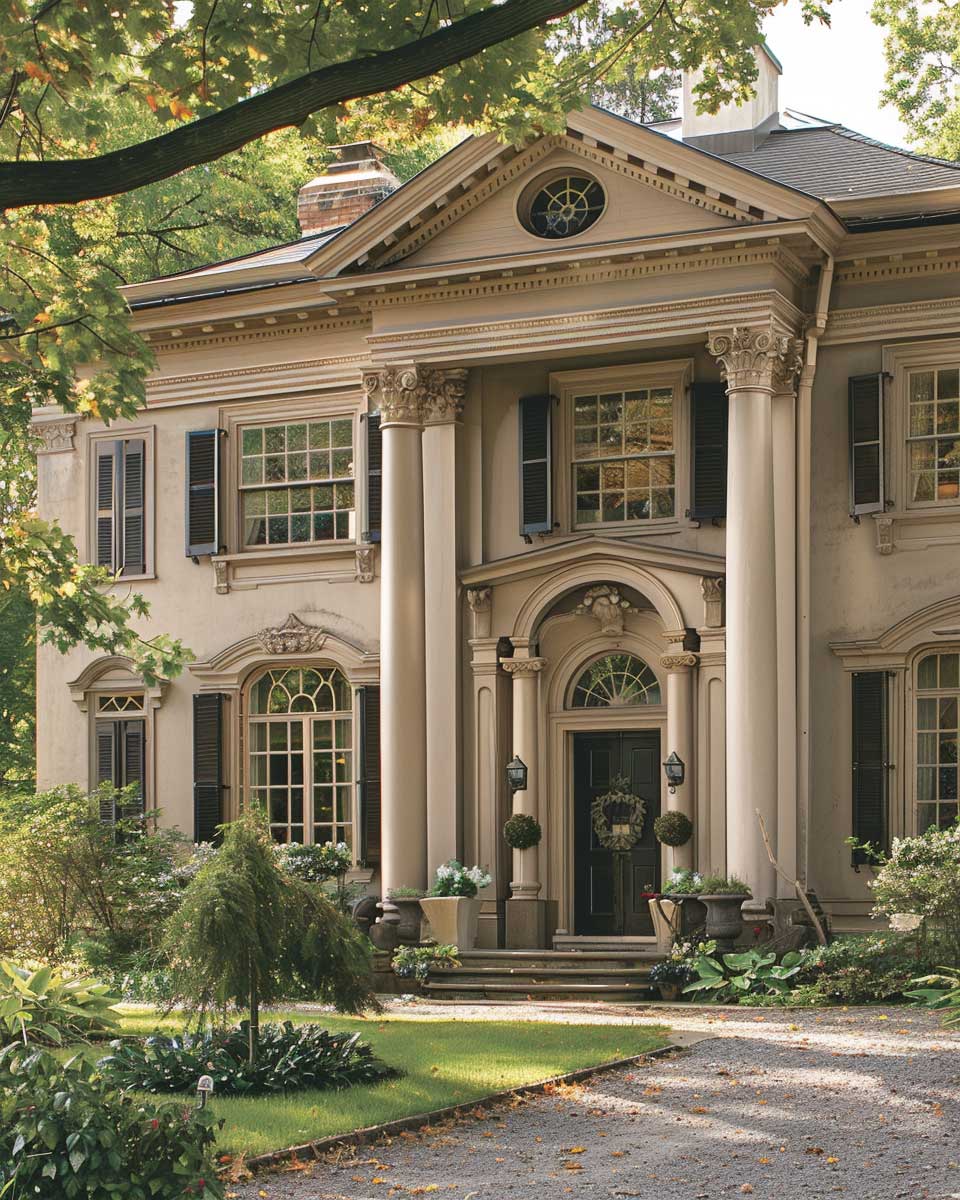

For houses with brick or stone foundations, let the masonry undertone lead the selection. A warm red-brick foundation pairs cleanly with a yellow-undertone beige like Sherwin-Williams Accessible Beige and a taupe that pulls toward brown rather than violet. Getting this sequence wrong — choosing the body color first without checking it against the foundation — is the most common mistake on Georgian exterior repaints, and one of the costliest to fix once the scaffold is down. For more on how exterior paint colors work across different classic home styles, see these house painting designs and colors outside for classic style houses.
Craftsman Porches Read Richer with Earthy Taupe Color Choices
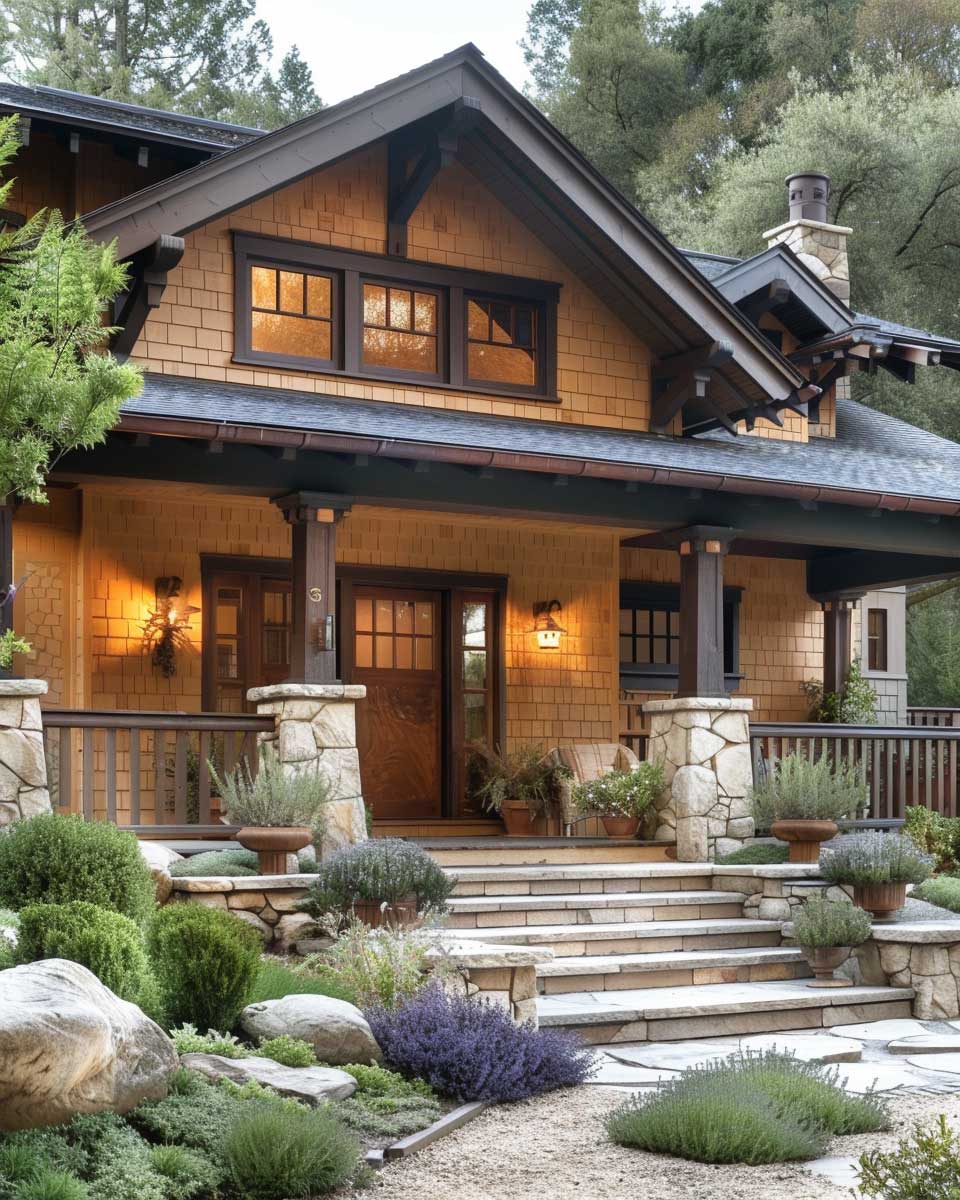


Earthy taupe color on a Craftsman home works because the style was designed around materials that already live in the same palette — rough-sawn cedar, river stone, clinker brick. The paint doesn’t decorate the Craftsman; it extends the material logic outward. Benjamin Moore’s Taos Taupe 2111-40, described as a rich warm taupe that goes beyond basic gray, is a reliable starting point: it carries enough brown to connect to wood siding and exposed beams without pulling pink, which is the failure mode for lighter taupes in direct sun.
Craftsman porches have specific color challenges that Georgian facades don’t. The deep porch soffit and the roof overhang create large shadowed planes that stay darker than the sunlit body — sometimes four or five LRV points darker than the paint chip suggests. Lighter warm beige on the body prevents those shadowed planes from reading as black. Darker taupe on the exposed rafter tails, knee braces, and columns makes those hand-built details pop instead of receding. This is not a subtle distinction: on a porch-heavy bungalow, getting the value relationship right between body and trim is the difference between a house that looks cared-for and one that looks like the contractor ran out of paint.
Glidden’s Taupe Tapestry — a midtone shaded beige with a taupe undertone available in Fundamentals and HEP exterior lines — covers up to 400 sq ft per gallon and can be applied in temperatures as low as 35°F, which matters on the Pacific Northwest bungalows where the Craftsman style is most common. What to avoid: using a single taupe for both body and trim on a Craftsman. The built-in woodwork disappears, the structural depth the style is known for collapses, and the house looks like a monochrome box. Two values minimum — always.
Don’t choose your beige body color from an interior paint chip. Interior beiges are formulated for incandescent and LED light; outdoors, under full UV, they routinely read two to three shades lighter and often shift yellow or pink. Always sample exterior-grade paint directly on the actual surface, applied over primer, observed at midday and at dusk. One $8 sample pot saves you from repainting an entire elevation.
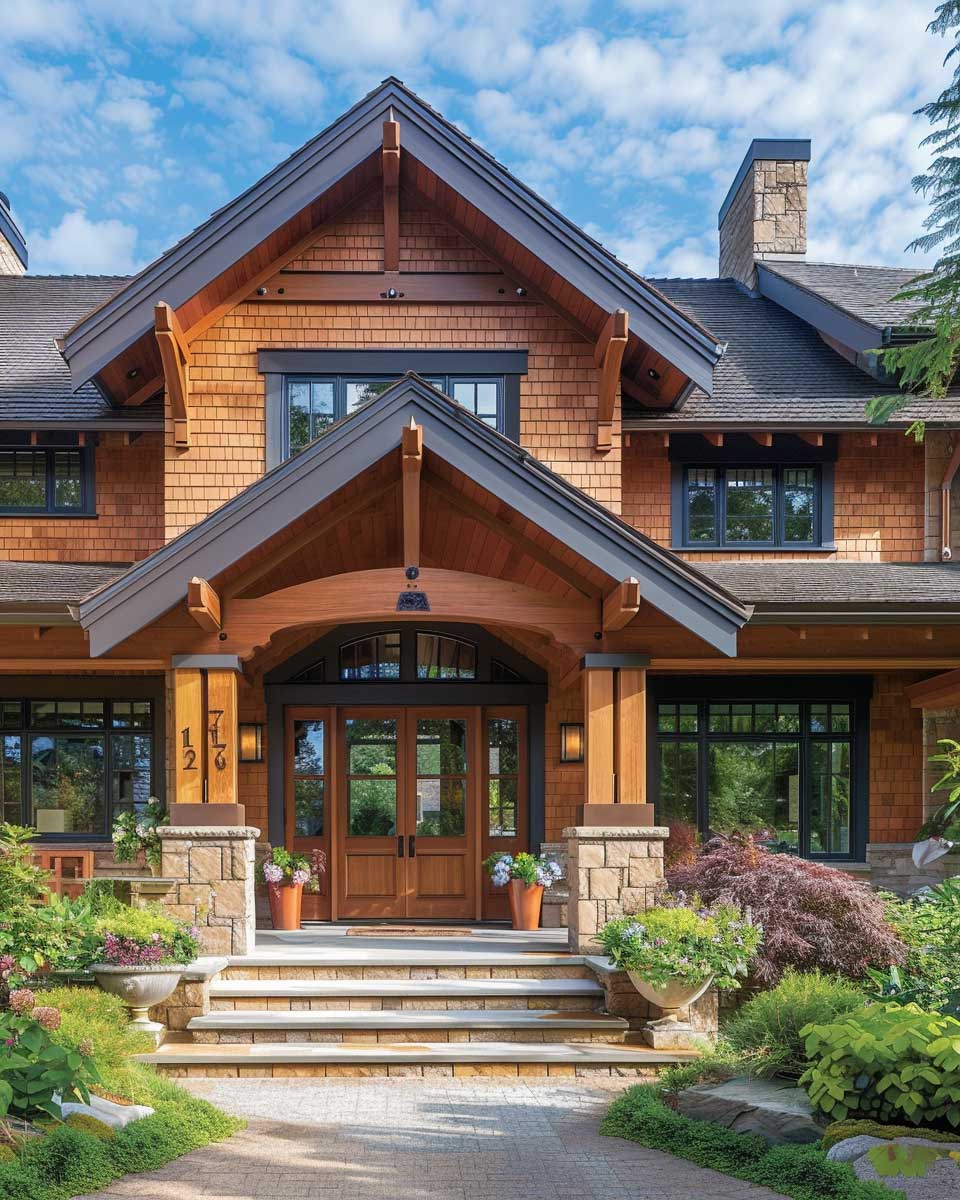


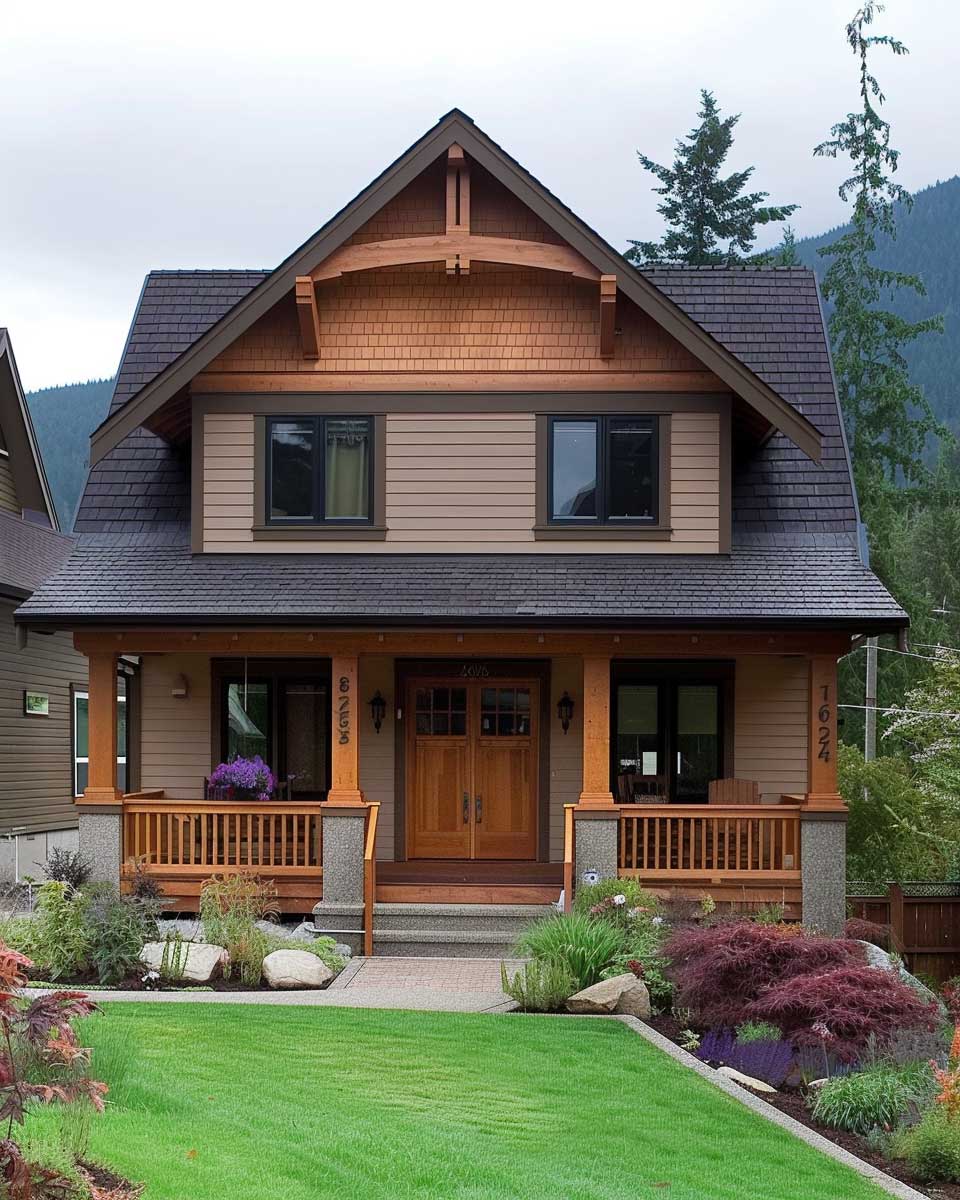
Landscaping intensifies the earthy palette rather than fighting it. Mature oaks, ornamental grasses, and native stone pathways all carry colors in the brown-amber-gray range that the taupe-and-beige exterior echoes. The house reads less like a painted object and more like something that grew from the lot — which was exactly what the Craftsman movement was after in the first place. To explore how body and trim color ratios work across different traditional styles, the two-tone exterior paint combinations for traditional homes library goes deeper on application strategy.
Colonial Revival Exteriors Let Warm Beige and Taupe Color Combinations Do the Formal Work


Exterior taupe house color combinations work on Colonial Revival architecture for a mechanical reason: the style uses multiple surface planes — siding, shutters, door surround, pediment — and taupe reads differently on each one depending on angle and shadow depth. On sunlit siding, a warm beige reads cream-gold. On a shaded shutter set 4 inches from the same wall, that same paint reads two shades darker and grayer. Colonial Revival builders understood this — they designed the shadow play in. The taupe trim and beige body relationship exploits that shadow play rather than fighting it.
Benjamin Moore Revere Pewter HC-172 — the brand’s best-selling exterior color of the last decade according to paint professionals — sits at an LRV of 55.51, which puts it in the taupe-greige zone that makes it flexible across Colonial, Craftsman, and Georgian styles. For a classic Colonial Revival exterior, stylists recommend using Revere Pewter or a similar warm greige on shutters and the front door, with a lighter warm beige (Pale Oak OC-20 or Accessible Beige SW 7036) on the main siding. The three-level system — beige body, taupe shutters, white trim on casings — gives the multi-pane Colonial windows enough contrast to be legible from the street without using a third distinct color.
What frequently goes wrong on Colonial Revival repaints: choosing a taupe with purple or violet undertones for the shutters. In morning light on an east-facing facade, a violet-leaning taupe will read pink against a warm beige body — not elegant, just mismatched. The fix is to pull a warm brown-based taupe with no pink. Hold the shutter chip against the body chip at midday before committing. Does the shutter read darker and grounded, or does it read pink and restless? Warm and grounded is the test to pass. Exterior repainting on standard clapboard Colonial siding typically runs $2.50–$5 per sq ft for labor, putting a full exterior repaint on a 2,500 sq ft house at roughly $6,000–$12,000 before materials — another reason to get the color right the first time.


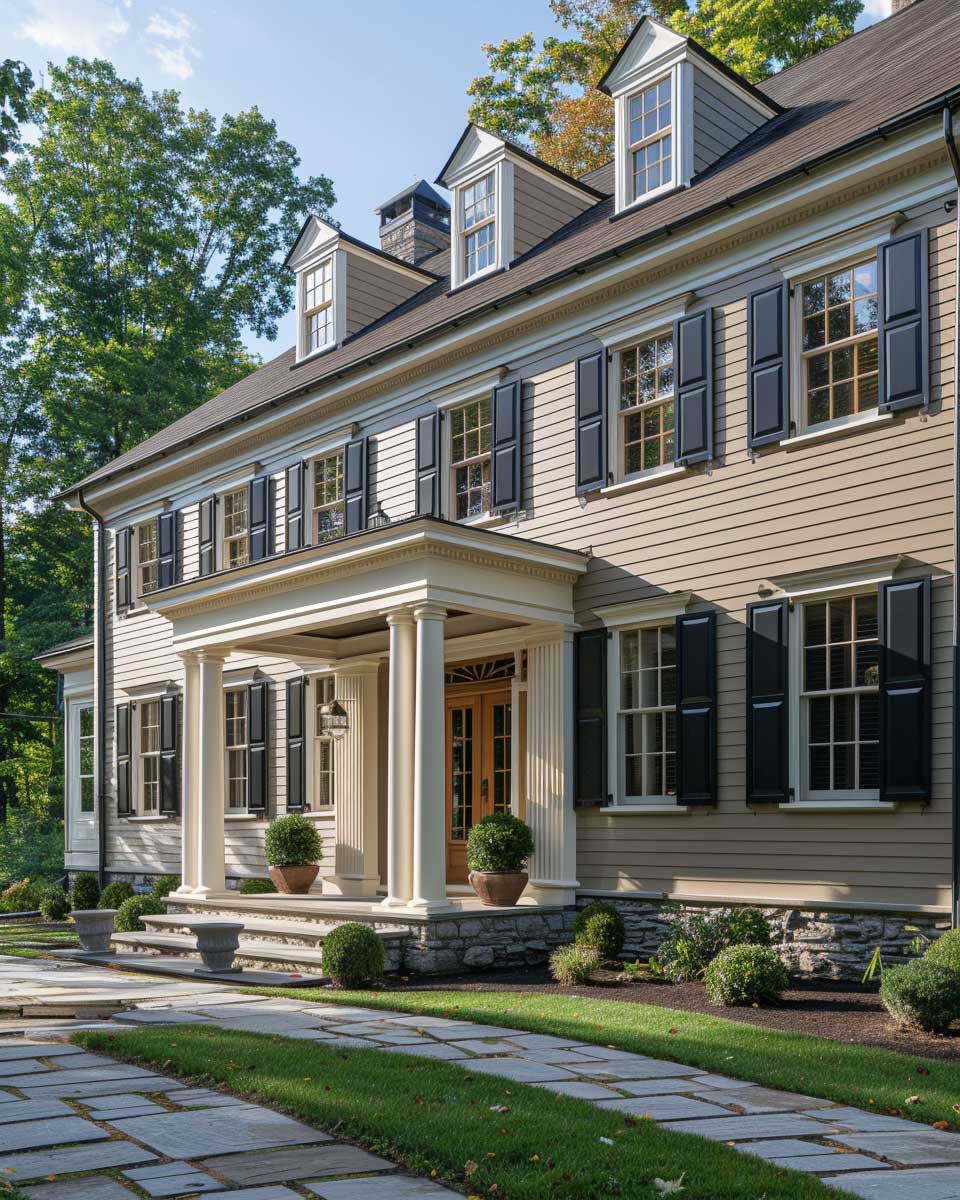
The most overlooked surface on a Colonial Revival is the garage door, which can represent 20–25% of the visible facade on a front-loading three-car garage. Painting it the same beige as the siding makes the facade look like a wall with a door slot punched in it. Try the taupe instead — or at minimum a shade two LRV points darker than the body. The garage door reads as a designed element rather than an afterthought, and the symmetry the style relies on survives. For color guidance from an authoritative source on pairing neutrals across an exterior, Benjamin Moore’s full exterior paint color collection includes taupe and beige families organized by undertone family — useful when matching against an existing roof or brick color.
| Style | Body Color Direction | Trim / Accent | Key Risk |
|---|---|---|---|
| Georgian | Light warm beige (LRV 55–65) | Brown-gray taupe on cornices and casings | Too-close values — symmetry disappears |
| Craftsman | Mid warm beige (LRV 50–60) | Darker earthy taupe on beams and columns | Single-tone monotony — woodwork vanishes |
| Colonial Revival | Light warm beige (LRV 58–68) | Warm taupe shutters, white casing trim | Purple-undertone taupe reading pink at morning |
For further reference on how two-tone color contrasts play on traditional home styles — including beige-and-brown earthy combinations with specific application ratios — explore these two-tone exterior house paint ideas for traditional homes.
The Verdict
Warm Beige and Taupe Exterior Paint Colors Work Because They Don’t Fight the Architecture
The palette succeeds on Georgian, Craftsman, and Colonial Revival homes for the same reason: it follows the surface geometry rather than overriding it. Beige holds the body; taupe marks the structure. The eye reads the architecture first and the color second — which is exactly what classic exteriors are supposed to deliver.
Match undertones before purchasing. A yellow-undertone beige needs a brown-based warm taupe; a pink-undertone beige needs a gray-brown cooler taupe. Getting this wrong costs a full repaint cycle — 5 to 10 years of looking at a mistake.
Plan for two coats plus 10% overage at 350–400 sq ft per gallon, inspect every south- and west-facing elevation after year five, and keep a quart of the trim color for touch-ups. Save this post before your next paint store visit.