Red and white bathroom ideas turn an ordinary wet room into a high-contrast space that feels intentional rather than accidental. A single red accent wall against crisp white surfaces costs roughly $40–$80 per gallon for quality mildew-resistant paint and covers a standard 5×8 bathroom with one gallon for two coats. The scheme works because white reflects light while red creates a clear focal point, so the room reads larger and more energetic at the same time.
Most small full baths need only 1 quart to 1 gallon of paint for walls. Choose satin or semi-gloss finishes rated for bathrooms; they resist moisture better than flat paints and wipe clean after daily steam. Cherry red versus burgundy shifts the mood from playful to formal, yet both pair cleanly with white fixtures and chrome hardware.
Skip pure matte on the red wall if ventilation is weak. Satin holds up longer in humid conditions and still looks rich under recessed lights or a simple chandelier.
- One gallon of bathroom-grade paint covers a typical 5×8 room with two coats at $20–$80 per gallon.
- Accent wall only uses 1 quart versus full-room coverage of 1–1.5 gallons.
- Satin or semi-gloss lasts longer than flat in steam-heavy spaces.
- Cherry red vs burgundy: brighter energy versus quieter luxury.
- Professional labor runs $250–$650 for a standard bath; DIY stays under $150 in materials.
- White surfaces bounce light; red pulls the eye and adds depth without shrinking the floor plan.
- Deep reds often need an extra coat compared with lighter whites.
Accent Wall Power in White Bathrooms


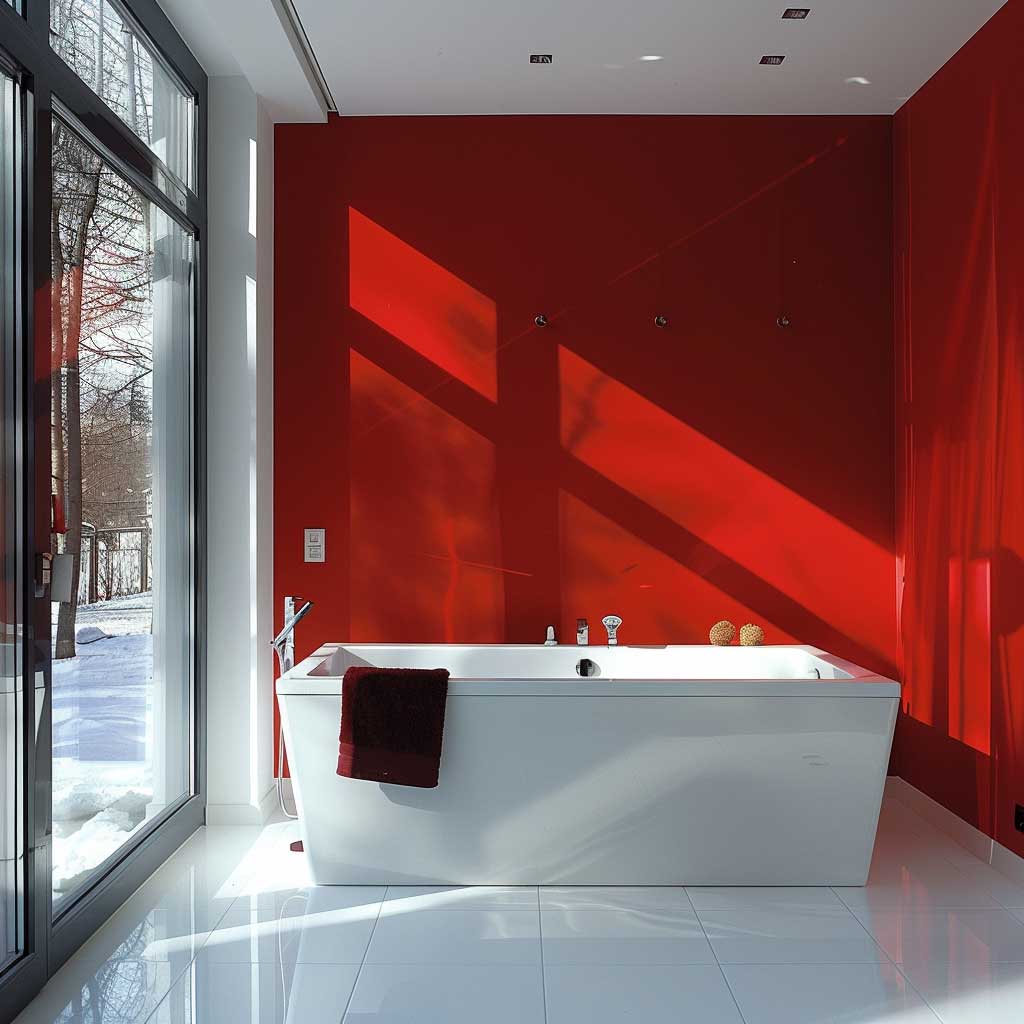

A red accent wall in a predominantly white bathroom delivers the strongest contrast for the lowest paint volume. One accent surface usually needs less than a quart while the remaining three walls stay white and reflective. The result is immediate energy without the cost of full-room coverage at 1–1.5 gallons.
Why does this pairing work better than all-red walls? White keeps light bouncing around the room so the red feels intentional rather than heavy. Modern fixtures in white or chrome sharpen the edge; a freestanding tub and high-gloss cabinets amplify the bounce. Avoid painting every wall red in rooms under 80 sq ft—the space can feel closed in within days.


Softer reds such as burgundy or deep cherry lower the intensity while keeping the contrast. White towels, clear glass doors and silver hardware act like neutral buffers. Natural light keeps the red vivid and the white crisp; evening recessed lights or a chandelier bounce off the white surfaces and warm the red. For more color-pop approaches that stay controlled, see these contemporary bathroom color ideas.


Lighting decides whether the red reads sharp or muddy. Daylight maximizes the difference; warm artificial light softens it after dark. Place the accent wall opposite the main light source for the cleanest result.
Striped Walls That Balance Pattern and Scale


Classic red and white striped walls introduce pattern without requiring extra square footage. Wider stripes make a louder statement; narrower ones act more like texture. Equal distribution of the two colors keeps the room from feeling crowded—especially useful in baths under 100 sq ft.
Does a frameless mirror help? Yes. It reflects the geometry and extends the pattern so the space feels continuous. White marble flooring with subtle gray veins supplies a neutral base that lets the stripes stay the star. Chrome fixtures and a white pedestal sink reinforce the clean modern edge.


Skip uneven stripe widths that lean too heavy on red; the room can feel restless. Keep the ratio close to 50/50 and the pattern stays energetic rather than chaotic. The same logic applies to morning routines—visual rhythm can lift the mood without added cost beyond the paint itself.
Red Vanity Contrast Against White Walls


A red vanity against white walls creates the same contrast effect as an accent wall but concentrates the color on a single functional piece. Professional vanity painting typically costs $300–$800 depending on size; a full vanity replacement starts higher. White marble tops and gold or chrome hardware keep the look polished rather than costume-like.
How does the temperature balance work? Warm red meets cool white and produces a room that feels both inviting and precise. Gold-framed mirrors and plush white towels layer texture without adding new colors. The combination reads spa-level when ventilation and mildew-resistant paint protect the finish. For softer palette alternatives that still deliver contrast, explore these mint and chocolate bathroom paint schemes.


Don’t pair a high-gloss red vanity with warm brass if the rest of the room stays cool-toned; the finishes fight. Chrome or polished nickel keeps the palette contemporary. One strong red piece is enough—adding red towels or art on top can dilute the impact.
Paint Finish and Cost Comparison
Choosing the right sheen and brand determines how long the red and white bathroom ideas hold up under daily steam. Satin and semi-gloss outperform flat in moisture resistance and cleanability. Premium lines such as Benjamin Moore Aura Bath & Spa or Sherwin-Williams Emerald sit in the $70–$85 range per gallon yet often need fewer coats than budget options at $20–$40.
| Option | Price per gallon | Coverage (sq ft) | Best sheen | Moisture resistance | Typical coats for deep red |
|---|---|---|---|---|---|
| Budget latex | $20–$40 | 300–350 | Satin | Basic | 3 |
| Mid-range (Behr, Valspar) | $35–$55 | 350–400 | Satin / Semi-gloss | Good | 2–3 |
| Premium (Aura, Emerald) | $70–$85 | 400+ | Matte / Satin / Semi-gloss | Excellent | 2 |
| Specialty mildew-proof | $35–$45 | 350–400 | Semi-gloss | Highest (5-yr claims) | 2 |
Deep reds almost always require an extra coat compared with white because the pigment load is higher. Plan for that extra half-gallon when the accent color is saturated. A full professional job on a standard bath averages $250–$650; DIY materials stay under $150 if the walls are already sound.
External pricing and coverage data from major manufacturers confirm these ranges. For detailed product specs and current formulations, consult the Benjamin Moore bathroom color resource.
Practical Execution Rules
Preparation decides whether the red stays vivid or peels within a year. Clean walls thoroughly, repair any moisture damage, and use a quality primer designed for bathrooms. Two thin coats outperform one thick coat every time. Ventilation after painting matters as much as the formula itself—run the exhaust fan for several days while the film cures.
Test the red under both daylight and artificial light before committing the full wall. A sample board leaning in the room for 48 hours reveals undertones that a tiny chip never shows. Keep white surfaces pure rather than creamy if the red leans cool; warm off-whites can muddy the contrast.
- Prime every surface that will receive red.
- Allow full cure time before heavy steam exposure.
- Wipe excess moisture daily for the first month.
- Choose hardware that matches the temperature of the red.
Final Palette Decisions
Red and white bathroom ideas succeed when contrast is deliberate and paint quality matches the humidity load. An accent wall or red vanity costs far less than a full remodel yet shifts the entire room’s energy. One gallon of the right formula covers most standard baths and lasts years longer than a bargain can.
Cherry red delivers brightness; burgundy delivers quiet luxury. Equal stripe ratios keep pattern lively without overwhelm. White remains the reflector that makes the red work.
Choose satin or better, test light carefully, and stop at one strong red element. The result is a bathroom that feels intentional every time the door opens.