A modern small black bathroom works when black covers one wall or a handful of fixtures and the rest of the room stays light enough to bounce daylight back. Most black paints sit below LRV 10, which means they absorb over 90% of the light that hits them, so the trick is placing black where it frames the room instead of swallowing it. Does black make a tiny bathroom feel smaller? Only when it lands on every surface at once. Start with one accent wall, one set of black hardware or one patterned floor, not all three.
Budgets can stay modest too. Ceramic subway tile commonly runs $1.50–$8 per sq ft before labor, matte black faucets start around $24 at big-box retailers, and a 24-inch black wall-mounted vanity sells for roughly $216. That puts a black accent wall, new taps and a compact vanity within reach of a small-scale update rather than a gut renovation. Price the three upgrades side by side and begin with the one that fixes your biggest problem.
The sections below cover tile, fixtures, black walls and black-and-white floors, each with typical costs, LRV numbers and the mistakes that turn drama into gloom. A comparison table near the end lines up every option by price, light impact and upkeep. Pick the move that matches the budget you already have.
- Black paint usually sits below LRV 10; Tricorn Black and Black Magic sit at LRV 3.
- Keep white trim and ceilings above LRV 80 so black edges look crisp, not dingy.
- Ceramic subway tile: about $1.50–$8 per sq ft vs $4–$15 per sq ft for labor.
- 3×12 subway tile shows fewer grout lines than 3×6 on a black accent wall.
- Matte black faucets run roughly $24–$200 at mass retailers.
- Porcelain checkerboard costs $3–$6 per sq ft vs $12–$25 for real cement encaustic.
- Size the fan at 1 CFM per sq ft, with a 50 CFM minimum.
Black Tile Accents Give a Modern Small Black Bathroom Its Backbone
Black tile accents are the most controlled entry point among small black bathroom ideas, because one tiled wall sets the tone while three lighter walls keep the room open. Glossy black subway tile behind the sink or tub acts like a picture frame, giving the eye a single strong edge to land on. Standard ceramic subway tile costs about $1.50–$8 per sq ft, with installation typically adding $4–$15 per sq ft. Tile the wall you see first from the doorway, not the one hidden behind it.
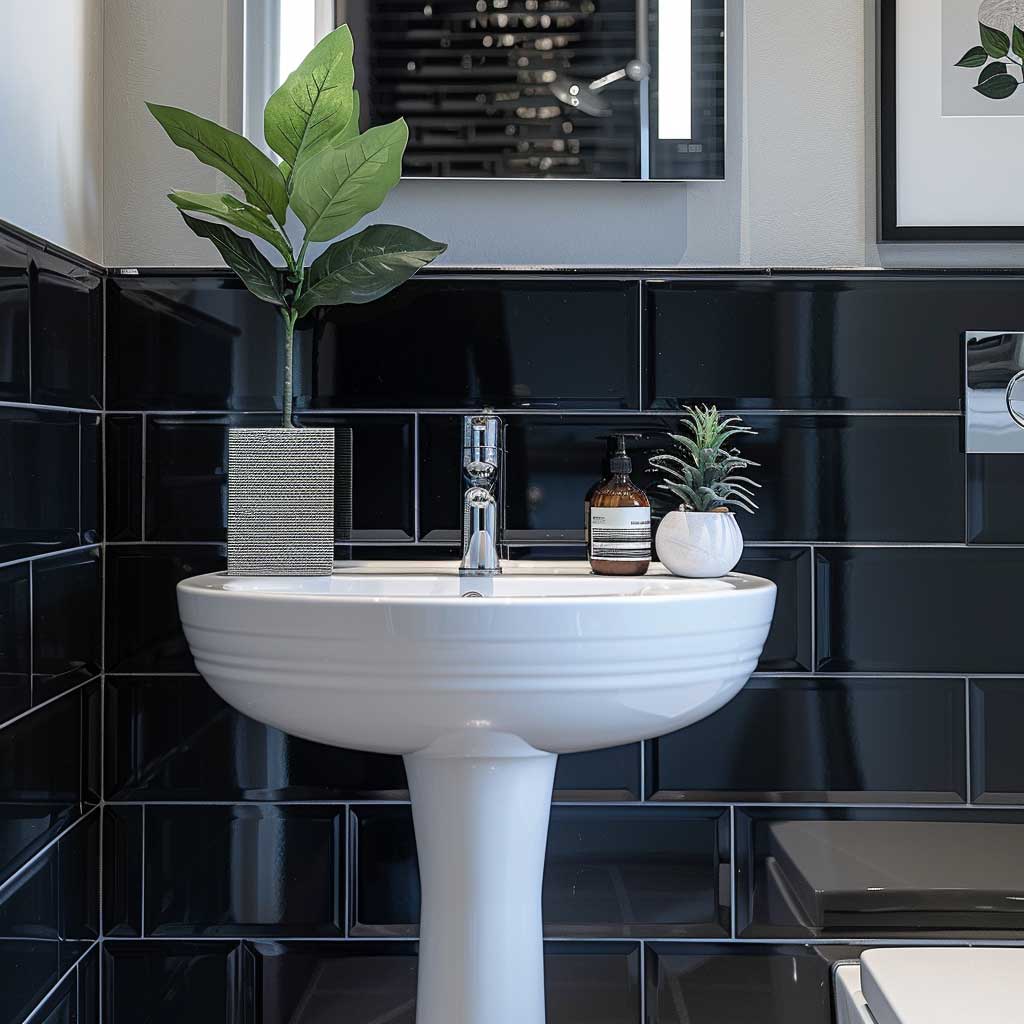
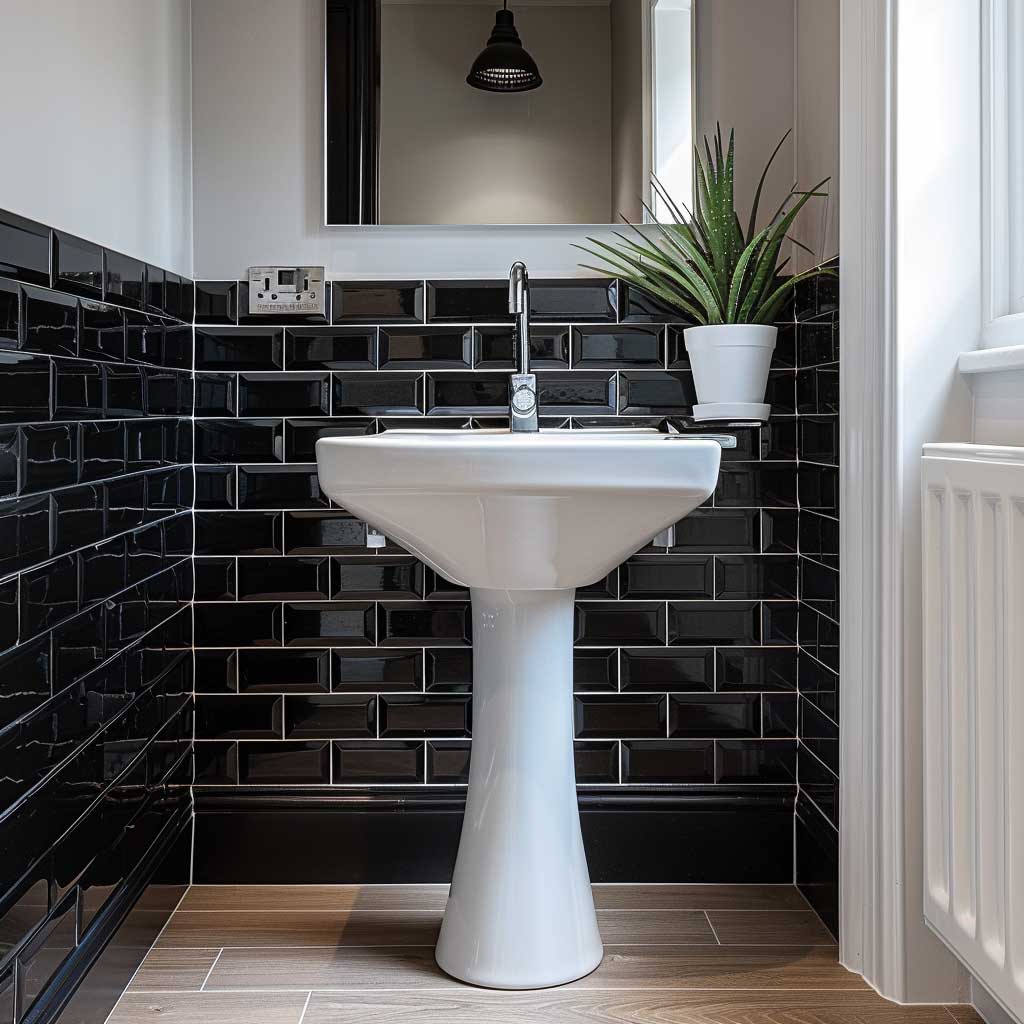
Which size works better on a dark wall, 3×6 or 3×12? Classic 3×6 tile reads traditional and slightly busy, while 3×12 stretches the wall with fewer grout lines and looks calmer in a cramped room. Long tiles expose lippage if the wall isn’t flat, so they need a careful installer. On a black accent wall, choose 3×12 when the substrate is straight and 3×6 when it isn’t.
Light gray walls next to black tile keep the contrast soft rather than harsh. A gray near LRV 58 sits roughly 50 points above most black tile and paint, enough separation for the tiled wall to read deliberate instead of muddy. The same effect shows up in this breakdown of navy paint at LRV 4 vs LRV 8 in a modern bathroom, where a few reflectance points change the whole mood. Pair black tile with a mid-to-light gray rather than a second dark shade.
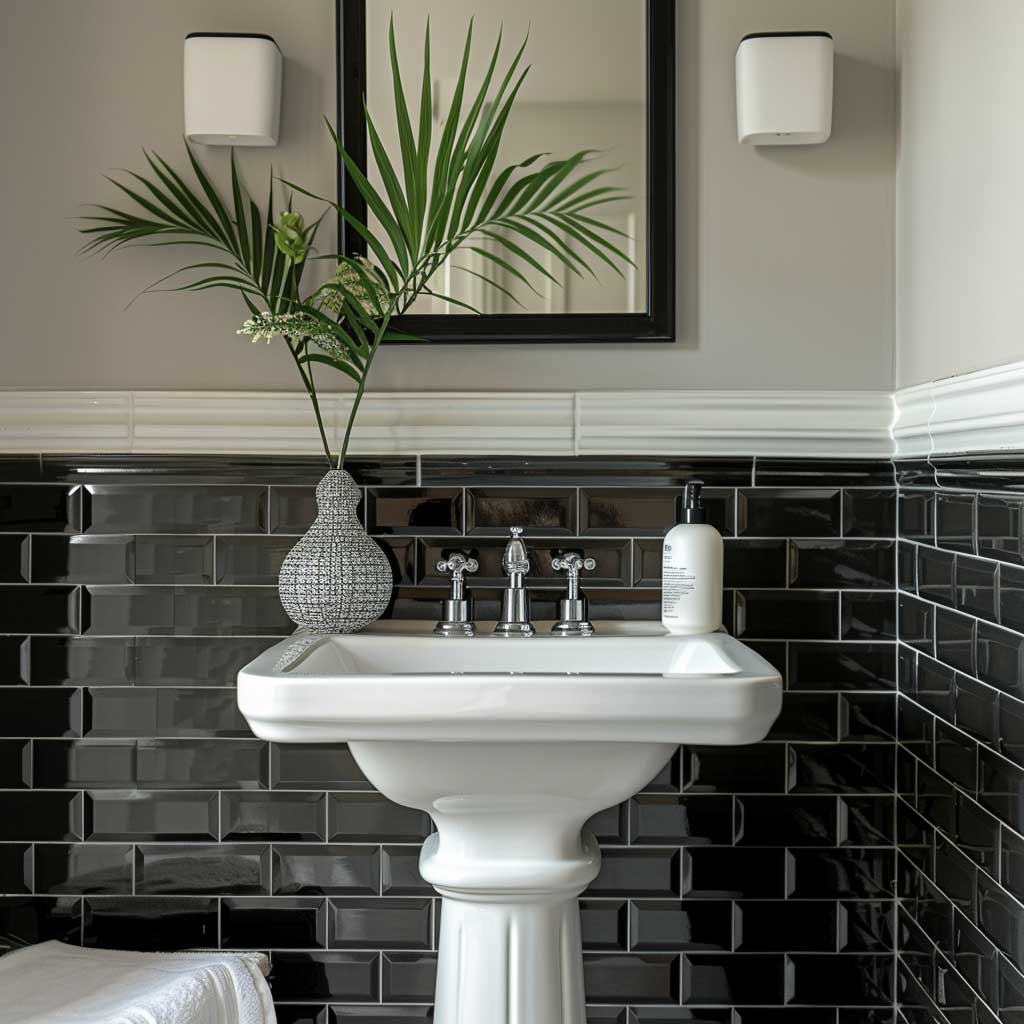

White fixtures and a frameless mirror handle the brightening that black tile can’t. A pedestal sink takes up less floor than a cabinet vanity and shows more white surface against the dark wall, like a lit window on a night street. A frameless mirror doubles the visible room without adding another dark line, and one potted plant breaks up the hard surfaces. Don’t tile all four walls black in a windowless bathroom; one wall is the safe limit.
Matte Black Fixtures Do More Work Than Their Size
Small bathroom ideas with black fixtures change the room’s character for less money than any tile job. Matte black faucets at mass retailers range from roughly $24 to about $200, so swapping the tap, towel bar and shower trim can stay within a few hundred dollars. Black hardware works like eyeliner: thin lines, big definition. Replace the faucet first, since it is the fixture the eye checks every single day.
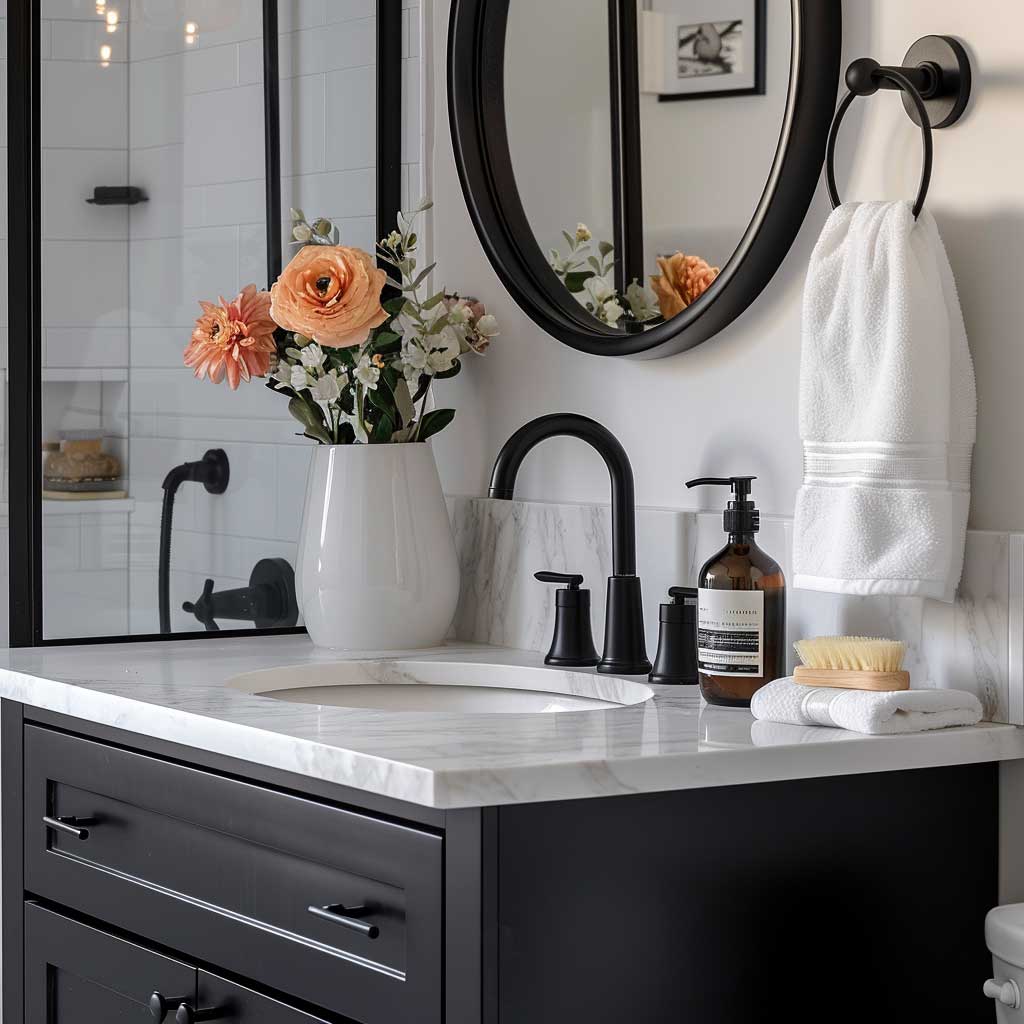
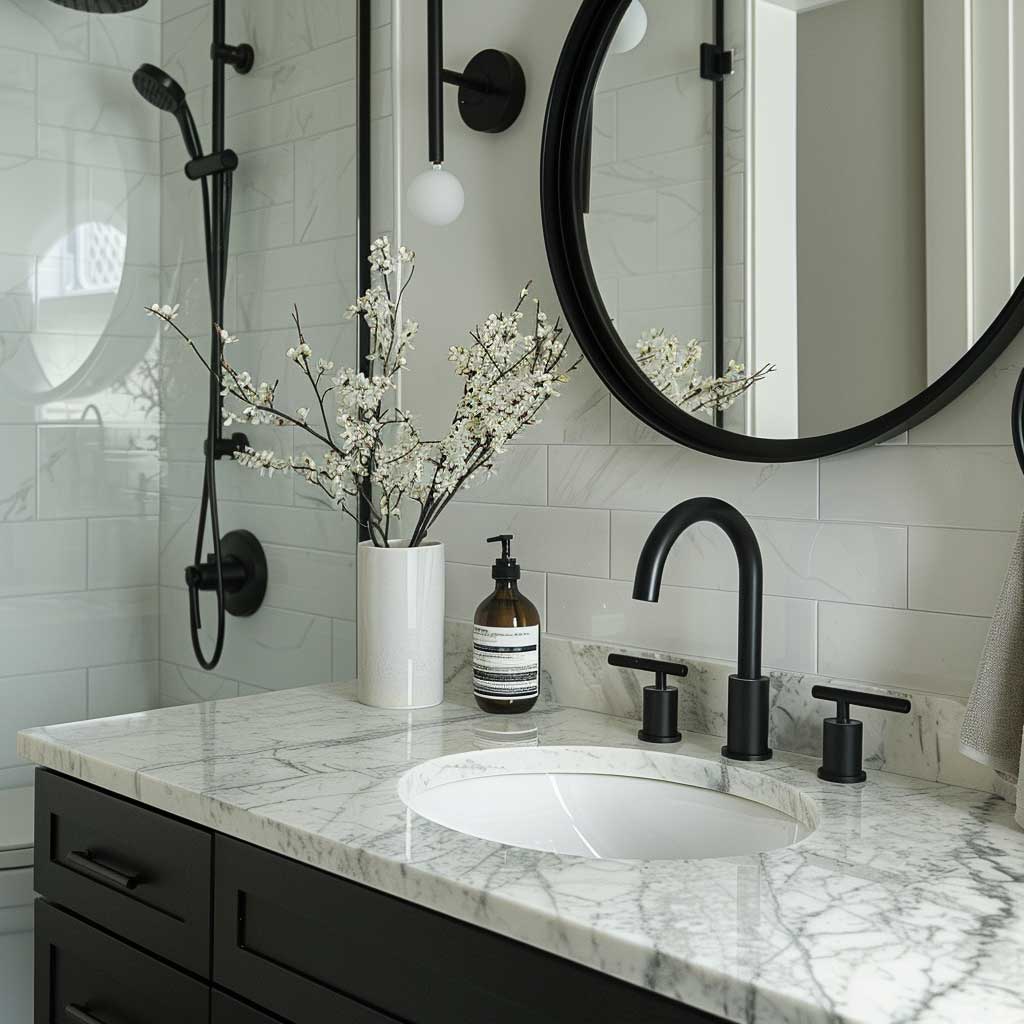
Is matte black harder to keep clean than chrome? Chrome shows fingerprints as bright smears, while matte black shows hard-water marks as pale rings, so neither finish is maintenance-free. A quick wipe with a dry cloth after use keeps the black coating even for years. Skip abrasive pads and bleach cleaners on black finishes, because they dull the surface fast.
A black framed shower enclosure outlines the wet zone like a pencil line on a sketch, giving structure to a room that otherwise blurs into white. The countertop finishes the picture: absolute black granite typically runs $40–$75 per sq ft installed, and a prefab 24-inch granite vanity top costs about $200–$350. Black granite vs white marble is the practical comparison here, since dense black stone handles splashes well and usually costs less. Choose black granite when the counter sits beside a busy sink.
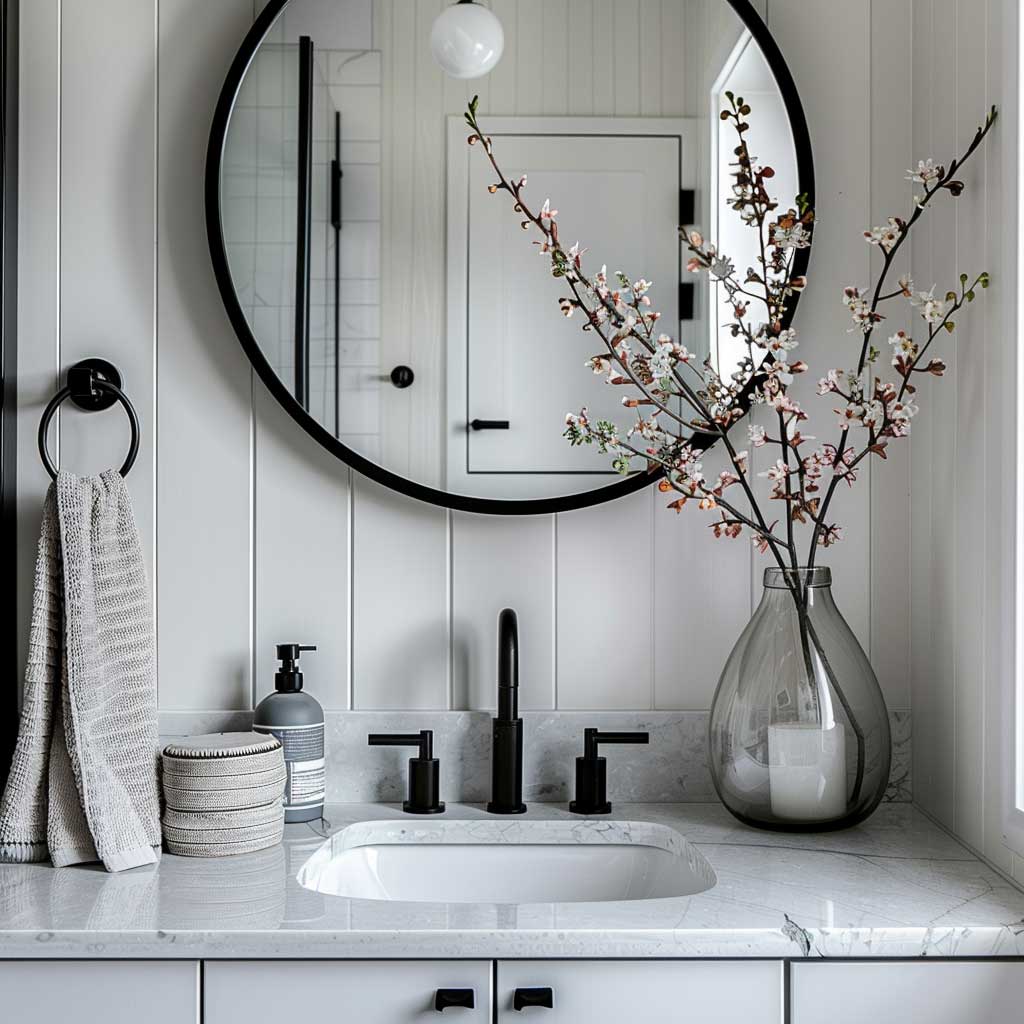
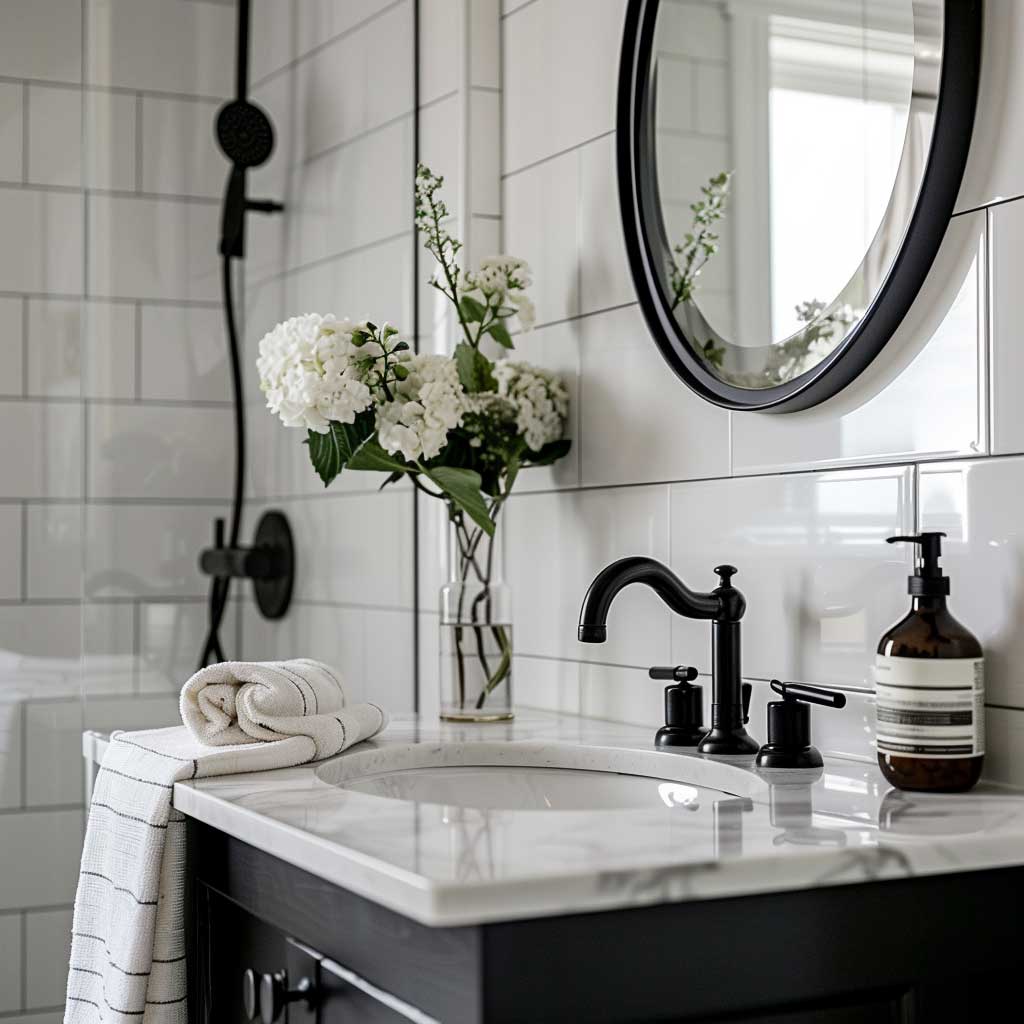
A round mirror with a thin black frame ties the fixtures together, because its circle interrupts all the straight tile lines. Black accessories beyond that, such as a soap pump, bin and towel ring, should repeat one finish rather than mixing matte and gloss. A few matching pieces read intentional, while a dozen start to look like a hardware aisle. Keep white walls behind the black fixtures so every line stays visible.
Black Walls in a Small Bathroom Live or Die by LRV
Black walls in a bathroom can feel cocooning or cave-like, and light reflectance value decides which one you get. LRV runs from 0 to 100, and the darkest blacks paint pros specify, Tricorn Black and Black Magic, sit at LRV 3, while softer blacks such as Iron Ore sit at LRV 6 and Wrought Iron near 8. Below LRV 10, a single point makes a visible difference on the wall, as this color consultant’s guide to LRV in paint colors explains. Sample two blacks side by side before committing to one.
Should a windowless powder room go black at all? It can, if the black is a softer shade and the trim stays bright, since color consultants keep interior trim and ceilings above LRV 80. White trim works like the outline on a coloring page; remove it and the shapes disappear. Never pair an LRV 3 black with a white below LRV 80, or the edges will look gray and tired.
- Measure the floor and size the fan at 1 CFM per sq ft, with a 50 CFM minimum.
- Pick a black near LRV 3 for a room with a window and a softer black near LRV 6–8 for one without.
- Paint the ceiling and trim in a white above LRV 80.
- Test a 12×12 inch sample under both 2700K and 4000K bulbs.
- Run the fan about 20 minutes after every shower to protect the finish.
Dark floors follow the same logic as dark walls. A solid black floor shows every footprint and water spot, while a solid white floor shows every speck of dirt, so small bathrooms with dark floors usually do better with a pattern or a charcoal tone. Warm 2700K bulbs keep black paint rich after dark, while 4000K light over the mirror gives truer color for shaving or makeup. Use both temperatures instead of choosing one.
Black and White Floors Turn a Small Black Bathroom Design Into Pattern
A black and white bathroom built on a patterned floor gives small black bathroom design a sense of movement without darkening the walls. Geometric tile works like a rug that never needs washing: it defines the zone and hides daily dirt better than either color alone. Porcelain checkerboard typically costs $3–$6 per sq ft, encaustic-look porcelain $5–$10 and genuine cement tile $12–$25. Choose porcelain for a bathroom floor unless you’re ready to seal cement on a schedule.

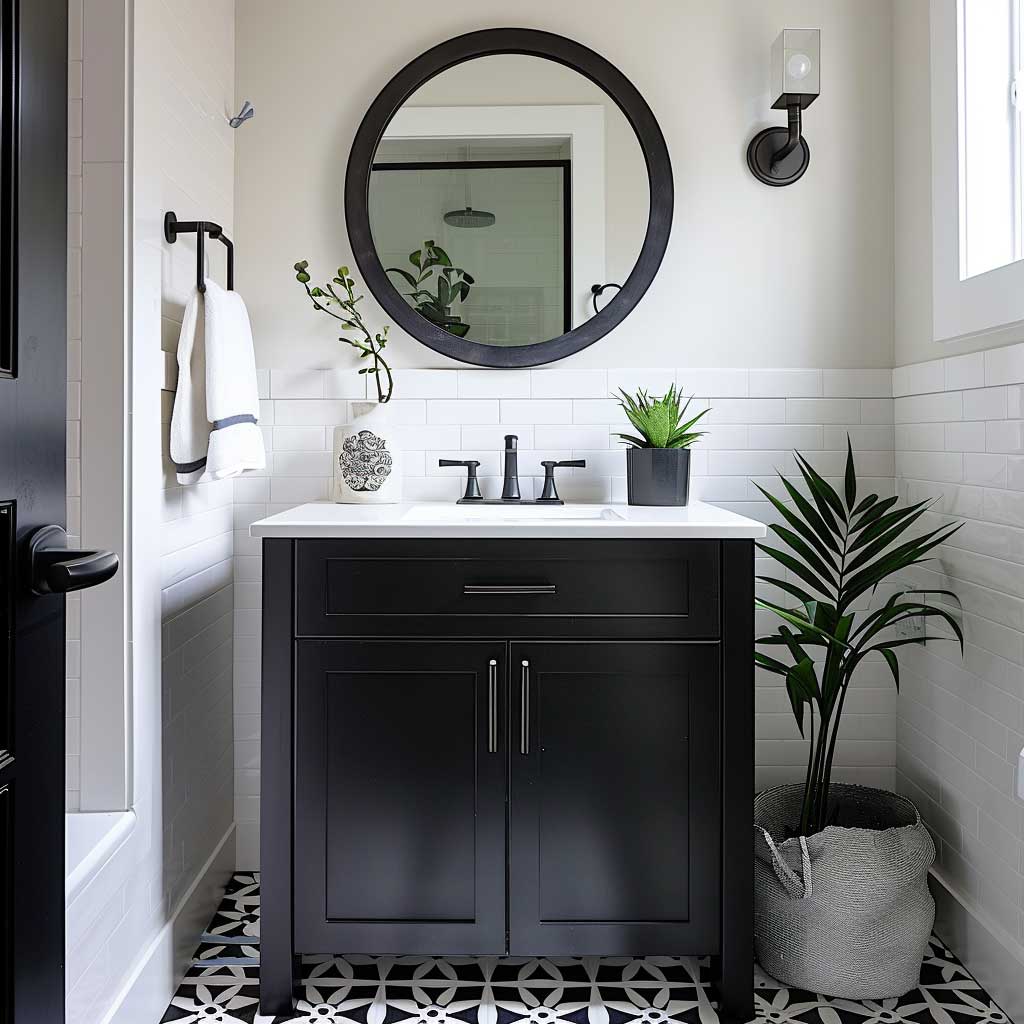
Pattern needs more tile than a plain layout. Installers commonly advise ordering 15–20% extra for patterned floors, and complex layouts can add about $2–$4 per sq ft in labor. On a 40 sq ft floor, that premium alone comes to roughly $80–$160. Buy the overage up front, because a second batch rarely matches the first.
Small bathroom ideas with a black vanity anchor the pattern so the floor doesn’t float. A 24-inch black wall-mounted vanity with sink sells for around $216 at mass retailers, 30-inch versions run about $243–$295, and solid-wood black vanities climb close to $1,000. Wall-mounted vs freestanding matters in a tight room, since visible floor under the cabinet makes the pattern look larger. Go wall-mounted whenever the floor is the star.
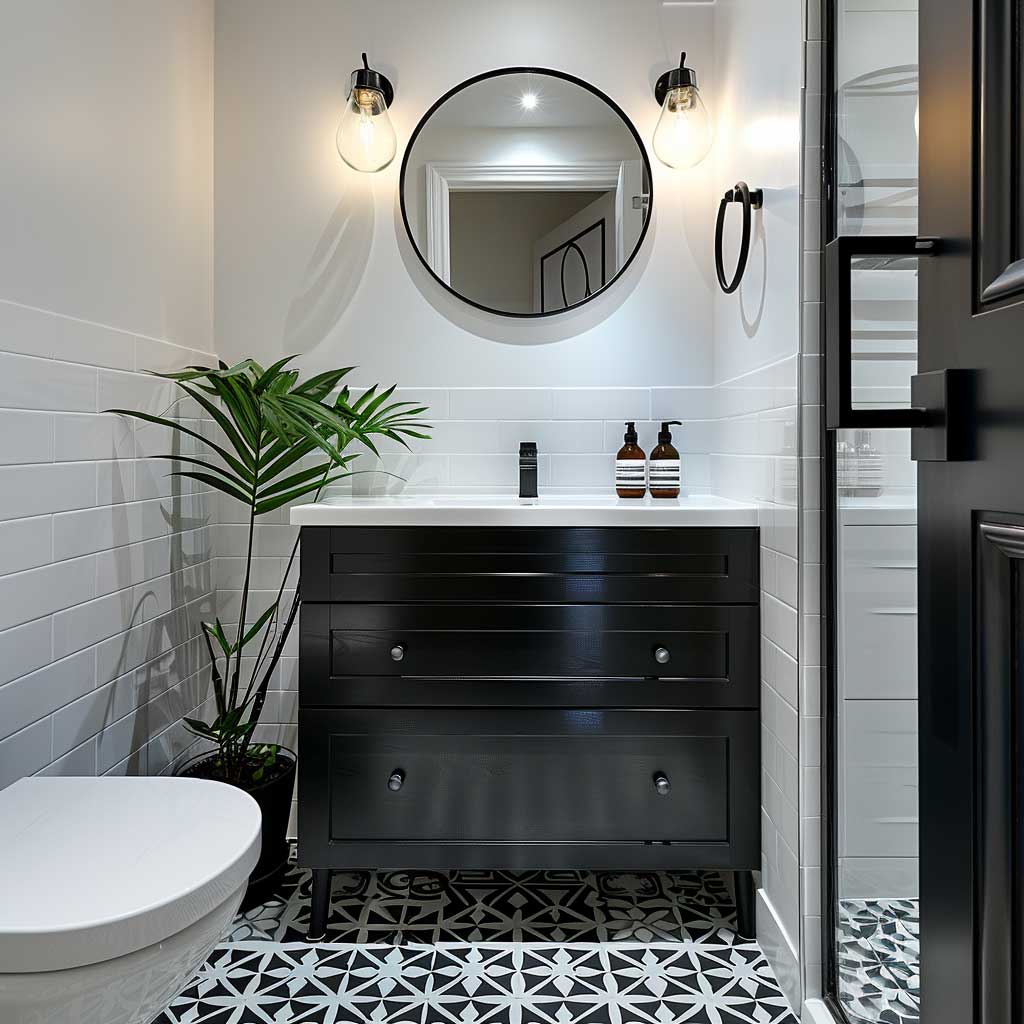

White walls give a bold floor room to breathe, the opposite of color drenching a room in one saturated hue, where walls, ceiling and trim all share a single deep shade. A round black mirror and a slim wall sconce repeat the floor’s contrast at eye level. Is bright white grout a good idea on black and white tile? Designers usually prefer warm gray or off-white, because pure white grout looks harsh against a graphic pattern. Keep the walls plain whenever the floor carries a strong motif.
Compare Black Finishes for a Modern Small Black Bathroom
Comparing black options by cost and upkeep shows which one fits a compact black bathroom budget. Tile and floors cost the most per sq ft, while fixtures deliver the biggest visual change per dollar. The table lines up typical prices next to light impact and cleaning effort. Read the upkeep column before the price column.
| Black element | Typical cost | Light impact | Upkeep | Best for |
|---|---|---|---|---|
| Black subway accent wall | $1.50–$8/sq ft tile + $4–$15/sq ft labor | Medium, one wall only | Grout cleaning | Bathrooms with a window |
| Matte black fixtures | About $24–$200 per faucet | Low | Wipe off hard-water rings | Fast refresh on any budget |
| Black painted walls | Blacks at LRV 3–8 | High, absorbs over 90% of light | Touch-ups show | Well-lit powder rooms |
| Black and white porcelain floor | $3–$10/sq ft + $6–$14/sq ft install | Low to medium | Hides everyday dirt | Busy family bathrooms |
| Black vanity, 24–30 in | About $216–$295 (near $1,000 solid wood) | Low | Wipe-clean fronts | Compact layouts |
| Absolute black granite top | $40–$75/sq ft installed | Low | Periodic sealing | Heavy-use sinks |
Don’t Do This
- Don’t paint all four walls of a windowless bathroom in an LRV 3 black; a softer black near LRV 6 returns about twice the light.
- Don’t pair black walls with trim or ceilings below LRV 80.
- Don’t fit a fan under 50 CFM, whatever the bathroom size.
- Don’t order patterned tile without 15–20% extra for cuts and breakage.
- Don’t mix matte and glossy black hardware in one small room.
Pick One Black Statement and Commit
A modern small black bathroom stays bright when black takes one lead role instead of every role: one tiled wall, one set of fixtures or one patterned floor, framed by white trim above LRV 80. That single rule matters more than any product choice.
For tile, a black subway wall costs roughly $1.50–$8 per sq ft before labor, and 3×12 formats keep grout lines quieter than 3×6. Put it on the wall visible from the doorway.
For the fastest change, swap to matte black fixtures in the $24–$200 range and add a thin round black mirror. Wipe the finish dry to stop hard-water rings.
For black walls, choose a shade between LRV 3 and 8 based on daylight and run a fan of at least 50 CFM. For floors, black and white porcelain at $3–$10 per sq ft delivers graphic impact without the sealing that cement tile demands.