Light exterior paint colors for small houses are the single fastest way to add 20 feet of visual square footage without touching a wall. I repainted a 900-square-foot cottage last spring — Sherwin-Williams Alabaster with white trim — and neighbors assumed we’d added a room. You’ll notice the same optical trick in every neighborhood where compact homes hold their own against larger builds: it’s always a light exterior, never a dark one. The three colors below — sky blue, soft beige, and light gray — are the palette I return to again and again for small footprints that need to read big from the curb.
None of these are safe, boring choices. Each one has a personality, a failure mode if you pick the wrong undertone, and a specific trim pairing that makes or breaks the whole look. Miss the undertone by even one shade family and your light-colored house becomes a faded accident. Get it right and the house looks like it was designed by someone who actually knew what they were doing.
Quick Scan
- Sky Blue — reflects light, reads larger, works best on cottages and coastal-adjacent styles. Pair with crisp white trim only.
- Soft Beige — warmest option, blends with any landscape, pairs with dark brown or sage green doors. Avoid pure yellow undertones.
- Light Gray — most modern of the three, sharpens architectural lines, gets muddy if the undertone tips purple. Benjamin Moore Pale Oak or Sherwin-Williams Repose Gray are the safe entries.
- All three reflect enough sunlight to lower surface temperatures — a real energy argument in warmer climates.
- None of these work on every house. Scroll past the section that doesn’t match your architecture.
Sky Blue on a Small House Exterior Earns Its Keep After 3 PM


Sky blue does something architecturally useful that most people don’t think about: it picks up the color of the sky above it, so by mid-afternoon the house and the light source start to feel like one continuous surface. I’ve watched this happen from the street and it reads as effortless spaciousness rather than decoration. For small house exterior paint, that’s the whole game. The bad news? Baby blue — the washed-out pastel version — does the opposite. It sits flat against the sky, looks dated by about 1987, and according to Emily LaMarque of LaMarque Design Studio, “easily washes out and can make your exterior feel exceptionally cheap.” The version you want has a green-gray undertone, not a purple one.
My go-to sky blue for small exteriors is Sherwin-Williams Rainwashed (SW 6211) at around $75 per gallon in Duration Exterior. It has just enough gray to keep it from looking like a nursery. Pair it with pure white trim — Benjamin Moore White Dove OC-17 — and a navy or forest green front door to anchor the whole composition. What doesn’t work: blue-gray trim on a blue house. I tried it on a client project once and the house looked like it was made of one continuous denim sheet. You need contrast or the small footprint collapses visually into itself.
Does sky blue hold up in non-coastal settings? Absolutely. It reads as fresher and more interesting than the sea of greige you get in most suburban developments, and it photographs warm in golden-hour light — which matters more than people admit when your house is competing on listing apps. High-quality exterior paint in this color family should have an LRV (light reflectance value) above 55 to do the visual-expansion work reliably. Check the spec sheet before you buy.
One place sky blue fails quietly: red brick. The cool blue fights warm brick undertones and the house ends up looking like it can’t decide what it wants to be. If your small house has a brick base or chimney, shift to soft beige or a warm-toned gray instead. Brick is already doing visual work — let it.
Soft Beige Is the Exterior Color That Makes Every Landscape Look Intentional
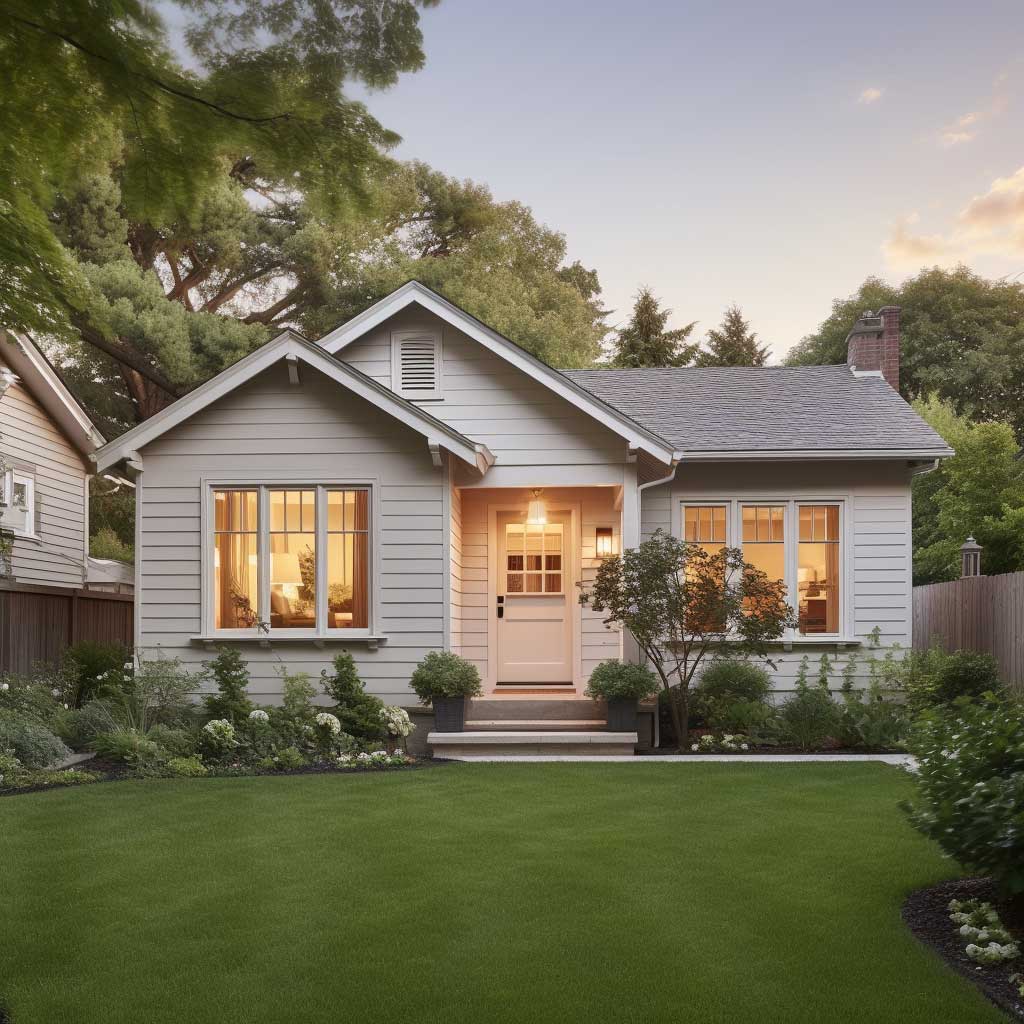


Soft beige is what I reach for when a small house sits inside heavy landscaping — lots of mature trees, garden beds, neighboring stone walls. It’s the color equivalent of a neutral shoe: nothing fights it, everything sits beside it comfortably. Think of it like the house is made from the same material as its surroundings, just refined. That’s exactly why it reads as larger than it is — the eye doesn’t stop at the wall, it keeps traveling into the yard. For small house exterior paint, this is the most forgiving palette position you can take.
The specific beige matters more than most people realize. Sherwin-Williams Accessible Beige (SW 7036) is the industry workhorse at around $78 per gallon — it has a warm gray undertone that keeps it from going yellow in afternoon sun. Joanna from Little Greene is the European equivalent, a pale taupe that photographs especially warm in natural light. Both survive the “3 PM on a west-facing wall” test without going orange. What fails that test: any beige with a strong yellow undertone. I’ve bought three wrong ones over the years, and you can’t see the problem until the paint is dry and the sun is at the worst angle.
You’ll want a contrasting door color to keep a beige exterior from reading as unfinished. Sage green, dark navy, or even terracotta all work better than a matching beige door — that’s just a beige wall with a handle in it. I stole this trick from a designer in Copenhagen who said a front door should be “the one sentence in a paragraph that uses a different verb.” Dark chocolate brown shutters and white window trim round out the palette without adding visual noise.
Don’t Do This
Don’t choose a beige with a strong pink undertone for a small exterior. In certain afternoon light, pink-beige reads as “the house needs a repaint” rather than “warm and inviting.” Hold your paint chip against a piece of white paper outside at noon — if the pink is visible, put it back. The same rule applies to gray-beige hybrids that lean lavender. Lavender beige is one of those colors that looks sophisticated on a chip and looks like a mistake on 900 square feet of siding. I made this error on my own house once. Primed and repainted six months later. Don’t be me.
For a deeper look at how small house exteriors use color to reframe scale and proportion, the roundup at artfasad.com on exterior paint colours for small houses covers a wider range of tones — including some bolder options that challenge the “light is always right” assumption.
Light Gray Exterior Paint Sharpens the Lines a Small House Actually Has


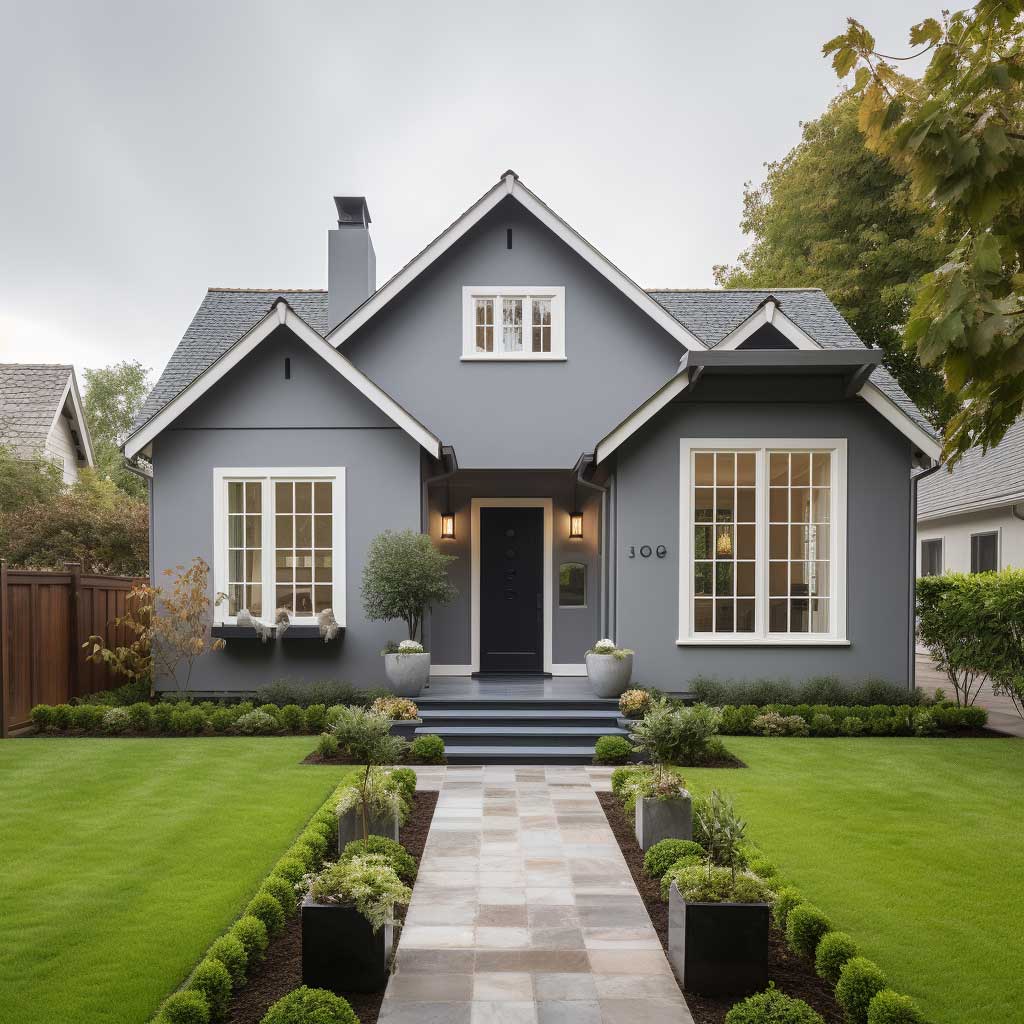

Light gray is the most architecturally honest of the three colors here. It doesn’t try to make the house feel warm or coastal — it just shows the structure exactly as it is, with high fidelity. That’s actually the point. A well-designed small house has clean lines, sensible proportions, deliberate window placement. Light gray lets all of that read without interference, the way a white mat in a frame stops drawing attention to itself and lets the photograph do the work. Repose Gray by Sherwin-Williams (SW 7015) is the current benchmark at around $76 per gallon in the Emerald Exterior line.
What kills light gray on a small house: a purple undertone. I’ve watched this happen in real time — a color that looked like a clean silver on the chip, poured on four walls, suddenly reads as lavender in shadow. The fix before you buy is to test the chip on the actual north-facing wall of the house, not just the south-facing one. North light is honest. South light flatters everything. Sherwin-Williams Chelsea Gray (SW 9545) and Benjamin Moore Pale Oak OC-20 both pass the north wall test. They stay gray even when the light is doing nothing for them.
Light gray pairs particularly well with geometric or contemporary-style small homes — the clean lines of the architecture act as the contrast element that beige and blue have to borrow from trim color. You still want a sharply contrasting door, though. Bright white, deep charcoal, or black all work. A gray door on a gray house is not a monochromatic scheme — it’s just a house where nobody finished making decisions. Carr Lanphier, COO of Improovy Painters, specifically recommends Chelsea Gray because “white exterior trim really pops” against it — that pop is doing the visual heavy lifting that makes the small footprint feel resolved.
Sherwin-Williams’ exterior color selector lets you upload your own house photo and test grays against your actual roofline and trim — worth 20 minutes before you commit to five gallons. The tool doesn’t replace a real-world sample on the wall, but it eliminates the obviously wrong undertones fast.
For more context on how light gray and other neutral exterior palettes perform across different house styles and color scheme pairings, the full breakdown at artfasad.com’s exterior colors guide covers combinations and contrast ratios in much more detail.
Light Gray vs. Soft Beige vs. Sky Blue — How They Perform
| Color | Best House Style | Trim Pairing | Fails When | Specific Brand Pick |
|---|---|---|---|---|
| Sky Blue | Cottage, coastal, traditional | Crisp white only | Paired with warm brick or yellow undertone trim | SW Rainwashed SW6211 (~$75/gal) |
| Soft Beige | Rustic, farmhouse, landscaped | Dark door + white window trim | Pink or yellow undertone chosen | SW Accessible Beige SW7036 (~$78/gal) |
| Light Gray | Contemporary, geometric, minimal | Black or charcoal door, white trim | Undertone tips purple on north wall | SW Repose Gray SW7015 (~$76/gal) |
Final Take
Light Exterior Paint Colors for Small Houses Work Because Physics Is On Their Side
Light surfaces reflect more light. More reflected light makes surfaces read as larger. This isn’t a design opinion — it’s how eyes process contrast and boundaries. A dark exterior shrinks a small house against the landscape. A light one erases the wall and shows you the sky.
The three colors in this post — sky blue, soft beige, and light gray — are not interchangeable. Each has a specific architecture type, a specific failure mode, and a specific price point to execute correctly. Pick the one that matches your structure, not the one you feel warmest about on a chip in the store.
Save this post before your next trip to the paint counter.