
A gray and lavender bedroom works because gray does the quiet background work while lavender adds just enough warmth to keep the room from feeling cold. The pairing suits trim, a single accent wall or a two-tone split, and each option needs a very different amount of paint: a quart covers roughly 100–125 linear feet of trim, while one gallon handles about 375–400 square feet of wall. Does it work in small or dim rooms? Yes, as long as the wall shade has a light reflectance value (LRV) around 40 or higher and the deeper lavenders stay on accents.
Think of gray as the linen tablecloth and lavender as the single sprig of flowers on the table. Light shades such as an LRV 54 lavender or an LRV 60 gray bounce daylight around a north-facing room, while LRV 23–29 shades read moody and need warm 2700K–3000K bulbs at night. The sections below cover placement, paint quantities and exact shade numbers so you can decide in one pass. Settle on placement first, then pick the shade.
Quick Scan
- Lavender trim on gray walls takes about one quart of paint for the 50–75 linear feet of baseboards and casings in a typical bedroom.
- An accent wall behind the bed (12 × 8 ft, about 96 sq ft) needs a single gallon, even with two coats.
- Two-tone walls look balanced with the color break at one-third height: roughly 32 inches on an 8-foot ceiling.
- Light lavender (LRV 40–54) opens up a small room; deep gray lavender (LRV 23–29) wraps it in shadow.
- Warm 2700K–3000K bulbs keep lavender soft at night, while cooler bulbs push it toward blue.
- Test a poster-size swatch at morning and evening light before buying full gallons.
- Living rooms follow the same rules but cost more, with average interior painting at $2–$6 per square foot.
Lavender Trim Sharpens Soft Gray Walls
Among gray and lavender bedroom ideas, lavender trim on soft gray walls is the lowest-commitment way to try the pairing. A light gray like Agreeable Gray, listed at LRV 60, keeps the walls bright, while lavender on baseboards, door casings and window frames outlines the room like piping on a tailored jacket. Compared with crisp white trim, lavender softens the edges and makes the gray read warmer. Choose a lavender at least one step darker than the walls so the outline stays visible.


How much paint does trim actually take? A standard bedroom has roughly 50–75 linear feet of baseboards and casings, and one quart of trim paint covers about 100–125 linear feet per coat, so a single quart usually handles two coats. Average gallon prices run $15–$40 depending on finish, which makes a quart of lavender a small bet compared with repainting four walls. Use satin or semi-gloss on trim, because flat finishes scuff quickly on surfaces that take kicks and vacuum bumps.
Skip lavender on the crown molding in a room with an 8-foot ceiling. A colored line at the very top stops the eye and makes the ceiling feel lower, while gray or white crown molding lets the wall run upward without a break. Keep lavender on the baseboards and door casings, and repeat it in bedding in one shade only. Two lavender tones across trim and textiles is the limit before the room starts to look themed.
A Lavender Accent Wall Anchors a Gray and Lavender Bedroom
A lavender accent wall behind the headboard is the classic lavender and gray bedroom layout, and it works like a stage backdrop that pulls attention to the bed first. A typical 12-by-8-foot wall measures about 96 square feet, so one gallon covering 375–400 square feet handles two full coats with paint left for touch-ups. Compared with painting all four walls, that cuts the lavender spend to roughly a quarter. If you are weighing one feature wall against painting every surface in a single hue, compare the trade-offs of an accent wall versus color drenching in a modern bedroom before you buy.


Which lavender suits an accent wall? Mid-tone shades between LRV 29 and 40, such as Dried Lavender at LRV 29 or Modern Lavender at LRV 40, hold their color next to light gray without shouting. Darker options like an LRV 23 gray lavender suit rooms with strong daylight or good lamps, because they absorb most of the light that reaches them. Test on a poster-size sample rather than a chip, since small swatches surrounded by white always read darker than the finished wall.
Avoid putting the accent wall on the window wall. Backlit lavender turns flat and gray-blue during the day, and the effect you paid for disappears. Plan for two coats when moving from white or pale gray to lavender, since paint makers note that one coat only covers well over a similar color. Finish with brushed-nickel lamps and a gray upholstered headboard to tie the wall back to the baseboards.
Two-Tone Walls Give a Gray and Lavender Bedroom Structure
Two-tone gray and lavender walls split each wall horizontally, and the height of that split decides whether the room feels balanced or chopped in half. The common rule places a chair rail about one-third of the way up, which works out to roughly 32 inches on an 8-foot ceiling; some designers prefer 25% of wall height, or about 30 inches on a 10-foot ceiling. A rail 2–3 inches wide is the most common size and gives the color change a clean edge. Never split the wall at the midpoint, because a 48-inch line on an 8-foot wall creates two halves that compete.
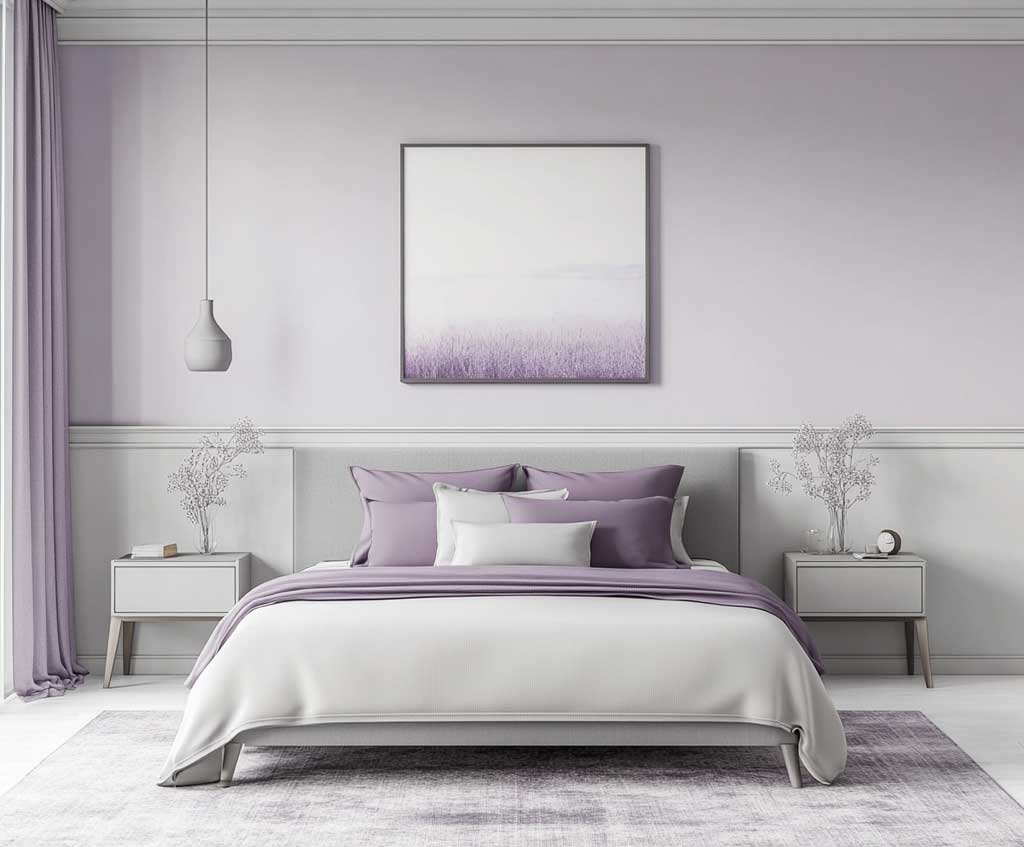


Should gray go on the bottom or the top? Gray below and lavender above is the safer order, because the more practical gray hides furniture scuffs while the lighter lavender draws the eye toward the ceiling. Flip it only in rooms with ceilings above 9 feet, where a heavier lavender base keeps the space from feeling cavernous. It works like a well-cut outfit: darker trousers, lighter shirt, and the whole look stays grounded.
A 12-by-14-foot room with 8-foot ceilings has about 416 square feet of wall, according to the Cloverdale Paint estimating guide. With a 32-inch rail, roughly 140 square feet goes gray and 275 square feet goes lavender, so one gallon of gray covers two coats while lavender needs two gallons for the same result. Under 2700K–3000K bulbs both shades stay warm, while 5000K daylight bulbs turn the lavender noticeably bluer. Buy dimmable warm bulbs for both bedside lamps.
| Approach | Lavender area | Lavender paint to buy | Coats | Contrast level |
|---|---|---|---|---|
| Lavender trim | 50–75 linear ft | 1 quart | 2 | Low |
| Accent wall | About 96 sq ft (12 × 8 ft wall) | 1 gallon | 2 | Medium to high |
| Two-tone split | About 275 sq ft above a 32-inch rail | 2 gallons plus 1 gallon gray | 2 | Medium |
| Full lavender walls | About 416 sq ft (12 × 14 ft room) | 2–3 gallons | 2 | High |
Don’t Do This
- Don’t choose lavender from a 2-inch chip; test a poster-size sample at morning and evening light.
- Don’t light lavender walls with 5000K daylight bulbs; stay in the 2700K–3000K range for a soft, warm read.
- Don’t use flat paint on trim; satin or semi-gloss resists scuffs far better on baseboards and doors.
- Don’t use two lavender wall shades in one room; one wall shade plus one textile shade is the limit.
- Don’t skip the second coat when going from white to lavender; one coat only works over a similar color.
Lavender Gray Paint Colors Ranked by Light Reflectance
Lavender gray paint colors sit on a narrow line between purple and gray, and the LRV tells you which side a shade will land on in your room. LRV measures the percentage of light a color reflects, so an LRV 54 shade bounces back more than twice the light of an LRV 23 shade. Treat it as a dimmer switch built into the paint: higher numbers brighten, lower numbers dim. Pick wall shades first by LRV, then by undertone.
| Shade | Brand and code | LRV | Reads as | Best use |
|---|---|---|---|---|
| Agreeable Gray | Sherwin-Williams | 60 | Warm light gray | Main walls around lavender accents |
| Candied Lavender | HGTV Home by Sherwin-Williams HGSW 2406 | 54 | Pale gray lavender | Full walls in small or dim rooms |
| Modern Lavender | Sherwin-Williams SW 9688 | 40 | Balanced lavender grey colour | Accent wall or upper two-tone band |
| Dried Lavender | Sherwin-Williams SW 9072 | 29 | Dusty blue-violet | Accent wall in a bright room |
| Gray Lavender | Valspar 4005-4A | 23 | Deep and dramatic | Trim, doors and small accents |
What separates a good lavender gray wall paint from a muddy one? Undertone matters as much as depth: Modern Lavender is so gray that Benjamin Moore’s Excalibur Gray matches it at a color difference of just 1, which is visually identical in normal room light. Candied Lavender, by contrast, keeps more visible violet at LRV 54 and reads clearly purple on a sunny wall. Choose the grayer shade if the room already has warm wood floors, since stronger violet can clash with orange-toned oak.
Don’t put an LRV 23–29 lavender on all four walls of a small north-facing bedroom. Without direct sun, those shades absorb most of the light and the room reads closer to slate than lavender. Keep the deep shades for one wall, doors or trim, and run an LRV 40–60 color everywhere else. Buy sample pots of two neighboring shades and compare them side by side on the same wall.
Gray and Lavender Living Room Ideas Use the Same Playbook
A gray and lavender living room follows the same placement rules as the bedroom, but the larger surface area changes the budget. Average interior painting costs run $2–$6 per square foot including paint and materials, and one gallon covers roughly 350 square feet per coat by the same cost data. A 16-by-20-foot room with 8-foot walls has about 576 square feet of wall, so two coats of lavender everywhere would take around four gallons versus one gallon for a single feature wall. That gap is why most living rooms keep lavender to one wall or to textiles.
- Lavender wall behind the sofa, with light gray on the other three walls.
- Gray walls with lavender cushions, throws and a patterned rug for a reversible look.
- Lavender built-in shelves or a painted door as a small, contained accent.
Is it smarter to start with pillows or paint? Textiles let you test lavender for the price of a few cushions, while paint commits you to 1–4 gallons depending on coverage. If the room has strong moldings or built-ins, painting walls, trim and shelves in one soft lavender gray can work better than a single accent, as shown in this look at how colour drenching unifies walls, trim and ceiling. Avoid splitting a living room into three or more colors, which turns the space into a patchwork quilt rather than one calm envelope.
Pick One Lavender Move and Commit
One clear lavender gesture on a gray base beats three timid ones, and the cheapest version costs a single quart of trim paint. Lavender trim, an accent wall and a two-tone split all work; the right pick depends on how much contrast you want and how much light the room gets.
For a low-risk test, paint 50–75 feet of trim lavender over LRV 60 gray walls. For a clear focal point, put one gallon of an LRV 29–40 lavender on the wall behind the bed.
For structure, set a chair rail at about 32 inches on an 8-foot wall and keep gray on the lower third. Budget two gallons of lavender for the upper band in a standard 12-by-14-foot room.
Whatever you choose, light it with 2700K–3000K bulbs and test a poster-size swatch at two times of day. Those two checks prevent most lavender regrets before the first full coat goes on.
Complete guide
Bedroom Design Ideas That Actually Change How You Sleep, Feel and Live
Styles, colors, furniture, walls, layouts — 300+ ideas in one place
Complete guide
Grey Home Color Ideas for Every Room and Every Shade
Exteriors, kitchens, living rooms, bedrooms, bathrooms — all in one place
You Might Also Like

Related Topics