Red shag haircut with bangs sits in a rare category of styles that look intentionally undone but require real structural thinking to pull off. The layered architecture creates movement from root to tip, while bangs — curtain, choppy, or wispy — anchor the face with a frame that turns a bold color into a full look. This isn’t a cut that ages quietly in a drawer; it demands maintenance, attention, and the right stylist conversation.
Fiery red intensifies every quality the shag already has. The multidimensional hue shifts from copper to crimson depending on the light, so layers that might read as a single texture in neutral tones suddenly become a cascade of warm contrasts. The result is a hairstyle that moves — literally and visually — in a way that flat, single-length styles never do.
The catch with red specifically is its fading speed. According to Davines, even the most skilled colorist cannot prevent noticeable fade within four weeks, because red pigment molecules are physically too large to fully anchor inside the hair cuticle. Plan for color touch-ups every four to eight weeks, budget the salon cost accordingly ($55–$180 for single-process color, per Yelp’s pricing data), and the rest of the look takes care of itself.
– Red shag with curtain bangs = most face-universal option; soft central part balances strong layer texture
– Choppy fringe (above brow) = highest-impact, highest-commitment — trim every 3–4 weeks or it loses its edge
– Tousled red shag = lowest daily styling time; sea salt spray on damp hair and done
– Red fades in ~4 weeks; ask colorist to go one shade darker on application to buy extra time
– Trim schedule: 6–8 weeks for short shags, 8–12 weeks for mid-length (MasterClass / The Hair Standard)
Curtain Bangs Pull the Red Shag Haircut from Retro to Current
The curtain bang version of the red shag haircut with bangs is where most stylists start with hesitant clients — and for good reason. A central or slightly off-center part divides the fringe into two soft wings that fall on either side of the face, creating a diagonal line that visually narrows the forehead without the hard-commitment energy of a blunt fringe. This style has been the default Pinterest reference since curtain bangs re-entered mainstream styling circa 2020 and hasn’t let go.

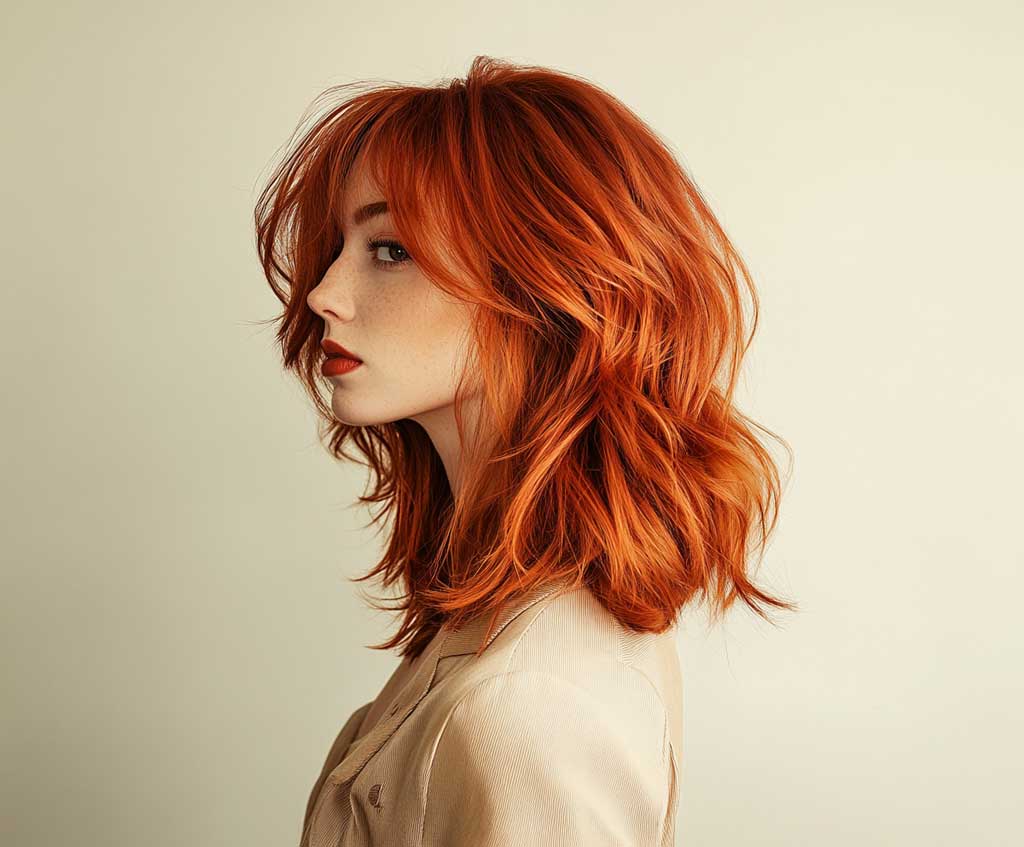


The structural trick here is contrast: the smoother, swept curtain bangs land against choppy, disconnected layers throughout the rest of the cut. Think of it as the visual equivalent of a raw-edge garment with a clean lapel — the roughness reads as intentional because something neat is anchoring it. On wavy or naturally textured hair, this contrast arrives on its own; on straight hair, a quick pass with a 1-inch wand through the mid-lengths creates the necessary separation between bangs and body.
Red layers in natural light behave like a prism. A copper-based fiery red shifts toward orange under direct sun and deepens to burgundy in shadow — two completely different looks from the same appointment. Stylists often recommend going one shade darker than your target at application, because the fade naturally delivers exactly the hue you want by week three. That one tip alone can stretch a color appointment from four weeks to six. For the same cut adapted for round face shapes, the shag haircut for round faces shows exactly which layer placement and fringe angles prevent the cut from widening the face.




What kills curtain bangs faster than anything: blow-drying them downward with a flat brush instead of rolling them outward with a round brush. The flat-dry approach trains the hair into a rigid wall across the forehead — the opposite of the soft, outward sweep the style is built on. Two minutes with a small round brush on the last inch of each bang section sets the shape for the whole day. Skip that step and you’ll be pinning them back by noon and wondering why the cut doesn’t look like the reference photo.
Curly and wavy hair types get something extra from this configuration — the curtain fringe forms a soft wave on its own with almost no product. Straight hair needs that brief curl-wand flick to create matching movement. Either way, the styling window for this particular version is about two to three minutes after washing, making it the most practical entry point into red shag territory.
Choppy Fringe Makes Red Shaggy Hair Land as a Deliberate Edge Statement
Red shaggy hair with short, choppy fringe plays by completely different rules than the curtain version — and the commitment level is proportionally higher. The bangs sit just above or at the eyebrows, cut with point-scissor texture so the ends are jagged rather than blunt. That jagged edge is load-bearing: it’s what separates “edgy shag” from “standard fringe with layers,” and it’s what photographers reach for when they want a hairstyle to look like it belongs in an editorial rather than a yearbook.
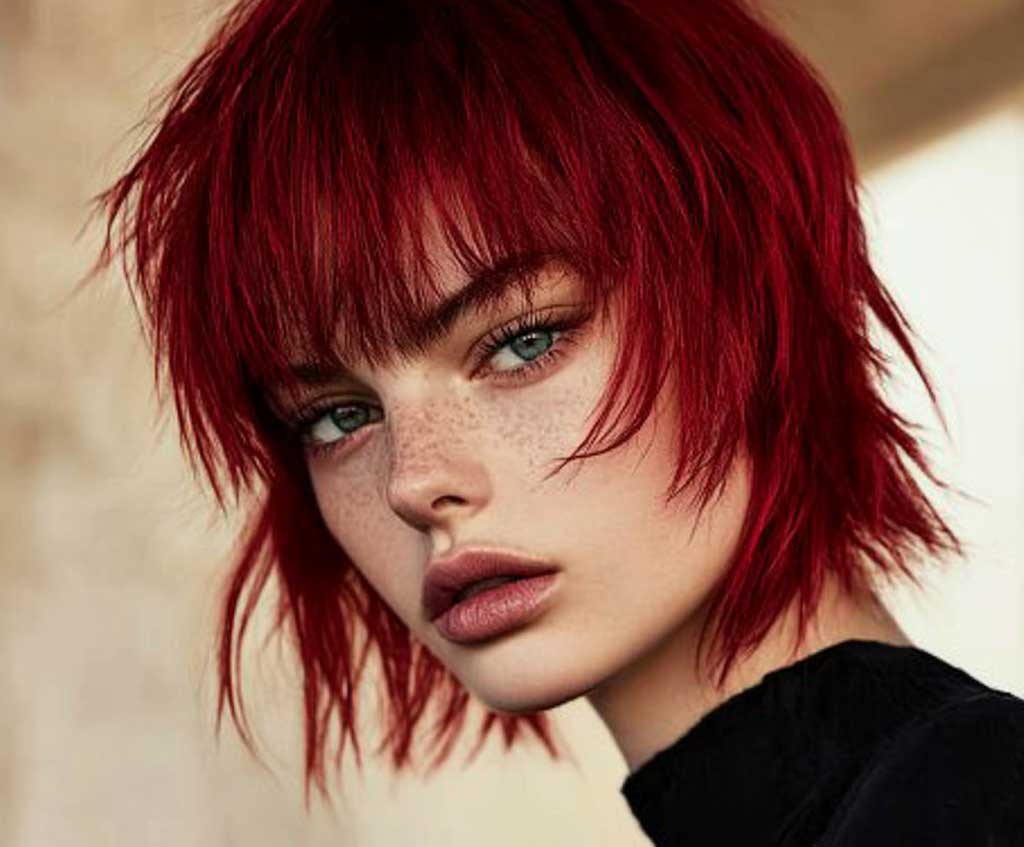


Deep, burgundy-leaning red tones work especially well with this fringe shape because the intensity of the color reinforces the sharpness of the cut — the two reinforce each other the way a strong jawline reinforces a strong silhouette. Copper or strawberry red, by contrast, can soften the edge slightly, which suits anyone who wants the choppy structure without the full punk-adjacent energy. What doesn’t work: a deep red with blunt-cut straight-across bangs. The horizontal line across the forehead flattens the face and turns the fringe into a visor rather than a feature. Point-cut texture is non-negotiable here.
Maintenance cadence for choppy fringe is the harshest ask of any bang style. Hairstylists recommend trimming fringe every three to four weeks (Healthline / Luxy Hair) — roughly twice as often as the full shag cut itself, which needs reshaping every six to eight weeks per MasterClass. Asking yourself whether you’ll realistically make that appointment is a more useful decision filter than looking at photos. The cut looks spectacular at peak; it looks awkward growing out fast.
Don’t let red-shag fringe grow past the bridge of the nose without a trim. Once the bangs hit that length, the face-framing geometry collapses — they start tucking behind the ears, which defeats the entire point of the cut. Stylists call this the “two-week window”: trim at two to three weeks for micro-bangs, four weeks for longer choppy fringe. Miss it by more than a week and you’re in grow-out territory, not style territory.
Don’t apply heavy wax or pomade to choppy shag bangs. The product weight mats the textured ends together into a clump that reads as a blunt fringe — undoing the point-cut work entirely. Reach for a light texturizing spray like Redken Beach Spray ($28 at Ulta) instead: it adds separation and hold without the glue effect.
Don’t try to “fix” a choppy fringe with a flat iron when it grows slightly uneven. Flat-ironing magnifies unevenness on textured cuts; a quick dry trim with sharp scissors at home is far less damaging and keeps the point-cut character intact.


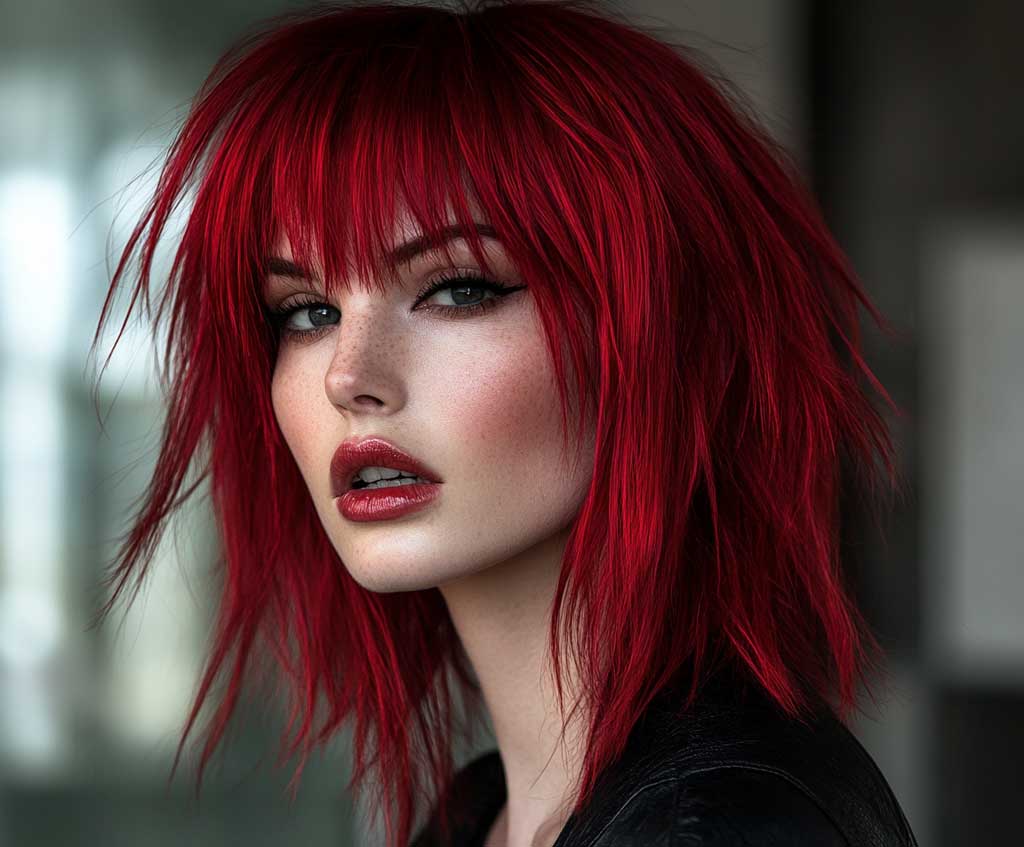

Styling the choppy-fringe version takes about ninety seconds of actual product work. Spray Redken Beach Spray or a similar lightweight texturizer on damp hair, scrunch the layers from mid-length to ends, then use your fingertips — never a comb — to separate the fringe into three or four distinct pieces. That separation is the look. Letting the fringe air-dry as one solid section defeats the point-cut entirely. The bangs should look like they fell that way, which means engineering them precisely so they appear not to have been touched at all.
Is this the right fringe for every face shape? No. Stylists recommend the above-brow choppy fringe most confidently for oval, heart, and longer face shapes. On round faces, this exact fringe length can emphasize facial width — a longer, more angled fringe (or the curtain version from the section above) usually works better. The rule of thumb: if your face is as wide as it is long, don’t let fringe end at the widest point of your cheekbones.
Tousled Red Shag with Bangs — the Style That Improves When You Stop Touching It
The tousled version of the red shag haircut with bangs is built on a paradox that every low-effort-hairstyle fan eventually discovers: it looks best when you stop styling it. The layers are cut to move independently — each strand falls slightly differently from its neighbor, so the overall effect is windblown in a way that is structurally impossible on one-length hair. Outdoor light, which would flatten most cuts, makes a tousled red shag glow. Copper layers scatter differently at ten in the morning than at three in the afternoon, which is part of why photos of this style in natural light look unreasonably good.




The product equation for a tousled red shag is deliberately minimal. A sea salt spray or lightweight texturizing spray misted onto damp hair — not soaking wet, not dry — then scrunched once and left alone. The Davines professional color team advises washing red hair no more than three times per week to slow the fade; the tousled shag naturally rewards this because slightly older, slightly oilier hair holds wave definition and layer separation better than freshly washed strands. You are, functionally, being encouraged to be lazy in the most productive possible way.
What does “tousled” look like when the bangs are included? The fringe in this style usually sits longer — at cheekbone level or grazing the eye — and is swept to one side or left hanging loose across the forehead with the ends deliberately separated into two or three pieces rather than lying flat. It’s the visual equivalent of someone who walked out the door in a hurry but had a great haircut. The fiery red color handles the rest of the heavy lifting: even without product or styling, a well-cut red shag at this length reads as a deliberate aesthetic rather than an accidental one.
For festival-ready versions of this exact setup — where the tousled quality needs to survive humidity, movement, and zero mirror access — see short shag haircuts for music festivals, which covers the specific product approach and trim length that holds up for eight-plus hours outdoors. The maintenance interval for a mid-length tousled shag is on the more forgiving end: every eight to twelve weeks according to The Hair Standard, with the cut growing out gracefully between appointments rather than losing structure abruptly.




On naturally curly or wavy hair, the tousled shag requires essentially nothing — the curl pattern and the layer structure amplify each other, creating volume and definition simultaneously. Straight hair needs that single sea salt spray step to manufacture the separation the curl provides on its own. One mistake worth avoiding: reaching for a diffuser on the highest heat setting. The heat flattens the curl definition and, more critically for red hair, accelerates color fade with every use. Low heat or air-dry is the answer; the lived-in quality you want is actually incompatible with the aggressive heat that would “style” it.
The color maintenance schedule for this version is no different from the others — red fades on the same timeline regardless of fringe shape — but the tousled style is the most forgiving of grow-out. Because the cut is designed to look undone, the transition from fresh-appointment red to week-four fade reads as a tonal shift rather than a failure. That slight softening as the color warms from crimson toward copper actually suits the aesthetic, which is why this is the version most often chosen by people who know they won’t make it back to the salon on a rigid schedule.
| Style | Best For | Trim Interval | Key Risk |
|---|---|---|---|
| Curtain Bangs Shag | Most face shapes, wavy hair | 6–8 weeks full cut, 4–6 weeks bangs | Bangs trained flat if dried wrong |
| Choppy Fringe Shag | Oval, heart, long faces | 6–8 weeks full cut, 3–4 weeks fringe | Grows out fast; looks rough past 4 weeks |
| Tousled Loose Shag | All textures, low-maintenance preference | 8–12 weeks full cut | Color fades to orange without product protection |
Red hair requires a specific maintenance routine beyond the cut itself. Davines recommends washing no more than three times per week, using cool rather than hot water to keep the cuticle sealed, and seeing a colorist every four to eight weeks for touch-ups — avoiding overlap onto previously colored sections to prevent over-processing. A color-depositing shampoo between appointments extends vibrancy noticeably. For the full breakdown on why red pigment molecules behave differently from other colors and what that means practically, Davines has a detailed guide on keeping red hair from fading that covers the cuticle science and salon timing in plain language.
The Bottom Line
Red and layers do the work — you choose how much edge to add with the fringe.
Curtain bangs are the most face-friendly entry point and the lowest daily commitment. Choppy fringe above the brow is the highest-impact option — budget a trim every three to four weeks or the geometry collapses. The tousled version forgives irregular salon visits better than any other configuration.
Color maintenance is non-negotiable across all three: plan for touch-ups every four to eight weeks, wash cool and infrequent, and use a color-depositing product between appointments. The cut can be low-maintenance. The red cannot.
Save this post before your next salon visit so you have the reference photos ready.
Related Topics
FAQ
What is the difference between a red shag haircut with curtain bangs vs choppy fringe?
How often does a red shag haircut need to be trimmed?
How do I keep fiery red hair from fading fast on a shag cut?
What products work best for styling a tousled red shag with bangs?
Can I get a red shag with bangs if my hair is straight?
What does a red shag haircut with bangs cost at a salon?
Complete guide
Hairstyles with Bangs That Actually Work for Your Face Shape
Blunt, curtain, wispy, micro, Korean, side swept — every bang style in one place
Complete guide
The Shag Haircut Playbook — Every Length, Face Shape and Texture Covered
Short, medium, long, curly, pixie, bangs, by face shape — all in one place