Black and white short hairstyles pair a dark base with bright white or silver sections, and on older women the contrast often does the work that makeup used to do. Do they suit gray hair? Yes, often better than a single flat shade, because natural white strands already supply half of the palette. The catch is regrowth: hair grows about half an inch a month, so any contrast line moves roughly an inch every 6–8 weeks. Plan the color around that rhythm before you choose the cut.
Cost depends on how much of the head gets lightened. Highlights on short hair typically run $60–70 at an average salon, while national averages for highlight services sit closer to $219, with most quotes between $151 and $319. Streaks and tips cost less than a full black-to-white fade, which needs color on every section. Ask for a quote that lists toner separately, since gloss visits every 4–6 weeks add up faster than the first appointment.
The four looks below range from graphic streaks to natural white with dark lowlights. Each one comes with a trim rhythm, a color calendar and the mistake that ruins it soonest. Short black and white hair forgives a lot, but not a cut and a color that age at different speeds. Match both clocks and the look stays sharp between visits.
Quick Scan
- Hair grows about half an inch a month, so a contrast line shifts roughly 1 inch every 6–8 weeks.
- Partial highlights on short hair typically cost $50–100+, versus $80–150 for a full head.
- Asymmetrical bobs and pompadours need trims every 4–6 weeks; curly crops stretch to 6–8 weeks.
- Hand-painted white tips cost about twice as much as basic foils, around $100–150.
- Purple shampoo once a week keeps white sections bright; save 2–3 weekly uses for stubborn yellow.
- Natural white hair plus black lowlights is the lowest-upkeep route, with no bleach on the light sections.
Asymmetrical Bob With Bold White Streaks on Jet Black
An asymmetrical bob with white streaks is the most graphic of the black and white hairstyles for women, because the longer side gives the light sections a runway. The jet-black base acts like a blackboard and the streaks like chalk lines: the darker the board, the louder each line reads. Thin babylights blur into gray from across a room, while wide ribbons stay readable at a glance. Ask for fewer, wider streaks rather than many fine ones.
How many streaks does the cut need? Usually 2–4 placed along the longer side, which keeps the job in partial-highlight territory at roughly $50–100+ on short hair instead of $80–150 for a full head. Fewer sections also mean less bleach on hair that is already drier than it used to be. Ask the colorist to start each streak a finger-width from the part so the root stays soft as it grows.
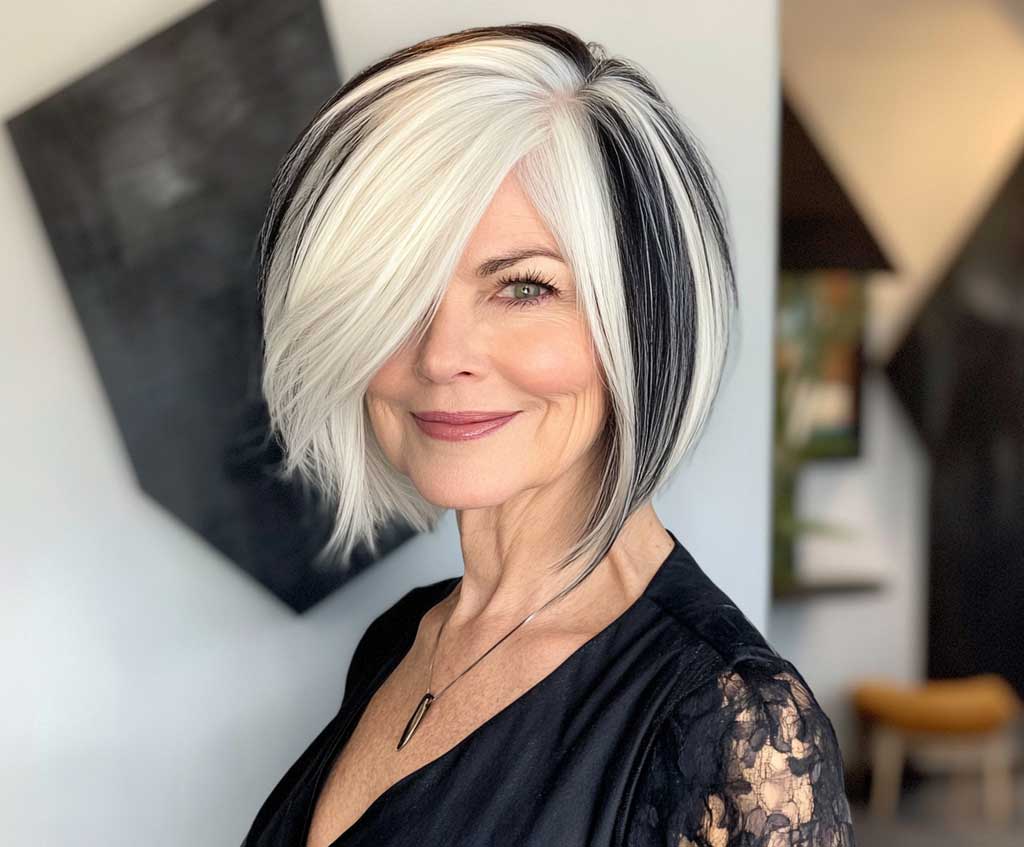
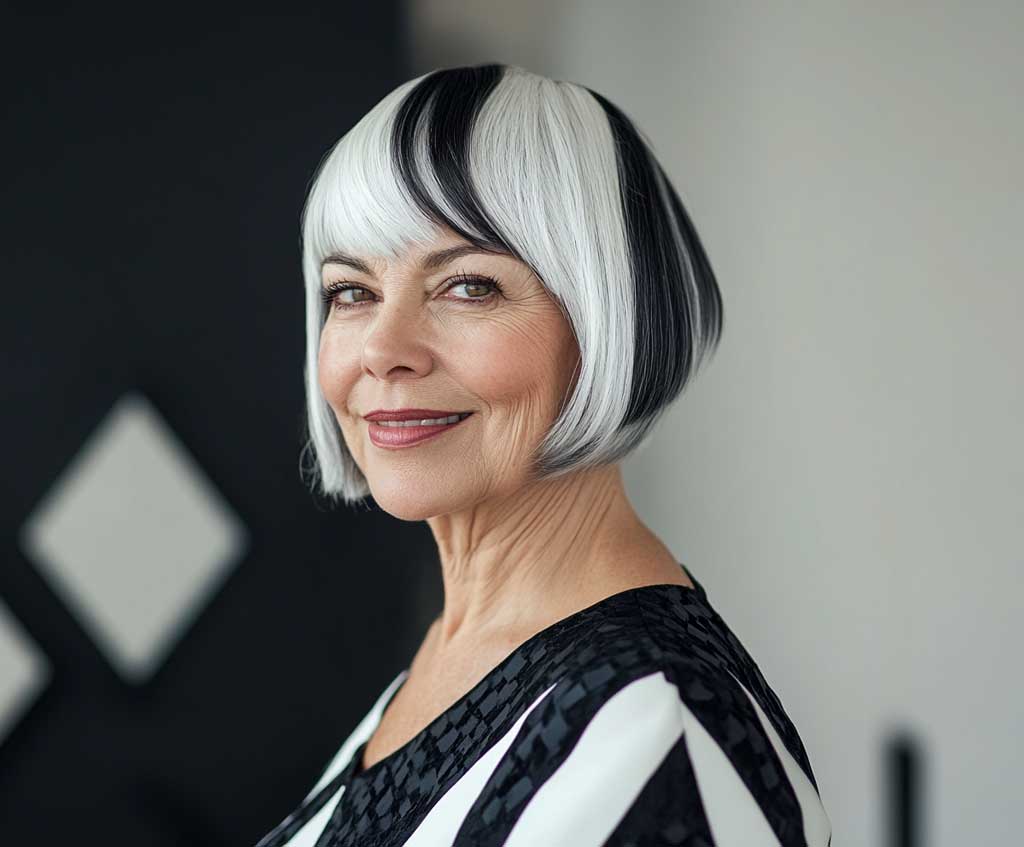

The sharp angle is also the fastest to lose shape. Precision bobs typically need trims every 4–6 weeks, compared with 6–8 weeks for softer layered cuts, because a one-sided line shows every quarter inch of growth. Gray hair is usually coarser and drier than pigmented hair, so a blunt edge on silver strands can start to puff out within a month. Book the trim and any toner refresh on the same visit to save one trip per cycle.
Still unsure whether a bob is the right base at all? This bob haircut vs pixie cut comparison by face shape shows where a shorter crop wins on crown lift. Do not let the stylist use heavy thinning shears on the white sections, since coarse silver hair frizzes at shredded ends; point cutting keeps the edge clean. The look flatters oval, heart and square faces best when the long side lands at the jaw. Keep the short side above the earlobe for the strongest contrast.
Curly Crop With White Tips That Show Off Texture
A curly crop with white tips is the softer route to black and white hairstyles for women with natural texture, since each coil carries its own spot of light. The dark base holds the shape and the bright ends sit on the outside of every curl, like frost on the tips of a hedge. Tip painting is a freehand, balayage-style technique, and balayage usually costs about twice as much as basic highlights, around $100–150. Ask for the white to stop well short of the scalp so regrowth never reads as a stripe.
Is the crop hard to style? Less than a straight cut, because curls hide uneven growth and a short, shag-like shape can simply be scrunched and air-dried. Curly crops usually stretch to 6–8 weeks between trims, compared with 4–6 weeks for the asymmetrical bob above. Skip the flat iron on lightened tips entirely, since bleached ends already sit at the fragile end of the heat scale. Work a curl cream in while the hair is still soaking wet for the cleanest definition.

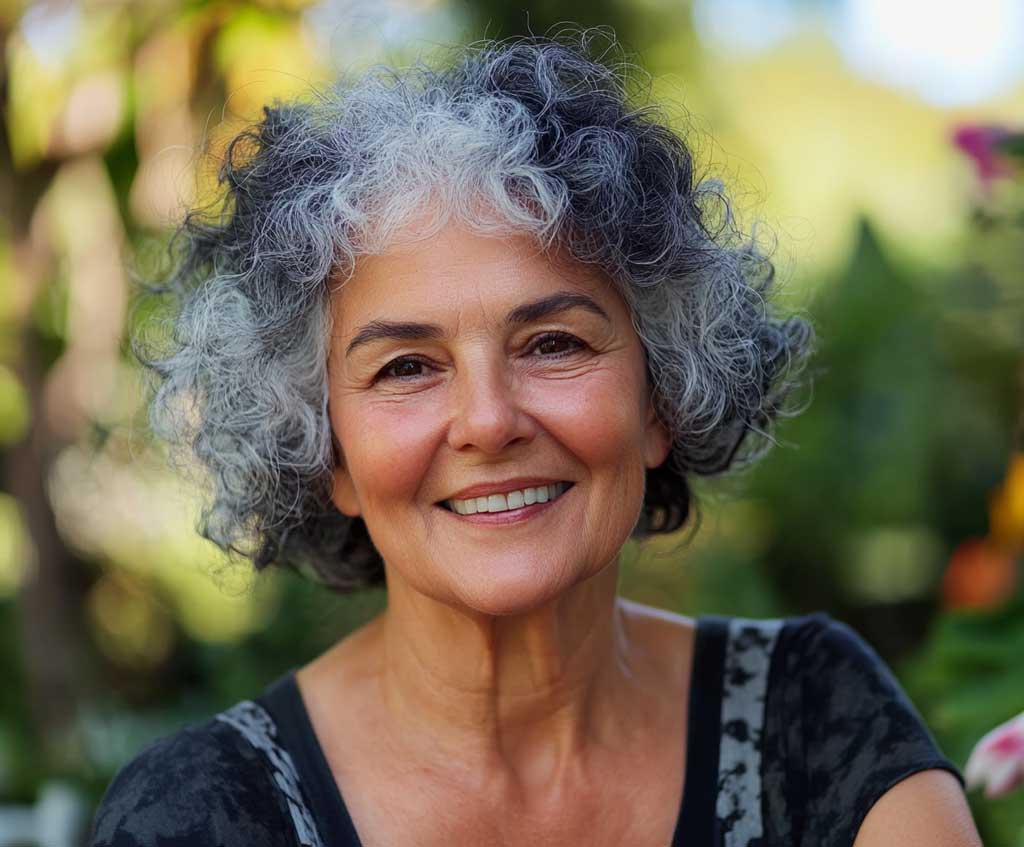
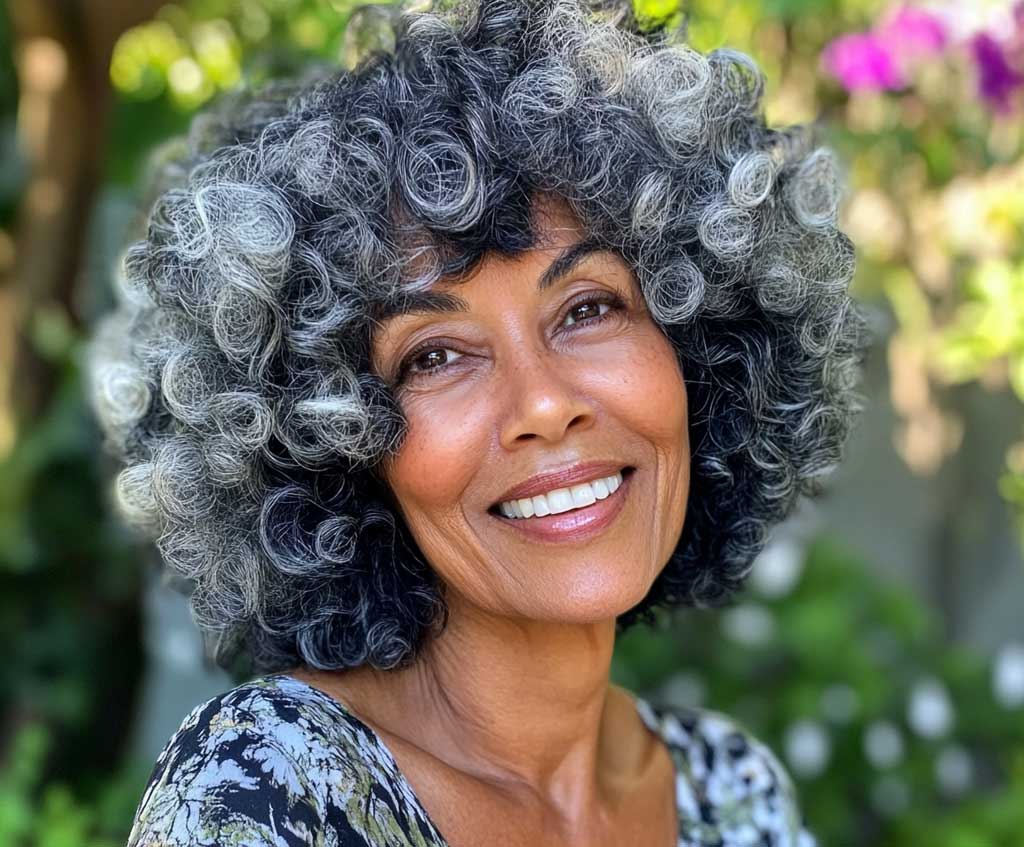
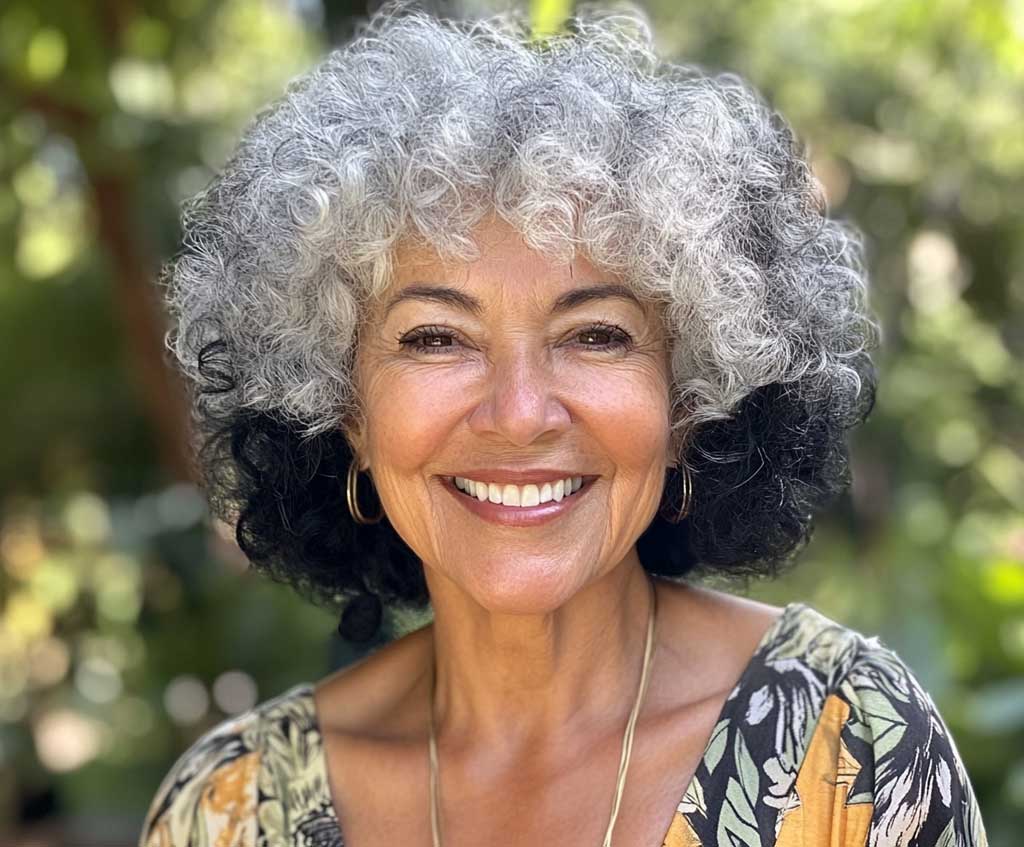
White tips turn yellow faster than black lengths fade, and on curls the cast shows on every highlighted bend. Purple shampoo once a week is the standard rhythm for gray and white hair, with 2–3 weekly uses reserved for stubborn brassiness. Using it at every wash can tint fine white ends lavender, and curly hair absorbs pigment unevenly. Concentrate the purple formula on the tips, not the black base, where it only dries the hair.
Soft vs high-contrast is the main decision here. Silver-gray tips on charcoal curls read gentle and grow out quietly, while pure white on jet black looks like a graphic print and needs a gloss every 4–6 weeks. Gray hair produces less oil than pigmented hair, so a weekly deep conditioner keeps the white ends from turning brittle. Choose silver tips if you see a colorist only every two months.
Sleek Pompadour With a Black to White Fade
A sleek pompadour with a black and white fade is the most polished take on contrast hair for older women, with height at the front and a gradual shift in shade toward the crown. Think of an ink wash rather than a stripe: no single line marks where black stops and white begins. That blend matters, because half an inch of monthly regrowth disappears inside a gradient but shows instantly on a hard edge. Ask for the transition zone to cover at least a third of the hair’s length.
How much heat does the quiff need? Heat-tool makers place fine or chemically treated hair at roughly 250–300°F, compared with 370°F and above for coarse, untreated hair, and lightened white sections belong in the low range. A round brush and a dryer on medium build the lift, while a flat iron only presses it down. Set the front with a light pomade worked from the root upward, never from the ends.

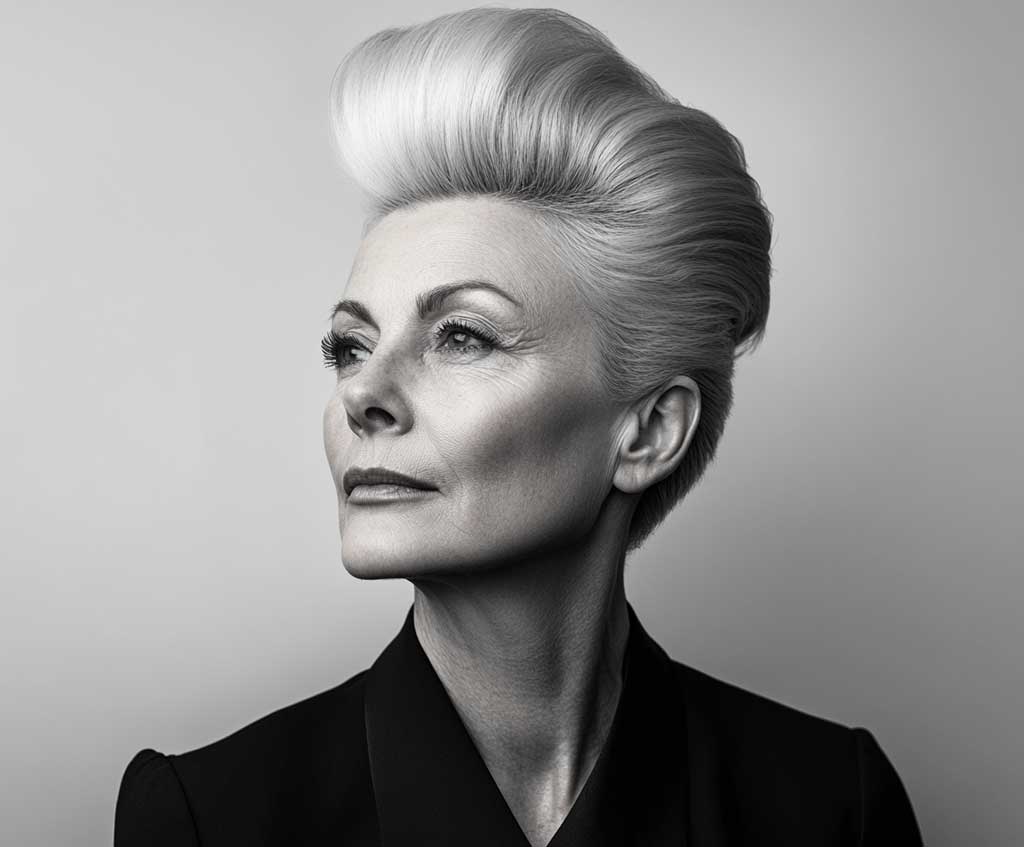
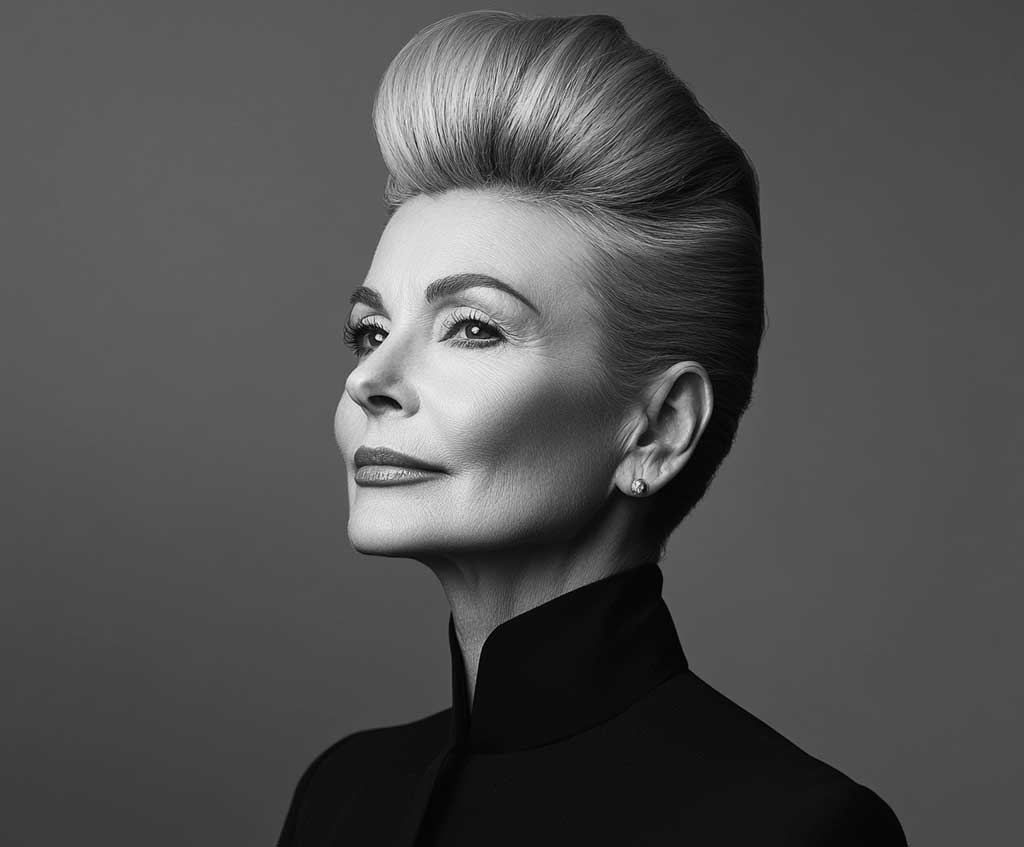
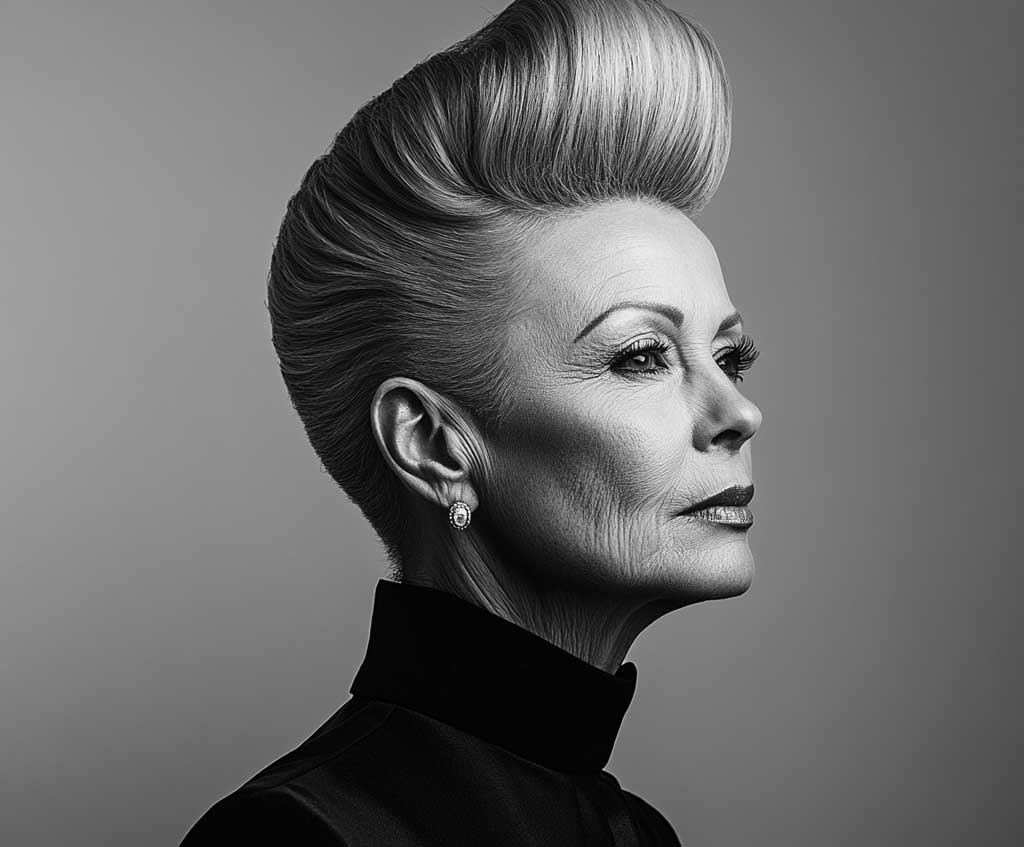
The fade asks for more color work than streaks or tips, because every section sits somewhere on the gradient. Full highlights on short hair typically cost $80–150, against $50–100+ for partial work, and the dark nape may need a root touch-up every 4 weeks if natural gray shows through. Do not put a permanent box kit on the white crown, since those formulas are built to cover gray, not keep it bright. Limit home touch-ups to the dark nape and sides, where a 10-minute root kit is enough.
The pompadour works for formal and casual settings alike, and the contrast echoes a white shirt under a black jacket for an outfit that mirrors the hair. Pompadour vs flat crop is a trade between height and speed: the quiff needs a blow-dry on every wash day, while a crop can dry on its own. Older women with fine hair gain the most from the quiff, because the lift adds visible volume at the front. Choose the pompadour only if you already blow-dry most mornings.
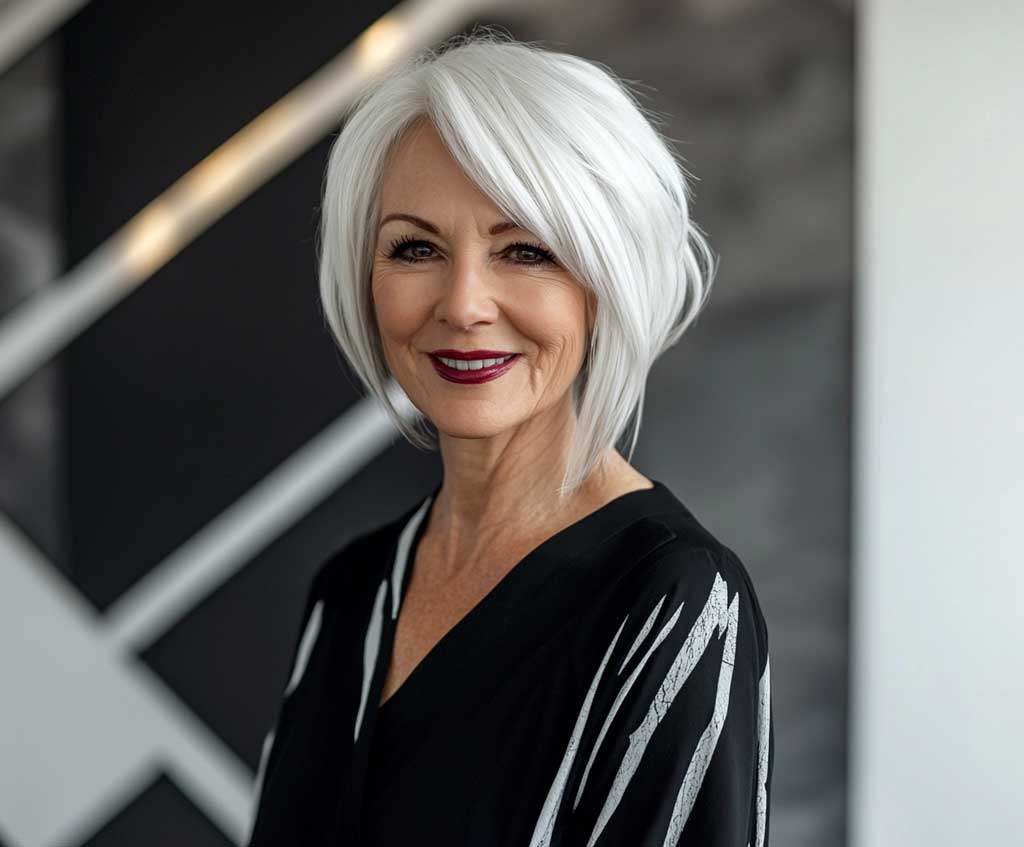
Natural White Hair Is a Shortcut to Black and White Short Hairstyles
Short haircuts for older women with white hair can reach the same black and white effect with half the chemistry, because the white is already there. Instead of bleaching streaks into dark hair, the colorist adds black or deep charcoal lowlights into natural silver. It works like shading a pencil sketch: the paper stays white and only the lines get darker. Ask for lowlights on the underside and nape first, where depth looks intentional.
Why is this the lowest-upkeep option? Natural roots grow in white, matching the brightest part of the look, so half an inch of monthly growth blends instead of contrasting. Gray hair is coarser and its cuticle more resistant, so dark lowlights may need longer processing than on pigmented hair. Color brands suggest treating gray root growth with touch-ups about every 4 weeks and full color every 6–8 weeks when covering gray, and the lowlight route usually stretches toward the longer end. Book a lowlight refresh when the dark pieces start to look sparse, not on a fixed date.
- Lowlights into natural white: no bleach on the light sections, refresh every 6–8 weeks.
- Bleached streaks into black hair: toner every 4–6 weeks and a higher breakage risk.
- Silver gloss on natural white: brightens yellowed strands in a single visit.
- Purple shampoo at home: once a week keeps white sections clean between appointments.
Natural white also yellows from sun, hard water and hot tools, and a yellow cast flattens the contrast faster than growth does. Don’t try to fix it with an all-over platinum dye, which adds dryness to hair that already makes less oil. A weekly purple shampoo vs a salon gloss every 4–6 weeks is the cheapest comparison in this whole category. Keep a UV-filter spray by the door for days spent outdoors.
Upkeep and Cost for Black and White Short Hairstyles Compared
Black and white short hairstyles differ less in the cut than in the color calendar, so the real comparison is cost per month, not the first bill. A streaked bob and a full fade can look similar in a photo and still sit $50 or more apart at the salon. Toner visits every 4–6 weeks matter most for the white sections, because brightness fades before the cut grows out. Treat the color like a gym membership rather than a one-off purchase, and budget the monthly fee first.
Bleached white and platinum follow the same rule: the lighter the section, the shorter the gap between toning visits. This platinum blonde long bob upkeep breakdown shows the same 4–6 week cycle on a longer cut. Pairing every toner visit with a trim cuts the number of salon trips roughly in half. Ask for both services on one booking.
| Style | Color technique | Typical salon cost, short hair | Trim rhythm | Color refresh | Upkeep level |
|---|---|---|---|---|---|
| Asymmetrical bob with white streaks | 2–4 bleached streaks on black | $50–100+ (partial) | Every 4–6 weeks | Toner every 4–6 weeks | High |
| Curly crop with white tips | Hand-painted tips | About $100–150 | Every 6–8 weeks | Gloss every 4–6 weeks, purple shampoo weekly | Medium |
| Pompadour with black to white fade | Full gradient color | $80–150 (full) | Every 4–6 weeks | Dark roots every 4 weeks | High |
| Natural white with black lowlights | Dark lowlights in natural silver | $50–100+ (partial) | Every 6–8 weeks | Lowlights every 6–8 weeks | Low |
Natural white with lowlights wins on budget, while the pompadour fade wins on polish and loses on time in the chair. The streaked bob sits in the middle at $50–100+ but asks for the strictest 4–6 week trim calendar. Curly tips cost more upfront, around $100–150, and forgive more as they grow. Choose by how often you realistically visit a salon, not by the photo.
Don’t Do This: never ask for black hair to be lifted all the way to white in one sitting to save a second appointment. Most clients reach very light shades through several lightening sessions, and a single aggressive bleach on coarse, gray-mixed hair can leave breakage at the nape. Two sessions 4–6 weeks apart vs one marathon appointment is the difference between clean white and yellow, snapping ends. Ask for a strand test before any major lift.
Pick the Contrast, Then the Calendar
Black and white short hairstyles look sharpest when the cut and the color run on the same clock: trims every 4–8 weeks and toner every 4–6 weeks.
Choose the asymmetrical bob for graphic streaks at the partial-highlight price of about $50–100+, and book trims every 4–6 weeks to keep the angle crisp.
Go for the curly crop with white tips if you see a colorist every two months, since curls stretch trims to 6–8 weeks and hide regrowth.
Pick the pompadour fade for maximum polish, or natural white with black lowlights for the lowest upkeep. In every version, purple shampoo once a week keeps the white sections bright.