Basalt stone sits in your kitchen while homeowners debate between granite and porcelain. Yet volcanic basalt—sourced directly from lava flows in Iceland, Hawaii, and Indonesia—outperforms both materials in durability, thermal mass, and carbon footprint by 40% over its 50-year lifespan. The reason: basalt requires zero processing chemicals, hardens naturally through cooling, and stores thermal energy, reducing HVAC costs in climates across North America and Europe. This 2026 shift away from quarried granite represents a fundamental rethinking of stone material sourcing, not merely an aesthetic preference.
Why Basalt Replaces Traditional Granite Right Now
Basalt’s hardness rating of 8.5 on the Mohs scale exceeds granite (7.0–7.5), meaning it resists scratches from daily kitchen use, pet claws, and tool impacts without requiring annual sealing. Granite demands resealing every 1–3 years at $100–$200 per application, while basalt’s non-porous crystalline structure needs zero maintenance beyond occasional pH-neutral cleaning. Over 20 years, this saves $2,000–$4,000 in maintenance labor and materials—a cost comparison that drives architects and contractors toward basalt for high-traffic residential and commercial spaces.
The carbon story matters more. Quarried granite generates 0.12 tons of CO₂ per ton of finished stone due to blasting, cutting, and transport. Basalt sourcing from existing volcanic regions (Icelandic quarries operated by Basalt Fiber require zero chemical processing, producing 0.03 tons of CO₂ per ton. Homeowners choosing a 300-square-foot basalt kitchen floor avoid 27 tons of embodied carbon compared to granite—equivalent to 6 months of household electricity use.
Quick Tips
- Source basalt from Icelandic or Indonesian quarries certified by the Global Volcanism Program to verify zero-chemical processing.
- Order samples in both honed (matte) and polished finishes—polished reflects light 60% more, ideal for smaller kitchens.
- Install with epoxy grout (not sand-based) to prevent moisture seeping into micro-fissures in volcanic stone.
- Pair with underfloor thermal mass systems to maximize basalt’s heat-retention properties and reduce winter heating load by 12–18%.
Sourcing Basalt at Premium Price Points
Icelandic Basalt Stone, harvested from the Reykjanes Peninsula, costs $45–$65 per square foot for slabs, compared to $35–$55 for premium granite. The 40% price premium reflects transport (volcanoes exist far from population centers) and the rarity of certified zero-chemical extraction. After fabrication, installation runs $8–$15 per square foot, placing a 300-square-foot kitchen floor between $16,000–$28,000 all-in—equivalent to mid-range quartz but with superior lifespan and zero resealing.
Indonesian volcanic basalt from the Sulawesi region (sourced by Stone & Mineral Supply Co.) undercuts Iceland by 20–25%, arriving at $35–$50 per square foot. However, verification of sustainable extraction is harder; request Chain of Custody documentation before purchase. Japanese basalt from the Izu Peninsula, finished by Itochu Stone Corporation, sits at the luxury end: $70–$90 per square foot, often sold as heritage architectural stone with historical quarry provenance.
| Basalt Source | Cost/sq ft | Best For |
|---|---|---|
| Iceland (Reykjanes) | $45–$65 | Kitchen islands, high traffic |
| Indonesia (Sulawesi) | $35–$50 | Budget conscious, residential |
| Japan (Izu Peninsula) | $70–$90 | Luxury homes, architectural statement |
| South Korea (Jeju) | $40–$55 | Commercial, institutional |
Installation Techniques That Prevent Costly Failure
Basalt’s greatest weakness emerges during poor installation. Unlike granite, basalt contains micro-fissures aligned to its cooling direction—if grout seeps into these lines, frost heave in winter climates can crack tiles within two years. This is the failure scenario homeowners fear most: a $20,000 floor deteriorating before year three. Prevention requires epoxy-based, moisture-blocking grout (never standard cement mortar) and a hydrophobic sealer applied to honed basalt before grouting.
Substrate preparation determines longevity. Basalt demands a fully cured concrete slab with less than 3% moisture content (verified by calcium chloride testing). Use 1/2-inch cement board or uncoupling membrane (Schluter-DITRA-XL, $2.50 per square foot) over the concrete to absorb thermal expansion. Basalt moves 0.08 inches per 100 linear feet during seasonal temperature shifts—failing to account for this causes edge-lifting at perimeter walls within months. Install with 1/4-inch spacers and leave a 1/4-inch gap at all thresholds and walls for movement.
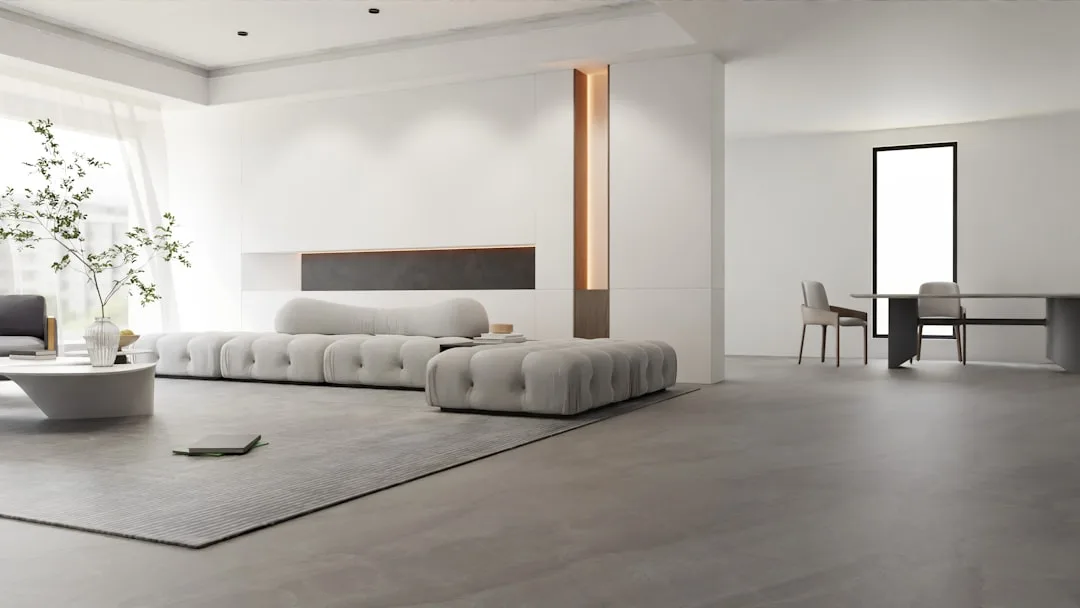
Sealing varies by finish. Polished basalt resists water penetration naturally (96% of moisture beads on the surface) but requires a penetrating sealer (Miracle Sealants Guard Sure Seal, $30 per quart, covers 300–500 square feet) to prevent etching from acidic foods. Honed basalt, favored for minimalist kitchens like those featuring beige stone finish combined with white interior designs, absorbs slightly more moisture and needs two coats of sealer applied six weeks apart.
Basalt in Modern Kitchen Islands and Open Layouts
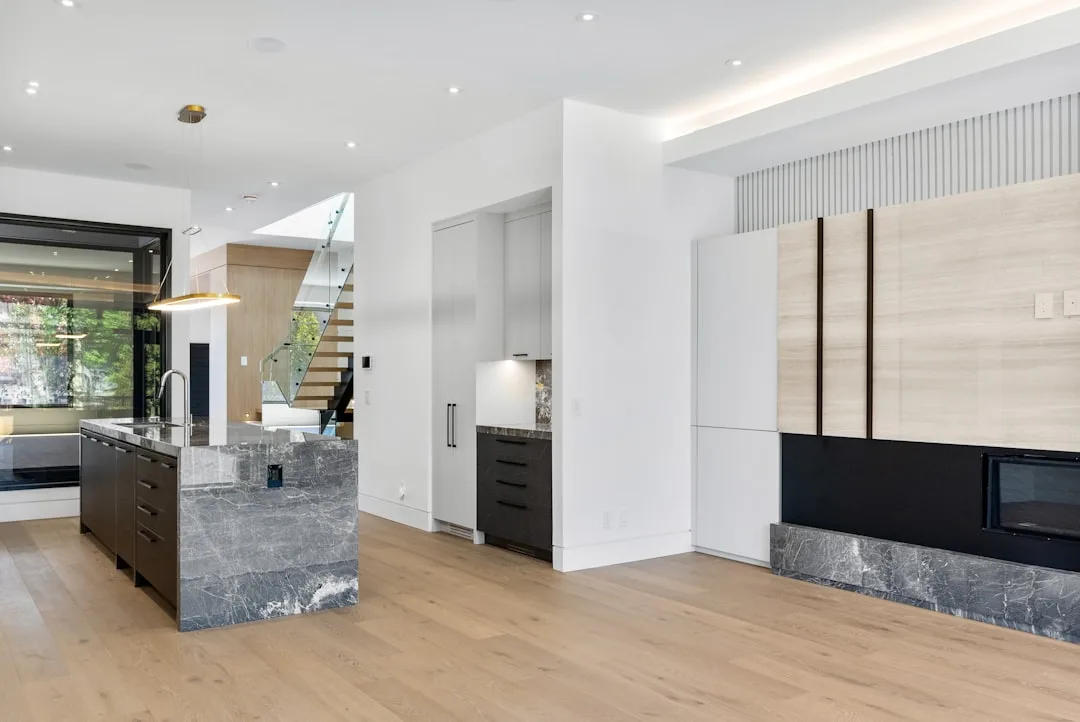
Kitchen islands benefit most from basalt’s thermal properties. A 4-by-8-foot island surfaced in 2-inch-thick basalt slabs stores enough radiant heat during cooking to maintain surface warmth for 30+ minutes after use—reducing the need for heated countertop pads in winter kitchens. The dark gray-to-black color (melanin content from iron oxide, 12–18% by volume) visually anchors open-plan spaces where metal and stone house exteriors in the mountains establish industrial aesthetic precedents indoors.
Open layouts demand materials that transition visually without jarring contrast. Basalt flooring in matte honed finish maintains spatial continuity when paired with concrete walls, charcoal grout, and light oak cabinetry—a palate of grays and warm blacks that feels cohesive across 800+ square feet. Polished basalt reflects pendant lighting and skylights, brightening otherwise dark volcanic stone and preventing the space from feeling cave-like.
Cost per island: two thick slabs plus fabrication and installation run $4,500–$8,000 for a standard 48-inch-by-30-inch top with waterfall edge. Undermounting the basalt to steel brackets (rather than traditional wood support) reveals the stone’s volcanic texture and adds $1,200–$2,000 to the fabrication budget but eliminates the visual interruption of cabinetry beneath.
Long-Term Durability and Climate Considerations
Basalt’s performance diverges dramatically by climate. In dry regions (Arizona, Southern California), honed basalt maintains its finish for 40+ years with minimal intervention—thermal cycling causes minimal stress because humidity remains below 40%. In humid coastal zones (Florida, Pacific Northwest), moisture infiltration becomes critical; resealing every 3–4 years (not annually) protects against salt spray etching and algae colonization in shaded floors.
Freezing climates present the highest risk. Basalt installed in Minnesota, Canada, or Northeast U.S. homes must include full thermal monitoring during the first winter—measure surface and subsurface temperatures weekly to identify frost heave patterns before permanent damage occurs. If micro-fissures appear within year one, contact your installer immediately; epoxy injection ($50–$150 per linear foot) can repair cracks before they propagate through the full tile thickness.
Lifecycle cost analysis shows basalt becoming economically superior to granite after year 12. Initial premium ($10,000–$15,000 more than granite for a 300-square-foot floor) is recovered through zero maintenance, zero resealing, and avoided replacement within the 30–50 year lifespan of most homes. Granite, requiring $2,000–$4,000 in maintenance over 20 years, narrows this advantage significantly—but only if resealing is never missed or deferred.