Black and white bathroom decor works because the two colors sit at opposite ends of the light scale: a bright white such as Sherwin-Williams High Reflective White reflects about 93% of the light that hits it, while Tricorn Black returns roughly 3%. That 90-point gap gives every tile edge, faucet and mirror frame a crisp outline, so even a small room reads organized. Does the scheme still look current? Yes, because it borrows from vintage hexagon floors and modern matte fixtures at the same time. Let white cover the largest surfaces and use black to draw the lines.
Cost is easier to control than the dramatic look suggests. Ceramic subway tile starts around $5 per square foot, and an average 40-square-foot bathroom floor typically costs $450–$1,150 to tile with installation. Marble pushes material alone to $15–$40 per square foot, so most classy monochrome rooms mix one stone surface with plain ceramic everywhere else. Price the floor first, because it sets the budget for everything above it.
The sections below move through tile patterns, the vanity zone, accent colors, Art Deco styling and finishes, with two comparison tables near the end. Each one gives prices, mounting heights or proportions instead of mood words. Jump straight to the tables if the tile is already chosen and only the fixtures remain.
Quick Scan
- Bright white paint reaches LRV 93 vs about 3 for the deepest blacks, the contrast that makes the scheme work.
- Ceramic subway tile starts near $5 per sq ft vs $15–$40 for marble.
- Classic 1-inch hexagon and 3/4-inch penny tiles define the Art Deco floor.
- Hang vanity sconces about 60 inches high and 36–40 inches apart.
- Plan 1,500–3,000 lumens for a single-sink vanity vs 3,000–4,000 for a double.
- Follow a 60-30-10 split: white, then black, then one accent color.
- Matte black faucets cost about 20–40% more than chrome but hide fingerprints better.
Black and White Tile Patterns Set the Whole Room
Most black and white bathroom decorating ideas start with tile, because pattern covers more surface than any accessory ever will. A checkerboard floor makes a bold, graphic statement, while white 3-by-6-inch subway tile on the walls stays calm and lets the fixtures lead. Ceramic subway runs from about $5 per square foot, compared with $8–$15 for porcelain, so walls are an easy place to save. Pick one loud surface, floor or wall, and keep the other quiet.
Why does white tile make a small bathroom feel bigger? Whites in the LRV 82–94 range send back more than four-fifths of the light they receive, as this breakdown of how light reflectance numbers make gray and white rooms look larger explains in detail. Black tile does the opposite, soaking up light like a velvet theater curtain. A black floor under white walls keeps the room bright, while the reverse makes the ceiling seem to drop. Put the darkest tile on the floor or in a single wainscot band.


Layout changes the mood as much as color does. Herringbone and basketweave read traditional, a straight stack reads modern, and a 1-inch hexagon mosaic reads vintage. Ceramic hexagon costs about $5–$10 per square foot versus $15–$25 for natural stone versions, so the vintage look stays affordable. Don’t mix three patterns in one bathroom; two is the ceiling for a room this size.
Grout color quietly decides whether the pattern looks crisp or busy. White grout on white subway tile makes the wall read as one smooth sheet, while dark grout outlines every brick like a pencil sketch. Midrange subway projects typically run $12–$25 per square foot installed, and changing grout later means paying for labor twice. Test both grout colors on a sample board before the tiler mixes a full batch.


Matte versus glossy is the last tile decision, and it affects cleaning more than looks. Glossy white tile bounces light around a windowless room, while matte black tile hides water marks better underfoot. A marble floor at $15–$40 per square foot plus $10–$15 for installation needs regular sealing, whereas porcelain lookalikes skip that chore entirely. Choose porcelain whenever the bathroom gets daily family traffic.
The Vanity Zone Defines a Modern Black and White Bathroom
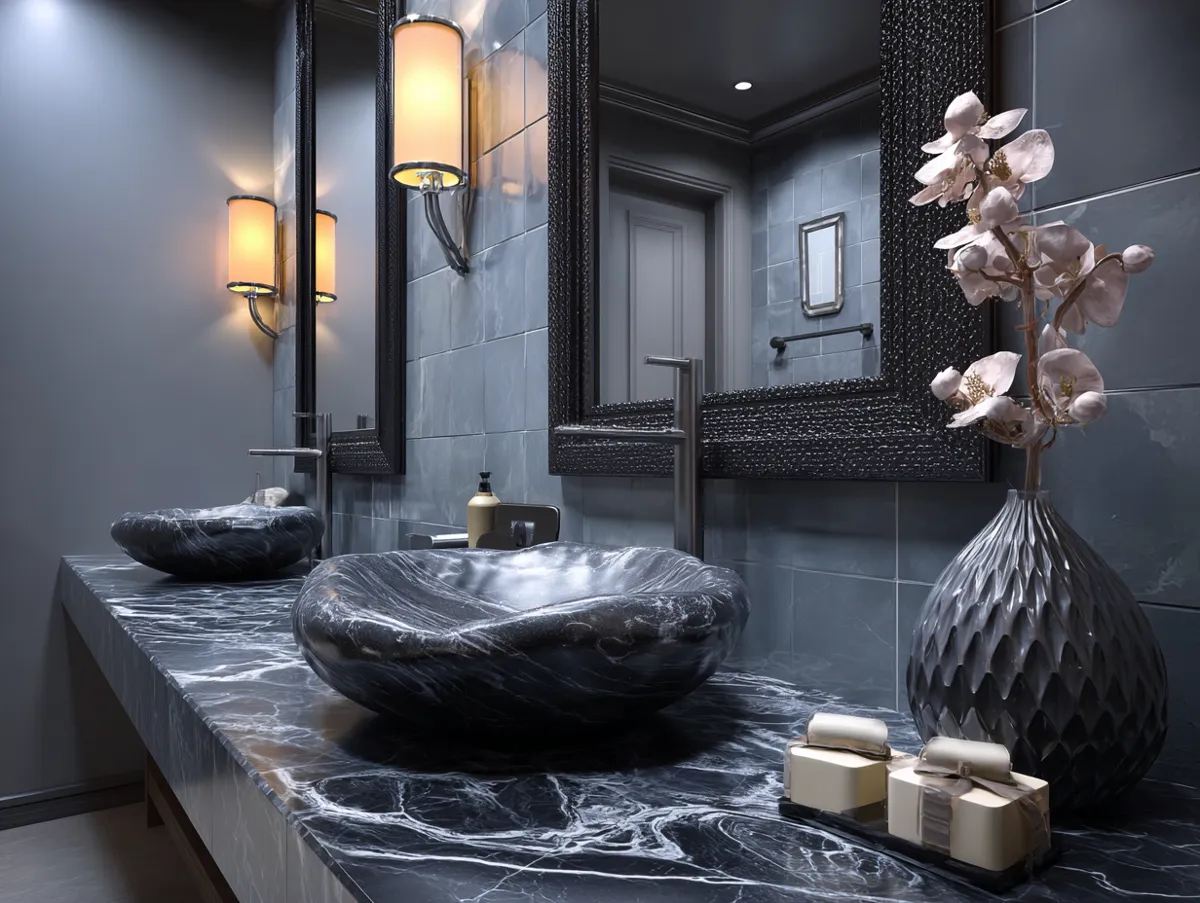
A modern black and white bathroom is judged at the vanity, since that is where you stand twice a day under the brightest light. White cabinets with a black countertop open up a narrow room, while black cabinets under a white top look heavier and more formal. Single vanities usually fit 24–48 inches of wall, compared with 60–72 inches for a double, and that width decides how much contrast the wall can carry. Measure the wall before deciding which color goes where.
Countertop material sets the budget for this zone. Bathroom quartz typically costs about $80–$180 per square foot installed and never needs sealing, while marble needs resealing every 6–12 months. White quartz with soft gray veining gives the marble look on a busy morning counter without the maintenance calendar. Pick quartz for a family bath and save real marble for a guest room.


Mirror and light work as a pair, like a stage and its spotlight. Side sconces centered about 60 inches from the floor and 36–40 inches apart light the face evenly, while a single bar above the mirror casts shadows under the eyes and chin. Is a bar ever the better choice? Yes, in a narrow room with no wall space beside the mirror, as long as it sits around 75–80 inches high and spans roughly three-quarters of the mirror width. Never hang a one-light fixture alone above the glass.
Brightness and color quality matter more than the fixture finish. A single-sink vanity needs about 1,500–3,000 lumens and a double about 3,000–4,000, with CRI 90+ bulbs in the 2500–3000K range for accurate skin tones, according to this vanity lighting buyer’s guide from Golden Lighting. Black sconces against white tile look sharp, but a cheap low-CRI bulb inside them flattens every face in the mirror. Check the CRI on the box before checking the price.


Storage keeps the monochrome look clean, because clutter breaks a two-color scheme faster than any wrong shade. Full-depth drawers bring every bottle forward, compared with doors that hide items behind a single shelf. Black pulls on white drawers repeat the faucet finish and tie the vanity to the rest of the room. Don’t leave open shelves above the sink unless you’re ready to restyle them every week.
Accent Colors That Warm Up Black and White Bathroom Decor
Choosing an accent color for a black and white bathroom gets easier with the 60-30-10 rule, which assigns about 60% of a room to the main color, 30% to the secondary one and 10% to an accent. In most bathrooms white takes the 60% on walls and tile, black takes the 30% on floors, frames and fixtures, and the accent fills the last slice. Think of it as a pocket square on a black suit, small enough to fold away yet impossible to miss. Keep the accent to towels, plants, art or one painted door.
Which accent colors hold up longest? Warm brass, sage green and deep navy, because each relates to both black and white without fighting either. Bright red or hot pink can work too, but past 10% of the room they start to feel like a themed restaurant. Genuine brass faucets typically cost $400–$1,200 compared with $150–$400 for chrome, so many owners bring brass in through cheaper mirror frames and towel bars first. Test the accent with towels before committing to metal.
- Brass or gold: mirror frames, cabinet pulls, one faucet
- Sage or olive green: potted plants, hand towels, a painted vanity
- Navy: bath mat, shower curtain, one accent wall
- Natural wood: a stool, a floating shelf, a bath tray
The white’s undertone changes how any accent looks. A softly warm white such as Pure White at LRV 84 flatters brass and wood, while a brighter, cooler white near LRV 90–93 sharpens navy and green. Don’t pair a creamy white with a blue-leaning black, because the cream will look dingy beside it. Hold the paint chip next to the accent towel in the bathroom’s own light.
Art Deco Glamour for a Black and White Bathroom
A black and white art deco bathroom borrows its rules from the 1920s and 1930s, when geometric floors and polished metal signaled a modern, hygienic home. White was considered the most sanitary color, and black pigment turned plain floors into bold patterns. Small 1-inch hexagon tiles on the floor and 3-by-6-inch subway tile on the walls became the signature pairing. Copy that combination if you want the period look without hunting for salvage tile.
Pattern choice decides how strong the Deco statement feels. Penny rounds came in 3/4-inch and 1-inch sizes and look almost woven from across the room, while pinwheel tiles, usually white around a black center, read more graphic and formal. Most versions now ship on 12-by-12-inch sheets, which keeps installation close to a standard mosaic job. Is a checkerboard still Deco? It fits the era, but it reads louder than hexagon, so it suits a larger floor better than a tiny powder room.
- 1-inch hexagon: white field with a black border or flower motif
- Penny round: 3/4-inch or 1-inch, for a soft woven texture
- Pinwheel: white tiles wrapped around a small black square
- 3-by-6 subway: walls and wainscot with thin grout joints
Metal finish is where Deco style parts ways with plain modern monochrome. Polished chrome or brass, fluted glass and a round or fan-shaped mirror recall a jazz-age hotel lobby, compared with the flat matte black of contemporary black and white bathrooms. Don’t stack every motif at once, since a starburst mirror, a patterned floor and fluted cabinets together look like a costume. Pick one statement element and keep the rest simple.
Luxury Accents and Accessories for White Bathrooms With Black Accents
Accessories for a black and white bathroom carry most of the luxury, because a few well-chosen pieces cost far less than retiling. Fixtures come first: a black faucet, shower head and towel bar against white tile give an all-white room its black accents in one move. Matte black usually costs about 20–40% more than chrome, and a $150 version is typically powder-coated while a $400 one is usually PVD, the tougher finish. Pay for PVD on anything your hands touch daily.


Does matte black show water spots? It hides fingerprints better than chrome, but in hard-water areas mineral marks can stand out on dark finishes. Chrome shows every drop yet tolerates stronger cleaners, while black coatings need mild soap and a soft cloth. If your water leaves white crust on the kettle, choose chrome or brushed black stainless for the faucet.
Textiles soften all those hard surfaces. A plush white bath mat on a black floor and thick white towels add warmth the way a runner softens a stone hallway. Black-and-white striped or waffle towels bring in pattern without breaking the two-color rule. Don’t buy cheap black towels, since poor-quality dye fades to gray after a few washes and spoils the contrast.


Glass and greenery finish the luxury look. A frameless glass shower door keeps the tile visible from wall to wall, compared with a curtain that hides half the room. A trailing plant or a vase of white flowers brings life into a scheme that can feel cold under 4000K bulbs, and warmer 2500–3000K light near the mirror keeps it inviting. Place the plant where it catches daylight from the window.
Art is the last layer and the easiest one to swap. A large black-and-white photograph or a framed botanical print gives the walls a focal point without adding a third color. Keep frames to one finish, black or brass, so the art reads as part of the room rather than a gallery wall. Hang the center of the piece near eye level so it lines up with the sconces.
Don’t Do This
- Don’t tile a small bathroom floor to ceiling in black; keep dark surfaces below about waist height.
- Don’t hang a one-light fixture alone above the mirror; use two sconces 36–40 inches apart.
- Don’t put low-CRI bulbs at the vanity; look for CRI 90+ at 2500–3000K.
- Don’t buy a $150 powder-coated black faucet for a busy family bath; a $400 PVD finish lasts longer.
- Don’t let the accent color spread past 10% of the room.
- Don’t install marble at $15–$40 per sq ft without a sealing plan.
Comparing Tiles and Finishes for Black and White Bathroom Decor
Comparing tiles and finishes side by side shows that price gaps in a monochrome bathroom come from stone and metal far more than from color. Ceramic subway at about $5 per square foot and marble at $15–$40 sit at opposite ends, and a PVD black faucet can cost more than twice a powder-coated one. Is the cheapest row the best value? Rarely, because upkeep costs time every single year. Read the upkeep column before the price column.
| Tile option | Material cost | Installed or extra | Upkeep | Best use |
|---|---|---|---|---|
| Ceramic subway 3×6 | From about $5 per sq ft | $12–$25 per sq ft installed (midrange) | Low, grout wipe-down | Walls, budget refresh |
| Porcelain subway | $8–$15 per sq ft | Labor about $5–$10 per sq ft | Low | Showers, wet floors |
| Ceramic 1-inch hexagon | $5–$10 per sq ft | Sold on 12×12 in sheets | Low to medium, more grout lines | Art Deco floors |
| Stone hexagon | $15–$25 per sq ft | Mosaic labor | Medium, needs sealing | Statement floors |
| Marble tile | $15–$40 per sq ft | Install $10–$15 per sq ft | High, regular sealing | Luxury focal floor |
| Faucet finish | Typical price | Spots and prints | Durability | Best for |
|---|---|---|---|---|
| Chrome | About $150–$400, the baseline | Shows spots, tolerates strong cleaners | High | Hard-water homes |
| Matte black, powder-coated | Around $150 | Hides fingerprints | Can chip at edges | Guest baths |
| Matte black, PVD | Around $400, 20–40% over chrome | Hides prints, mineral spots show in hard water | High | Daily-use modern baths |
| Genuine brass | $400–$1,200 | Shows wear as patina | High when solid | Accent metal, Art Deco rooms |
The Monochrome Verdict
Black and white bathroom decor stays classy when white covers roughly 60% of the room and black draws the lines. That split rides on a reflectance gap of about 90 points, from roughly 93 for bright white down to 3 for the deepest black. No other two-color pairing outlines tile, fixtures and mirrors as sharply. Start every plan from that proportion.
For a budget refresh, white ceramic subway at around $5 per square foot with a black hexagon or checkerboard floor gives the biggest change for the least money. An average 40-square-foot floor lands near $450–$1,150 installed. Spend the savings on the faucet, since it is the piece hands touch every day.
For the vanity, center sconces near 60 inches high, keep them 36–40 inches apart and plan 1,500–3,000 lumens for one sink. Use CRI 90+ bulbs at 2500–3000K, and pay the extra 20–40% for PVD black only where hands touch it daily. Before buying a cabinet, compare widths and countertops in these luxury bathroom vanity designs with real prices and sizes.
For character, add one accent at about 10% of the room, whether brass, sage or navy, or go full Art Deco with 1-inch hexagons and 3-by-6 subway tile. One statement element reads intentional. Three read like a showroom floor.