A black painted brick wall is one of the fastest ways to give a living room, kitchen or hallway real depth without tearing anything out. It works on interior brick as long as the surface is clean, dry and sealed with a masonry primer first. Plan on two finish coats and roughly twice the paint you would use on drywall, since brick takes a gallon over about 150–200 square feet instead of 350–400. Treat it as a weekend project, not an afternoon job.
Where does it work best? A single feature wall behind a sofa, a kitchen wall framing open shelves or a narrow entry corridor all gain contrast instantly. Near-black shades with a light reflectance value around 3 absorb almost all light, so the relief of each brick and mortar joint becomes the pattern. Think of it as the dark velvet lining of a jewelry case: everything placed in front looks sharper. Skip it only if the brick is crumbling, damp or laid less than a year ago.
Done yourself, typical paint costs run about 12 to 28 cents per square foot, while painters quoting general interior work charge around $2 to $6 per square foot. The interior brick wall painting ideas below compare rooms, shades and finishes so the result looks deliberate rather than heavy. Start by measuring the wall, because every later decision scales from that number.
Quick Scan
- Brick covers 150–200 sq ft per gallon vs 350–400 sq ft on drywall, so buy about double.
- Two finish coats is the baseline; going past four rarely improves the result.
- Wait about 24 hours after cleaning, about 3 hours after primer and at least 4 hours between coats.
- Tricorn Black (LRV 3) reads inky and graphic; Wrought Iron (LRV 6) reads as soft charcoal.
- Semi-gloss wipes clean in kitchens and hallways, while matte hides uneven brick faces in living rooms.
- DIY paint runs roughly 12–28 cents per sq ft vs about $2–$6 per sq ft for a painter.
- Paint on brick typically lasts 8–17 years before a full redo.
Black Brick Wall Living Room Ideas With Real Contrast
A black brick wall in the living room works best as one accent surface rather than four dark sides of a box. Pick the wall your eye meets first from the doorway, usually behind the sofa or around the fireplace, and keep the other three light. A typical 12-by-8-foot feature wall is 96 square feet, so two coats need about 192 square feet of coverage, roughly one gallon on brick. Measure before the paint store visit and add a quart for touch-ups.
Still deciding between one dark wall and a fully dark room? The trade-offs described in accent walls versus color drenching apply to brick as well: a single wall keeps the room open, while drenching wraps every surface in one tone. In a 12-by-12-foot room with 8-foot ceilings, the walls total 384 square feet, so one painted brick wall covers just a quarter of that area yet shifts the whole mood. Begin with the accent version, since adding dark walls later is far easier than lightening black brick.


Light furniture against black brick behaves like chalk on a blackboard: every outline reads clearly. An emerald velvet sofa, a pale oak coffee table or a cream bouclé chair stands out far more here than against white paint. Do not pair the wall with a black leather sofa and a charcoal rug, or the seating disappears into the brick after sunset. Keep at least two large pieces in a mid or light tone.


Lighting decides whether the room feels dramatic or simply dim. A near-black such as Tricorn Black has an LRV of about 3, so it returns only around 3% of the light that hits it, while a softer charcoal near LRV 6 bounces back roughly twice as much. Is that a deal-breaker? Only when the room depends on one ceiling fixture; add a floor lamp and a picture light and the brick edges start to glow. Plan at least three light sources before the first coat goes on.
Kitchens Turn Sharper With a Black Painted Brick Wall
Black interior brick in a kitchen trades rustic warmth for crisp contrast against white counters and steel appliances. Grease is the first obstacle, so wash the wall with a trisodium phosphate solution of about half a cup per gallon of water and scrub the joints with a stiff brush. Let the brick dry for roughly 24 hours, because trapped moisture returns later as bubbles under the paint. Never skip degreasing behind the range, where splatter builds up fastest.


Sheen matters more in the kitchen than in any other room. Semi-gloss wipes clean after a sauce splash, while flat paint holds fingerprints the way suede holds dust. The catch is that gloss also highlights uneven brick faces, so old reclaimed brick often looks better in satin than in full semi-gloss. Buy sample pints in two sheens and live with both on the wall for 48 hours.
Does a black kitchen wall make the room feel smaller? Only when cabinets and counters are dark too; with white marble or pale oak, the brick recedes and the island steps forward. A wall 10 feet wide and 8 feet tall needs about 160 square feet of coverage for two coats, so one gallon usually finishes it with some left over. Label the leftover can and store it for touch-ups near the cooktop.

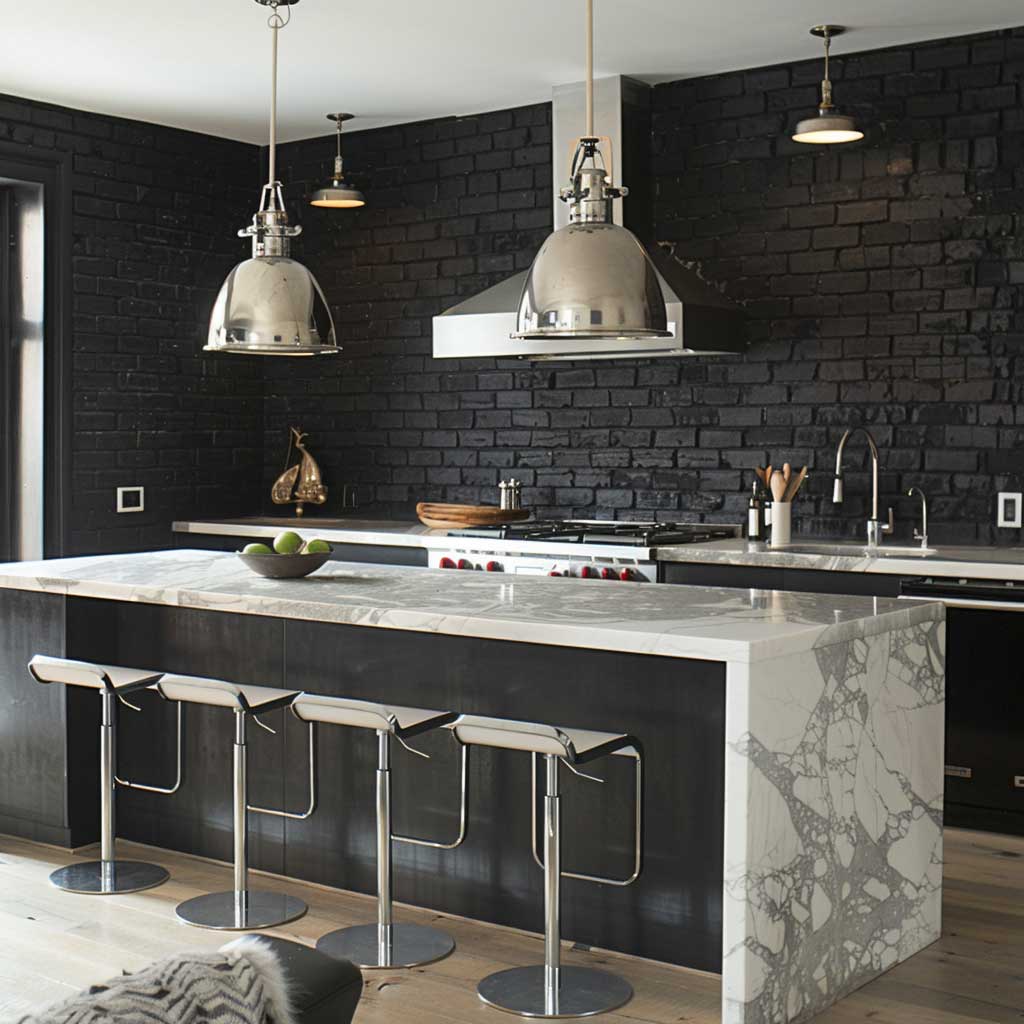


Pendants over the island do double duty against black brick: they light the work surface and graze the wall texture at the same time. Brass or matte white shades read clearly against a near-black backdrop, while black shades vanish into it like a coat in a dark closet. Avoid black fixtures on black brick unless the goal is to make them disappear. Choose one metal finish and repeat it on the faucet and cabinet pulls for a tighter look.
Hallways Gain the Most From Black Painted Brick
Black painted brick in a hallway turns a pass-through space into the first impression of the whole home. Narrow corridors rarely get much daylight, so the choice between a true black and a soft charcoal matters more here than anywhere else. Tricorn Black at LRV 3 reads inky and graphic, while Wrought Iron at LRV 6 keeps a touch of gray softness under weak bulbs. Pick the softer shade when the hallway has no window at all.


A black brick interior wall in a corridor works like a mat around a framed print: white frames, monochrome photography and a slim console all move forward. Do not hang a dense grid of dark-framed art, because black frames on black brick dissolve into visual noise. Is semi-gloss worth it here too? Yes, since bags, shoulders and strollers brush hallway walls daily, and a wipeable sheen survives that traffic better than flat paint. Leave a hand’s width between frames so the brick stays part of the composition.


Warm wall sconces bring out the relief of every mortar line, which a single overhead fixture flattens. Paint on brick typically lasts about 8 to 17 years, so a hallway refresh done now should outlive several rounds of rugs and art. The weak spots are outside corners at shoulder height, where chips show first against black. Keep a small jar of the wall color and a stiff artist brush in the closet for quick fixes.
Painting Bricks Black Step by Step Without Peeling
Painting bricks black follows the same sequence as any masonry job, but dark color exposes shortcuts faster than white does. New brick needs about a year to dry and acclimate before paint, and any crumbling mortar must be repaired first. Does brick need primer when the topcoat is black anyway? Yes, because primer works like the base coat under nail polish: without it, color soaks in unevenly and chips sooner. Budget for primer as seriously as for the paint itself.
Pros favor a ¾-inch nap roller to push paint into mortar joints, followed by a brush for gaps the roller skips, as shown in this professional painter’s brick painting walkthrough. The same source puts coverage on brick at about 150–200 square feet per gallon versus 350–400 on drywall. That gap is the most common reason DIY jobs run out of paint halfway up the wall. Buy the full amount at once so every can matches.
- Dust brick and mortar joints with a stiff brush; for soot or grease, mix half a cup of TSP into a gallon of water.
- Treat mildew with one part bleach to three parts water, leave it for 30 minutes, then scrub.
- Let the wall dry for about 24 hours.
- Roll on masonry primer, brush it into the joints and wait roughly 3 hours.
- Apply the first black coat with the same thick-nap roller and brush.
- Wait at least 4 hours, add the second coat and check every joint with a brush.
Don’t Do This
- Don’t use acid-based cleaners on brick before painting; they can ruin adhesion.
- Don’t paint brick that was washed less than 24 hours ago; trapped water turns into bubbles.
- Don’t stop at one coat: porous brick needs at least 2 coats, and more than 4 rarely helps.
- Don’t paint brick laid less than a year ago; it is still drying out.
- Don’t use ordinary wall paint inside a firebox; that zone needs heat-resistant paint.
Brick fireplace surrounds are a special case, since a semi-gloss finish sheds soot more easily and the firebox interior calls for heat-resistant paint. If the plan is a full surround rather than paint alone, compare options in this look at fireplace feature walls in stone, brick and plaster. Paint over existing brick costs a fraction of new cladding, while stacked stone changes the wall for good. Paint first and keep cladding for a later renovation if the dark look still feels right after a year.
Choosing the Black Shade and Finish for Interior Brick
The black shade decides whether a brick wall painted black reads as ink or as charcoal. Popular near-blacks sit between LRV 3 and LRV 6, a narrow range that still looks very different in a dim room versus a sunny one. Which one suits north light? A slightly warmer or lighter black, because cool true blacks can turn flat and cave-like when the sun never reaches the wall. Test two large swatches side by side for a full day before buying gallons.
| Shade | Brand and code | LRV | Undertone | Best brick setting |
|---|---|---|---|---|
| Tricorn Black | Sherwin-Williams SW 6258 | 3 | True neutral | High-contrast living room accent wall |
| Black Beauty | Benjamin Moore 2128-10 | About 4 | Subtle cool, blue-black | Modern kitchen with steel appliances |
| Black Magic | Sherwin-Williams SW 6991 | About 5 | Faintly warm | Softer living rooms and bedrooms |
| Cracked Pepper | Behr PPU18-01 | 5 | Warm, red-orange | Rooms with brass and oak accents |
| Wrought Iron | Benjamin Moore 2124-10 | 6 | True neutral | Windowless hallways and entries |
Finish changes black as much as the shade does. Matte absorbs light like a chalkboard and hides chipped brick faces, while semi-gloss catches light along every edge and wipes clean in seconds. Avoid high-gloss on old, uneven brick, since it spotlights every chip and patch. Match the sheen to how often the wall gets touched, not to how the paint chip looks in the store.
Budget is the last comparison worth running before the first coat. A painter at $2–$6 per square foot would charge about $192–$576 for a 96-square-foot feature wall, while a DIY job keeps the spend mostly to paint, primer and tools. A mineral stain is the third route: it soaks into brick instead of forming a film, so it never peels, but it cannot be scrubbed like paint. Price the wall all three ways before committing.
| Approach | Typical cost | Coverage or labor | Time and prep | Durability and upkeep |
|---|---|---|---|---|
| DIY paint | About 12–28¢ per sq ft in paint; $200–$1,000 estimated project with tools | 150–200 sq ft per gallon on brick | 7–18 hours total incl. drying | Peels with age; needs scraping before repainting |
| Professional painter | About $2–$6 per sq ft for interior walls | $20–$50 per hour labor | Crew handles prep, primer and 2 coats | Paint on brick lasts about 8–17 years |
| Mineral stain | Varies by product | Soaks into brick, no surface film | Recoat after a simple wash | Won’t peel or flake; not washable like paint |
Where a Black Painted Brick Wall Pays Off Most
One black painted brick wall of about 96 square feet changes a room more than repainting all 384 square feet of surrounding drywall in another neutral. The texture does the decorating, so the wall needs light furniture and layered lighting rather than more objects.
Buy roughly double the paint you would need for drywall, since brick covers 150–200 square feet per gallon instead of 350–400. Plan two coats as the default and stop at four at most.
Choose an LRV 3 black for graphic contrast in bright living rooms and an LRV 5–6 charcoal for dim kitchens and windowless hallways. Semi-gloss belongs where hands and bags touch the wall; matte belongs where uneven brick needs forgiving.
Respect the waiting times: about 24 hours after cleaning, about 3 hours after primer and at least 4 hours between coats. Done in that order, the finish should hold for 8–17 years before it needs a full refresh.