Modern wall tiles for the living room are doing something paint never could: they add material weight, light-play, and permanence in one move. I’ve installed three different tile finishes across two renovation projects, and the gap between a living room that photographs flat and one that stops visitors cold comes down almost entirely to wall surface choice. The wrong pick isn’t just ugly — it’s expensive to undo. The right one, chosen for how the room actually catches light at 7pm, stays quietly impressive for decades.
This piece covers the three material categories that perform in real rooms: ceramic, mosaic, and marble. Each section includes what the tile actually does to the space, what you’ll pay for it, and the one mistake that makes otherwise good tiles look mediocre on the wall.
Quick Scan
- Main keyword: modern wall tiles for living room
- Ceramic: large-format matte, $3–$9/sq ft — fewer grout lines, more contemporary impact
- Mosaic: glass or ceramic chips, $8–$22/sq ft — use as accent wall or fireplace surround only
- Marble: natural or porcelain-look, $12–$45/sq ft — reflective surface adds depth in smaller rooms
- Key rule: tile one wall at most; covering all four reads as a wet room
- Brand note: Daltile’s Gamma, MSI’s Miraggio, and Arizona Tile’s Canyon all release living-room-ready collections worth comparing
Ceramic Wall Tiles Earn More When the Format Goes Large
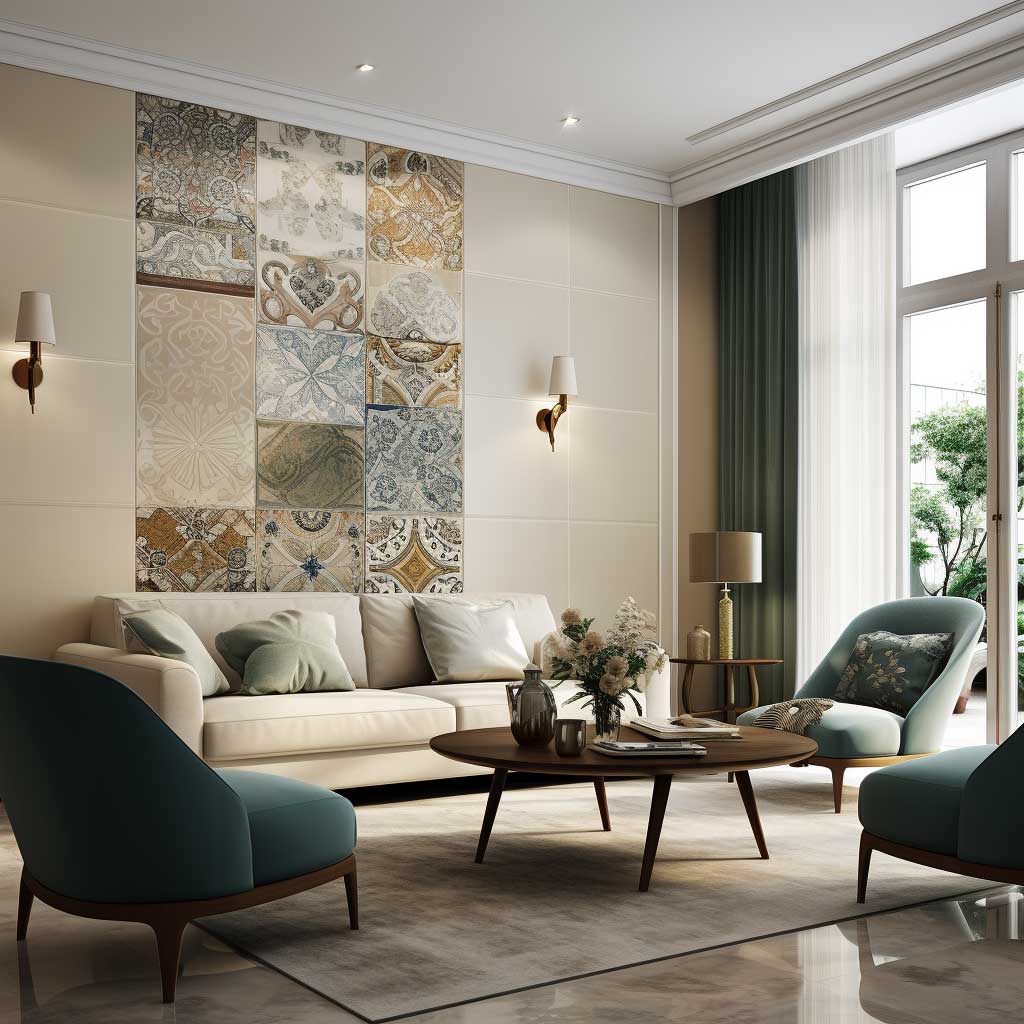


Ceramic is the workhorse of living room wall tiles — affordable, forgiving, and available in formats that have genuinely evolved. My go-to recommendation for any room over 200 sq ft is large-format ceramic at 24×48 inches or wider. Fewer grout lines mean the wall reads as a single surface rather than a grid, and that shift alone makes the room feel larger without any furniture rearrangement. Daltile’s new Acreage collection runs around $4.50/sq ft and delivers exactly this effect in a slim wood-look mosaic that works beautifully behind a console.
Matte finish over gloss — every time, on living room walls. Gloss ceramic bounces afternoon light in the wrong direction and picks up every dust smear. I bought a glossy cream tile for a feature wall once, and it spent more time looking like a dirty mirror than a design choice. Matte surfaces absorb and diffuse light softly, which means the wall performs whether you’ve got overhead recessed lighting or a single floor lamp. For color, warm tones — greige, terracotta-adjacent, soft sage — are outperforming stark whites and grays because they read warmer in the evening.
Budget reality: you can tile an accent wall in a standard living room for $600–$1,200 including installation if you stay in the $3–$9/sq ft ceramic range. Don’t go lower than $3 — the glaze on budget ceramic cracks within three years in rooms that experience temperature swings. Spend the savings on a better adhesive and a professional installer rather than a premium tile brand you don’t actually need.
Is texture worth adding? Yes, but selectively. Textured ceramic — ribbed, embossed, or 3D surface — reads beautifully in rooms with decent natural light because the shadows shift throughout the day. Pair it with utterly plain furniture. A textured wall tile behind a busy sectional is visual noise. Behind a simple linen sofa, it’s architecture. You’ll notice this balance in almost every living room photograph that holds up over multiple years.
For more on how to build a full wall-surface strategy around tiles, these wall decor approaches for modern living rooms cover the wider material mix worth considering alongside ceramic.
Mosaic Living Room Walls Work in One Spot or They Don’t Work at All


Mosaic tile in the living room is the design equivalent of a good pair of statement earrings — extraordinary in the right dose, suffocating when you overdo it. I’ve seen homeowners cover a full accent wall in glass mosaic and immediately make the room feel like a hotel lobby from 2008. The fix is restraint: fireplace surround, niche background, or a single floor-to-ceiling panel behind the sofa. That’s the boundary. Step past it and the tile stops being a focal point and starts competing with everything else in the room.
Glass mosaic reflects light in a way no other living room wall tile material can match. Each small chip picks up light at a slightly different angle, which creates a shimmering quality that shifts as you move through the room — not sparkle-party-bathroom shimmer, but a quiet, constantly-changing depth. The Oasis Tile Greek Key Black and White Glass Mosaic ($18/sq ft) does this exceptionally well against a plain white or warm-gray room. Pair it with one very simple area rug and let the wall do the talking.
Stone mosaic is the more grounded alternative. Tumbled travertine or honed limestone chips in a mosaic format bring warmth without the shimmer, which works better in rooms where the lighting is more ambient than directional. Expect to pay $10–$15/sq ft for stone mosaic sheets, plus additional adhesive and grout costs. Installation is more time-consuming than large-format tile because the sheets need careful alignment — budget for a professional if the area is over 40 sq ft.
Color in mosaic is a trap for most people. Bold, multi-color mosaic patterns in living rooms age fast — I’d rate their design shelf life at about four years before they start to look dated. Monochromatic mosaic in charcoal, warm white, or earthy sand is the version that photographs well in year one and still looks intentional in year twelve. Go bold only if you’re confident the room is staying exactly as it is for a long time.
Don’t Do This With Living Room Wall Tiles
- Don’t tile more than one wall. Two tiled walls in a living room make it feel like a changing room. Pick one.
- Don’t mix tile materials on the same wall. Mosaic border on a ceramic panel sounds layered; it reads as unfinished.
- Don’t use glossy ceramic behind a television. The reflections are intolerable in any evening light.
- Don’t skip grout color decisions. Gray tile with white grout looks like graph paper. Match grout to tile within two shades.
- Don’t install marble without sealing it. Unsealed natural marble absorbs wine and oil. Seal before grouting, then again every 18 months.
Marble Wall Tiles Add Square Footage Without Moving a Wall


Marble wall tile is the only living room wall tile material that visually expands a room through its surface alone. Polished marble reflects ambient light and creates an impression of depth — a 14-foot wall with continuous marble veining reads as if it extends further than it does. I’ve owned two of these installations and the effect is genuinely different from what photographs convey. In person, the sense of depth is almost architectural. That’s not hyperbole; it’s how reflective stone surfaces interact with light in enclosed rooms.
Natural marble starts at around $12/sq ft for Carrara and escalates quickly — Calacatta Gold runs $35–$55/sq ft and Statuario can exceed $100/sq ft. For most living rooms, the better financial decision is a high-quality porcelain marble-look tile. MSI’s Miraggio Quartz line and Daltile’s Divinium porcelain both reproduce the veining detail of natural marble at $8–$18/sq ft. I’ve placed them side by side in showrooms; at normal viewing distance, the distinction requires deliberate effort to spot. The porcelain is also more forgiving — sealed at the factory, resistant to wine spills, and easier to cut without the fragility of natural stone.
Bookmatch installation — where adjacent tiles mirror each other’s veining pattern — is the detail that separates a marble wall that looks like a renovation from one that looks like architecture. It costs more in planning and cuts, but the visual result is worth the extra two hours on-site. Without bookmatch, random veining on large-format marble tiles reads as patchy. With it, the wall has a symmetry that feels intentional and expensive even at porcelain prices.
The one style mistake I see repeatedly: pairing warm-toned marble (gold, rust, or amber veining) with cool-gray furniture. The undertones fight each other. Marble with warm veining needs warm-neutral furniture — linen, warm white, camel, walnut wood tones. Cool white or blue-gray marble, like classic Carrara, pairs with cooler grays, slate blues, and chrome finishes. Get this pairing right and the room feels considered. Get it wrong and the most expensive tile in the house looks like it was installed by mistake.
If you’re building a full feature wall that integrates tiles with other texture elements like exposed stone or raw material accents, living rooms with exposed brick walls show how raw material surfaces anchor a space in a way that marble and brick share as a design logic.
| Material | Price / sq ft | Best Use | Maintenance | Design Risk |
|---|---|---|---|---|
| Ceramic (large format) | $3–$9 | Full accent wall, behind sofa | Low — wipe clean | Low — hard to get wrong |
| Glass Mosaic | $8–$22 | Fireplace surround, niche only | Medium — grout upkeep | High — overuse is common |
| Natural Marble | $12–$100+ | Feature wall, fireplace wall | High — sealing required | Medium — pairing mistakes |
| Porcelain Marble-Look | $8–$18 | All-purpose feature wall | Low — factory sealed | Low — forgiving material |
For an authoritative look at which tile collections are performing in real interiors right now, Houzz’s tile trend roundup from the International Surface Event covers the Daltile, MSI, and Arizona Tile releases worth comparing before you commit to a material.
The Bottom Line
Living Room Wall Tiles Pay Off When You Choose the Right Material for the Room’s Actual Light
Most tile regrets come from choosing a material based on how it looks in a showroom at noon — not how it reads in your room at 8pm under lamp light. Pick your sample, take it home, and live with it for three evenings before ordering.
Ceramic gives you the most freedom with the least financial risk. Mosaic earns its place in one defined spot. Marble — natural or porcelain-look — is worth the premium if the wall gets natural light and the furniture pairing is correct.
Save this post before your next tile showroom visit.